What is Swiss International Style?
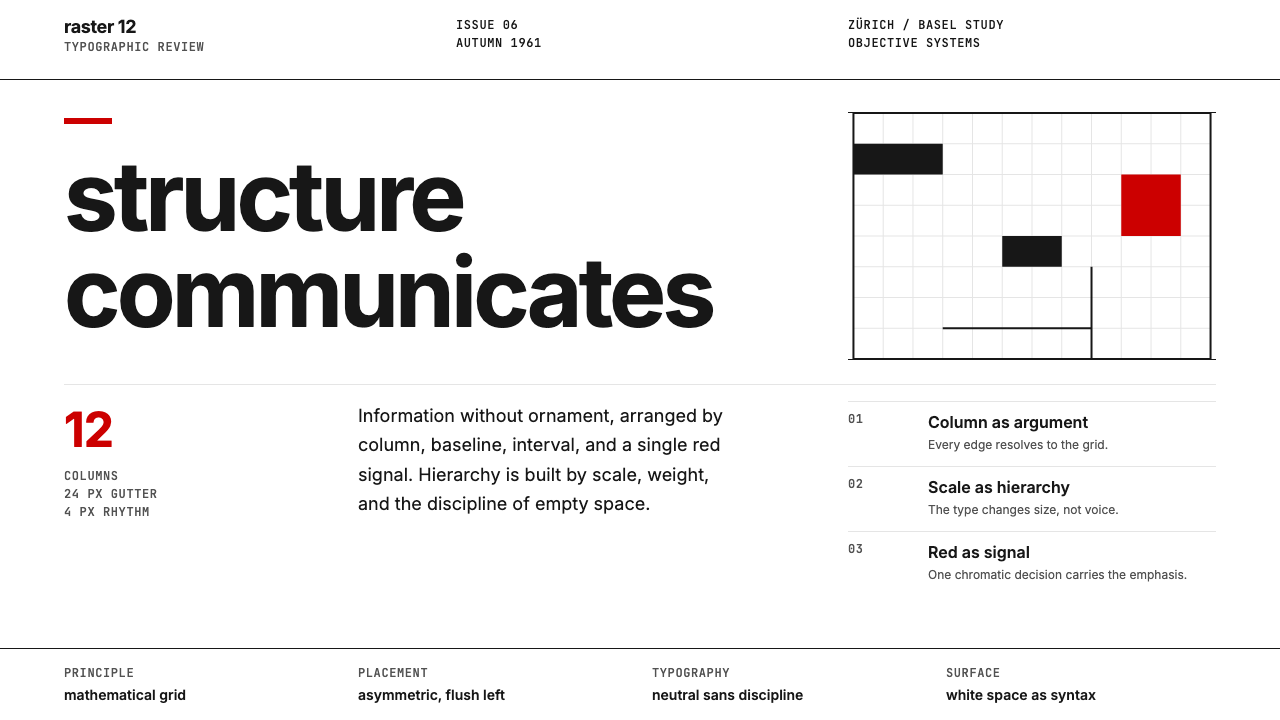
Swiss International Style made objectivity beautiful — the mathematical grid, the disciplined sans-serif, and the principled silence of white space became the visual grammar of global modernism.
Swiss International Style in brief
Swiss International Typographic Style — also called International Style or Swiss Style — is a design movement that emerged from Zürich and Basel in the 1950s with a single, radical ambition: communication should be achieved through structure, proportion, and hierarchy, never through decoration. Where earlier modernisms had experimented with abstraction and expression, Swiss Style systematized those experiments into a rigorous methodology applicable to any medium, at any scale, for any audience.
Its visual identity is immediately recognizable: a mathematical grid underlying every layout, sans-serif typefaces set at controlled weights and sizes to establish hierarchy, asymmetric composition balanced through tension rather than mirror symmetry, and expansive white space treated not as emptiness but as an active structural element. Photography, when used, is integrated as a precise rectangular element of the composition rather than as illustration. Color, when present, tends toward flat and restrained: a single accent or a strictly limited palette in service of clarity, not mood.
The style was not merely an aesthetic preference — it was a philosophical position. Information design should be neutral, precise, and universally legible regardless of the reader's cultural background. This ambition for universality explains both the style's enormous influence on corporate identity, wayfinding, and editorial design across six decades, and its critics' charge that it can feel cold or institutionally impersonal. Both assessments are, in their way, accurate.

Where does Swiss International Style come from?
The style's intellectual roots run back to the New Typography movement of the 1920s, particularly the typographic writings and practice of Jan Tschichold, whose 1928 book 'Die neue Typographie' argued for asymmetric layouts, sans-serif typefaces, and the active use of white space. The Bauhaus in Dessau had explored similar territory, but its output was more experimental and politically charged than the systematic professionalism that Swiss Style would embody. What happened in Switzerland in the 1950s was a crystallization: the scattered modernist experiments of the previous generation were refined into a teachable, reproducible discipline.
Two cities drove the crystallization. In Basel, Armin Hofmann and Emil Ruder developed an approach to typographic education at the Allgemeine Gewerbeschule (Basel School of Design) that treated the grid, the typeface, and white space as the primary instruments of communication. Ruder's 1967 book 'Typographie' became an international standard text. In Zürich, Josef Müller-Brockmann worked as a graphic designer and teacher whose poster work for institutions such as the Zürich Tonhalle concert hall demonstrated that mathematical precision and visual poetry were not mutually exclusive. His 1961 book 'Grid Systems in Graphic Design' codified the underlying methodology with an explicitness that no earlier modern designer had attempted.
The political and economic context of postwar Switzerland mattered. As a neutral country untouched by wartime destruction, Switzerland was in an unusual position: a functional, export-oriented economy needing clear, internationally legible communication for its products and institutions. The Swiss printing and publishing industry was sophisticated and technically demanding. Design clients — pharmaceutical companies, cultural institutions, international organizations headquartered in Geneva — required a visual language that would work across linguistic and cultural borders. The style answered precisely that need, which is why it spread so quickly beyond its origins.
By the early 1960s, the style had become genuinely international. American corporations including IBM, Knoll, and the New York subway system adopted its principles directly or hired designers trained in its methods. The influence passed through designers who emigrated — or whose students emigrated — to New York, London, and Tokyo. Helvetica, designed by Max Miedinger in 1957, became the movement's typographic ambassador, eventually the most widely used typeface in the world. When Massimo Vignelli designed the New York subway map and identity system in 1970, he was essentially transplanting a Zürich methodology into one of the world's most complex wayfinding problems.
What defines the Swiss International Style look?
The Mathematical Grid
The grid is not a guideline in Swiss Style — it is the fundamental architecture of every composition. Page area is divided into precise modules, with consistent margins, gutters, and column widths that establish a spatial logic governing the placement of every text block, image, and caption. The grid makes hierarchy visible through position as much as through scale: elements anchored to the primary columns carry more visual authority than those set in secondary zones. Unlike decorative frameworks, the Swiss grid is invisible in the finished work — what the viewer perceives is not the grid itself but the order and legibility it produces.
Sans-Serif Typography
Swiss Style elevated the sans-serif typeface from a display novelty to the universal vehicle of modern communication. The rationale was functional: serifs were considered vestigial ornament, and the clean geometry of sans-serif letterforms was held to be more legible at small sizes, more reproducible across print media, and more neutral in voice. Hierarchy is created entirely through size, weight, and spatial relationship — a large, heavy heading above a compact body paragraph communicates primacy without any decorative intervention. Tight, precise letter-spacing and controlled line-lengths are treated with the same care as the grid itself.
Objective Photography
Where earlier graphic traditions used illustration to interpret subject matter, Swiss Style embraced photography as the objective record of fact. Images are selected and cropped with structural rigor — usually rectangular, aligned to the grid, and scaled to carry their exact informational weight within the composition, no more, no less. A photograph of a product is expected to communicate the product's form clearly and without editorializing. Photographic montage and layering are used sparingly; when they appear, the combination is compositionally geometric rather than painterly or expressive.
Asymmetric Balance
Swiss compositions never achieve balance through bilateral symmetry — the traditional device of classical layouts. Instead, elements of differing sizes and visual weights are positioned across the grid so that the composition reads as dynamically stable rather than static. A large photograph on one side of a spread is balanced by a column of text and a narrow block of caption on the other; a single bold number might anchor an otherwise quiet field of body type. This asymmetric balance creates a directed reading path — the viewer's eye moves through the composition in a designed sequence, not randomly.
White Space as Structure
In Swiss Style, white space is not the absence of design — it is one of its primary materials. Generous margins, open gutters, and deliberate breathing room around typographic elements are as carefully measured as the elements themselves. White space performs multiple functions simultaneously: it separates and groups information, it establishes the hierarchy of sections, it provides visual rest that makes sustained reading possible, and it signals precision and authority. Crowding the grid with elements is treated as a failure of discipline, not a sign of thoroughness.
Restrained Color
Swiss Style does not mandate monochrome, but it is highly selective with color. When color appears, it is typically a single strong hue deployed to signal a specific hierarchy level — a section marker, an accent on a key data point, or a categorical distinction in a chart or diagram. The background is almost invariably white or a near-white, allowing the typographic and photographic elements to carry maximum contrast. Gradients, tints, and multi-color decorative schemes are avoided as deviations from the discipline of direct communication. Color earns its place by doing a specific job, or it is not used at all.
Neutrality as Method
Underlying every formal decision in Swiss Style is an aspiration toward communicative neutrality — the idea that the designer's voice should be subordinated entirely to the message's clarity. This distinguishes Swiss Style from expressive modernisms such as Constructivism or Italian Futurism, where formal choices carry the designer's personal or political signature. In Swiss Style, the grid, the typeface, and the white space are chosen because they are the most effective vehicles for information, not because they are beautiful or because they signal the designer's sensibility. Paradoxically, this self-effacement produces a highly consistent and recognizable aesthetic — the discipline of restraint has its own unmistakable signature.

Who shaped Swiss International Style?
Müller-Brockmann is the most widely cited practitioner of Swiss Style, and his poster work for the Zürich Tonhalle concert series — produced between the late 1940s and 1970s — remains the canonical demonstration of how mathematical grid structures and geometric form can achieve both precision and emotional resonance simultaneously. His 1961 book 'Grid Systems in Graphic Design' provided the methodology's first fully explicit codification and remains in print today. As a teacher and theorist, he articulated the philosophical underpinning of the style with unusual clarity: the designer's responsibility is to the communication, not to personal expression.
Hofmann taught at the Basel School of Design for over four decades and shaped the visual thinking of an entire generation of international designers, many of whom brought his methods to American and British design schools. His poster work is distinguished by an extreme economy of means — a single strong image or form, black type at a powerful scale, and white space treated as a compositional equal to the positive elements. His 1965 book 'Graphic Design Manual' described the Basel methodology and became required reading at design schools worldwide. Hofmann's approach was more perceptual and experimentally rigorous than Müller-Brockmann's more analytical grid thinking, but both men shared the conviction that visual communication could be taught systematically.
Ruder was Hofmann's colleague at Basel and approached typography as a discipline in its own right, insisting that the typeface, letter-spacing, word-spacing, and line length were together as important as any illustrative or photographic element. His 1967 book 'Typographie' — simultaneously a theoretical text and a visual demonstration — showed how a single well-chosen typeface, set with rigor and sensitivity, was sufficient to carry an entire designed work. Ruder's emphasis on legibility as the primary criterion of typographic quality influenced not only Swiss Style but the entire subsequent development of western typographic education. He also championed the work of Adrian Frutiger, whose Univers typeface system — designed with a logical family structure across weights and widths — became one of the movement's preferred instruments.
Bill was a Bauhaus-trained Swiss designer, architect, and artist who served as a crucial bridge between the earlier Bauhaus experiments and the systematic Swiss Style of the 1950s. After studying at Dessau, he returned to Switzerland and worked across graphic design, industrial design, sculpture, and architecture, applying the same rationalist discipline across every medium. He was founding director of the Hochschule für Gestaltung Ulm (Ulm School of Design) from 1951, which extended and formalized the Bauhaus methodology for postwar industrial contexts. His work demonstrated that a rationalist aesthetic was not a constraint on visual invention but its most productive condition.
Frutiger was a Swiss typeface designer whose work became inseparable from Swiss Style's identity. His Univers type family, released in 1957, was the first major sans-serif typeface systematically designed across a comprehensive range of weights and widths under a unified visual logic — a rationalist grid for letterform design. His Frutiger typeface, designed originally for the signage system of Paris's Charles de Gaulle airport in 1975, demonstrated that the Swiss typographic principles of neutrality and legibility could function in large-scale wayfinding environments as effectively as on the printed page. Both typefaces became foundational to international corporate and institutional design.
How do you use Swiss International Style today?
Swiss International Style is one of the most directly applicable historical design systems to contemporary work, because its principles are architectural rather than decorative. Applying it correctly means thinking structurally first: define the grid, establish the typographic hierarchy, determine what the communication needs to do — and then trust those decisions to carry the design, rather than adding visual elements to compensate for structural weakness.
For presentation slides, Swiss Style delivers exceptional results on both cover and content pages. A strong cover uses the asymmetric compositional logic: a large photograph or bold typographic element anchors one zone of the grid while title text sits in controlled contrast on a white or near-white field. Rule lines or minimal geometric accents can mark the grid without decorating it. Content slides should be treated as grid layouts with strict column logic — one or two type sizes, a single accent for highlighted information, generous margins that let the content breathe. Data slides gain from the style's diagrammatic clarity: charts become grid-aligned geometric objects, labels are typographic rather than decorative, and the absence of gratuitous color lets the data pattern itself communicate.
For web interfaces, Swiss Style is particularly well-suited to information-dense applications: dashboards, analytics tools, pricing pages, and documentation. Establish a consistent column grid across all views; use a single sans-serif typeface at no more than three distinct weight levels; keep the background white or very slightly warm; reserve color strictly for interactive states and categorical distinctions. Navigation should be purely typographic — no icon decoration beyond functional indicators. Cards and containers should have clear geometric boundaries through line or shadow rather than color fill. The resulting interface reads as confident and precise rather than styled.
For editorial and marketing applications, Swiss Style supports strong information hierarchy without visual noise. An editorial layout benefits from the characteristic wide margin: body text occupies the inner columns while the outer margin holds captions, pull quotes, or section numbers — a spatial device that communicates structure at a glance. Marketing pages can use the style's poster-like boldness: full-width type at an assertive scale, alternating light and dark sections, and a single accent color applied consistently to calls to action. The photographic integration principle applies directly to marketing: images should be rectangular, grid-aligned, and sized to their informational role rather than scaled for decorative impact.
The most common failure when applying Swiss Style is confusing its formal characteristics for its actual content. Using a sans-serif typeface and a white background does not produce Swiss Style — those are surface features. The deeper work is in the grid: every placement decision must be justified by the grid's logic, not by visual instinct or decorative preference. A second frequent error is under-using white space; designers accustomed to filling layouts tend to crowd the grid, which destroys the hierarchy that the style's precision is meant to create. Restraint is not emptiness — it is the structure that makes each element's position and weight legible.

Swiss International Style — FAQ
What is the difference between Swiss International Style and Bauhaus?
Bauhaus (1919–1933) established the foundational principles — geometric form, rejection of ornament, the grid, the sans-serif typeface — that Swiss Style then systematized and professionalized. Swiss Style is typographically more rigorous, more committed to the mathematical grid as a prescriptive tool, and more restrained in color, typically working within a neutral or single-accent palette rather than the Bauhaus primary triad. Swiss Style also embraces photography as a structural element in a way Bauhaus work rarely did, and its ambition is explicitly communicative and universal rather than politically or artistically expressive. You can think of Swiss Style as the disciplined, post-ideological successor to Bauhaus experimentation — the same underlying logic, refined into a reproducible professional method.
Is Swiss Style always black and white, or can it use color?
Swiss Style is not inherently monochrome — it is selective with color. The style's classical output included strong use of a single accent color: think of the red in a Müller-Brockmann concert poster, or the precise color categories in an Otl Aicher wayfinding system. What Swiss Style avoids is decorative color — hues chosen for visual richness, mood, or brand personality rather than communicative function. When color appears in authentic Swiss Style work, it has a job: marking a category, distinguishing a hierarchy level, or directing the eye to a specific element. Two or more colors can coexist if each has a distinct, non-overlapping function. What does not belong is color that exists purely to make the composition more attractive.
Why did Swiss Style become the standard for corporate identity design?
Several properties of Swiss Style made it unusually well-suited to corporate identity: its emphasis on mathematical precision and reproducibility meant that a system designed in Switzerland could be applied consistently in print, on signage, in publications, and later on screen, across any language and any scale. Its deliberate neutrality — the aspiration to communicate without imposing a cultural or personal perspective — aligned with corporations' need to project authority and competence across diverse markets. And the grid system made it possible to define a visual identity as a set of rules rather than a set of specific designs, which meant different designers and vendors could implement it consistently. These properties are why organizations from the Lufthansa brand system to the early Apple interface drew directly on Swiss principles.
Can Swiss Style work for consumer products, or is it better suited to institutional contexts?
Swiss Style performs best where clarity, precision, and authority are the primary desired qualities — which does include some consumer products but excludes many others. It works strongly for financial services, technology platforms, healthcare information, premium packaging where rigorous restraint signals quality, and any context where the user needs to process information quickly and accurately. It is less effective for products whose primary appeal is warmth, sensory pleasure, cultural belonging, or playfulness — food, children's products, fashion, hospitality, and wellness are all contexts where the style's neutrality can read as cold or uninviting. The practical question is whether the product's core promise aligns with the values that Swiss Style communicates: precision, objectivity, and structural confidence.
How does Swiss Style treat illustration versus photography?
Swiss Style strongly prefers photography over illustration as a matter of principle. Photography is treated as the objective record of fact — it documents the appearance of a subject without imposing interpretive style. When Swiss Style does use illustration, it tends toward the diagrammatic: charts, information graphics, maps, and schematic drawings that present data or structure clearly and without decorative elaboration. Expressive or hand-crafted illustration is almost entirely absent from classical Swiss Style work, as it reintroduces the personal voice that the style's neutrality aspires to eliminate. This photographic preference was partly a philosophical commitment and partly a practical consequence of postwar printing technology, which made high-quality halftone reproduction of photography newly accessible at commercial scale.
Related design styles
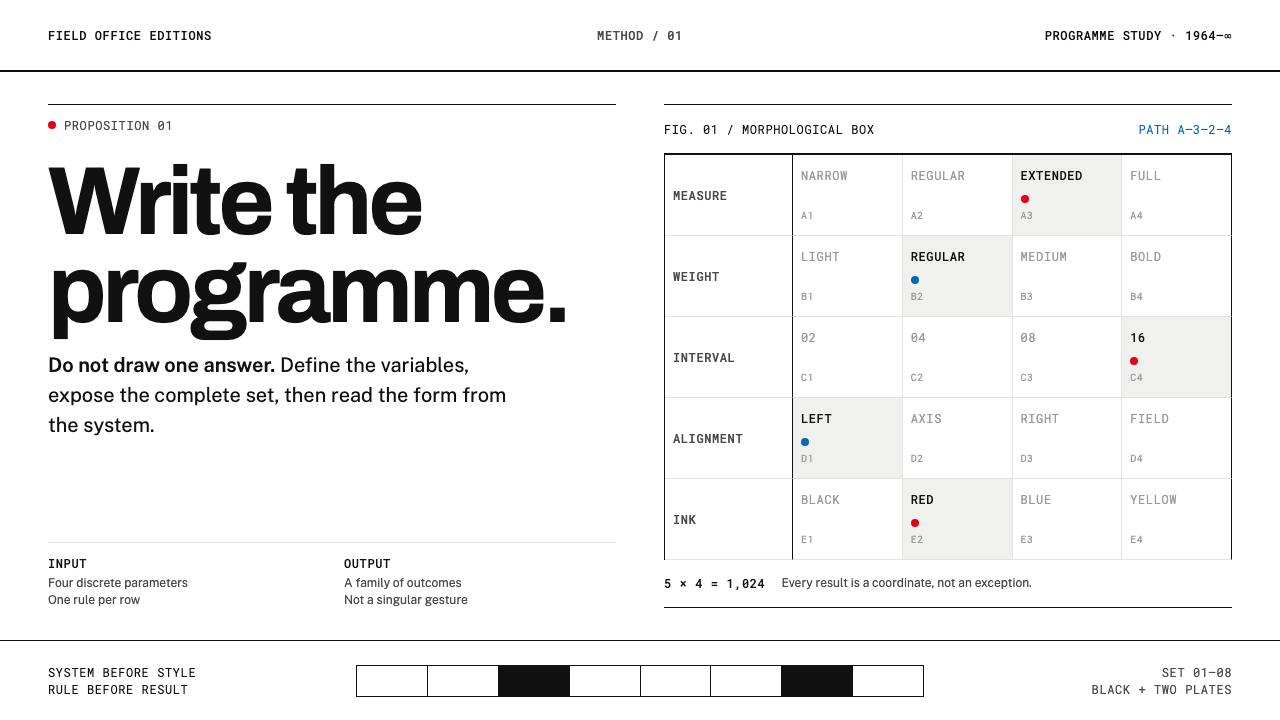 Karl Gerstner ProgrammesDesign becomes a programme. Black hairlines and a strict matrix turn paramete…
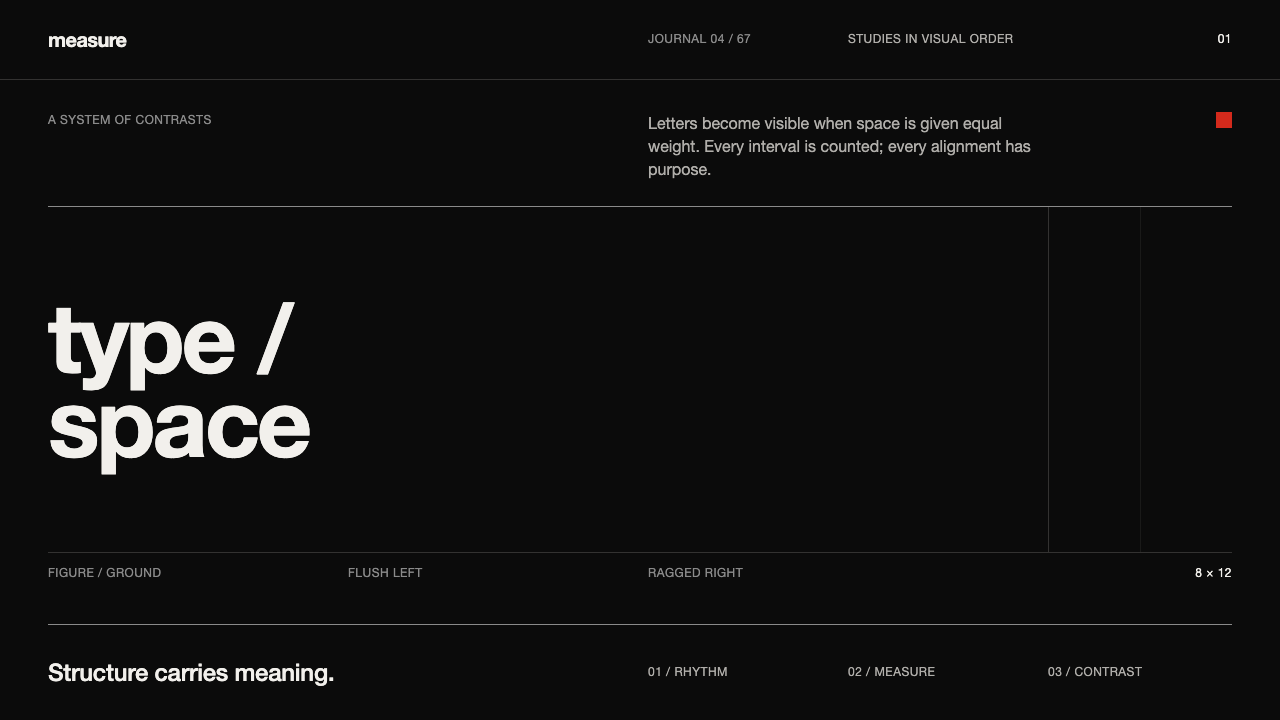 Emil Ruder TypografieDiscipline makes type visible. Near-white grotesque and measured space cut th…
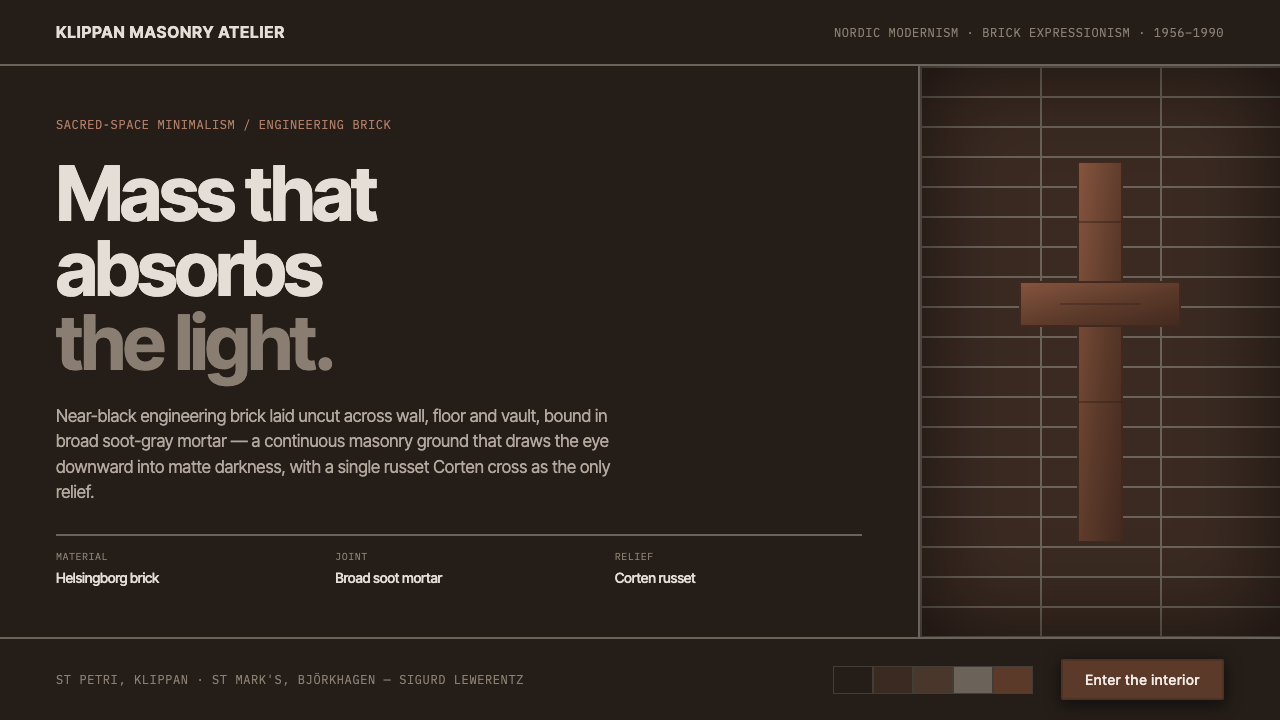 Lewerentz Dark BrickMass that absorbs light. Near-black engineering brick, broad soot mortar, one…
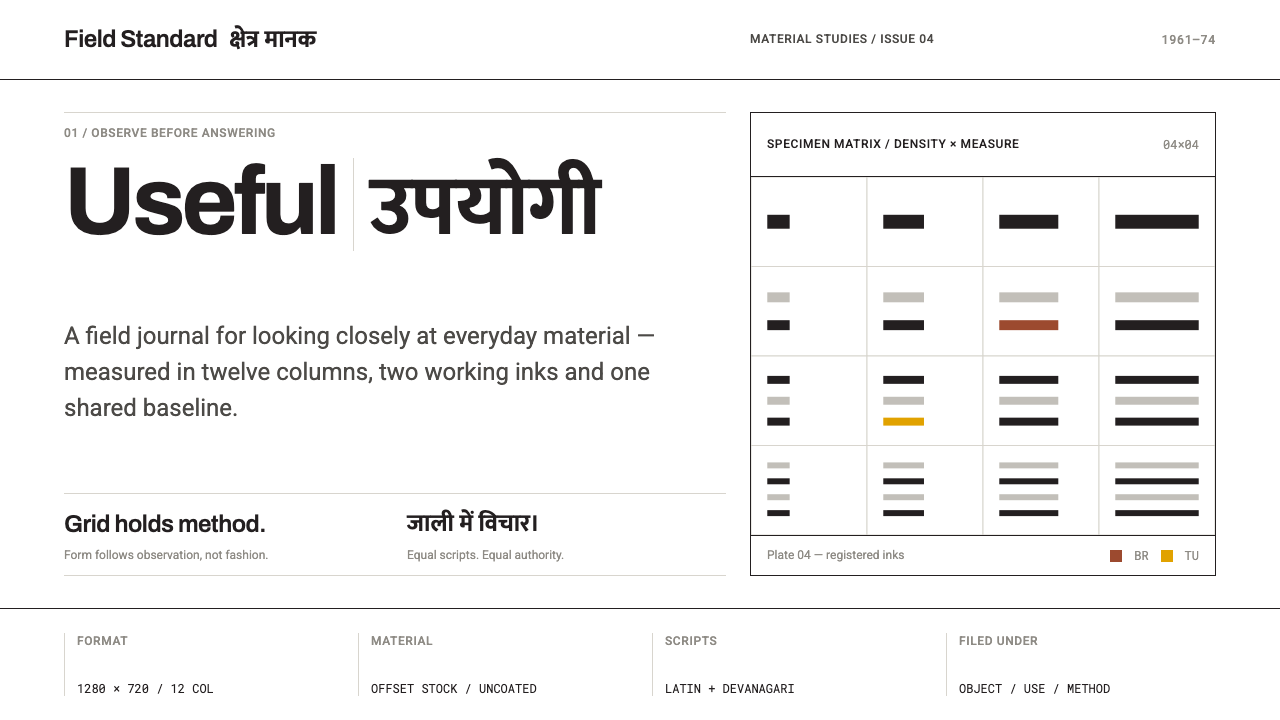 NID Ahmedabad ModernismStructure earns trust. Black rules and equal-weight scripts hold craft color…
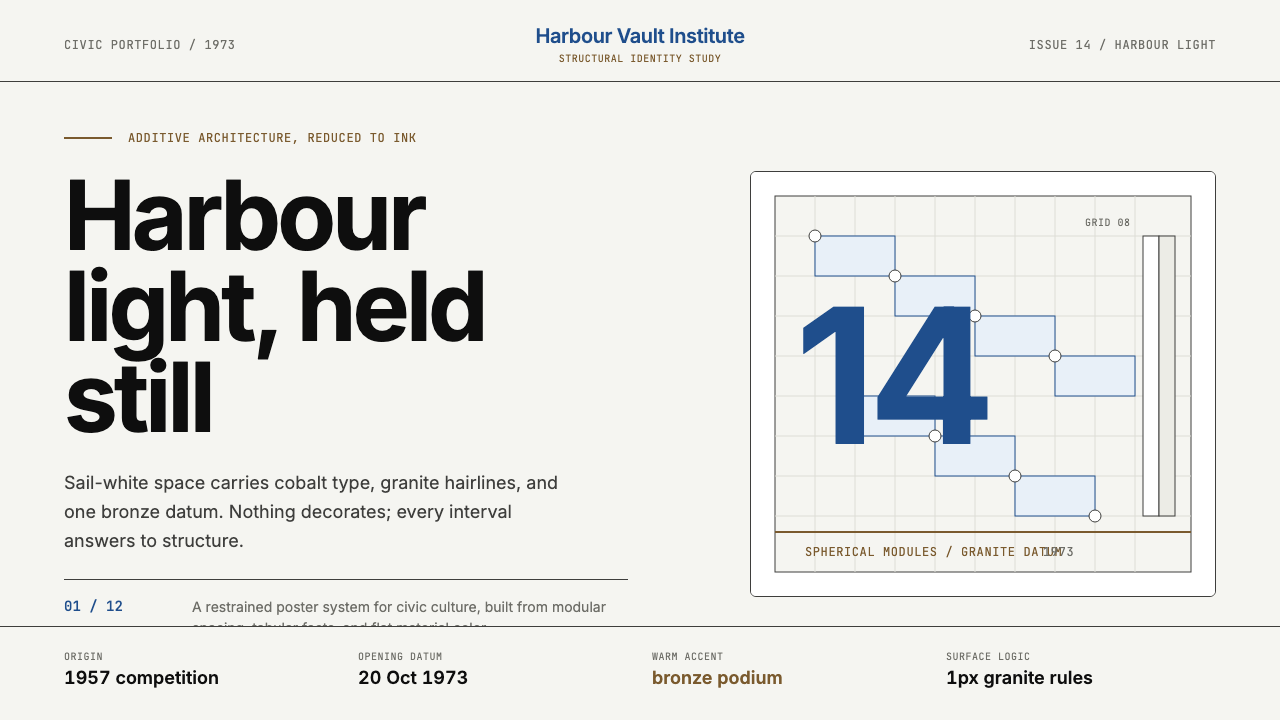 Sydney Opera House (Utzon, 1973)Civic restraint in harbour light. Sail-white space, cobalt type, bronze datum.
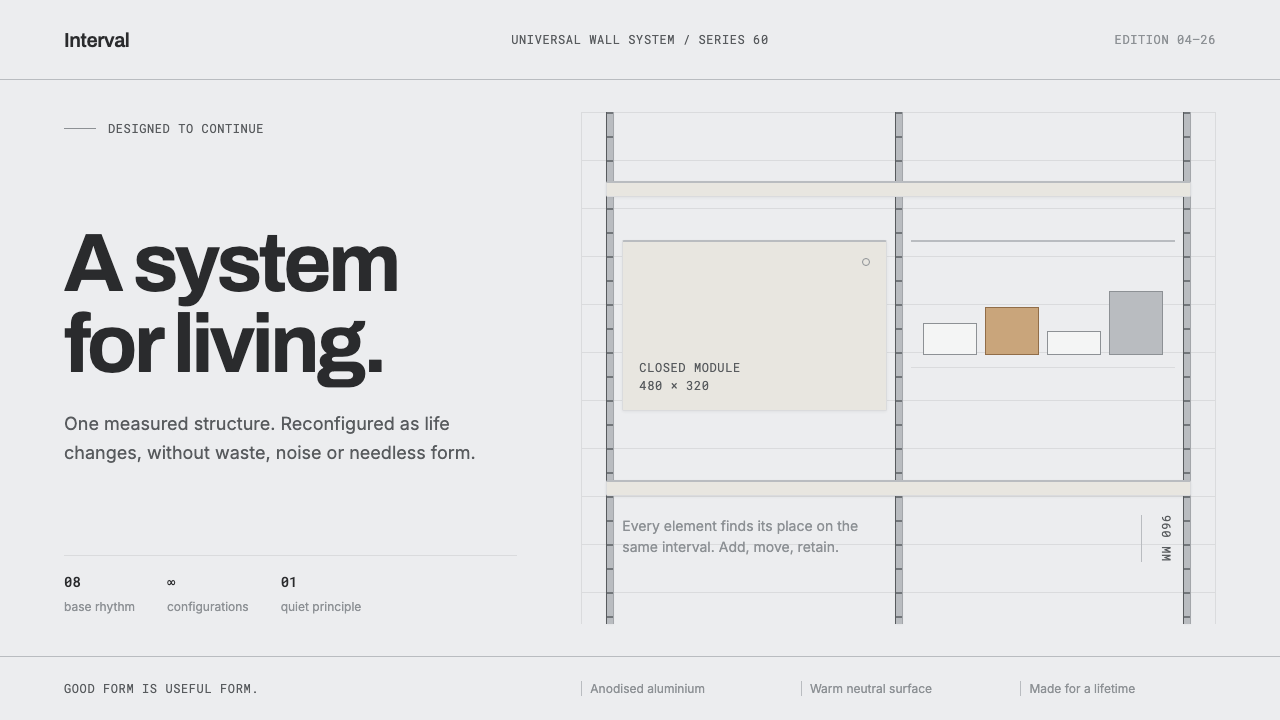 Vitsœ 606 ShelvingQuiet form, built to endure. Brushed silver rails impose rhythm on cool plast…