What is Müller-Brockmann Grid?
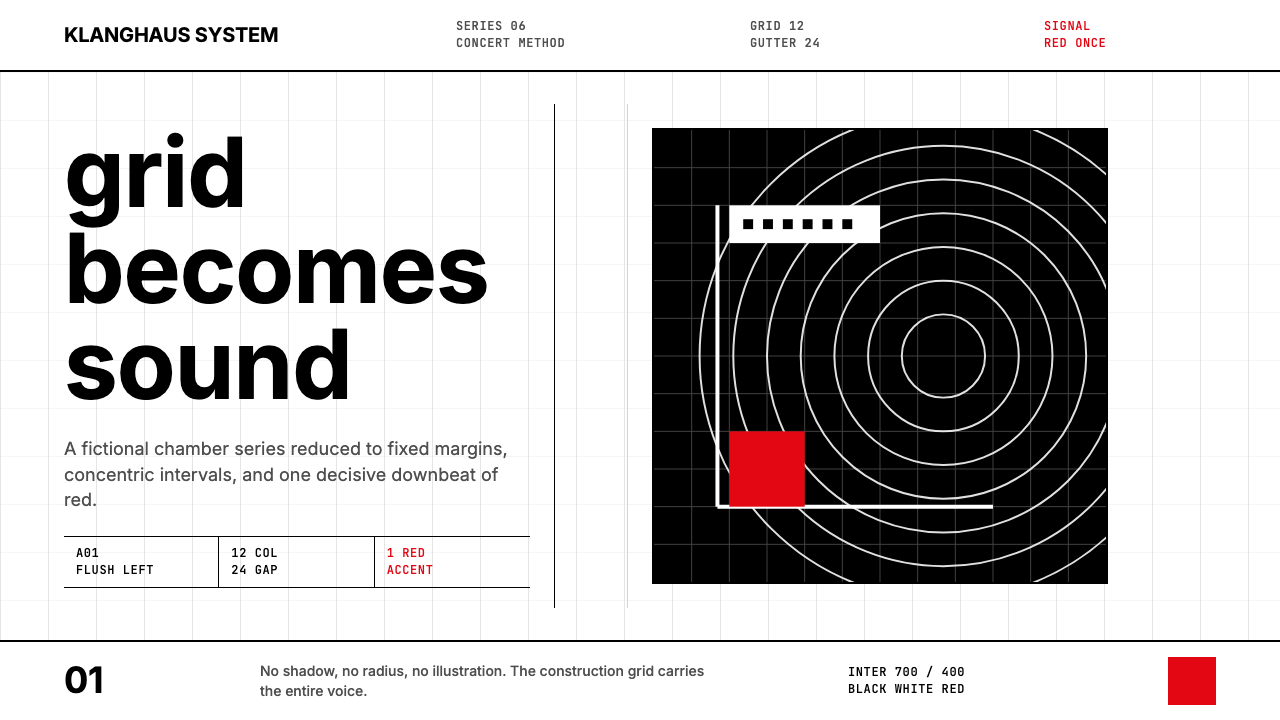
Josef Müller-Brockmann proved that the grid is not a constraint but a force — a mathematical system that gives visual communication the same inevitability as a Bach fugue.
Müller-Brockmann Grid in brief
The Müller-Brockmann Grid refers to the systematic approach to layout and visual organization developed and codified by Swiss designer Josef Müller-Brockmann, whose 1981 book Grid Systems in Graphic Design became the definitive reference for structured layout worldwide. The method divides any printed or digital surface into a precise network of columns, rows, and margin zones. Every element — headline, body text, image, caption, rule line — is placed in rational correspondence with this invisible architecture. Nothing drifts; nothing is eyeballed. The grid is the argument, and every placement is a sentence in that argument.
Visually, this system produces work of extraordinary rigor and calm authority. The palette is typically reduced to near-extremes: pure black on white, or white on black, with a single accent color — historically a saturated primary — used sparingly to mark the most critical element on the page. Type is set in a single geometric sans-serif family at clearly differentiated scales, creating hierarchy through contrast of size and weight alone. There are no decorative dividers, no gradient fills, no softening shadows. The white space is not emptiness — it is the grid's breathing, as structurally intentional as the content it frames.
The style belongs to the broader Swiss International Typographic Style (Schweizer Typografie), but Müller-Brockmann's specific contribution was to make the underlying grid explicit and teachable. Where others felt their way to balanced layouts through experience and taste, he gave designers a repeatable, transferable system. The result is a visual language that is simultaneously humble — it never calls attention to its own cleverness — and commanding, because every decision can be accounted for by the mathematics underneath.

Where does Müller-Brockmann Grid come from?
Josef Müller-Brockmann was born in 1914 in Rapperswil, Switzerland, and trained in Zurich under the designers Ernst Keller and Walter Käch — two figures who instilled in him the belief that design must be logical, universal, and free from personal expression. He opened his own studio in Zurich in 1936, the same year he began designing for the Zurich Tonhalle concert hall. The Tonhalle posters became the laboratory in which his grid methodology was tested against the most demanding constraint: communicating the emotional character of music through purely abstract geometry.
The peak years of his Tonhalle poster work, roughly 1955 to 1965, produced images that remain among the most recognizable in twentieth-century graphic design. The Beethoven poster — its concentric circles expanding outward from a dense center — was not an illustration of Beethoven's music but a geometric equivalent of it: waves of structured energy organized by mathematical interval. The Musica Viva series used expanding squares and arcs to give visual form to the temporal structure of modern composition. These works established the principle that would define his career: pure abstract structure, governed by mathematics, can communicate with the force of the most elaborate representational imagery.
The intellectual underpinning came from a broader Zurich context. Müller-Brockmann was a contemporary of Richard Paul Lohse, Carlo Vivarelli, and Hans Neuburg — the four designers who launched the journal Neue Grafik in 1958, which became the theoretical organ of the Swiss style. Emil Ruder at the Basel School of Design was developing parallel ideas about typographic rhythm and proportion. This was not a movement invented by one person but a collective reckoning with the same question: how can visual design achieve the objectivity and universality of mathematics without sacrificing communicative power? Müller-Brockmann's answer was the structured grid, and his 1961 book Gestaltungsprobleme des Grafikers (The Graphic Artist and His Design Problems) was the first systematic attempt to articulate it.
The 1981 publication of Grid Systems in Graphic Design (Rastersysteme für die Visuelle Gestaltung) crystallized decades of practice into a handbook that designers worldwide could apply directly. Written in both German and English with extensive diagrams, it showed not just what a grid was but how to construct one from first principles — how to determine column width from type measure, how to proportion the gutter to the column, how to nest image grids within text grids. The book arrived at the exact moment when desktop publishing was beginning to democratize layout design, and it became the standard reference for a generation of designers learning to navigate that new landscape. Müller-Brockmann continued to work and lecture until his death in 1996, and the methodology he codified has outlasted every stylistic trend of the intervening decades.
What defines the Müller-Brockmann Grid look?
The Mathematical Grid
The defining feature of the system is the grid itself: a precisely calculated network of vertical columns and horizontal fields, with gutters and margins derived from the same proportional logic as the type measure. Every layout begins with the construction of this invisible scaffold, and every element — regardless of its nature — must align to it. The grid is not a suggestion; it is the architecture. Departures from it must be deliberate and justified, because any element that ignores the grid implicitly argues that the grid was wrong.
Reduced Palette with Single Accent
The color approach is built on extreme restraint. The ground is near-pure white or full black; all body text and structural elements are the opposite extreme. Into this high-contrast field, a single accent color is introduced — typically a saturated primary, historically reds with urgency and authority — used only to mark the single most critical element in the composition. Everything else earns its place through contrast of value, not hue. The effect is that the accent color, used sparingly, carries disproportionate visual weight and immediately directs the eye.
Geometric Sans-Serif Typography
Text is set in a single geometric sans-serif family — historically Akzidenz-Grotesk or Helvetica in Müller-Brockmann's own work. The selection is not arbitrary: geometric sans-serifs share the same constructivist logic as the grid, reducing letterforms to their structurally necessary components without decorative addition. Type hierarchy is established exclusively through size contrast and weight contrast, not through mixing families. A headline might be several multiples larger than a subheading, which is itself clearly distinct from body text — the three levels are self-evident without any additional ornamentation.
Functional White Space
The white space in a grid-system layout is not residual — it is as calculated as the content it surrounds. Margins are wide enough to give the type field a sense of contained precision; column gutters are narrow enough to make the column relationship clear but generous enough to prevent visual merging. The negative space between sections is governed by the same grid intervals as the type spacing, so the whole surface has a single underlying rhythm. Purposeless decoration — anything not serving structure or communication — is absent because the white space already does that work.
Objective Image Placement
Images in a grid-system layout are not floated freely — they snap to the grid like every other element, occupying exactly one column, two columns, a half-field, or a full span. The image's scale is determined by its informational relationship to the surrounding text, not by its visual appeal in isolation. Photographs, when used, are typically high-contrast and tightly cropped, treated as flat geometric blocks rather than atmospheric scenes. Bleeds are permitted when the image's structural role justifies it; otherwise the image respects the same margin system as the type.
Structural Rule Lines
Horizontal and vertical rules — thin lines that divide or underscore sections — are used to make the grid's logic visible where needed. These are not decorative borders; they are grid lines promoted to the surface of the design. A rule separating a headline from body text confirms the grid field boundary. A vertical rule between columns makes the column structure explicit. Rules are used with economy: one or two visible grid-lines per composition is typically sufficient; using many converts a structural device into ornament.
Systematic Consistency
Perhaps the most underappreciated characteristic is the system's insistence on consistency across every page and surface. The same grid that governs a title page must govern the body pages, the index, and the appendix. The same proportion that determines the headline size on page one determines it on page eighty. This is not mechanical repetition — it is the application of a single underlying principle across all instances. In multi-page documents, this consistency is what makes the whole feel like a designed object rather than a collection of designed pages.

Who shaped Müller-Brockmann Grid?
Müller-Brockmann (1914–1996) is the central figure. His Zurich Tonhalle concert posters, his foundational texts, and his decades of practice in corporate identity design for clients including IBM and Nestlé established the grid system as both an aesthetic position and a professional standard. His 1961 book The Graphic Artist and His Design Problems articulated the philosophical case for objective design, while the 1981 Grid Systems in Graphic Design provided the practical methodology. He also served as a co-founder and editor of Neue Grafik, the journal that gave the Swiss International Style its theoretical voice.
Ruder (1914–1970) worked in parallel with Müller-Brockmann at the Basel School of Design, developing the typographic dimension of the Swiss style into a comprehensive pedagogy. His 1967 book Typographie: A Manual of Design articulated how the grid should govern not just column structure but the rhythm of type itself — the relationship between line length, leading, and the optical density of the text block. Ruder's teaching and writing shaped an entire generation of Swiss designers who carried the discipline to design schools across Europe, North America, and Japan.
Lohse (1902–1988) approached the same mathematical systematization from the direction of fine art rather than applied design. His serial and modular paintings — which explored how color and geometric form could be organized by strict mathematical rules rather than expressive intuition — gave the Swiss style its deeper theoretical grounding in constructivist logic. As a co-founder of Neue Grafik alongside Müller-Brockmann, he helped frame the intellectual argument that objective, system-based design was not a technical constraint but a philosophical position.
Yoshikawa (1934–2021) was Müller-Brockmann's partner, collaborator, and eventual wife, and her contribution to the studio's output has often been underacknowledged. She brought a rigorous understanding of Japanese visual culture to the Swiss grid methodology, demonstrating that the system's underlying logic — precise proportion, respect for negative space, the subordination of decoration to structure — was not culturally specific to Europe but had deep affinities with East Asian typographic and compositional traditions. Her presence in the Zurich studio contributed significantly to the international reach of the grid methodology.
Hofmann (1920–2020) taught at the Basel School of Design for decades and became one of the most influential design educators of the twentieth century. His approach to the grid was less strictly mathematical than Müller-Brockmann's and more rooted in visual perception and Gestalt psychology — but the results shared the same economy of means, the same rejection of decoration, and the same conviction that visual structure must be rational and demonstrable. His students, who spread across Europe and North America, carried the Basel discipline into the next generation of design education.
How do you use Müller-Brockmann Grid today?
The Müller-Brockmann Grid translates directly and powerfully into presentation design, where the lack of a structured system is one of the most common sources of visual disorder. For a slide deck, the grid approach begins before any content is placed: establish a consistent column structure — typically four or twelve equal columns — and commit to aligning every element to it. On cover slides, the title should occupy a defined grid zone (often the left two-thirds or the lower half), with white space performing structural work in the remaining area. A single accent element — a heavy rule line, a bold numeral, a geometric shape in the accent color — provides the only visual emphasis. For content slides, two or three typographic levels set at clearly contrasting sizes handle all information hierarchy without any decorative treatment. Data slides acquire a diagrammatic authority: charts and graphs become geometric objects aligned to the grid, with the accent color used only for the data series that matters most.
For web and digital interfaces, the system is particularly suited to dashboards, analytics platforms, pricing pages, and documentation sites — anywhere that density of information and clarity of hierarchy are the primary design problems. Establish a strict column grid (twelve columns is now standard in web frameworks), set body text in a geometric sans-serif at a comfortable reading size, and reserve all color beyond black and white for interactive states and critical alerts. Cards and panels should have clean rectangular borders rather than soft shadows; inputs should be clearly bordered rather than ghost-styled. Navigation is typographic — labels and wordmarks, not icon-heavy menus. The resulting interface feels authoritative and precise: every element earns its pixel because every element can be accounted for.
Editorial and marketing applications reward the system's poster-like boldness. A long-form article designed with these principles uses a narrow text column with a substantial outer margin — the margin becomes the home for pull quotes, footnotes, or running heads, all aligned to the same grid. Section breaks are marked by a bold horizontal rule at a grid-field boundary, not by decorative ornament. Marketing pages work well with alternating full-width blocks: cream ground with dark type, then dark ground with light type, with the accent color used consistently for a single call-to-action element. The boldness of the typographic scale — headlines that feel monumental — does the work that illustration would otherwise do, keeping the composition graphic rather than photographic in character.
In brand identity systems, the grid methodology produces materials that maintain coherence across every format without requiring a designer to make fresh decisions each time. A brand-standard document defines the column structure, the typographic scale, the margin proportions, and the accent color application rules. Everything that follows — business cards, letterheads, environmental signage, digital templates — is a faithful application of those rules. The result is not monotony but consistency: each artifact feels unmistakably part of the same system while being appropriate to its own format and function.
The most common mistake when working with this system is treating the grid as a background option rather than a load-bearing structure. Designers will define a column grid and then place elements wherever they look right, crossing column boundaries without intention, floating objects in the middle of fields with no alignment logic. This produces layouts that have the visual austerity of the style without its underlying intelligence — they look empty rather than precise. A related error is the cosmetic application of the accent color: using it on multiple elements simultaneously, applying it for visual variety rather than to mark hierarchy, or choosing a muted or complex hue rather than a clean saturated primary. The accent color only works when it is singular and unmistakable — the moment it appears on three elements, it stops being an accent and becomes noise.

Müller-Brockmann Grid — FAQ
What is the difference between the Müller-Brockmann Grid and generic grid-based design?
Every layout has some kind of implicit grid, even if it was never consciously constructed. What distinguishes the Müller-Brockmann approach is the rigor and derivability of the system: the grid is constructed from first principles — column width derived from the optimal line length for the typeface and size in use, gutter width proportional to the column, margin proportional to both — and then applied without exception. There is also a philosophical dimension: the grid is not a tool for achieving visual balance but a statement that objective, mathematical order is the correct foundation for all visual communication. Generic grid use is opportunistic; the Müller-Brockmann approach is principled.
Does this system require only black, white, and one accent color, or can a broader palette work?
The historical work of Müller-Brockmann himself used an extremely reduced palette — often only black, white, and a single intense red or yellow. The underlying reason is not aesthetic preference but logical necessity: the grid system achieves its authority through clarity of hierarchy, and every additional color competes for attention and dilutes that hierarchy. A broader palette is possible in contemporary applications, but it requires a corresponding increase in structural discipline. If two accent colors are used, they must be clearly differentiated in their roles — one for primary actions, one for secondary states — and neither should appear in the same composition as a decorative element. Three or more accent colors typically exceed the system's ability to maintain hierarchy without the layout beginning to feel arbitrary.
How does this style handle photography and complex imagery?
Photography in a Müller-Brockmann layout is treated as a geometric block, not as a naturalistic scene. Images are cropped to fit the grid — meaning they snap to one, two, or more column widths and to defined field heights — rather than being sized for their pictorial content. Photographs that contain a great deal of atmospheric complexity or tonal gradation tend to create visual tension with the surrounding high-contrast typography; the style works better with images that have clear, simple geometric structure: a single object on a plain ground, a strong horizontal or vertical composition, a high-contrast duotone reproduction. Images that resist cropping and geometric containment can be used, but they require careful handling, typically by treating them as full-width bleeds separated clearly from the typographic grid zones.
Is this style appropriate for brands that want to feel warm or approachable?
The grid system's visual character is precision, authority, and objectivity — qualities that are genuinely valuable for brands positioning themselves as expert, trustworthy, analytical, or rigorously modern. These are not warm qualities in the sensory or emotional sense. Brands in categories that depend on warmth, organic texture, or personal intimacy — food, wellness, children's products, artisan goods — will find the style working against their core communication goals. The style can be softened slightly through the choice of an accent color that reads as warm rather than clinical — a burnt amber reads differently than a process red — but this is adjustment at the margins, not a fundamental shift in character. For any brand where the user's emotional response of comfort or delight is the primary goal, a different foundational aesthetic will be more effective.
How do I know if I am applying the grid correctly, rather than just making things look neat?
The test is derivability: can you explain every placement decision by reference to the grid? If you moved a headline slightly to the left because it looked more balanced, you are not on the grid — you are eyeballing. If you can say the headline occupies column one through column five and its top edge aligns to the fourth horizontal field, you are on the grid. A secondary test is consistency: are you applying the same grid intervals for body-to-headline spacing as for image-to-caption spacing? If different relationships in the layout are governed by different logic, the grid is not really doing the structural work — it is a background presence rather than the load-bearing architecture. True grid discipline feels almost over-rigid before you are accustomed to it; the softening comes from understanding that the white space and proportion are doing aesthetic work, so the individual elements do not need to.
Related design styles
 Bechers Industrial TypologyDeadpan order. Mid-grey ground, Archivo labels, and strict hairline grids rev…
 Hasselblad 500C ChromeBuilt to be taken apart. Brushed silver-grey panels, matte-black leatherette,…
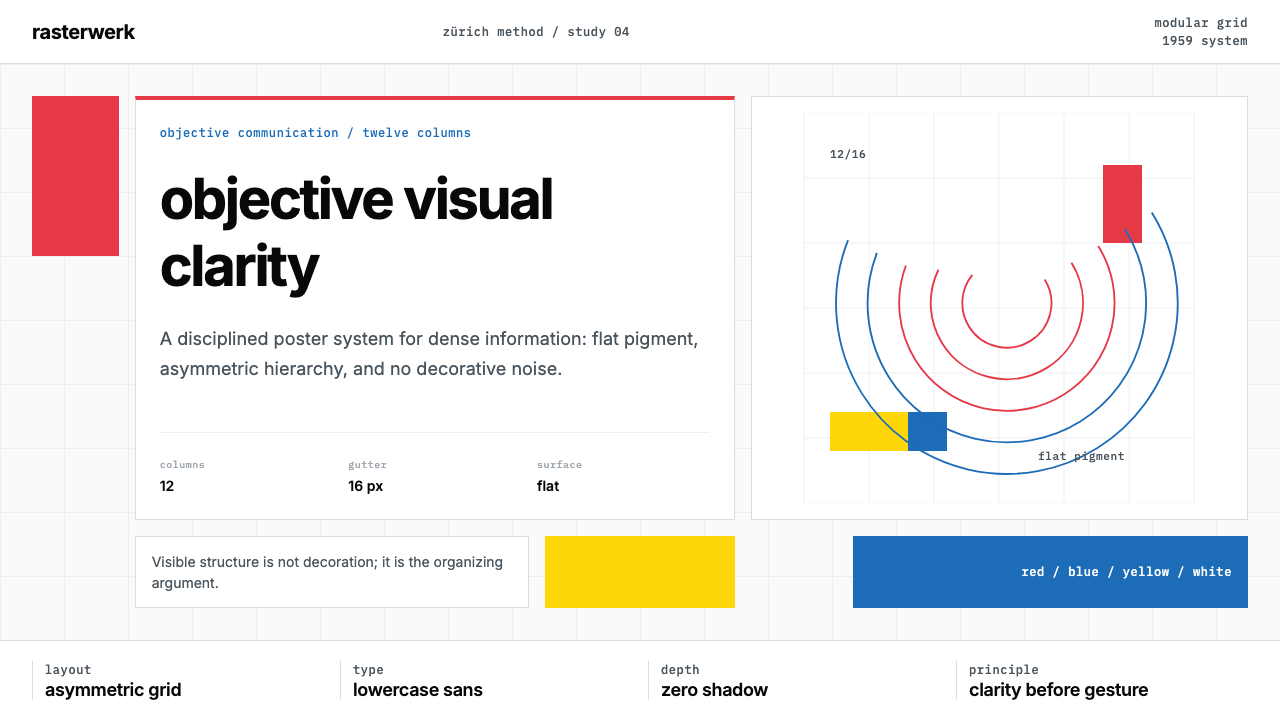 Müller-Brockmann SwissClarity is the system. Inter grids, red-blue blocks, and concentric arcs make…
 Schlieren ShadowgraphInvisible air becomes silver. Cool grayscale fields cut by precise shock line…
 Wim Crouwel GridGrid becomes freedom. Cobalt, red and yellow blocks lock Inter type to a 12-c…
 Anton Stankowski ConstructiveProcess becomes visible. Flat blue diagonals and hard square rules make chang…