What is Danish PH5 Louis Poulsen (1958)?
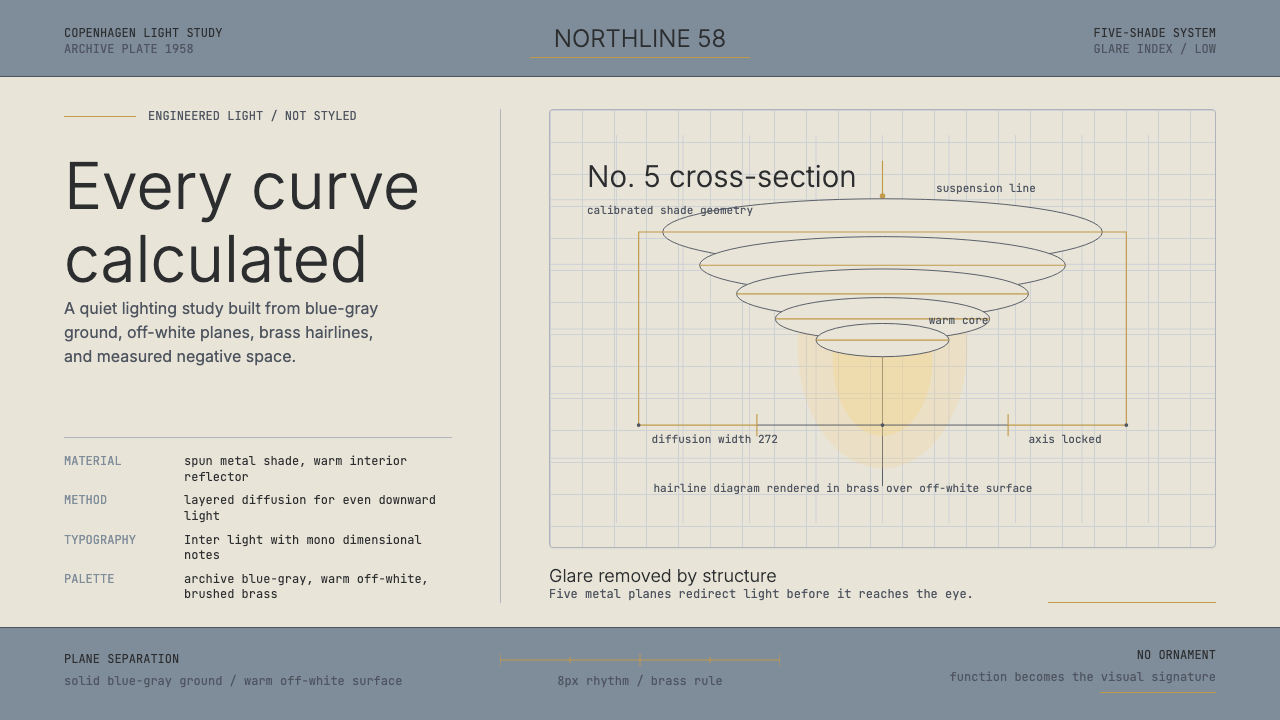
The PH5 pendant lamp taught the world that engineering and beauty are not opposites — they are the same calculation made visible.
Danish PH5 Louis Poulsen (1958) in brief
The Danish PH5 Louis Poulsen design system takes its name and visual logic from a single object: the PH5 pendant lamp, designed by Poul Henningsen and released by Louis Poulsen in 1958. That lamp — whose five layered metal shades were engineered to eliminate glare at every angle while bathing a room in warm, even light — became the defining artifact of Danish modern design. The visual language that grew around it is equally precise: cool blue-gray grounds, brass and warm-metal accents, technical cross-section diagrams used as decoration, and generous negative space that lets every element breathe.
What distinguishes this aesthetic from broader Scandinavian design is its specifically engineering-derived quality. Where Swedish grace tends toward softness and Norwegian craft toward materiality, the Danish PH tradition is diagrammatic — it shows its work. Shade cross-sections appear in catalogs and advertisements not as technical documentation but as the primary visual element, because the calculations themselves are considered beautiful. The style says: we are not hiding the engineering behind a surface; the engineering is the surface.
Visually, the system reads as cool without being cold, precise without being sterile. A characteristic palette of muted blue-gray sits alongside warm brass tones and clean white grounds. Hairline rules divide space the way precise measurements divide a technical drawing. The result is a design language suited to any context where trust, precision, and quiet confidence are the desired message.
Where does Danish PH5 Louis Poulsen (1958) come from?
Poul Henningsen began working on the problem of glare-free artificial lighting in the early 1920s, exhibiting his first multi-shade pendant at the 1925 Paris International Exhibition of Decorative Arts, where it won a gold medal. The fundamental challenge he set himself was optical rather than aesthetic: how to distribute light from a single electric bulb so that no angle of view exposes the bare filament. Every iteration of what became known as the PH lamp was driven by this optical calculation, with the shade geometry being an outcome of mathematics rather than a stylistic choice.
Louis Poulsen, the Danish lighting manufacturer founded in 1874, became Henningsen's manufacturing partner and, over decades, the custodian of his design philosophy. The firm's identity became inseparable from Henningsen's approach: a deep conviction that good lighting design is a matter of human welfare, not decoration. Poorly designed artificial light caused eyestrain, headaches, and what Henningsen called a degradation of the visual environment. His lamps were, in his framing, corrective instruments — engineered responses to an industrial-age problem.
The PH5, released in 1958, was the lamp in which Henningsen solved a problem that had persisted through earlier models: how to preserve warmth and color rendering while maintaining perfect glare control. He introduced a small red inner cone and a blue outer ring to the shade system, adding specific wavelengths of warm light to compensate for the cold quality of the electric light sources of the era. The lamp's signature profile — five asymmetric shades cascading from the ceiling fitting — became the silhouette most identified with Danish modern lighting worldwide.
Louis Poulsen's visual communication evolved to match the lamp's logic. Product photography placed the PH5 against flat, slightly warm gray or blue-gray grounds, isolating its profile with the clarity of a technical illustration. Catalog pages began featuring cross-section diagrams of the shade geometry, presented not as engineering reference but as visual centerpieces. This approach — treating the explanation of a product's mechanics as its most compelling visual argument — became the house style, and it remains so today. The brand's graphic identity, with its precise sans-serif type, measured white space, and restrained palette, is essentially a typographic extension of Henningsen's optical philosophy: nothing is there unless it earns its place.
What defines the Danish PH5 Louis Poulsen (1958) look?
Color Palette
The dominant ground is a muted blue-gray — cool but not harsh, closer to the color of overcast Scandinavian winter light than to anything corporate or technological. Against this ground, two accent registers operate: warm brass and aged gold tones for material and structural details, and pure white for typographic fields and negative space. Black appears as a precise accent for rules, diagrams, and technical annotations. The overall temperature is deliberately calibrated: cool enough to read as rigorous and trustworthy, warm enough to feel habitable.
Diagrammatic Illustration
The most distinctive visual element of this system is the technical cross-section drawing used as primary imagery. Shade geometry diagrams, light-distribution curves, and cutaway illustrations appear not in footnotes or appendices but as hero visuals — large, centered, and treated with the same visual weight as photography. These drawings are rendered in hairline or fine-line weight, with minimal fill, against the blue-gray ground. Their presence signals a worldview: the most compelling thing about this object is how it works.
Hairline Rules and Measured Space
Spatial organization relies on hairline rules — the thinnest possible line weight — rather than colored bands, boxes, or backgrounds to divide content. These rules echo the precision of a drafting table: they indicate measurement without weight, separation without bulk. White space is treated as a structural material rather than empty filler, with generous margins giving every element room to exist without crowding. The result is a layout that breathes, where the eye can move calmly from element to element.
Typography at Quiet Authority
Type in this system is set at light or regular weights — never heavy or compressed. The choice signals confidence without shouting: a brand that does not need to raise its voice because the engineering makes the argument for it. Headlines are generous in size but restrained in weight; body text is set with careful line spacing that makes reading feel unhurried. Type sits against light grounds in almost-black rather than pure black, softening the contrast just enough to sustain long reading without fatigue.
Brass as Structural Warmth
Brass and warm-metal tones appear not as decorative gilding but as functional accents that mark joints, edges, and pivot points — echoing the material role that brass plays in the physical lamp (the fittings, the suspension rod, the interior cone). In two-dimensional applications, these warm tones are used sparingly: a single highlight bar, a fine accent line, an occasional icon or detail. They counteract the coolness of the blue-gray palette without overwhelming it, functioning like the warm inner cone in the PH5 itself — corrective and calibrated.
Photography as Isolation
When photographs appear in this system, they function as isolation studies rather than lifestyle scenes. A lamp is photographed against a neutral ground, its profile fully visible, with studio lighting that reveals material texture — the brushed metal, the gentle curvature — without creating dramatic shadows that would obscure the shade geometry. Context and environment are minimized or eliminated entirely. The subject is treated the way a scientific specimen is treated: placed, isolated, illuminated to reveal structure.
Systematic Negative Space
Negative space in this aesthetic is not accidental or merely generous — it is load-bearing. Margins are wide because the visual system treats white or near-white ground as an active design element, not as background to be filled. The lamp's silhouette, placed in ample space, reads as a deliberate composition. This principle extends to type layouts, where wide margins and tall line spacing make text feel like a precision instrument rather than content compressed to fit a column.
Who shaped Danish PH5 Louis Poulsen (1958)?
Henningsen (1894–1967) was the central figure in Danish lighting design and the creator of the PH lamp series. Trained in architecture but deeply interested in optics and human-centered design, he spent four decades refining the multi-shade pendant concept he first exhibited in 1925. His approach was driven by a genuine conviction that poor artificial lighting degraded everyday human experience — a concern he expressed equally through polemical journalism and through the precise geometry of his lamps. The PH5 of 1958 is widely considered his masterpiece: the point at which optical correctness, material elegance, and warmth of light were simultaneously achieved.
As managing director of Louis Poulsen during the critical postwar decades, Kaastrup-Olsen was the commercial steward who enabled Henningsen's work to reach global scale. He understood that the PH lamp series was not merely a product line but a philosophy of light, and he positioned Louis Poulsen accordingly — as a design-driven manufacturer whose catalog reflected a coherent worldview. His leadership established the company's practice of commissioning serious architects and designers, a tradition that later brought Arne Jacobsen, Verner Panton, and others into the Louis Poulsen portfolio.
The most internationally recognized Danish architect and designer of the twentieth century, Jacobsen brought the same systemic thinking to furniture and architecture that Henningsen brought to lighting. His AJ lamp series, designed for Louis Poulsen, extended the brand's commitment to precision into adjustable task lighting. Jacobsen's parallel work — the Swan and Egg chairs, the SAS Royal Hotel in Copenhagen — demonstrated that Danish modern was not a single designer's vision but a coherent cultural tendency: organic form governed by functional logic, materiality as expression, zero ornament.
Where Henningsen and Jacobsen worked within the precise, restrained register of Danish modern, Panton pushed it toward chromatic boldness and experimental form. His work for Louis Poulsen — particularly the Flowerpot and Panthella lamp series — retained the brand's commitment to optical quality while embracing sculptural form and unexpected color combinations. Panton's contribution was to demonstrate that the engineering-driven sensibility of the PH tradition could coexist with playfulness and visual exuberance, without compromising the underlying rigor.
Founded in Copenhagen in 1874, Louis Poulsen began as an electrical supply company and evolved into one of the most influential lighting design manufacturers in history. Its partnership with Poul Henningsen, beginning in the 1920s, established a house philosophy that remains intact a century later: lighting design is a human-welfare problem, and good solutions require optical precision, not stylistic novelty. The company's ongoing production of the PH5 — unchanged in its fundamental optical geometry since 1958 — is itself a design statement: when something works correctly, it does not need to be reinvented.
How do you use Danish PH5 Louis Poulsen (1958) today?
The PH5 Louis Poulsen visual system is most powerful in contexts where credibility, precision, and understated confidence are the primary message. It does not perform warmth or approachability through softness; instead, it earns trust through evidence — the diagram, the specification, the exactly-right proportion. Before applying it, consider whether the product or message shares that underlying value structure. A medical device company, an architectural practice, a precision instrument manufacturer, a premium Danish-goods brand, or a technology firm positioning itself around reliability rather than novelty are natural fits. Consumer products requiring emotional warmth or playfulness are not.
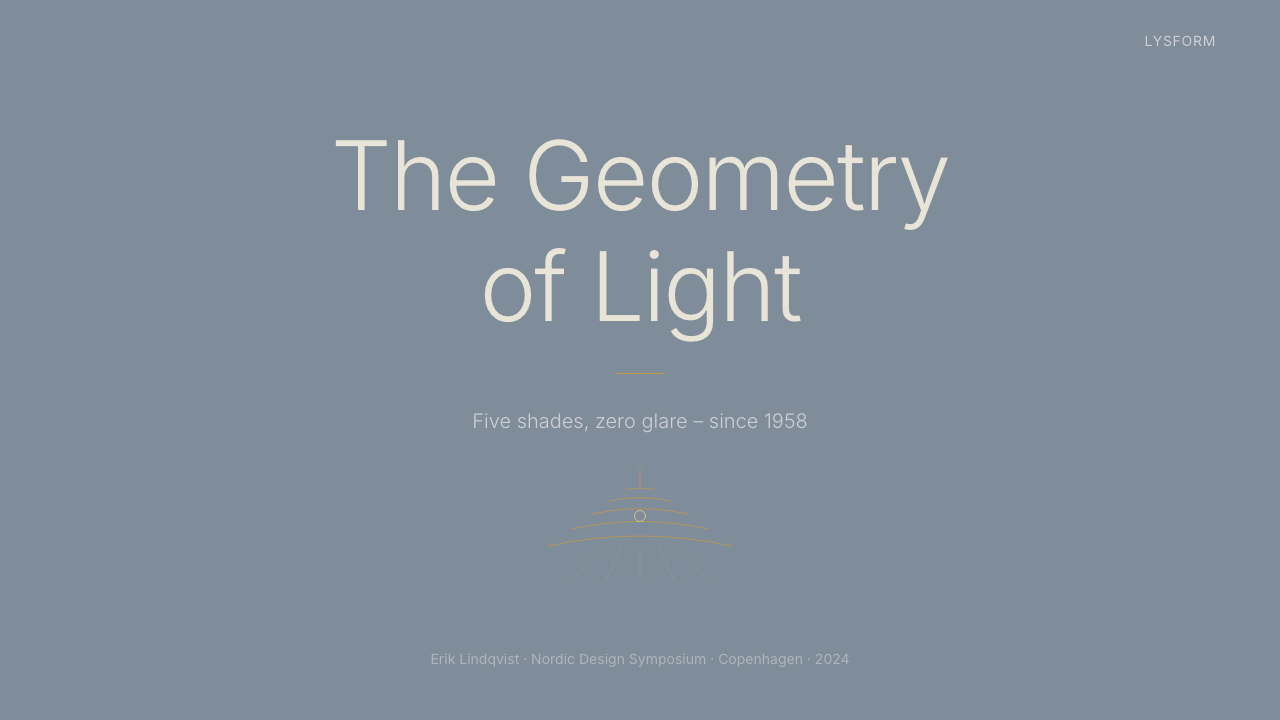
For presentation slides, this system rewards restraint. A cover page works well with a single centered diagram or lamp silhouette on the blue-gray ground, a product or company name in a light-weight sans-serif, and nothing else. The discipline of removing everything that has not earned its place should be applied ruthlessly. Content slides should treat the grid as a structural skeleton: content organized into a clear primary column with a wide secondary margin for annotations, with hairline rules marking transitions rather than decorative dividers. Data visualizations take on a technical-drawing quality — charts should feel like measurement instruments, with clean axis labels in a quiet weight and bars or lines colored from the palette's controlled range.
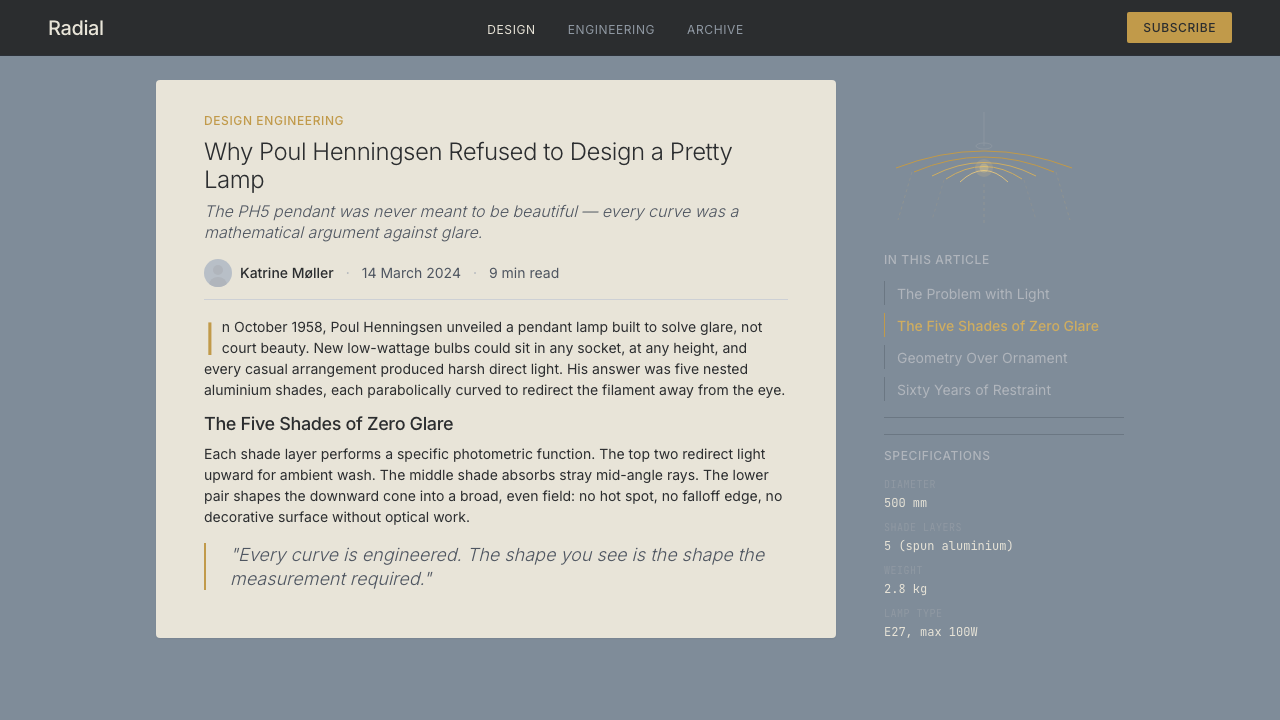
For web interfaces, the system is particularly well-suited to product detail pages, specification pages, and pricing tables where the goal is to communicate comprehensive information with maximum clarity. A well-executed version uses the blue-gray as a section background to separate major content areas, with white grounds for reading-intensive panels. Navigation is purely typographic, with no icon decoration beyond a single structural indicator. Cards avoid soft shadows entirely, using a hairline border or a very slight tonal shift instead — consistent with the system's logic that depth is declared, not softened.
For editorial and marketing materials, the style supports what might be called the luxury of understatement. A full-page advertisement can be nine-tenths negative space — the lamp profile isolated at center, a single line of type below in a quiet weight. Brochures and catalogs use the cross-section diagram as a recurring motif, allowing the explanation of how the product works to function simultaneously as the visual rhythm of the layout. In marketing copy, the register should match the visual discipline: declarative, precise, without superlatives or emotional pressure.
The most common mistake when applying this system is treating the cool palette and fine-line aesthetic as invitations to add more: more type sizes, more accent colors, more dividing rules, more diagrams. Authentic execution requires the opposite discipline. The blue-gray ground should cover large, undivided areas. White space should feel deliberately sized, not accidentally leftover. The brass accent, if used, should appear once or twice per layout, not as a repeating motif. The cross-section diagram earns its prominence by appearing rarely, not by repeating across every page. Restraint is not the finishing touch — it is the first decision.
Danish PH5 Louis Poulsen (1958) — FAQ
Is this style specifically about the PH5 lamp, or can it be applied to other products?
The style derives from the PH5 and the Louis Poulsen brand identity, but its underlying principles — engineering precision as aesthetic, technical diagrams as primary imagery, cool palette with warm-metal accents, diagrammatic rather than decorative illustration — are fully transferable. Any product or organization where rigor, precision, and functional excellence are core values can benefit from this visual language. The key is that the style must match the product's actual character: it would be misleading to apply a system that communicates engineering authority to a product that does not genuinely embody that quality.
How does this system differ from Swiss International Style, which also values precision and clean grids?
Both systems value precision and order, but they derive from different sources and project different characters. Swiss Style is typographically systematic — it is about the grid, the typeface, and the information architecture. The PH5 Louis Poulsen system is optically and materially derived — it is about how light behaves, how metal surfaces catch warmth, how the explanation of a mechanism can be the primary image. Swiss Style tends toward neutrality and universal applicability; the Danish PH system is more specific, warmer in its material references, and less typographically severe. Swiss work often feels like a communication system; PH work feels like a product catalog that has become its own aesthetic argument.
Can this visual system work for a dark-background or high-contrast version?
A dark inversion is possible but requires care. The canonical palette is cool-light — blue-gray grounds, white typographic fields, controlled warmth from brass accents. On a near-black ground, the same brass and warm-metal accents can function beautifully as foreground elements, and hairline rules in a light tone continue to provide structure without visual noise. The diagram, however, presents a challenge: fine-line technical drawings that read clearly on a light ground can become illegible at fine scales on dark grounds. Any dark-mode application should be tested specifically with the diagrammatic illustrations that are central to this system's character.
How should the cross-section diagram be used if I am designing for a non-physical product, like software?
The cross-section diagram is a specific reference to the PH lamp's optical engineering. When adapting this system to a software or digital context, the equivalent is a system diagram, an architecture schematic, or a flow illustration rendered in the same fine-line, minimal-fill style. The underlying principle is that the primary image should explain how something works rather than what it looks like in use. A software product could show its data flow as a precisely rendered schematic, its permission model as a layered diagram, or its processing pipeline as a cross-section of stages — all rendered in the system's visual vocabulary of hairline rules, blue-gray grounds, and sparse annotation.
Is the brass accent essential, or can it be omitted for a simpler palette?
The brass accent is not structurally required, but it performs an important function: it introduces warmth that prevents the cool blue-gray palette from reading as clinical or corporate in a negative sense. Without it, the system risks feeling merely minimal rather than purposefully calibrated. A simplified version that replaces brass with a warmer gray — still within the cool-to-warm range but not metallic — can work, particularly for contexts where a metallic reference would feel incongruous. What should not be omitted is the underlying temperature balance: some element in the system should introduce warmth to counteract the cool ground, just as the PH5 lamp itself used its inner cone to balance the temperature of the electric light source.
Related design styles
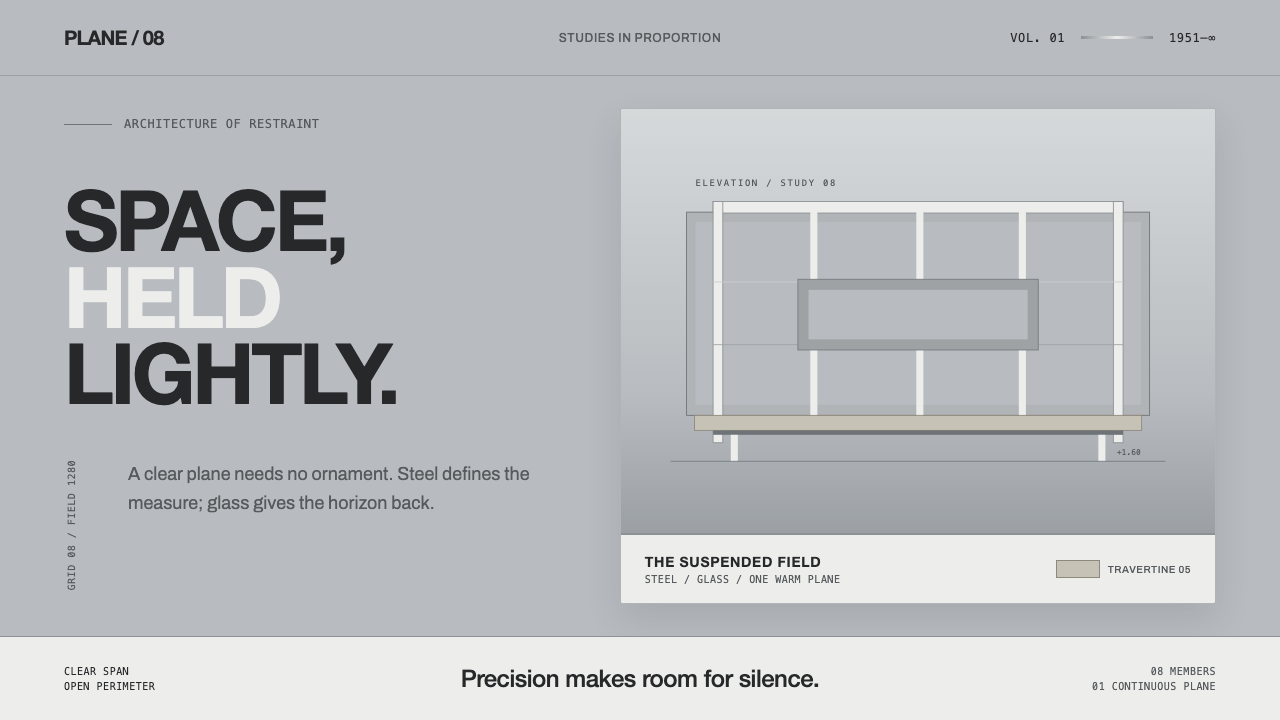 Farnsworth HouseWeightless by precision. White steel planes float across reflective gray with…
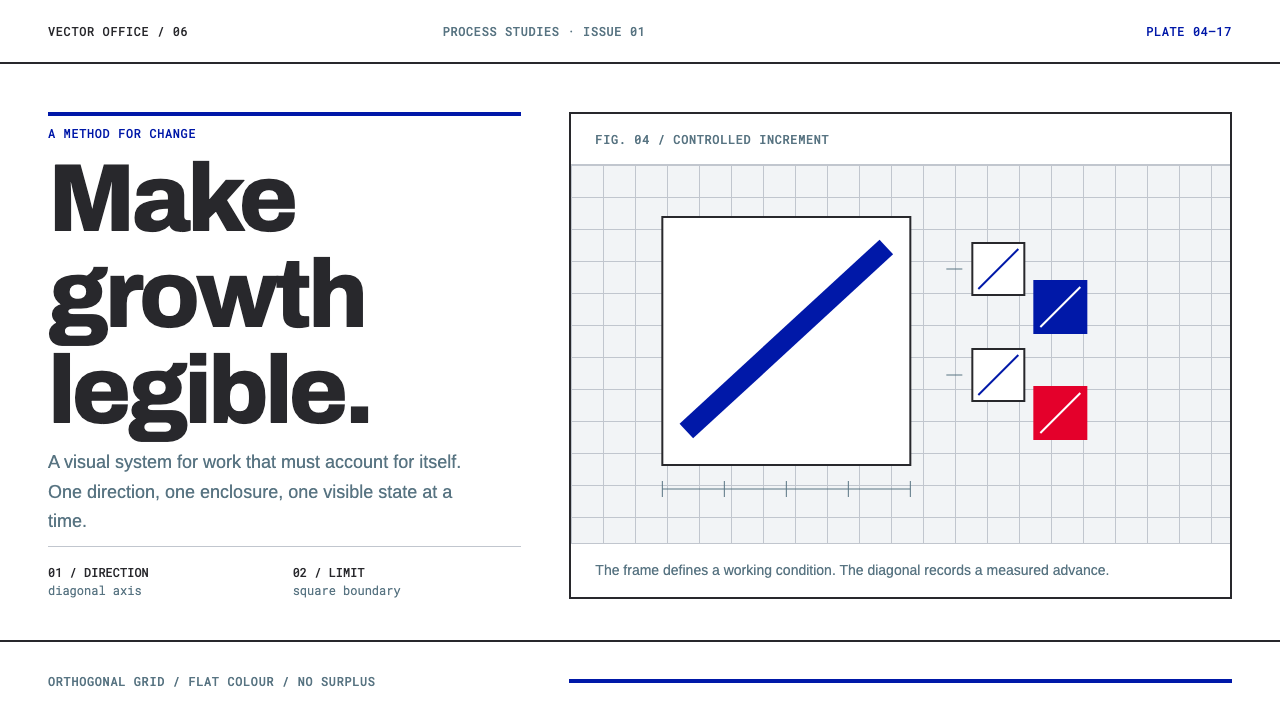 Anton Stankowski ConstructiveProcess becomes visible. Flat blue diagonals and hard square rules make chang…
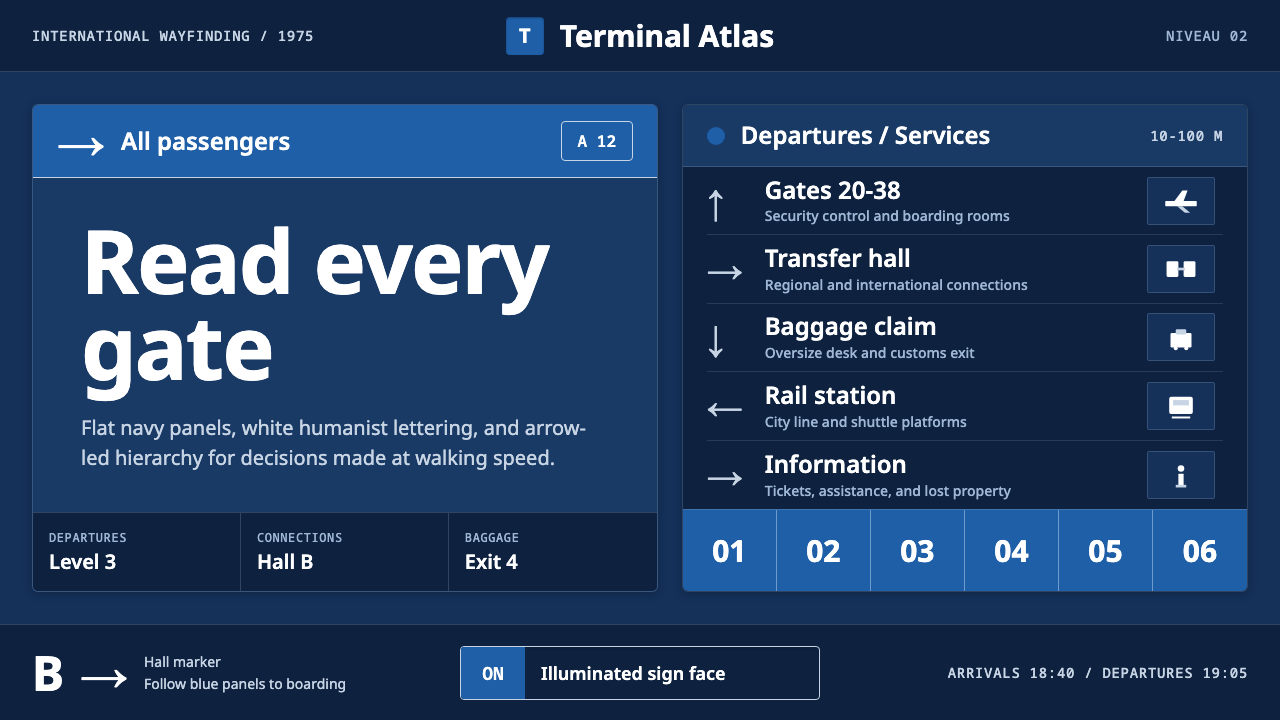 Frutiger CDG AirportLegibility at runway scale. Navy panels, white humanist sans, arrow-led grids.
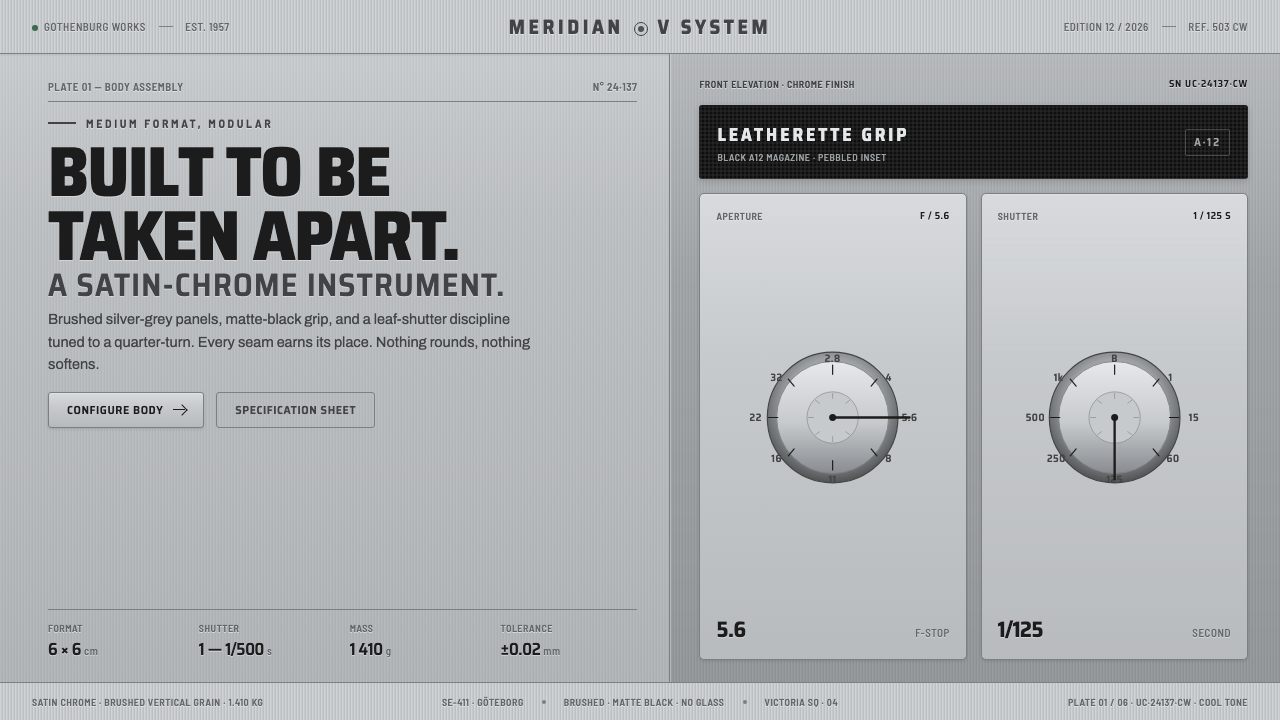 Hasselblad 500C ChromeBuilt to be taken apart. Brushed silver-grey panels, matte-black leatherette,…
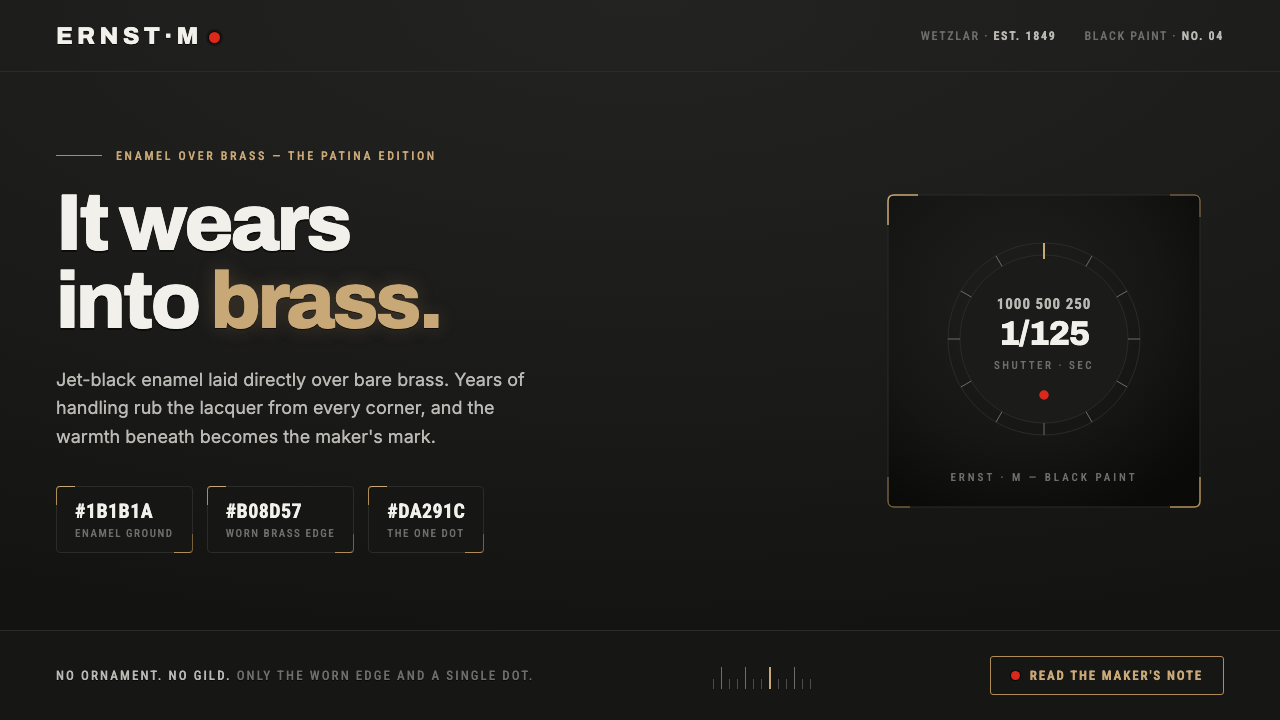 Leica M Black PaintIt wears into brass. Jet-black enamel over bare brass, exposed only at worn e…
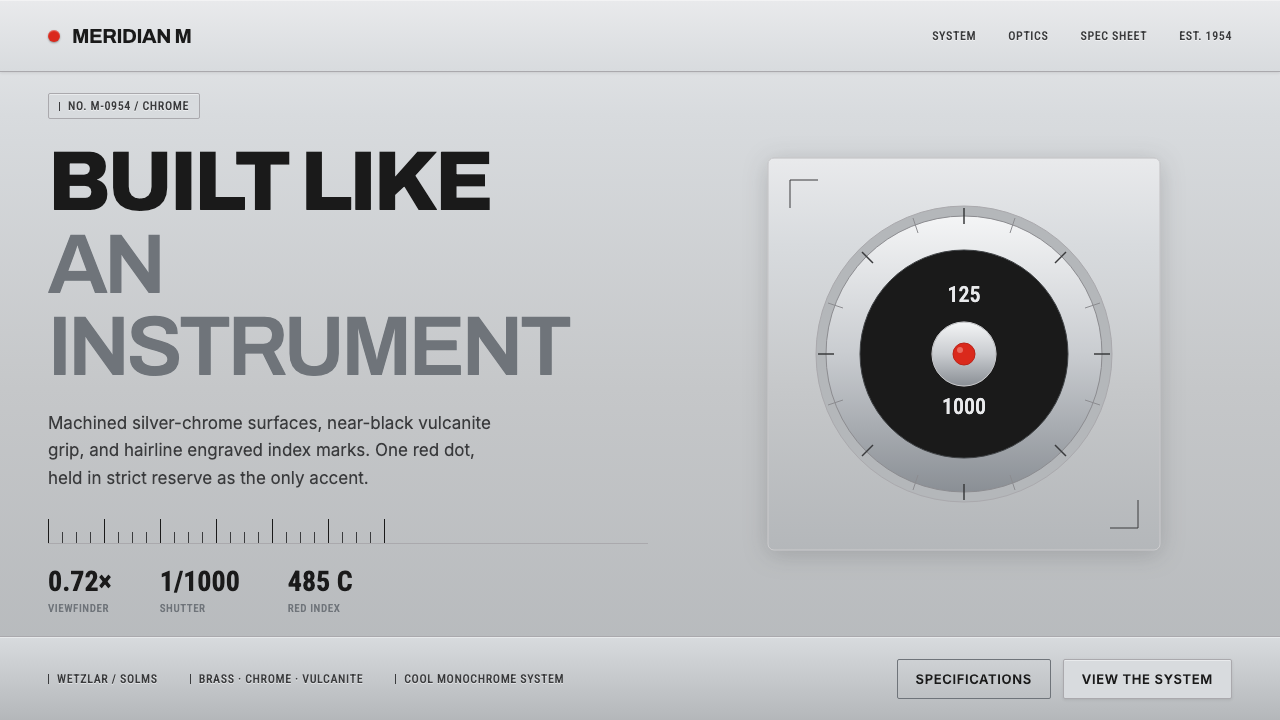 Leica M Silver ChromeBuilt like an instrument. Brushed silver-chrome on near-black vulcanite, one…