What is Ulm School (HfG Ulm)?
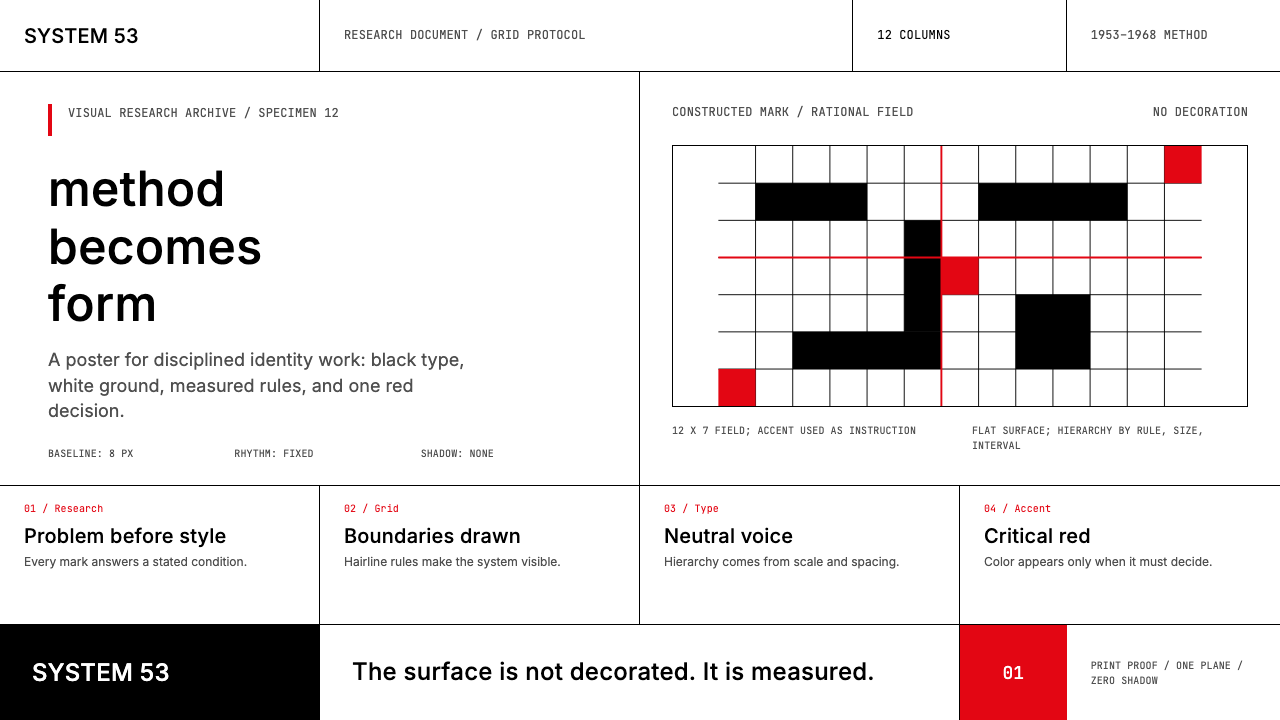
Where Bauhaus idealism met scientific method — the Ulm School distilled postwar functionalism into the most disciplined design language of the twentieth century.
Ulm School (HfG Ulm) in brief
The Hochschule für Gestaltung Ulm — known in English as the Ulm School of Design, or simply HfG Ulm — was a West German design institution that operated from 1953 to 1968. In those fifteen years it reshaped industrial design, visual communication, and corporate identity in ways still legible in the interfaces, signage systems, and product families that surround us today. Its visual language is defined by absolute constraint: pure black type on white ground, rigorous mathematical grids, hairline rules as the primary organizational device, and a single red accent used with the precision of a surgical instrument.
Where the Bauhaus had been a school of artistic experimentation grounded in craft, the Ulm School was a school of systematic design grounded in science, semiotics, and information theory. Its faculty did not simply teach students how to make things look a certain way; they developed theoretical frameworks for why designed objects communicate what they communicate, and how those communication structures could be optimized. Design was treated not as the application of taste but as the application of method.
The Ulm aesthetic is instantly recognizable: no gradients, no rounded corners, no decorative gestures of any kind. Structure is visible and intentional. Every line, every weight, every interval of space answers to a logic that can be articulated and defended. The result is a visual system that feels less like a style than like an argument — one that remains as persuasive today as it was when Otl Aicher designed the Lufthansa identity or Hans Gugelot shaped the Braun product line.

Where does Ulm School (HfG Ulm) come from?
The Ulm School was founded in 1953 in the city of Ulm, West Germany, by Inge Aicher-Scholl, Otl Aicher, and Max Bill. The school's founding was inseparable from the political and moral context of postwar Germany. Inge Aicher-Scholl was the sister of Hans and Sophie Scholl, who had been executed by the Nazi regime in 1943 for their role in the White Rose resistance movement. The school was conceived in part as a memorial to their legacy and as a practical institution for rebuilding German civic culture on democratic principles. This moral seriousness — the belief that design carried ethical weight and not merely aesthetic preference — would shape the Ulm program from its first semester.
Max Bill, a Swiss architect and designer who had studied at the Dessau Bauhaus under Walter Gropius, served as the first rector. He brought with him the Bauhaus conviction that form and function were inseparable, and that well-designed objects could improve the quality of everyday life. But Ulm quickly moved beyond the Bauhaus in methodological rigor. When Tomás Maldonado, an Argentine designer and theorist, joined the faculty and eventually succeeded Bill as rector in 1954, the school shifted decisively toward a scientific model. Maldonado introduced semiotics, information theory, and systems thinking into the curriculum, arguing that design problems were not fundamentally different from engineering problems and should be approached with the same analytical discipline.
The school's relationship with industry was central to its identity and output. A formal collaboration with the electronics company Braun, begun in the mid-1950s, produced some of the most celebrated objects of the century: the SK 4 phonograph, designed with Hans Gugelot, and the series of radio and audio products that established Braun's visual language for decades. Otl Aicher's work for Lufthansa, begun in 1962, created one of the first fully systematic corporate identity programs — a unified visual language applied consistently across aircraft livery, signage, printed materials, and uniforms. These were not exercises in style; they were systematic design programs in which every visual decision was grounded in functional and communicative criteria.
The Munich 1972 Olympic Games represented the apex of HfG Ulm's influence on public culture. Otl Aicher, leading the visual design team, developed a comprehensive visual identity that included the now-iconic pictogram system — a set of rigorously geometric, gender-neutral athlete silhouettes that communicated across language barriers to an international audience. The pictograms reduced the human figure to its essential geometric action and became the template for virtually every subsequent Olympic and public information symbol system. The Ulm School closed in 1968, a victim of political disputes with the state government of Baden-Württemberg over funding and ideological direction. But by then, its graduates and their work had already established a design methodology that would define the look of postwar modernity.
What defines the Ulm School (HfG Ulm) look?
Black-and-White Primacy
The Ulm School operates from a near-absolute chromatic restriction: black type and rules on white ground constitute the default visual state. This is not minimalism in a decorative sense but a principled commitment to contrast as the primary carrier of information. The white field is active, not empty — it is the ground against which every element is precisely measured. Any introduction of color is a deliberate act carrying communicative intent, not an aesthetic preference.
Mathematical Grid
Every layout element at HfG Ulm answers to a rigorous underlying grid — one derived from proportional systems and modular arithmetic rather than visual intuition. Columns, rows, gutters, and margins are not approximated but calculated. The grid is invisible in the final composition but evident in the precision of alignment: every text block, every ruled line, every white space interval corresponds to a specific position in the module system. This makes the Ulm grid feel different from looser grid systems — it has an internal consistency that the eye registers as authority.
Hairline Rules as Structure
Where most design systems use weight, color, or spatial separation to divide content zones, Ulm School work uses the hairline rule — a thin, precise horizontal or vertical line — as the primary organizing device. These lines are not decorative borders; they are structural articulations of the grid. They separate, they align, they create visual rhythm. Used consistently, they give a page or screen the quality of a precision instrument: everything in its place, every boundary declared.
Single Accent Color
The Ulm School permits one accent color — typically a clear, saturated red — and deploys it with surgical economy. It appears where maximum attention is required: a critical label, a primary call to action, a data point that demands isolation from its context. The red is not decorative warmth; it is a signal. Its power depends entirely on restraint. If it appears too often, or in areas of secondary importance, the signal degrades into noise. The discipline of a single accent, used rarely and with intent, is one of the Ulm system's most transferable principles.
Typographic Hierarchy by Scale
Ulm typography is built on grotesque sans-serif letterforms — clean, upright, with no calligraphic trace — and organizes hierarchy through scale and weight rather than decorative variation. A headline may be many times the size of body text; a label may be set in the same typeface at a fraction of that size with additional letter-spacing. There are no ornamental capitals, no italic inflections used decoratively, no mixing of contrasting typeface families. The entire hierarchy is produced by a single typeface doing its work at different scales.
Functional Semiotics
Unique among historical design movements, the Ulm School grounded its visual practice in semiotic theory — the study of signs and their meanings. Designers were expected to understand not only how to make an icon recognizable but why certain visual structures communicate certain meanings more efficiently than others. This produced a distinctive approach to pictogram and symbol design: forms are reduced to the minimum number of elements required for unambiguous reading, with no decorative residue. The Munich Olympic pictograms are the canonical example: each athlete figure is the geometric minimum necessary to convey its sport.
Zero Decorative Gesture
The Ulm School inherited from the Bauhaus the principle that ornament without function is waste, but it carried this further than the Bauhaus had. Where Bauhaus work sometimes permitted bold geometric shapes used expressively, Ulm design subordinates even geometric form to communicative necessity. There are no purely decorative shapes, no visual flourishes that exist for compositional pleasure, no rounded corners softening the severity of the system. Every element is what it is because it must be there. This absolute discipline is what distinguishes authentic Ulm-derived work from contemporary designs that adopt the aesthetic without the underlying logic.

Who shaped Ulm School (HfG Ulm)?
Otl Aicher was co-founder of HfG Ulm and the designer most responsible for translating its systematic principles into landmark public work. His corporate identity program for Lufthansa, begun in 1962, established a new standard for systematic visual communication: every element of the airline's public face — from aircraft livery to timetable typography — was governed by a unified visual grammar. His design team for the Munich 1972 Olympic Games produced the pictogram system that became the global template for public information iconography. Aicher also developed a comprehensive theory of visual language and typography, arguing that design was a form of ethics — that clarity and honesty in visual communication were moral commitments, not merely aesthetic ones.
Max Bill brought the direct link to Bauhaus pedagogy to the Ulm School: he had studied at Dessau under Walter Gropius, Marcel Breuer, and Paul Klee. As the school's first rector, he established the core curriculum and the principle that design should be rooted in concrete, mathematical relationships rather than subjective aesthetic judgment. A practicing architect, graphic designer, and sculptor, Bill embodied the Bauhaus ideal of the unified creative practitioner. His concept of 'concrete art' — art governed entirely by formal and mathematical rules with no representational or symbolic content — influenced the school's approach to form generation and its suspicion of any visual element that could not be rationally justified.
Tomás Maldonado, an Argentine designer and theorist, joined HfG Ulm in 1954 and became its rector, steering the school away from the Bauhaus's craft-and-art model toward a rigorous, science-based curriculum. He introduced semiotics, information theory, and systems thinking as foundational disciplines, arguing that the designer's task was to optimize communication structures rather than to express individual vision. Maldonado's influence turned Ulm into a research institution as much as a design school — a place where the theory of visual communication was developed alongside its practice. His writings on design theory, semiotics, and technology continued to shape design discourse long after the school closed.
Hans Gugelot was the head of product design at HfG Ulm and the principal architect of the Braun collaboration. Working with Dieter Rams and the Braun team, he designed the SK 4 phonograph — nicknamed 'Snow White's Coffin' for its austere white housing and flush glass lid — and established the product language that made Braun synonymous with rational, functional design. Gugelot's approach to product form was entirely consistent with the Ulm program: every surface, every detail, every proportion was determined by function and material logic, with no vestige of decorative styling. His work demonstrated that systematic design methodology could produce products of profound aesthetic quality — not despite the constraints, but because of them.
Inge Aicher-Scholl was the co-founder and first director of the Ulm School, and the person without whom it would not have existed. Her siblings Hans and Sophie Scholl had been executed by the Nazi regime in 1943 for their resistance activities, and Inge channeled the grief and conviction of that experience into building an institution dedicated to democratic education and the rebuilding of German public culture. She secured the political support and international funding — including from the American High Commission for Germany — that made the school possible. Though not herself a designer, her insistence that design carried moral and civic responsibility shaped the Ulm program's character as profoundly as any formal curriculum decision.
How do you use Ulm School (HfG Ulm) today?
The Ulm School aesthetic is among the most intellectually rigorous and transferable visual systems available to contemporary designers, but it rewards deep understanding rather than surface imitation. Applying it correctly means grasping its underlying logic — that every visual decision is a communicative act, that structure is the primary aesthetic medium, and that restraint is not a lack of expression but its highest form. Designers who absorb this logic can apply it to any medium; those who simply borrow its surface characteristics produce work that looks sparse without being principled.
For presentation slides, the Ulm approach excels on both cover and content pages. A cover should be treated as a systematic object, not a designed moment: title and subtitle in a single grotesque sans-serif at sharply contrasting scales, positioned on a strict grid, with a single hairline rule as the only graphic element beyond type. One small red accent — a geometric mark, a categorization label — may appear if there is a genuine communicative reason for it. Content slides should follow the same grid as the cover, using size and weight to establish two or three levels of hierarchy, and hairline rules to separate content zones. Data slides become diagrammatic: charts are treated as geometric objects in a white field, with the accent color used only to isolate the single most important value. Every other element is black on white.
For web user interfaces — particularly dashboards, analytics tools, and pricing pages — the Ulm system provides a scaffold of unusual clarity. Define a strict column grid and hold to it without exception. Keep backgrounds near-white or pure white; use black for all body text and secondary labels; reserve the accent color for the single most important interactive state or metric on any given view. Navigation should be purely typographic, with no icon decoration beyond a minimal geometric indicator for active states. Card components should have hard, precise borders rather than soft shadows — a card edge is a structural line, not a depth illusion. Form elements should be bordered and rectilinear; ghost inputs and pill-shaped buttons belong to a different visual logic entirely.
For editorial and marketing applications, the style supports powerful information hierarchy and memorable visual impact. An editorial layout in the Ulm tradition uses a narrow text measure for maximum readability, with wide margins reserved for annotations, cross-references, or section labels set small and light. Section breaks are marked by a bold horizontal rule, not decorative ornaments or whitespace alone. Marketing pages work well with the poster logic that underlies the style: large type at the scale of a command, alternating grounds — white type on near-black, black type on white — and the accent color used once, in the position of highest strategic importance, for the primary call to action. The system resists clutter not by being empty but by being exact.
A common and revealing mistake when applying the Ulm aesthetic is confusing systematic restraint with simple sparsity. Empty space is not the same as disciplined space: an authentic Ulm-derived layout is full of decisions — about grid intervals, about the precise weight of a hairline, about whether the accent color appears at all. Designers who remove elements without understanding why they should be removed produce work that reads as sterile rather than rigorous. A related error is introducing visual softness — rounded corners, ambient shadows, gradient fills — as a concession to contemporary taste. Each of these elements imports a logic incompatible with the Ulm system; even one rounded corner signals that the discipline has been compromised. The style is all or nothing: either every element answers to the same structural logic, or the argument collapses.

Ulm School (HfG Ulm) — FAQ
How does the Ulm School differ from the Bauhaus it grew from?
The Bauhaus was fundamentally a school of artistic practice grounded in craft: students made things with their hands, explored materials, and developed visual intuitions through studio work. The Ulm School absorbed the Bauhaus's formal vocabulary — the primacy of function, the rejection of ornament, the grid — but replaced its craft orientation with a scientific one. Where Bauhaus designers relied on developed aesthetic judgment, Ulm designers were expected to ground every decision in articulable criteria drawn from semiotics, information theory, or systems analysis. Ulm work tends to be cooler, more systematic, and less expressively bold than Bauhaus work — more precise where Bauhaus was vigorous.
Is the Ulm School the same as Swiss International Style?
They are close relatives that developed in parallel and influenced each other, but they are distinct. Swiss International Style, emerging in Zurich and Basel in the 1950s, prioritized the mathematical grid, neutral photography, and typographic precision — it is a visual language optimized for legibility at scale across multiple languages and media. The Ulm School shared these commitments but went further into design theory, semiotics, and the systematic grounding of every visual decision. Swiss Style tends to be warmer and more visually generous; Ulm work is more austere, more theoretically self-conscious, and more insistent that the design argument be fully articulated. In practice, the two often look similar — but the reasoning behind the choices is different.
Why does the Ulm system use only one accent color?
Because a signal has value in proportion to its rarity. In a system where black on white does all the structural work, the introduction of any color is an extraordinary event — it means something specific has been designated as requiring maximum attention. If two or three colors are used, this hierarchy of attention collapses: the viewer has to decode which color means what, and the automatic priority-reading that a single accent enables is lost. The Ulm logic here is semiotic: color in this system is not decoration but syntax, and a syntax that multiplies its high-priority markers degrades its own ability to signal priority. One accent, used rarely, communicates more than three used freely.
Can the Ulm style work for consumer-facing products or is it only suited to professional tools?
The Ulm system's values — authority, clarity, rational structure, precision — align naturally with professional and analytical contexts: enterprise dashboards, financial platforms, scientific and medical tools, institutional communications. In these contexts, its severity reads as competence and trustworthiness. Consumer products require more care. The style can work beautifully for consumer products where the user expects sophistication and values functional clarity over warmth — premium audio, precision instruments, architectural software, high-end publishing tools. It becomes a poor fit where the user experience depends on emotional warmth, organic texture, or cultural familiarity: food, wellness, children's products, social platforms. The question to ask is whether the product's core value proposition includes rationality and precision as user-facing qualities; if so, Ulm will amplify them.
How do the Munich 1972 Olympic pictograms embody Ulm School principles?
The Munich pictograms are perhaps the clearest demonstration of Ulm semiotic design methodology applied to a real-world communication problem at scale. The design team, led by Otl Aicher, faced the task of communicating dozens of sporting events to an international audience with no shared language. The solution was to reduce each athletic action to the minimum set of geometric elements that would allow unambiguous identification — no more, no less. Each figure is constructed from a constrained set of oval and linear elements, positioned on a grid, with no decorative detail that does not carry information. The result is a system rather than a collection: every pictogram obeys the same formal rules, making the set read as a coherent language. This is the Ulm method in its purest application — design as the optimization of a communication problem.
Related design styles
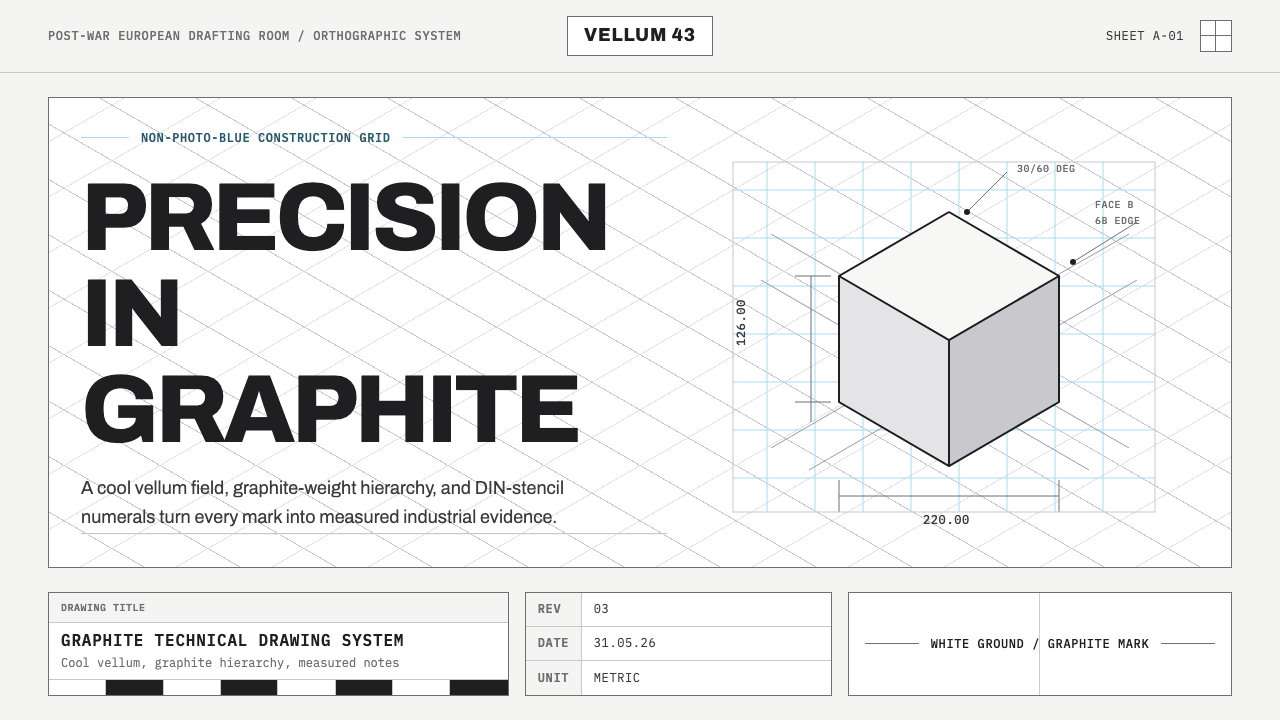 Graphite Technical DrawingDrafting-room precision. Non-photo-blue grid and graphite DIN lettering do th…
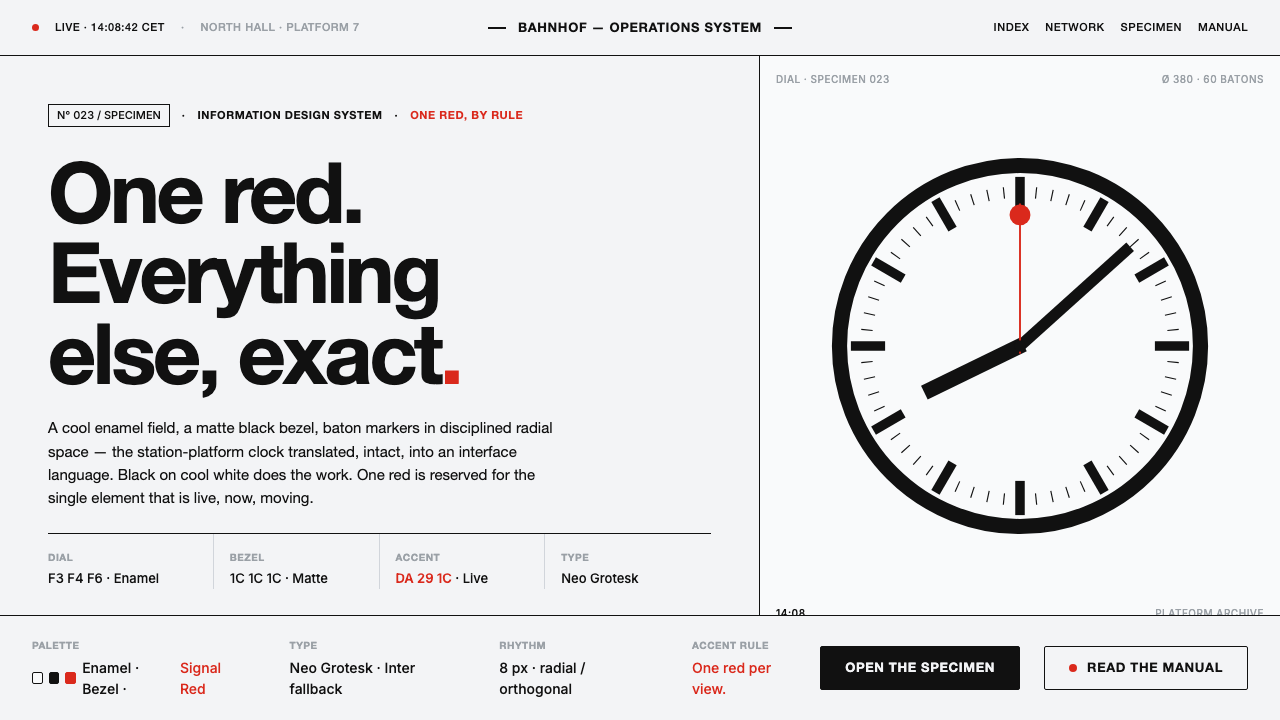 Hilfiker Railway ClockEverything exact, one thing live. Black hands on cool enamel white — one red…
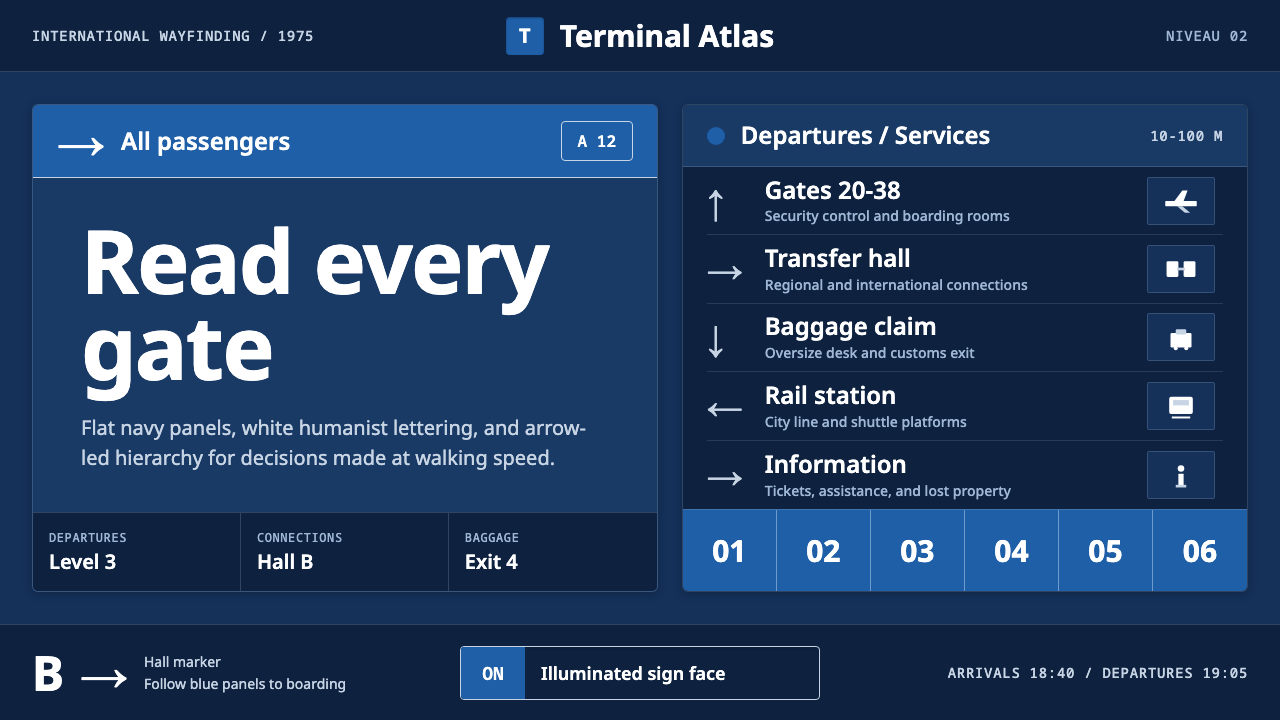 Frutiger CDG AirportLegibility at runway scale. Navy panels, white humanist sans, arrow-led grids.
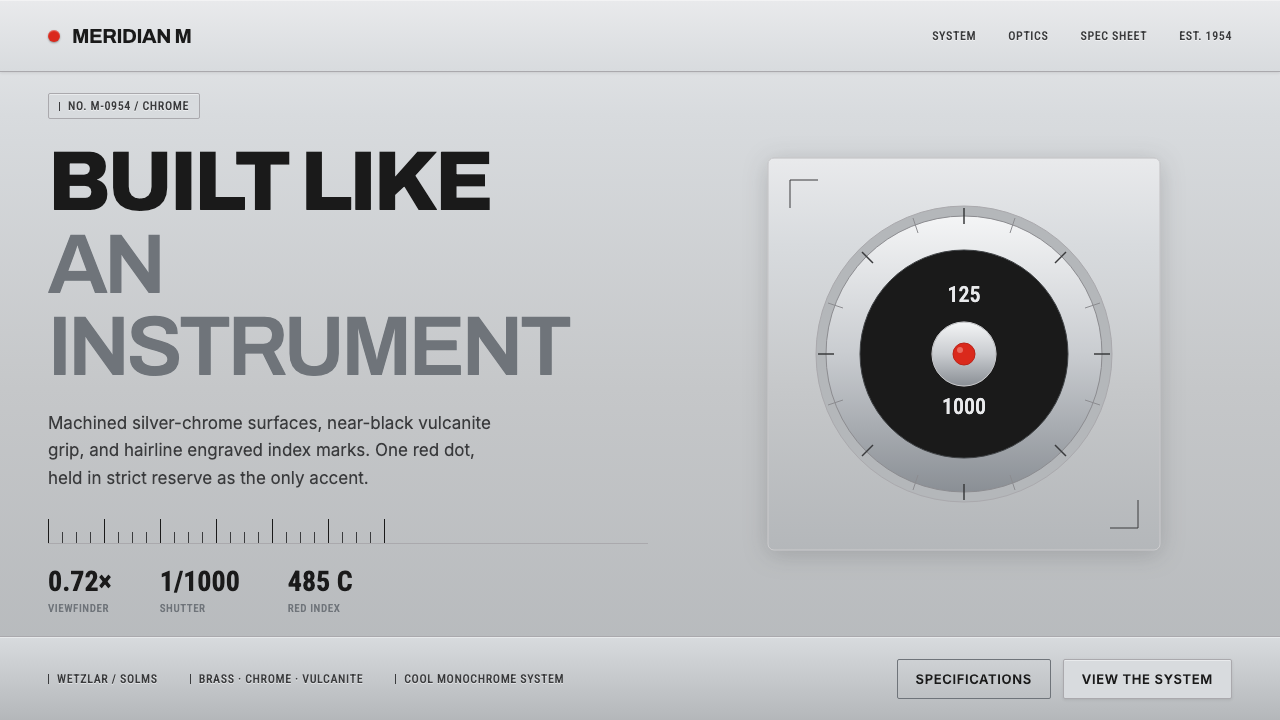 Leica M Silver ChromeBuilt like an instrument. Brushed silver-chrome on near-black vulcanite, one…
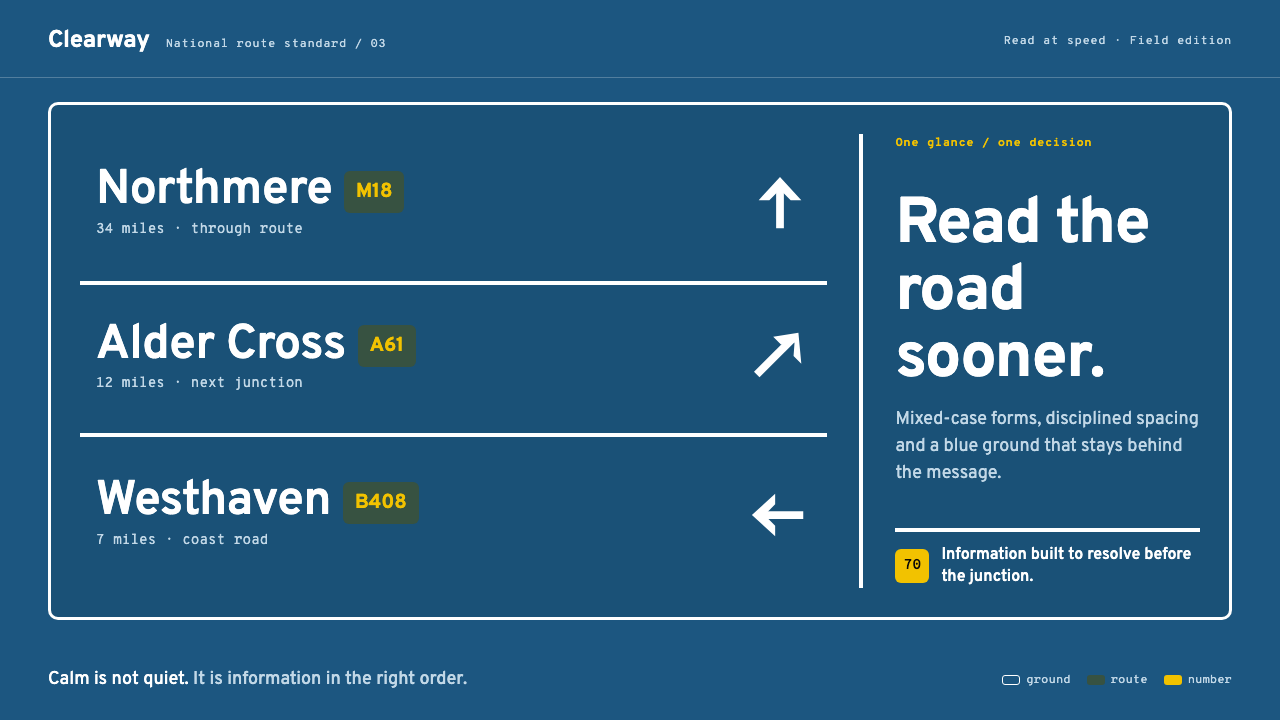 Transport UK Road SignsClarity at seventy. White mixed-case lettering advances across recessive moto…
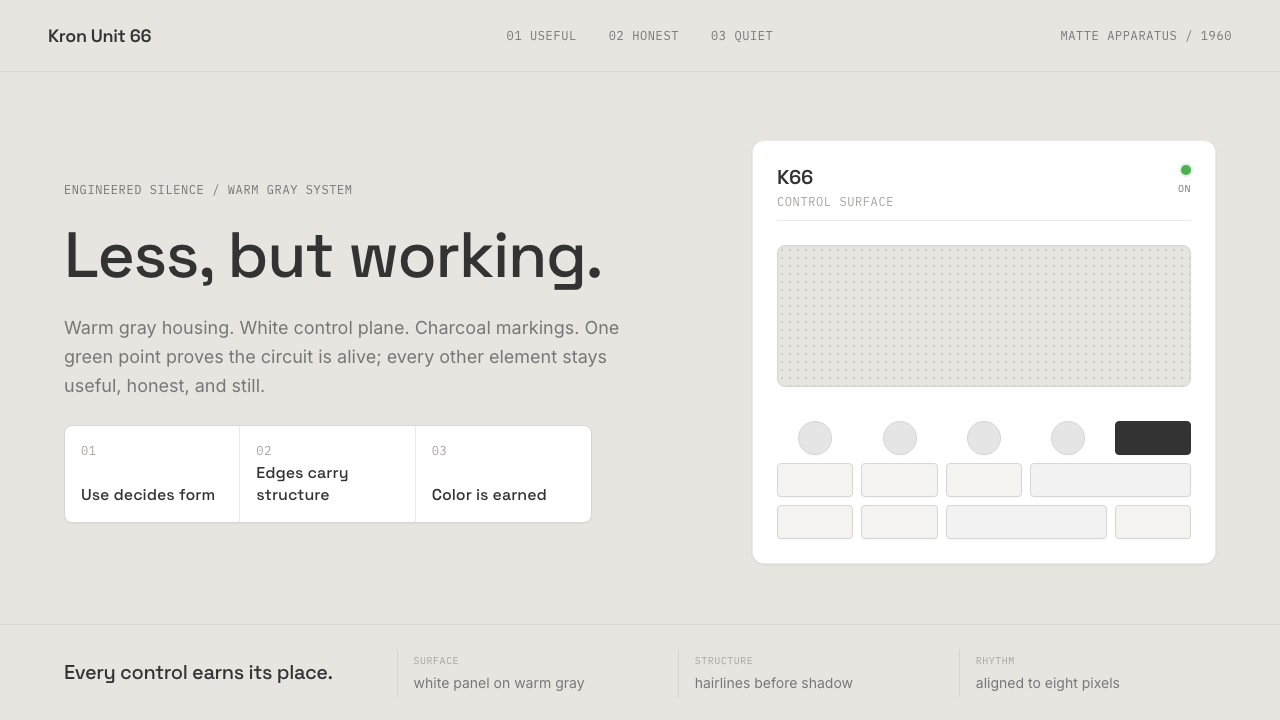 Dieter Rams / BraunQuiet by design. Warm gray, white panels, hairline grids, and one earned gree…