What is Cargo Collective Portfolio?
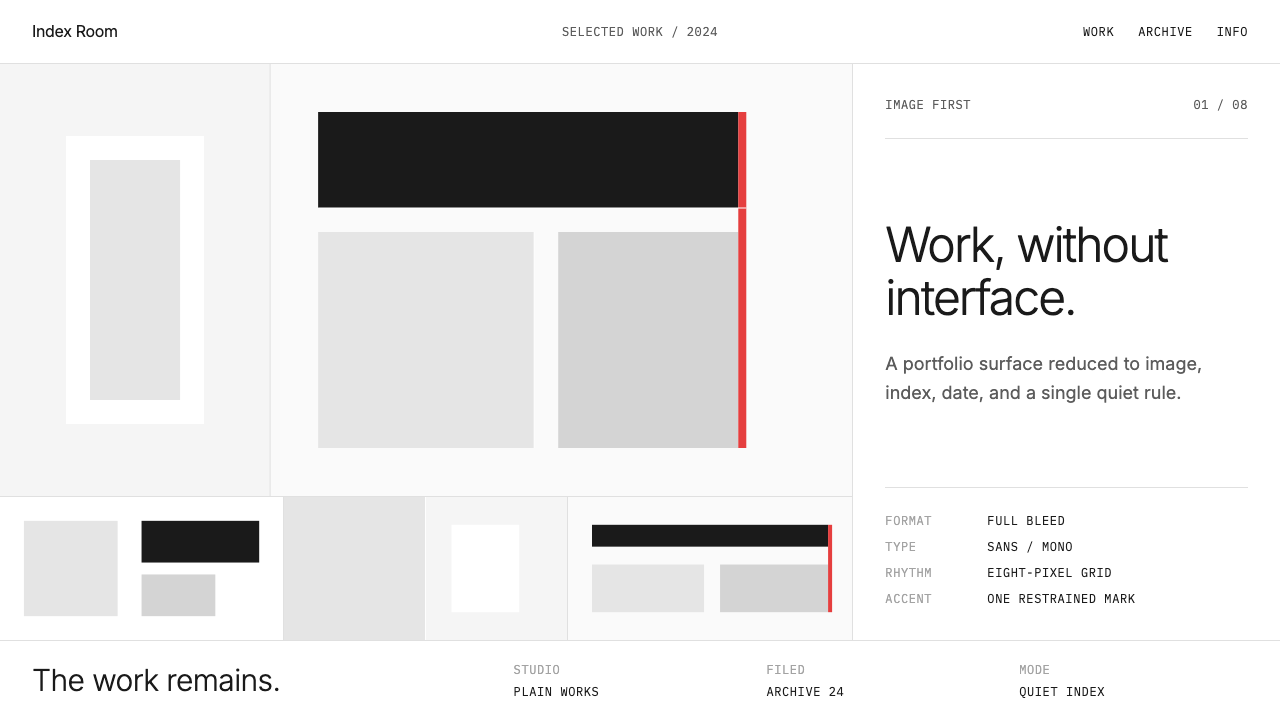
Cargo Collective made the designer's portfolio invisible — leaving only the work, framed by full-bleed imagery, monospace metadata, and silence.
Cargo Collective Portfolio in brief
Cargo Collective Portfolio is the visual language codified by the invite-only portfolio platform founded in 2007. Its aesthetic is defined by deliberate subtraction: no decorative chrome, no personality-driven interface elements, no visual noise competing with the work on display. What remains is a rigorously restrained system of full-bleed imagery, hairline rules, generous whitespace, and typographic hierarchy built from a single monospace voice for metadata alongside a tight-tracked sans for names and titles.
The style's central conviction is that the designer's interface should disappear. Unlike portfolio platforms that offer expressive customization, Cargo templates enforce a shared visual grammar — one that signals belonging to a community of taste-makers rather than individual brand identity. The work fills the frame; the frame refuses to speak. This philosophy produces layouts that feel simultaneously editorial and architectural: pages read more like museum vitrine arrangements than conventional web design.
What makes Cargo Collective Portfolio distinct from generic minimalism is its specific vocabulary of restraint. Hairline rules separate rather than decorate. Monospace type for project metadata — client names, years, categories — creates a ledger-like factual register that contrasts with the expressive imagery it annotates. White or off-white grounds are near-absolute; color, where it enters, does so only through the photography and artwork on display, never through the interface itself.

Where does Cargo Collective Portfolio come from?
Cargo Collective was founded in 2007 by Folkert Gorter, a Dutch designer, and Adam Spektor in Los Angeles, California. The platform launched as an invite-only community at a moment when portfolio hosting options for working designers were either generic (content management systems not built for visual work) or expensive (custom-developed sites). By restricting entry to designers vouched for by existing members, Cargo created a curated context — a signal that placement on the platform itself carried aesthetic credibility.
The platform's visual templates were shaped by the dominant taste currents in design culture during the late 2000s and early 2010s: a reaction against the decorative excess of the mid-2000s web, an embrace of Swiss typographic rigor, and the influence of print-derived editorial design on screen layout. Designers trained in print brought their page-layout instincts online — the narrow column for body text, the wide margin for annotations, the hairline rule as a structural device. Cargo's templates translated these sensibilities into repeatable screen patterns.
The current visual iteration of the Cargo aesthetic — the one recognizable in the broader design conversation — solidified roughly between 2020 and 2024, as the platform updated its template system for contemporary screen environments. This phase saw the full-bleed image grid become canonical: projects presented as edge-to-edge photographs in a masonry or strict grid layout, with all metadata collapsed beneath or overlaid in translucent monospace type. The interface chrome reduced to near-nothing: a persistent name in one corner, a navigation list in another, nothing else.
Cargo's influence spread far beyond its user base because the aesthetic it codified aligned with a broader professional designer ethos: restraint as expertise, whitespace as confidence, the refusal to decorate as a form of authority. Agencies, studios, and independent practitioners who never used the platform absorbed its vocabulary through exposure to portfolios that did. By the early 2020s, the Cargo aesthetic had become a recognizable genre — one shorthand for 'serious designer' in the same way that certain editorial magazines signal serious journalism.
What defines the Cargo Collective Portfolio look?
Full-Bleed Imagery
Photography and project imagery extend to the absolute edges of the container or viewport, with no visible margin, padding, or border separating the image from the interface boundary. This treatment makes the work itself the ground — the space the viewer inhabits — rather than an object placed inside a decorative frame. Full-bleed grids, where multiple projects tile edge-to-edge without gutters, amplify this effect: the portfolio becomes a continuous visual surface rather than a catalogue of discrete items.
Monospace Metadata
Project information — client names, years, categories, brief descriptions — is rendered in a monospace typeface that creates a deliberate register contrast with the display type used for names and titles. Monospace carries associations with code, ledgers, and technical documentation; in a portfolio context it frames the factual details of a project with a cool, systematic objectivity. The fixed-width character spacing also produces a quiet visual rhythm that is legible without drawing attention to itself.
Hairline Rules
Extremely thin horizontal or vertical rules divide sections, separate metadata from imagery, or mark the edges of content regions. These lines are structural rather than decorative — they provide spatial orientation without competing with the work they frame. Their weight is calibrated to be visible against a white ground without becoming a design element in their own right. The hairline rule is perhaps the single most recognizable signature of the Cargo visual language.
Neutral Ground
Backgrounds are consistently white or near-white — sometimes a very pale warm gray — creating a neutral ground from which the work can emerge without color competition from the interface. This is a deliberate renunciation of the designer's personal palette: the portfolio surface itself has no aesthetic agenda beyond reception. The neutrality is absolute in most templates; any warmth or coolness in the ground is barely perceptible and never a design statement.
Typographic Economy
The typographic system is built on the minimum number of voices required to establish hierarchy. Typically two: a sans-serif for names, section titles, and navigation, and a monospace for project-level metadata. There is no decorative type, no display font used for expressive purposes, no mixing of historical styles. Scale and weight carry all hierarchical meaning — a name set very large against a smaller monospace credit is the entire system. The restraint signals that the designer trusts the work to carry the expressive weight.
Navigation as Ghost
Navigation elements are reduced to their minimum functional form: a name or wordmark, a short list of section labels, possibly a contact link. These elements are positioned at the periphery of the layout — corners or edges — and rendered at a weight and size that keeps them visibly present but perceptually recessive. The viewer's eye is not drawn to the navigation; it is available when needed. This is the interface equivalent of the hairline rule: present, structural, and willfully unobtrusive.
Silence as System
Whitespace in the Cargo aesthetic is not empty — it is structural material. The generous space around titles, between metadata and imagery, at the edges of the viewport, is calibrated to give every element air to exist independently before the eye moves to the next. This differs from the whitespace in luxury branding (which signals premium positioning) or minimalist software UI (which signals focus). In a portfolio context, the silence is curatorial: it insists that each work receives the viewer's full attention before the next begins.

Who shaped Cargo Collective Portfolio?
A Dutch designer working in Los Angeles, Gorter co-founded Cargo Collective in 2007 and shaped the platform's curatorial identity as much as its technical infrastructure. His own design practice — characterized by typographic rigor, editorial restraint, and a preference for work that recedes in favor of its subject — became a template for the aesthetic the platform promoted. Gorter's decisions about which designers to admit during the invite-only era effectively defined the taste community the platform represented, and those curatorial choices became legible in the visual conventions the platform's templates enforced.
Spektor co-founded Cargo Collective alongside Gorter and served as a central figure in the platform's technical and product development. His contributions shaped the infrastructure that made the platform's distinctive template system possible — the constraints that enforce the visual grammar rather than simply offering it as an option. The platform's design decisions reflect a product philosophy aligned with the aesthetic it served: the fewer the choices offered to users, the more coherent the community's output.
The Dutch graphic designer whose system-based typographic approach — developed in the 1960s and 1970s through his work at Total Design — represents a direct ancestor of the Cargo aesthetic's typographic sensibility. Crouwel's belief that the designer's role was to create transparent systems through which content could pass, rather than expressive vehicles for personality, maps exactly onto the Cargo philosophy. His grid-based poster and catalogue designs for the Stedelijk Museum, with their strict typographic hierarchy and rejection of decorative convention, are a visible precedent for the portfolio layouts the platform would codify decades later.
The Dutch book designer known for her extreme typographic restraint and her insistence that the designed object should never compete with its content. Boom's book designs — sometimes nearly typeless, always architecturally structured — demonstrate the same conviction that animates the Cargo aesthetic: that the highest form of design service is to become invisible. Her work was widely admired in the design culture from which Cargo emerged, and her approach to whitespace as active material rather than passive absence influenced how a generation of portfolio designers thought about the role of the empty page.
The Amsterdam-based design studio whose rigidly typographic, system-driven approach to graphic design — built almost entirely from Helvetica in varying weights and sizes, with no imagery that could not be justified structurally — became one of the defining visual references for the design culture that Cargo Collective would serve. Experimental Jetset's insistence on typography as the primary visual material, and their rejection of photography and illustration in favor of textual form, represents the extreme ideological end of the restraint spectrum that Cargo templates navigate in a more accessible register.
How do you use Cargo Collective Portfolio today?
The Cargo Collective Portfolio aesthetic is transferable to any presentation context where the goal is to foreground content while the containing system recedes. The key discipline is consistency of restraint: every decorative impulse resisted, every added element justified by function. Applying it correctly means understanding what the system is refusing — not just what it contains.
For presentation slides, the style works best when treated as an editorial layout system rather than a slide template. Cover slides should use a single full-bleed image or a dominant near-white field with a name and perhaps a hairline rule — no background illustration, no gradient, no branded color block. Content slides follow a strict typographic grid: headlines in a clean sans-serif at large scale, body text restrained in weight and measure, monospace type for captions or data labels. Section-divider slides are pure whitespace with a centered label in small caps or tight-tracked sans — no decorative transitions. Data slides take on an almost diagrammatic quality: charts and tables should use the same typographic system as surrounding slides, with color reserved for data differentiation only and never for decoration.
For web UI applications — dashboards, pricing pages, product landing pages — the aesthetic translates into a strict grid structure with a neutral background, all interactive elements defined by border and position rather than color or shadow, and monospace type used consistently for any data or metadata display. Navigation should be typographic: a wordmark or name and a flat list of labels, positioned at the viewport edge. Call-to-action elements are the one place where a single non-neutral color may appear, used consistently and sparingly. Avoid soft drop shadows, rounded corners beyond a very slight radius, gradient backgrounds, and any decorative iconography.
For editorial and marketing contexts — article layouts, event materials, agency capabilities documents — the style supports a high-information density that reads as authoritative rather than austere. A two-column layout with a narrow text column and a wide annotation margin, divided by a hairline rule, creates the characteristic Cargo register in a document format. Full-bleed section openers alternate between an image and a near-white field with large display type. Marketing copy should be short and direct; the aesthetic is incompatible with verbose body text or densely bulleted feature lists. When deploying the style for a campaign or brand presentation, the visual quiet of the system creates a strong contrast with busier competitive materials — but only if that quiet is maintained consistently throughout.
The most common mistake when applying this aesthetic is treating restraint as minimalism and minimalism as simply reducing element count. Cargo's restraint is not about fewer elements — it is about elements that do not speak. A page with three large images and two lines of type can be visually loud if the type is expressive, the images are stylistically inconsistent, or the spacing is arbitrary. Conversely, a dense project listing with many items reads as quiet if every spacing decision is consistent and the typographic voice never deviates. The discipline is not reduction; it is refusal. Every design decision should be answerable with a functional reason, and anything that cannot be so justified should not be there.

Cargo Collective Portfolio — FAQ
Is the Cargo Collective Portfolio aesthetic the same as minimalism?
They overlap but are not identical. Contemporary minimalism — as seen in luxury brand identities or high-end consumer product interfaces — uses whitespace and restraint as signals of premium positioning. The Cargo aesthetic uses whitespace and restraint as curatorial discipline: the point is not to signal luxury but to create conditions in which the work can be seen without interference. Minimalism can be a style applied to any content; the Cargo aesthetic is specifically about the relationship between a designer's work and the frame that holds it. A minimal layout can still have expressive typography, a distinctive color ground, or a branded visual identity — the Cargo aesthetic refuses all of these.
Can this aesthetic work for a brand that needs a strong visual identity, not just a portfolio?
With adaptation, yes — but the core tension must be acknowledged. The Cargo aesthetic is designed to suppress the container's identity in favor of what it holds. A brand that needs to communicate values, personality, or differentiation through its visual system is working against this logic. The style can be adapted for brand contexts by introducing a single consistent color as a brand mark (used at the same restrained frequency the style demands), and by allowing the typographic voice to have slightly more weight and distinctiveness. What cannot transfer is any decorative layering, illustrative elements, or expressive color system. The brand must be willing to let its identity speak almost entirely through typographic tone and spatial discipline.
How does this aesthetic handle color photography — especially work that is itself visually loud?
This is one of the aesthetic's genuine productive tensions. The neutral, recessive interface is designed to accept whatever the work brings — including vibrant, complex, or visually aggressive imagery. The system does not suppress the photography; it insulates it. A full-bleed fashion photograph with intense color and high visual energy sits against the same white ground as a quiet typographic print — both read clearly because neither competes with a designed interface that is itself expressive. The discipline for the curator or designer is to maintain the system's neutrality even when the work it holds is anything but neutral. The moment interface color, expressive type, or decorative elements are introduced to 'match' a particular project's energy, the system breaks.
Is this aesthetic appropriate for designers early in their career, or does it require a strong body of work to sustain it?
The aesthetic carries an implicit claim: that the work is strong enough to stand without any supporting system. This makes it a high-stakes choice for portfolios with limited or uneven work. When the aesthetic succeeds, it reads as confidence and curatorial precision. When the work is thin, the neutral system has nothing to amplify — the whitespace becomes emptiness, and the absence of decorative support makes weaknesses more visible rather than less. Early-career designers building this kind of portfolio should prioritize depth over breadth: three or four thoroughly presented projects in this system will read more strongly than ten projects treated at a surface level. The aesthetic rewards completeness and penalizes incompleteness.
Does the Cargo aesthetic translate well to dark-mode or dark-background layouts?
A dark inversion is possible and not uncommon among designers who use the platform, but it changes the aesthetic's character significantly. The canonical Cargo register is light-ground: the white or near-white background is what creates the neutral reception field for photography. On a dark background, the full-bleed imagery reads differently — colors shift in perceived saturation, and the interface boundary becomes more visible rather than less, because dark grounds assert themselves in a way that light grounds do not. A dark variant can work well if it is treated as a consistent choice — every slide, every page, every section — rather than alternating between dark and light. Hairline rules and monospace metadata require slightly increased weight on dark grounds to maintain the same perceptual lightness they have on white.
Related design styles
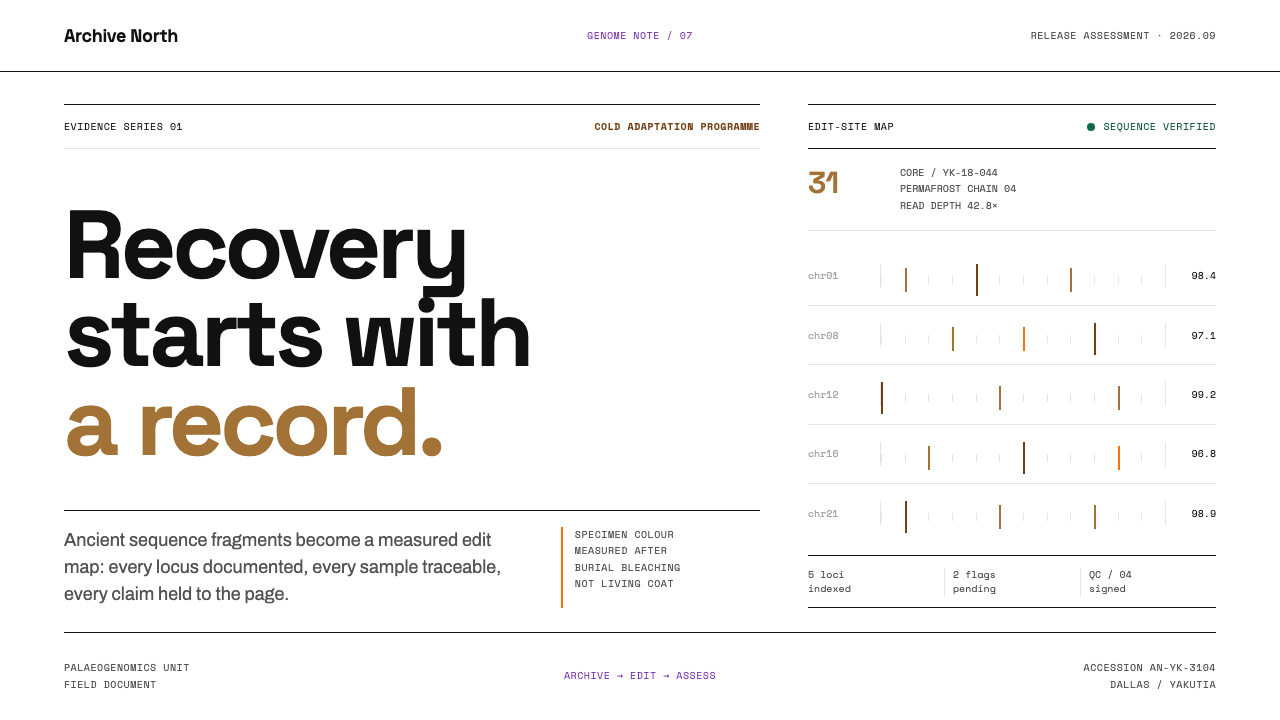 De-extinction LabResurrection reads as evidence. Black rules and specimen brown map every geno…
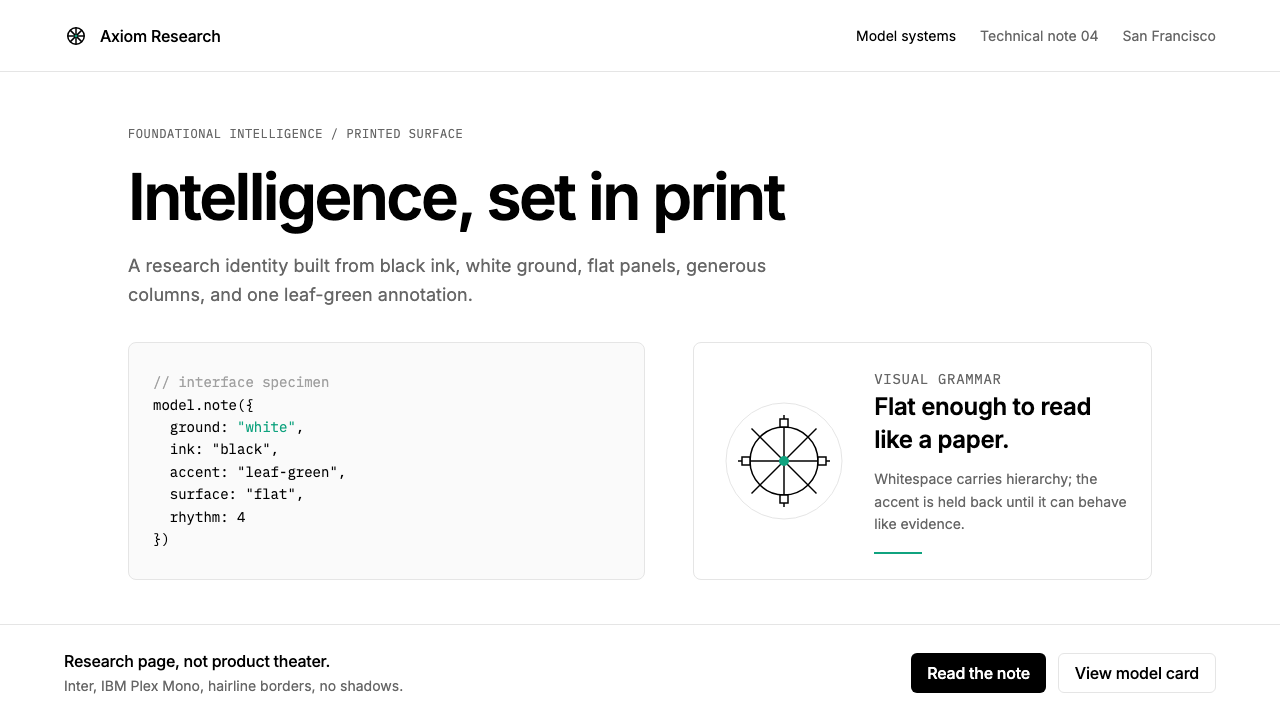 OpenAI 2024Research-grade restraint. Black-on-white Inter, flat code panels, one leaf-gr…
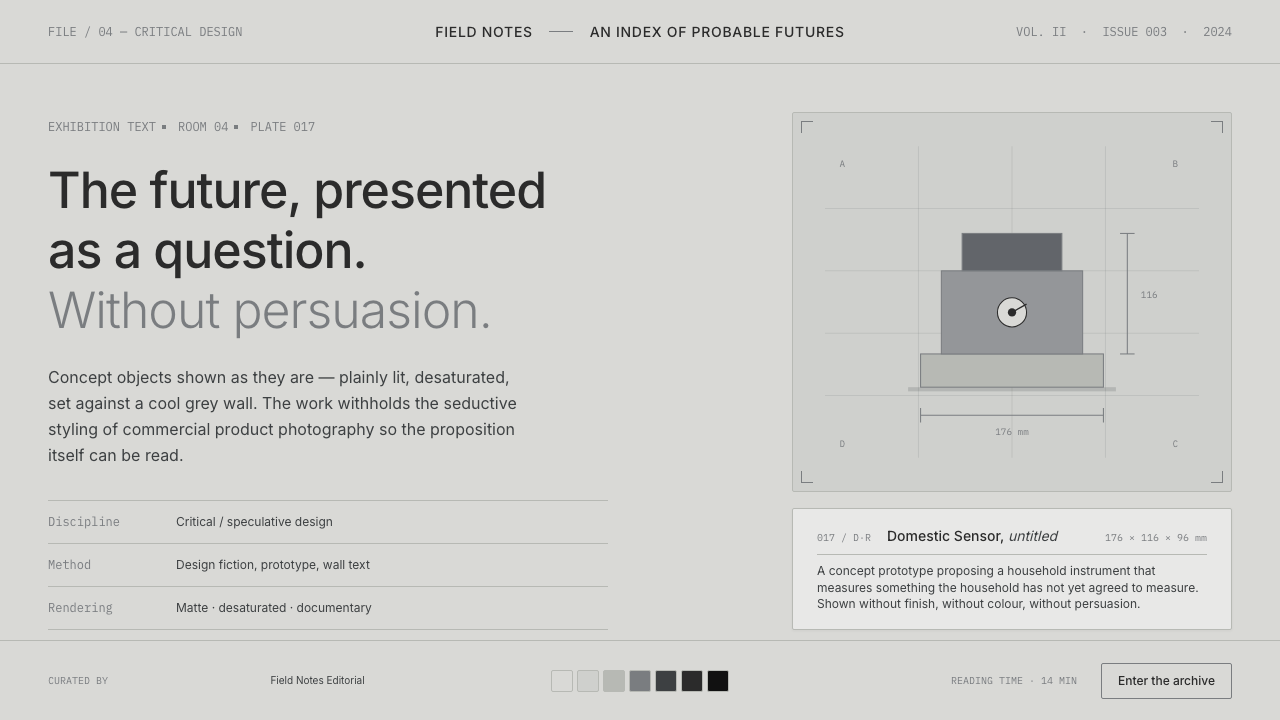 Speculative DesignRefuses to seduce. Cool-grey wall, Inter labels, matte concept objects — the…
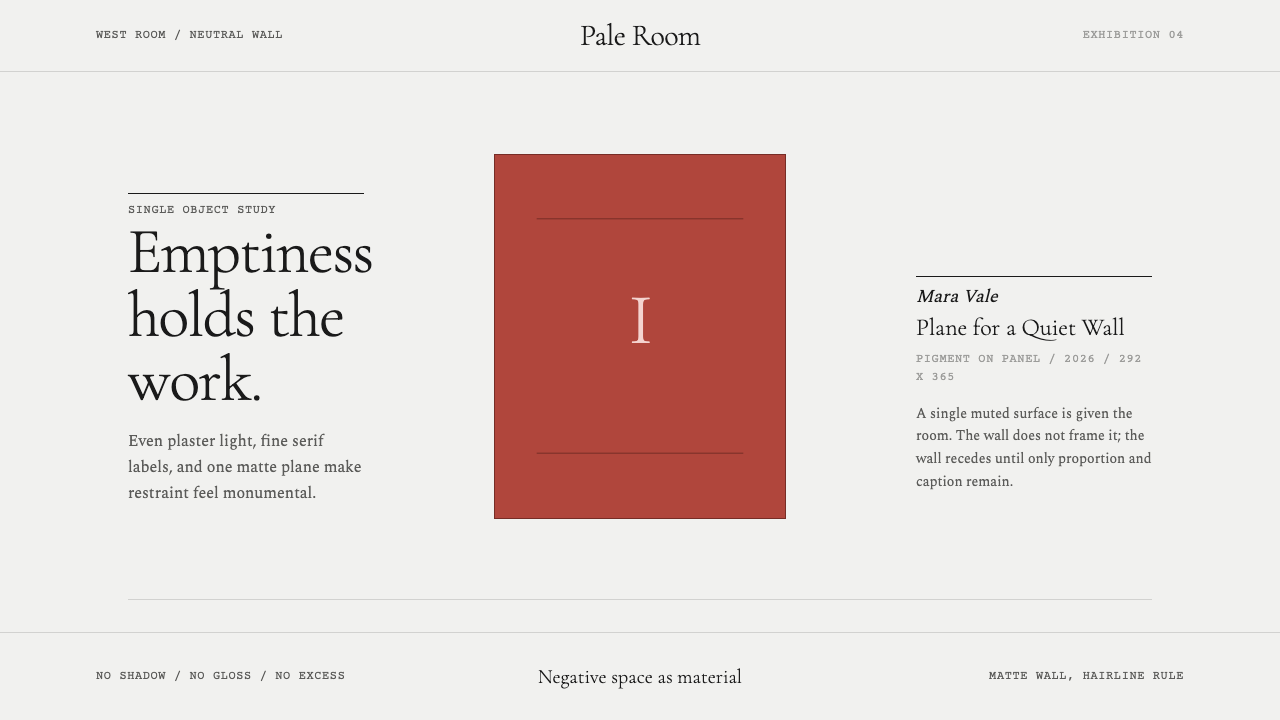 White Cube GalleryEmptiness is the medium. Cormorant labels and one terracotta plane hold the w…
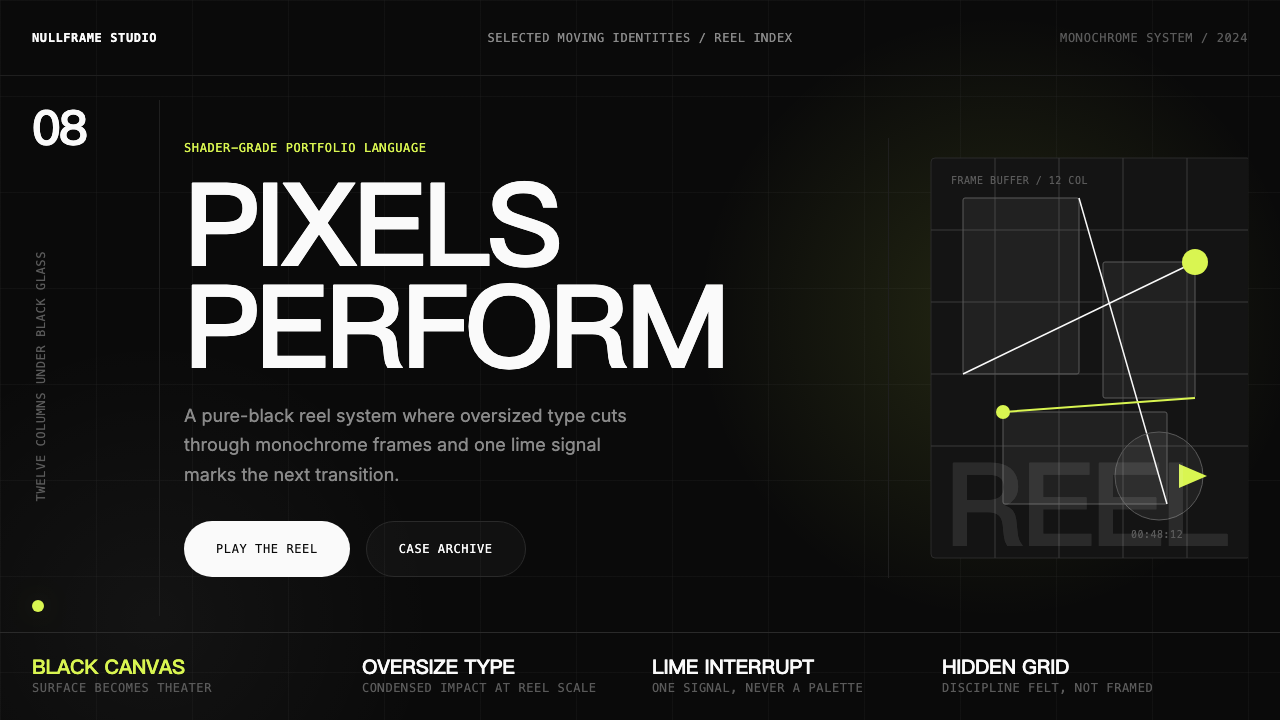 Awwwards Swiss PortfolioCinema, not interface. Black canvas, huge condensed type, and one lime signal…
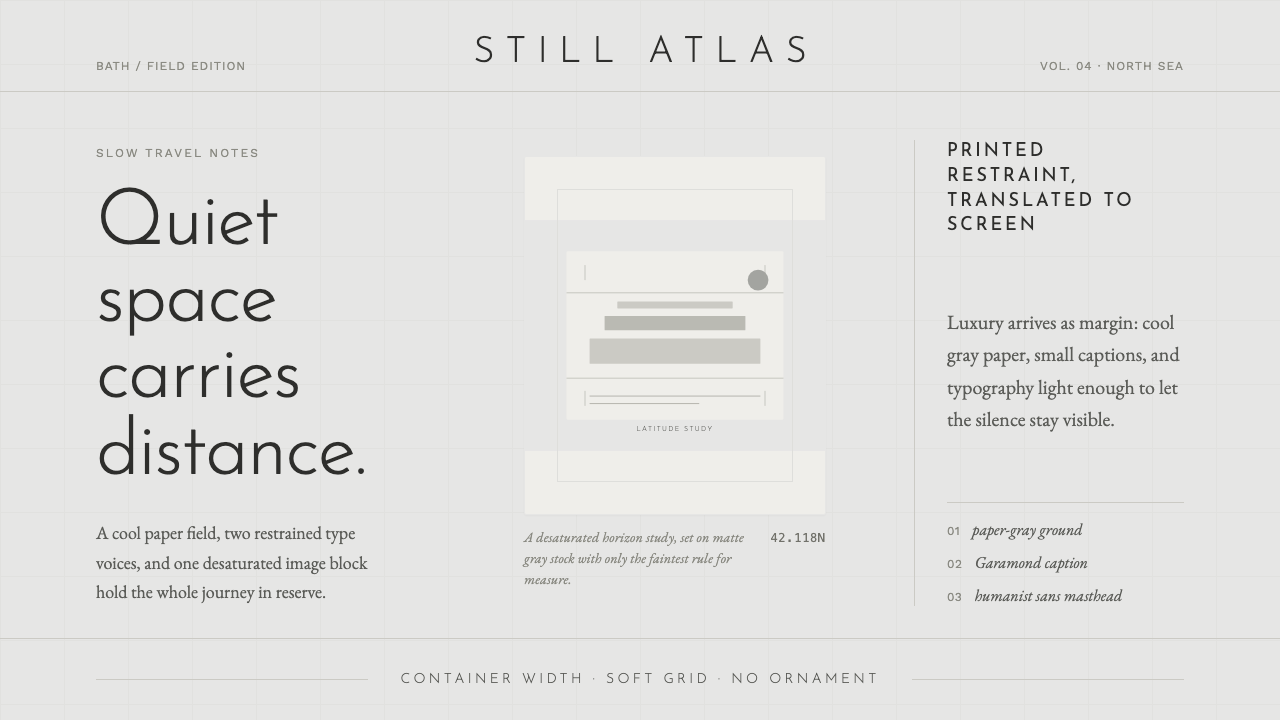 Cereal Magazine MinimalLuxury as margin. Cool paper-gray, light sans, and Garamond captions hold the…