What is Mercury Bank?
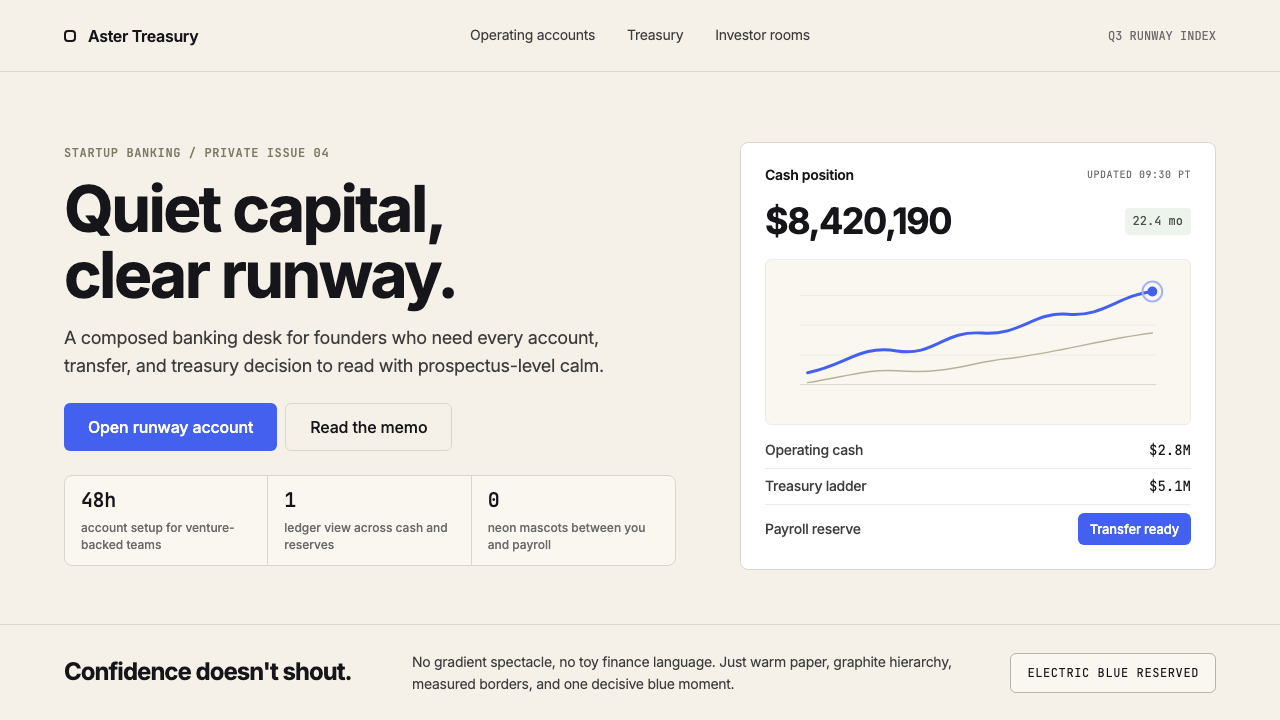
Mercury Bank proved that a fintech platform can earn startup trust not with neon energy or playful illustration, but with the quiet authority of a financial magazine.
Mercury Bank in brief
Mercury Bank is a banking platform and visual design language built for technology startups. Founded in 2017 in San Francisco, its interface pairs a warm cream background with deep charcoal typography and a single electric-blue accent reserved exclusively for primary actions. The result reads less like a typical fintech application and more like a well-edited financial magazine — editorial layouts, generous whitespace, and type set tight enough to carry the weight of a prospectus.
The aesthetic is built on restraint as confidence. Where competitor platforms competed for attention through gradient fills, animated illustrations, and saturated palettes, Mercury chose the opposite: one near-neutral ground tone, one deep typographic color, one accent so controlled it functions almost as punctuation. Every surface earns its presence. The visual language communicates seriousness not through the trappings of traditional banking — marble textures, serif crests, gold rules — but through the self-assurance of knowing exactly what to leave out.
Mercury's design is best understood as a bridge between two traditions: the editorial precision of financial journalism and the functional clarity of modern software interfaces. It borrows the cream-and-charcoal warmth of a print magazine while applying the systematic hierarchy and interactive logic of a digital product. The combination produces a brand that feels simultaneously established and contemporary — unhurried, but never static.

Where does Mercury Bank come from?
Mercury was co-founded in 2017 by Immad Akhund and Jason Zhang in San Francisco, California. Both founders had backgrounds in technology and had experienced firsthand the friction that early-stage startups face when opening business bank accounts — a process that in the United States often involves branch visits, paper forms, and weeks of waiting. Mercury was built to collapse that friction into a web interface that founders could navigate without a finance team.
The visual identity that Mercury developed over its first years reflected a specific cultural reading of its target audience. Startup founders — particularly those in the Y Combinator-adjacent ecosystem that Mercury served early — tend to distrust overt sales signals and respond poorly to playful or casual brand postures when significant money is involved. They are comfortable with dense information, accustomed to reading technical documentation, and receptive to a typographic seriousness that signals competence rather than approachability. Mercury's design language was built for this reader: someone who wants the platform to get out of the way and let them work.
The visual language matured significantly between the company's founding and its refined form around 2022 to 2024, as Mercury expanded its product suite to include treasury management, venture debt, and tools for CFOs managing more complex finances. Each expansion increased the information density demands on the interface. The cream-and-charcoal palette, the editorial whitespace, and the restrained use of the electric-blue accent all proved extensible — they could support transaction tables, yield curves, and multi-account dashboards without requiring any new visual logic.
Mercury emerged within the broader neo-bank and banking-for-startups category, alongside competitors who made different aesthetic choices. Some adopted playful, consumer-facing visual languages borrowed from the consumer fintech wave; others leaned into the austere minimalism of enterprise software. Mercury's position — editorial warmth without consumer casualness — was distinctive enough to become recognizable as a specific design posture, one that has since influenced how other B2B financial products think about visual identity. In the startup ecosystem, Mercury's interface became, for many founders, the reference point for what modern business banking should look like.
What defines the Mercury Bank look?
Ground Tone
The background is a warm cream rather than pure white — close enough to neutral that it reads as a ground, warm enough that it introduces an editorial, paper-like quality. This single choice establishes the entire mood: approachable without being casual, serious without being cold. Against this ground, deep charcoal type carries full authority without the harshness that black-on-white can produce. The cream is not decorative; it is load-bearing.
Single Accent Control
Mercury uses one accent color — a vivid electric blue — and uses it almost exclusively for primary interactive states: the main call-to-action button, active navigation indicators, and selected states. It does not appear in illustrations, backgrounds, or decorative elements. This extreme economy means the accent functions as a signal rather than a style choice: wherever electric blue appears, the user can act. The discipline requires trusting the rest of the visual system to carry hierarchy without color help.
Editorial Typography
Type is set with the deliberate contrast of a magazine: headlines carry significant scale and weight, body text is measured and unhurried, and the relationship between the two establishes hierarchy without relying on color or decorative ornament. Letterforms are contemporary and geometric — clean enough to read at small sizes across dense transaction data, authoritative enough to carry financial figures. Line lengths are controlled for readability rather than stretched to fill containers, and generous leading gives even dense content room to breathe.
Generous Whitespace
Whitespace in Mercury's interface is structural rather than decorative — it is the primary mechanism by which elements are grouped and separated. Sections are separated by space, not rules or borders. Cards breathe. Navigation items do not crowd each other. This approach requires confidence: filling a screen with space rather than content is a statement that the content which does appear is worth attending to. The whitespace is also what gives the interface its editorial, almost print-like quality.
Flat Surfaces, Subtle Depth
Interface elements are essentially flat: no simulated material textures, no gradient fills, no dramatic lighting effects. Depth, where it exists, is introduced through very light borders, thin shadows that are barely perceptible, or the slight warmth differential between the cream background and a slightly cooler card surface. This restraint keeps the interface from feeling decorative while allowing just enough structural differentiation for the eye to navigate content layers. The flatness also ensures that dense financial data — tables, charts, figures — is never competing with surface decoration.
Information Density as Design Value
Mercury's interface does not hide complexity — it organizes it. Transaction histories, account balances across multiple entities, treasury yields, and wire transfer details can all coexist on a single view because the typographic and spatial system is built to handle density without becoming noisy. This is a meaningful departure from consumer fintech, which typically abstracts financial detail behind simplified views. Mercury treats its users as capable of reading a complex page, and the design reflects that respect.
Zero Decorative Illustration
Mercury does not use character illustration, playful spot graphics, or decorative iconography of the kind common in consumer fintech. Where visual elements beyond type and data exist, they are functional: charts, graphs, and status indicators. Icons, where they appear, are minimal geometric marks rather than expressive pictograms. This absence of decorative illustration is one of the strongest signals the brand sends about who its audience is — people who came to manage money, not to be charmed.

Who shaped Mercury Bank?
Co-founder and CEO of Mercury, Akhund brought a technical and product background from his prior experience in the startup ecosystem, including participation in Y Combinator. His understanding of what early-stage founders need from a banking relationship — speed, clarity, programmatic access — shaped Mercury's product and, by extension, its visual philosophy. The emphasis on information density over simplification reflects the founder-as-power-user model he championed.
Co-founder of Mercury, Zhang's background complemented Akhund's in building the technical infrastructure that allowed Mercury's product to deliver on the promise its design implied: fast account opening, real-time transaction data, and API access for finance teams. In a product where the interface is inseparable from the underlying capability, the co-founder's technical decisions are also design decisions — the responsiveness and reliability of the platform are part of what the visual language is promising.
The in-house brand and design team responsible for developing and extending Mercury's visual system as the product expanded from a simple business checking account to a full financial operations platform. The team's discipline in maintaining the cream-and-charcoal palette and the controlled use of the electric-blue accent across an expanding product surface — without introducing visual noise or aesthetic drift — represents a sustained editorial judgment that is itself a form of design authorship.
Not a single figure but a cultural context: the cluster of startups, investors, and founders concentrated around Y Combinator and similar accelerators in San Francisco created a specific audience that Mercury was built to serve. This community's design literacy — its familiarity with Stripe's typographic precision, Linear's dark-mode density, and Notion's editorial whitespace — set a high bar for what a B2B financial product's interface needed to achieve. Mercury's visual language is partly a response to, and partly a product of, this audience's expectations.
How do you use Mercury Bank today?
Mercury's visual language is among the most transferable contemporary fintech aesthetics for professional and business-facing design contexts, precisely because it operates through restraint rather than stylistic signature. Applying it correctly means understanding what the system is doing: using one warm near-neutral ground to signal approachability without casualness, using charcoal type to carry hierarchy without the harshness of pure black, and reserving the single electric-blue accent as a functional signal rather than a decorative choice.
For presentation slides, the Mercury approach works exceptionally well on both cover pages and content-heavy financial decks. A cover benefits from the editorial balance of the style: the title in large, measured type against a cream field, with restrained use of the electric blue for a single highlighted word or label. Avoid the temptation to add a gradient or an illustration; the confidence is in the space. Content slides should be treated as organized tables of information — clean type hierarchies defined by size and weight alone, no decorative dividers, and data presented in charts whose visual language matches the interface: clean bars and lines with the electric blue reserved for the primary series or the most important figure. Section dividers work best as bold typographic statements rather than graphic ornaments.
For web interfaces — dashboards, pricing pages, account settings, and financial operations tools — Mercury's aesthetic is nearly a direct template. Define a layout grid and commit to it. Keep the background warm but not distracting: cream rather than stark white. Use charcoal for all primary text, light gray for secondary and metadata, and electric blue only for interactive states. Card components should have minimal borders or the lightest possible elevation treatment rather than soft shadows. Tables, which are the workhorse of any financial interface, should be typographically clean: consistent row heights, clearly differentiated column headers, and figure columns that align on decimal points rather than left-aligned edges. The style's handling of data density makes it particularly well-suited to complex multi-account views that would feel cluttered in a less systematically organized visual system.
For editorial and marketing work — company blogs, case studies, investor-facing materials, and social cards — the Mercury visual language translates well to long-form layout. An article page in this style uses a controlled measure for body text (not full-width), with generous margins that can hold pull quotes or footnotes. Section breaks are typographic — a bold label or a horizontal space — never a decorative rule or an icon. Marketing pages benefit from the style's poster-like confidence: alternating full-width sections in cream-on-charcoal and charcoal-on-cream, with the electric blue used sparingly for a single call-to-action per screen. Social cards and open graph images work well at high typographic contrast with minimal visual elements — the design's strength is in what it does not include.
The most common mistake when applying Mercury-style design is importing the visual tone without maintaining the discipline that produces it. Adding a second accent color — even a subtle one — immediately fragments the signal-to-noise ratio that the single electric-blue achieves. Similarly, replacing the cream ground with pure white loses the warmth that distinguishes Mercury from colder enterprise software; replacing it with a tinted or branded color loses the editorial neutrality entirely. The style also struggles when illustration or decorative photography is introduced: these elements carry a casualness or a consumer-brand warmth that works against the financial-magazine seriousness the palette and typography are trying to establish. When in doubt, remove rather than add.

Mercury Bank — FAQ
Is Mercury Bank design the same as Swiss International Style or Stripe's design language?
They share overlapping values — typographic precision, functional hierarchy, restraint — but are meaningfully distinct. Swiss International Style is historically rooted in a mathematical grid and a near-exclusive commitment to photography over illustration, with a much cooler and more neutral color temperature. Stripe's design language is cooler, more violet-inflected, and built around a dark, energetic identity that signals technical sophistication. Mercury's design is warmer — the cream ground and charcoal type introduce an editorial, paper-like quality that neither Swiss Style nor Stripe possesses. Mercury is also more restrictive in its accent use: one color, one purpose, used far more sparingly than Stripe's gradient-heavy feature marketing.
Can Mercury-style design work for a dark-mode or dark-background layout?
Mercury's canonical identity is light-ground: the cream background is definitional, not incidental. A dark inversion is technically possible but requires rethinking several decisions. On a dark ground, the warm cream logic inverts to something closer to a warm off-white or light-gold for primary text — pure white tends to be too harsh against the softness the system relies on. The electric-blue accent holds reasonably well on dark grounds, but its signal function changes: it can no longer rely on the contrast of warm-versus-cool to draw the eye, and must earn attention through luminosity alone. A dark Mercury variant can work for data-dense night-mode interfaces, but it should be treated as a translation rather than a direct inversion.
Why does Mercury avoid illustration when so many fintech brands rely on it heavily?
Illustration in consumer fintech typically serves two purposes: it humanizes abstract financial concepts, and it signals that the brand is approachable and non-intimidating. Both functions make sense for products targeting individuals who may be anxious about money or unfamiliar with financial products. Mercury's target audience — startup founders, CFOs, and finance teams — neither needs these reassurances nor responds well to them in a professional context. For this audience, illustration can signal a product that is trying too hard to be friendly, which undermines the trust that comes from matter-of-fact competence. Mercury's absence of illustration is not a stylistic austerity; it is an audience-aware decision about what trust actually looks like for its users.
How does Mercury-style design handle color in data visualization and charts?
Mercury's single-accent discipline extends naturally into data visualization. In a system where electric blue is the primary action color, it is also the natural choice for the primary data series in any chart — the most important metric, the current period, the selected account. Secondary series are handled in grays and charcoal tones that recede without disappearing. This limited palette actually improves financial charts by reducing visual competition between data series: the eye goes immediately to what is blue, which is what the chart is arguing. Categorical data — multiple series at equal importance — does require some additional colors, but the Mercury approach handles this by choosing desaturated, muted tones that feel consistent with the charcoal-and-cream system rather than importing a separate bright palette.
Does Mercury-style design suit industries beyond fintech?
Mercury's visual system is well-suited to any B2B professional context where authority, clarity, and information density matter more than warmth or brand expressiveness. Legal technology, enterprise analytics, investment research platforms, and professional services firms all operate in registers where Mercury's editorial seriousness reads as competence. The style adapts less well to contexts that depend on sensory warmth, cultural specificity, or consumer-facing emotion — food and hospitality, wellness products, children's platforms, or any brand where the primary emotional register is comfort or delight rather than confidence and clarity. The diagnostic question is not whether the style can be applied, but whether the values it communicates — precision, restraint, professional trust — are the values the product needs to project.
Related design styles
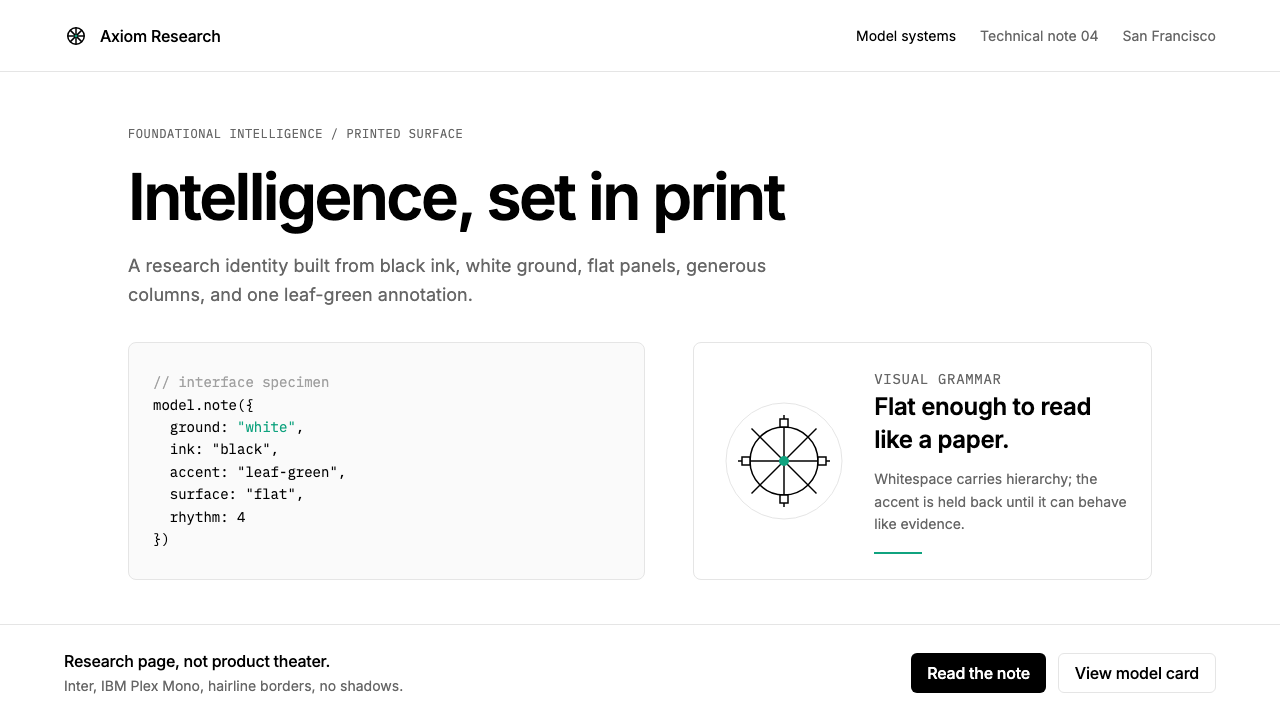 OpenAI 2024Research-grade restraint. Black-on-white Inter, flat code panels, one leaf-gr…
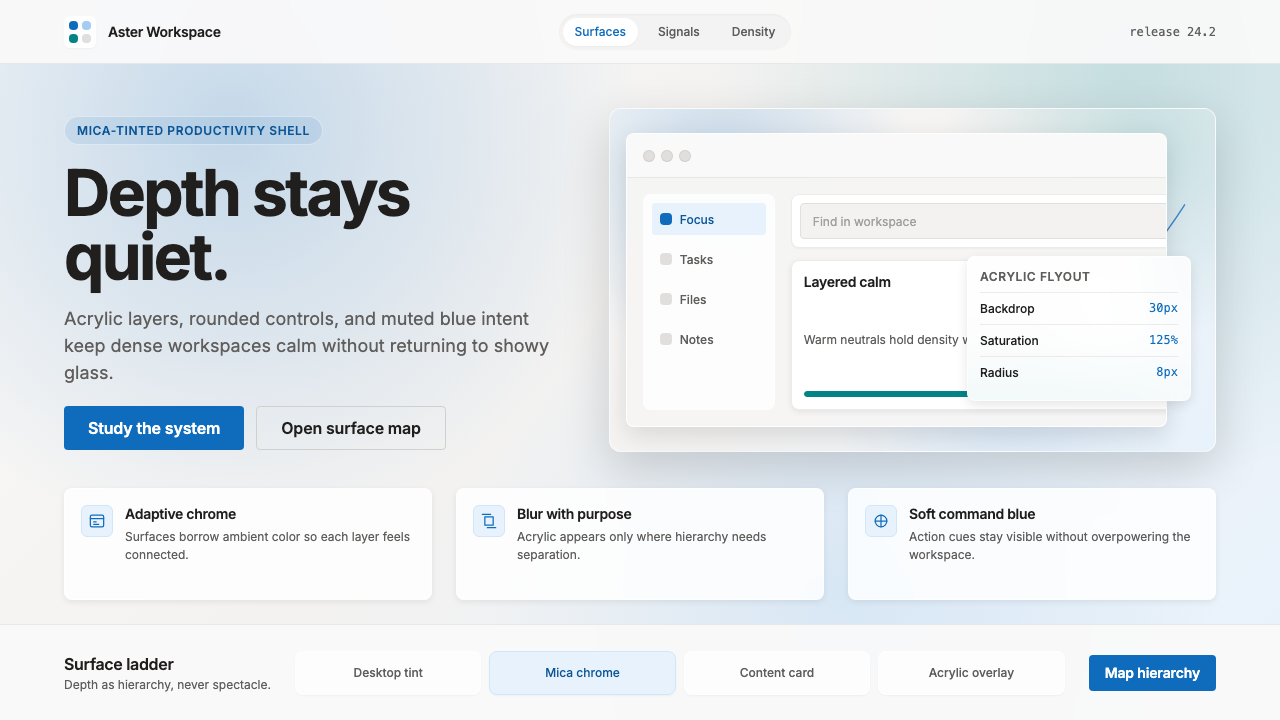 Microsoft Fluent 2Disciplined translucency. Warm Mica neutrals, acrylic blur, and muted blue cr…
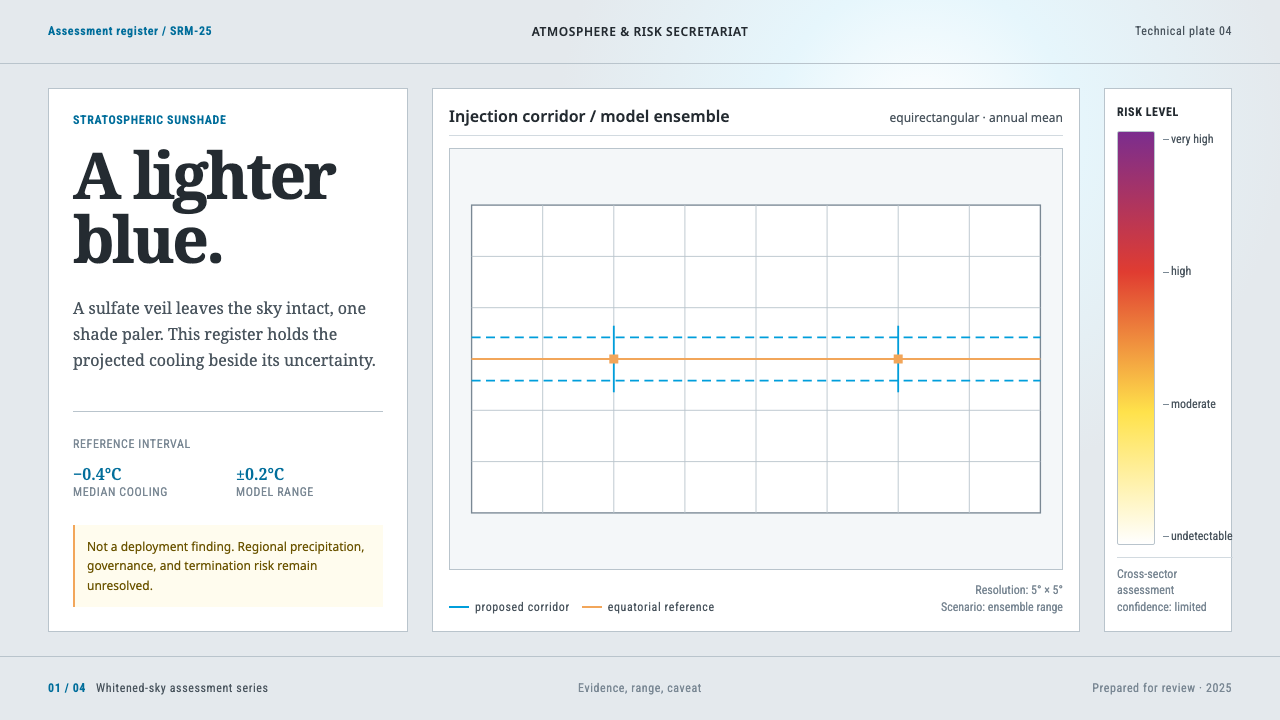 Stratospheric SunshadeUncertainty is the message. Pale sky stock, UN blue corridors, and an IPCC ri…
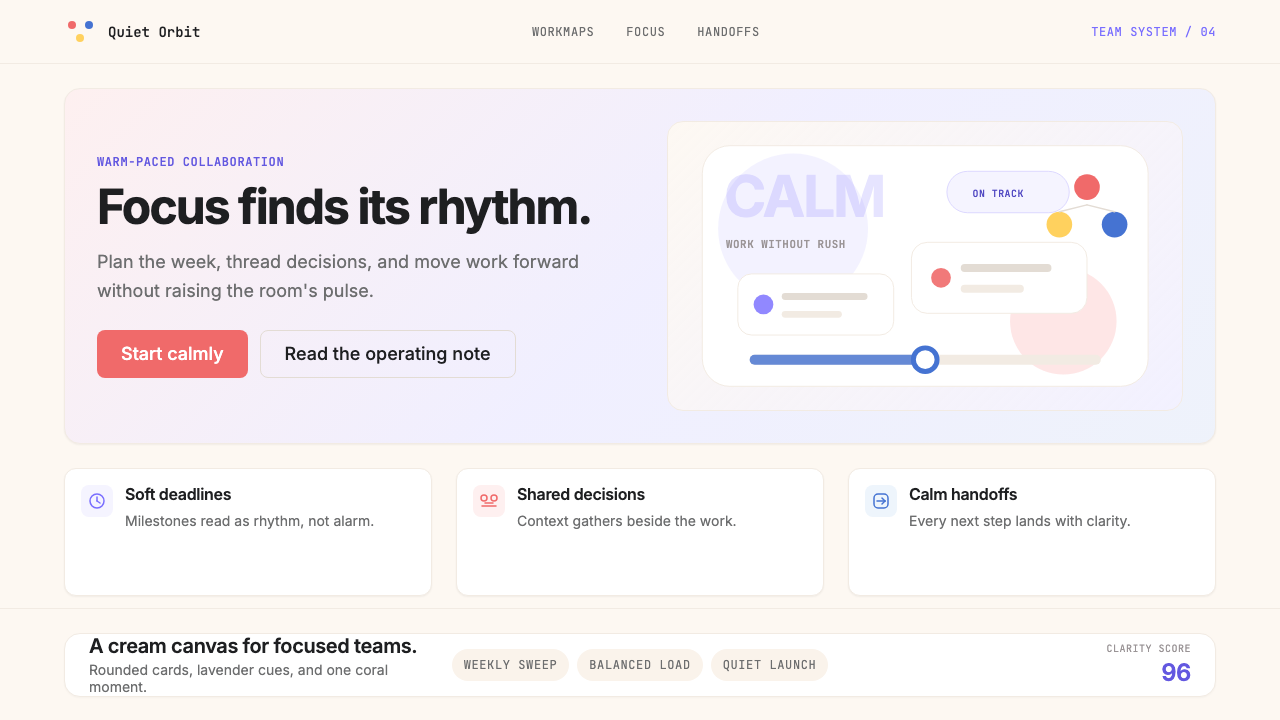 AsanaCalm productivity breathes. Cream canvas, lavender panels, coral-blue-yellow…
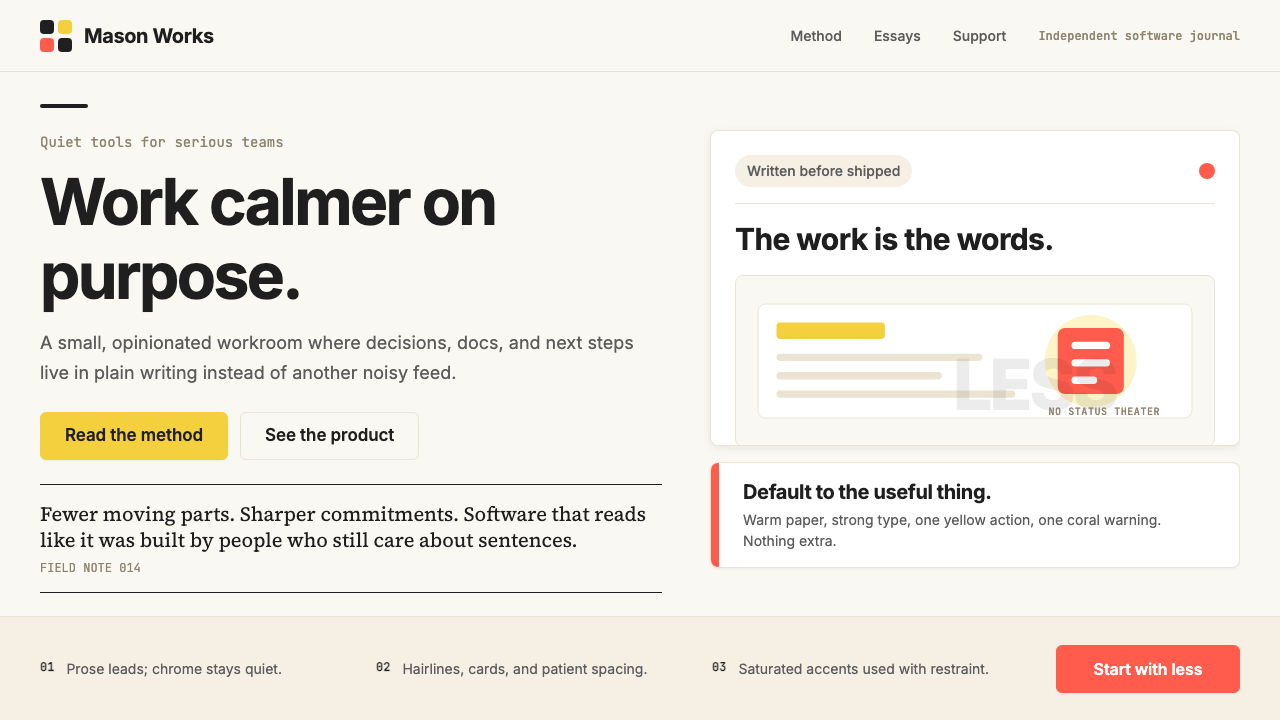 Basecamp / 37signalsQuiet craft, strong opinions. Cream paper, tight sans type, yellow and coral…
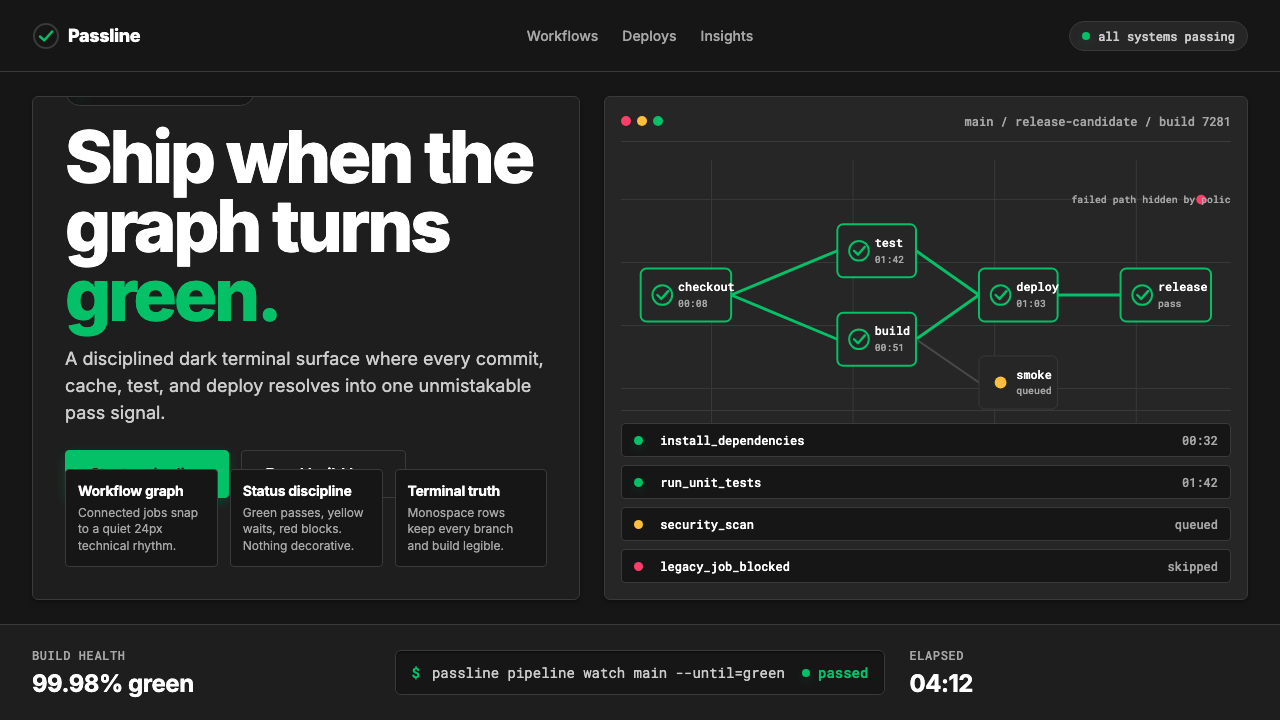 CircleCI Pipeline-GreenConfidence goes green. Emerald status lines cut through terminal-black pipeli…