What is Basecamp / 37signals?
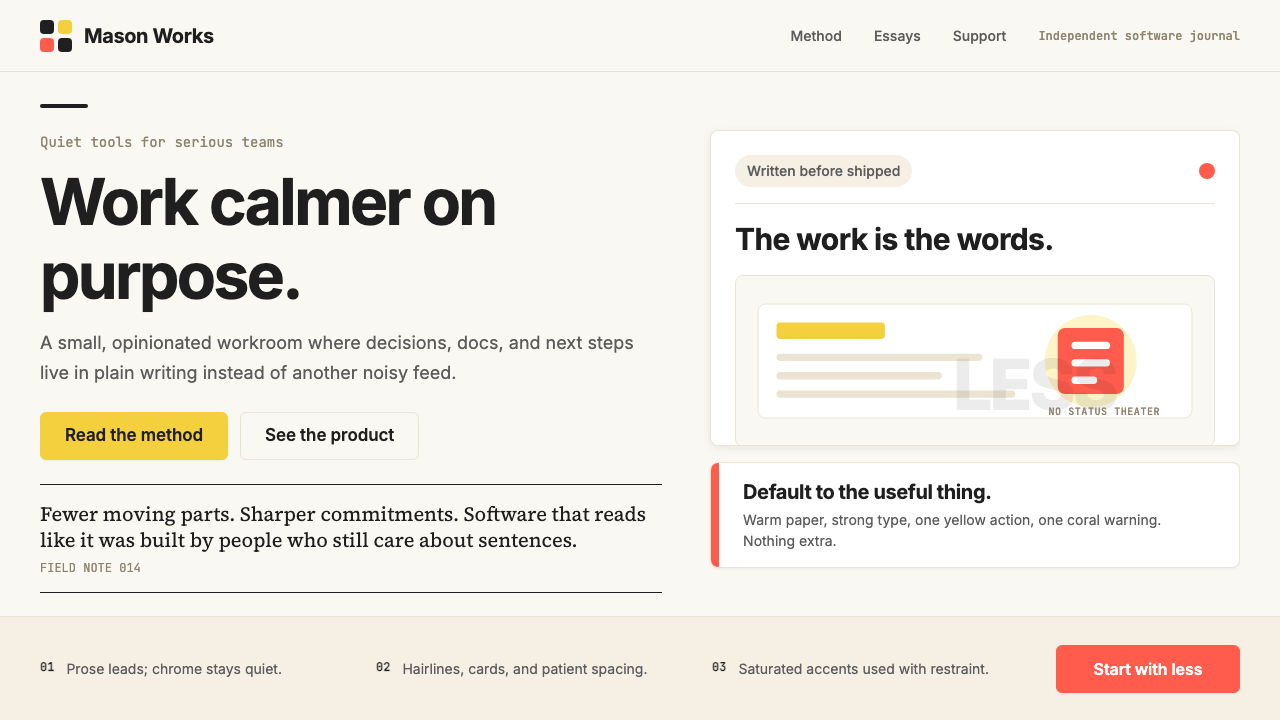
Basecamp proved that software can have a point of view — quiet cream grounds, saturated yellow and coral, and type-forward layouts that say more by showing less.
Basecamp / 37signals in brief
Basecamp by 37signals is a project-management SaaS whose visual identity is inseparable from the company's philosophy: fewer features, sharper opinions, calmer surfaces. Where most productivity software reaches for gradients, motion, and silicon-valley blue, Basecamp reaches for warm paper tones, a tightly controlled accent palette, and long-form writing treated as the primary design medium.
The current identity — developed through a series of deliberate brand refreshes culminating around 2022 to 2024 — uses a warm-cream ground that reads more like a well-made book than a web application. Saturated yellow and coral provide the only color punctuation; everything else is neutral. The typographic system favors a humanist sans-serif with a slightly warm, mechanical character that balances modernist legibility with craft warmth.
What distinguishes Basecamp's aesthetic from adjacent 'minimal' styles is its editorial confidence. The layouts are not sparse because nothing was added; they are sparse because everything unnecessary was removed with an opinion. White space is generous not as a luxury signal but as a functional commitment: the product is for thinking people who do not want to be interrupted by interface noise.

Where does Basecamp / 37signals come from?
37signals was founded in Chicago in 1999 as a web-design consultancy by Jason Fried, along with partners including Carlos Segura and Ernest Kim. The name referenced the number of radio signals detected from space that had briefly been considered candidates for extraterrestrial intelligence — a nod to the idea that signal, not noise, was the company's business. The early studio produced client work for small businesses, and its spare, content-forward visual sensibility was evident from the start.
In 2003, the company began building its own software tools to manage its own projects. Basecamp launched publicly in 2004 and within a year had generated enough revenue that 37signals shifted from client services to software products entirely. This transition — from service business to opinionated software company — was not just commercial; it defined the company's relationship with design. Unlike venture-backed startups that hired large design teams to compete on visual novelty, 37signals built with a small team and treated visual restraint as a competitive advantage rather than a compromise.
The publication of 'Getting Real' in 2006, followed by 'Rework' in 2010 and 'Remote' in 2013, established Jason Fried and David Heinemeier Hansson as prominent voices arguing against growth-at-all-costs software culture. The books were written in direct, unadorned prose — the same voice that informed the product's visual language. 37signals consistently positioned Basecamp not against specific competitors but against a default mode of doing business: the assumption that software should have more features, more color, more noise.
The company has undergone several name and identity transitions. In 2014, 37signals renamed itself Basecamp, collapsing the company and product into one identity. In 2022, the parent entity reverted to 37signals to accommodate new products, while Basecamp remained the flagship. Each visual refresh has moved in one direction: toward greater typographic confidence, a warmer and more restricted palette, and a more deliberate editorial presence. The current identity, with its cream grounds and controlled yellow-coral punctuation, represents the design philosophy at its most distilled.
What defines the Basecamp / 37signals look?
Warm-Cream Ground
The base surface is not white but a warm, slightly yellowed cream that reads like quality paper stock. This choice shifts the entire emotional register away from the clinical brightness of most web applications and toward something that feels considered and calm. The warmth of the ground also makes the yellow accent feel less synthetic — it harmonizes rather than shocks. Against this ground, even a modest amount of dark type feels substantial and authoritative without needing weight or aggressive sizing.
Controlled Accent Palette
Color beyond the cream ground is used with extreme economy. Saturated yellow — vivid but not neon — marks calls to action, section anchors, and moments of brand emphasis. Coral or warm red appears as a secondary accent, used for states or contrasting modules but almost never simultaneously with yellow at the same visual weight. The result is a palette that reads as rich without being busy: each color carries weight because it is rarely deployed, and the moments where it appears become landmarks in the layout.
Typography as Hero
Basecamp's layouts treat text not as content to be decorated but as the primary visual material. Headlines are set large and confident, with generous line spacing that gives each line room to breathe. Body copy is set at a reading-optimized measure — neither too wide nor too narrow — with a rhythm that rewards sustained attention. The type hierarchy is simple: a headline, a subhead, body. There are no decorative dividers, no pull-quote styling boxes, no sidebars competing for attention. The writing earns its own space.
Deliberate White Space
Margins and padding in Basecamp's layouts are not the minimum required to prevent crowding — they are generous by design. Sections breathe. Elements have room around them. This white space is not a luxury signal but a functional commitment: it slows the visual pace, reduces cognitive load, and communicates respect for the reader's attention. In a landscape of content-dense interfaces, the refusal to fill available space is itself an opinion.
No Stock Photography
Basecamp's marketing and editorial work is conspicuously free of stock photography. Where many SaaS products populate their pages with pictures of smiling people in open-plan offices or abstract architectural shots meant to connote innovation, Basecamp uses illustration, custom iconography, or simply committed typographic layouts. This absence is principled: stock photography signals generic aspiration, while a well-crafted text-only layout signals that the content itself is worth reading.
Flat, Editorial Card Structures
UI components in the Basecamp design language favor clear borders and flat surfaces over soft shadows and floating depth. Cards are defined by ruled lines or background-tone shifts rather than drop shadows. Interactive elements signal their affordance through color and border weight rather than three-dimensional lift effects. The overall effect is that the interface feels like a document rather than a physical object simulation — which aligns with the editorial values of the brand.
Opinionated Copywriting as Visual Element
In the Basecamp aesthetic, copy is not a fill-in-the-blank placeholder — it is a primary design decision. Marketing headlines are direct, occasionally provocative, and written in a voice that takes positions. The typographic system is designed to honor this: short, punchy headlines set at generous scale, followed by longer explanatory prose set at a comfortable reading size. This interplay between bold statement and considered explanation is itself a compositional pattern that gives the layouts their rhythm and credibility.

Who shaped Basecamp / 37signals?
Co-founder and CEO of 37signals, Fried has been the primary voice and editorial presence behind Basecamp's brand identity. His writing — in the company's books, blog posts, and product communications — established the direct, opinionated prose style that the visual language is designed to serve. Fried has consistently argued that the company's refusal to take venture capital and its commitment to profitability over growth is inseparable from its design philosophy: a smaller, more focused product requires a smaller, more focused visual language.
Co-founder and CTO of 37signals, DHH created Ruby on Rails while building Basecamp and has been as influential in shaping the company's aesthetic values as in its technical ones. His public arguments against the culture of overwork, excessive complexity, and growth-at-all-costs were co-authored with Fried in the company's books and continue to frame the brand's positioning. The design language reflects DHH's technical philosophy: do not add what you cannot maintain; remove what does not serve the core.
For many years head of product strategy at 37signals, Singer developed the Shape Up methodology — a product development framework that rejects traditional sprint cycles in favor of six-week cycles with clearly scoped work. Shape Up was published as a free online book and became influential in product circles beyond 37signals. Singer's contribution to the design identity is largely structural: his insistence on well-bounded, clearly scoped work translates visually into layouts that have clear edges and do not try to do everything at once.
An early partner and design lead at 37signals, Kim helped establish the editorial and visual sensibility that shaped the studio's early output and, by extension, the Basecamp product identity. The spare, content-forward aesthetic of the agency's early web work — before SaaS was even a common category — anticipated the principles that would later be codified in Basecamp's visual brand. Kim's contributions represent the design lineage that connects the company's consulting origins to its product identity.
How do you use Basecamp / 37signals today?
The Basecamp aesthetic is particularly well-suited to presentation slides where the speaker, not the deck, is meant to be the focus. On a cover slide, commit to the cream ground and set the title in a large, confident humanist sans-serif with generous spacing — no stock photo background, no gradient overlay, no decorative icon. A single yellow or coral horizontal bar or typographic accent is enough to signal brand. The cover should feel like a well-made book jacket: quiet, legible, authoritative.
For content slides, treat each slide as an editorial layout rather than a bullet-point container. One idea per slide. Headlines are short and direct. Body text, if it appears at all, is set at a comfortable reading size with only two or three lines per slide — enough to support the spoken point, not enough to replace it. Data slides should present numbers with the same typographic confidence: large numeral, a brief descriptor, and white space doing the explanatory work. Charts, if used, are rendered in the accent palette with clean, undecorated axes.
For web UI applications — dashboards, pricing pages, settings panels — the Basecamp approach offers a clear alternative to shadow-heavy, gradient-rich interface conventions. Start with a near-white or cream canvas, define a strict column grid, and use ruled dividers and background-tone shifts rather than drop shadows to separate sections. Interactive states should be communicated through color (yellow for primary action, coral or muted tones for secondary) and border weight rather than elevation or animation. The interface should feel like a well-organized document rather than a three-dimensional space.
In editorial and marketing contexts — long-form articles, product announcement pages, pricing comparisons — the style rewards commitment to writing. Set body copy at a comfortable measure, allow generous paragraph spacing, and resist the temptation to break every section with an image or icon. Section headers can be set in the accent color sparingly; use rules or background shifts to segment longer content. Marketing hero sections should lead with a direct, opinionated headline set large against the cream ground, followed by a single line of explanatory subtext. The call to action should be unmissable — yellow button, high contrast — but not surrounded by decorative elements competing for attention.
A common mistake when applying this style is treating the warm-cream palette as permission for a generally relaxed or informal visual register. The Basecamp aesthetic is neither casual nor cozy — it is precise and opinionated, with every element present for a reason. Resist adding rounded corners on everything, whimsical illustrations, or a conversational script typeface to 'warm it up.' The warmth comes from the ground tone and the generous white space, not from decorative softening. Similarly, do not substitute the accent colors for a broader pastel range — the restricted palette is the discipline, and expanding it dilutes the system.

Basecamp / 37signals — FAQ
How does Basecamp's style differ from Swiss International Style or minimal SaaS design?
Swiss International Style is mathematical, grid-obsessive, and uses photography and a broad neutral palette; it aims for universality and institutional authority. Minimal SaaS design (think early linear gradients softened into light grays and white, with blue CTAs) aims for approachability and frictionlessness. Basecamp sits between and apart from both: it is warm where Swiss style is cool, opinionated where minimal SaaS is neutral, and editorial where most interfaces are transactional. The cream ground and restrained accent palette give it a warmth that Swiss style lacks; the commitment to direct, opinion-forward copy gives it a conviction that most minimal SaaS avoids.
Can this style work for a product that is not a productivity or SaaS tool?
It can, but it requires alignment between the style's implied values and the product's actual character. The Basecamp aesthetic communicates: calm authority, intellectual seriousness, craft without flash, and an implicit belief that the reader is thoughtful and unhurried. This makes it well-suited for publishing platforms, research tools, educational products, independent media, and any brand that wants to position itself against mainstream tech visual culture. It is poorly suited to food, fashion, entertainment, or any product where sensory richness, cultural specificity, or emotional immediacy are primary values.
How should the yellow accent be used without it feeling corporate or warning-like?
Context and proportion are everything. A yellow that reads as a warning in isolation becomes a brand signal when used consistently on primary actions, selected states, and site-level anchors. The key is to use it with restraint — as a single note that the eye learns to recognize rather than a repeated blare. The warm-cream background helps significantly: yellow against cream reads as warm and confident, not caution-tape aggressive. Avoid pairing it with dark navy or black in large areas, which pushes it toward warning territory. Keep it to interactive elements, accent bars, or key typographic moments; let the neutral ground do the heavy lifting.
Is it possible to do a dark-mode version of this style?
A dark inversion is possible but challenging. The style's warmth depends heavily on the cream ground — switching to a dark surface risks losing the character that makes the aesthetic distinctive. If a dark mode is needed, prefer a very dark warm brown or charcoal over a neutral gray or pure black, to preserve some of the ground's warmth. Yellow remains usable at high contrast against dark, but coral becomes tricky — it can read as error-state red in dark contexts. The typographic system transfers well; the editorial confidence is independent of the light-dark axis. Expect the dark mode to feel more austere and slightly less immediately warm than the light version.
How do you balance the style's opinionated voice with a client or institutional context that requires perceived neutrality?
The visual system is separable from the editorial voice. You can apply the cream ground, the restrained accent palette, the generous white space, and the editorial layout discipline without writing copy in the direct, occasionally provocative style that Basecamp itself uses. Institutions that want to be seen as trustworthy and considered — universities, research bodies, policy organizations, long-form journalism platforms — can use this visual language effectively by pairing it with measured, authoritative prose rather than marketing directness. The style communicates seriousness and craft regardless of whether the copy adopts the 37signals voice.
Related design styles
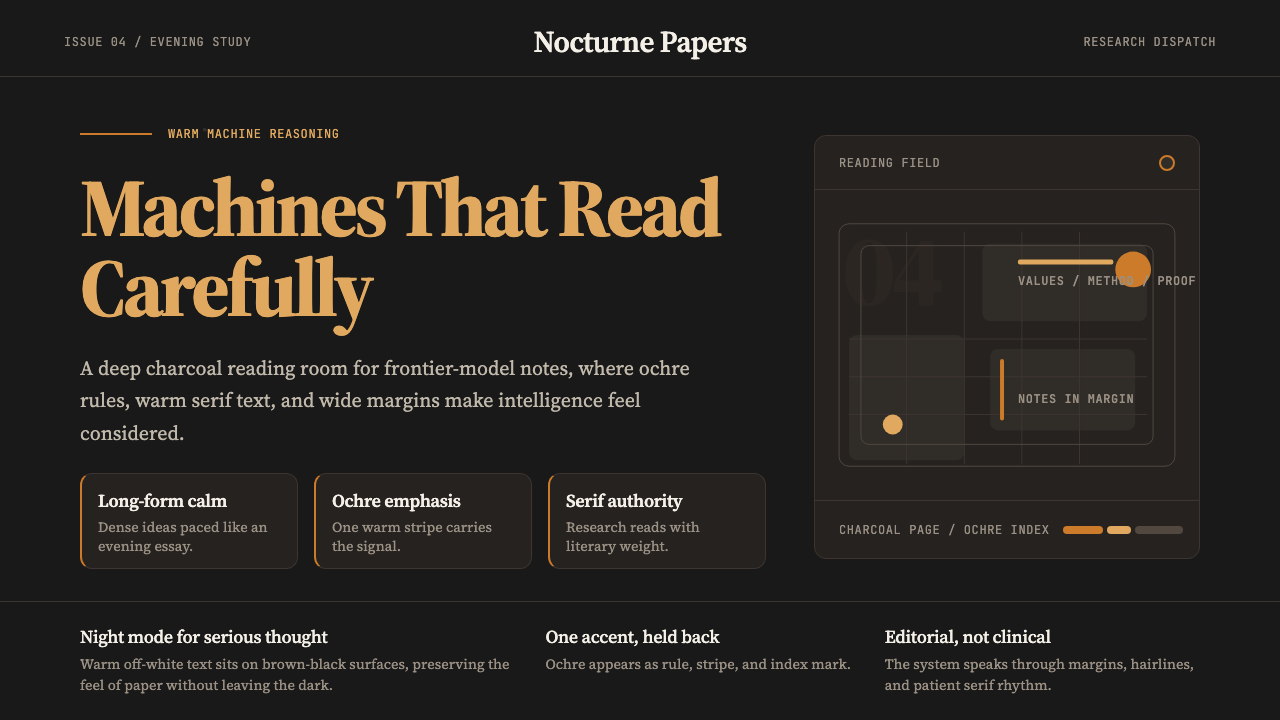 Claude / Anthropic Warm 2024Warm intelligence at night. Ochre rules and Source Serif glow on deep charcoa…
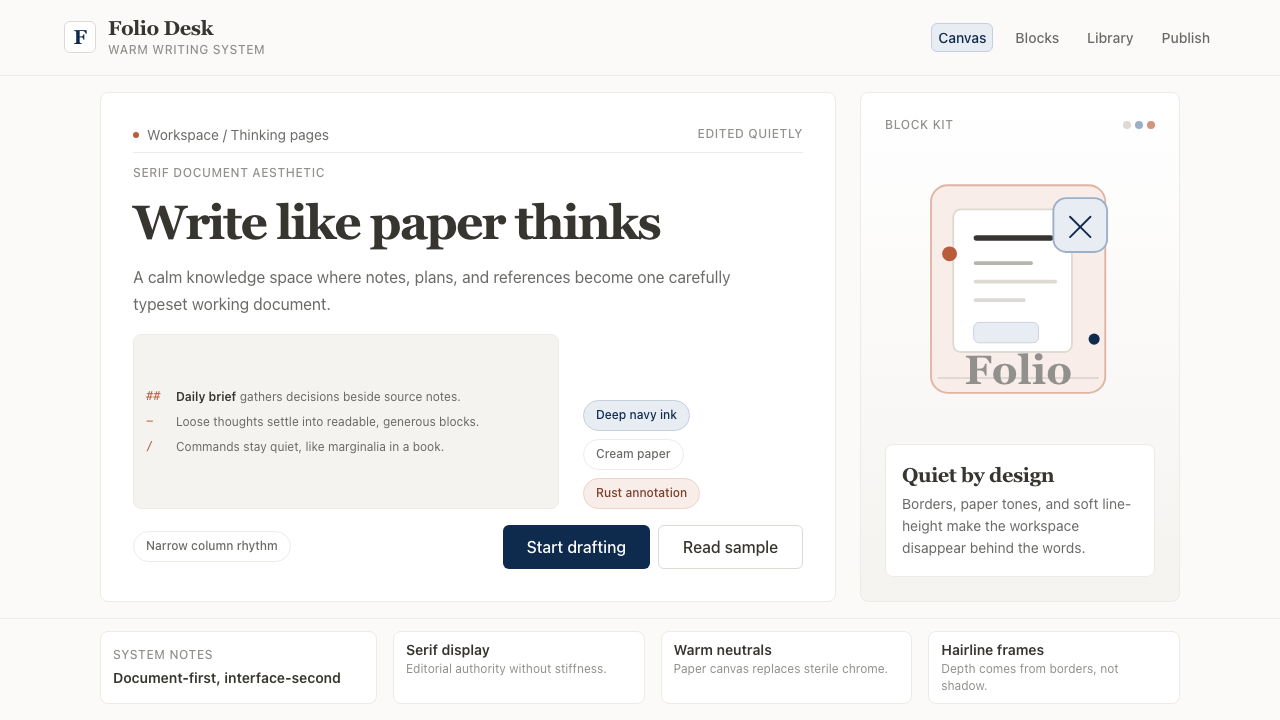 Notion ModernWriting feels papery. Source Serif on warm cream, navy ink, and hairline bord…
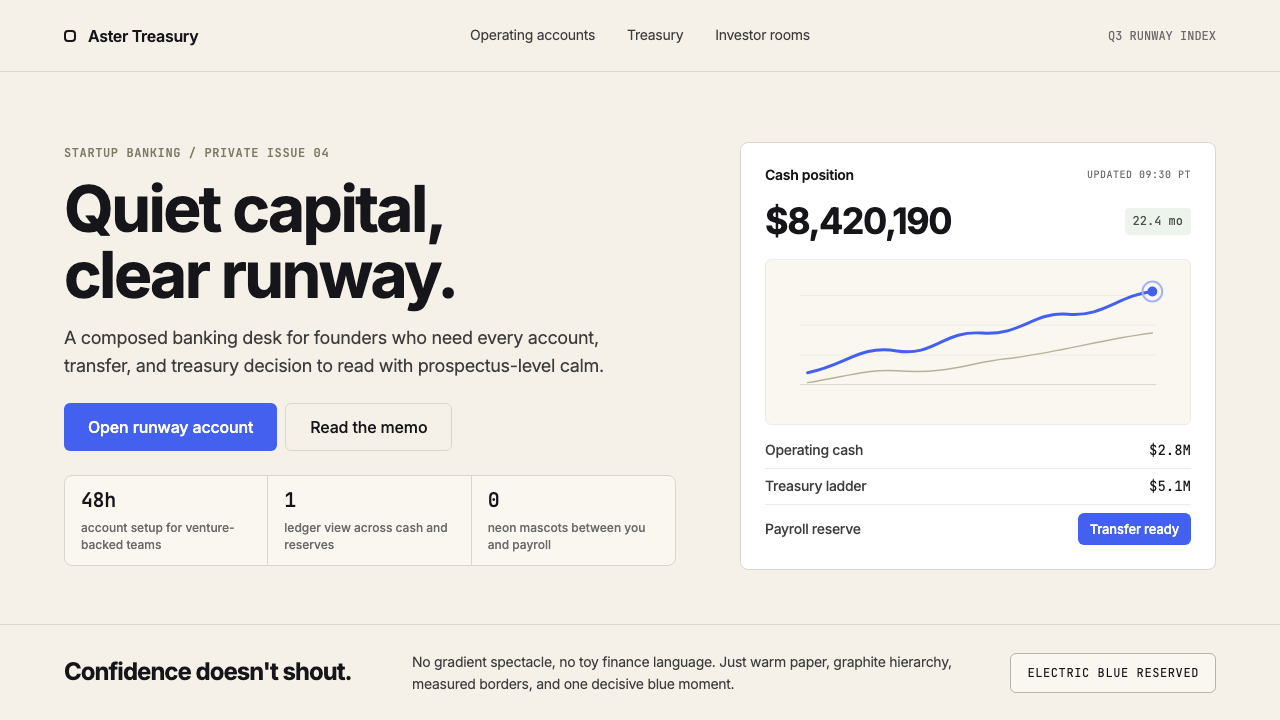 Mercury BankQuiet precision wins. Cream paper, charcoal Inter, and one electric-blue spar…
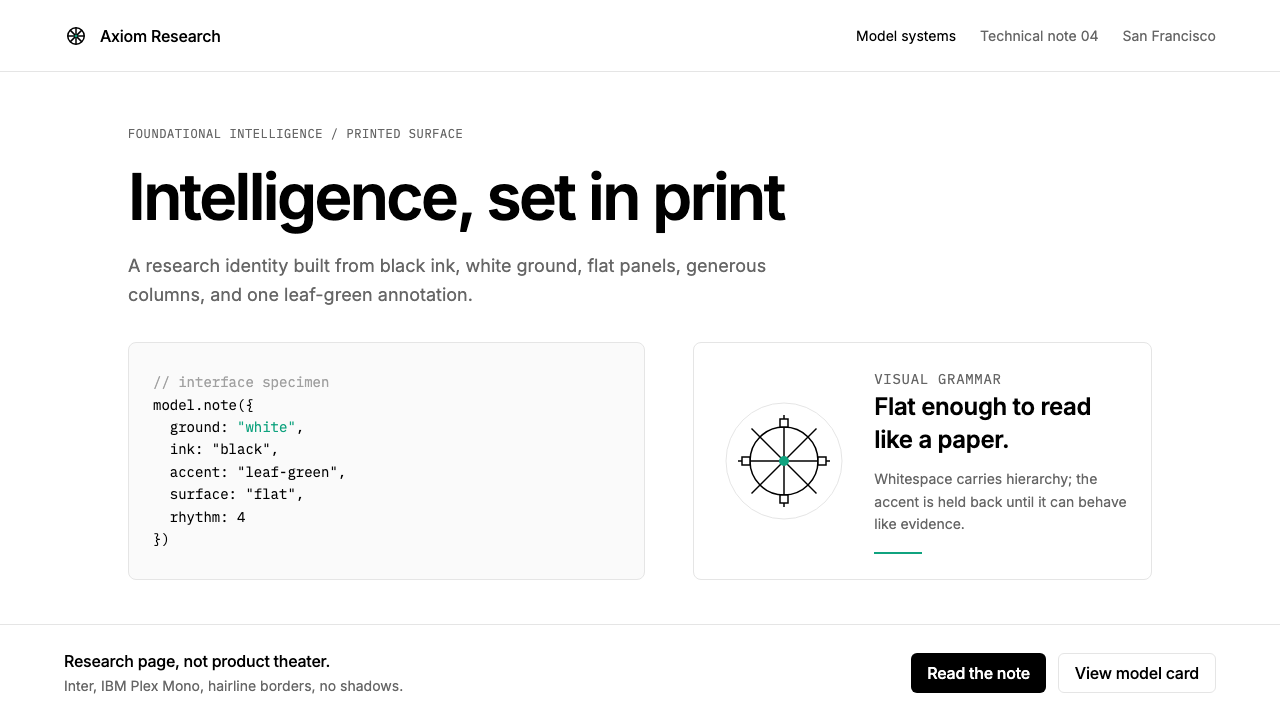 OpenAI 2024Research-grade restraint. Black-on-white Inter, flat code panels, one leaf-gr…
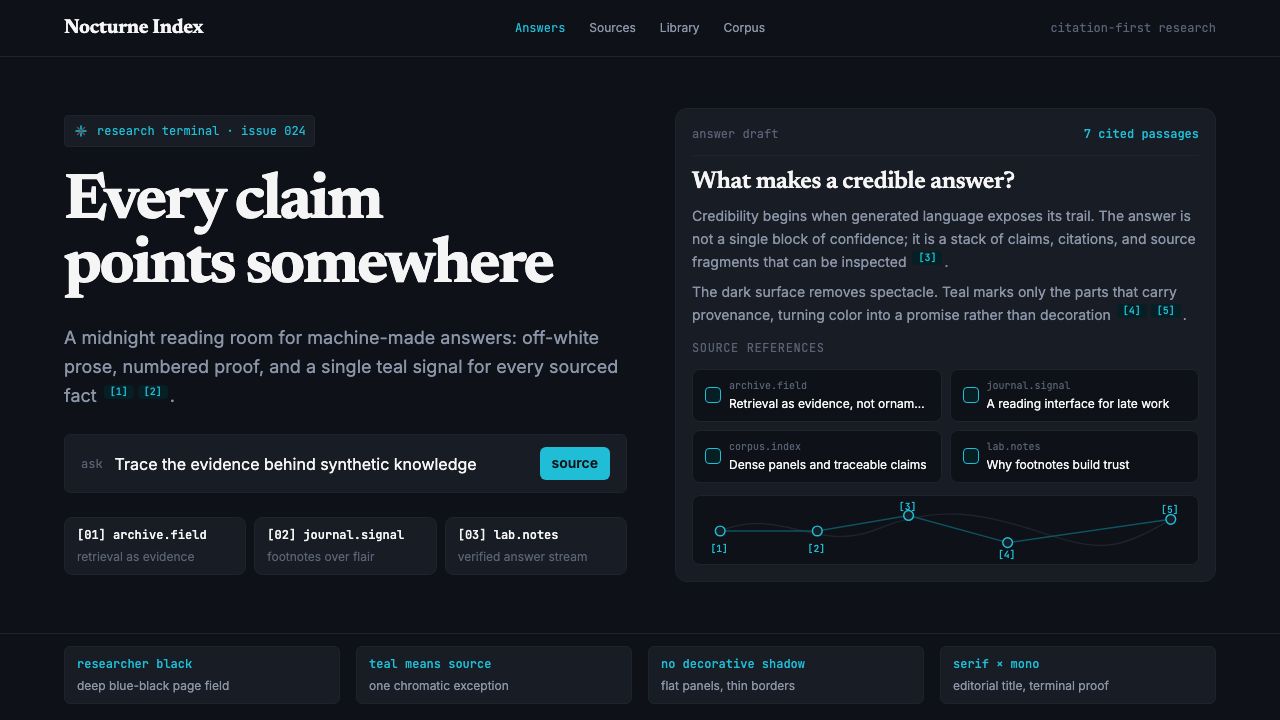 Perplexity AISerious search after midnight. Teal citations cut through black panels and de…
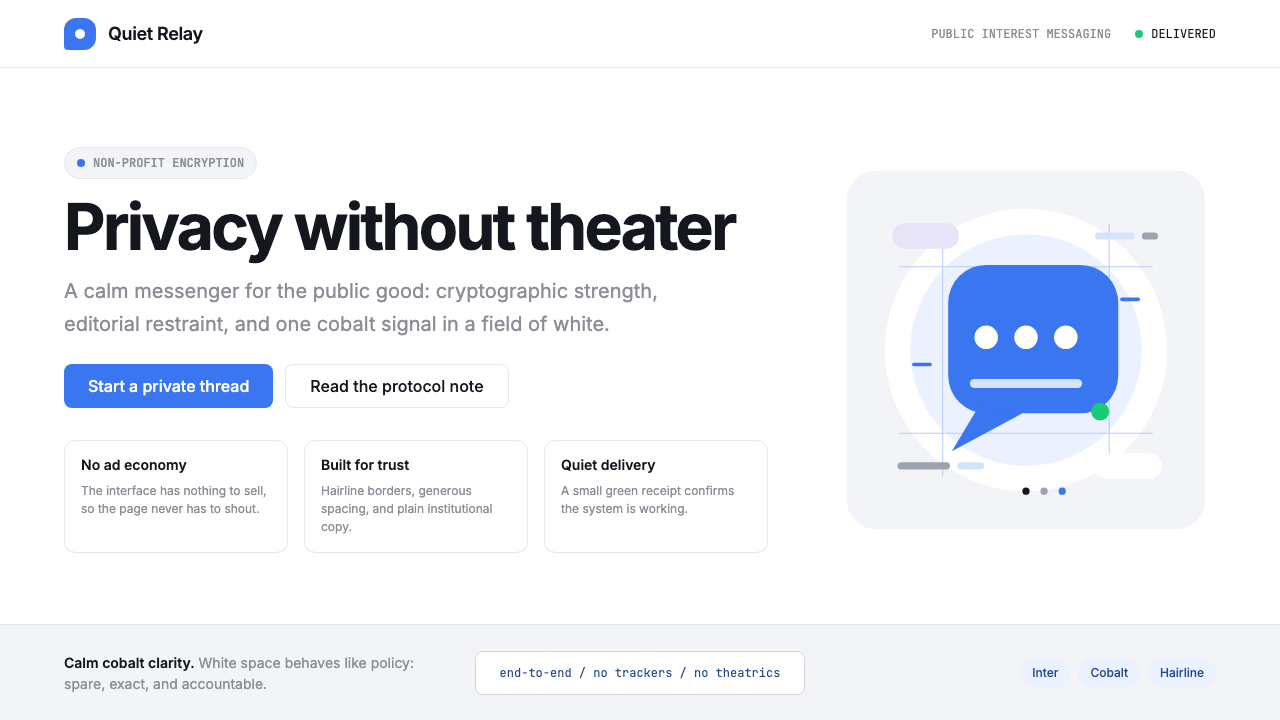 Signal Encrypted MessengerCalm privacy, plainly stated. Cobalt Inter type and white space carry the tru…