What is Awwwards Swiss Portfolio?
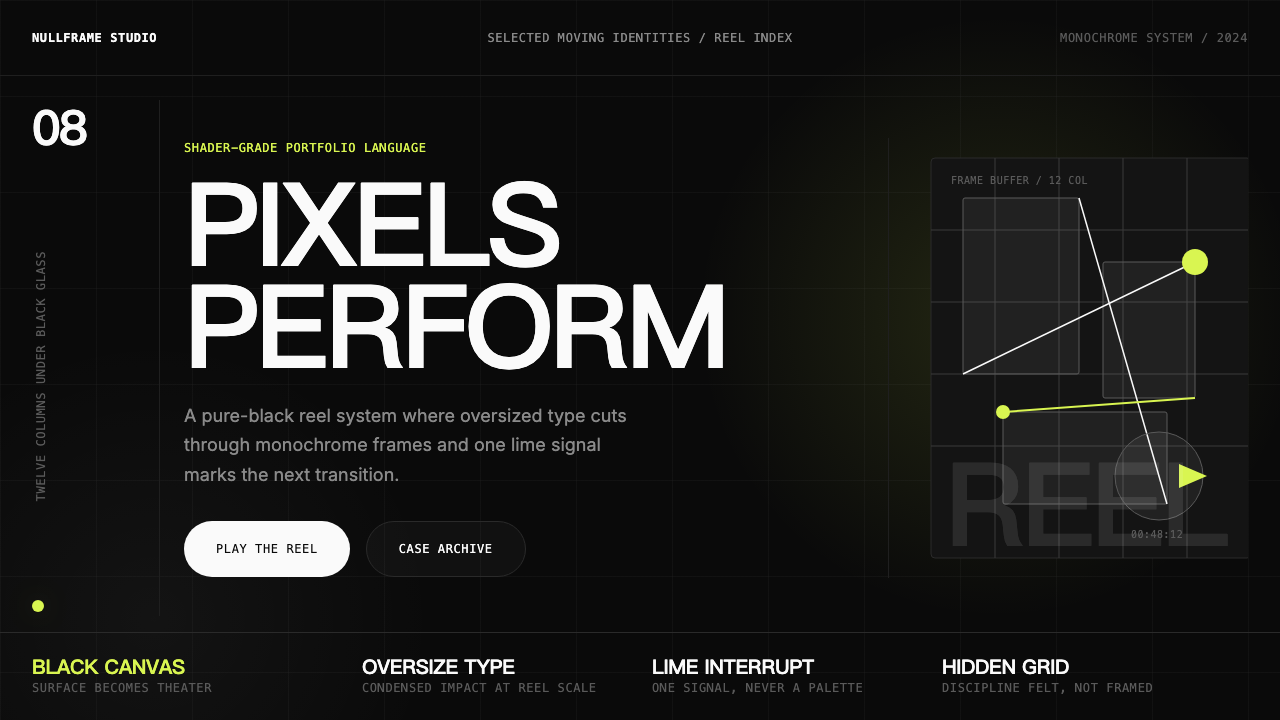
Cinema, not interface: a cinematic black canvas, oversize condensed display type, and a single electric accent color propel the portfolio reel of the world's most awarded digital studios.
Awwwards Swiss Portfolio in brief
The Awwwards Swiss Portfolio style is the shared visual language that emerged from a generation of Awwwards Site-of-the-Day-winning digital studios — Locomotive, Active Theory, Akaru, Resn, and their peers — in the years spanning roughly 2018 to 2024. It distills the agency formula into a remarkably consistent set of decisions: a near-total black canvas, hero-scale condensed display type, smooth-scroll inertia, and transitions driven by WebGL shaders. The style treats the browser not as a document viewer but as a film medium, where every frame advance, every cursor movement, and every section reveal is choreographed.
What unifies this style beneath its surface theatrics is a philosophy of restraint in service of the work. The portfolio itself — the reel, the case studies, the moving images — is the protagonist. Everything else is stage design. Monochromatic backgrounds eliminate visual competition; the entire palette contracts to a single accent hue — lime green, electric magenta, or saturated blue — that punctuates headings, hover states, and progress indicators without asserting independent presence. Text is enormous where it speaks and invisible where it serves. Space is cinematic: generous, intentional, and timed.
The style borrows its grid rigor from Swiss International Style and its typographic drama from the condensed display tradition, but it departs from both in one decisive way: it is fundamentally interactive. Static screenshots of these sites are almost meaningless. The design only becomes itself when the cursor triggers a magnetic pull, when the scroll triggers a parallax depth shift, when a transition dissolves one project into the next through a liquid-membrane effect. This insistence on motion as a structural element — not decoration, not delight, but architecture — is what separates the Awwwards Swiss Portfolio from any print-derived aesthetic.

Where does Awwwards Swiss Portfolio come from?
The Awwwards platform was founded in Barcelona in 2009 as a peer-judged awards site for the web design community. Its early years coincided with the twilight of Flash-based interactive web experiences and the emergence of HTML5 and CSS3 as capable mediums for visual experimentation. Studios that had built their reputations on Flash-era nonlinearity — parallax, full-screen video, unconventional navigation — began migrating those ambitions into the new technical substrate. Awwwards became the curatorial lens through which the community recognized the most ambitious of these experiments, and a feedback loop formed: winning studios influenced each other, and the judging criteria subtly rewarded a particular kind of polished craft.
The aesthetic crystallized around 2018, when WebGL became performant enough across consumer browsers to support real-time shader transitions and 3D canvas effects without requiring specialist plugins. Montréal-based Locomotive developed their smooth-scroll library — later open-sourced — which gave other studios a consistent way to implement the inertia-scrolling effect that had become a hallmark of high-craft portfolio sites. Active Theory in Los Angeles and Akaru in Paris were pushing real-time WebGL scene transitions. Resn in Auckland were experimenting with cursor deformation and hover physics. Though these studios operated on different continents with different cultural backgrounds, the Awwwards judging and peer recognition system drew them toward a shared formal vocabulary.
The condensed display typeface at the center of the style — most commonly a bold grotesque compressed to extreme narrowness — has roots in European commercial printing of the nineteenth century, where condensed wood and metal type allowed maximum headline size within a fixed column width. Its adoption by digital agencies in the late 2010s was partly an aesthetic statement (the weight and height of condensed type at large scale creates a cinematic poster effect) and partly a functional one: ultra-condensed letterforms allow long project titles to occupy a single line at hero scale without wrapping, preserving the clean horizontal logic of the layout.
The style's relationship to Swiss International Style is one of selective inheritance. It adopts the Swiss commitment to grid discipline and typographic hierarchy, and it shares the Swiss preference for sans-serif letterforms and the elimination of decorative ornament. But where Swiss Style was fundamentally static and print-derived — its grid living in the flat plane — the Awwwards Swiss Portfolio style treats the grid as a departure point for motion. Scroll position becomes a timeline; section transitions become cuts and dissolves; the cursor becomes a design element with its own physics. The result is a hybrid: Swiss precision in the resting state, cinematic choreography in motion — a visual language made possible only by the browser as a medium and the GPU as a rendering engine.
What defines the Awwwards Swiss Portfolio look?
Cinematic Black Canvas
The background is near-absolute black — not a softened charcoal or a dark navy, but the deepest tone the screen can produce. This choice is foundational: it transforms every lighter element into something that appears to emit rather than reflect light, giving the site a luminous, theatrical quality impossible on light-ground layouts. The blackness also functions as a temporal signal, borrowing the conventions of cinema projection and film trailers to prime the viewer for a reel-presentation experience rather than a document-browsing one.
Oversize Condensed Display Type
Hero typography is set at extreme scale — the kind of size where individual letterforms become architectural elements occupying most of the viewport height. The typeface is invariably a heavy grotesque compressed to a narrow width, which allows long phrases and project titles to read across the full width of the screen without line breaks. The contrast between the immense weight of the letterforms and the darkness behind them creates an impression of text as physical object rather than communicative mark. Secondary type, by contrast, is set small and light, creating a scale ratio that signals hierarchy instantly.
Single Accent Color
The entire palette is monochromatic except for one accent hue — most commonly lime green, electric magenta, or a saturated cyan-blue. This color appears sparingly and strategically: on an active navigation item, a hover state, a scroll progress indicator, or a single typographic highlight. Its rarity is what gives it power. Because the eye has been deprived of color across the majority of the layout, the accent hue reads with disproportionate force at first encounter. Using more than one accent color, or applying the accent at large area, would immediately dissolve this effect.
Smooth-Scroll Inertia and Parallax
Scrolling in this style is never the default browser scroll. A JavaScript-managed scroll system intercepts native scroll events and re-renders movement with momentum and easing — the page continues moving briefly after the user stops scrolling, and decelerates with a physical quality that feels weighted rather than mechanical. Within this scrolling system, different layers move at different speeds, creating parallax depth: background elements drift slower than foreground type, mid-ground images shift at a rate between the two, producing a convincing sense of three-dimensional space on a flat screen.
WebGL Transition and Shader Effects
Transitions between sections or between portfolio projects are not CSS fades or slides — they are GPU-executed shader programs that distort, liquify, or ripple the incoming and outgoing content. Common effects include a liquid-membrane morph where the edge between two images dissolves like a surface tension break, or a noise-based grain wipe that advances in organic rather than geometric waves. These transitions require a capable GPU and a well-optimized implementation; when executed poorly they become a performance liability, but when done well they are the most distinctive visual signature of the style.
Magnetic and Deformed Cursor
The system cursor is replaced or augmented by a custom cursor object — often a small circle or dot — that exhibits two distinct behaviors. In open space, it trails the actual pointer position with a slight easing lag, giving it physical weight. Near interactive elements such as buttons or project thumbnails, the cursor deforms: it expands into a filled circle that engulfs the target element, or the target element itself shifts magnetically toward the cursor position as if attracted. This interaction transforms every hover event into a micro-choreography, making even navigation feel designed.
Typographic Hierarchy Without Decoration
Beyond the hero display type, the typographic system is lean and functional. Navigation labels are set small and widely tracked in capitals, reading as coordinates rather than calls to action. Body text in case studies is set at a reading-comfortable measure in a neutral grotesque, kept well away from the hero content so the two voices never compete. Section numbers or project indices appear in a lighter weight at a size too small to interrupt but large enough to anchor position. There are no decorative rules, no pull-quote ornaments, no icon-text lockups — hierarchy is achieved entirely through scale, weight, and placement.

Who shaped Awwwards Swiss Portfolio?
A Paris-based creative developer whose personal site and client work exemplified the mature form of the Awwwards Swiss Portfolio aesthetic — combining extreme typographic scale, WebGL distortion effects, and immaculate micro-interaction design. Hocdé's work was cited repeatedly in Awwwards jury notes as a benchmark for technical craft married to visual restraint, and his public experiments with shader-based transitions influenced how other studios approached the GPU as a compositional tool.
A French creative developer and Awwwards developer of the year honoree, Lemonnier built a body of work that demonstrated how the condensed-type-and-black-canvas formula could be applied across diverse client contexts without becoming formulaic. His projects for cultural institutions and luxury brands showed that the style's cinematic authority could serve ends beyond self-promotion, legitimizing it as a deployable visual language rather than merely a portfolio-site genre.
Co-founder and creative director at Active Theory, a Los Angeles–based studio that became synonymous with the most technically ambitious tier of Awwwards-caliber work. Active Theory's projects for major entertainment and technology clients pushed WebGL scene transitions, audio-reactive visuals, and real-time 3D canvas work into the mainstream of award-winning web design, establishing the template that many subsequent studios emulated and iterated upon.
The Spanish-born developer and artist who created Three.js, the JavaScript library that abstracted WebGL sufficiently to make GPU-driven visual effects accessible to web developers without deep graphics programming backgrounds. Three.js did not create the Awwwards Swiss Portfolio aesthetic, but it provided the technical infrastructure on which much of it runs. Cabello's decision to make Three.js open-source and extensively documented was arguably the single most enabling act for the entire creative coding community that produced this style.
The Montréal-based studio that, in addition to producing award-winning sites of their own, open-sourced Locomotive Scroll — the smooth-scroll library that became the most widely adopted infrastructure layer for inertia-scrolling in the Awwwards creative community. By releasing the library publicly, Locomotive effectively standardized the scroll feel of the style across hundreds of studios worldwide, making what had been a costly custom implementation available to any team willing to integrate a dependency.
How do you use Awwwards Swiss Portfolio today?
The Awwwards Swiss Portfolio style was built for portfolio and showcase contexts, but its visual language translates well to other high-stakes presentation formats — provided you understand which elements are structural and which are medium-specific. The black canvas, the typographic scale hierarchy, and the single-accent color discipline are all transferable. The WebGL transitions, the custom cursor, and the smooth-scroll physics are browser-native behaviors and cannot be replicated in static media. When adapting this style, begin by identifying which layer of the aesthetic you are working in.
For presentation slides — cover and section architecture — the style provides a strong template. A cover slide works best with the full canvas black, a single project title set in a condensed grotesque at the largest size the slide dimensions allow, and one accent-color detail: a colored rule beneath the studio name, or a highlighted word in a subheading. Section opener slides should follow the same discipline: near-total black, one large typographic element, one color signal, no imagery competing for attention. Content slides inside case studies or data sections shift register: the black ground remains, but type size decreases and a loose grid of text and image panels replaces the hero composition. Data visualization in this style reads best when chart elements — bars, lines, nodes — are rendered in the accent color against the dark ground, with all axes and labels in a subdued off-white.
For web interfaces — dashboards, pricing pages, and product landing pages — the style's authority works well in contexts where the product needs to signal creative credibility or premium quality. The implementation logic: commit fully to the dark canvas; define one primary accent color and use it only for interactive states, active selections, and primary calls to action; set all primary navigation in small-caps with generous tracking; use a single display typeface at two sizes only — large for section titles, small for body — and do not introduce a second typeface family. Card components should have visible borders in a low-contrast grey rather than shadows; the border treatment reads as precision rather than depth-simulation, which is consistent with the style's values.
For editorial and marketing applications — long-form articles, brand campaign pages, and promotional emails — the style's cinematic scale translates into structural contrast between sections. A marketing page built in this language alternates between full-bleed black sections with large condensed type and dark-grey sections with smaller reading type, using the accent color consistently on primary action buttons and key metrics. Editorial layouts should use generous vertical spacing between sections to preserve the breathing-room quality that distinguishes the style from merely dark-themed design. Avoid filling every section with imagery; the black space between images is as intentional as the images themselves.
A persistent mistake when applying this style outside its native browser context is treating the accent color as a decoration budget rather than a signal system. Because the style trains the eye to read the accent color as meaningful — a hover state, an active item, a key data point — using it for illustrative or atmospheric purposes breaks the visual contract. Similarly, introducing a second accent color, even a closely related one, immediately halves the signal strength of both. Discipline means using the accent color less than feels natural, trusting the scale and contrast of the typography to carry the visual interest, and reserving color for moments of genuine communicative purpose.

Awwwards Swiss Portfolio — FAQ
Is this really a 'Swiss' style, or is that label misleading?
The Swiss label is a genealogical reference rather than a geographical one. The style inherits the grid discipline, typographic hierarchy, and rejection of ornament that define Swiss International Style as it emerged from Basel and Zurich in the mid-twentieth century. But it was developed primarily by studios in Montréal, Paris, Barcelona, Los Angeles, Auckland, and Amsterdam — none of them Swiss. The name signals visual DNA, not national origin. Where classical Swiss Style was static and print-native, this descendant style is interactive and browser-native. The shared inheritance is structural: the commitment to the grid as primary organizing logic, the insistence that type can carry visual interest without decoration, and the belief that restraint is not poverty but authority.
Can this style work for a product that is not a creative agency or portfolio?
Yes, with clear-eyed adaptation. The style's authority — its cinematic scale, its monochromatic discipline — communicates premium positioning and creative seriousness, which can serve product categories beyond digital agencies: luxury goods, high-end audio and technology hardware, entertainment platforms, and cultural institutions all benefit from the same visual register. The key adaptation is tonal: a portfolio site for a motion studio can afford to be almost aggressively self-referential in its craft display, whereas a luxury product page needs to redirect the same visual energy toward the product itself. The black canvas, the condensed type, and the single accent color travel well; the cursor effects and WebGL transitions should be evaluated against the product audience's technical context and patience for interaction.
What makes a site in this style feel authentic versus derivative?
Authenticity in this style comes from the integration of motion and content rather than the application of visual tropes. A derivative site applies the black canvas, oversize type, and WebGL transitions as a theme layered on top of otherwise conventional content architecture. An authentic site designs the content architecture around the motion: the scroll sequence is the editorial sequence; the transition effect is the content transition; the cursor behavior changes meaning based on context. The motion is not a feature — it is the medium. Practically, this means that authentic work tends to emerge from teams where the developer and designer are either the same person or in very close collaboration, because the interactive decisions cannot be separated from the visual ones.
How should this style handle accessibility, given its reliance on motion and dark backgrounds?
Accessibility is a genuine tension in this style and cannot be dismissed as a secondary concern. On the motion side, the smooth-scroll inertia, parallax layers, and WebGL transitions can be severely disorienting for users with vestibular disorders — a prefers-reduced-motion media query should disable or significantly attenuate all scroll-physics and transition effects, falling back to instant position changes and simple opacity transitions. On the contrast side, the dark background with near-white text and a single accent color generally produces high contrast ratios that exceed accessibility standards — but the accent color itself, particularly if it is a saturated lime or magenta, must be checked against the dark background at the font sizes where it appears, since small saturated text can fail contrast requirements even at high perceptual saturation. The magnetic cursor and custom cursor object should not be the only interactive affordance — keyboard focus states must be clearly visible, and focus order must follow the visual content sequence.
How is this different from simply making a dark-themed website?
Dark-themed websites use a dark background as a preference or aesthetic choice, often accompanying a light-mode equivalent and applying standard visual conventions — drop shadows for depth, multiple accent colors, conventional scroll behavior — within the dark color scheme. The Awwwards Swiss Portfolio style uses the black canvas as a foundational commitment from which the entire visual logic derives: the accent color has the power it does precisely because everything else is dark; the condensed display type reads as it does precisely because there is no background noise competing with it; the scroll physics create the effect they do because the dark ground makes spatial depth legible in a way that a lighter, noisier background would obscure. Dark theme is a color setting. This style is a compositional system in which the darkness is load-bearing.
Related design styles
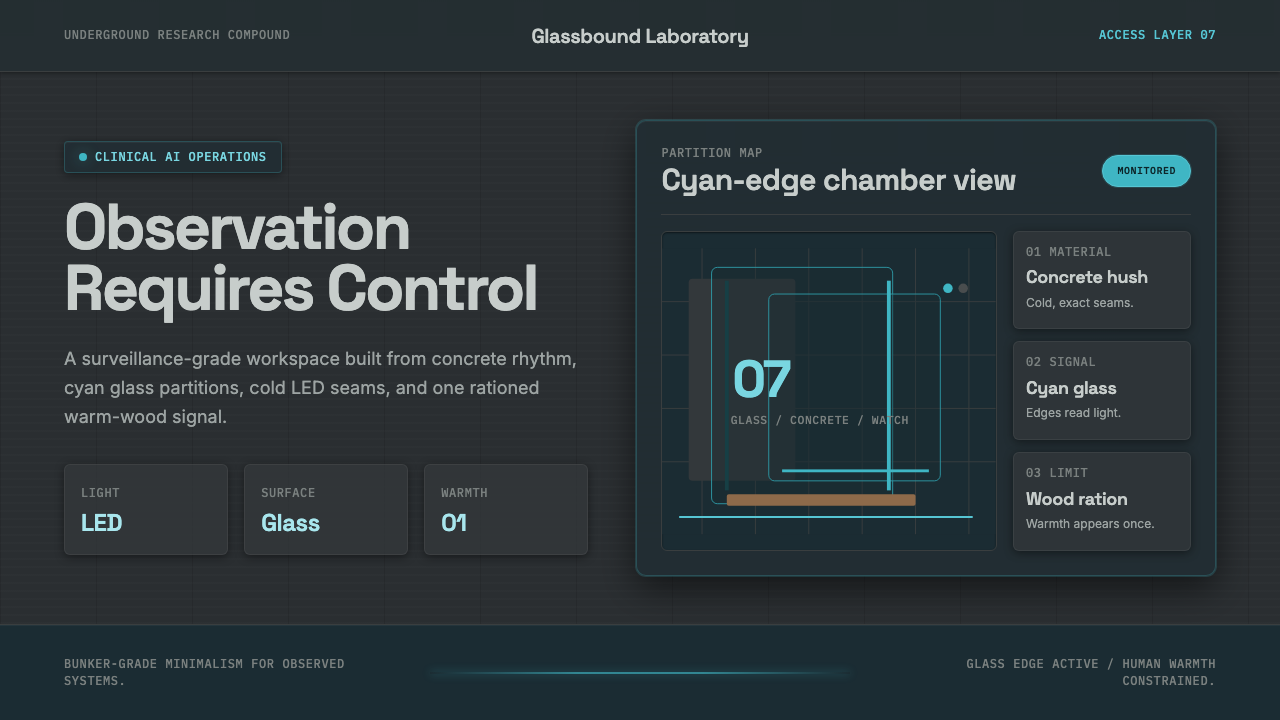 Ex MachinaClinical control, made visible. Concrete gray, cyan glass, LED seams, one woo…
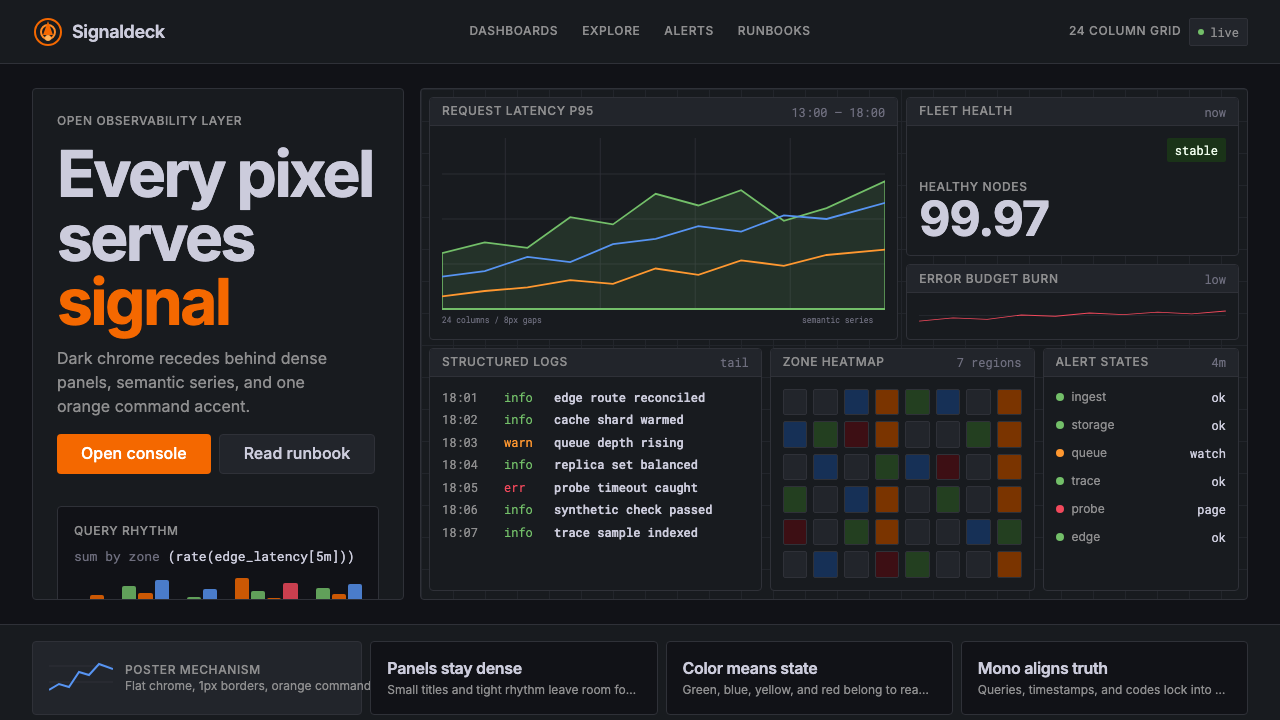 GrafanaData first, chrome last. Orange accent cuts through dense dark panels and sem…
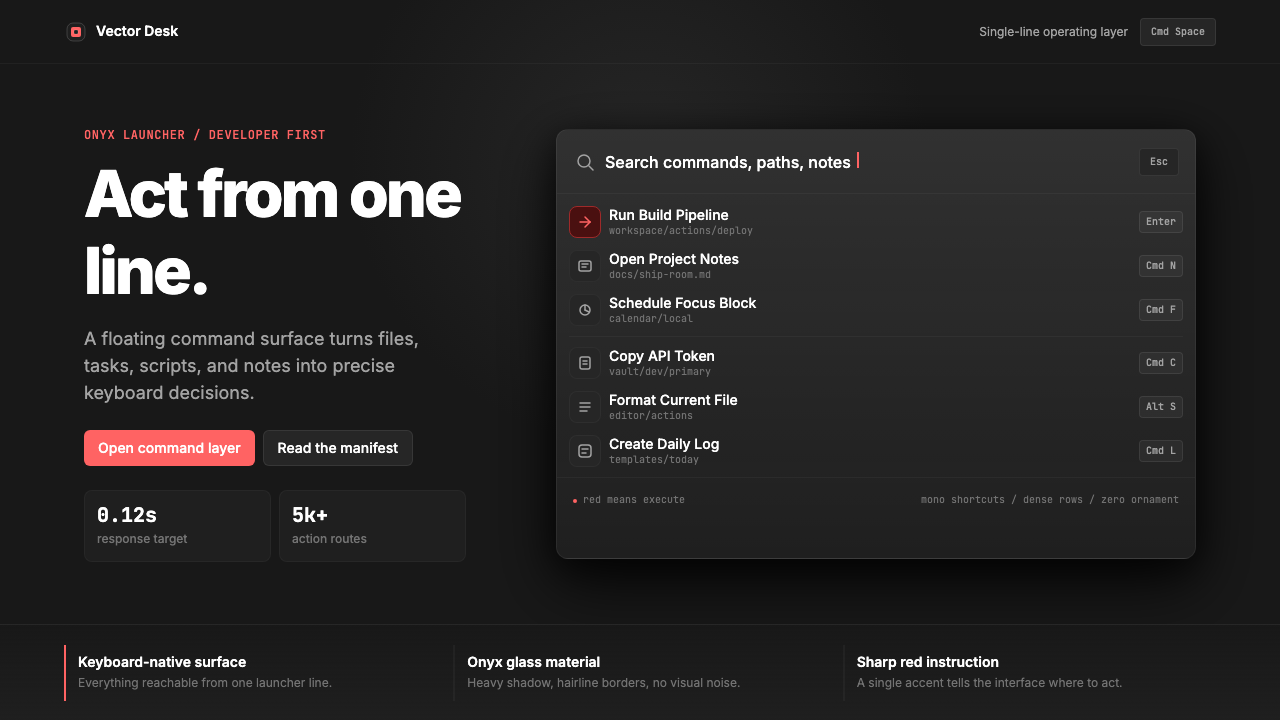 Raycast Spotlight Launcher (2023)Obsidian confidence. Sharp red cuts through Inter rows and mono shortcut chip…
 Android Bugdroid GreenFriendly tech, reduced to geometry. Vivid green pops from Grey 900 and rounde…
 Arctic Terraform StationEvery colour carries a duty. Sky-blue panels, coded modules and hard seams en…
 Bento Grid UIPremium tech, calmly compartmentalized. Near-black bento tiles and one Action…