What is Olivetti Pintori (1955)?
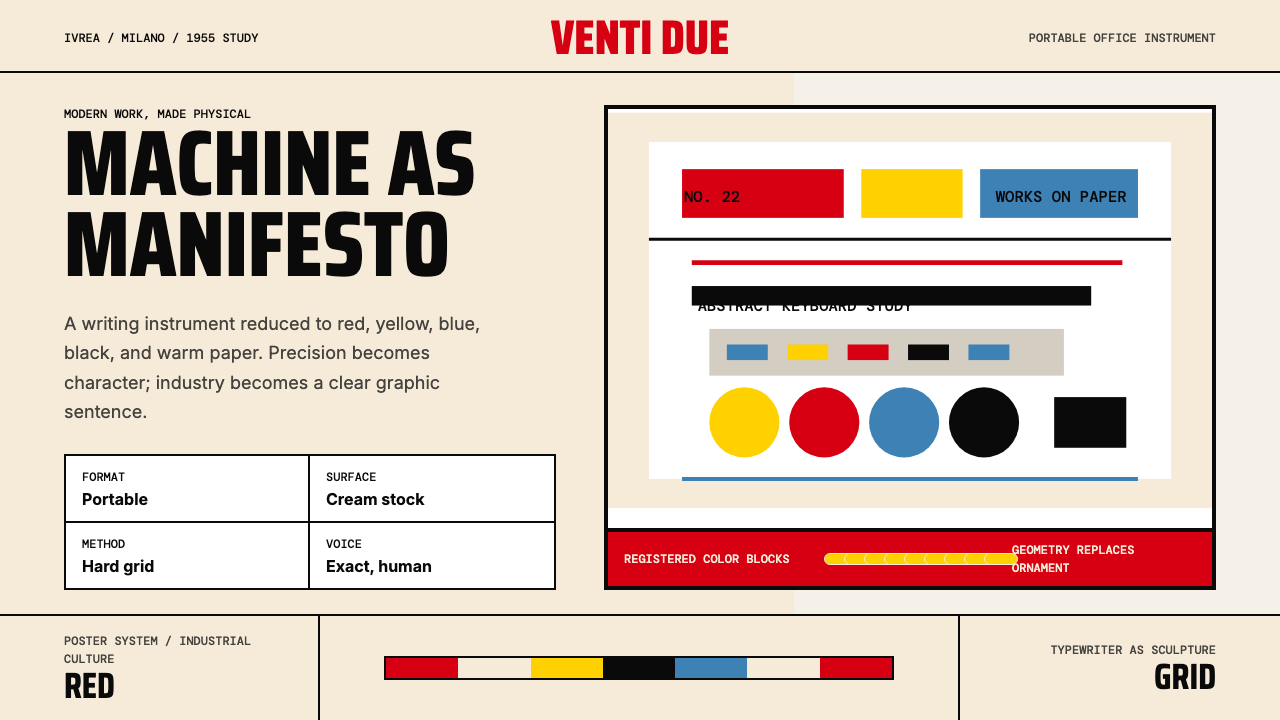
Giovanni Pintori turned a typewriter company into a manifesto — warm cream grounds, machine red, and hard geometry made Italian industry feel like art.
Olivetti Pintori (1955) in brief
Olivetti Pintori (1955) names the visual language that Giovanni Pintori distilled for Olivetti across three decades, with the iconic Lettera 22 poster of 1955 standing as its purest expression. The system rests on a warm cream paper ground, a decisive Olivetti red, and geometric machine-forms abstracted to the edge of pure composition. It replaced decorative illustration with intellectual clarity — every surface treated as a modernist poster, every form earned by function.
The palette is restrained but never cold. Cream grounds give warmth that stark white cannot; the characteristic red is neither fire-engine nor brick but a confident industrial tone that reads as both authority and vitality. Sun-yellow and sky-blue appear as counterpoints — used sparingly to punctuate hierarchy or signal contrast, never as background noise. Black anchors type and structural divisions with absolute decisiveness.
Unlike purely rationalist corporate systems, Pintori's work carries a poetic charge. Machine parts — typewriter keys, typebars, mechanical linkages — are abstracted into floating geometric symbols that suggest function without depicting it literally. The result is a rare balance: rigorous enough to project corporate credibility, warm and inventive enough to feel human. It is this tension between industrial order and artistic sensibility that distinguishes Olivetti's design culture from all its contemporaries.

Where does Olivetti Pintori (1955) come from?
Olivetti was founded in 1908 in Ivrea, a small Piedmontese town at the foot of the Alps, by Camillo Olivetti. From its earliest years the company was unusual: Camillo believed that a well-designed factory producing well-designed machines would be both more productive and more humane than the industrial norm. This philosophy — that beauty and efficiency were allied rather than opposed — would become the organizing conviction of Italian industrial modernism and the foundation upon which his son Adriano would build one of the world's most influential design programs.
Adriano Olivetti, who took control of the company in 1938, expanded his father's instincts into a comprehensive cultural program. He hired architects to design factories and worker housing, commissioned artists to make posters, brought in designers to shape the machines themselves, and established a publishing house. Into this environment came Giovanni Pintori, who joined Olivetti in 1936 as a young Sardinian-born graphic designer trained at the Institute for Higher Industrial Arts in Monza. Pintori would remain at Olivetti until 1967, serving as head of the advertising office and producing the visual identity that made the company famous worldwide.
The year 1955 was pivotal. Marcello Nizzoli had already designed the Lettera 22 portable typewriter — one of the most celebrated industrial design objects of the twentieth century — and Pintori's poster campaign for it became the canonical image of Italian corporate modernism. The poster abstracted the typewriter's mechanical innards into floating geometric fragments on a cream field, anchored by a block of Olivetti red and spare sans-serif type. It was reproduced globally and entered the permanent collections of major design museums, cementing Pintori's and Olivetti's reputations simultaneously.
The movement that produced this work sits at the intersection of several forces: post-war Italian optimism about industry and reconstruction, the influence of Swiss and Central European modernism filtering through design schools like Monza, and the particular Olivetti belief — unusual for a corporation — that design was a social and cultural responsibility rather than mere marketing. Adriano Olivetti corresponded with architects, philosophers, and urbanists; he saw the factory town of Ivrea as a laboratory for a better relationship between capital, labor, and civic life. Pintori's posters were not advertisements in the conventional sense: they were cultural propositions.
What defines the Olivetti Pintori (1955) look?
Color
The palette centers on warm cream as ground, with a confident industrial red as the dominant accent — neither decorative nor aggressive, but declarative. Sun-yellow and sky-blue serve as secondary counterpoints, used to create visual hierarchy or punctuate a composition rather than to fill backgrounds. Black is reserved for type and hard structural lines. The system avoids both the austerity of pure white and the softness of pastels; its warmth is the warmth of good paper and physical craft.
Geometric Abstraction
Machine forms — typewriter keys, type bars, mechanical linkages, spools — are extracted from their functional context and recomposed as pure geometric elements: circles, rectangles, diagonals, and regular grids floating against open ground. The abstraction is never total; a careful eye can always recover the mechanical origin. This suspended legibility is the system's signature: it rewards close looking without demanding it.
Typography
Type is clean, upright, and sans-serif — selected for legibility and neutrality rather than personality. Headlines are set at generous scale to claim visual authority, while body text or supporting copy remains compact and secondary. Spacing between elements is deliberate and open: the white or cream ground is treated as a positive design element rather than empty margin. All-caps settings are used sparingly, for labels and product names, not as a general tone.
Composition
Layouts are structured by an invisible but strongly felt grid. Compositions tend toward asymmetry — a large geometric cluster in one quadrant balanced by generous open space in another, or a dominant color block offset by a slender column of type. This asymmetric balance is not accidental but calculated: the eye is led through the page rather than arriving at a static center. The overall effect is of controlled tension, like a well-balanced but not obviously symmetrical piece of typography.
Flatness and Material Clarity
Every element is flat: color areas are solid without gradients, shapes have clean edges without soft shadows, and there is no simulation of three-dimensional depth through lighting effects. Where a sense of depth exists, it comes from compositional layering — one flat shape placed over another — not from illusionistic rendering. This flatness is not a technical limitation but a deliberate visual argument: the designed surface is its own reality, not a window onto another world.
Industrial Warmth
What distinguishes this system from colder rationalist modernism is a persistent warmth in material and spirit. The cream ground evokes paper, printing, and the physical act of writing; the red has a handcrafted quality — one thinks of sealing wax, of ink, of the precision object held in the hand rather than the institutional color field on a corporate wall. Even the geometric abstraction carries a sense of craft: these shapes feel drawn and placed with care, not generated by formula.
Cultural Proposition
Pintori's work for Olivetti was conceived not as advertising in the conventional sense but as cultural communication — closer to the poster tradition of exhibition and public art than to the product brochure. This origin gives the system a certain boldness that purely commercial graphic systems lack: the compositions are willing to be abstract, to leave space empty, to foreground aesthetic intelligence over product information. Applied today, this cultural register elevates any communication that adopts it.

Who shaped Olivetti Pintori (1955)?
Born in Sardinia in 1912 and trained at the Institute for Higher Industrial Arts in Monza, Pintori joined Olivetti in 1936 and remained until 1967, serving as head of the advertising office for most of that time. He was not a single-campaign designer but a sustained visual intelligence: over three decades he produced posters, brochures, exhibition graphics, and advertisements that maintained a coherent identity while never repeating themselves. His Lettera 22 poster of 1955 — geometric machine-fragments on cream, anchored by Olivetti red — became the defining image of Italian corporate modernism and entered the permanent collections of MoMA and other major museums. After leaving Olivetti he continued as an independent designer, but the Olivetti years remain the defining chapter of his career.
Adriano Olivetti (1901–1960) took control of the family company in 1938 and transformed it from a successful typewriter manufacturer into one of the twentieth century's most ambitious experiments in corporate culture. He believed that the corporation had social responsibilities extending far beyond profit: he built worker housing, schools, libraries, and cultural centers in Ivrea; he corresponded with architects, urbanists, and philosophers; he ran for political office. His hiring of Pintori, Nizzoli, and later Ettore Sottsass was not a marketing decision but a cultural one — he wanted Olivetti's objects and communications to embody a set of human values, not merely to sell machines. His death in 1960 left a void that the company never entirely filled.
Nizzoli joined Olivetti in 1938 and became the industrial designer most responsible for the physical objects that Pintori's graphics celebrated. His Lexikon 80 typewriter (1948) and the Lettera 22 portable (1950) — the latter considered one of the most beautiful machines ever made — gave Pintori the sculptural subject matter that his poster campaigns abstracted and elevated. The collaboration between Nizzoli's three-dimensional industrial design and Pintori's two-dimensional graphic language is the core of what the world recognizes as the Olivetti aesthetic: an unusual unity between the object and its representation.
Sottsass joined Olivetti in 1958 as a consultant designer and over the following decades designed some of the company's most iconic products, including the Valentine typewriter (1969) and early mainframe computers. His sensibility — warmer, more color-saturated, and more culturally eclectic than either Nizzoli or Pintori — represents a next chapter in the Olivetti story that absorbed the 1955 visual language and began to transform it. His later founding of the Memphis design group drew explicitly on the Olivetti experience of treating industrial objects as cultural artifacts, though in a deliberately more ironic and maximalist register.
How do you use Olivetti Pintori (1955) today?
Olivetti Pintori (1955) is among the most practically useful historical design systems for contemporary work, because its visual principles are simultaneously strong and warm — capable of projecting intelligence and authority without the severity that colder modernist systems can carry. Applying it well means understanding what it is actually doing: using the cream ground to establish a material presence, using the red as a decisive accent that commits to a statement, and using geometric abstraction to suggest that the work has been composed rather than merely assembled.
For presentation slides, this system performs exceptionally well on both cover and content formats. A cover slide should be treated as a poster: one bold geometric form or abstracted mechanical element in the foreground, a clean product or concept name in a generous sans-serif, and the characteristic color combination — cream and red, or cream and deep black — doing the structural work. Content slides benefit from an open grid with wide breathing room; hierarchy is established through scale and color, not through decorative dividers or background fills. Data visualization slides are particularly well-suited to this system — charts and graphs become geometric objects in their own right, with bar charts reading as architectural elements and the palette lending consistency across multiple data series.
For web user interfaces, the system is well-suited to dashboards, product pages, and any context where clarity and considered visual intelligence are primary values. A practical approach: establish the cream or near-white ground as the default surface, reserve the red for the single most important interactive or status element per view, and use black with confidence for all typographic hierarchy. Card components should have clean, hard borders rather than soft diffuse shadows; interactive states should be communicated through color change and geometric indicators rather than animation-heavy affordances. The flat, bold quality of the system scales reliably from desktop to mobile without loss of character.
For editorial and marketing applications, the Pintori language supports ambitious layouts that reward sustained attention. A long-form article or report can use the style's poster logic at a section level: major section breaks treated as compositional moments, with a color field or a large geometric element marking the transition. Marketing pages can adopt the system's cultural register directly — rather than leading with product specifications, lead with an abstracted image that suggests the product's world, then resolve into information. The Olivetti precedent is instructive here: the most celebrated posters did not depict the typewriter photographically but translated its mechanical logic into pure visual form, trusting the audience's intelligence.
A common mistake when applying this system is treating the Olivetti red as a general highlight color to be used liberally throughout a composition. In authentic Pintori work, the red is used decisively and sparingly — it marks a specific statement, not a general decorative impulse. Overusing it dilutes the authority it provides. Similarly, the geometric abstraction should feel composed and considered, not randomly scattered: each shape should have a reason to be where it is, whether that reason is structural, hierarchical, or symbolic. The difference between Pintori-derived work and work that merely borrows the surface is precisely this quality of considered placement — the sense that every element was put there for a reason.

Olivetti Pintori (1955) — FAQ
How is Olivetti Pintori different from Swiss International Style, which also uses geometric forms and sans-serif type?
The two systems share formal tools — geometric forms, sans-serif type, grid-based composition — but differ fundamentally in temperature and intent. Swiss International Style, as it developed in the 1950s and 1960s, was driven by a commitment to neutral, universal communication: the system should work for any client, any message, any culture. Pintori's work was the opposite of universal; it was intensely specific to Olivetti, to Italy, to a particular moment when industry felt like culture. The cream ground and the warm red are not neutral; they carry a material warmth that Swiss grids rarely do. Pintori also allowed himself compositional poetry — floating geometric fragments, deliberate ambiguity — that a strict Swiss functionalist would have edited out as insufficiently purposeful.
Can this system work for digital products, or does it feel too rooted in print and poster history?
It translates to digital contexts very naturally, partly because its core principles — flat color, clean geometry, open space, decisive typographic hierarchy — were already structurally suited to screen environments long before digital design existed as a discipline. The absence of gradients and soft shadows means the system does not rely on rendering effects that strain at small sizes or on lower-resolution displays. The challenge in digital application is resisting the temptation to add motion, hover effects, and interaction states that contradict the system's composed stillness. Used well in a dashboard or data product, the Pintori language communicates that the interface has been thought about — that intelligence, not just engineering, has been brought to bear.
Is the warm cream ground essential, or can the system work on a pure white or dark background?
The cream ground is not strictly essential, but replacing it changes the emotional register meaningfully. On pure white, the system becomes crisper and more clinical — closer to rationalist modernism and further from the warmth that distinguishes Pintori's work. The red reads more aggressively against white than against cream, and the overall feel shifts from material toward digital. This is not necessarily wrong — a contemporary application might deliberately want that crisper quality — but it is a different statement. On a dark background, the system requires rebalancing: the red tends to dominate, the cream moves to serve as a primary type and accent color, and the sky-blue and sun-yellow become more prominent counterpoints. The dark inversion works best when committed to fully rather than attempted as a partial reversal.
How do I handle photography or illustration within this design system?
Photography, when used, should be treated as a flat compositional element rather than a naturalistic scene-setter. The Olivetti tradition — influenced by mid-century Italian photography and design photography — favored close-cropped details, unusual angles, and high contrast that emphasized geometric qualities in objects over narrative or atmospheric qualities. A photograph of a product detail, cropped to isolate a geometric form and treated at high contrast, integrates naturally into the system. Full-bleed lifestyle photography with soft natural light is fundamentally at odds with the system's logic. Illustration, if used, should tend toward the diagrammatic — line-based, flat, precise — rather than toward organic, expressive, or decorative forms.
Where does this style work poorly, and what contexts should designers avoid?
The system struggles wherever softness, organic warmth, or sensory richness are primary emotional values. Food and beverage brands, wellness and health applications, children's products, fashion and beauty, and any context where the user experience depends on organic texture and human intimacy will find the system's geometric decisiveness working against rather than for the communication. The style also tends to read as masculine in cultural contexts where gender-coded warmth is expected — a limitation worth acknowledging rather than fighting. Additionally, the system is poorly suited to highly photographic or illustrative contexts: it was built around abstraction, and forcing it to coexist with realistic imagery creates a tonal conflict rather than a productive tension. Knowing these limits is as important as knowing the style's strengths.
Related design styles
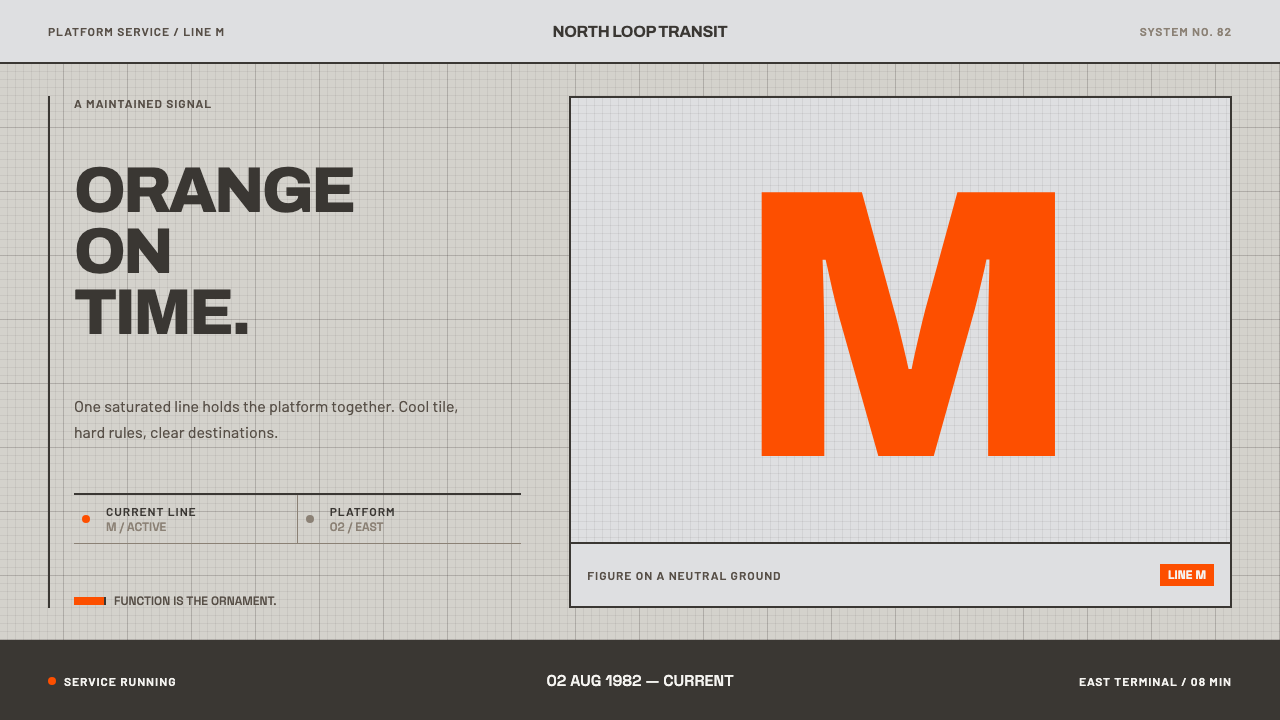 Helsinki Metro OrangeOne orange does the work. Archivo signage cuts across an 8px concrete tile gr…
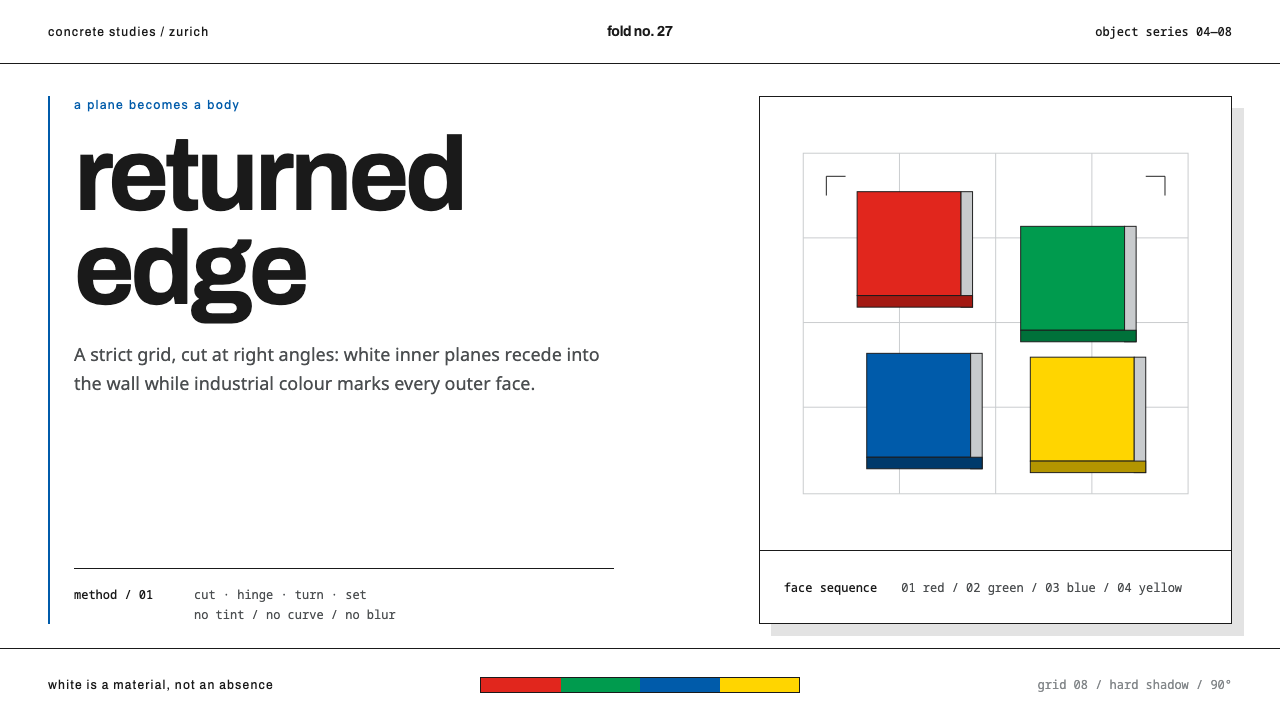 Nelly Rudin ConcreteFlat planes gain force. Archivo grids stage four industrial colours with hard…
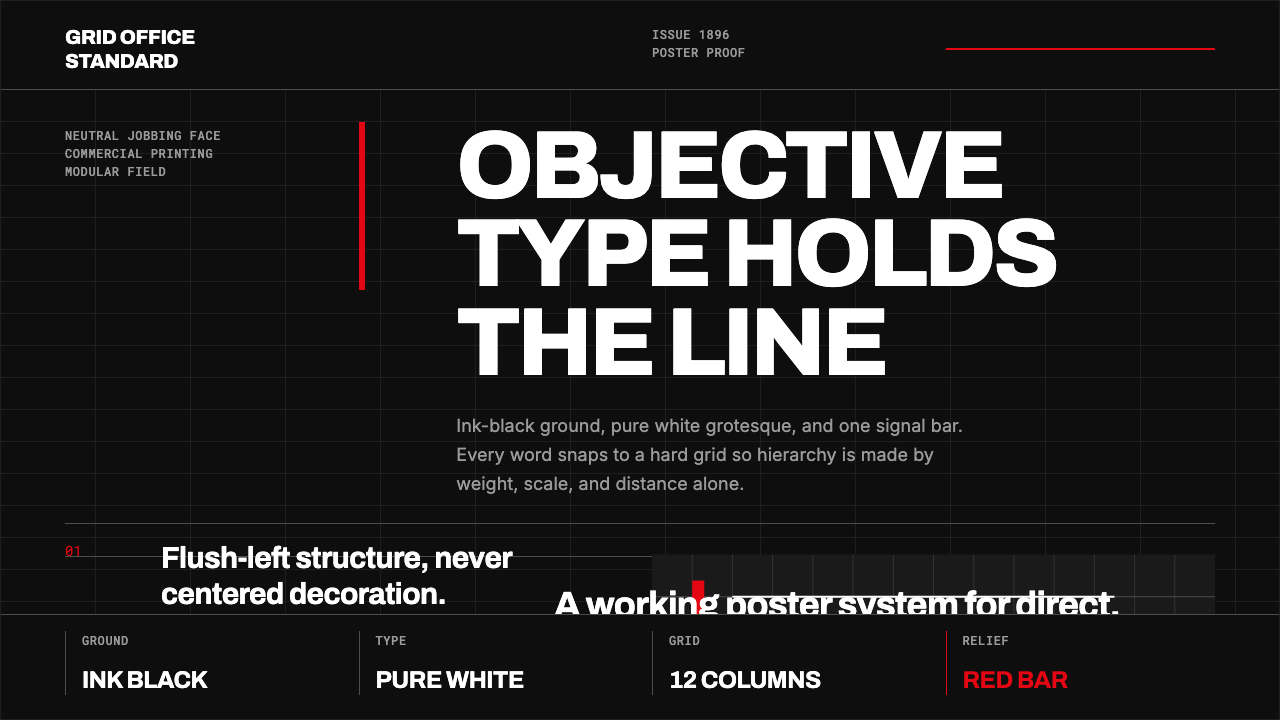 Akzidenz-Grotesk BertholdObjectivity in black ink. White grotesque type, hard grid, one rationed red b…
 Chilean Allende-Era Propaganda (1972)Solemn revolution. Red, cobalt and yellow lock into thick black mural geometr…
 Joy Division — Unknown PleasuresRestraint becomes signal. Black field, tight Helvetica, and white pulsar line…
 Lufthansa (Aicher)Systems speak first. Melon yellow, navy disc mark, lowercase Helvetica on a h…