What is Joy Division — Unknown Pleasures?
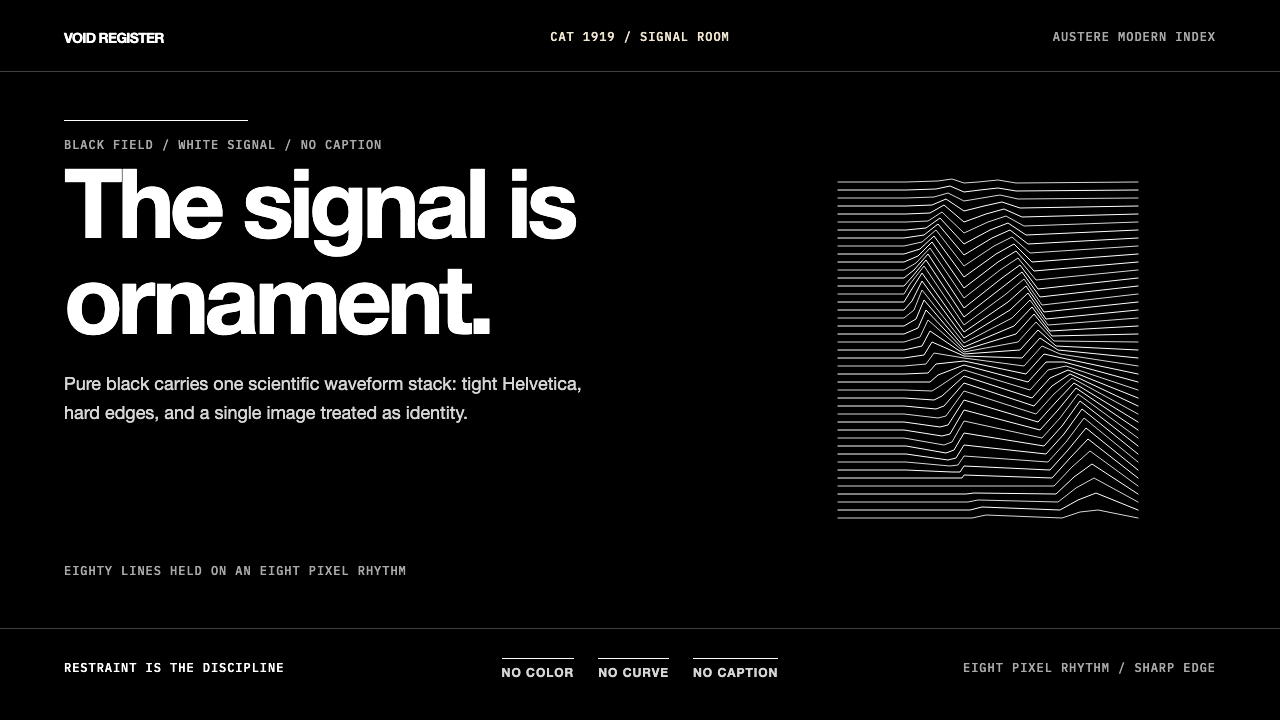
A single astronomy diagram — eighty stacked pulsar radio waves on pure black — became post-punk's most enduring visual signal.
Joy Division — Unknown Pleasures in brief
The Unknown Pleasures aesthetic is a visual system built entirely on restraint. Its foundation is a deep, field-filling black ground that refuses any warmth or ambiguity, carrying a single white line-art graphic and type set so tightly that no air seems to breathe between letters. Every element is stripped to the minimum required to communicate — and then the minimum is stripped again.
The central image — eighty successive radio-pulse profiles from pulsar CP 1919, redrawn from a 1971 Cambridge astronomy paper — is not used as scientific illustration. It is used as pure form: a dense stack of irregular white mountain-ridge lines that vibrate with rhythmic energy, each wave slightly different from the last, the whole mass suggesting both data and landscape, both signal and noise. The graphic is placed without caption, without annotation, without any framing device. It simply exists against the black, unexplained.
This is a style where the ground is the statement. Black does not merely function as background — it is the dominant material, the surface that everything else cuts into. Type appears as incision rather than addition. The graphic reads as transmission rather than decoration. The total absence of color, texture, and hierarchy beyond the single image produces a visual atmosphere that is simultaneously scientific and emotional, cool and charged.

Where does Joy Division — Unknown Pleasures come from?
The cover of Joy Division's debut album Unknown Pleasures was released in June 1979 on Factory Records, the Manchester independent label co-founded by Tony Wilson. The design was the work of Peter Saville, then twenty-three years old, who had become Factory's in-house designer without a formal brief or budget — Wilson simply allowed him to do as he wished. The source image Saville chose had appeared two years earlier in the Scientific American article 'The Geometry of Radio Galaxies' in 1977, adapted from an original graph in Harold Craft's 1970 doctoral dissertation at Cornell. The radio pulses of CP 1919 — the first pulsar ever identified, discovered in 1967 by Jocelyn Bell Burnell — had been stacked into an offset-perspective waterfall plot that read simultaneously as data visualization and terrain. Saville inverted the image from black-on-white to white-on-black, stripped all labeling, and placed it without explanation.
Factory Records was itself a deliberate aesthetic project. Wilson and his partner Alan Erasmus launched it in 1978 with an ethos that was explicitly opposed to the commercial logic of the major-label industry. The label's catalogue was catalogued obsessively — every Factory release, including meeting minutes and the building lease, received a FACT number — and its visual output was treated with the same seriousness as the music. Saville was given complete creative autonomy; Factory famously had no contracts with its artists. This institutional attitude made Factory records among the most visually coherent output of any label in the period, and Saville's work for Joy Division, New Order, and Orchestral Manoeuvres in the Dark set a standard for album art that influenced independent graphic design for decades.
Post-punk Manchester in the late 1970s was a specific cultural environment: industrial decline, cheap rehearsal spaces, a network of venues anchored by the Electric Circus and later the Factory club itself, and an art-school sensibility that overlapped with music in ways that were unusual for British pop. Joy Division — Ian Curtis on vocals, Bernard Sumner on guitar, Peter Hook on bass, Stephen Morris on drums — emerged from this milieu having absorbed both the aggression of punk and the art-damaged alienation of German electronic music, particularly Kraftwerk and Can. Their sound was bleak, rhythmically locked, and emotionally raw. Saville's design found the visual equivalent of that affect without illustrating it literally.
The image passed almost immediately into the permanent visual lexicon of popular culture. It appeared on posters, T-shirts, and eventually on objects ranging from coffee mugs to phone cases, often reproduced by people who had no idea of its scientific origin. The pulsar diagram became a free-floating signifier of a certain aesthetic sensibility — dark, serious, spare, resistant — detached from Joy Division entirely and available for adoption by anyone who wished to signal those values. This is the peculiar fate of truly successful design: it becomes a commons, and its origins recede into background.
What defines the Joy Division — Unknown Pleasures look?
Ground
The black field is not a background — it is the primary material. It is deep, absolute, and non-negotiable: no warmth, no texture, no gradient softening the edges. Everything else on the composition is cut from this ground rather than placed on it. This inversion of figure-ground hierarchy is the style's most fundamental characteristic: the light marks are intrusions into darkness, not additions to a neutral surface.
Line-Art Graphic
The defining visual element is a stacked, oscilloscope-style line drawing — waveforms or contour lines plotted sequentially so that they build into a dense, ridge-like mass. The individual lines are thin and precise; the cumulative form is organic and almost topographic. Critically, the image carries no label, no axis, no legend. It is scientific data presented as pure form, stripped of the apparatus that would make it legible as science.
Monochrome Palette
The palette is two values: pure black and pure white, with no intermediate tones, no gray, no color. This binary reduction is not minimalism as aesthetic preference but as philosophical commitment — the elimination of every tonal ambiguity that might soften the contrast or introduce a mood beyond the stark. In contemporary applications, this monochrome logic can accommodate a single muted accent, but the moment a second hue appears, the system's tension collapses.
Extreme Type Compression
Type in this system is set with tracking compressed far beyond conventional comfort — letters sit against each other with almost no air between them, producing a wordmark-like density even in running text. The typeface itself is characteristically clean and modern, its geometry precise and its stroke weight uniform. The effect of extreme compression is that text reads as a solid mark before it is read as language — weight precedes word.
Isolation and Silence
The composition is structured around generous amounts of empty black space surrounding the central graphic. This is not negative space in the conventional design sense — it is silence as content. The emptiness is not a frame; it is part of the signal. A single image or text element placed within a vast dark field acquires a different weight and urgency than the same element placed within a busy composition. The style depends on this isolation as much as on any graphic element.
Scientific Detachment
The aesthetic borrows the visual grammar of scientific and technical illustration — graphs, oscilloscope traces, survey maps, data prints — and deploys it without the apparatus of scientific communication. No labels, no scales, no explanatory text. The borrowed authority of the scientific image is used to produce not understanding but atmosphere: a sense that the design is indexing something real, something measured, something beyond personal expression or commercial intent.
Structural Austerity
There is no ornamentation, no border, no rule line, no decorative device of any kind. The composition's structure is entirely load-bearing: where something sits, how large it is, how much space surrounds it — these decisions carry the full visual and emotional weight of the design. This is not the austerity of poverty or limitation; it is the austerity of a system that has decided what it wants to say and removed everything that does not serve that saying.

Who shaped Joy Division — Unknown Pleasures?
Saville co-founded Factory Records' visual identity from its inception in 1978 and served as the label's unofficial creative director for the following decade. Trained at Manchester Polytechnic, he brought a deep knowledge of European modernism — particularly Swiss International Style and Constructivism — to a context that was otherwise dominated by punk's raw immediacy. His Unknown Pleasures design demonstrated that album art could operate as autonomous graphic work rather than promotional packaging. Saville went on to design for New Order, Orchestral Manoeuvres in the Dark, and later for fashion houses including Givenchy and Burberry, becoming one of the few designers whose work is recognizable as a distinct body across commercial and cultural contexts.
Wilson was a Granada Television presenter, cultural impresario, and the co-founder of Factory Records. His contribution to the Unknown Pleasures aesthetic was largely institutional: he created the conditions — no contracts, unlimited creative autonomy, no commercial pressure on design — under which Saville's work was possible. Wilson's philosophy held that art and commerce were not merely compatible but that commercial context was the proper site for serious artistic ambition. He later co-founded the Hacienda club, which became central to the Manchester music scene of the 1980s and early 1990s. His legacy is less a body of designed work than a set of institutional decisions that enabled others' work.
The vocalist and lyricist of Joy Division, Curtis was the human source of the music's emotional character — his lyrics drawn from literature (Dostoevsky, J.G. Ballard), his performance style physically intense and almost involuntary in its abandon. Curtis died by suicide in May 1980, at twenty-three, on the eve of Joy Division's first North American tour. His death fixed the band — and the album's aesthetic — in a particular emotional register that has made separation of the music from its visual presentation nearly impossible. The Unknown Pleasures image is inseparable, in cultural memory, from the sense of a signal transmitted from somewhere unreachable.
The astrophysicist who, as a Cambridge doctoral student in 1967, first identified the radio pulsar CP 1919 — the source of the signal whose profile forms the Unknown Pleasures graphic. Bell Burnell's discovery was among the most significant in twentieth-century astronomy; her supervisor Antony Hewish received the Nobel Prize in Physics in 1974 for the work, a decision that remained controversial for decades given Bell Burnell's central role. She was not involved in the album's design and was reportedly unaware that the pulsar chart had been used in this way until years after the release. Her scientific work, intended entirely as astronomy, became one of the most recognized visual artifacts in popular music history.
Guitarist and co-founder of Joy Division, Sumner co-wrote the music that the Unknown Pleasures design was built to represent. After Curtis's death, Sumner became the vocalist and primary musical voice of New Order — the band Joy Division's remaining members formed in 1980 — and continued working with Saville on a sustained series of influential sleeve designs. New Order's run of Saville-designed releases through the 1980s extended and evolved the visual language begun with Unknown Pleasures, establishing that the aesthetic was a genuinely systematic design approach rather than a one-off creative gesture.
How do you use Joy Division — Unknown Pleasures today?
The Unknown Pleasures visual system is highly transferable to contemporary design contexts precisely because its principles are structural: a dominant dark field, a single precise graphic, compressed type, and disciplined silence. Applying it correctly requires understanding that the system's power comes from what it refuses rather than what it includes. Every element added beyond the minimum erodes the tension that makes the style effective.
For presentation slides, the style is most effective when the dark field is treated as the primary surface throughout — not just on a cover — and each slide contains only one central visual idea. A cover built in this language should use a single data-inspired or waveform-derived graphic: an oscilloscope trace, a topographic contour, a signal plot, or a grid of precisely spaced lines, centered or offset slightly from center, with the title in tightly tracked clean type beneath or above it. Content slides benefit from generous black margins, a single image or diagram treated as the sole visual anchor, and type that appears as a precise incision rather than a decorative element. Data visualization slides can use the waveform-stacking logic directly: time-series data, audio waveforms, or comparative frequency plots rendered as white lines on black become both functionally legible and visually charged.
For web and product interfaces, the system translates well to contexts where seriousness, technical authority, and focus are product values — developer tools, analytics dashboards, security platforms, and high-end audio or music applications. The approach: set the entire interface on a near-black or deep charcoal ground, use white or near-white for all primary text and interface elements, and introduce a single muted accent — a deep amber, a cool white-blue, or a reduced-saturation green — only for interactive states and active selections. Borders should be fine and precise rather than heavy; spacing should be generous and consistent. Avoid introducing multiple accent colors or warm gradients: either collapses the system immediately.
For editorial and marketing design, the style supports a poster-logic where one graphic carries the full communicative weight. A feature article using this language might use a full-bleed dark ground on the opener, with the headline set in tightly tracked type and a single abstract image — waveform, terrain plot, spectrographic pattern — as the sole visual. Interior content pages can relax to a lighter ground while maintaining the typographic compression and the single-image-per-spread discipline. Marketing pages work well when they treat each section as a contained dark composition with one idea, one image, and restrained type, rather than building up multiple competing visual elements.
A common mistake when applying this aesthetic is using it as a dark-mode template, adding gradients, lens flares, or atmospheric glow effects in the belief that these heighten the drama. They do not — they dissolve exactly the quality that makes the system work, which is the flatness and precision of the marks against an absolute dark. The style's power is archival and diagrammatic, not cinematic. A second common error is allowing the type to drift toward decorative spacing or mixed weights, losing the compressed uniformity that makes the wordforms read as marks before they read as language. The discipline of the original is: one image, one typeface, one weight, one size per hierarchy level, maximum black, minimum everything else.

Joy Division — Unknown Pleasures — FAQ
Is this style just dark mode design?
No, and the distinction matters. Dark mode is a display preference that inverts a light-ground interface for reduced eye strain — it is a technical accommodation, not an aesthetic system. The Unknown Pleasures aesthetic uses black as a positive material: the darkness is the content, not a setting. Dark-mode interfaces typically maintain the same compositional logic, color accents, gradients, and spatial hierarchy as their light counterparts. The Unknown Pleasures system requires a fundamentally different compositional approach — single graphic, extreme typographic compression, no gradients, no layering, disciplined silence. You can have a beautiful dark-mode interface that has nothing in common with this style, and you can apply this style's principles in ways that are not technically dark mode at all.
Can this aesthetic work with color?
With extreme care and in very limited quantities. The original system is binary — black and white only — and the full tension of the aesthetic depends on that binary quality. If color is introduced, it must be a single hue, kept to a very low saturation, and used only for one specific function — typically an active interactive state, a single highlight, or a data encoding in a visualization. The moment two distinct colors appear simultaneously in the composition, the system's severity begins to relax in ways that are difficult to control. Color in this context should feel like a finding — something discovered in the signal — not like a design decision made to enliven the palette.
How is this different from generic post-punk or goth dark aesthetics?
The Unknown Pleasures aesthetic is distinguished by its scientific and diagrammatic quality rather than its darkness per se. Post-punk and goth dark aesthetics frequently use texture — distressed surfaces, halftone noise, torn-edge treatments, atmospheric grain — as expressive material. The Unknown Pleasures system refuses all texture: its marks are precise, its lines are clean, its type is uniform. The darkness is not moody or atmospheric in a romantic sense; it is absolute and technical. The source material is a scientific diagram, and the design retains that diagram's quality of measured exactness even as it strips the scientific context. This makes it closer, in spirit, to scientific instrument readouts and data print aesthetics than to the painterly or handcraft sensibilities that often underpin dark style movements.
What kinds of products or brands is this aesthetic wrong for?
The Unknown Pleasures aesthetic communicates seriousness, technical authority, and emotional restraint — it is fundamentally a cool and closed visual register. It is wrong for any context that requires warmth, accessibility, playfulness, or cultural openness. Consumer products aimed at families, children, or mass-market audiences will find the severity alienating. Health and wellness brands depend on approachability and organic warmth that this system structurally excludes. Food and hospitality brands need sensory richness — the suggestion of texture, temperature, and pleasure — that an absolutely flat monochrome system cannot provide. The aesthetic is also poorly suited to contexts where inclusivity and welcome are core values: the visual language signals membership in a specific, somewhat exclusive, cultural sensibility, which can feel excluding rather than inviting to audiences outside that sensibility.
Is the waveform graphic required, or can the system work with other imagery?
The waveform is the original's specific graphic, not a required element of the style. The underlying principle is a single precise line-art image of scientific or technical derivation — something that reads as measurement, signal, or data. Other images that share this quality can work within the system: seismic traces, topographic contour plots, architectural section drawings, sound spectrograms, mathematical function plots, circuit diagrams simplified to their essential lines. What does not work is illustrative imagery, photography, or anything with tonal range or organic texture — these reintroduce the very qualities the system is designed to exclude. The test is whether the image could plausibly have come from a technical instrument or a scientific publication: if yes, it may belong in this system. If it could as easily have come from a photography session or an illustration commission, it does not.
Related design styles
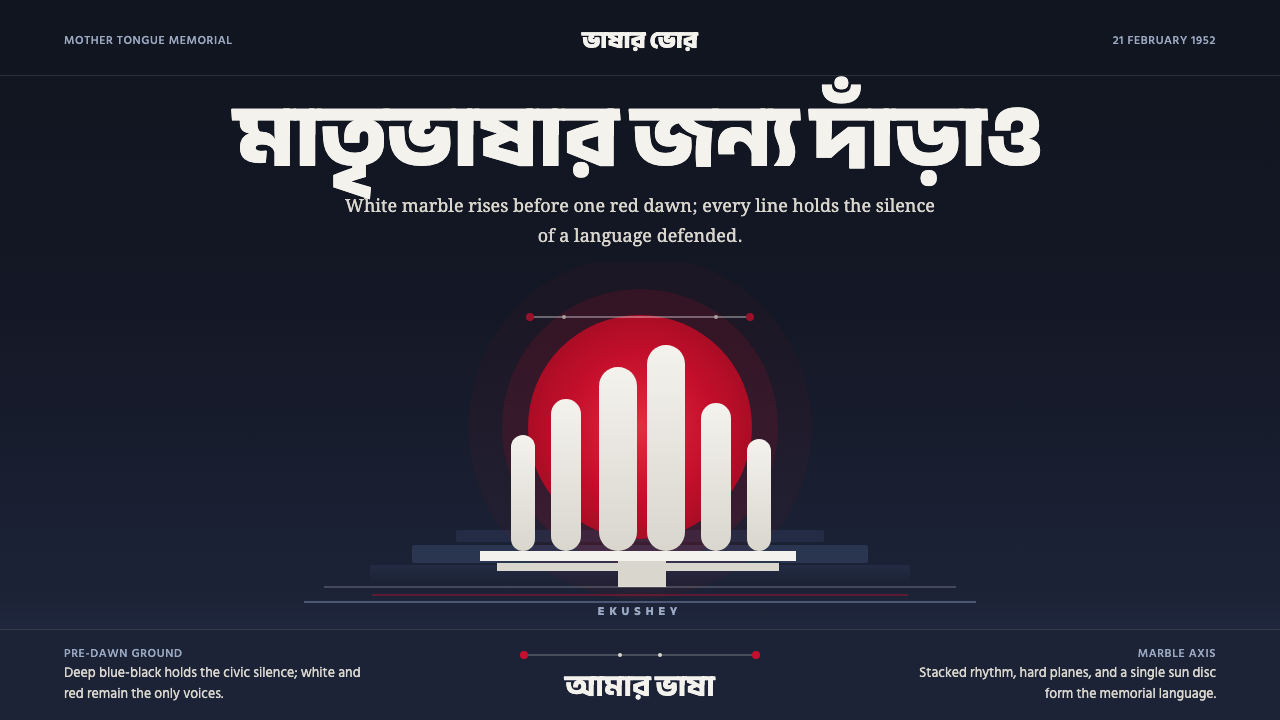 Dhaka Shaheed MinarSolemn before dawn. Marble columns and one red sun hold the page in civic sil…
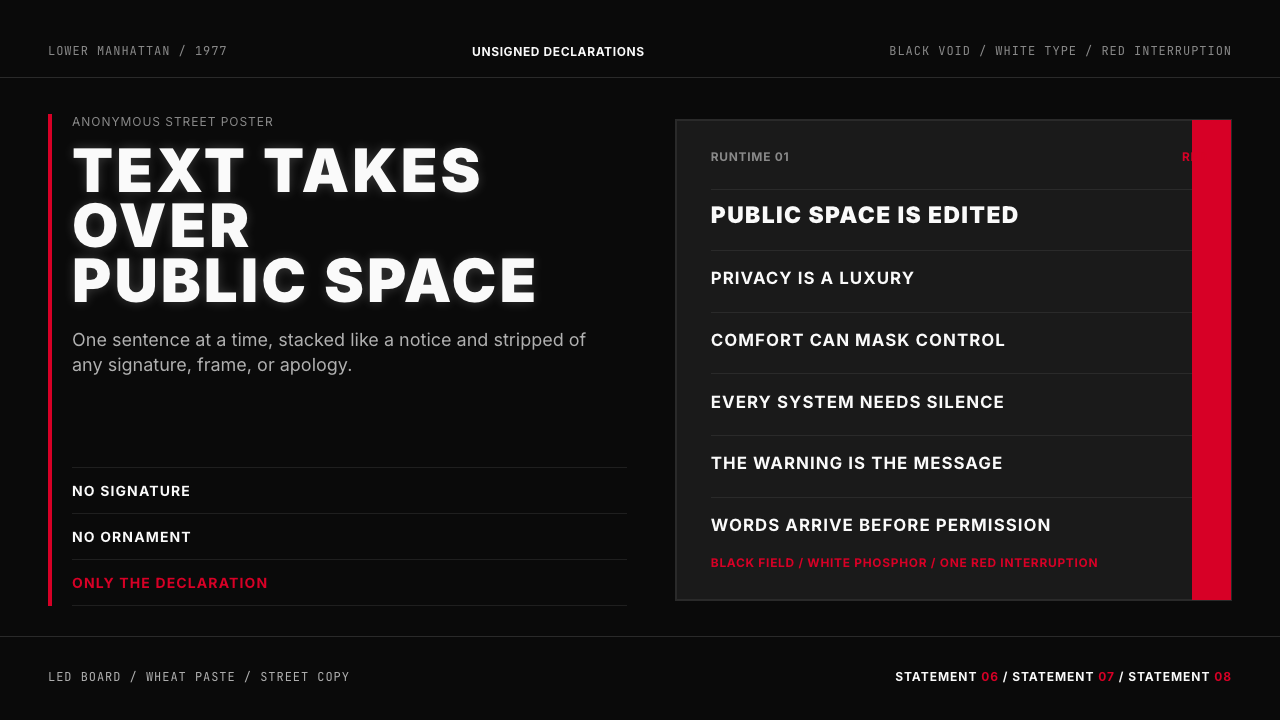 Jenny Holzer Truisms (1977)Austere declarations. White all-caps on black, cut by a single red warning.
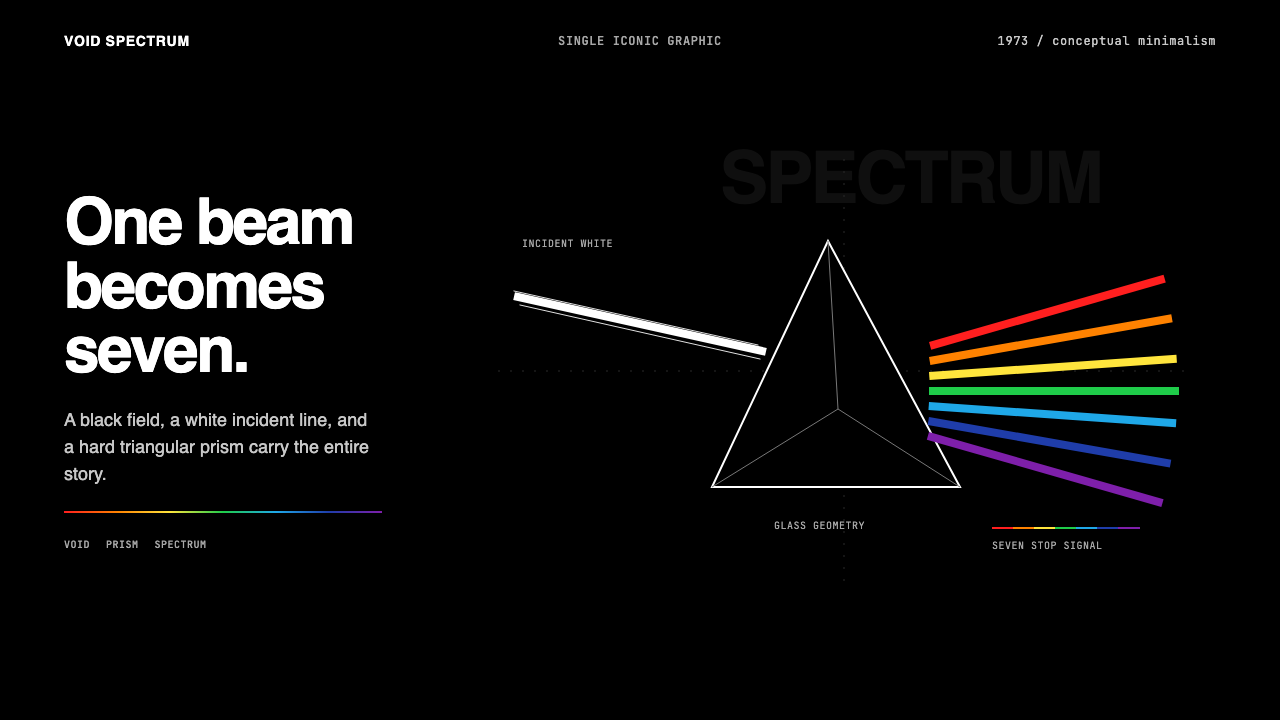 Pink Floyd — Dark Side of the MoonOne image does everything. Black void, white beam, hard prism, seven exact co…
 Olivetti Pintori (1955)Industry becomes poetry. Cream paper, machine red, and hard geometry abstract…
 Akzidenz-Grotesk BertholdObjectivity in black ink. White grotesque type, hard grid, one rationed red b…
 Off-White (Virgil Abloh era)Industrial irony, labeled. Yellow stripes and Helvetica quotes turn luxury in…