What is Jenny Holzer Truisms (1977)?
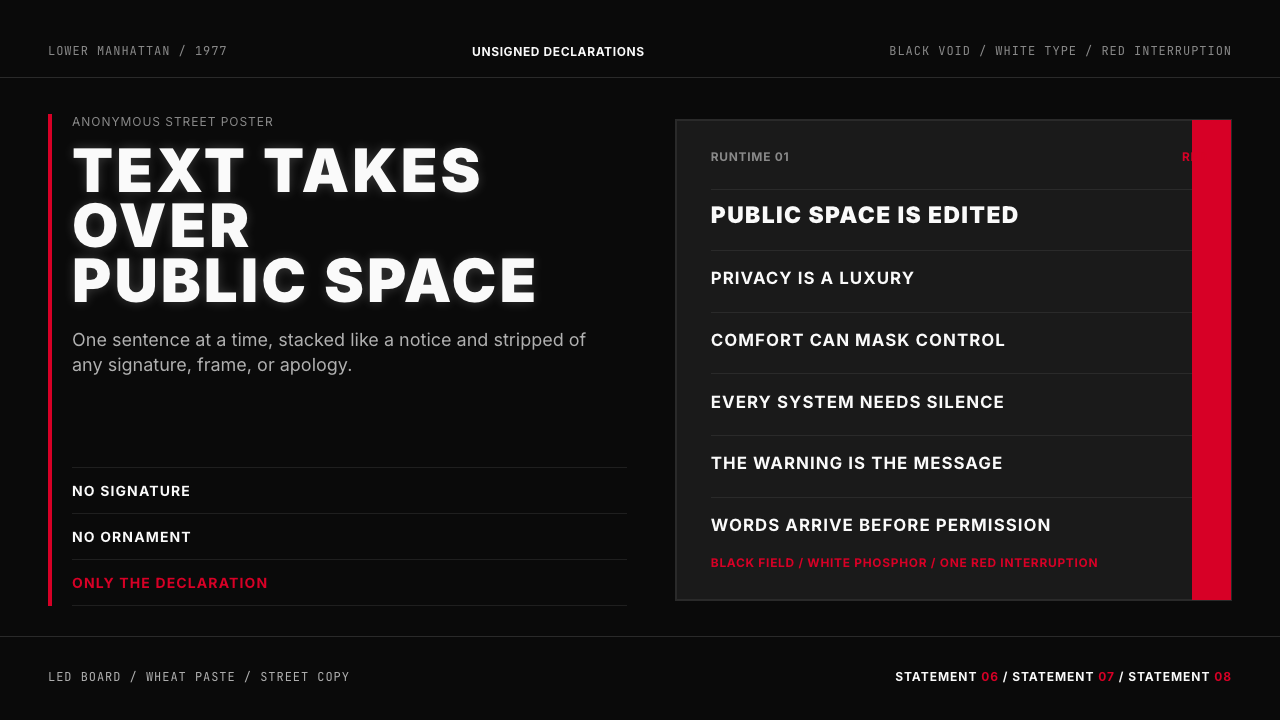
Jenny Holzer reduced art to a single weapon: a declarative sentence set in all-caps type, pasted anonymously onto Lower Manhattan walls in 1977 — no signature, no gallery, just language invading public space.
Jenny Holzer Truisms (1977) in brief
Jenny Holzer Truisms is a visual system built entirely on language as image. Beginning in 1977, Jenny Holzer produced a series of anonymous broadsheets — hundreds of declarative sentences set in all-capitals, wheat-pasted across Lower Manhattan without attribution or explanation. The sentences ranged from the darkly ironic to the genuinely unsettling: statements that sounded like proverbs but twisted mid-thought. There was no author to argue with; there was only the words on the wall.
The design system that emerged from this practice is defined by its radical austerity: a void black ground, high-contrast white type set in a blunt, industrial letterform, and a single red accent reserved for warnings or the sharpest provocations. Color is not decoration here — it is syntax. White speaks; red screams; black swallows everything else. The result is an aesthetic that functions equally well as a street poster, an LED scrolling board, or a digital interface: a surface that is entirely type, entirely statement, with nothing softening the collision between viewer and text.
What distinguishes this system from generic dark-mode minimalism is its conceptual backbone. Every formal decision — the all-caps setting, the absence of punctuation hierarchy, the near-total suppression of imagery — is in service of a specific communicative posture: the anonymous public declaration. The text is not labeled, not attributed, not framed. It arrives as if from nowhere and demands to be reckoned with.

Where does Jenny Holzer Truisms (1977) come from?
In the autumn of 1977, Jenny Holzer was a recent arrival to New York City, studying in the Whitney Museum's Independent Study Program. The program assigned students a reading list of dense critical theory — texts by Marx, Freud, structural linguists, feminist theorists. Holzer found herself fascinated and alienated in equal measure. Her response was to distill the contradictions she encountered into short, declarative sentences and take them directly to the street. She typed them up, printed them on inexpensive broadsheet paper, and began wheat-pasting them across Lower Manhattan — on construction hoardings, building walls, telephone poles — without her name attached.
The initial Truisms series comprised approximately 250 individual statements. They were presented as a list, alphabetized with no hierarchy: 'A little knowledge can go a long way' sat beside 'Abuse of power comes as no surprise.' The alphabetical ordering was deliberate: it refused to rank the statements by importance, refused to impose a narrative. Each sentence arrived on equal footing, which made the cumulative effect stranger and more disorienting than any single statement. Passersby who saw only a fragment encountered a different work than those who read the full list; this contingency was built into the project from the start.
The Truisms were immediately contextually radical because they occupied the same visual register as commercial advertising and political signage — mass-printed text in public space — but without a product, a party, or an author. This confusion of categories was intentional. Holzer was working in the tradition of Conceptual and language-based art pioneered by Lawrence Weiner and Joseph Kosuth, artists who argued that an idea stated in language is itself a complete artwork. She was also, whether explicitly or not, operating within a feminist-conceptual practice that questioned who gets to speak in public and on what terms.
By the early 1980s, the project expanded into new media. Holzer began working with electronic LED signs — the scrolling boards then appearing in commercial spaces — and produced work for Times Square's Spectacolor board in 1982, one of the first works of public digital art. The LED medium was a perfect match: the scrolling text mimicked the language of news tickers and stock displays, embedding her statements inside the visual infrastructure of financial and informational power. Later works appeared in museum atria, government buildings, and stadiums. The formal vocabulary remained constant across all these scales — all-caps type, high contrast, minimal color — because the posture of anonymous declaration required no elaboration.
What defines the Jenny Holzer Truisms (1977) look?
Black Ground as Void
The background in Holzer's system is not dark gray or charcoal — it is an absolute, light-absorbing black. This is not a design choice for legibility or sophistication; it is a conceptual stance. The void black ground eliminates all environmental context, all surface warmth. Text floats in it as if projected rather than printed. Nothing competes with the words. Every other color — white, red — reads with maximum intensity against this ground precisely because the ground offers nothing of its own.
All-Capitals as Tone
Setting text in all capitals removes the visual cues we normally use to infer tone — question marks, italics, mixed case that signals proper nouns versus common speech. The result is a flattened, assertive register: every statement arrives with equal authority, whether it is genuinely provocative or deceptively bland. All-caps also reads at a distance, functioning as signage rather than reading text. This double function — readable up close as statement, legible at a distance as signal — is built into the typographic choice from the outset.
Red as Alarm
Red appears in the system only when the content or context demands an escalation of urgency — a warning, a provocation at the limit of what white text can carry. It is never decorative, never applied to a header simply for visual interest. Because red is withheld almost everywhere, its appearance carries disproportionate weight: the eye goes to it immediately, and the content it marks is understood as charged. This scarcity is the mechanism. Using red liberally would collapse the system into generic alert design.
Text as the Only Image
Holzer's system contains no illustration, no photography, no iconography beyond the letterform itself. The type is not a label on top of an image; it is the entire surface. This is a radical inversion of most communication design, where text explains images. Here the text must carry all the visual weight, all the emotional load, and all the information simultaneously. This constraint demands that every typographic decision — size, weight, spacing, case — work harder than it would in a mixed image-text environment.
LED Register and Scrolling Temporality
The LED scrolling board — where a single sentence moves across a dark field letter by letter or word by word — is the system's most characteristic output. The temporality this imposes is essential: the viewer cannot take the whole statement in at once. Reading becomes a form of waiting; revelation is rationed. This has direct design implications. Layouts and interfaces inspired by this system should treat text as event rather than as static label — something that arrives, commands attention, and passes. The pacing is part of the content.
Anonymity as Formal Device
The original Truisms carried no byline, no brand mark, no URL. This absence of attribution is not an oversight — it is a structural decision that changes how the text is received. An authored statement invites arguments about the author's credibility, intention, or agenda. An anonymous statement must be argued with on its own terms. Design systems inspired by this work sometimes misapply this principle by adding prominent logos and authorship signals, which dissolves the tension entirely. The aesthetic works best when the communicative surface is allowed to stand without an owner.
Compression and Aphoristic Rhythm
Every Truism is a single sentence. No sub-clauses extend into a second line of thought; no qualifications hedge the assertion. This compression is formal as well as rhetorical — short, blunt statements fill a line without awkward widows or orphans, read quickly at a glance, and embed in memory. Design work in this mode should resist the urge to expand: a five-word header operates differently than a fifteen-word one, and the system's power diminishes with each additional word that could have been cut.

Who shaped Jenny Holzer Truisms (1977)?
Born in 1950 in Gallipolis, Ohio, Holzer studied painting before arriving in New York in 1977. Her shift from studio painting to anonymous street intervention was rapid and deliberate: she recognized that the gallery system framed art in ways that neutralized its confrontational potential. By taking text to the street — and later to LED boards, projections on buildings, stone benches engraved with charged phrases, and museum atria — she maintained the work's ability to surprise and implicate unprepared viewers. Major public projects include the 1982 Times Square Spectacolor board, installations at the Guggenheim Museum New York in 1989, and the United States Pavilion at the 1990 Venice Biennale, where she became the first woman to represent the United States solo.
A peer and near-contemporary of Holzer, Kruger developed a related but distinct practice: she combined cropped black-and-white photography with bold red banner text in a style derived explicitly from magazine advertising layouts of the 1950s and 1960s. Where Holzer's system is pure language on void, Kruger's appropriates the visual grammar of mass media. The two practices are frequently paired in discussions of language-based feminist-conceptual art, and together they established the template for text-driven public visual art that has been widely imitated in graphic design, street art, and social media visual culture.
Weiner is one of the founding figures of Conceptual art's language-based wing. Beginning in the late 1960s, he produced works consisting entirely of text — declarative statements about actions, materials, and conditions — that could exist as printed matter, wall text, or simply as a verbal statement. He argued that the idea conveyed in language was the art; the physical object was optional. Holzer's Truisms are in direct dialogue with this position, extending it from the gallery context into truly anonymous public space and adding the dimension of ideological provocation.
A central figure of the Pictures Generation — the loose grouping of New York-based artists working in the late 1970s and 1980s who interrogated mass media, originality, and authorship — Levine is best known for re-photographing the canonical photographs of modernist masters and presenting them as her own. Like Holzer, she used appropriation and the removal of authorship as a critical tool. The Pictures Generation context is essential for understanding what made the Truisms radical: they emerged in an art world actively dismantling the authority of the singular author-genius and investigating how meaning is produced by systems rather than by individuals.
How do you use Jenny Holzer Truisms (1977) today?
The Holzer Truisms system is well-suited to any design context where language must bear the full communicative burden and where an authoritative, confrontational register is appropriate. Unlike decorative or illustrative styles, this system demands that the content itself be strong — the aesthetic cannot rescue weak copy. Before applying it, ensure that the statements, headlines, or messages it will carry are genuinely worth presenting at full intensity.
For presentation slides, this system is most powerful used selectively rather than throughout. A cover slide that foregrounds a single bold declaration in all-capitals against a void black ground sets a tone of urgency and authority that primes the audience before the first content slide appears. Content slides in a complementary minimal style — high-contrast, typographic, without decorative elements — can sustain the register without requiring every page to be as confrontational as the cover. Data slides benefit from the system's diagrammatic quality: visualizations rendered in white with a single red element for the primary finding, all against black, communicate a clear priority hierarchy without legend clutter.
For web interfaces, the system applies well to dashboards, alert systems, pricing pages, and any product where the primary interaction is reading and deciding rather than browsing. The approach prioritizes typographic hierarchy above all else: use a bold, industrial, uppercase treatment for primary labels, a lighter weight for supporting information, and reserve any accent color exclusively for the most urgent state — an overdue item, a critical alert, a top-tier pricing option. Navigation should be purely typographic; any iconography should be reduced to the simplest possible geometric marker rather than a pictograph. The interface should feel like a display board, not a decorated application.
For editorial and marketing work, the style is effective for campaigns that need to communicate conviction and cut through visual noise. Full-bleed black panels with a single declarative statement work as hero sections, billboard treatments, or social media assets. The key is treating each surface as a poster rather than a page: one idea, one moment, maximum contrast. For email layouts or multi-column editorial formats, the system can be adapted by using a dominant black header band with white all-caps text above a lighter body-text region — maintaining the declaration-as-opening-gesture while allowing room for narrative detail below.
A common mistake is applying the Holzer aesthetic purely at the surface level — black backgrounds, white text, occasional red — without committing to the tonal discipline the system requires. The most frequent failure mode is hedging: softening the type treatment with mixed case, adding decorative supporting elements, using red as a general accent color rather than a reserved alarm. Each of these compromises individually seems minor, but together they dissolve the system's defining quality: the sense that the text arrived from nowhere and demands an answer. If the visual environment feels comfortable, the system has been misread.

Jenny Holzer Truisms (1977) — FAQ
Is this system appropriate only for dark themes, or can it work on light backgrounds?
The canonical Holzer Truisms format is black ground with white type, and the void-black quality is essential to the system's confrontational posture. A light-background inversion — white or near-white ground with black all-caps text — is possible but significantly changes the character of the work. The light version reads as more institutional, less urgent; it loses the sense of text materializing out of darkness. The light inversion works best as a secondary register within a system that leads with the dark canonical form — for example, body content pages in a presentation that opened with a black-ground cover statement.
How does this system differ from generic dark-mode design?
Generic dark-mode design uses dark backgrounds primarily for visual comfort in low-light environments, and it typically preserves a full typographic hierarchy — various weights, sizes, and colors creating a layered informational structure. The Holzer system uses black as a conceptual void, not a comfort measure. It suppresses hierarchy rather than elaborating it: all-caps flattens the typographic register; the near-absence of imagery removes any visual relief from the text encounter; color is rationed rather than applied for visual variety. The test is whether the design could function equally well in the opposite (light) mode without loss — if yes, it is dark-mode design, not Holzer-derived design.
Can this system be used for branding, or does the anonymity principle conflict with brand identity?
There is an inherent tension, but it can be managed productively. Holzer's work deliberately suppressed authorship; brand identity work necessarily asserts it. The resolution lies in applying the system's aesthetic vocabulary — the typographic discipline, the color severity, the confrontational text treatment — while allowing the brand mark to occupy a clearly designated position that does not compete with the declarative surface. Brands that successfully reference this system tend to use it for campaign work rather than identity systems: a product launch, a manifesto moment, a campaign that needs to feel like it arrived from outside the usual advertising register. Using it as the primary identity system requires a very high tolerance for severity and a product whose values genuinely align with what the aesthetic communicates.
What types of content work well as text in this system, and what falls flat?
The system rewards declarative, assertive language: statements that take a position, name a condition, or demand a response. Short sentences of five to twelve words tend to work best — long enough to contain a complete thought, short enough to land with impact. Superlatives, process descriptions, feature lists, and hedged claims ('we strive to,' 'we believe in') all struggle in this system: they lack the blunt weight that the visual environment demands. The aesthetic is essentially a magnifier — it amplifies the quality of the text beneath it. Strong, surprising, or genuinely true statements become powerful. Weak or corporate-safe language becomes visibly inadequate.
Is it appropriate to use actual Jenny Holzer Truisms texts in a design project?
The Truisms texts are Jenny Holzer's copyrighted literary works, not public domain material, despite their anonymous origins and public dissemination. Using them verbatim in a commercial design project without permission would constitute copyright infringement. The appropriate approach is to draw on the formal system — the typographic treatment, the color vocabulary, the compositional approach — while writing original declarative text suited to the project's actual content. The formal system can be legitimately referenced and applied; the specific texts cannot be reproduced without authorization. When the system is applied well, original text written in its spirit can carry equal authority to the source material.
Related design styles
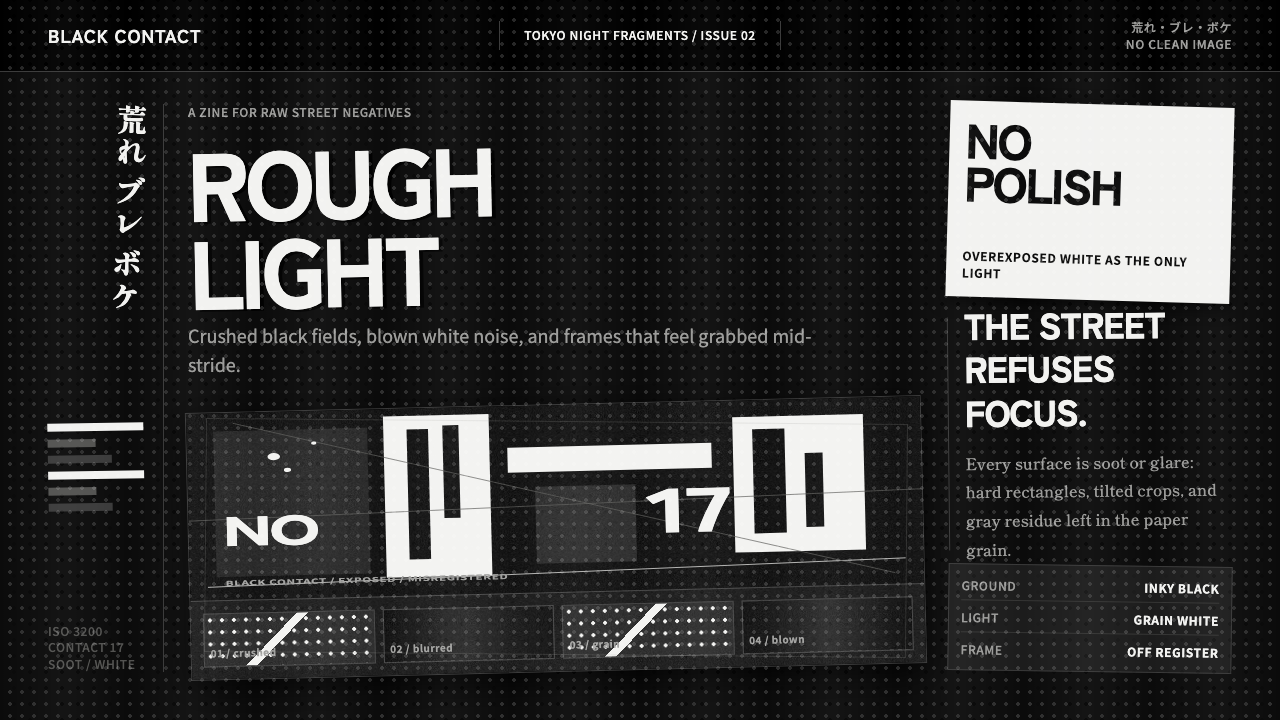 Daido Moriyama Are-Bure-BokeNothing is clean. Inky black, blown white grain, and tilted frames make the i…
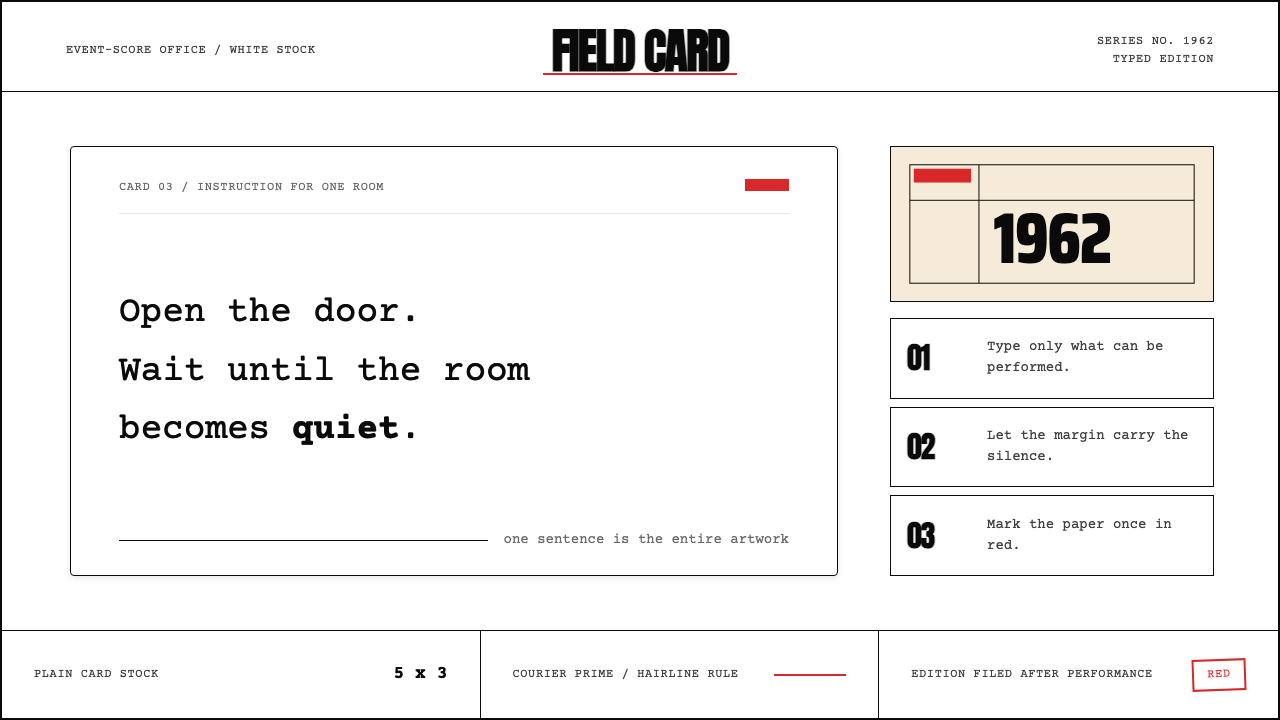 Fluxus Event Score (1962)Instruction becomes art. Courier on white card, hairline rules, one sharp red…
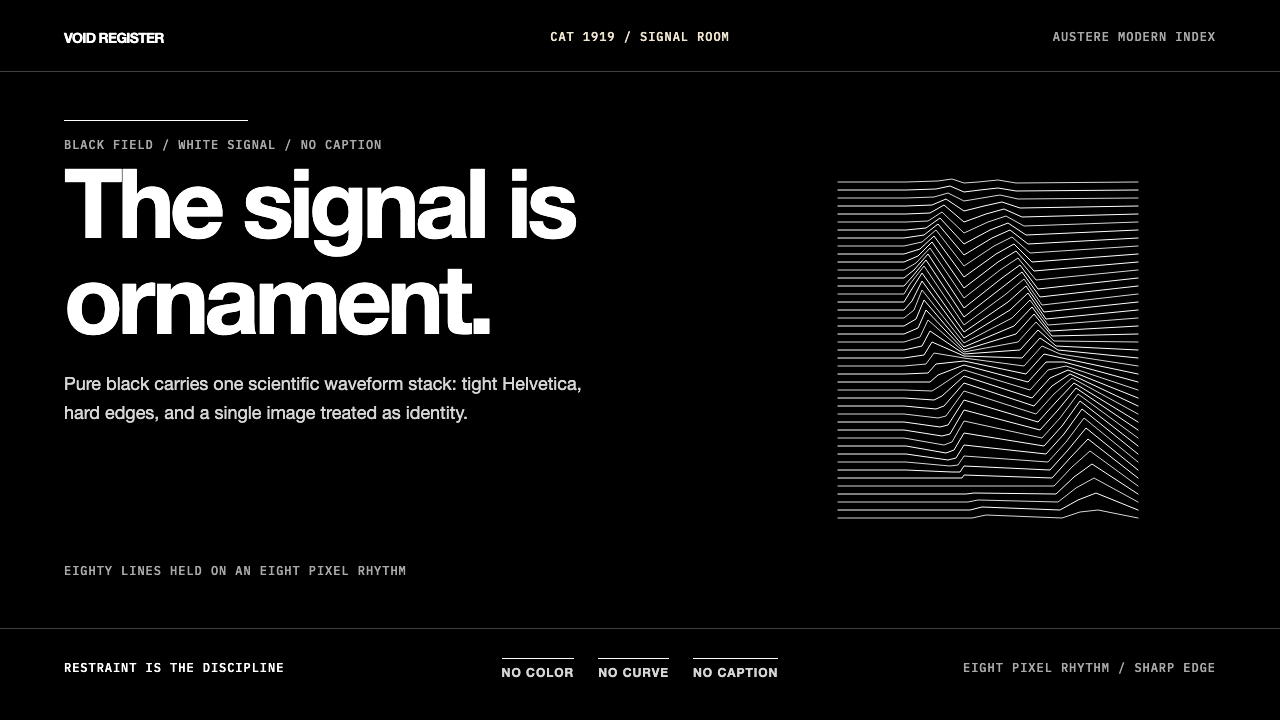 Joy Division — Unknown PleasuresRestraint becomes signal. Black field, tight Helvetica, and white pulsar line…
 Bowie — Ziggy StardustTheater at full voltage. Cream-on-black portrait cut by one red and electric-…
 Czech New Wave PosterConcept before spectacle. Ink black, bone type and one poster-red incision fr…
 Fela Kuti Afrobeat Album (1976)Protest rhythm made visual. Red-yellow-green blocks and compressed Anton shou…