What is Fela Kuti Afrobeat Album (1976)?
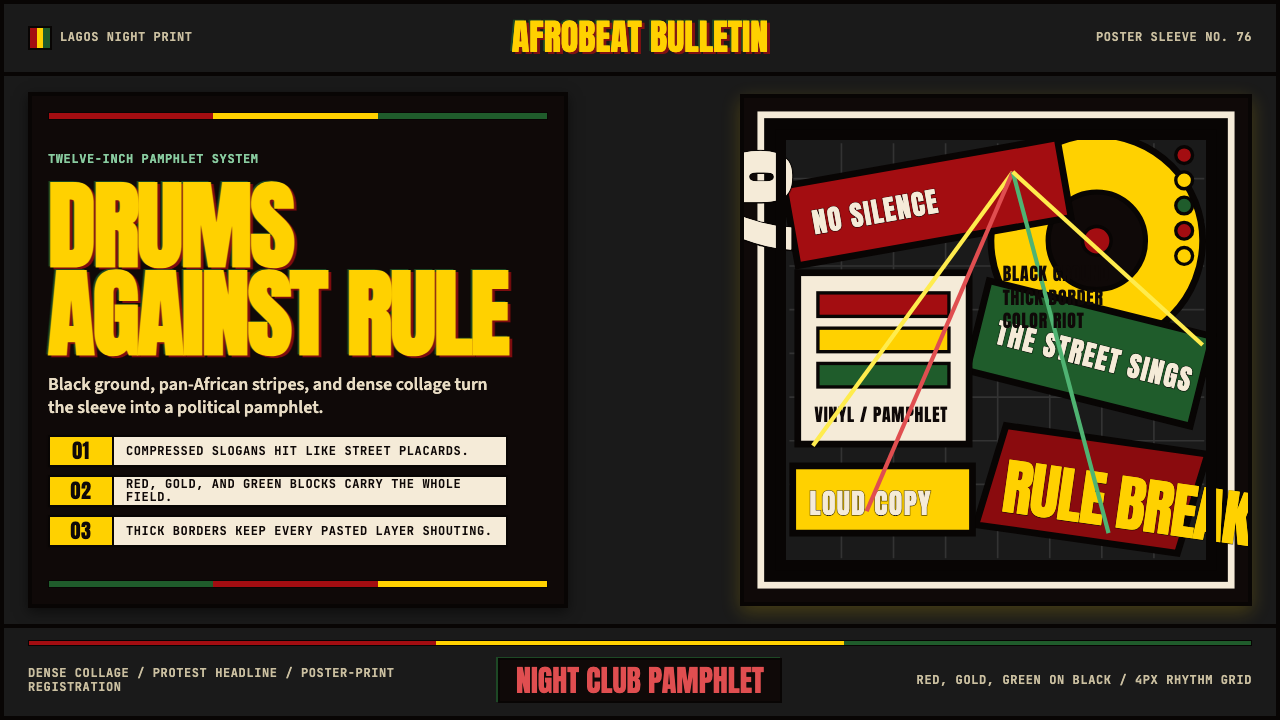
Protest music made visual: the scorched-black, pan-Africanist album sleeves of Fela Kuti's Lagos recordings fuse dense collage illustration, compressed headline type, and saturated red-yellow-green into a graphic language that shouts as loudly as the music inside.
Fela Kuti Afrobeat Album (1976) in brief
The Fela Kuti Afrobeat Album design system draws from the visual universe of Fela Anikulapo Kuti's peak recording years, roughly 1972 through 1985, and in particular the sleeve art that artist Lemi Ghariokwu created for Fela's Kalakuta and Coconut releases throughout the mid-to-late 1970s. Those covers — dense with hand-drawn figures, political symbolism, bold lettering, and compressed color fields — were simultaneously music packaging and political broadsheets, circulating through Lagos markets and record shops as contraband challenges to the military governments of the period.
Aesthetically the system is loud, confrontational, and unapologetically loud. A deep black ground anchors everything; against it, the pan-Africanist triad of red, yellow, and green — the colors shared by the flags of Ghana, Guinea, Senegal, and other post-independence African states — blazes at full saturation. Type is set in compressed bold sans-serif letterforms that behave like protest-placard headlines rather than book typography. Borders are thick and black, evoking the registration marks of a silkscreen print. Illustrations, where present, are dense with layered figures and symbolic detail rather than clean negative space.
Unlike design systems rooted in reduction and restraint, this aesthetic celebrates accumulation and intensity. It is not trying to whisper; it is trying to fill a room. That energy, channeled through contemporary digital work, produces interfaces, covers, and presentations with a rare quality: they read as urgent.

Where does Fela Kuti Afrobeat Album (1976) come from?
Afrobeat as a musical form was codified by Fela Kuti and his drummer Tony Allen beginning around 1968, blending Yoruba traditional music, highlife, James Brown-style funk, and free jazz into extended groove compositions that could stretch to twenty minutes or more on a twelve-inch single. Fela, educated in London at the Trinity College of Music and politicized by Black Power movements he encountered during a 1969 visit to the United States, returned to Lagos with a dual mission: to make music that belonged explicitly to Africa and to use that music as explicit political commentary on colonial legacies, military rule, and Western cultural imperialism.
The visual identity of that mission was largely the creation of Lemi Ghariokwu, who began collaborating with Fela in 1974 at the age of eighteen and went on to design approximately twenty-six album covers over the following decade. Ghariokwu had no formal design training; he was a self-taught illustrator who absorbed influences from Egyptian hieroglyphics, traditional Yoruba textile patterns, American underground comics, and the psychedelic poster art circulating in Lagos at the time. The aesthetic he developed was emphatically hand-made: dense ink illustration, hand-lettered type, and saturated color blocking that looked more like an agitprop pamphlet than a commercial record sleeve.
The political context was inseparable from the visual language. Fela's Kalakuta Republic — the communal compound in Lagos where he lived with his musicians and wives, and which he declared a sovereign state exempt from Nigerian law — was a physical embodiment of resistance. The album covers functioned as the visual proclamations of that republic. When the Nigerian military raided and burned Kalakuta in February 1977, killing Fela's mother, the subsequent album 'Coffin for Head of State' depicted a coffin being delivered to the presidential residence — an image so politically charged that the record was effectively banned. The covers were not decoration; they were evidence.
The pan-Africanist color palette had specific historical resonance. Red, yellow, and green — sometimes called the pan-African colors — were popularized by Marcus Garvey's UNIA movement in the early twentieth century and then adopted by numerous African independence movements and post-colonial states. Their appearance on Fela's album covers was a deliberate alignment with a broader diasporic political tradition, linking the music to a geography that extended beyond Nigeria to the entire African continent and its descendants worldwide. The deep black ground was equally intentional: night as context, shadow as resistance, darkness as the ground from which something explosive emerges.
What defines the Fela Kuti Afrobeat Album (1976) look?
Color: Black Ground with Pan-African Triad
The palette is built on a deep, near-absolute black ground that functions as the visual equivalent of night or silence — the condition against which everything else asserts itself. Against this ground, red, yellow, and green operate at maximum saturation, with no tinting, shading, or modulation. Red carries urgency and blood; yellow carries gold, sun, and mineral wealth; green carries land, vegetation, and the continent itself. Unlike restrained palettes where color is used sparingly as accent, this system treats all three colors as primary actors, each given territory, with black as the stage. White appears rarely and only for type or detail, never as a ground.
Typography: Compressed Placard Energy
Headlines are set in compressed bold sans-serif letterforms — type that has been squeezed horizontally so that more characters fill a given width, creating a dense wall of text that reads as a shout rather than a statement. The visual effect is closer to a protest placard or newspaper front page than to conventional music packaging. Letter-spacing is tight, sometimes touching. Type is often reversed out of a color block — white or yellow letterforms on red or black — rather than set on a white ground. Body text, where it appears on covers or liner notes, uses a sharp contrast in scale to the headline, reinforcing the urgency of the primary message.
Illustration: Dense Collage and Political Allegory
The illustration style is characterized by maximum density: figures are layered on figures, symbols overlap symbols, and negative space is treated as wasted opportunity. Ghariokwu's drawings are executed in a bold ink line that holds up at the scale of a vinyl sleeve and reads clearly even when reproduced in high contrast. The imagery is allegorical and specific: military figures, dancing bodies, the Lagos skyline, traditional masquerades, courtroom scenes, and abstract political symbols all appear in the same composition without hierarchy of realism. It is documentary and surreal simultaneously — Nigerian editorial cartooning crossed with West African ceremonial art.
Borders: Thick Silkscreen Framing
Heavy black borders frame compositions in a way that echoes silkscreen poster printing, where borders emerge naturally from the layering of ink on paper and the registration process. These borders are structural rather than decorative: they define the edge of the visual field, separate zones of color and illustration, and give the whole composition the feel of a printed broadsheet or pamphlet. Within compositions, thick rules and dividers operate similarly — separating headline from body, image from text — with a weight that reinforces the system's confrontational character.
Texture: Ink, Grain, and Handmade Character
Unlike digital-era design systems built on smooth gradients and pixel-perfect edges, this aesthetic carries the texture of its original production process. Ink bleeds slightly at edges; solid color fields have a slight grain or variation suggesting offset lithography or silkscreen. This is not imperfection — it is the system's honest signature. In contemporary applications, reproducing this quality requires resisting the temptation of perfect digital flatness: a slight texture overlay, a rough edge on a color block, or hand-lettered accents can preserve the handmade urgency without descending into nostalgic pastiche.
Composition: Full-Bleed Intensity
Compositions fill their format completely, with no comfortable margins and no quiet corners. Color blocks and illustrated zones push to the edges. Where a conventional design system might leave breathing room, this one fills it with another figure, another declaration, another stripe of color. This full-bleed intensity is not a failure of restraint — it is a formal argument that silence is complicity. The arrangement of color zones tends toward horizontal banding — broad stripes that echo both the structure of a flag and the visual logic of a vinyl record label.
Symbol and Text Integration
Text and image are treated as equals in this system, neither subordinate to the other. Headlines can interrupt an illustration; a figure can overlap a block of type; the artist and album name can be embedded directly within a drawn scene rather than isolated in a typographic zone. This integration echoes traditional West African textile and object design, where pattern and symbol carry communicative content inseparable from their visual form. The result is a surface where reading and looking are simultaneous rather than sequential acts.

Who shaped Fela Kuti Afrobeat Album (1976)?
Fela Kuti (1938–1997) was the musician, bandleader, and political activist whose recordings provided the content and context for the visual system described here. Trained in London and radicalized by exposure to the American Black Power movement, he returned to Lagos and established Kalakuta Republic as a space of creative and political autonomy. His music — extended, polyrhythmic Afrobeat compositions performed by his rotating ensemble Africa 70 and later Egypt 80 — was inseparable from its visual presentation. The album sleeve was part of the political act. Fela was imprisoned multiple times by successive Nigerian military governments, and his persecution gave the visual language of his albums an urgency that was not metaphorical but biographical.
Ghariokwu (born 1955) is the Lagos-based artist who designed the majority of Fela's iconic album covers between 1974 and 1984. Beginning the collaboration at eighteen with no formal training, he developed a hybrid visual language that fused Nigerian editorial illustration traditions, traditional Yoruba symbolic imagery, and the international visual vocabulary of political poster art. His covers for albums including 'Expensive Shit,' 'Zombie,' 'Coffin for Head of State,' and 'Beast of No Nation' are now recognized as significant works of African graphic art independent of their function as music packaging. Ghariokwu continues to work as an artist and has lectured internationally on the political dimensions of his Fela-era work.
Tony Allen (1940–2020) was Fela's drummer and musical co-architect for over a decade, widely credited as the rhythmic inventor of Afrobeat. His contribution to the design system is indirect but essential: the polyrhythmic, layered structure of the music — multiple rhythmic patterns cycling against each other at different intervals — has a direct structural analogy in the visual system's approach to layered color fields, overlapping illustration, and multiple competing visual rhythms occupying the same surface simultaneously. Understanding Allen's rhythmic logic helps explain why the visual system looks the way it does: it is not chaotic accumulation but structured density.
Femi Kuti (born 1962), Fela's eldest son, continued performing and recording Afrobeat from the 1990s onward, and the visual language associated with the tradition extended into his album and concert work. Femi's visual productions draw from the same foundational palette and typographic intensity while incorporating influences from the subsequent decades of African graphic design, digital production tools, and international music marketing. His continuation of the tradition demonstrates that the visual system is not frozen in 1976 but is capable of evolution while retaining its core character — a useful reference point for designers working with the style today.
Marcus Garvey (1887–1940) was the Jamaican-born Black nationalist leader whose Universal Negro Improvement Association popularized the red, black, and green pan-African color combination in the early twentieth century. That combination — in Fela's visual system modified to red, yellow, and green against black, aligned with the colors of independent African states — connects the album covers to a diasporic political tradition that predates Nigerian independence by four decades. Designers working with this system should understand that the color choices are not arbitrary or purely decorative: they are a precise historical citation with a specific political meaning.
How do you use Fela Kuti Afrobeat Album (1976) today?
Applying the Fela Kuti Afrobeat Album system correctly requires accepting its core proposition: this is not a style that whispers. The visual energy comes from controlled intensity, not from decoration applied to a neutral layout. The starting point for any application is the deep black ground, from which the color, type, and imagery emerge. Designers who begin with a light background and try to add the other elements will find the system resists — the logic runs in one direction, dark to vivid.
For presentation slides, the system works powerfully on both cover and section-divider pages. A cover built in this style places the title in compressed bold type reversed out of a wide color band — red or yellow on black, or black on red — with an illustrative or photographic element occupying a second zone. The full-bleed approach means no slide title floats on empty white space; every element is grounded in a color field. Content slides should use a simpler version of the system: one dominant color zone at the top or left, a black type zone for body content, and the characteristic thick rule as a divider. Data slides can assign one color from the triad to each data series, with bars and segments appearing as solid saturated blocks against the dark ground — charts become geometric objects with the same assertiveness as the illustration style.
For web UI and dashboards, the system is particularly effective in contexts where urgency and clarity of status are required — monitoring dashboards, real-time data displays, alert systems, and platforms communicating about consequential information. The approach: black or very dark near-black background throughout, with red reserved for critical alerts and negative states, yellow or amber for warnings and active states, and green for positive or safe states. This color-to-state mapping aligns with established UI conventions while giving the interface a visual intensity that reinforces the seriousness of the information. For pricing pages, the three-color system maps naturally to tiered plans: one color per tier, with the recommended tier receiving the highest-saturation treatment.
For editorial and marketing work, the system produces striking visual impact in contexts where the message is intended to be urgent, politically inflected, or culturally assertive. Music releases, cultural event promotion, social justice campaigns, and platforms with an explicitly activist brand character are natural fits. The full-bleed approach translates well to social media formats: a square or vertical composition with the characteristic black ground, one or two color fields, and compressed headline type reads as distinctive at small sizes in a feed. For longer editorial formats — scrolling web articles or printed magazines — use the horizontal banding principle: alternate sections built from the triad colors and black, with type reversed where necessary for contrast.
A common mistake when applying this system is treating the pan-African colors as a purely decorative palette and the black background as a stylistic choice rather than structural elements with specific meaning. The result is work that borrows the surface appearance while losing the directional energy: colors that drift toward pastels, borders that thin to suggestions, type that reduces to conventional weight. A second common error is equating density with randomness — piling elements without the underlying structure of color zones, typographic hierarchy, and illustrative rhythm that makes the originals legible despite their complexity. If the composition is simply crowded rather than densely organized, the style is not being applied; it is being approximated.

Fela Kuti Afrobeat Album (1976) — FAQ
How does this style differ from other political poster traditions, such as Soviet Constructivism or Cuban revolutionary graphics?
The most significant difference is the role of illustration and the use of darkness. Soviet Constructivism and its descendants favor geometric abstraction, flat planes, and diagonal dynamism on light grounds. Cuban revolutionary graphics, particularly the ICAIC poster tradition, use bold color and silhouette but with considerable negative space and a more elegant relationship between figure and ground. The Fela Kuti system is categorically denser and more narrative: the illustration is figurative, symbolic, and crowded with specific characters and political references that reward close reading. The deep black ground is also distinctive — it places the work in night rather than daylight, which has a specific emotional and political valence absent from the lighter-ground traditions.
Can this style work for brands or products that have no connection to West African culture or political activism?
It can, but the question deserves honest consideration. The visual language is not culturally neutral — it carries the specific historical meaning of pan-Africanism, political resistance, and a particular moment in Nigerian cultural history. Using it decoratively, without awareness of that meaning, risks reducing a serious political aesthetic to surface style. That said, the underlying formal qualities — density, saturated color on dark ground, confrontational type — are applicable wherever urgency and directness are genuine values. The safest applications are those where the brand's actual values — loudness, cultural assertiveness, political clarity, night-time energy — genuinely align with the aesthetic's origins, rather than simply borrowing its visual drama.
How should photography be used within this system?
Photography enters the system most effectively when it is treated as an element to be composited rather than a window to be opened. High-contrast processing — pushing shadows to near-black and highlights toward the dominant color of the composition — integrates photographs into the color system rather than placing them in visual competition with it. Duotone treatment in the triad colors, particularly red-and-black or yellow-and-black, is historically resonant: it echoes both the color limitations of offset printing in Lagos in the 1970s and the high-contrast aesthetic of protest photography and reportage. Documentary photography of musicians, crowds, urban environments, and political gatherings is thematically appropriate; aspirational lifestyle photography is not.
What is the difference between using this style and simply using a dark background with bright colors?
The difference lies in specificity and structure. Many contemporary dark-mode interfaces use bright color accents on dark grounds — neon on charcoal is a common combination in gaming and tech interfaces. What distinguishes the Fela Kuti system is the combination of specific color values from the pan-African tradition, the confrontational compressed headline typography, the dense illustrative layer, the thick structural borders, and the full-bleed composition without comfortable margins. Any one of these elements on its own produces a dark-ground design; all of them together, pulled from the same historical reference, produce the specific aesthetic being described here. Authenticity comes from understanding the whole system rather than selecting individual elements.
Is this style appropriate for digital animation and motion graphics?
Yes, and the musical origins of the system suggest specific motion principles. Afrobeat is a polyrhythmic form in which multiple rhythmic layers cycle at different intervals, creating a dense groove that evolves without ever fully resolving. Motion applied to this visual system should echo that structure: elements enter and exit at different rhythmic intervals rather than all animating together; color zones shift at a slower tempo than illustrative elements; type pulses or compresses at a rhythm distinct from the background. Hard cuts between full-bleed color states — a full screen of red suddenly replaced by a full screen of black — are more appropriate than smooth crossfades. The style resists gradual, ambient motion; it rewards percussive, decisive transitions.
Related design styles
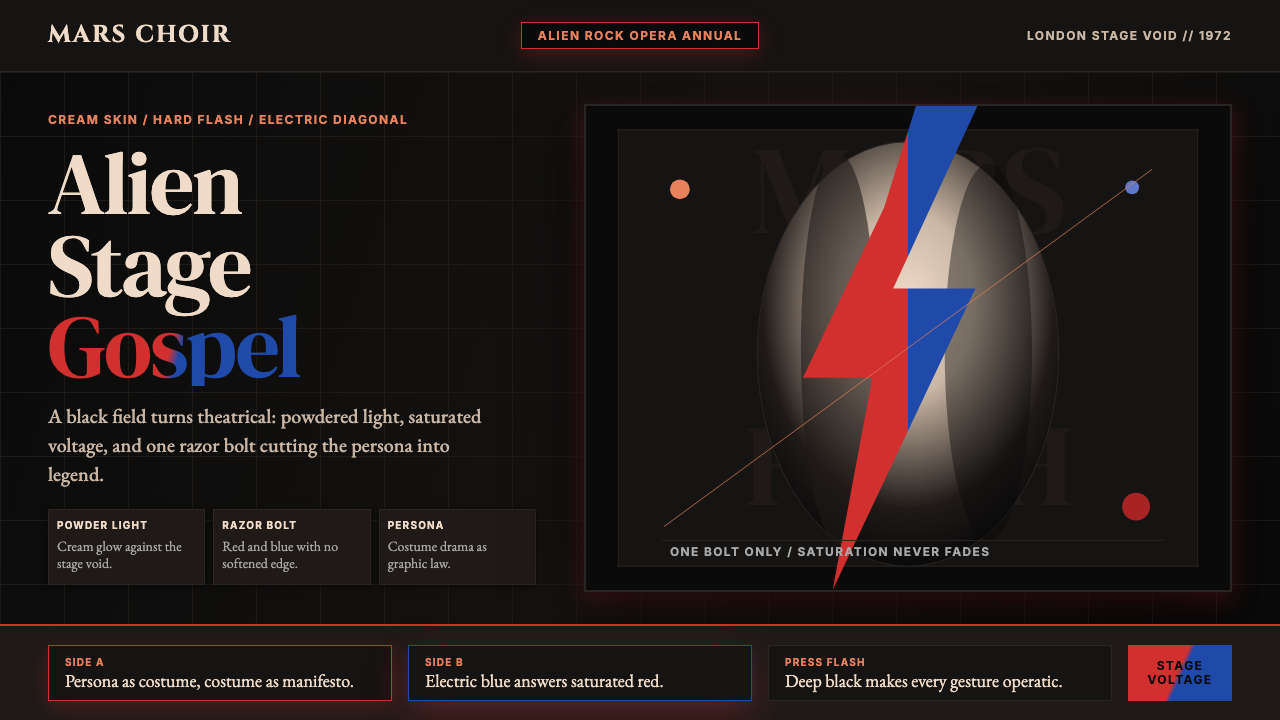 Bowie — Ziggy StardustTheater at full voltage. Cream-on-black portrait cut by one red and electric-…
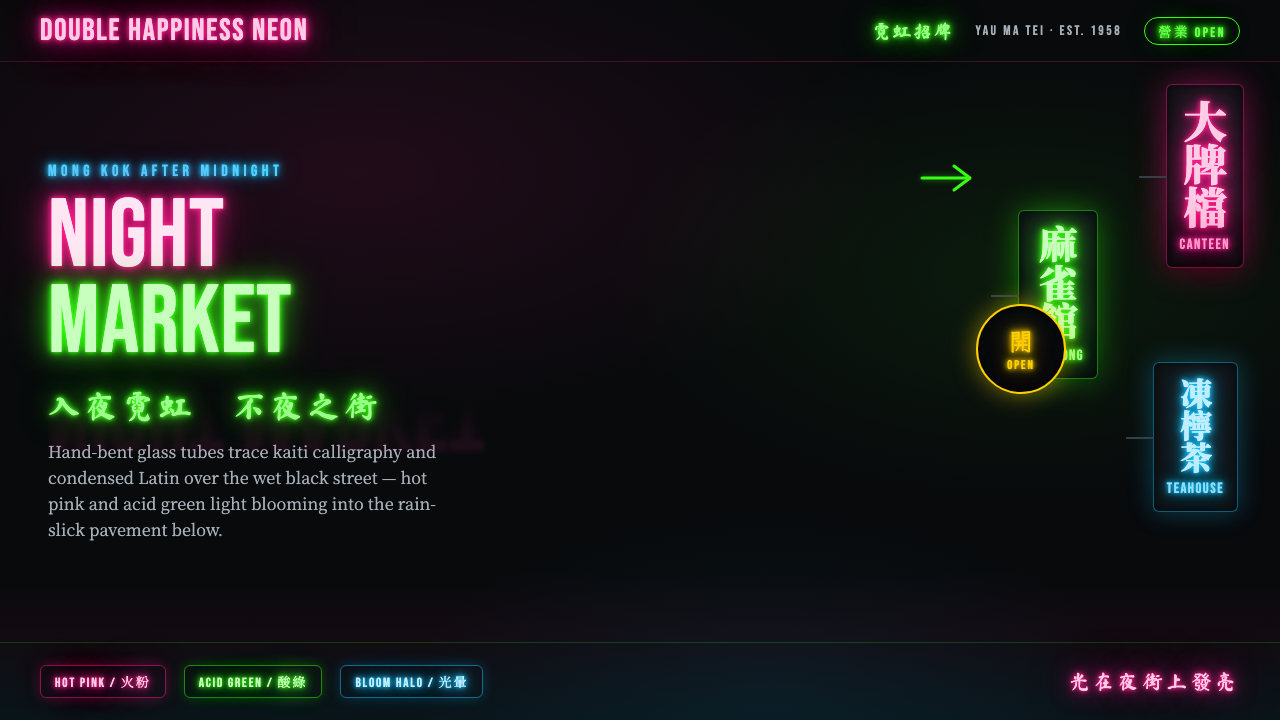 Hong Kong Neon SignboardsLight only reads against the wet black night. Hand-bent pink and green tubes…
 Hulk Gamma GreenDon't make us whisper. Muscle green, trouser purple, inked panels, Ben-Day ha…
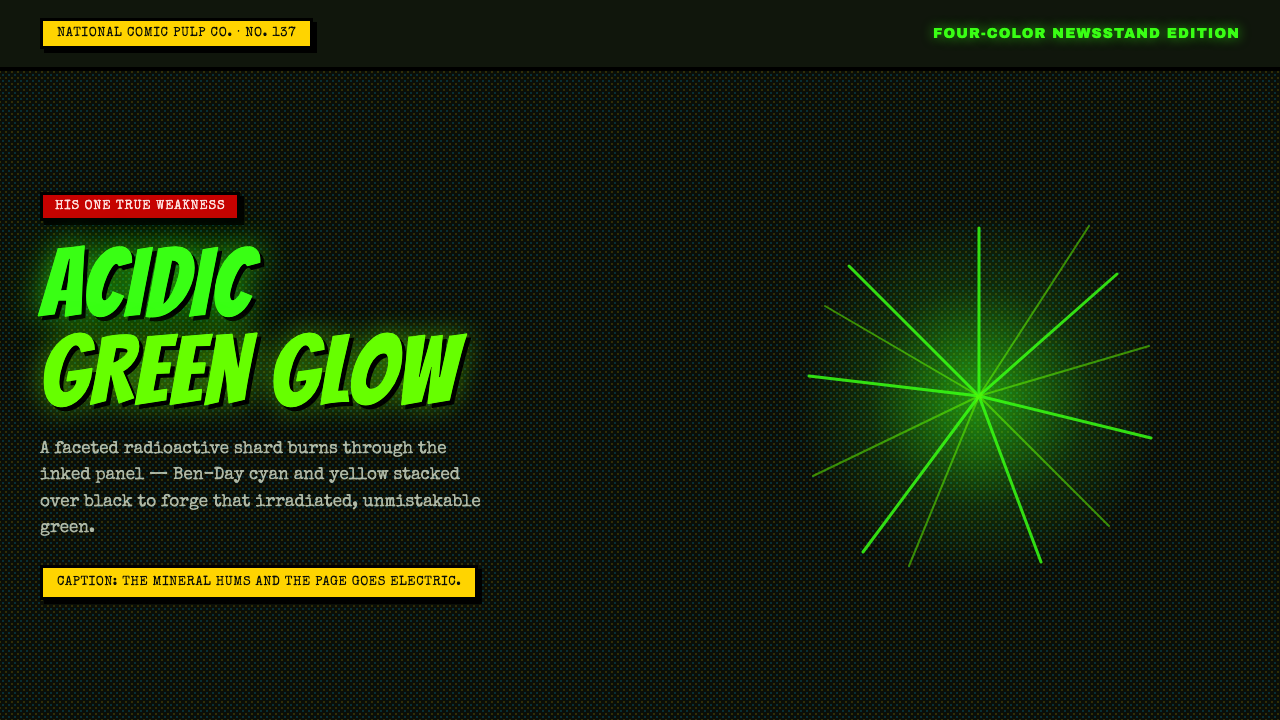 Kryptonite GreenRadioactive pulp glows hard. Neon green shard, black gutters, Ben-Day grit.
 Pinball BackglassGlows like paid light. Monoton type, black outlines, orange-red halftones cro…
 Buzludzha MonumentMonumentality without repair. Stained concrete frames cobalt tesserae, ruby g…