What is Levantine Keffiyeh Black & White?
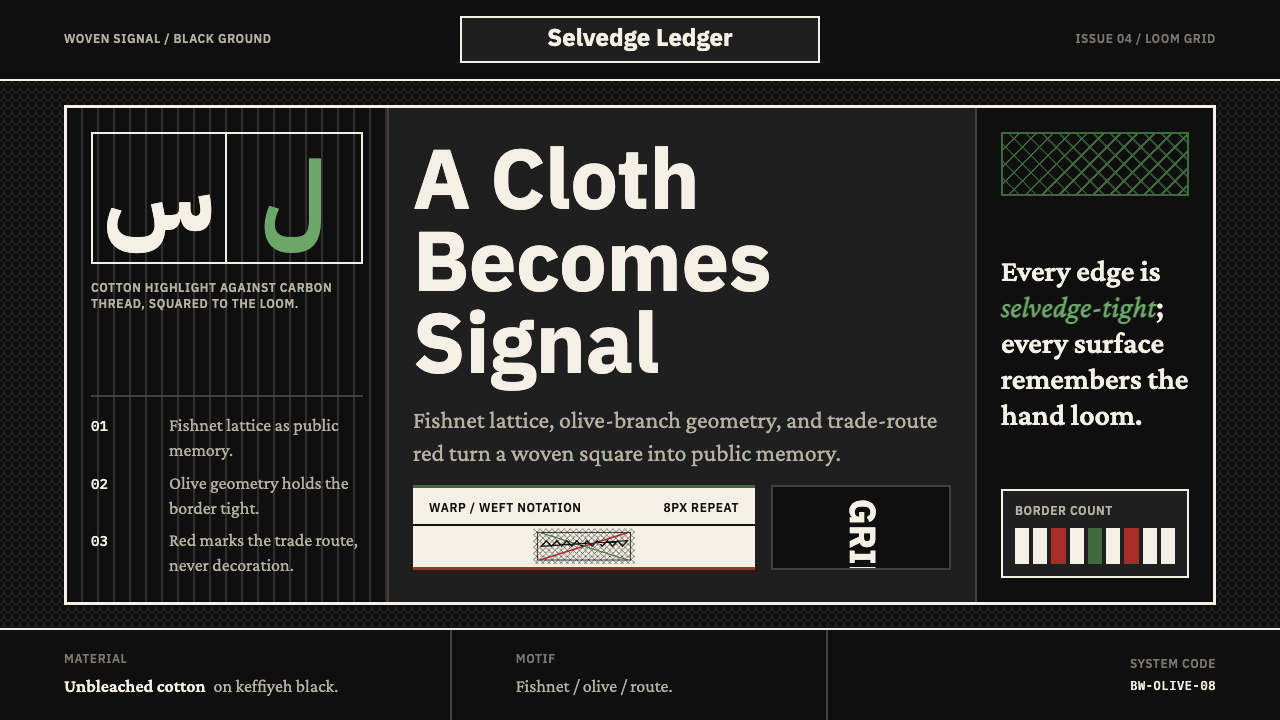
The Palestinian keffiyeh transforms a hand-woven cotton textile — fishnet lattice, olive-branch borders, trade-route motifs — into a design language built on political weight, geometric discipline, and unbleached restraint.
Levantine Keffiyeh Black & White in brief
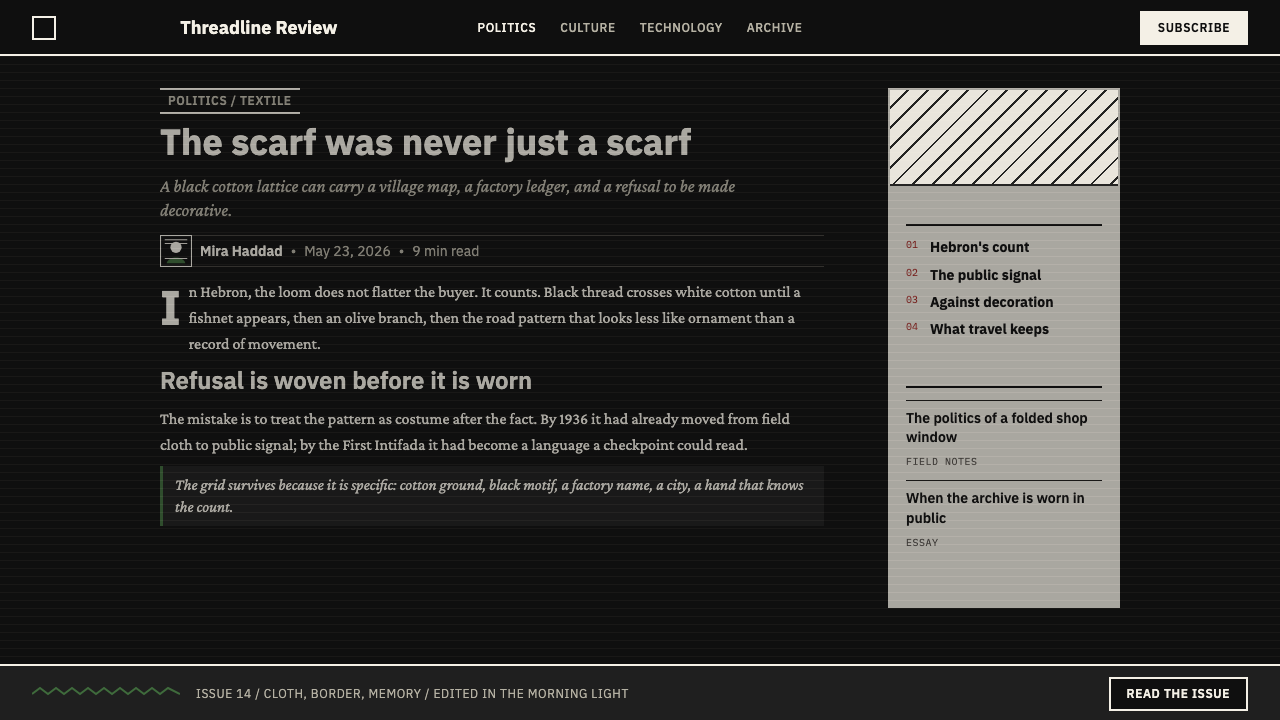
The Levantine Keffiyeh Black & White design system takes its entire visual logic from one of the world's most politically charged textiles: the Palestinian keffiyeh, a black-and-white cotton headscarf hand-woven in Hebron whose fishnet lattice, olive-branch borders, and trade-route chain motifs have carried decades of solidarity, resistance, and cultural identity. Where most historical styles abstract their source into generic ornament, this system insists on legibility — every pattern element remains traceable to the original cloth.
At its core, the style operates in a binary: deep, full black against unbleached cotton white. There is no softening gray ramp, no warm neutral midtone that would dilute the contrast. The fishnet lattice — the open diamond grid that gives the keffiyeh its woven texture — functions here as a structural ground layer, applied at low opacity so it reads as surface rather than decoration. Olive-branch chain motifs become dividers, section breaks, and ruling elements. The geometry is square-built throughout, honoring the orthogonal logic of a hand-loom grid where every thread crosses at a right angle.
The system carries an optional third accent derived from the trade-route variant of the keffiyeh, where a restrained olive green or a muted Palestinian red replaces pure white as the highlight tone. These accents appear sparingly — a single call-to-action, a status indicator, a highlighted row — and are never deployed simultaneously. The aesthetic discipline of the keffiyeh itself enforces the restraint: the original cloth uses pattern variation, not color multiplication, to create visual complexity.
Where does Levantine Keffiyeh Black & White come from?
The keffiyeh has been worn across the Greater Levant — Palestine, Jordan, Iraq, Syria — for centuries as practical headwear: protection against sun, sand, and cold. The specific black-and-white pattern that defines this design system crystallized in the early twentieth century around the villages and textile workshops of Hebron, known in Arabic as al-Khalil. The Hirbawi Textile Factory, founded by Yasser Hirbawi and later continued by his son Izzat Hirbawi, became the last operational keffiyeh loom in Palestine — a living artifact of a craft tradition that industrialization and conflict nearly extinguished.
The keffiyeh's transformation into a political symbol accelerated during the 1936 Arab Revolt, when Palestinian peasants adopted the black-and-white checkered headscarf as a marker of solidarity and resistance — one that could not be confiscated like a flag or a pamphlet. After 1948, the scarf traveled with the Palestinian diaspora, and by the 1960s it had become the signature item of the fedayeen, the Palestinian guerrilla fighters whose visual identity was photographed and broadcast worldwide. Yasser Arafat, who led the Palestine Liberation Organization for decades, made the keffiyeh draped in a specific triangular fold over the right shoulder into a personal emblem recognized internationally.
Leila Khaled, the Palestinian activist and PFLP member photographed holding a Kalashnikov in 1969, wore the keffiyeh in images that circulated globally through the 1970s and became touchstones for the Left's adoption of Palestinian solidarity iconography. By the 1980s and 1990s, the keffiyeh had migrated far beyond its geographic and political origins: it appeared on European student protestors, American anti-war demonstrators, and eventually in mainstream fashion. Each wave of adoption introduced new readings — solidarity symbol, anti-establishment marker, fashion accessory — while the original Hebron-woven cloth continued its contested, politically charged existence.
The keffiyeh-as-solidarity moment intensified again from the 2010s onward, particularly in the context of the Boycott, Divestment and Sanctions movement and renewed international attention to the Palestinian situation. The Hirbawi factory, which had nearly closed due to competition from Chinese-manufactured imitations, became a focus of conscious-consumer campaigns. For designers engaging with this visual system, the origin is not background context — it is structural information. The pattern's political legibility is inseparable from its aesthetic identity. Using it without that awareness produces work that is aesthetically coherent but historically illiterate.
What defines the Levantine Keffiyeh Black & White look?
Binary Palette
The foundational palette is an uncompromised pairing of deep black and unbleached cotton white — not pure optical white, but the warm, slightly cream tone of undyed cotton fiber. This distinction matters: the warmth of the cotton ground prevents the high-contrast palette from reading as sterile or clinical. Everything else — texture, pattern, depth — is produced through layering within this binary, not through additional hues.
Fishnet Lattice Ground
The open diamond lattice woven into the keffiyeh functions in this system as a structural texture applied beneath content layers. At very low opacity it reads as surface grain — the visual equivalent of feeling a woven cloth. At higher opacity it becomes an explicit decorative field. The key discipline is never allowing the lattice to compete with content; it exists to make surfaces feel material, not to demand attention.
Olive-Branch Dividers
The olive-branch border motif that runs along the keffiyeh's selvedge edge becomes, in interface and layout work, a primary structural divider. Rendered as a continuous chain pattern in fine line weight, it separates sections, marks hierarchy breaks, and functions as a ruled line that carries symbolic freight. The motif should be used sparingly — as a section separator or a single decorative rule — never tiled as background fill.
Square Grid Geometry
Every compositional decision in this system defers to the orthogonal logic of the hand-loom grid. Layouts are built on square or near-square modules. Rounded corners are excluded — the selvedge edge of a woven cloth is perfectly straight. Data visualizations, cards, containers, and image crops all share this hard-edged, right-angled geometry. The effect is one of structural inevitability: nothing feels arbitrarily placed.
Selvedge-Tight Edges
Where most contemporary styles allow generous bleed and visual breathing room at margins, the keffiyeh system draws inspiration from the tight selvedge edge of the woven cloth — the finished border where threads are locked in. In practice, this translates to confident, close-cropped compositions where content reaches near to the container boundary. Negative space is used precisely and intentionally, not as ambient air.
Trade-Route Accent
The classic black-and-white keffiyeh has a less common variant that introduces a third color — a muted olive green or a Palestinian red — representing the dye colors of the trade routes that historically connected the Levant to broader Mediterranean and Arabian networks. In this design system, one of these tones may be introduced as a single accent for interactive states, calls to action, or alert conditions. The accent is always singular: olive green and red never appear together.
Woven Surface Quality
The overarching sensory register of the system is textile rather than digital. Surfaces should feel woven — achieved through the lattice ground texture, through avoiding smooth gradient fills, and through favoring slightly irregular or hand-cut visual rhythms over mechanically perfect repetition. This quality distinguishes the style from purely geometric black-and-white systems that read as corporate or clinical. The imperfection is intentional: it is the signature of the hand-loom.

Who shaped Levantine Keffiyeh Black & White?
Yasser Hirbawi founded the Hirbawi Textile Factory in Hebron, which became the last Palestinian-owned keffiyeh manufacturer still using traditional looms. His son Izzat continued the operation after Yasser's death, maintaining hand-loom production in the face of severe competition from mass-manufactured imitations, particularly those produced cheaply in China from the 1990s onward. The Hirbawi family's factory is both the material source of the authentic pattern and a symbol of Palestinian artisanal survival — it represents the specific woven geometry that this design system directly translates.
As chairman of the Palestine Liberation Organization from 1969 until his death in 2004, Arafat made the keffiyeh — draped in a triangular fold over his right shoulder and pinned to suggest the shape of historic Palestine — into one of the most recognizable political garments of the twentieth century. His consistent wearing of the black-and-white pattern at every international forum, from the United Nations General Assembly to the Oslo Accords signing, transformed the textile from regional headwear into a global diplomatic symbol. For designers working with this system, Arafat's visual identity demonstrates how a single textile pattern can function as a complete communications strategy.
Photographed in 1969 by Eddie Adams's colleague Leroy Griffith, Khaled became one of the most visually circulated women in 1970s political photography. Her image — keffiyeh-draped, with a rifle — was reproduced on posters across Europe, the Middle East, and Latin America, cementing the keffiyeh's association with resistance movements globally and accelerating its adoption by left-wing solidarity movements far outside the Arab world. From a design-history perspective, Khaled's image marks the moment the keffiyeh pattern became an international graphic symbol, detaching from its textile origin to function as pure visual shorthand.
The collective decision during the 1936 Arab Revolt in Mandatory Palestine for urban Palestinian men to adopt the keffiyeh — previously rural headwear — as a mark of solidarity and as camouflage (making it harder for British authorities to identify urban organizers among peasant crowds) was a decisive moment in the textile's political biography. This strategic adoption transformed the keffiyeh from a class marker into a cross-class solidarity symbol, and established the pattern's association with organized resistance that persisted through every subsequent generation. The 1936 moment is the direct historical ancestor of the contemporary design system's political charge.
How do you use Levantine Keffiyeh Black & White today?
The Levantine Keffiyeh Black & White system is built for contexts where strength of conviction, cultural depth, and visual authority matter more than approachability or warmth. Before applying it, a practitioner must sit with the question of intent: the pattern carries political meaning that is actively contested. Applied thoughtlessly, it reads as appropriation; applied with awareness and purpose — in solidarity contexts, cultural editorial, documentary work, or explicitly political communication — it can be among the most powerful visual systems available.
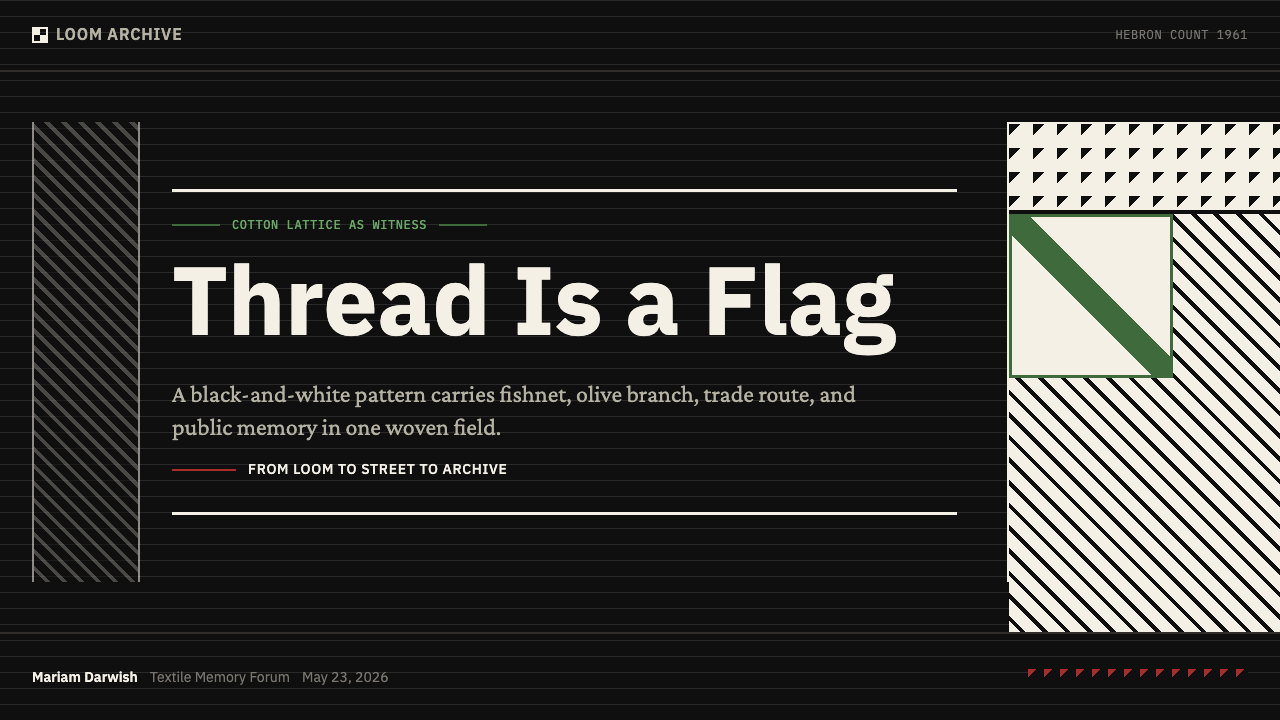
For presentation slides, the system performs best on high-stakes cover pages and section dividers where the binary drama of deep black against cotton white can be fully deployed. A cover built on this system should use one large structural element — a wide horizontal band of lattice texture, an olive-branch rule running the full slide width — as the compositional anchor. The title sits in bold, uppercase type with generous tracking; no decorative borders compete with the pattern elements. Content slides should strip back to near-white grounds with black type and the lattice texture dialed to near-invisible: let the cover's visual power carry forward as memory, not as constant repetition.
For web dashboards and data-heavy interfaces, the system offers a disciplined alternative to the generic light-gray-and-blue that dominates enterprise software. The binary palette maps cleanly to state differentiation: active rows use the cotton-white ground, inactive or empty states use a near-black field with reversed type. Data tables and charts built on the square-grid module system maintain the orthogonal rigidity that makes the style recognizable. A single trade-route accent — olive green for positive indicators, muted red for alerts — provides the semantic color layer without diluting the system's stark identity. Pricing pages benefit from the style's poster-like authority: a full-width hero in deep black with white headline type, a lattice-texture section break, then a clean white comparison table below.
For editorial and marketing work — particularly in publishing, documentary, or cultural journalism — the system lends gravitas and historical resonance to layouts that need to feel considered rather than produced. An article layout in this system uses a narrow primary text column with wide margins reserved for pull quotes set in high-contrast reversed type (white on black). Section headers appear as olive-branch-ruled breaks. Photography, when used, should be treated with high-contrast processing that flattens tonal range — mid-tones compressed, highlights pulled toward cotton white, shadows toward full black — so images feel continuous with the typographic field rather than interrupting it.
The most common mistake when applying this system is deploying the lattice texture at high opacity as a background fill across large surface areas. At full opacity, the lattice competes with every element placed over it, destroying the hierarchy the system depends on. The second common mistake is treating the black-and-white palette as license for theatrical high-contrast without restraint — stacking bold reversed type over lattice-textured dark panels while also using both accent colors simultaneously. Authentic application of this system requires the same discipline as the original textile: pattern variation, not pattern saturation. One structural element at a time. Silence is where the weight lives.
Levantine Keffiyeh Black & White — FAQ
Is it appropriate to use the keffiyeh pattern in commercial design?
This is genuinely contested territory. The keffiyeh pattern has been adopted by fashion brands, streetwear labels, and commercial designers — and has drawn criticism each time for reducing a politically charged symbol to aesthetic merchandise. The more thoughtful approach is to treat this system as suitable for contexts where the pattern's political and cultural weight is acknowledged and engaged rather than erased: documentary campaigns, solidarity branding, cultural publishing, editorial work. For purely decorative commercial applications where the origin is irrelevant, the aesthetic goals are usually better served by geometric black-and-white systems that carry no borrowed cultural freight.
How does this system differ from other black-and-white geometric styles?
The key distinction is texture and origin. Systems like Bauhaus or Swiss International Style use black and white as a neutral structural ground — the color relationship is about contrast and clarity, not cultural reference. The keffiyeh system introduces surface texture through the lattice motif and the olive-branch divider, both of which are recognizable as specific cultural artifacts. The result is a black-and-white system that reads as material and historically situated rather than universal and ahistorical. The warmth of the cotton-white ground is also different from the cool optical white of the Swiss tradition.
Can the system be used in a light-ground rather than dark-ground layout?
Yes, and the light-ground version — cotton white as the primary field, deep black as type and structural elements — is arguably more versatile for sustained reading contexts like long-form editorial or documentation. The dark-ground version (deep black primary, white type) carries more visual weight and is better suited for cover pages, section breaks, and hero panels where impact takes priority over readability. The system should commit to one or the other within a given composition; mixing light and dark grounds works only when the transition is used as a deliberate structural signal, not as decoration.
What kind of typefaces work with this system?
The system's orthogonal, textile-inflected geometry calls for typefaces with strong structural clarity — extended sans-serif families with a range of weights from light to bold, where the letterforms feel constructed rather than drawn. Condensed weights work well for headlines alongside the lattice texture because they echo the vertical warp threads of the woven cloth. Arabic script, where used, should be chosen from modern geometric Arabic designs that share the system's orthogonal discipline rather than from calligraphic styles whose organic curves would read as contradictory. The key principle is that the typeface should feel like it belongs to the same structural logic as the pattern.
Does the political context of the keffiyeh make this system off-limits for non-Palestinian designers?
Cultural exclusivity is not the argument this design system makes. The keffiyeh has functioned as a global solidarity symbol for decades — it has been worn and used by people worldwide in explicit acts of political engagement. The question is not identity but intent and context. A non-Palestinian designer working on a solidarity campaign, a documentary publication, or cultural journalism is engaging with the system in the tradition of the keffiyeh's own political history. The same designer applying the pattern to a corporate brand identity for an unrelated business would be engaging in the kind of aesthetic extraction that the system's origin makes ethically uncomfortable. Knowing the difference matters more than national origin.
Related design styles
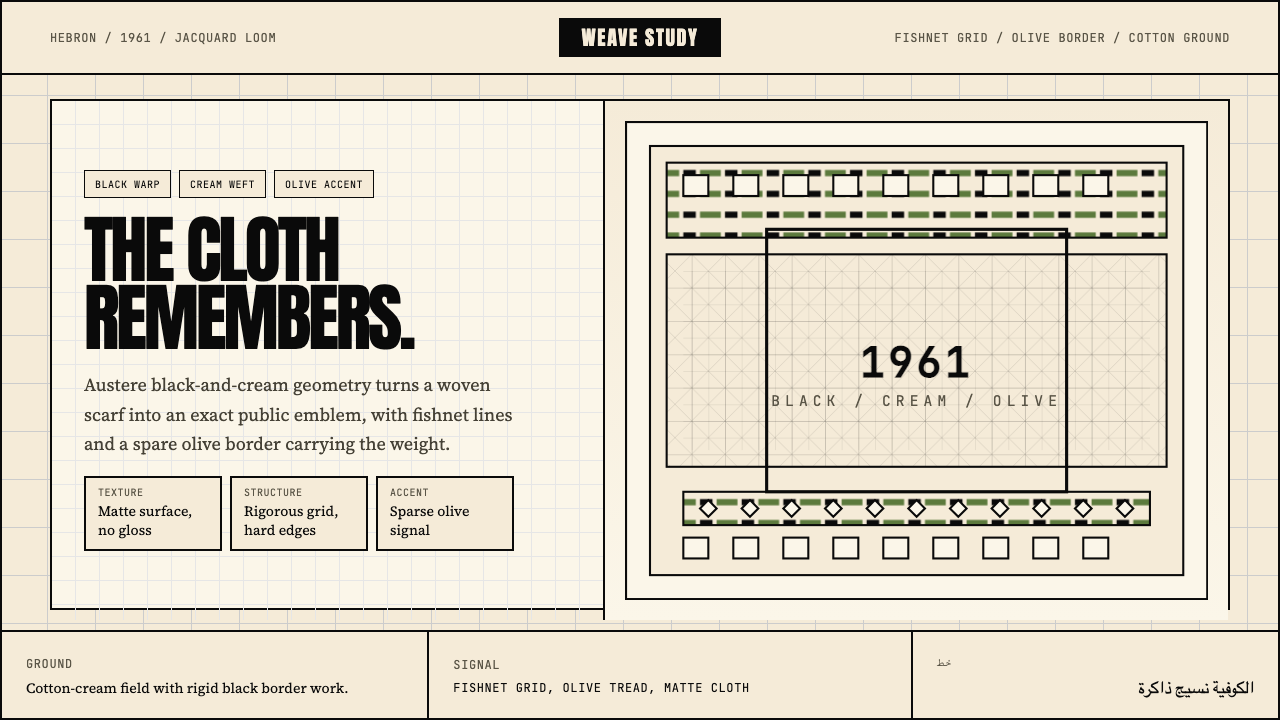 Palestinian Keffiyeh GridMemory in black and cream. Fishnet grid, olive border, and austere Anton type.
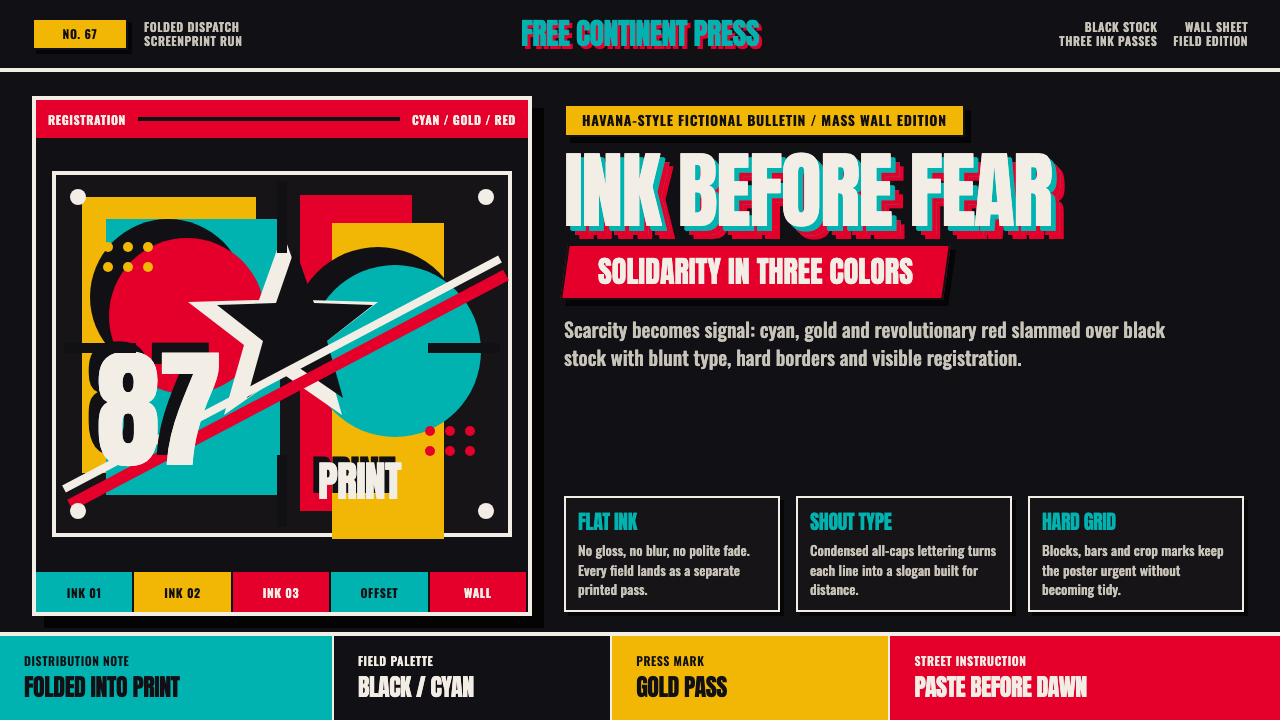 Cuban OSPAAAL Tricontinental PosterUrgency from scarcity. Cyan, gold and red slam over black in blunt silkscreen…
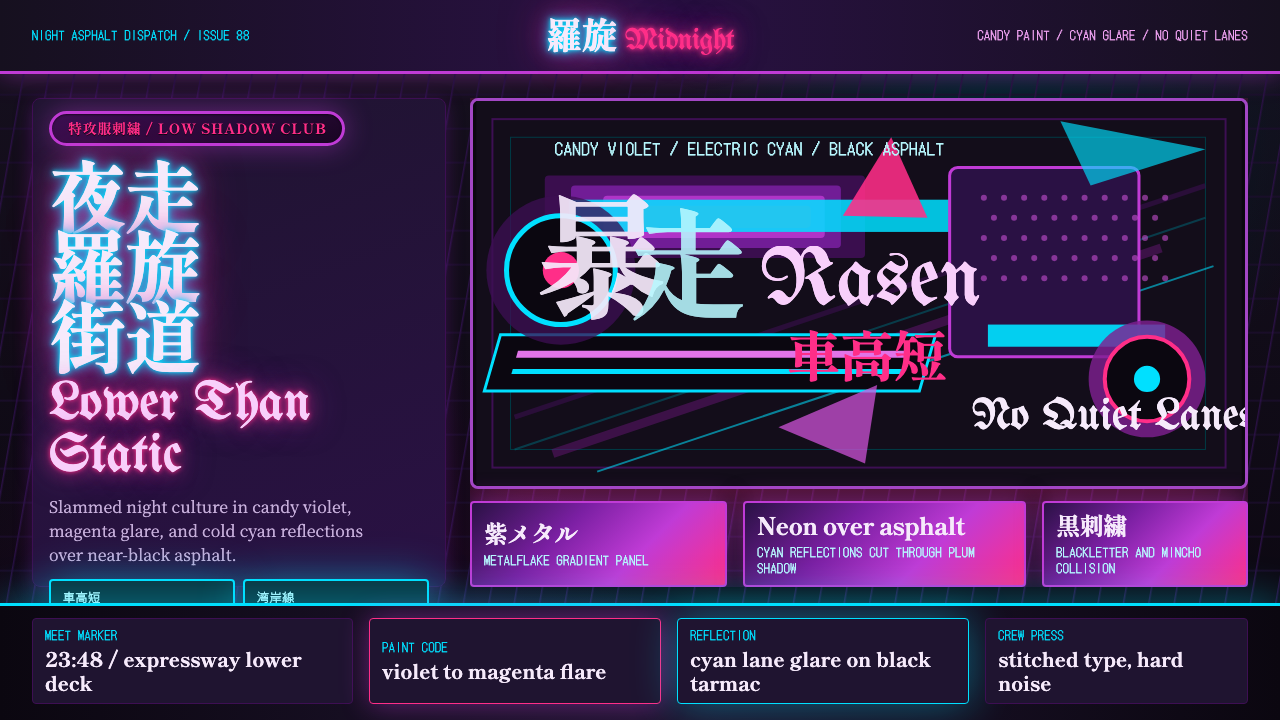 JDM BosozokuNight culture shouts. Candy violet, cyan neon, and stacked Mincho-blackletter…
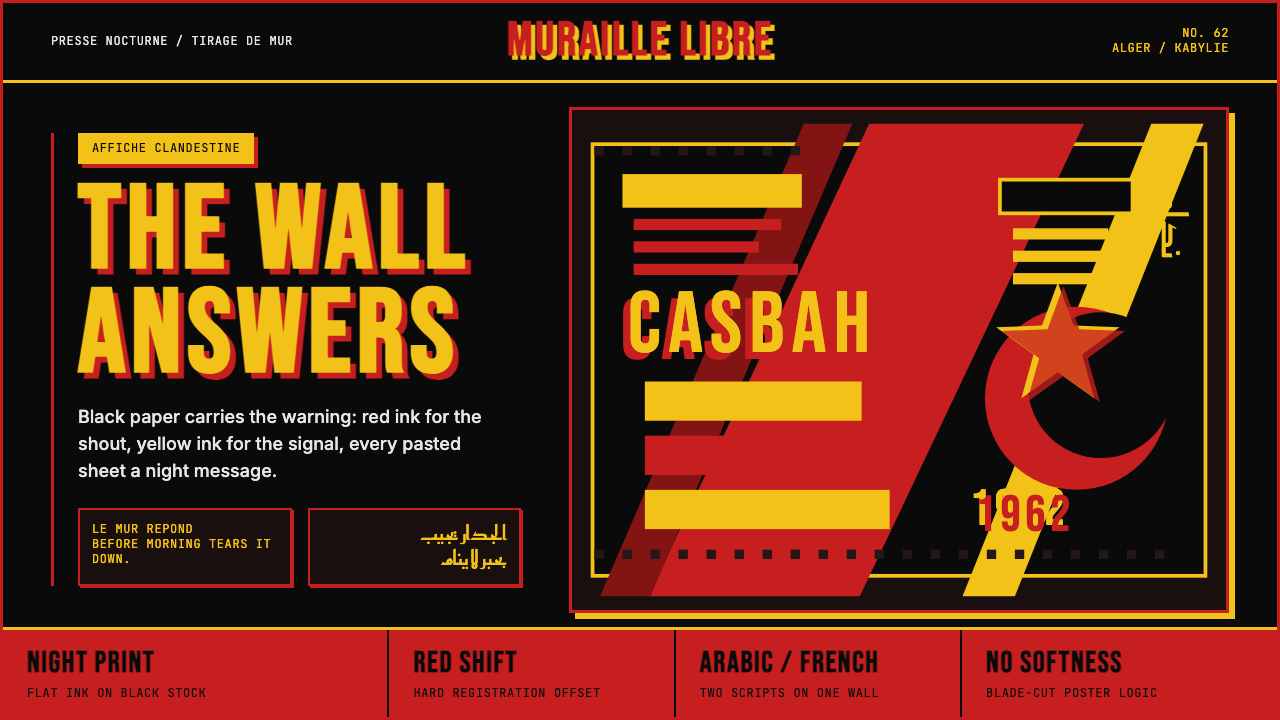 Algerian Casbah Poster (1954–1962)Every surface is a manifesto. Blood red, warning yellow, and stencil type hit…
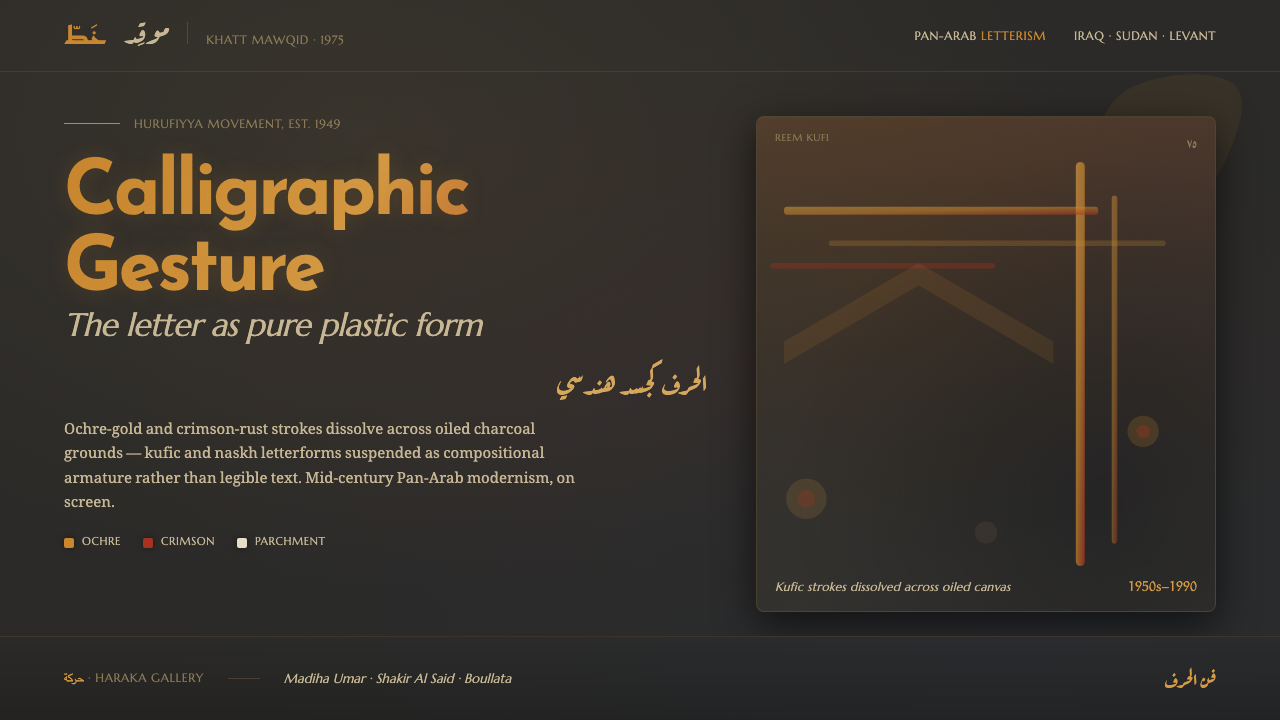 Hurufiyya Letter ArtArabic letters as pure gesture. Ochre and crimson strokes dissolve across oil…
 Buzludzha MonumentMonumentality without repair. Stained concrete frames cobalt tesserae, ruby g…