What is Manga Panel Layout?
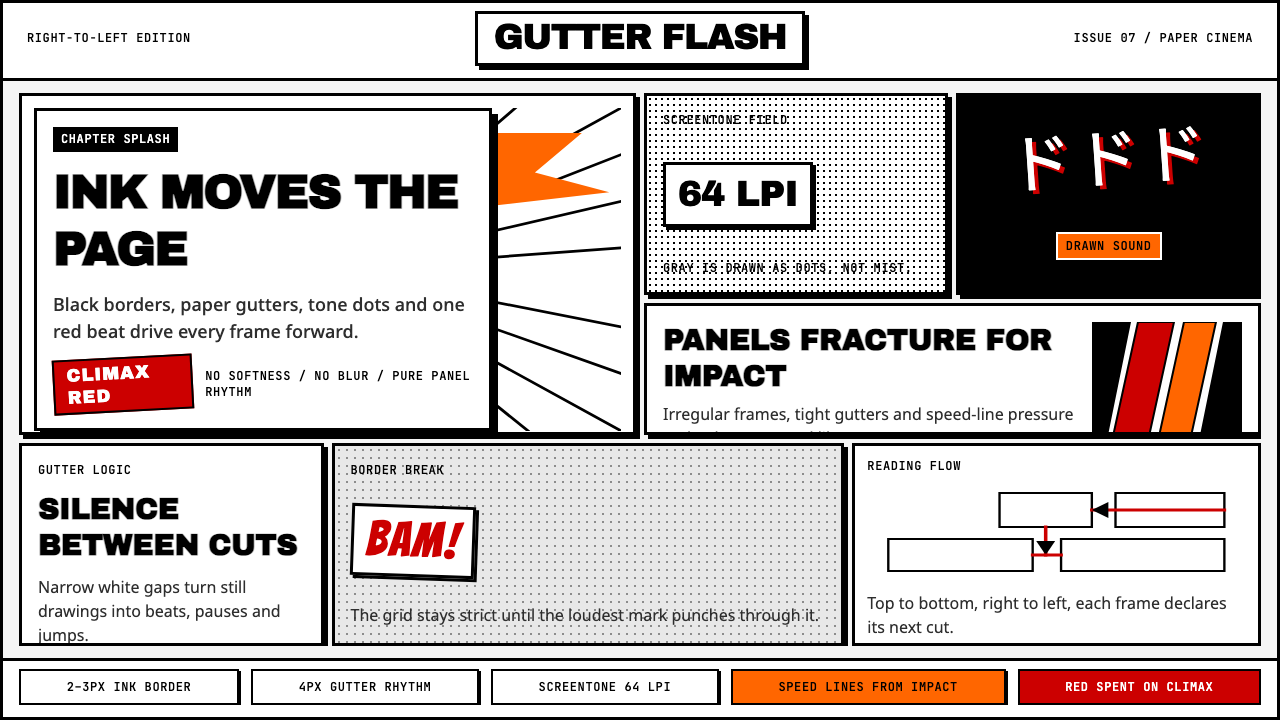
Manga Panel Layout is the page-as-cinema grammar of Japanese comics — ink-black borders, screentone halftones, radiating speed lines, and a single blazing red reserved for the moment everything changes.
Manga Panel Layout in brief
Manga Panel Layout is the visual grammar that gives Japanese comics their cinematic power. It is a discipline of pure monochrome — ink black against paper white, with screentone gray supplying shadow, texture, and atmospheric depth — punctuated sparingly by a single high-energy accent color, most often a saturated red, that appears only when a page demands maximum emotional force. The style strips every compositional decision down to line weight, gutter rhythm, and halftone density, making each element carry narrative meaning rather than decorative weight.
Unlike Western comics, which typically stack uniform rectangular panels in tidy rows, manga panel layout treats the page as a single dynamic stage. Panels are irregular in size and angle; borders shatter at climactic moments; full-bleed spreads erase the frame entirely when a scene's scale demands it. Reading direction flows right to left, which shapes how panels accelerate or decelerate action. The gutter — the white or black gap between panels — is not dead space but an active storytelling beat, controlling tempo the way a film editor cuts between shots.
The system is encyclopedic in its means: speed lines radiate from a focal point to convey motion; impact frames isolate a single image in stark close-up; onomatopoeia are hand-lettered as drawn objects with their own weight and gesture rather than typeset text. Together these devices produce a visual rhythm that readers internalize so deeply they describe manga as 'fast' or 'slow' — a temporal sensation produced entirely by spatial composition on a static page.

Where does Manga Panel Layout come from?
The foundations of modern manga panel layout were laid by Osamu Tezuka, whose 1947 work 'Shin Takarajima' (New Treasure Island) astonished Japanese readers with its filmic pacing. Tezuka had grown up watching American animation and cinema during the war years; when he began drawing comics, he applied the director's eye to the page, breaking action across multiple panels the way a camera cuts between angles. Where pre-war Japanese comics (manga as a term had existed since the eighteenth century, most famously in Hokusai's sketches) used static, self-contained images with text above or below, Tezuka made the panel sequence itself carry the story's motion. He is often called 'the God of Manga' precisely because his innovations were structural rather than merely stylistic.
The postwar decades saw the manga industry institutionalize Tezuka's innovations through the weekly anthology magazine system. Publications like Weekly Shōnen Jump (launched 1968) and its rivals created a production culture of radical efficiency: artists working with assistants to meet weekly deadlines developed the screentone sheet — a physical adhesive film printed with dots at various densities, cut and applied to paper to simulate gray tones without painting — as a labor-saving device that simultaneously became a defining aesthetic signature. The dot pattern visible in printed manga is not a printing artifact but an intentional visual texture with its own expressive range, from fine crosshatching-like shadow to coarse atmospheric haze.
The visual vocabulary of speed lines, impact frames, and broken panel borders emerged through competitive pressure among artists working within the shōnen (boys') manga tradition. Akira Toriyama, creator of Dragon Ball (1984), refined the action-manga grammar to a point of near-mathematical precision: his compositions balance negative space against dense action with such clarity that the eye moves through a page without hesitation. Katsuhiro Otomo's Akira (1982–1990) pushed the monochrome palette to its technical limits, using halftone density and panel scale to render urban destruction at a cinematic resolution that influenced not only manga but film directors worldwide.
Eiichiro Oda's One Piece (serialized from 1997 and still ongoing) represents the mature, globally exported form of the system. Oda uses the full toolkit: irregular panel grids that fracture and reassemble across spreads, gutters of variable width that control reading pace, and a deployment of the shōnen red accent color — applied to key cover pages and emotional climaxes — that functions like a key change in music. The international success of One Piece, along with earlier exports like Dragon Ball and Akira, carried the visual grammar of manga panel layout into global popular culture, where it now informs animation direction, graphic novel design, and digital content creation far beyond Japan.
What defines the Manga Panel Layout look?
Monochrome Palette with a Single Accent
The working palette is ink black, paper white, and screentone gray in various densities. Color is absent from the page interior almost entirely; when it appears — on cover pages, in color-insert chapters, or at a climactic full-spread — it is typically a single saturated warm color, most commonly a vivid red in the shōnen tradition, that reads against the monochrome field with maximum contrast. The restraint is not a limitation but a compositional discipline: every tonal decision carries weight precisely because there are so few of them.
Panel Border and Gutter as Rhythm
Thick ink borders define each panel as a discrete cinematic frame. The weight of the border communicates narrative status: a standard panel has a solid black border; a flashback or dream sequence may use a wavered or dotted line; and a climactic moment shatters the border entirely, allowing imagery to bleed beyond the frame. The gutter — the space between panels — varies in width to control reading tempo, functioning like the duration of a cut in film editing. A narrow gutter compresses time; a wide gutter expands it into a pause.
Screentone and Halftone Texture
Screentone is the technical heart of the style's gray range. Physically, it was adhesive film printed with regular dot patterns at varying densities; digitally, it is simulated through bitmap fills. Fine dot patterns read as smooth mid-gray shadows on faces or fabric; coarser patterns produce an atmospheric haze behind a character or signal a transition in time. The visible dot structure is not an incidental feature of the production process but a deliberate aesthetic texture that distinguishes manga-style halftone from photographic or painterly gray, giving the surface an almost mechanical, engraved quality.
Speed Lines and Motion Marks
Speed lines are straight lines radiating outward from a focal point to convey motion, impact, or the sudden arrival of something significant. They can fill an entire background, replacing environmental detail entirely to direct the eye inward. Variants include rotation lines (circular radiating patterns for spinning objects), impact bursts (star-shaped line clusters at a point of contact), and focus lines (concentrically converging lines that pull the reader's gaze to a specific face or object). Each is a visual convention so codified that readers process it as motion data rather than decoration.
Irregular Grid and Panel Hierarchy
Manga panel grids are not uniform. A single page might contain one large establishing panel, three medium action panels, and one narrow reaction strip — each sized in proportion to its narrative importance. The largest panel on a page typically shows the climax of that page's action; small panels compress transitional moments. Diagonal panel divisions cut against the horizontal-vertical convention to add visual tension. When a scene's drama justifies it, the page grid collapses entirely into a single full-bleed image or a double-page spread that treats the two pages as a single panoramic canvas.
Hand-Lettered Onomatopoeia
In manga, sound words are not typeset — they are drawn. Onomatopoeia such as the rumbling 'GOGO' (ゴゴゴ) or the crashing 'DODO' (ドドド) associated with Hirohiko Araki's JoJo's Bizarre Adventure are rendered as letterforms with their own scale, perspective, and visual weight, occupying the composition as a graphic element rather than a caption. The size of the onomatopoeia relative to the panel indicates the sound's intensity; its angle and distortion indicate directionality and impact. This transforms language itself into an image, blurring the boundary between word and picture.
Line Weight as Information
In manga illustration, line weight is not an aesthetic preference but a semantic system. Heavy contour lines define solid foreground figures; lighter lines render background elements and fabric folds; the thinnest lines, often applied with a mapping pen or fine brush, suggest hair detail, metal texture, or distant architectural line. The transition from thick to thin within a single stroke conveys the gesture and pressure of a moving limb. Because the palette is limited to black, white, and gray, every distinction in depth, materiality, and movement must be carried by line — and master artists use this constraint to produce images of extraordinary visual complexity.

Who shaped Manga Panel Layout?
Tezuka is the architect of the modern manga page. His 1947 'Shin Takarajima' introduced cinematic panel sequencing to Japanese comics — close-ups, reaction shots, and motion-across-panels techniques imported directly from film grammar. Over his prolific career, which produced Astro Boy, Black Jack, Phoenix, and hundreds of other series and one-shots, he established the vocabulary that all subsequent manga artists would expand upon. His insistence that manga could address adult themes with the same visual intelligence as cinema legitimized the medium as a serious art form in Japan, and his structural innovations are so fundamental that they are now invisible — absorbed into the baseline expectation of what a comics page should do.
Toriyama's work on Dr. Slump (1980) and Dragon Ball (1984) refined action-manga composition into a model of efficient clarity. His layouts are distinguished by their use of negative space: backgrounds are often stripped away entirely during combat sequences, leaving figures suspended in white or halftone fields that amplify the sense of speed and impact. His character designs — rounded forms with clear silhouettes readable at small panel sizes — are inseparable from his page designs, which are calibrated to carry legibility at the speed of the weekly reading experience. Dragon Ball's global translation into dozens of languages is partly a tribute to a visual system so clearly structured that it communicates across cultural contexts.
Otomo's Akira, serialized in Young Magazine from 1982 to 1990, represents the technical apex of monochrome manga art. Working in an unusually large original page size that allowed for extraordinary detail density, Otomo rendered Neo-Tokyo's urban fabric with an architect's precision — intricate background crowd scenes, mechanically accurate machinery, and destruction rendered at such scale that a single explosion might be deconstructed across a twelve-panel sequence. His use of screentone pushed the medium's halftone range to its limits, creating images whose tonal complexity rivals photography. The 1988 theatrical film adaptation, which Otomo directed, demonstrated that the cinematic logic embedded in his page compositions could translate directly to animation.
Oda's One Piece, which began serialization in Weekly Shōnen Jump in 1997 and has become the best-selling manga series in history, demonstrates the mature grammar of shōnen panel layout at its most expressive. Oda is known for page compositions of exceptional density: a single page might contain nine to twelve panels with fully rendered backgrounds, character-specific lettering styles for each voice, and facial expression ranges that communicate emotional subtext without captions. His deployment of color in cover pages and chapter frontispieces — typically a warm red and orange palette against black — has established a visual identity for the series that functions independently of plot, making cover compositions recognizable as One Piece even in abstraction.
Urasawa, creator of Monster (1994), 20th Century Boys (1999), and Pluto (2003), demonstrates that the manga panel grammar is equally powerful in slow, psychologically complex narratives as in high-speed action. His layouts use extended sequences of small, tightly composed panels to build unease and suspense — a technique opposite to Toriyama's negative-space dynamism but equally calibrated to the reader's eye movement. Urasawa's page compositions show that the gutter and panel scale are tempo instruments capable of stretching a single moment of revelation across multiple pages, using the medium's spatial logic to create dread as precisely as Toriyama's layouts create exhilaration.
How do you use Manga Panel Layout today?
Manga Panel Layout is one of the few historical visual grammars that transfers directly to contemporary presentation design because its core logic — using spatial composition to control tempo and attention — maps cleanly onto slide sequences. Used correctly, it is a high-impact style for decks that need to convey energy, narrative momentum, or a sense of climactic revelation.
For slide covers, the style works through bold asymmetric composition: a single large image occupying most of the frame, cropped aggressively as a manga panel would crop a character's face, with the title set in heavy, high-contrast type against an ink-black or pure-white ground. The occasional use of a single warm red accent — on a border element, a rule, or a highlighted word — should follow the manga convention of restraint: it appears once, where the eye should land first. Content slides benefit from the grid logic of a manga page: establish a clear panel hierarchy among the slide's elements, using size to signal narrative importance rather than position alone. Data slides can adopt the manga convention of stripping the background to white and letting bar charts and flow diagrams occupy the visual field as geometric objects in their own right.
For web interfaces, the style is best suited to product launch pages, gaming platforms, and any context where the audience already has fluency in manga visual culture. Dashboard design can adopt the panel-layout principle of variable-weight containers — a primary data card that occupies the equivalent of a full-page manga spread, surrounded by smaller metric panels as supporting frames. The monochrome base with single red accent works well for notification systems and alert hierarchies, where the accent color carries immediate semantic weight. Navigation elements should feel typographic and direct, without decorative softening.
In editorial and marketing contexts, manga panel layout produces striking results for event posters, campaign headers, and social media cards. The key technique is the impact frame: a single cropped image isolated within a heavy black border, with speed-line texture radiating into the background. For marketing copy, the onomatopoeia convention translates into oversized, hand-feel type treatments for key headlines — not literally drawn, but set in typefaces with enough weight and irregularity to suggest the drawn-letter quality. Print campaigns benefit from the style's intrinsic reproducibility: because it relies on high-contrast black and a single spot color, it is economical at any production scale.
A common and costly mistake when applying manga panel layout is equating the style with chaos. The system's apparent asymmetry and energy are products of precise underlying control: every panel break, every gutter width, every speed-line angle is a deliberate decision calibrated to the reader's eye movement. Designers who apply the visual surface — the black borders, the screentone fills, the dramatic type — without understanding the tempo logic produce layouts that feel frantic rather than dynamic. The discipline to strip away color entirely except for a single accent, to use that accent once and at the highest-stakes moment, and to size panels in proportion to their narrative weight rather than their visual interest is what separates authentic manga-derived design from superficial pastiche.

Manga Panel Layout — FAQ
Is manga panel layout only appropriate for entertainment or gaming contexts?
Not at all, though it does carry cultural associations with youth culture and sequential narrative that are worth considering. The underlying compositional logic — variable panel hierarchy, gutter-controlled tempo, monochrome restraint with single-accent deployment — is a structural toolkit applicable to any context that benefits from strong visual rhythm and clear information hierarchy. Technology product launches, editorial feature stories, fashion editorial, and sports media all use manga-derived compositional techniques successfully. The key is deploying the system's logic rather than its full surface iconography: a presentation that uses panel-scale hierarchy and monochrome discipline without explicit speed lines or screentone can read as modern and rigorous without triggering entertainment-context associations.
How do you adapt the right-to-left reading direction for audiences that read left to right?
The reading-direction convention is one of the most culturally specific elements of the system and is typically the first thing adapted for non-Japanese audiences. Most international manga publications simply mirror the page layout to read left-to-right, which works because the compositional logic of panel hierarchy is directional rather than fixed: what matters is that panel size and placement guide the eye through a deliberate sequence, not that the sequence runs in any particular horizontal direction. For original design work, designers outside Japan default to left-to-right panel flow without any loss of manga-system logic. The gutter rhythm, the panel hierarchy, the monochrome discipline, and the single-accent deployment all function independently of reading direction.
Can manga panel layout work in a color-rich environment, or does it require near-monochrome?
The style's structural core — panel borders, gutter rhythm, screentone texture, variable panel hierarchy — can technically coexist with a broader color palette, but the design logic starts to break down when multiple saturated colors compete for the same structural role that the single accent is designed to occupy. The power of the warm-red accent in shōnen manga comes entirely from its rarity against the monochrome field; introduce a second accent color and both lose their impact. Color-rich variants of manga-influenced design tend to work best when the expanded palette is applied systematically — one color per character, one color per story arc — preserving the principle of deliberate deployment even when extending the total palette. Full-color manga series, like some of Moebius's work or recent global webcomics, typically develop entirely different compositional logic rather than applying full color to the monochrome panel system.
What is the difference between manga panel layout and Western comics composition?
The differences are structural and historical rather than superficial. Western comics — the American superhero tradition in particular — developed from newspaper comic strips, which established a uniform grid of equal-sized panels as the baseline format. Even as superhero comics grew more sophisticated, they retained a preference for stable, horizontal panel rows and a relatively consistent panel size within a page. Manga layout, shaped by Tezuka's film-grammar influence and the production pressures of weekly anthology serialization, developed a far more variable grid in which panel size is directly proportional to narrative importance. The Western tradition also maintained a clearer separation between image and text, with dialogue in speech bubbles and captions in separate boxes; manga integrates onomatopoeia as drawn elements within the image field. In practice, these differences have blurred significantly since the 1980s as each tradition has absorbed influences from the other.
How does screentone work in digital design, where physical film is not available?
Digital screentone is simulated through bitmap halftone fills — raster patterns of dots at fixed sizes and densities applied as a layer or fill style over grayscale areas. Most professional illustration software offers halftone filter effects that can approximate the visual character of physical screentone, though the results vary: physical screentone has a slight irregularity from manual application and printing registration that digital tools tend to produce too precisely. For authentic-feeling results, designers working digitally often seek out screentone texture assets, apply halftone patterns at the correct print resolution for the output medium, or deliberately introduce subtle misregistration. The key aesthetic quality to preserve is the structured, mechanical dot — as opposed to grain, noise, or organic texture — because that regular dot pattern is what gives the style its characteristic balance between hand-made and printed, between drawn and reproduced.
Related design styles
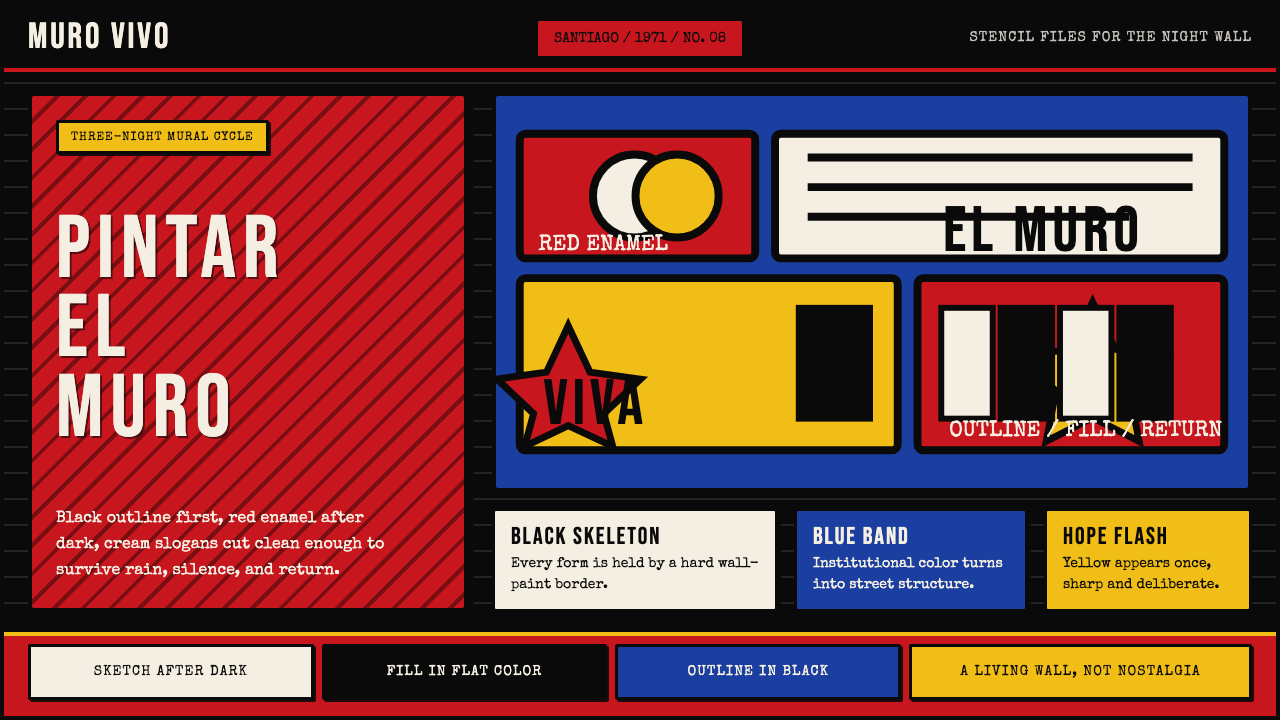 Chilean BRP Ramona Parra 1971Resistance stays alive. Blood red panels, black outlines, and stencil type re…
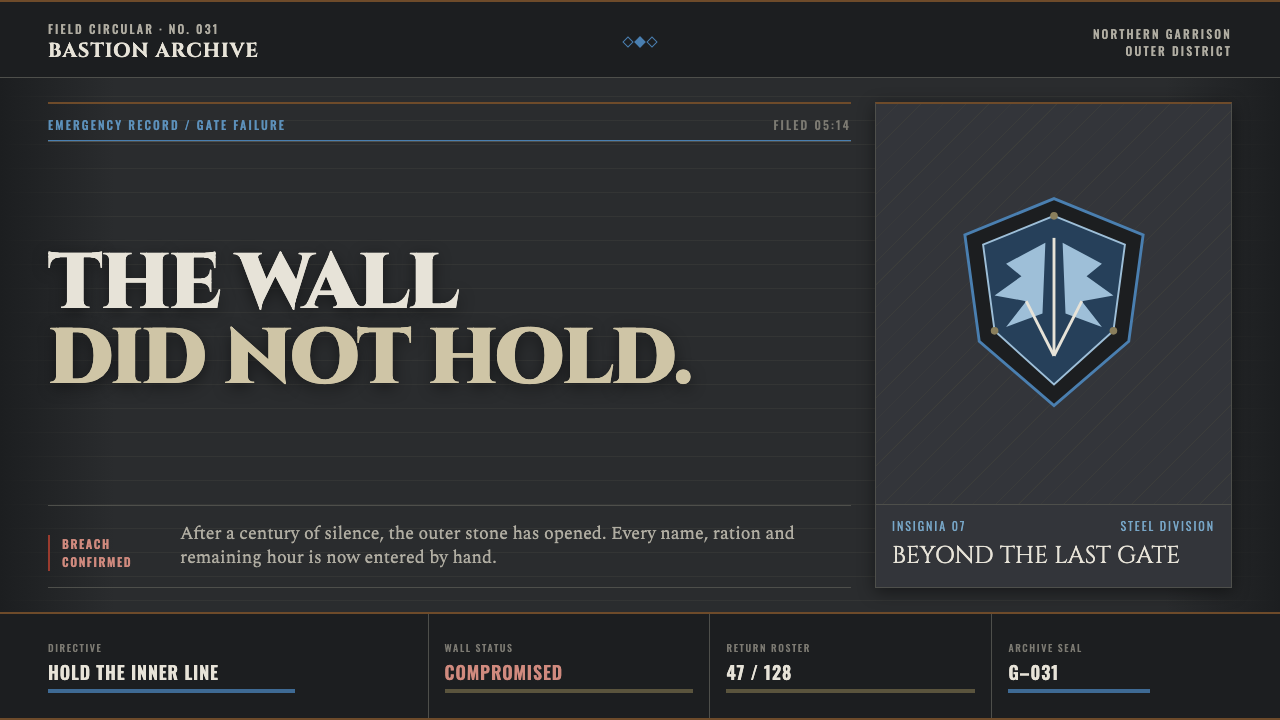 Attack on Titan (2013)Dread becomes duty. Stone-gray bands, engraved caps and one steel-blue crest…
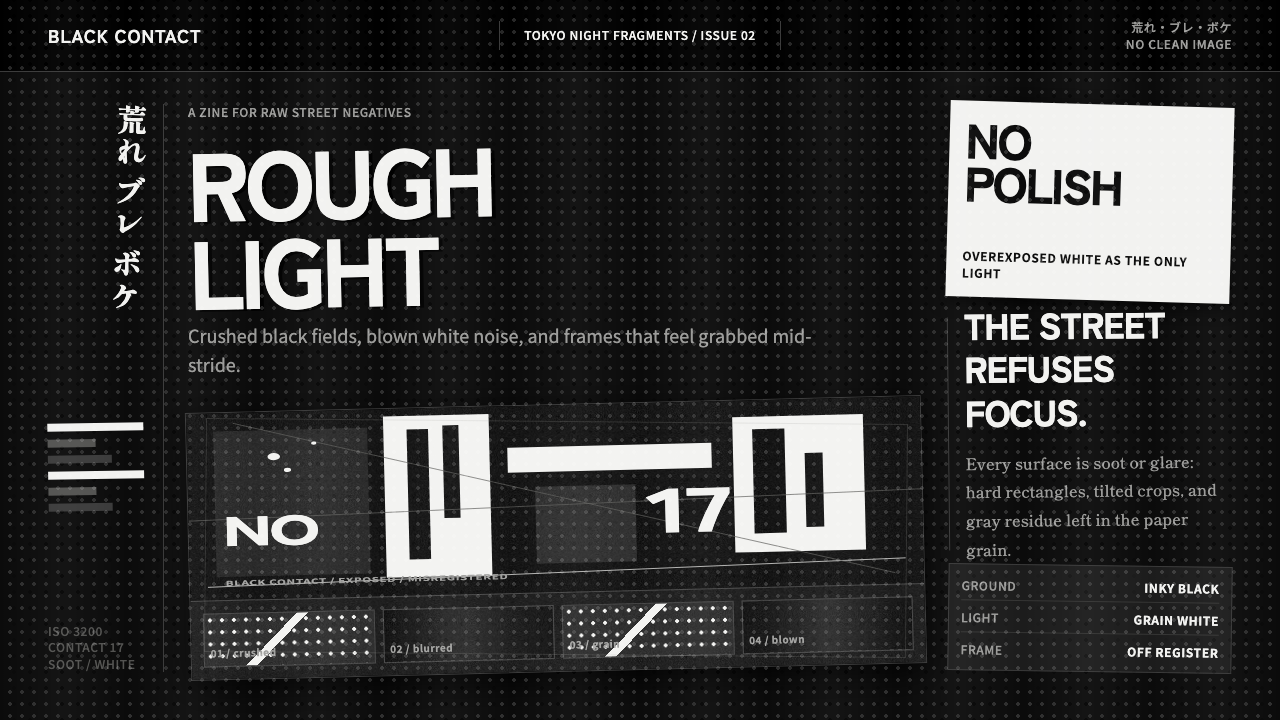 Daido Moriyama Are-Bure-BokeNothing is clean. Inky black, blown white grain, and tilted frames make the i…
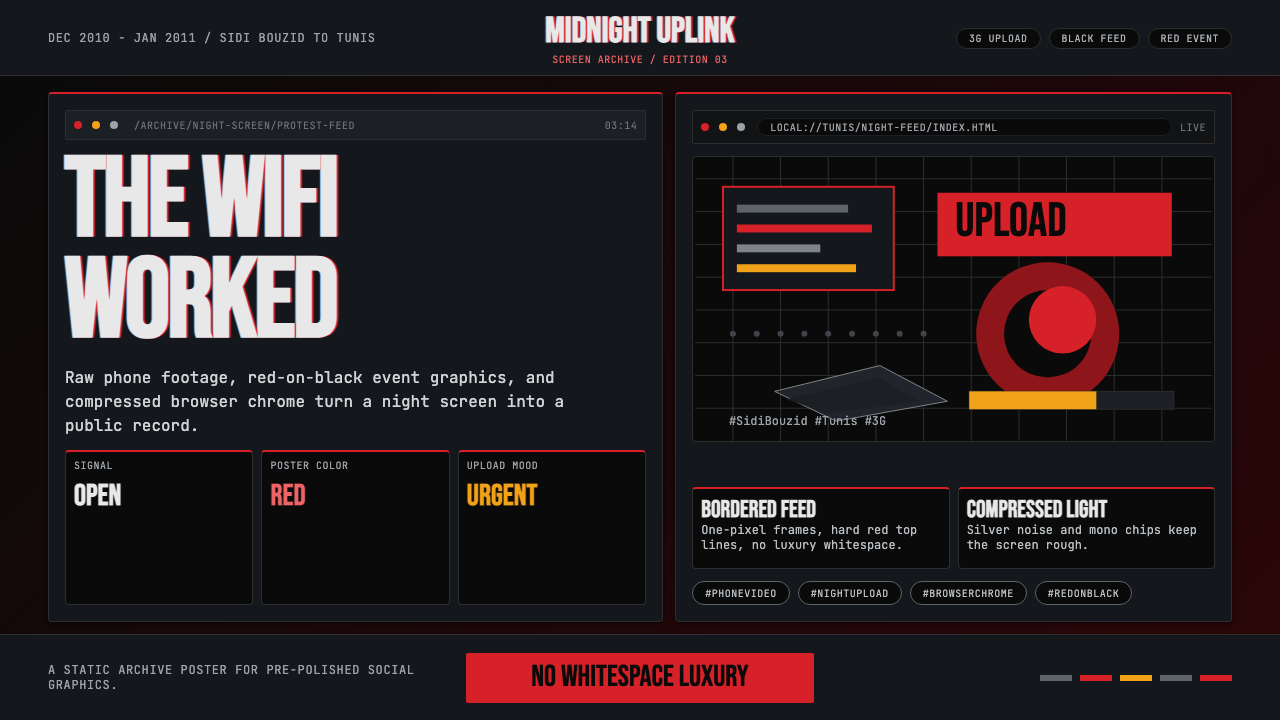 Tunisian Jasmine Revolution (2010)Raw urgency wins. Red browser grids and mono hashtags compress 3am protest in…
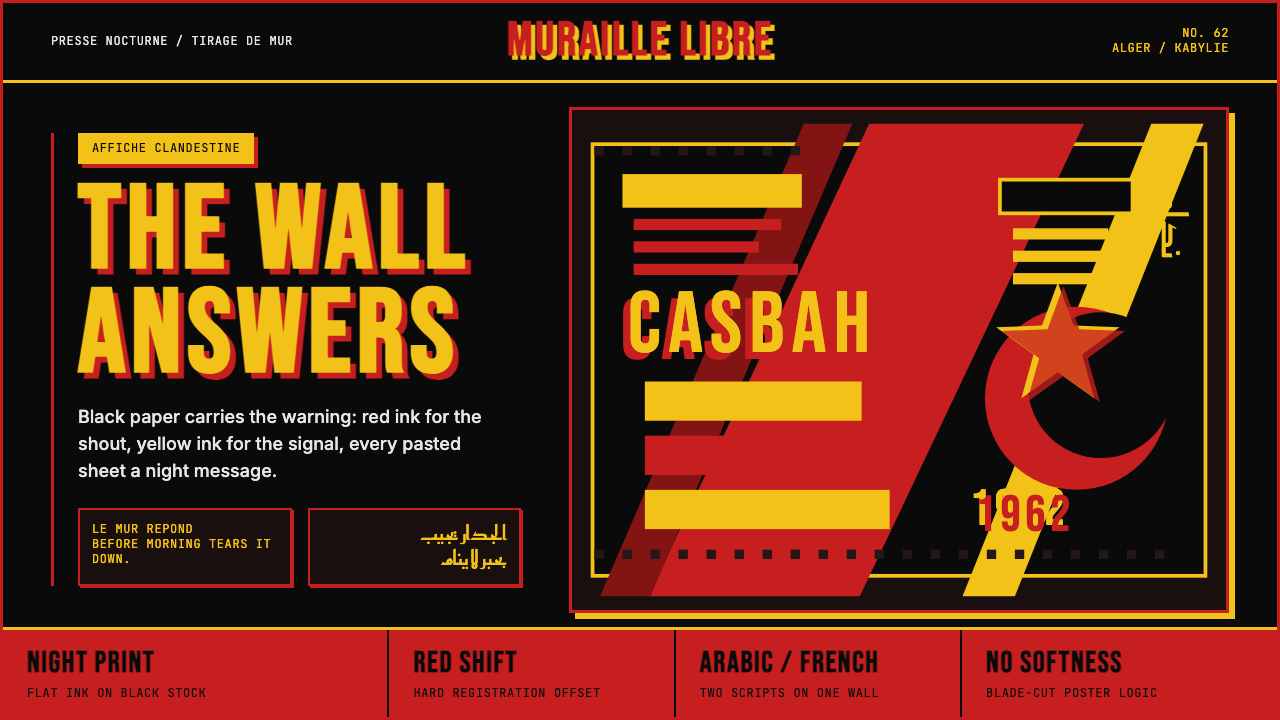 Algerian Casbah Poster (1954–1962)Every surface is a manifesto. Blood red, warning yellow, and stencil type hit…
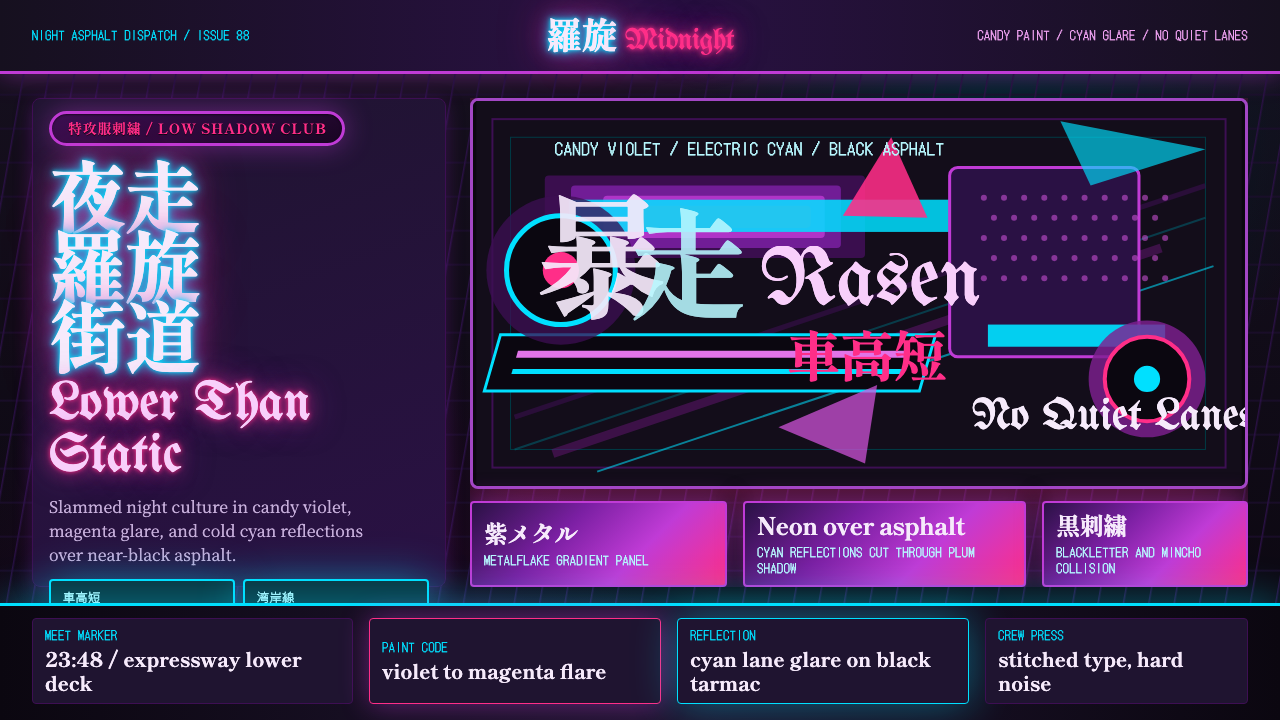 JDM BosozokuNight culture shouts. Candy violet, cyan neon, and stacked Mincho-blackletter…