What is Algerian Casbah Poster (1954–1962)?
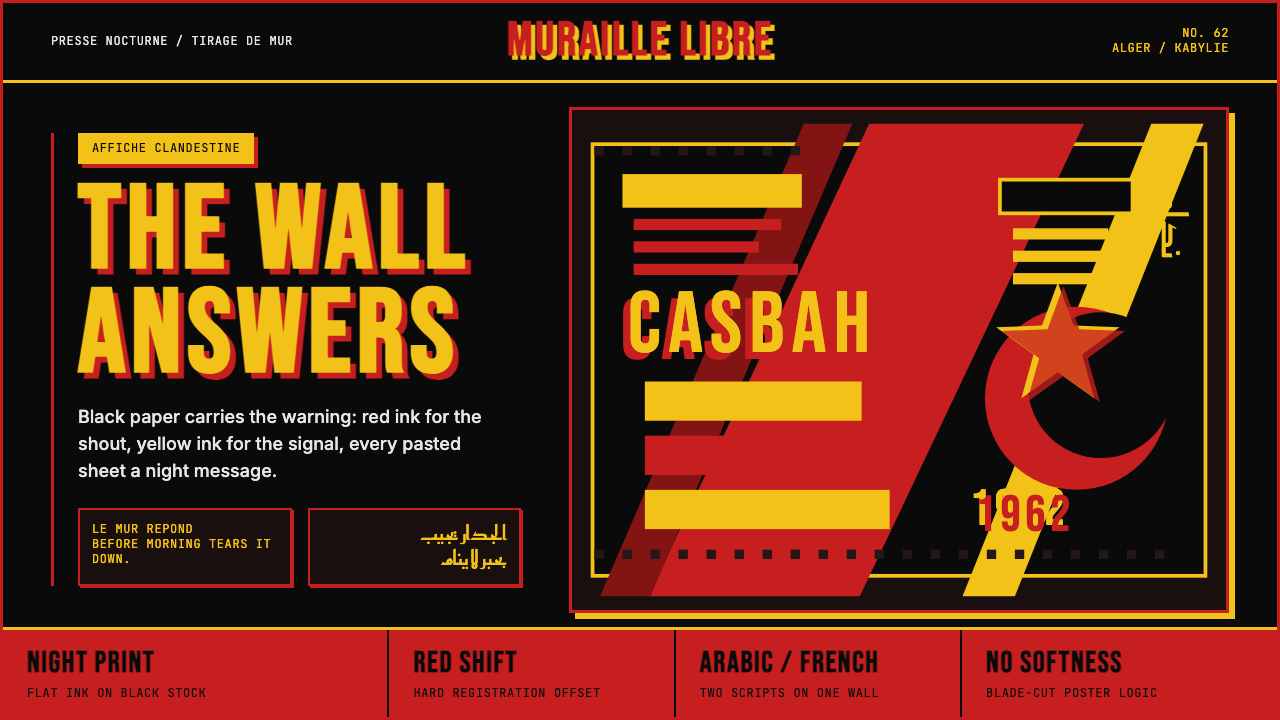
Born in the casbah and the maquis camps, the FLN's silkscreen posters fused blood-red ink, stenciled Arabic script, and flat partisan printing into one of the twentieth century's most urgent visual languages.
Algerian Casbah Poster (1954–1962) in brief
The Algerian Casbah Poster style refers to the visual system produced by the Front de Libération Nationale (FLN) and allied cultural cells during Algeria's War of Independence (1954–1962). Printed on whatever paper was available — newsprint, recycled stock, coarse cardboard — and pulled through crude silkscreen frames in clandestine workshops hidden inside the labyrinthine casbah of Algiers and the mountain camps of Kabylie, these posters were not made for gallery walls. They were made for walls in the literal sense: plastered on the façades of the medina at night, passed hand to hand through networks of resistance couriers, reproduced in solidarity publications as far as Havana and Paris.
The visual grammar that emerged from these conditions is defined by scarcity transformed into strength. A strict, dark ground — black or near-black newsprint — serves as the field. Against it, two or three flat colors do all the work: blood red for urgency and sacrifice, warning yellow for the Islamic crescent and star and for marginal text that demands attention, and white or pale cream for stenciled portraits and large text blocks. There are no gradients, no halftones, no decorative flourishes. Ink either covers or it does not. Registration between layers is intentionally imprecise — the slight offset between a red field and a black figure is not a flaw to be corrected but a signature of the physical conditions under which the work was made.
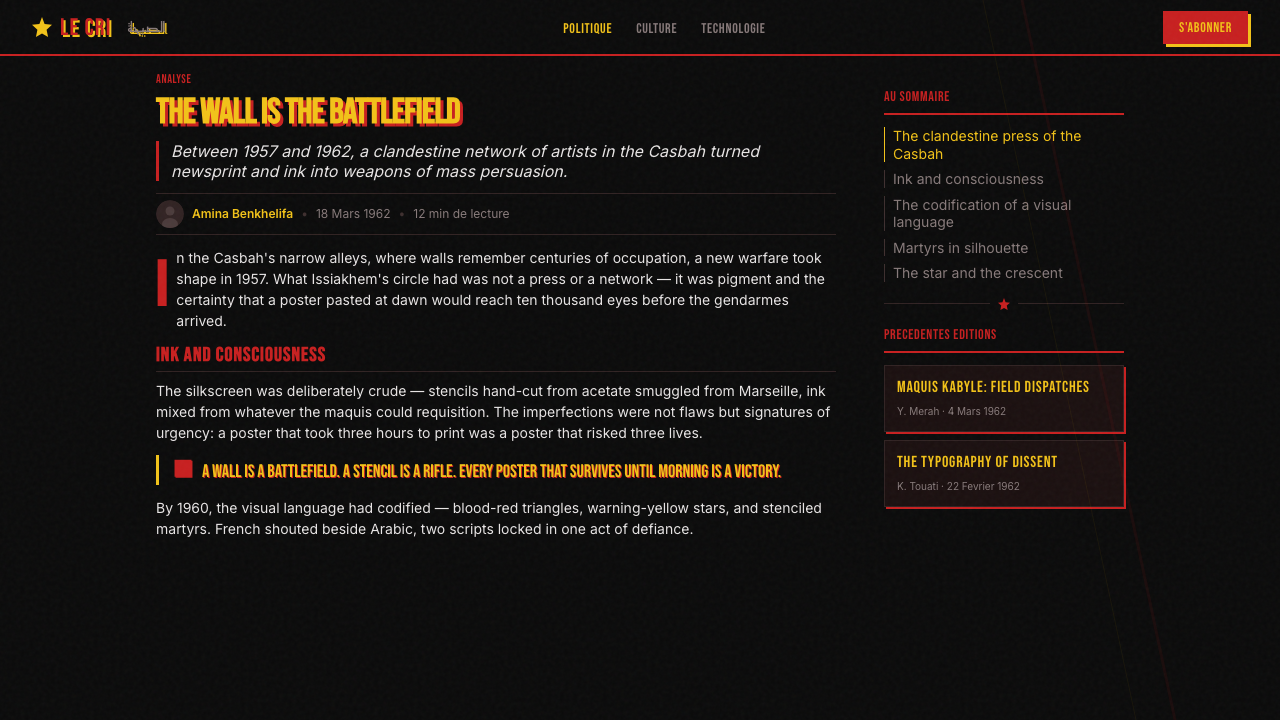
What distinguishes this system from other revolutionary graphic traditions of the same era is its bilingual visual field. Arabic script and French roman type coexist on the same surface, neither subordinate to the other. The Arabic is often hand-cut or stenciled in a bold, condensed calligraphic hand derived from Maghrebi tradition; the French appears in whatever flat san-serif letterform the available type or stencil could produce. This dual-language, dual-script composition is not a design choice in the contemporary sense — it is a document of the cultural situation: a colonized society asserting its native language in the same breath that it addresses the international press in the colonizer's tongue.
Where does Algerian Casbah Poster (1954–1962) come from?
The FLN launched its armed uprising on the night of 1 November 1954, attacking French military and police targets in coordinated actions across northern Algeria. The political context had been building for decades: France had held Algeria as an integral department since 1830, treating it not as a colony but as sovereign French territory, while systematically denying full citizenship to the Muslim majority. The war that began in 1954 was simultaneously a war of national liberation, an anti-colonial uprising, and a brutal internal struggle within the Algerian independence movement itself. By the time it ended in 1962 with the Évian Accords and Algerian independence, somewhere between 300,000 and 1.5 million Algerians had died — estimates vary enormously depending on the source.
The FLN's propaganda operation was run partly from inside Algeria and partly from external bases in Tunisia and Morocco, beyond the reach of French military pressure. Within the country, the Casbah of Algiers — the dense, Ottoman-period medina that climbs the hillside above the European colonial quarter — became the central nervous system of urban resistance. Its layered, interlocking architecture made French military penetration difficult and provided cover for clandestine printing operations. It was here and in the maquis camps of Kabylie that the visual language of the movement was forged: not in a design school, not according to a theoretical program, but in immediate response to the need to communicate quickly, cheaply, and irrepressibly to populations that were partly literate in Arabic, partly literate in French, and often illiterate in both.
The cultural figures around whom the movement's visual identity coalesced were a cross-section of the Algerian intelligentsia shaped by both Maghrebi tradition and French colonial education. M'hamed Issiakhem, a painter who had lost his arm in a hunting accident as a child and who studied at the École des Beaux-Arts in Paris, brought European painterly sensibility to the poster idiom. Mohamed Khadda, who would become one of Algeria's most important abstract painters after independence, worked in the visual orbit of the resistance and later developed an aesthetic that explicitly connected modernist abstraction to Arabic calligraphic tradition. Frantz Fanon, the Martinican psychiatrist and theorist who joined the FLN in Tunisia and wrote 'The Wretched of the Earth' during the war, provided much of the intellectual framework that gave the visual propaganda its ethical weight: the argument that colonial violence dehumanizes both colonizer and colonized, and that the cultural assertion of the colonized — including visual culture — is an inseparable part of political liberation.
The posters found international distribution through solidarity networks that connected the Algerian independence movement to anti-colonial struggles worldwide. The Fédération de France du FLN organized support and distribution among Algerian migrant workers in metropolitan France; international solidarity organizations reproduced the visual material in publications circulating across the Non-Aligned world. The Tiers-mondiste poster tradition — solidarity graphics linking liberation struggles in Algeria, Cuba, Vietnam, and later Angola and Mozambique — drew directly on the visual conventions the Algerian material had established: dark grounds, flat color, stenciled portraiture, bilingual or multilingual text. By the time Algeria gained independence in July 1962, the visual grammar of the casbah printer had become a foundational reference for revolutionary graphic design on four continents.
After independence, the aesthetic life of the movement transformed. Djamila Bouhired, a resistance fighter whose trial and near-execution in 1957 made her the most internationally recognizable face of the Algerian cause — her portrait stenciled on countless surfaces — became a symbol of postwar Algeria. The Aouchem manifesto of 1967, signed by Issiakhem, Khadda, and others, called for an Algerian modernism rooted in the Amazigh and Arabo-Berber visual inheritance rather than imported Western models. The roughness and urgency of the wartime visual language was retrospectively claimed as a foundation for post-colonial Algerian cultural identity.
What defines the Algerian Casbah Poster (1954–1962) look?
Dark Ground
The visual system is built on a foundation of deep, dark ink — black newsprint or a dense black printed field that absorbs light rather than reflecting it. This is partly a material legacy of wartime printing conditions, where cheap newsprint was the available substrate, and partly a deliberate rhetorical gesture: the dark ground signals night, clandestinity, and the conditions of underground resistance. All other colors read as emergent — torn out of darkness — rather than applied to a neutral surface.
Blood Red and Warning Yellow
The two dominant accent colors carry precise cultural and rhetorical weight. The red — a saturated, arterial tone — is the color of sacrifice and urgency, of blood and fire, of the revolution in its most physical dimension. The yellow serves a different function: it marks the Islamic crescent and star, the movement's emblematic symbol, and appears in marginal text and annotations that demand attention. The combination of deep red against black creates an almost physically visceral sensation; yellow against black creates maximum luminosity — the visual equivalent of a shout.
Hard Registration Offset
A signature visual quality of the system is the visible misregistration between ink layers — a slight but deliberate or unavoidable offset between the color fields and the outlines or figures printed over them. In professional printing this would be a defect. Here it is an aesthetic fact: it records the conditions of production, the shaking hands and improvised equipment of clandestine printing. Contemporary applications of the style often preserve or exaggerate this offset as a mark of authenticity, recognizing that the roughness is the meaning.
Stenciled Portraiture
Human figures appear primarily through the stencil — hand-cut templates that allow a portrait or a silhouette to be reproduced quickly across multiple surfaces. The stencil imposes its own formal logic: fine gradations of tone are impossible, so faces and figures reduce to bold contrast between light and dark areas. Eyes become dark voids or bright points; features are read by shadow and highlight alone. The stenciled portrait is both faster than typeset text and more emotionally immediate — a fighter's face recognized at a glance before any word is read.
Bilingual Visual Field
Arabic and French share the picture plane without hierarchy. The Arabic script — typically rendered in a bold, condensed hand derived from Maghrebi calligraphic tradition — occupies the same visual weight and spatial priority as the French text. This coexistence is not decorative; it is political. It refuses the colonial assumption that French is the language of public address and Arabic the language of private life. The resulting compositions are dense, often difficult to parse without knowledge of both scripts, and visually complex in ways that most European graphic traditions of the period were not.
Flat Ink, No Gradients
Every element in the system is flat — ink either covers the substrate or it does not. There are no blended transitions between colors, no soft shadows suggesting volume, no atmospheric effects implying depth. This flatness is simultaneously a technical constraint of silkscreen printing at scale and a rhetorical choice: gradients soften, modulate, and aestheticize. A flat color field is uncompromising. The refusal of gradation is the refusal of ambiguity.
Urgency as Structure
Unlike design systems organized around aesthetic equilibrium, the casbah poster system is organized around rhetorical urgency. Composition is not balanced for restful viewing but weighted for impact: the most important visual element — a face, a phrase, a symbol — is the largest, the most saturated, the most immediately visible. Secondary information clusters densely around it or along the edges. The result is a compositional logic closer to a warning sign than a gallery work, where the hierarchy of attention is non-negotiable and the viewer is not invited to linger but commanded to look.
Who shaped Algerian Casbah Poster (1954–1962)?
Issiakhem is among the most significant visual artists associated with the Algerian independence movement. Having lost his arm in a childhood accident and trained at the École des Beaux-Arts in Paris, he brought a painterly depth to the bold, reduced visual vocabulary of partisan graphics. After independence he became a leading figure in Algerian cultural life, teaching and exhibiting widely. His work negotiated the difficult space between European modernist training and the imperative to forge a distinctly Algerian visual language — a tension that defines the most serious aesthetic work to emerge from the independence generation.
Khadda worked in the visual orbit of the resistance during the war years and became after independence one of Algeria's most internationally recognized painters. His great achievement was to develop a form of abstraction that grounded itself explicitly in the Arabic calligraphic tradition and Amazigh visual heritage rather than simply importing the visual logic of European abstract expressionism. His formulation — that modernity and indigenous tradition are not opposites but generative tensions — became the intellectual backbone of the Aouchem manifesto, which he co-signed in 1967 and which shaped postcolonial Algerian visual culture for a generation.
Bouhired was a resistance fighter in the Algiers network of the FLN who was arrested, tortured, tried, and sentenced to death by French military authorities in 1957. Her trial provoked an international outcry, and her image — reproduced in posters, pamphlets, and solidarity publications across the world — became the most recognizable face of the Algerian independence cause. She was not a graphic designer, but her face became the primary visual material of the movement's poster language: stenciled, simplified to its essential contrasts, and reproduced endlessly. Her survival (the death sentence was commuted) and her continued political engagement after independence made her a living embodiment of the visual archive that bore her image.
Fanon was a psychiatrist from Martinique who joined the FLN in Tunisia and served as editor of its publication El Moudjahid. His two major books written during and immediately after the war — 'A Dying Colonialism' and 'The Wretched of the Earth' — provided the movement with its most sophisticated theoretical account of why cultural production, including visual propaganda, was inseparable from political liberation. His argument that colonialism operates partly by devaluing and suppressing the cultural expressions of the colonized gave the casbah posters an intellectual frame: the act of printing, in Arabic, in public, at risk, was itself a revolutionary act, not merely a vehicle for delivering political messages.
The Aouchem group — its name means 'tattoo' in Tamazight, the Amazigh language — was formed in 1967 by a circle of Algerian painters including Issiakhem and Khadda. Their manifesto explicitly rejected the importation of Western modernist styles as a replacement for colonial culture and called instead for an art rooted in Algeria's own visual inheritance: Amazigh tattoo motifs, Arabic calligraphic tradition, and the rough material honesty of the wartime poster practice. Though Aouchem was a post-independence formation, it represents the direct intellectual continuity of the casbah poster aesthetic — the claim that visual roughness, material directness, and cultural specificity are not primitive but principled.
How do you use Algerian Casbah Poster (1954–1962) today?
The Algerian Casbah Poster style is one of the most potent — and most easily misused — historical references available to contemporary designers. Its power derives entirely from its material conditions and political urgency: the dark ground, the hard red, the registration offset, the stenciled face. Applying these elements decoratively, stripped of their meaning, produces a kind of aesthetic tourism that trivializes the original. Used honestly — with awareness of what the system was made to do and what it cost to make it — it remains one of the most arresting visual languages in the twentieth-century repertoire.
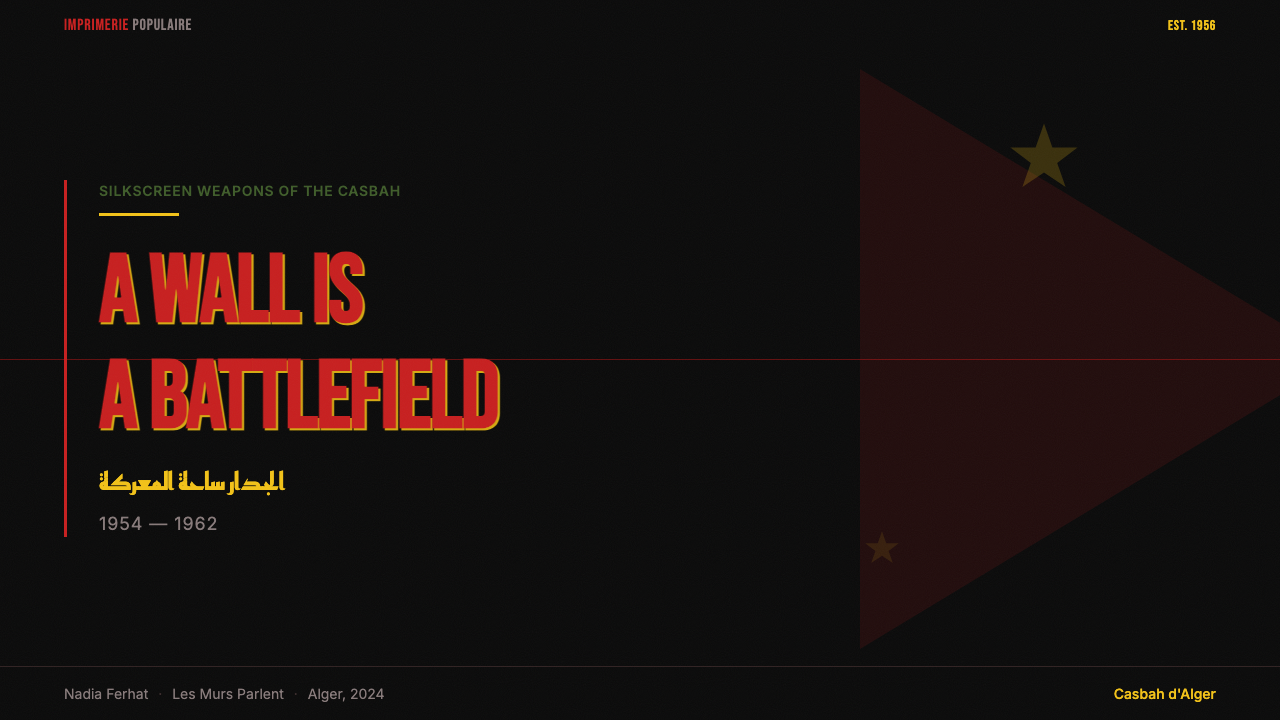
For presentation slides, the style works best in contexts where the content itself carries genuine urgency or moral weight: advocacy work, investigative reporting, public health communications, social justice campaigns. A cover slide built on this system uses the dark ground as its base, reserves one saturated accent color for a single focal element — a statistic, a portrait, a phrase — and treats all other information as secondary. Content slides should be sparse: one idea per surface, text rendered in high contrast against the dark field, no decorative elements. If data must appear, treat charts as geometric shapes in their own right — flat bars or arcs in the restricted palette, labeled with high-contrast type, no grid lines or background shading.
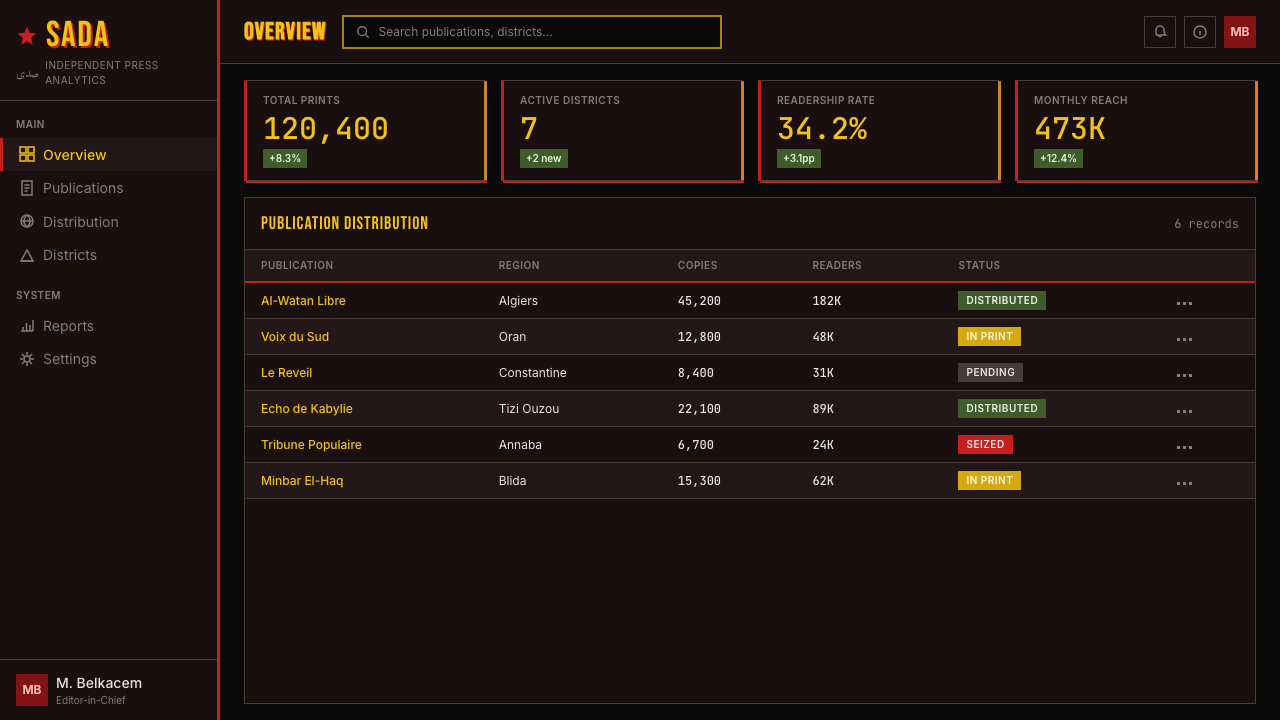
For web interfaces, the style is genuinely challenging to deploy at scale, because the visual intensity that makes a single poster arresting becomes exhausting across an entire interface. The most effective approach is to use the system selectively: a dark-ground hero section or a full-bleed alert banner built on casbah conventions, with the remainder of the interface adopting a lighter, less confrontational treatment. Dashboard elements that benefit from the style include status indicators and alert states, where the red-yellow-black palette communicates urgency without ambiguity. Navigation and information architecture should remain legible and calm — the style functions as a signal register, not a continuous background texture.
For editorial and marketing work, the style has a direct line to social-documentary and activist design traditions that have remained continuously vital from the 1960s to the present. Editorial spreads can use the dark-ground, high-contrast, stencil-portrait grammar effectively for profiles of activists, coverage of conflicts, or any content where the visual needs to carry emotional weight before a word is read. Marketing applications are more constrained: the style signals political commitment, material scarcity, and collective struggle — associations that fit some campaigns and actively damage others. Organizations working on rights, environment, and equity causes find the visual register immediately legible; commercial brands that borrow it without that context tend to read as cynical.
The most common mistake when applying this style is flattening it into a generic 'grunge' aesthetic — adding texture overlays, distressing type, layering halftone patterns — without understanding that the original system's roughness was functional, not decorative. The casbah poster does not look the way it looks because someone chose a worn texture filter; it looks the way it looks because it was printed with imprecise equipment on cheap paper in dangerous conditions. A contemporary application that wants the style's authority must earn it through structural honesty: commit to the restricted palette, accept the flat ink, and resist the temptation to smooth out the edges that carry the meaning.
Algerian Casbah Poster (1954–1962) — FAQ
How is this style different from other revolutionary poster traditions of the same era?
The Algerian system shares features with Cuban revolutionary posters, Soviet constructivist graphics, and Vietnamese war posters — all use flat color, bold type, and the stencil or silkscreen — but it is distinguished by two things most of the others lack: genuine bilingualism and the specific register of imprecision that comes from clandestine printing rather than state-sponsored production. Cuban and Soviet posters were produced with institutional resources; the casbah posters were made in hiding. That difference in production conditions is visible in the work, and it is precisely this difference that gives the system its peculiar authority. The roughness is not a style choice; it is evidence.
Can this style work for products and brands that have no connection to political struggle?
It can work visually, but it carries risk. The style's visual signature — dark ground, blood red, rough registration — is so saturated with historical meaning that it functions almost like a quotation. Using it in a purely commercial context without that context creates a disconnect that sophisticated audiences often read as cynical. That said, some contexts work well: music labels, small-run publishing, documentary film, independent journalism, and organizations whose work genuinely involves risk, scarcity, or advocacy. The style rewards authenticity and punishes pretense. If the work earns it, the visual authority is real; if the work doesn't earn it, the style becomes a costume.
What is the role of Arabic calligraphy in the system, and how should a designer approach it today?
Arabic calligraphy in the original posters is not decorative — it is the primary language of address to the Algerian population, and its bold, condensed Maghrebi forms were chosen for legibility at distance and rapid reproduction through stencil. For contemporary designers working outside the Arabic-speaking world, the element requires the most care. Using Arabic script without fluency in the language and its calligraphic traditions is a form of appropriation that can easily misfire — letterforms misread, meanings distorted, cultural specificity reduced to decoration. The better approach is to ask what the bilingual visual field represents: not Arabic specifically, but the principle that the designed surface can carry more than one cultural register simultaneously. That principle can be applied with cultural materials appropriate to the specific design context.
How does the dark ground interact with accessibility requirements for digital interfaces?
The dark-ground, high-contrast palette of the casbah poster system is in many respects naturally well-suited to accessibility: white or near-white text on a very dark background exceeds standard contrast requirements comfortably. The area of potential difficulty is the secondary accent colors. Warning yellow against black produces strong contrast; blood red against black is more borderline, particularly for users with certain forms of color vision deficiency who may not distinguish red from dark backgrounds at lower saturations. In digital applications, it is worth verifying that interactive elements relying on red alone for their distinction meet contrast requirements, and where they do not, pairing the color signal with a shape or text indicator.
Is there a risk of this style appearing dated, given its strong historical associations?
The irony is that the casbah poster system does not feel dated in the way that many design styles of the same period do. This is partly because it was never fashionable in the mainstream design sense — it was always marginal, underground, produced under constraint — and partly because the political conditions it was made to address (colonial domination, armed resistance, the right of peoples to determine their own cultural forms) have not resolved themselves into comfortable history. When a style is tied to ongoing questions rather than closed historical chapters, it retains urgency. The greater risk is not that it looks old but that it is used so often as a shorthand for radical credibility that it begins to feel like a gesture rather than a commitment.
Related design styles
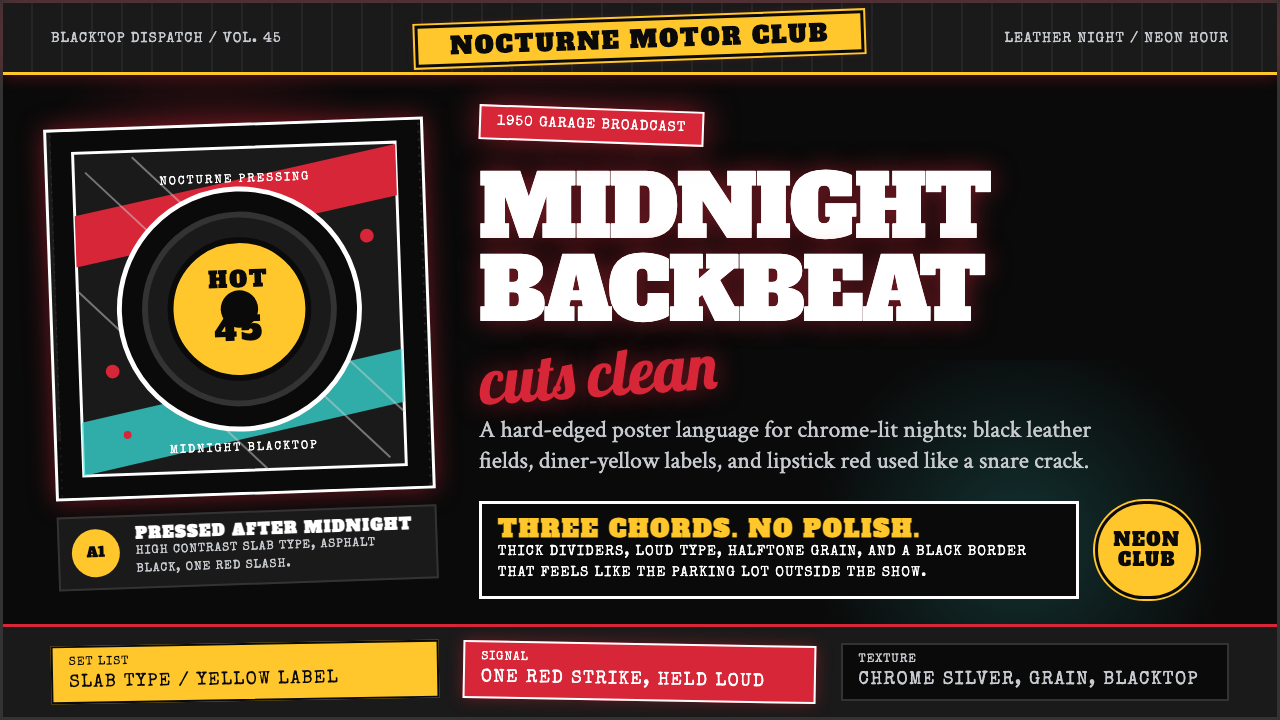 Rockabilly Greaser (1950)Loud after midnight. Asphalt black, chrome-yellow circles, and one lipstick-r…
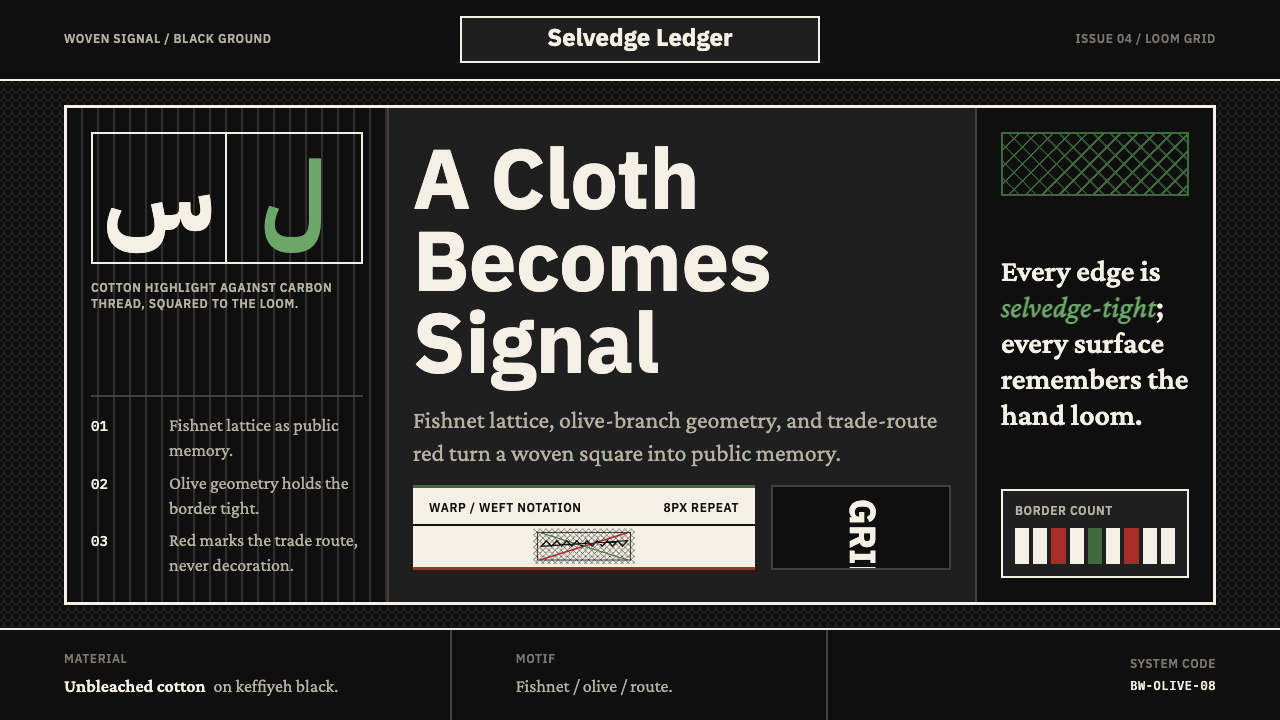 Levantine Keffiyeh Black & WhitePolitical textile, not ornament. Cotton type and fishnet lattice cut through…
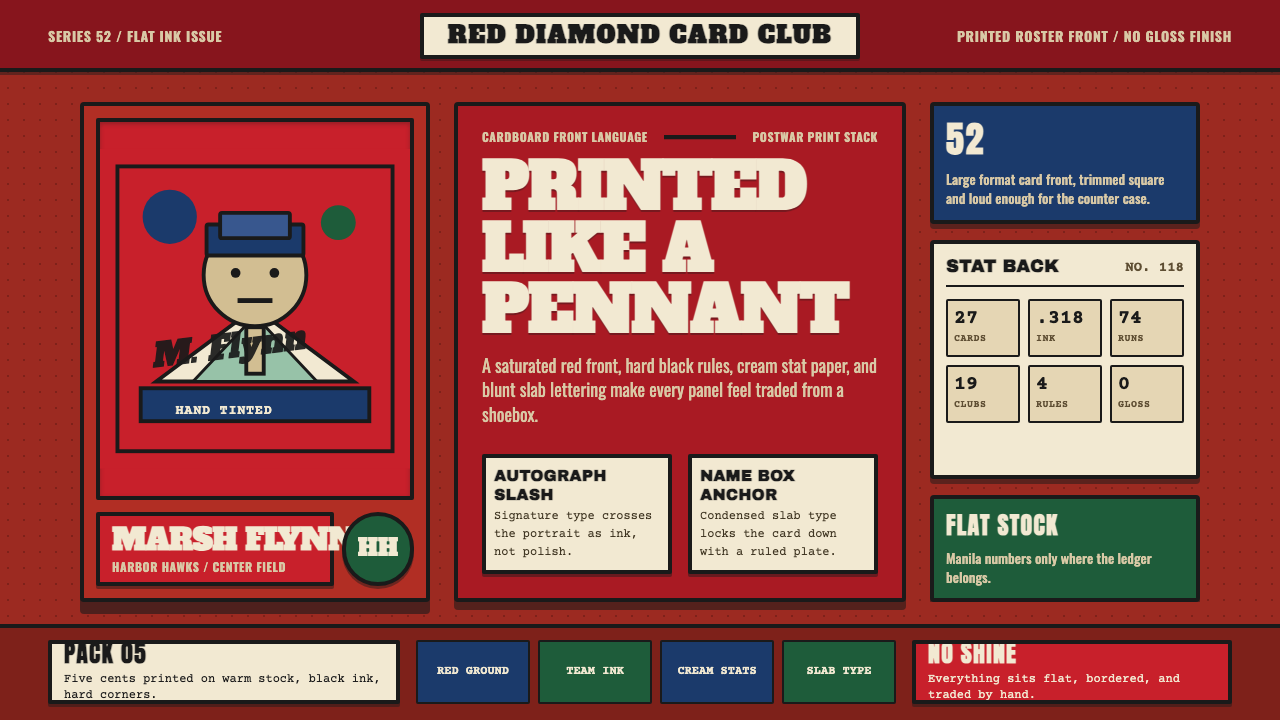 Topps Baseball CardCardboard heat. Brick-red slab panels, cream stats, and condensed type feel p…
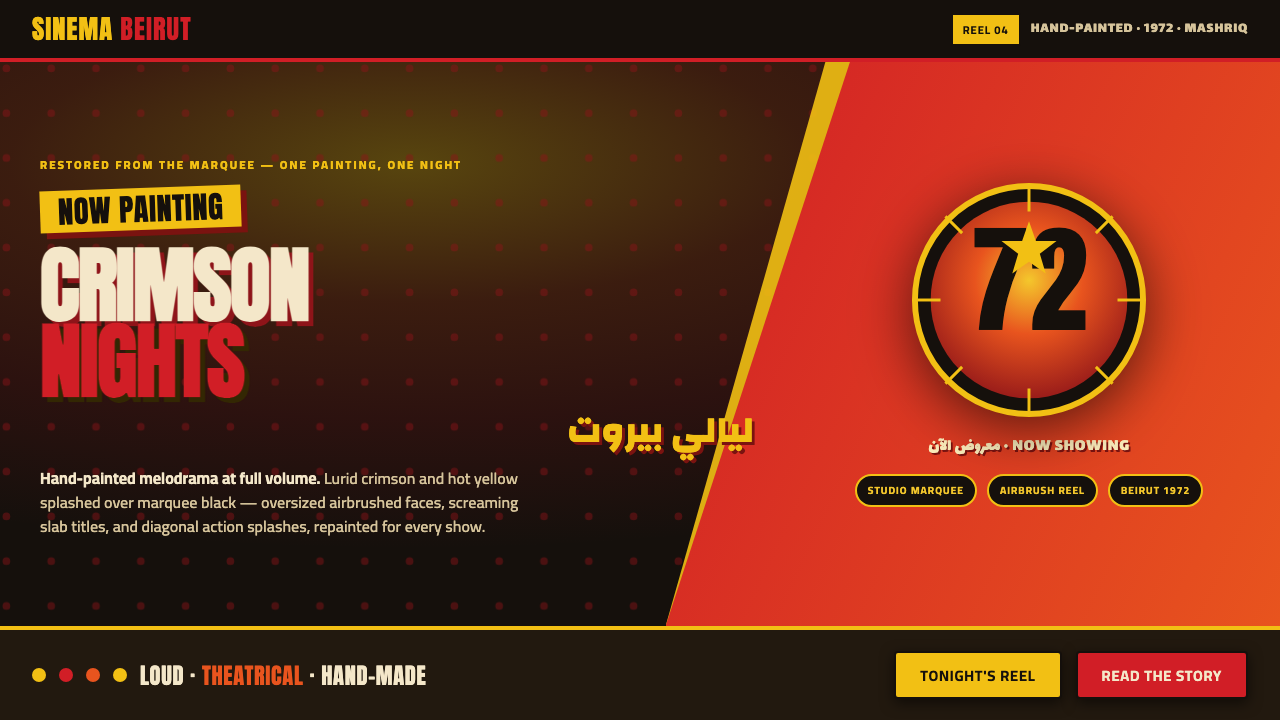 Lebanese Film PosterMelodrama at full volume. Lurid crimson and hot yellow on marquee black, slab…
 Manga Panel LayoutCinema in ink. Black panels, screentone dots, speed lines, and one red strike.
 Palestinian Keffiyeh GridMemory in black and cream. Fishnet grid, olive border, and austere Anton type.