What is Soviet Brutalism (1972)?
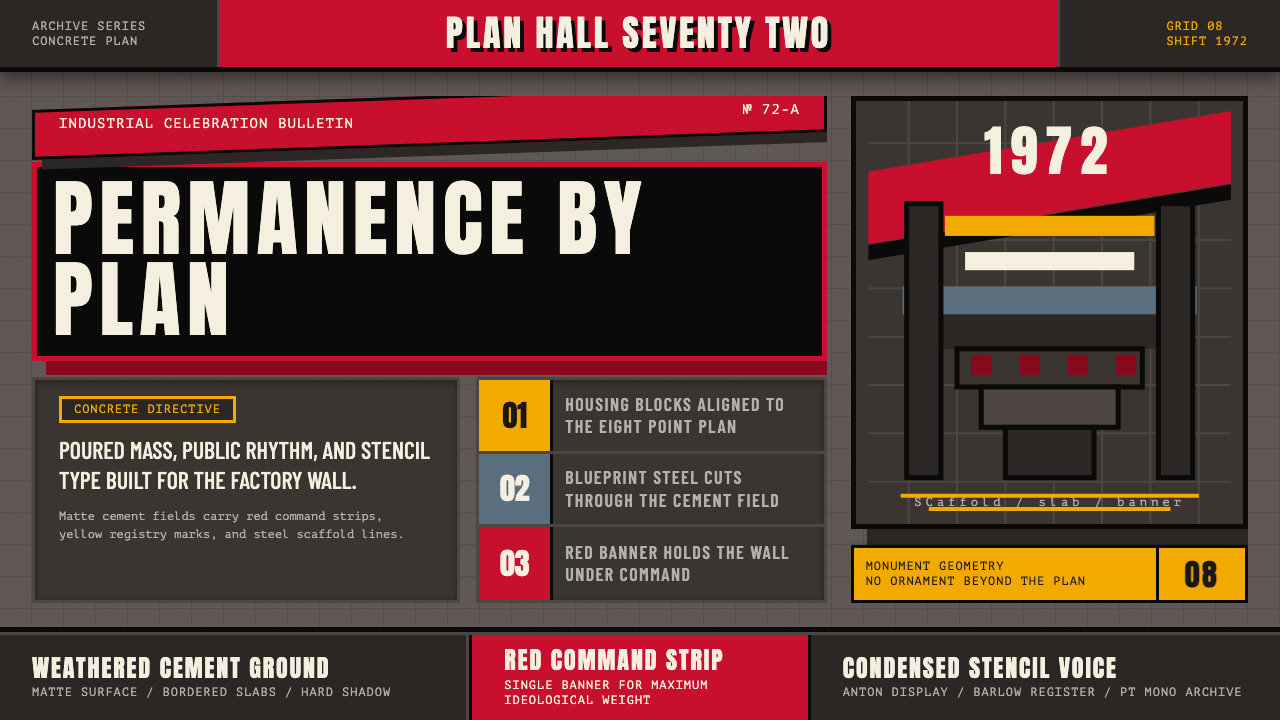
Soviet Brutalism cast ideology in poured concrete and billboard stencil — a visual language built to outlast the individuals who made it.
Soviet Brutalism (1972) in brief
Soviet Brutalism is the visual system that emerged from the USSR's monumental building and propaganda campaigns of the late 1950s through the mid-1980s. It fuses architectural Brutalism — the unapologetic use of raw, board-formed concrete as both structure and surface — with the state poster tradition: bold condensed stencil letterforms, a palette anchored in weathered cement gray and Soviet red, and compositional geometry derived from Constructivism's unfinished project. The result is a style that reads simultaneously as a physical material and a printed graphic.
Where Bauhaus used geometry to rationalize industrial production, Soviet Brutalism used it to proclaim the permanence of the collective. Housing micro-rayons, cascade war memorials, factory mosaic murals, and Five-Year-Plan posters all share the same formal logic: monumental scale, compressed but legible type, a limited palette that does not compete for attention, and silhouette imagery of workers, machines, and monuments against austere geometric grounds. Everything is heavy, matte, and unambiguous.
The 1972 moment that this design system captures is specific: the high-water mark of Soviet poster culture, when state graphic design had absorbed Constructivist lessons and settled into a mature visual language used in print, enamel signage, textile banners, and architectural surface decoration simultaneously. It is the moment before détente softened the visual rhetoric — dense, confident, and relentlessly frontal.

Where does Soviet Brutalism (1972) come from?
The architectural roots of Soviet Brutalism lie in Khrushchev's 1955 decree condemning the decorative excesses of Stalinist architecture — the ornate spires and cornices of the Seven Sisters skyscrapers — as wasteful of state resources. This top-down edict redirected Soviet construction toward prefabricated concrete panel systems and monolithic cast-in-place structures. Suddenly raw concrete was not a sign of poverty but of rational socialist planning. Architects across the USSR, from Moscow to Tashkent to Yerevan, were handed a material and a mandate: build permanently, build legibly, build at scale.
The graphic tradition that ran parallel to and through Soviet architecture drew its energy from an earlier source: the Soviet avant-garde of the 1920s. Constructivist designers — Alexander Rodchenko, El Lissitzky, Varvara Stepanova — had already established the visual grammar of diagonal dynamics, bold sans-serif type, photomontage, and a red-black-white palette working together as a single rhetorical machine. By the 1930s, Stalin's Socialist Realism had partially suppressed this abstraction in favor of heroic figuration. But the underlying formal discipline — the grid, the stencil, the silhouette — survived in anonymous state graphic production: factory safety posters, collective farm signs, and municipal enamel plaques that blanketed every public surface in the Soviet Union.
The 1960s brought a partial rehabilitation of abstract and geometric approaches. International exchanges, including Soviet participation in world expositions, exposed state designers to Western modernism without endorsing its individualism. Soviet graphic design journals published studies of Polish poster school work and Yugoslav experimental typography. By the early 1970s, a distinctly Soviet hybrid had emerged: geometric rigor and bold stencil type — legible to a worker with a ten-second glance — combined with monumental photographic silhouettes and the authoritative weight of architectural concrete texture. The 1972 Munich Olympics (in which the USSR competed) and the simultaneous Sapporo Winter Games prompted an unusual burst of state graphic production, the artifacts of which serve as benchmarks for this aesthetic moment.
Geographically, Soviet Brutalism was never purely Russian. Some of its most concentrated built examples stand in Armenia, Georgia, and the Central Asian republics, where local architects like Jim Torosyan and Viktor Jorbenadze combined Brutalist mass with references to regional vernacular geometry. In Poland, East Germany, and Yugoslavia — outside the USSR proper — allied Brutalism developed its own inflections, sometimes more formally experimental, sometimes more ornamentally decorated. The 1972 design system draws primarily on the metropolitan Soviet core: the propaganda poster vocabulary of Moscow and Leningrad studios, the monumental public sculpture tradition associated with Yevgeny Vuchetich, and the civic architecture of the late Khrushchev and Brezhnev eras.
What defines the Soviet Brutalism (1972) look?
Color
The palette is built around a small number of load-bearing tones. Weathered cement gray — not a clean neutral but a heavy, slightly warm gray with residual texture — serves as the dominant ground. Against it, Soviet red functions as the single high-saturation accent: the color of banner fabric, propaganda enamel, and revolutionary blood. A near-black charcoal carries structural lines and type at full weight. Occasional off-white or bare paper tones appear in highlights and lettering. Secondary colors, if they appear at all, are muted and industrial — ochre, oxide brown, military khaki — never clean or bright. The system is built for dominance, not variety.
Typography
Display type is condensed and stencil-derived: letterforms cut from metal or cardboard templates, with characteristic notches and bridges where the stencil material had to remain connected. This is not a stylistic affectation but a trace of the actual production method — posters painted through physical stencils at billboard scale. Body text, when present, is set tight and compact in a narrow weight, occupying as little ground as possible. There is dramatic contrast in scale between headline and supporting text: the headline might occupy a third of the composition while everything else recedes to near-caption size. Uppercase dominates; mixed case is rarely used.
Geometry and Composition
Soviet Brutalist composition inherits the Constructivist grid but strips out its playful diagonal dynamism. Layouts tend toward vertical monumentality: elements stack rather than rotate, the horizon line sits low or is entirely absent, and figures rise against open sky or flat geometric grounds. Rectangles and hard-edged polygons dominate. Circles appear, but as contained elements — a medallion, a sun, a machine gear — not as free-floating focal points. The overall composition is frontal, symmetrical or nearly so, and designed to be read at distance. There is no invitation to linger; everything resolves at first glance.
Texture and Surface
Unlike Bauhaus, which insisted on flatness as a principle, Soviet Brutalism incorporates simulated or referenced material texture as a carrier of meaning. The rough grain of board-formed concrete, the weave of banner fabric, the coarse dot structure of low-resolution newsprint — these surface qualities are not decorative. They signal weight, age, permanence, and collective labor. In two-dimensional work, texture appears as a background field rather than a foreground element, grounding the composition in materiality rather than ornamenting it. The effect is that even a printed poster carries a sense of mass.
Silhouette and Figure
Human figures in Soviet Brutalist work are almost never portrayed with facial detail or individual expression. Instead, they appear as upward-facing silhouettes — workers with raised tools, athletes in motion, soldiers in formation — where the body's posture communicates collective purpose rather than individual character. The silhouette is cut sharp and held against a plain geometric ground or an open sky. This treatment simultaneously elevates the figure to symbolic status and effaces its particularity. The same logic applies to architecture: buildings and monuments appear as silhouettes or outlines, rendered in their most recognizable profile.
Density and Hierarchy
Soviet Brutalism does not rely on white space as an organizing principle. Where Bauhaus uses the empty field as a compositional element, Soviet Brutalism fills the ground — every area carries either a tone, a texture, or an image. Hierarchy is established through scale and contrast rather than through spacing: the largest element is the most important, the highest-contrast element commands first attention. Supporting information is present but subordinated, pushed toward corners or the base of the composition. This creates a visual weight that communicates seriousness and finality; nothing is tentative, nothing is quiet.
Banner and Emblem Motifs
Certain recurring formal motifs characterize Soviet Brutalist work: the diagonal banner or ribbon cutting across a composition, the starburst or radiant aureole behind a central figure, the laurel or wheat-sheaf framing device, the five-pointed star as punctuation mark. These are not arbitrary decoration — they are the shared symbolic vocabulary of a visual system that needed to communicate identically in dozens of languages across a continent-spanning state. In contemporary design applications, these motifs can be used sparingly as compositional anchors that signal the reference without overloading it.

Who shaped Soviet Brutalism (1972)?
Pavlov was among the most prolific Soviet architects of the Brutalist period, responsible for a series of landmark public and institutional buildings in Moscow and other major Soviet cities. His work demonstrated how raw concrete could be deployed at civic scale with formal rigor and symbolic weight — not merely as an economical building material but as an architectural statement. The visual logic of his facades — grid-based modular repetition, recessed windows creating deep shadow, weight concentrated at the base — directly parallels the compositional principles of Soviet graphic design of the same era.
Vuchetich was the preeminent Soviet monumental sculptor, responsible for the massive figurative installations at Mamayev Kurgan in Volgograd — including the figure known internationally as The Motherland Calls — and the Treptower Park Soviet War Memorial in East Berlin. His work defines the visual scale and ideological ambition of Soviet Brutalism at its most extreme: the human figure amplified to architectural dimensions, gesture replacing individual expression, stone and metal achieving the visual weight of poured concrete. The upward-facing silhouette that recurs in Soviet graphic design is in large part derived from the visual grammar his monuments established.
Torosyan was a leading architect in Soviet Armenia, whose work in Yerevan and surrounding regions represents one of the most distinctive regional inflections of Soviet Brutalism. Working primarily in local volcanic tuff stone alongside cast concrete, he demonstrated how Brutalist mass and monumental geometry could absorb local material and formal traditions without compromising ideological clarity. His buildings are among the most photographed examples of late Soviet architecture precisely because they complicate the usual assumption that Brutalism was a homogeneous, centrally directed style.
Jorbenadze designed some of the most formally audacious Brutalist structures built anywhere in the Soviet Union, including several landmark public buildings in Tbilisi, Georgia, that pushed cast concrete into sculptural territory rarely attempted in official Soviet practice. His work represents the latitude that peripheral Soviet republics sometimes enjoyed in architectural experimentation, and it stands as evidence that Soviet Brutalism at its best was not a single frozen form but a set of formal commitments — weight, geometry, material honesty — that could be interpreted with genuine ambition.
Much of the most powerful Soviet graphic design of the 1960s and 1970s was produced by anonymous collectives and state-employed designers working through organizations such as TASS Windows, Iskusstvo publishing, and regional Kombinat studios. Individual authorship was rarely credited; the work belonged to the state. This collective anonymity is itself a formal principle with visual consequences: styles were codified into manuals, stencils were shared across studios, and the resulting consistency of visual language across a vast geographic territory was unprecedented in design history. Contemporary applications of Soviet Brutalism implicitly reference this anonymous authority.
How do you use Soviet Brutalism (1972) today?
Soviet Brutalism translates powerfully into contemporary design work when the goal is to project authority, permanence, or ideological confidence. It is a particularly strong choice for brands and products that want to signal that they are serious, built to last, and uninterested in trends. The visual weight of the style carries meaning before a single word is read — it is a posture as much as an aesthetic. But applying it well requires understanding that the style's power comes from restraint within a very limited formal vocabulary, not from accumulating its most recognizable symbols.
For presentation decks, Soviet Brutalism is exceptional on cover pages and section dividers where monumental impact matters. A cover built from a dominant cement-gray field, one large stencil-style headline in near-white, and a single high-contrast Soviet-red geometric accent — a band, a bar, a hard-edged polygon — communicates with the frontal directness of a propaganda poster. Content slides should maintain the density principle: no generous padding, text aligned to a firm grid, data visualized as flat geometric shapes in the same limited palette. Avoid the temptation to lighten the style for readability; contrast and weight are how the system communicates hierarchy.
For web interfaces, the style suits dashboards, analytics tools, and B2B platforms where seriousness and data density are features rather than liabilities. The approach requires committing to a heavy visual weight: near-black grounds or cement-toned grounds with Soviet-red interactive accents, bold condensed type for labels and headings, flat borders rather than soft shadows, and minimal rounded corners. Navigation should be typographic and compact. The danger in web applications is using too much of the palette simultaneously — the red accent must remain truly sparse, reserved for the one element that most needs to communicate urgency or action.
For editorial and marketing work, Soviet Brutalism functions as a strong compositional system for feature pieces, manifestos, annual reports, and campaign materials where authority is the primary register. A full-spread editorial layout benefits from the low horizon line principle: a large silhouette figure or architectural photograph treated in high-contrast duotone occupying the upper two-thirds of the composition, with compressed headline type anchored at the base. Marketing posters work on the same logic as the original state posters: one dominant visual hierarchy, one accent color, a slogan-scale headline, and supporting copy subordinated in scale. The style is particularly effective for campaigns that position a brand as a builder or a long-term thinker.
The most common mistake when applying Soviet Brutalism is mistaking it for a set of graphic symbols — stars, banners, stencil fonts — that can be layered onto any layout to produce the effect. Authentic Soviet Brutalist design does not use these symbols decoratively; every element present is load-bearing. The second common error is softening the palette: introducing warmer tones, more varied grays, or brighter reds in an attempt to make the style more approachable. The approach of the original work was precisely the opposite — the limited, severe palette is what creates the sense of institutional inevitability. A third error is ignoring density. The style does not use whitespace as a luxury; if large empty areas appear, the composition is not reading as Soviet Brutalist, it is reading as a pale quotation of it.

Soviet Brutalism (1972) — FAQ
How does Soviet Brutalism differ from Constructivism?
Constructivism (roughly 1920–1934) was an avant-garde movement driven by individual artists and designers who were also theorists — Rodchenko, Lissitzky, Tatlin — and who believed that art could and should transform social consciousness through radical formal innovation. Its compositions are dynamic, diagonal, and energetically unstable. Soviet Brutalism, by contrast, is institutional and monumental: it emerged from state organs, not avant-garde studios, and its formal language prioritizes permanence and legibility over dynamism. Where Constructivism rotates and thrusts, Soviet Brutalism stacks and looms. The two share a grid, a red-black-white palette, and a sans-serif sensibility, but the emotional registers are entirely different — Constructivism is urgent and forward-projecting, Soviet Brutalism is final and backward-validating.
Can this style work for non-political or commercial projects?
Yes, but it requires deliberate recontextualization. The style's connotations — collective action, state authority, ideological permanence — are strong and specific. In commercial work, these translate best into attributes like reliability, seriousness, long-term commitment, and industrial-scale capability. Technology infrastructure companies, labor-focused platforms, manufacturing brands, and organizations working on large civic problems can absorb these associations productively. Where it struggles: consumer lifestyle products, anything requiring warmth or playfulness, and any brand whose positioning relies on individual expression or personalization. The style works best when the product itself has something genuinely monumental about it — or wants to make the case that it does.
Is the style inherently dark-background, or can it work on light grounds?
Historic Soviet posters used both. The cement-gray ground that characterizes this design system reads as a mid-tone rather than a dark background — it is heavy without being black. A light-ground variant is historically legitimate: many Soviet posters used near-white or pale yellow grounds with black type and red accents. The critical issue is maintaining the visual weight, which depends not on background darkness but on type boldness, element density, and the sparingness of the red accent. A light-ground version that spreads the red liberally or uses a lightweight typeface will not read as Soviet Brutalist; a light-ground version that preserves the density, the stencil-weight type, and the single-accent discipline can be just as convincing.
How should photography be used within this aesthetic?
Photography in Soviet Brutalist work is never used naturalistically. Historic posters either avoided photography entirely in favor of painted silhouettes and geometric forms, or used photography processed into stark high-contrast duotones that reduced the image to near-silhouette quality. In contemporary applications, the principle holds: photographs should be treated in high-contrast duotone using the palette's tones rather than their natural colors, cropped tightly and composed against flat geometric grounds rather than allowed to bleed freely, and selected for images where the subject is readable as a strong silhouette. Portrait photography showing individual faces in detail runs counter to the style's collective logic and should be avoided or abstracted.
What distinguishes a thoughtful Soviet Brutalism application from kitsch?
Kitsch Soviet Brutalism uses the visual symbols — the stars, the hammers, the red banners — as costume. Thoughtful application uses the formal principles — weight, geometry, density, frontal composition, hierarchical scale — and arrives at the symbols only when they serve the specific communicative need. The most convincing contemporary work in this mode often contains very few of the obvious iconographic references; it is recognizable as Soviet Brutalist because of how elements are placed and weighted, not because of which symbols are present. A secondary test: does the work feel like it was designed for distance and durability, or for close inspection and novelty? Soviet Brutalism was made to be read at thirty meters on a concrete wall; if it only works on screen at full resolution, the formal logic has not been internalized.
Related design styles
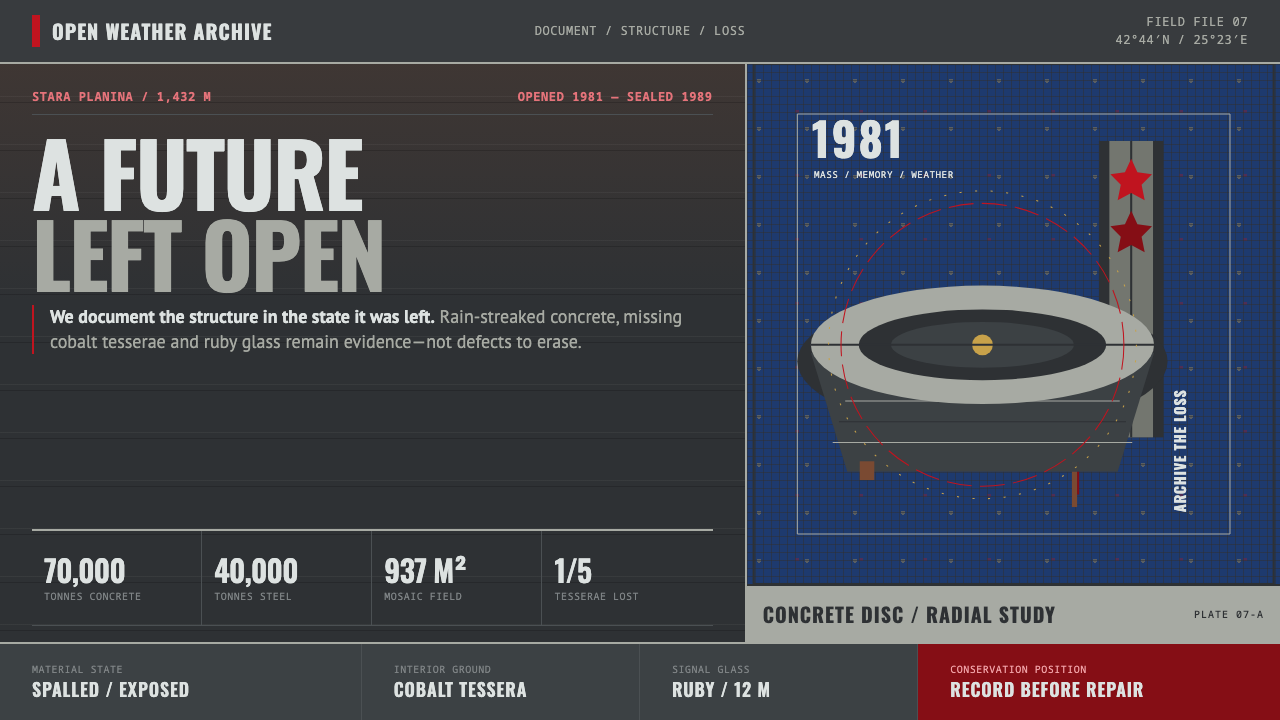 Buzludzha MonumentMonumentality without repair. Stained concrete frames cobalt tesserae, ruby g…
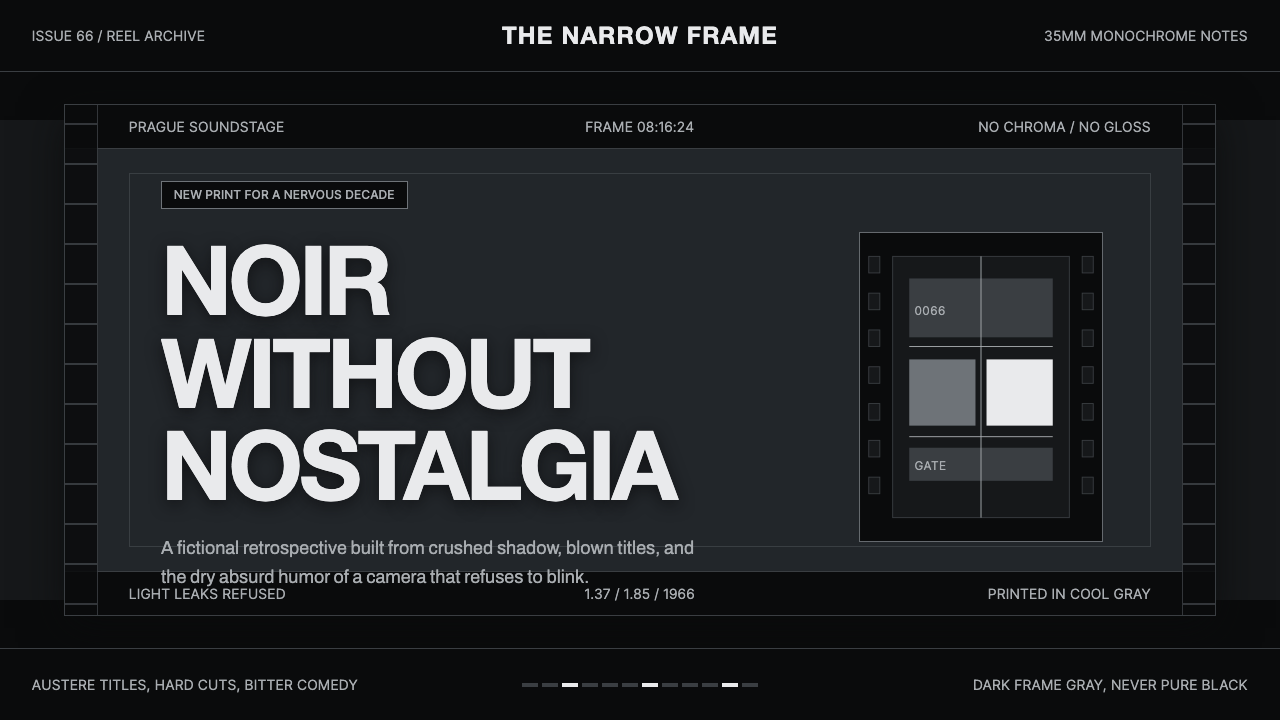 Czechoslovak New Wave CinemaNoir without nostalgia. Letterbox bars, off-white titling, and 35mm grain do…
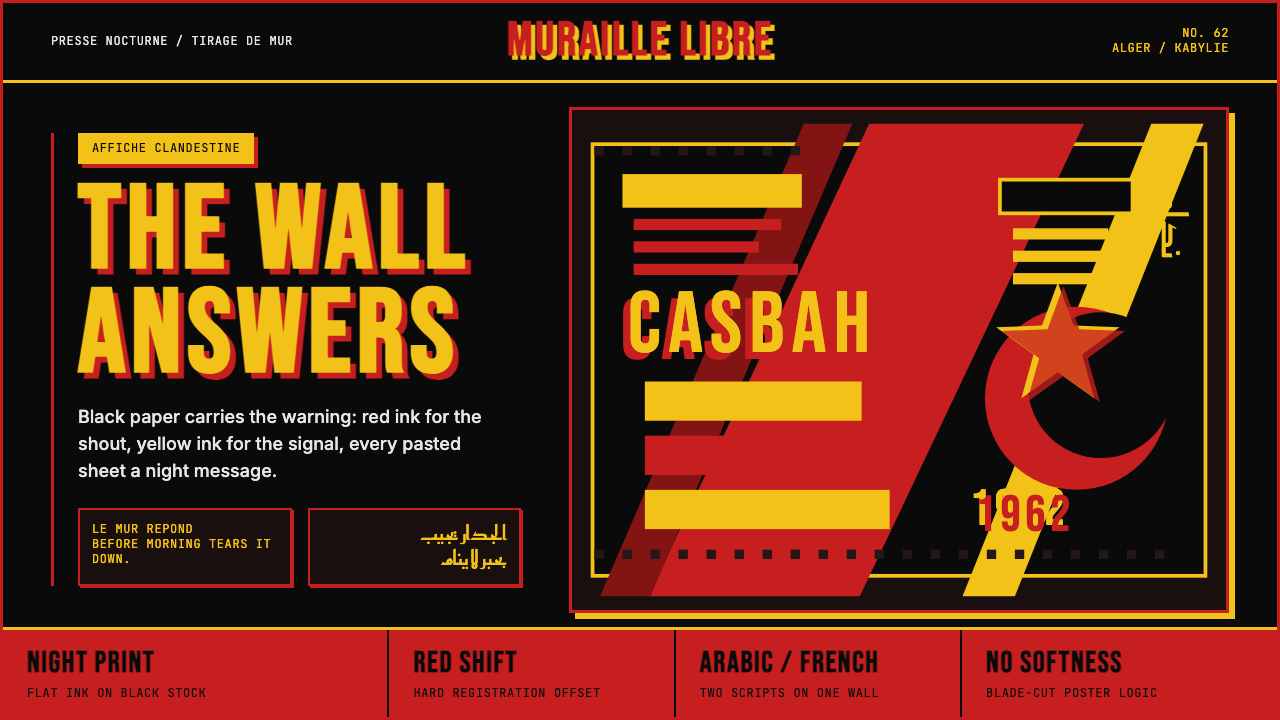 Algerian Casbah Poster (1954–1962)Every surface is a manifesto. Blood red, warning yellow, and stencil type hit…
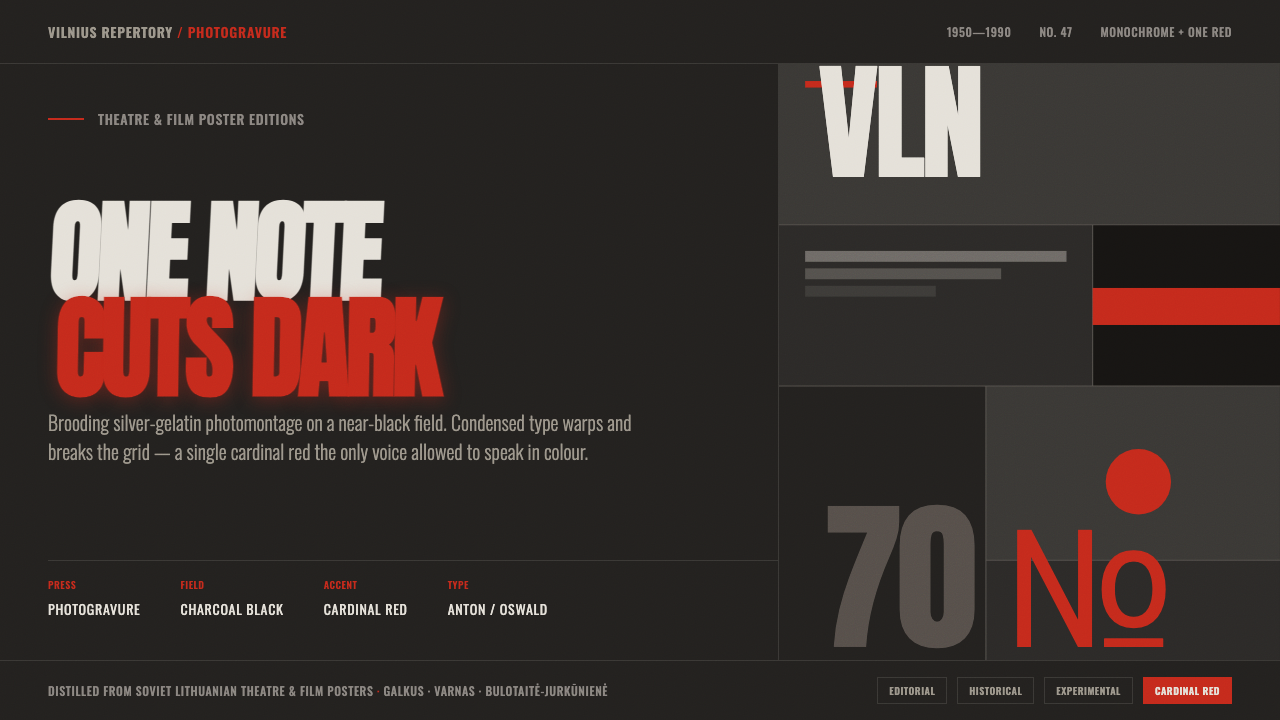 Lithuanian Poster ArtMonochrome plus one red. Charcoal photogravure field, warped Anton type, a lo…
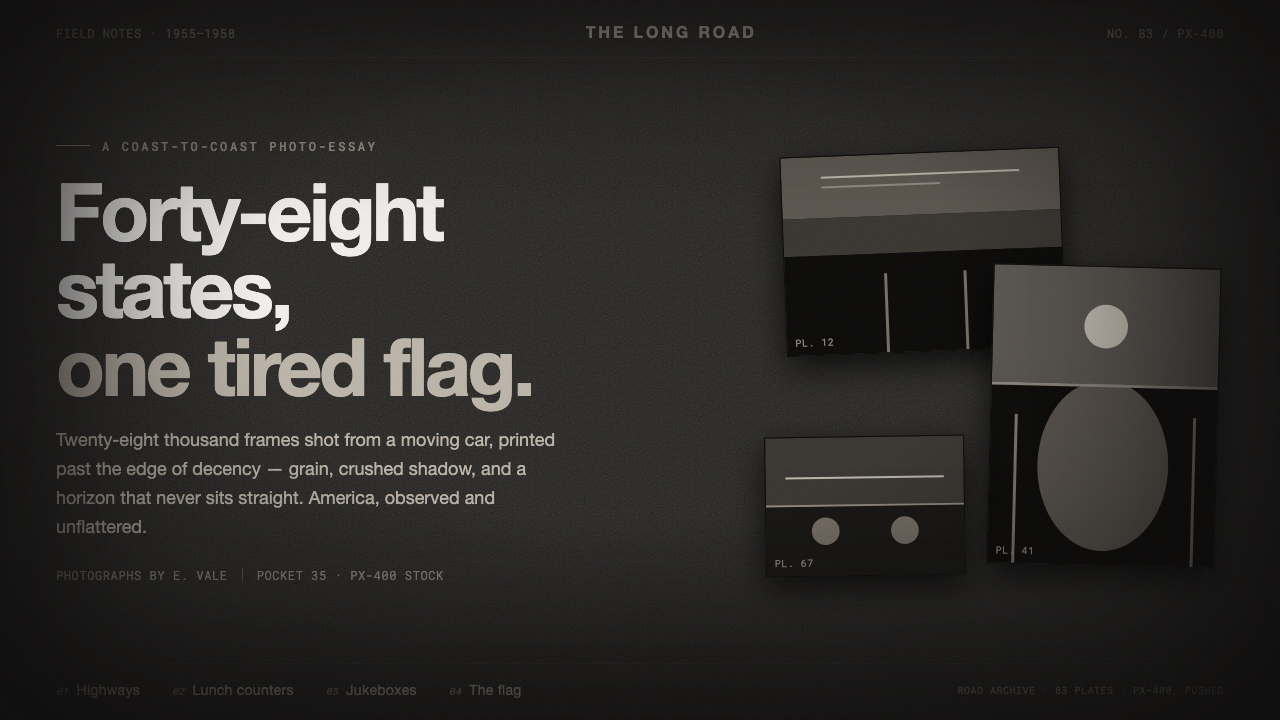 Robert Frank The AmericansReportage, polish stripped off. Warm sooty charcoal, crushed near-black shado…
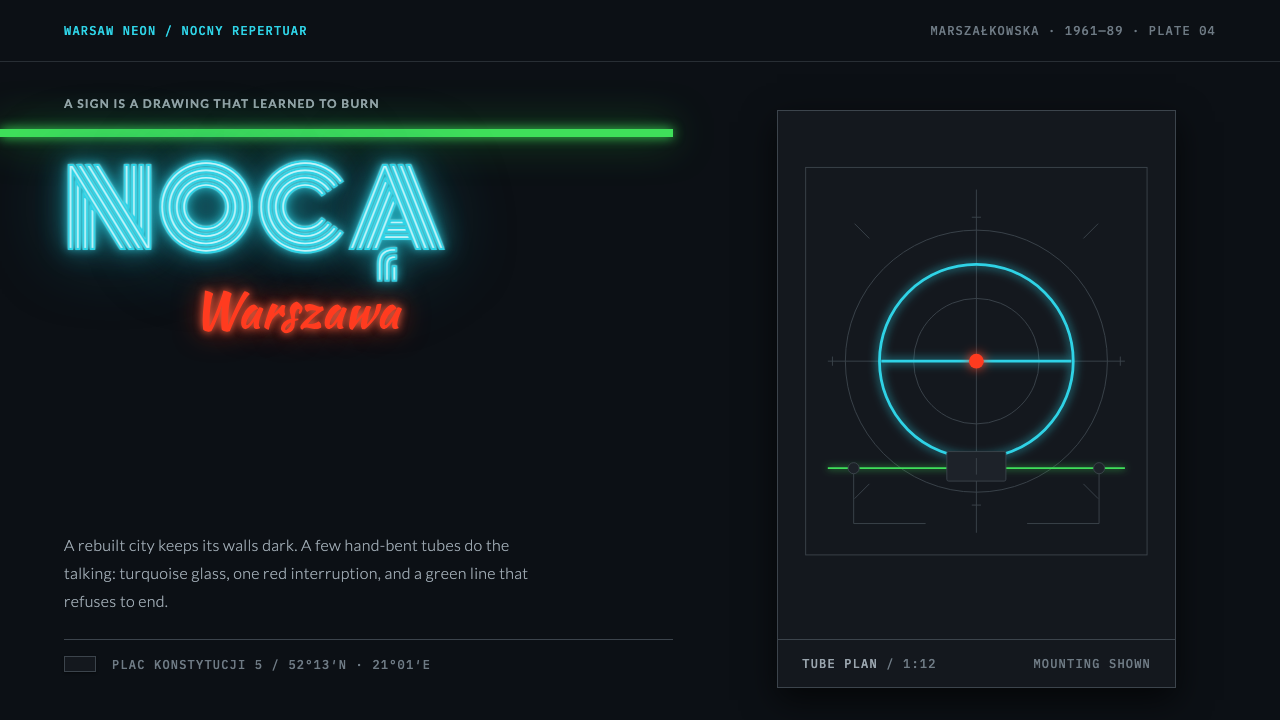 Warsaw NeonNight belongs to the handmade sign. Turquoise tube type rides a green facade…