What is Milton Glaser / Push Pin?
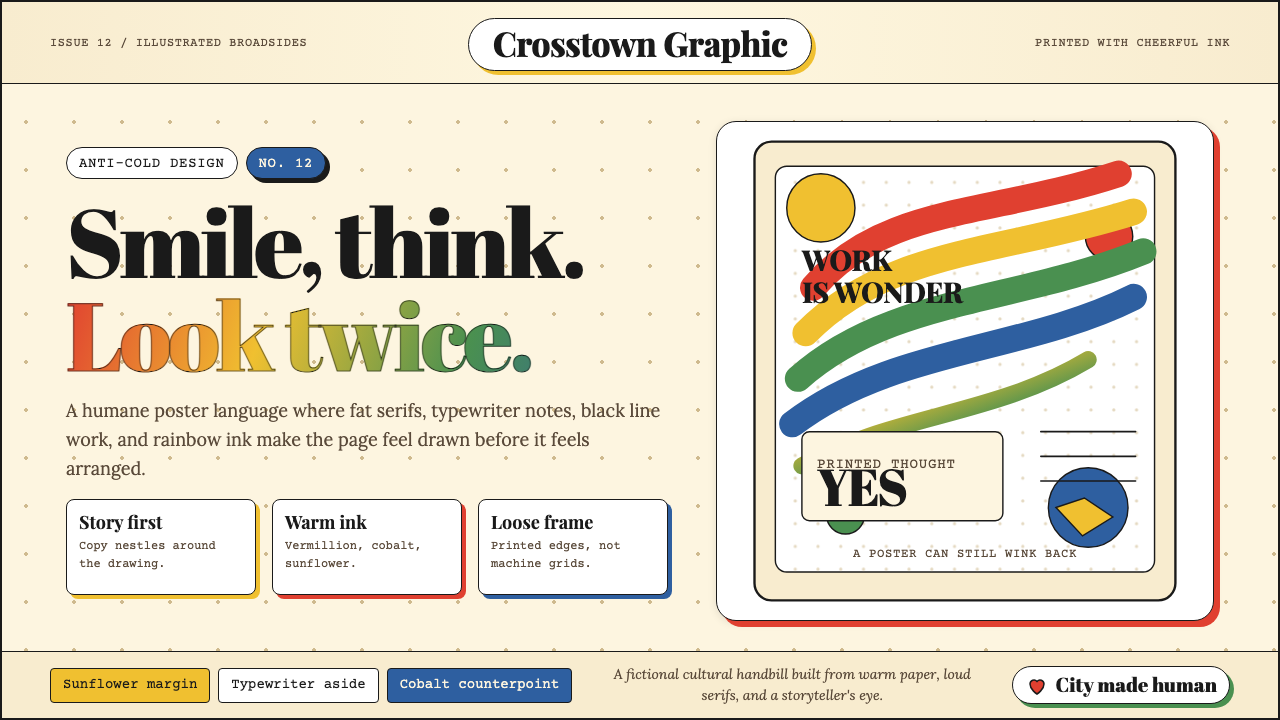
Milton Glaser and Push Pin Studios proved that illustration is graphic design — and that warmth, wit, and eclecticism are just as rigorous as any grid.
Milton Glaser / Push Pin in brief
Milton Glaser / Push Pin is the American counter-movement to Swiss International Style: eclectic, illustrative, and unapologetically warm. Where Swiss minimalism sought universal rules and mechanical neutrality, Push Pin embraced historical ornament, hand-drawn line, and the expressive power of a storyteller's eye. The resulting visual language is not chaos — it is a different kind of discipline, one that prizes wit, surprise, and human connection over rational systems.
The aesthetic is built on a warm palette of vermillion, cobalt blue, and sunflower yellow deployed against cream or off-white grounds. Composition is driven by illustration and arc rather than the orthogonal grid. Serifs — historicist, slab, or display-weight — coexist with typewriter-body text, and the pairing is deliberate: different typographic eras in conversation signal erudition rather than inconsistency. Period-mixing is a method, not a mistake.
The style is also fundamentally optimistic. Glaser's work — from concert posters to food packaging to the 'I ❤ NY' mark — assumes that the viewer is intelligent, curious, and capable of delight. The visual complexity invites lingering rather than demanding instant comprehension. This makes Push Pin a powerful counter-choice whenever a design brief calls for personality, narrative, and the kind of warmth that geometric minimalism structurally cannot provide.

Where does Milton Glaser / Push Pin come from?
Push Pin Studios was founded in New York City in 1954 by Milton Glaser, Seymour Chwast, Ed Sorel, and Reynold Ruffins — four graduates of the Cooper Union school of art. The name came from the pushpin bulletin boards on which they displayed their work. From the start, the studio positioned itself as an alternative to the clean rationalism then dominating American corporate design. While Madison Avenue agencies refined Swiss-influenced grids, Push Pin raided art history for Victorian engravings, Art Nouveau flourishes, and Art Deco geometry, recombining them with a Pop sensibility.
The studio published its own promotional magazine, the Push Pin Monthly Graphic (later Push Pin Almanack), which it sent to art directors and clients. This self-published vehicle was itself a design statement — each issue adopted a completely different visual register, from mock-Victorian broadsheets to psychedelic color fields, demonstrating the studio's argument that no single style should monopolize graphic communication. The Almanack became internationally influential, arriving in design studios from London to Tokyo and introducing a generation of designers to the possibility of a post-Swiss eclecticism.
Milton Glaser's individual career within and after Push Pin produced several works that achieved cultural-artifact status. In 1966 he designed a poster of Bob Dylan for Columbia Records in which the musician's silhouetted profile is surrounded by a mass of rainbow-colored hair rendered in sinuous lines drawn from Art Nouveau. The poster was included as an insert in Dylan's Greatest Hits album and is estimated to have reached several million households, making it one of the most widely distributed posters in American print history. In 1977, commissioned to rebrand New York State tourism, Glaser sketched the 'I ❤ NY' logotype — combining a capital I, a red heart symbol, and the letters NY — on a scrap of paper in the back of a taxi. The mark has since been reproduced on billions of objects and remains the most recognizable city identity in the world.
Glaser remained active as a designer and educator until his death in June 2020, the day of his ninety-first birthday. Seymour Chwast, his longest-running Push Pin collaborator, continued working into his nineties, maintaining the studio's commitment to illustration-as-design and to the idea that graphic work should carry personal voice. The Push Pin legacy is now studied in virtually every American design school, and its influence is visible wherever contemporary designers resist the pull of systematic minimalism in favor of narrative, warmth, and visual surprise.
What defines the Milton Glaser / Push Pin look?
Warm Eclectic Palette
The signature Push Pin palette centers on a warm triad: vermillion red, deep cobalt blue, and saturated sunflower yellow, deployed against cream or aged-paper grounds rather than clinical white. Unlike the symbolic rigor of Bauhaus primaries, these colors feel painterly and tactile — they suggest pigment, not pixel. Warm neutrals and earthy ochres enter the palette frequently, softening the composition and evoking the hand-printed quality of lithographic posters from the late nineteenth and early twentieth centuries.
Illustration as Structure
In Push Pin work, the illustration is not decoration applied to a layout — it is the layout. Figurative and decorative drawing determines where the eye travels, where type is anchored, and how the composition breathes. Line quality ranges from delicate crosshatching that evokes Victorian engraving to bold flat silhouettes that read at poster scale. This integration of image and text as a single compositional act distinguishes the style from approaches that treat imagery as a container to be filled with type.
Historicist Type Mixing
Push Pin typography refuses the modernist commitment to a single-family system. Display headlines may draw from ornate Victorian wood type or Art Nouveau letterforms full of organic curve; body text often takes a more readable, book-like serif; captions or supporting text might employ a typewriter or slab register. The deliberate collision of typographic eras signals the studio's core argument: that history is a resource to be mined rather than a tradition to be escaped. The mixing is always purposeful — each face is chosen for its cultural resonance within the particular piece.
Arc, Curve, and Organic Line
Where Swiss modernism is orthogonal, Push Pin is curvilinear. Arcs structure compositions, lines flow rather than march, and borders undulate or feature hand-drawn irregularity rather than mechanical precision. The sinuous quality owes debts to Art Nouveau, to psychedelic poster art of the 1960s, and to the organic drawing traditions of mid-century American illustration. This curvilinear energy makes the style feel alive and in motion even when static — a quality that flat geometric systems rarely achieve.
Pop Color over Vintage Texture
A characteristic Push Pin juxtaposition places flat, saturated pop color directly over aged, textured surfaces — a screaming yellow fills a shape traced over a Victorian engraving ground, or a flat cobalt silhouette sits on a ground that reads like worn letterpress paper. This collision between the immediate and the historical is not random: it compresses time, asserting that visual traditions from different eras can inhabit the same plane and converse as equals. The tension between smooth pop color and rough antique texture is itself the message.
Asymmetric, Story-Led Composition
Push Pin layouts are asymmetric, but the organizing logic is narrative rather than mathematical. Composition follows the story the piece is telling: figures face each other or reach toward type, directional lines lead the eye through a sequence, masses of color suggest weight and mood rather than grid alignment. There is no rigid modular system; instead, there is the designer's cultivated sense of what a composition needs to feel complete, surprising, and alive. This approach demands strong visual judgment but rewards it with work that is unmistakably handmade.
Wit and Cultural Quotation
Push Pin work consistently demonstrates intellectual wit — the knowing reference, the unexpected historical citation, the visual pun that rewards attention. Glaser and his collaborators drew on sources from Renaissance portraiture to Japanese woodblock prints to dime-novel illustration without hierarchical prejudice, treating world visual culture as a shared commons. This erudite playfulness communicates that design can be both learned and fun, that sophistication and warmth are not opposites. The wit is never ironic in the detached postmodern sense; it is warm, collegial, and aimed at connection.

Who shaped Milton Glaser / Push Pin?
Glaser co-founded Push Pin Studios in 1954, left to open Milton Glaser Inc. in 1974, and remained prolific for the next five decades. His 1966 Bob Dylan poster brought psychedelic line work and Art Nouveau curves into mainstream American print culture in a single image. His 'I ❤ NY' mark, sketched in the back of a taxi in 1977, became the most imitated city identity in history. Glaser also redesigned New York magazine with Clay Felker, bringing an editorial design sensibility to weekly journalism that influenced magazine layout worldwide. He taught for decades at the School of Visual Arts in New York and argued consistently that design is fundamentally a humanist discipline — not a problem-solving system but a meaning-making practice.
Chwast co-founded Push Pin with Glaser and remained its longest-running creative force, working actively into his nineties. His visual style is more overtly cartoonish and satirical than Glaser's — deeply influenced by American comic strips, Victorian illustration, and the graphic arts of political caricature. Chwast's anti-war posters of the Vietnam era became iconic examples of illustration used for direct political argument, and his typographic experiments — including his own display typefaces drawn in deliberately naive, irregular letterforms — pushed the studio's eclecticism further toward visual storytelling. He was instrumental in establishing the Push Pin aesthetic as a lasting alternative canon within American graphic design.
Sorel, another founding member of Push Pin, left the studio relatively early to pursue a career as an editorial illustrator and caricaturist, contributing regularly to The New Yorker, The Atlantic, and other major publications over several decades. His sharp caricatures of political figures drew on European satirical print traditions — Daumier, Rowlandson, Gillray — and demonstrated that the Push Pin commitment to illustration as a primary communicative tool extended naturally into journalism and social commentary. Sorel's career illustrated the breadth of the Push Pin diaspora: the studio was as much an attitude toward image-making as it was a house style.
McMullan was among the second generation of Push Pin-affiliated illustrators whose work carried the studio's sensibility into theater and cultural poster design. His long collaboration with the Lincoln Center Theater — producing hand-painted season posters that combined loose watercolor rendering with expressive lettering — became one of the most visible examples of illustration-led design in American cultural institutions. McMullan's posters demonstrated that the Push Pin conviction, that image and typography should form a single emotional argument, could sustain a long-form institutional identity without ever becoming formulaic.
How do you use Milton Glaser / Push Pin today?
Milton Glaser / Push Pin is a style that rewards specificity of application. It is not a neutral container — it arrives with a strong personality, a warm emotional register, and an inherent association with American cultural vitality of the mid-to-late twentieth century. Used well, it lends a project authority, wit, and a sense of handmade care that is structurally unavailable to minimalist systems. The first question to ask is not how but whether: does the project's subject matter and audience welcome warmth, narrative, and visual complexity, or does it demand the rational clarity that geometric minimalism provides?
For presentation slides, Push Pin works with particular power on covers and section dividers, where a bold illustrative moment can establish the personality of an entire deck before a word of content is read. A cover composition anchored by a central illustrative figure, surrounded by curving ornamental type set in a warm cream-and-vermillion palette, communicates energy and confidence immediately. Content slides should be handled with restraint: preserve the warm ground color and historicist type choices, but reduce illustrative complexity so that information hierarchy remains legible. Data slides can incorporate the style's decorative sensibility through border treatments, hand-drawn chart embellishments, and warm palette fills for bars and segments — while keeping the underlying data structures clean and readable.
For web interfaces, the style is most naturally at home in editorial contexts — cultural publications, food and lifestyle brands, independent bookshops, creative agencies, and music platforms where personality is a competitive advantage. Dashboard and pricing page applications are possible but require discipline: anchor the layout with a clear typographic hierarchy, limit the illustrative elements to accent positions rather than letting them compete with functional UI components, and ensure that interactive states are communicated through clearly readable color shifts rather than decorative elaboration. The style's characteristic asymmetry can create visual interest in hero sections and feature blocks without undermining the usability of forms, tables, or navigation.
For editorial and marketing work, Push Pin is closest to its native territory. A feature article layout in this style uses a generously scaled illustrative drop cap or opening image, warm body text in a readable book serif, and section breaks marked by ornamental rules or small decorative devices rather than plain horizontal lines. Pull quotes can be set in a contrasting display face at an angle or within an arched or oval frame. Marketing pages benefit from the style's poster logic: treat each content section as a self-contained visual argument with its own illustration, color key, and typographic register, then compose the page as a sequence of distinct moments rather than a single continuous grid.
A common mistake when applying this style is mistaking eclecticism for anything-goes. Push Pin's historical promiscuity is always purposeful — each borrowed element is chosen for its cultural resonance and its function within the specific composition. Mixing too many historical references without clear editorial logic produces visual noise rather than wit. A second common error is under-investing in the illustrative elements: applying the warm palette and historicist typefaces to a layout that lacks genuine illustration results in something that reads as vaguely retro without any of the style's narrative power. The illustration is not optional decoration; it is the engine of the approach.

Milton Glaser / Push Pin — FAQ
How is Push Pin different from other retro or vintage design styles?
Most retro design styles simulate a specific historical period — they reproduce the printing artifacts, color limitations, and type conventions of a particular era in order to evoke nostalgia. Push Pin is something different: it is a method of active historical quotation, not passive reproduction. Glaser and his collaborators chose elements from Victorian, Art Nouveau, Art Deco, and other traditions not to evoke a time but to make an argument — about the richness of visual history, about the intelligence of the viewer, about the possibility of graphic design as cultural commentary. The difference is visible in the results: Push Pin work feels contemporary and witty even decades later, while most period simulation ages quickly.
Can the Push Pin style work for digital-native interfaces, or is it inherently print-oriented?
The style originated in print and its deepest strengths are print-adjacent: the textured grounds, the hand-drawn line quality, the lithographic color relationships all translate most naturally to static surfaces. That said, the style adapts to digital contexts provided the designer accepts certain trade-offs. Textured grounds may need simplification for performance. Highly detailed illustration may need to be reserved for large-format moments — hero sections, splash screens, empty states — rather than applied throughout an interface. Micro-interactions should use the palette and typographic register rather than animated illustration, which can easily become overwhelming. Used this way, Push Pin digital work retains the style's warmth and personality without fighting against the performance and legibility requirements of interactive software.
The style feels complex — how do you keep it from looking cluttered?
The key discipline is compositional hierarchy: every Push Pin piece has a single dominant element — usually the central illustration — and everything else is subordinate to it. Clutter happens when multiple elements compete for primacy at the same scale and contrast level. Glaser's compositions are actually highly controlled: the illustrative mass anchors a clear center of gravity, type is placed in relation to that anchor rather than independently, and the decorative elements (borders, ornamental rules, secondary color fills) are consistently smaller and lower in contrast than the primary figure. The eclecticism operates within a clear visual hierarchy, not outside it. When applying the style, establish the dominant element first and let everything else find its supporting position.
Is this style appropriate for brands that want to appear modern and forward-looking?
It depends on what kind of modernity the brand is claiming. Push Pin is not suited to projecting technological rationalism or clinical efficiency — for those signals, geometric systems are structurally better aligned. But there is a kind of modernity that values craft over automation, personality over neutrality, and cultural depth over optimized minimalism — and for that version of contemporary, Push Pin is a strong choice. Brands in independent food, music, publishing, fashion, cultural institutions, and creative services can use the style to signal that they are modern in the sense of confident, cultured, and human rather than modern in the sense of algorithmic and scalable.
How should imagery and photography be handled within a Push Pin layout?
Push Pin is fundamentally a drawn style, and photography sits uneasily within it when treated naturalistically. Where photography appears in Push Pin-influenced work, it benefits from being treated as a graphic element: cropped aggressively into an illustrative shape, given a duotone wash in the palette's warm tones, or framed within an ornamental border that makes it read as a considered artifact rather than a documentary snapshot. Alternatively, photography can be deliberately set in tension with illustration — a photographic figure surrounded by drawn ornamentation — but this requires compositional confidence to avoid looking unresolved. As a general rule, if the brief allows it, drawn or painted imagery is more internally consistent with the style than photographic imagery and will require less compensatory treatment.
Related design styles
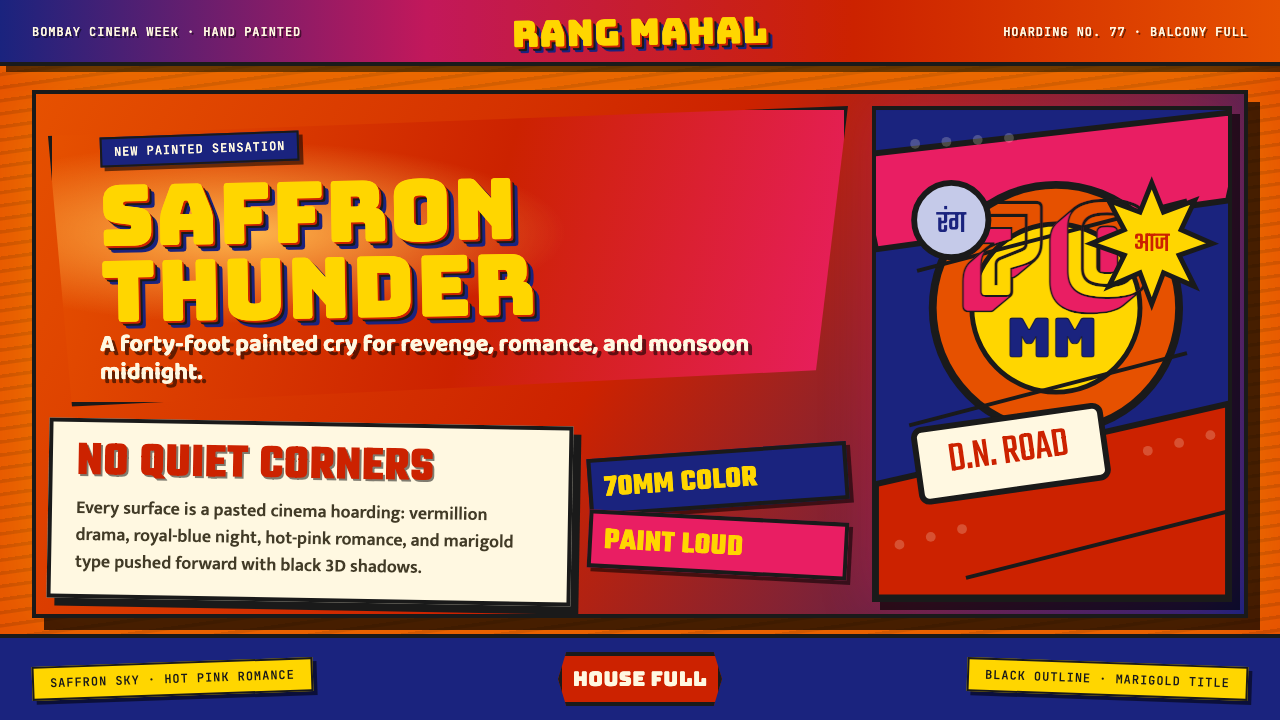 Bollywood Poster Art (1970s)Subtlety is unaffordable. Saffron fields, Bungee shadows, diagonal hoarding d…
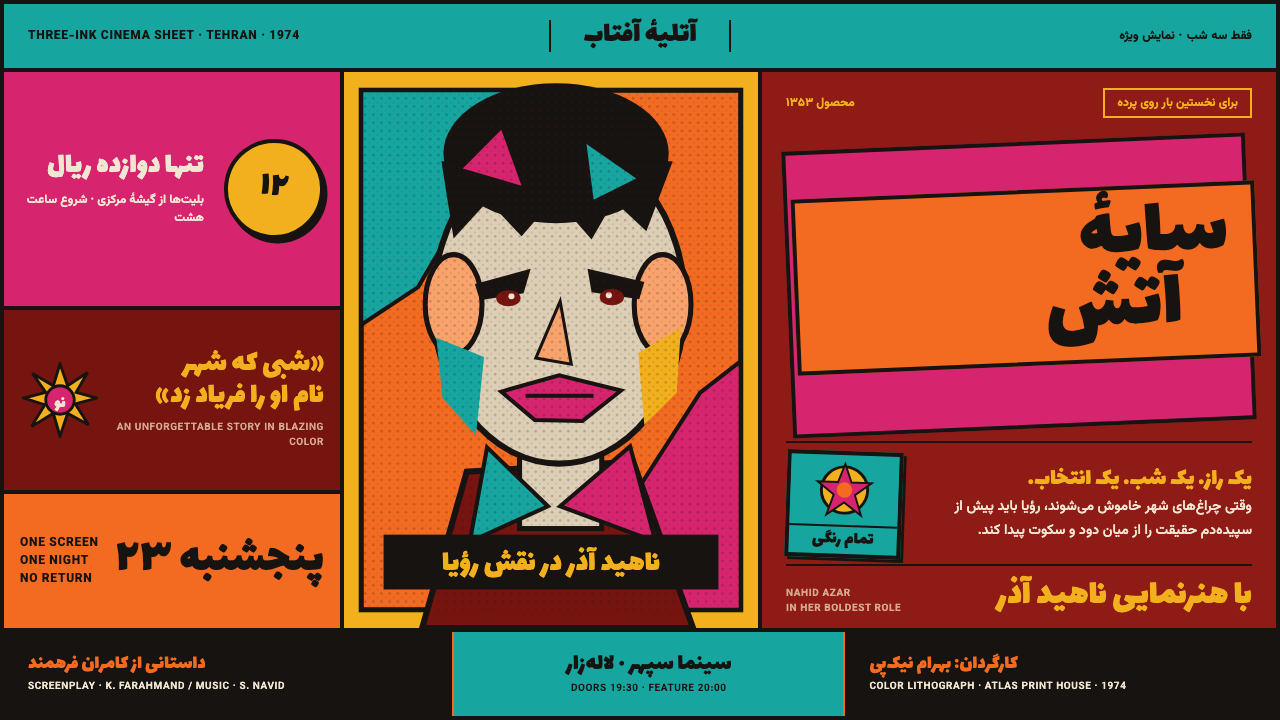 Iranian Film PosterCinema shouts in flat ink. Persian lettering clashes orange, turquoise and ma…
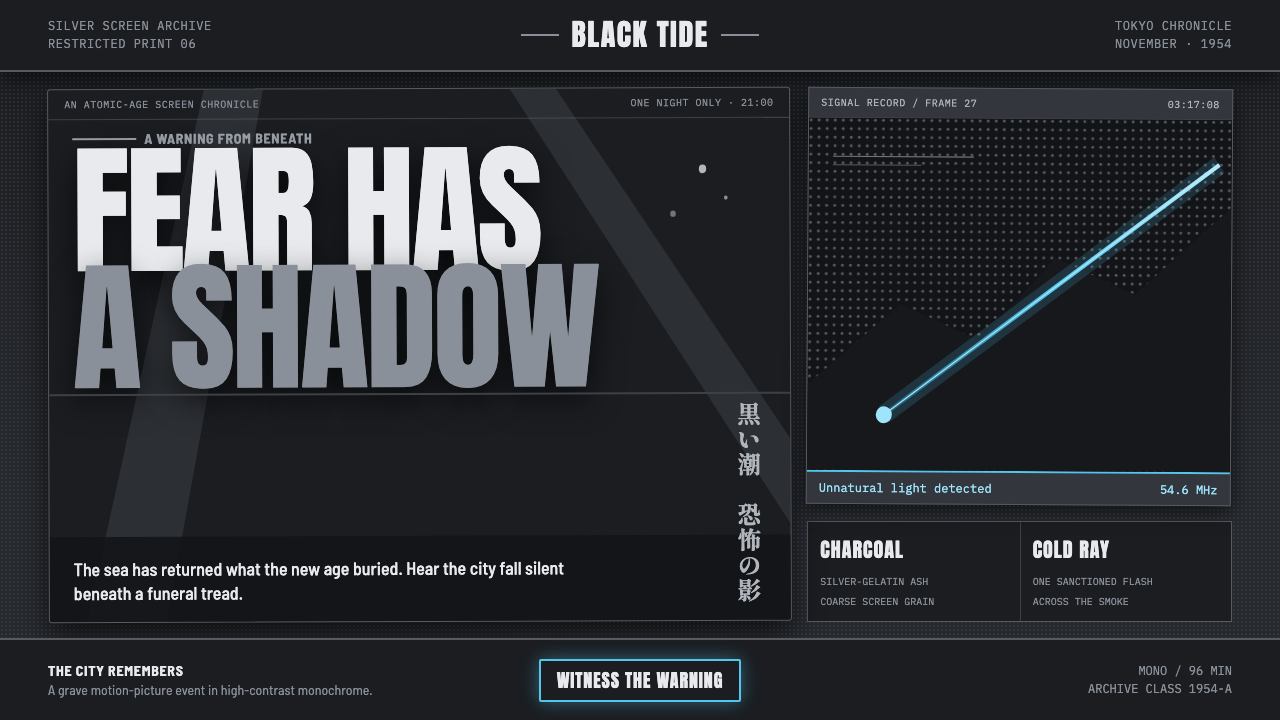 Godzilla (1954 Showa)Fear takes monumental form. Charcoal halftones split under one atomic-blue ra…
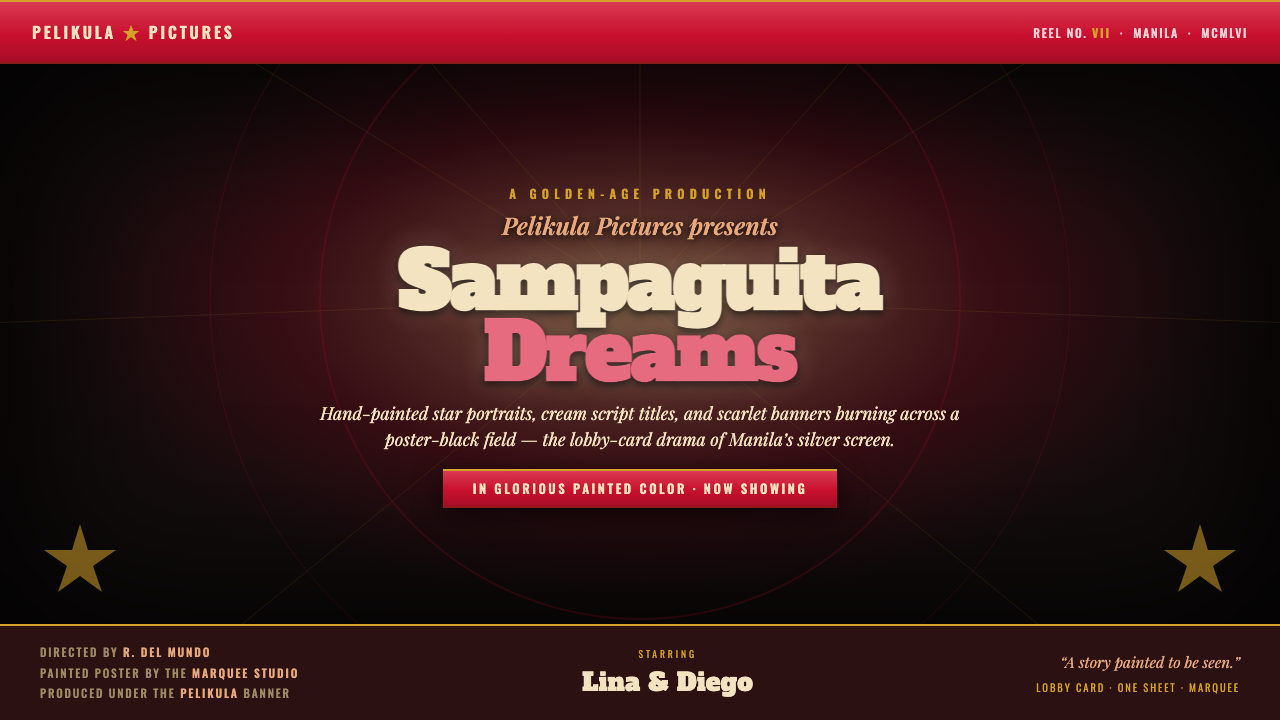 Manila LVN Film PosterLobby-card drama for the screen. Cream slab title on poster-black, scarlet ba…
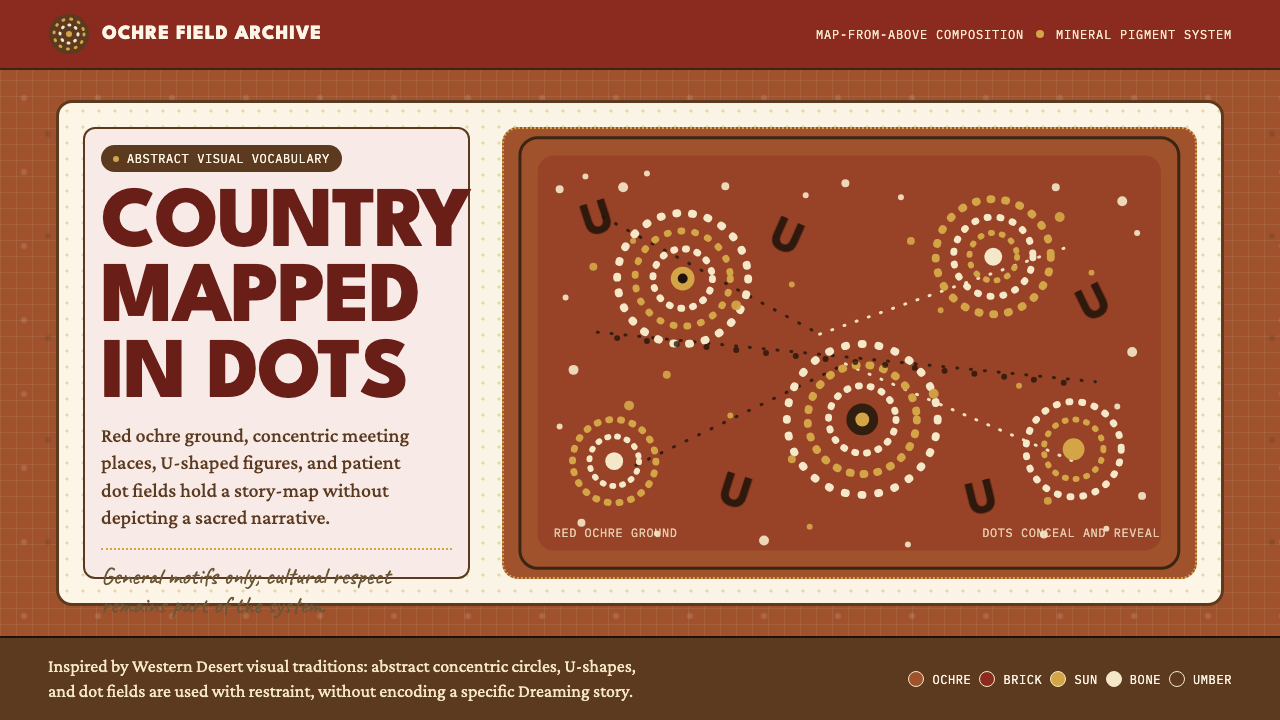 Aboriginal Dot PaintingAncient story-map energy. Red ochre, bone dots, concentric circles, and U-mar…
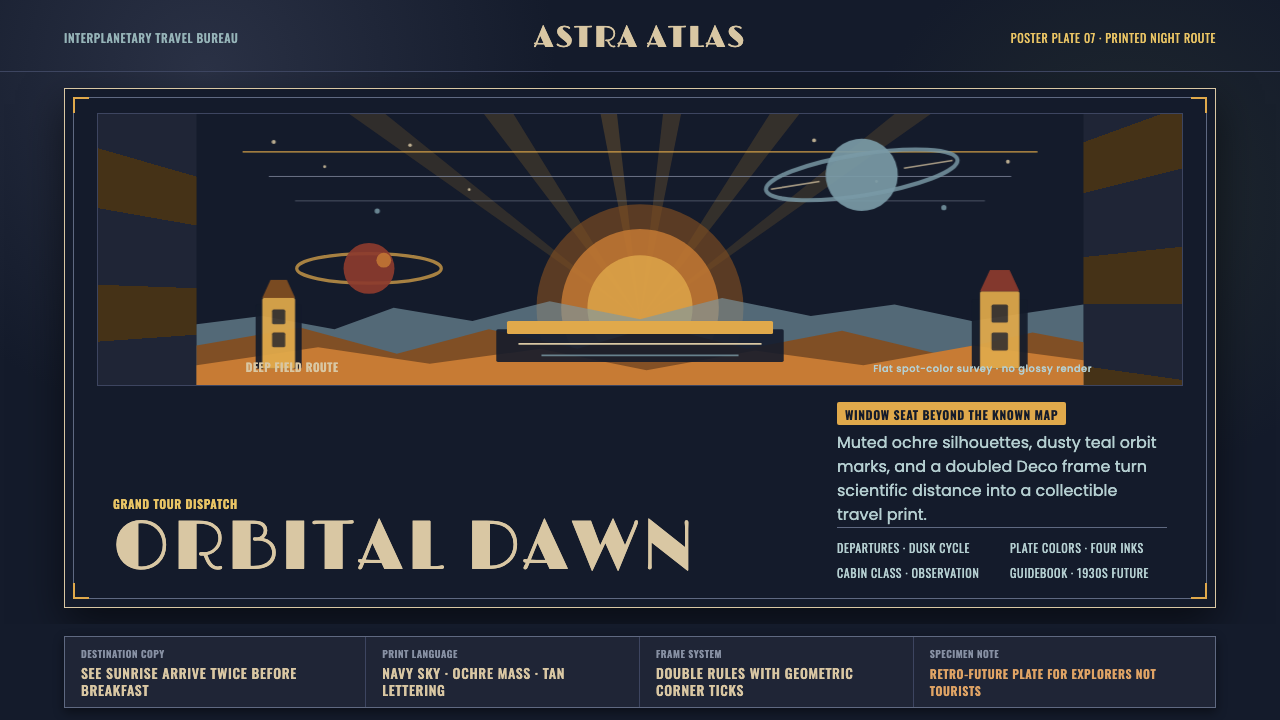 JPL Visions of the FutureSpace travel as print craft. Burnt orange silhouettes and Deco tan type on na…