What is Bollywood Poster Art (1970s)?
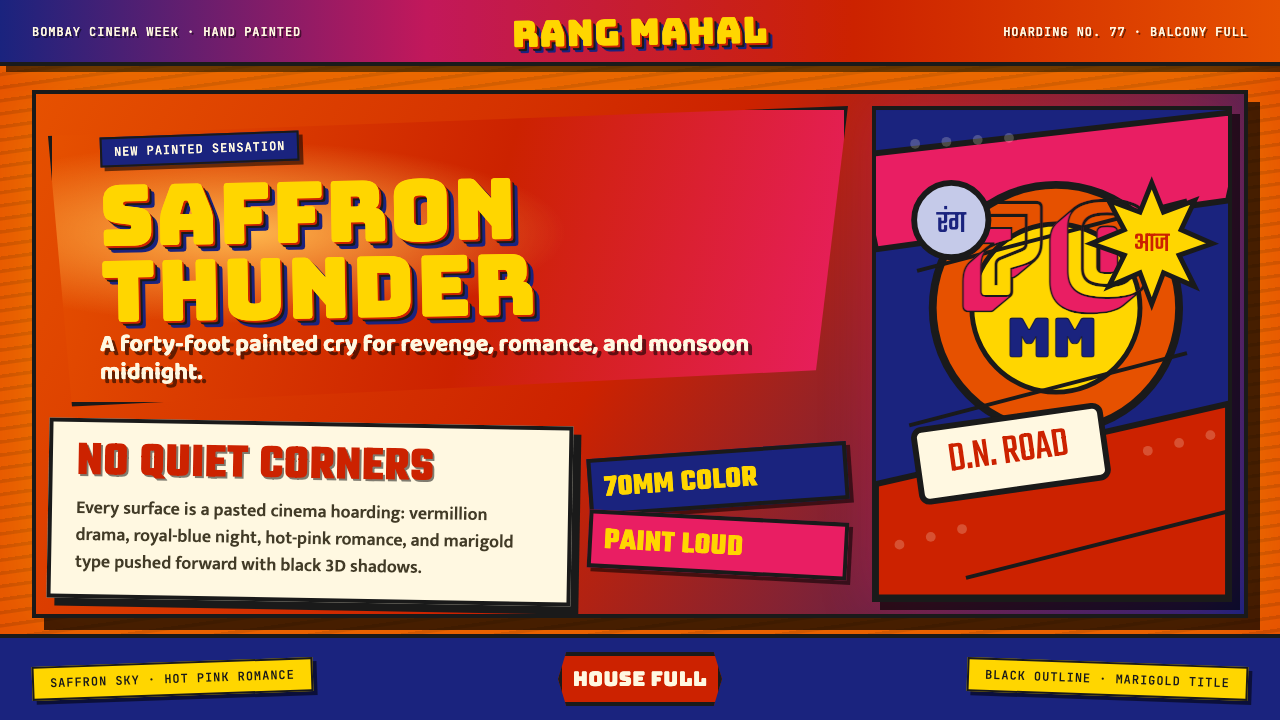
India's hand-painted cinema billboards turned the streets of Bombay into a ten-metre opera — maximum saturation, diagonal fury, and heroes too large for any frame.
Bollywood Poster Art (1970s) in brief
Bollywood Poster Art of the 1970s is the hand-painted cinema billboard tradition of Mumbai — monumental actor portraits, thundering diagonal compositions, and colors pushed to the outer edge of visibility, all executed by master craftsmen in the studios that lined D.N. Road in what was then Bombay. This is the visual grammar of Hindi cinema's golden age: the era of Sholay, Deewaar, and the brooding, fist-clenched 'angry young man' embodied by Amitabh Bachchan.
The style operates on a single governing conviction: subtlety is an affordable luxury, and nobody in this industry could afford it. Every hue is opened to full saturation. Every title is cast in deep three-dimensional shadow. Every figure — hero, villain, leading lady — bursts diagonally across the picture plane as though the hoarding itself cannot contain them. The background is never neutral; it is saffron orange, Bengal red, midnight indigo, or a churning collision of all three, overlaid with the thick, pressured texture of oil and enamel applied by brush at enormous scale.
What makes this tradition visually distinctive is not excess for its own sake but the internal coherence of its visual language. The hand-painted medium produces a warmth and slight imprecision that no mechanical print can replicate — brush strokes remain legible at close range, yet at thirty paces the composition locks into an irresistible gestalt. The poster had to sell a film to an audience passing on foot, on bicycle, on a crowded bus; it had to work in direct sunlight and monsoon rain. These material constraints produced an aesthetic logic as rigorous, in its own way, as anything the Bauhaus ever codified.

Where does Bollywood Poster Art (1970s) come from?
The tradition of hand-painted cinema publicity in India traces back to the silent film era of the 1910s and 1920s, when studios in Bombay began commissioning large outdoor hoardings to announce new releases. The artists who produced these works came from a range of craft backgrounds — sign-painting, theatrical backcloth work, and the older tradition of devotional image-making — and they brought to cinema publicity a visual vocabulary already calibrated for maximum impact at distance. By the time sound cinema arrived in the early 1930s, a distinct professional class of film poster artists had emerged, concentrated in the workshops along D.N. Road in central Bombay.
The 1950s and 1960s saw the craft reach a level of sophistication that set the stage for the explosion of the following decade. As the Hindi film industry grew in commercial scale, the budgets available for publicity materials increased, and the artists working in D.N. Road studios were able to develop increasingly ambitious visual strategies. The shift from a largely monochrome or limited-color aesthetic to the fully saturated polychrome approach that defines the 1970s style was partly driven by improvements in the pigments and enamels available to painters, and partly by the escalating competitive pressure between studios to claim visual dominance on the street.
The 1970s represented the peak of this tradition for several reasons that extend beyond aesthetics. Hindi cinema in this period was navigating profound social tensions — the collapse of the optimistic Nehruvian vision, urban unemployment and migration, political corruption, and a deep sense of systemic injustice among the working poor. The figure of the angry young man, scripted by Salim-Javed and embodied by Amitabh Bachchan in films like Zanjeer (1973), Deewaar (1975), and Sholay (1975), gave this social turbulence a cinematic face. The posters reflected this emotional register: their visual violence — the clashing colors, the figures lunging out of the frame, the explosive typography — was not decorative but expressive of the films' own psychological intensity.
The hand-painted tradition began its gradual decline in the 1980s as offset lithography and, later, digital printing made mechanical reproduction faster and cheaper than commissioning individual paintings. By the early 1990s, most major productions had shifted to photographic and digitally composed key art, and the D.N. Road studios had dwindled significantly. A handful of master artists continued working into the 2000s, and the tradition has since been the subject of significant archival and preservation work — most notably by collector and filmmaker Shreyank Arora and by institutions including the Osian's Cinema Foundation. What was once purely commercial ephemera is now recognized as a major chapter in South Asian popular art history.
What defines the Bollywood Poster Art (1970s) look?
Saturated Palette
The color language of 1970s Bollywood posters operates at the absolute outer limit of pigment saturation. Saffron orange, crimson red, electric yellow, and deep indigo are not modulated or toned down — they are deployed at full intensity and allowed to collide without mediation. This is not a failure of color theory but a deliberate strategy for a specific display environment: the hoarding must compete with sunlight, with the noise of the street, and with every other hoarding on the block. The result is a palette that registers as festive, urgent, and emotionally overwhelming at distance.
Diagonal Drama
The compositional spine of a Bollywood poster is almost always diagonal. Figures lean, lunge, or fall across the picture plane at sharp angles; title lettering cascades at a slant; background architectural elements and action lines reinforce the sense of arrested motion. This diagonal bias has both a practical and an expressive justification: a diagonal composition is more dynamic than a vertical or horizontal one, and it allows the artist to fit multiple large-scale figures into a single frame without resorting to equal-sized stacking. The diagonal implies velocity — something is happening, has just happened, or is about to happen.
Three-Dimensional Lettering
Film titles in 1970s Bollywood posters are never flat. They are built up as three-dimensional objects — letterforms extruded with deep offset shadows, often in a contrasting or complementary hue, and sometimes outlined in a third color to separate them from the background. The shadow direction is consistent within a poster but varies between artists and productions. The effect makes the title legible at great distance and gives the words a physical presence, as though they have been pressed into or grown out of the poster surface rather than applied to it.
Heroic Portraiture
The human figure is the central subject of every major Bollywood poster, and it is rendered at a scale that verges on the iconic. The lead actor's face — or the assembled cast arranged in hierarchical scale — dominates the composition, with peripheral figures rendered smaller not for spatial-perspective reasons but to signal their lesser narrative importance. Skin tones are heightened: complexions are painted warmer and more luminous than photographic reality, with strong highlight passages on the forehead, cheekbones, and chin that give faces a sculpted, almost metallic quality. Eyes are rendered with particular intensity, sometimes enlarged slightly beyond anatomical proportion to ensure legibility at distance.
Narrative Collage
A single Bollywood poster often contains the narrative information of an entire film compressed into one image. The main figure occupies the foreground; secondary characters or key scenes are arranged as smaller vignettes in the middle and background layers; vehicles, weapons, landscapes, or architectural motifs fill any remaining space. There is no white space, no breathing room — every square inch is committed to storytelling or visual excitement. This density is not clutter but a deliberate abundance, a promise to the viewer that the film itself will be equally full.
Hand-Crafted Texture
The hand-painted surface of the Bollywood hoarding is both a technical fact and an aesthetic resource. At close range, individual brushstrokes are visible — particularly in sky areas, flesh tones, and background washes — and they give the image a haptic quality that mechanical printing cannot achieve. The slight imprecision of hand-rendering means that no two copies of a poster were ever identical; artists working in the same studio from the same reference would produce subtly different results. This variability was not a flaw but a mark of the living craft behind the image.
Emotional Hyperbole
The Bollywood poster does not represent a scene from a film — it performs an emotional state at maximum amplitude. Villains scowl with theatrical menace; heroes glower with compressed rage; romantic leads glow with an idealized tenderness that transcends any specific moment. The visual register is deliberately larger than life, because the hoarding is competing for attention in a chaotic urban environment and because Hindi popular cinema of this period was itself a form of emotional spectacle rather than psychological realism. The poster is an advertisement for a feeling, not a document of a story.

Who shaped Bollywood Poster Art (1970s)?
Maqbool Fida Husain is the most internationally recognized figure to emerge from the tradition of Indian commercial art, though his engagement with cinema was as a filmmaker and fine artist rather than a poster craftsman. His own painting practice — monumental figuration, raw color, and compressed narrative — shares deep structural affinities with the Bollywood poster aesthetic and has been credited with helping legitimize Indian popular visual culture in the eyes of fine-art institutions. His 1967 filmThrough the Eyes of a Painter and subsequent works demonstrated that the sensibility of Indian cinema culture had penetrated the highest registers of the fine arts.
Karkare was among the most celebrated master artists working in the D.N. Road studios at the peak of the tradition. His facility with large-scale portraiture — the ability to render recognizable likenesses of actors at billboard scale using oil and enamel on metal or canvas — made him one of the most sought-after craftsmen in the Bombay film publicity industry. He trained a generation of younger artists who carried forward the technical practices of the studio tradition even as the commercial context around them changed.
Pandit represented the compositional sophistication end of the craft spectrum — his posters were distinguished not only by technical facility but by a considered approach to the arrangement of multiple figures, the management of competing color fields, and the integration of lettering into pictorial space. Where some D.N. Road artists excelled in portraiture and others in action composition, Pandit was noted for his ability to resolve complex multi-element briefs into images that read as unified wholes rather than assembled parts.
Balkrishna Arts was one of the most prominent studios in the D.N. Road ecosystem, functioning less as an individual artist and more as a collective workshop in which multiple painters worked on different aspects of a single commission — one specialist handling portraiture, another handling background environments, a third handling lettering and title treatment. This division-of-labor model allowed the studios to meet the volume demands of a booming film industry while maintaining quality, and it closely parallels the guild-workshop traditions of European historical painting in its organizational logic.
How do you use Bollywood Poster Art (1970s) today?
Bollywood poster art of the 1970s is a style that requires commitment rather than restraint — its power comes from a willingness to occupy the full emotional and visual register rather than from holding back. Applying it correctly means understanding what the visual system is doing at a structural level: diagonal composition to create urgency, maximum saturation to claim attention, figure-dominant layout to establish emotional stakes, and typographic extrusion to make text compete visually with imagery rather than subordinate to it.
For presentation slides, this style is most effective at high-visibility moments: covers, section dividers, and key-statement slides where a single bold claim needs to land with force. A cover built in this language should place the speaker or subject at an angle against a field of vivid, saturated color, with the event or presentation title rendered in thick, shadow-cast lettering that crowds into the top or bottom third of the frame. Content slides should be used sparingly within this framework — the style is too visually intense for dense data or long prose. When data slides are required, treat charts as graphic elements in their own right: bars and segments should be rendered in the same saturated hues as the palette, with no neutral grays, and the chart title should receive the same typographic boldness as a film title.
For web interfaces, the style maps well onto landing pages, campaign pages, and product launches where impact and memorability are more important than long-session readability. A hero section built in this aesthetic should use a full-bleed saturated background, place the primary human subject at a dramatic diagonal, and layer the headline in bold extruded or outlined type that reads as an object in the composition rather than a label above it. Dashboard and data-heavy interfaces are a poor fit — the palette is too activating for extended screen use, and the density of visual information conflicts with the scannability that analytical tools require.
For editorial and marketing work, the style supports cultural celebration, film and entertainment coverage, travel and festival contexts, and any brief that calls for warmth, energy, and a distinctly non-Western visual authority. A magazine feature using this language might run a full-bleed portrait at diagonal crop, with pull quotes set in extruded display type, and section breaks marked not by horizontal rules but by bands of saturated color that interrupt the text field. Poster and out-of-home applications are the native territory of this style — it was born at billboard scale and performs best when the physical context allows the color and scale to do their full work.
The most common mistake when applying this style is using it as a surface treatment — adding saturated colors and a diagonal element to an otherwise conventional layout — without adopting its underlying compositional logic. The style only works when the diagonal, the figure scale, the color intensity, and the typographic weight all function together as a unified system. A second frequent error is color timidity: choosing versions of the palette colors that are slightly muted or slightly cooled, because the full-saturation versions feel excessive. They are not excessive — they are the point. A third mistake is applying this language to contexts where it creates cultural friction without illumination: deploying it for a fintech platform or a healthcare interface in a way that suggests South Asian popular culture as costume rather than as a coherent and rigorous visual tradition will read as superficial at best and appropriative at worst.

Bollywood Poster Art (1970s) — FAQ
Is this style purely nostalgic, or does it have genuine contemporary relevance?
It is neither purely nostalgic nor trivially contemporary. The 1970s Bollywood poster represents a set of compositional solutions to a genuine design problem — how to communicate narrative, hierarchy, and emotional intensity at large scale in a visually competitive environment — and those solutions remain valid wherever that problem recurs. Contemporary music festival posters, theatrical campaign art, and sports marketing materials frequently rediscover the same diagonal-dominant, figure-forward, saturated-ground approach independently. The style becomes nostalgic only when it is deployed specifically to evoke the 1970s rather than to solve a present communication challenge.
How does this style handle text-heavy content, and what are its limits there?
The style is fundamentally pictorial and was designed for a single dramatic message at a single reading distance. It handles short, punchy copy — a film title, a tagline, a cast list in hierarchical scale — very effectively. It handles long-form body text poorly, because the visual environment it creates is too activating for sustained reading, and because the typographic conventions of the style — large scale, heavy weight, strong shadow — are incompatible with the smaller, lighter, more neutral letterforms that comfortable extended reading requires. If you need to combine this aesthetic with significant amounts of text, treat the text block as a separate quieter zone within the composition rather than attempting to apply the poster's typographic logic uniformly.
Can this style work for digital interfaces designed to be used in dark or dim environments?
With significant adaptation. The original tradition was designed for outdoor daylight conditions, where maximum saturation is needed to cut through ambient brightness. In a dark interface context — a cinema kiosk, an entertainment app used in a darkened room, a streaming service night mode — the full-saturation palette becomes overwhelming and can cause eye strain in extended use. A dark-environment adaptation works best by reducing the number of simultaneously active saturated hues to one or two, using deep jewel-toned grounds (very dark versions of the palette colors) rather than pure black, and reserving peak saturation for focal interactive elements only. The diagonal composition and figure-forward portrait conventions can transfer intact; the palette requires modulation.
What distinguishes authentic engagement with this style from superficial borrowing?
Authentic engagement means understanding the compositional and communicative logic of the tradition and applying that logic to a new context. It means knowing that the diagonal is not decorative but structural — it manages multiple figures and implies motion. It means knowing that the saturation is not arbitrary but calibrated to an outdoor environment, and adapting it accordingly when the display context changes. It means treating the human figure as the primary carrier of emotional meaning, not as one visual element among many. Superficial borrowing means applying the surface markers — the saturated orange, the shadow on the title, the diagonal tilt — to content that has no connection to the tradition's communicative logic, producing work that looks like a costume rather than a continuation.
How should color be chosen when adapting this style, given its historically specific palette?
The historical palette of saffron, crimson, electric yellow, and indigo is not a mandatory formula but a set of choices that solved a specific problem — visibility in direct sunlight against the colors of a busy Indian street. When adapting the style, the relevant principle is maximum pigment saturation and warm-to-hot color temperature, not those specific hues. A version built around deep magenta, gold, and forest green could be as faithful to the aesthetic logic as one built around orange and red, provided that the saturation level is uncompromised and that the colors chosen have the same competitive relationship — they should push against each other, not harmonize. Harmonious color palettes are the opposite of this tradition's approach.
Related design styles
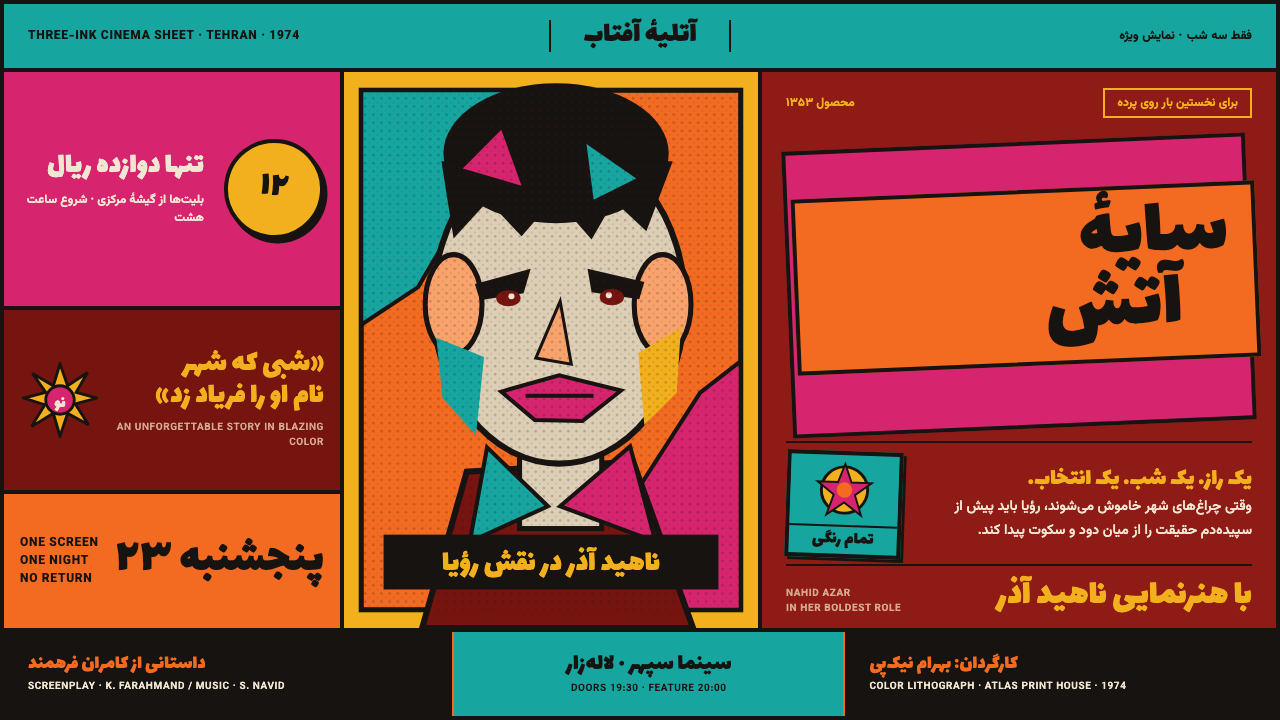 Iranian Film PosterCinema shouts in flat ink. Persian lettering clashes orange, turquoise and ma…
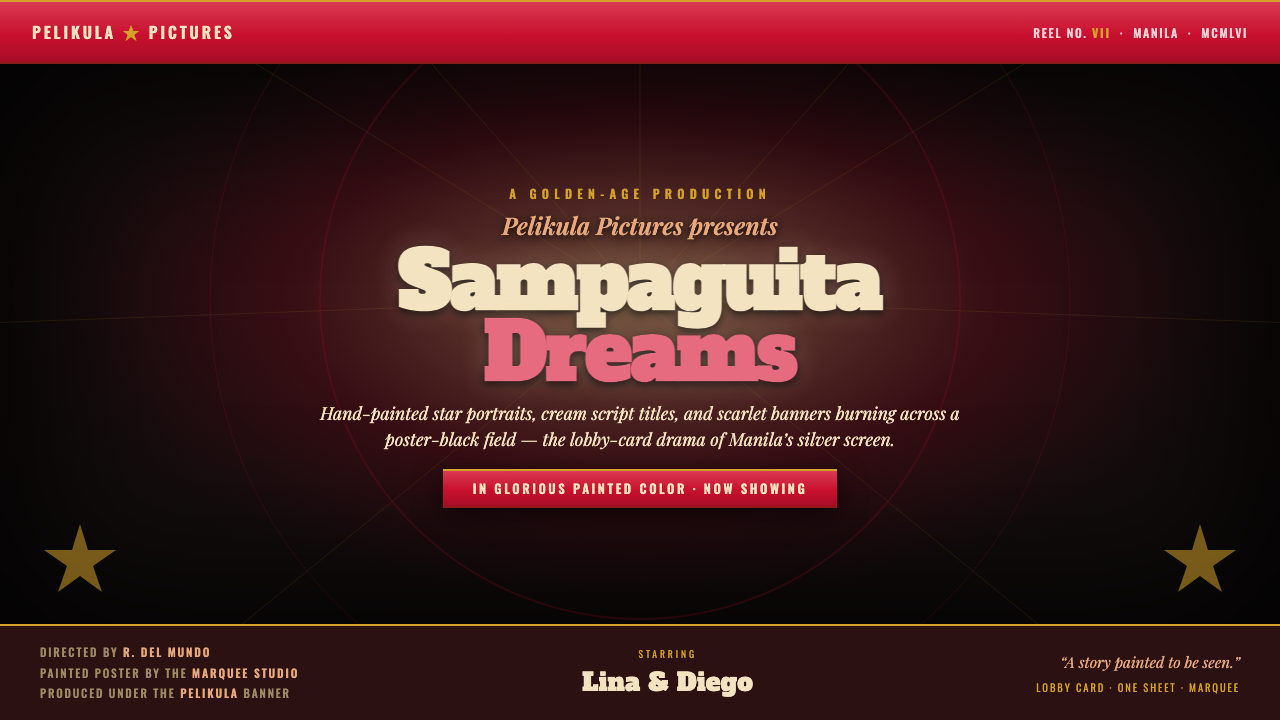 Manila LVN Film PosterLobby-card drama for the screen. Cream slab title on poster-black, scarlet ba…
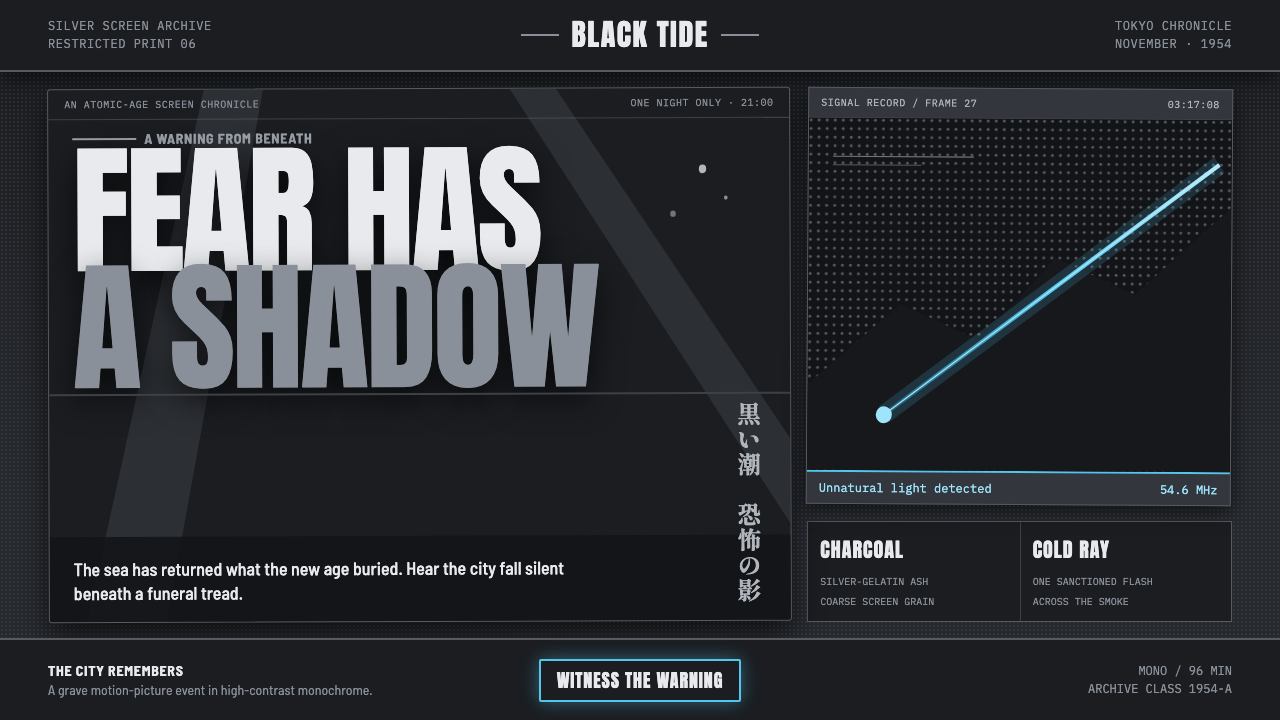 Godzilla (1954 Showa)Fear takes monumental form. Charcoal halftones split under one atomic-blue ra…
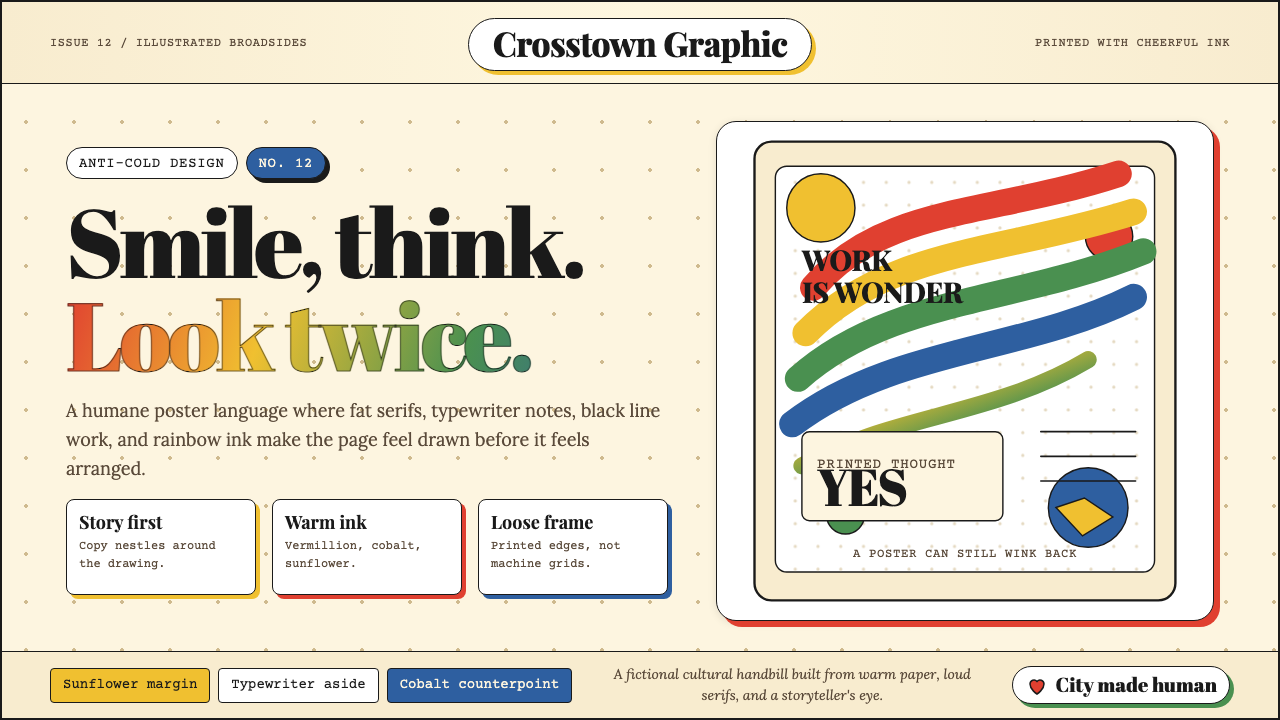 Milton Glaser / Push PinWarm counter-Swiss joy. Vermillion, cobalt and sunflower arcs orbit fat serif…
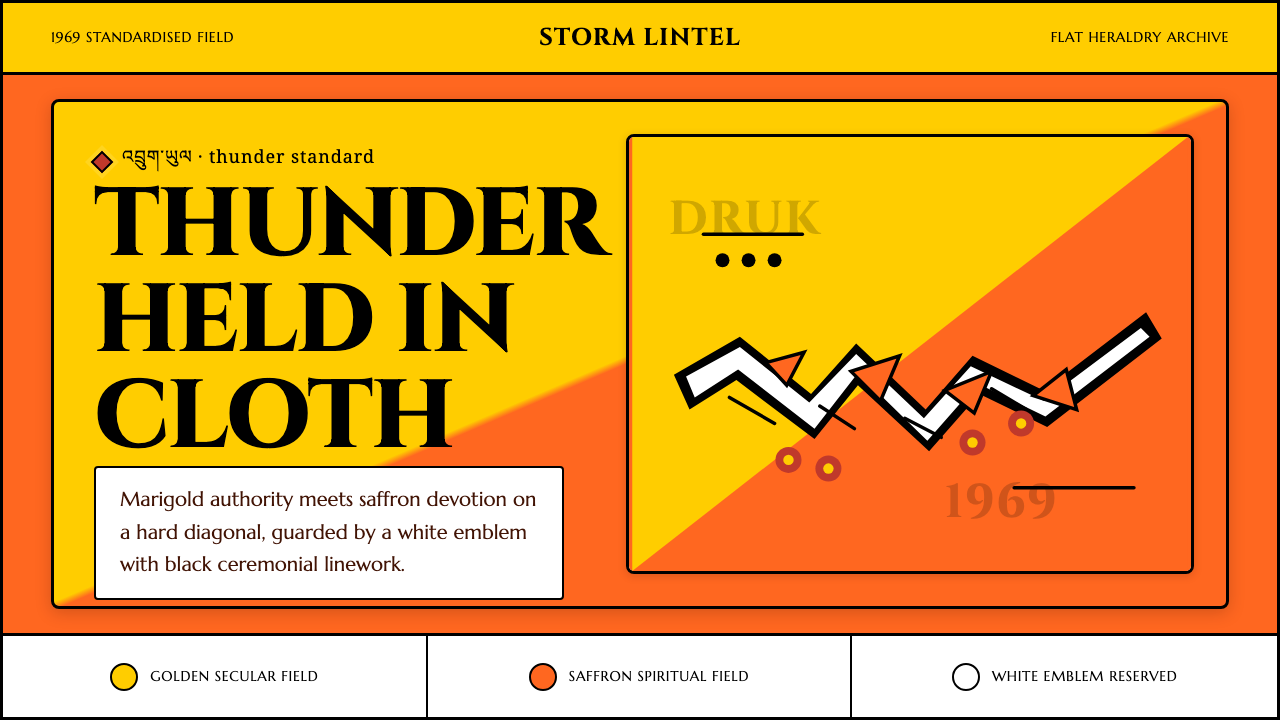 Bhutan Thunder Dragon FlagHeraldry hits like thunder. Marigold and saffron split hard around a white em…
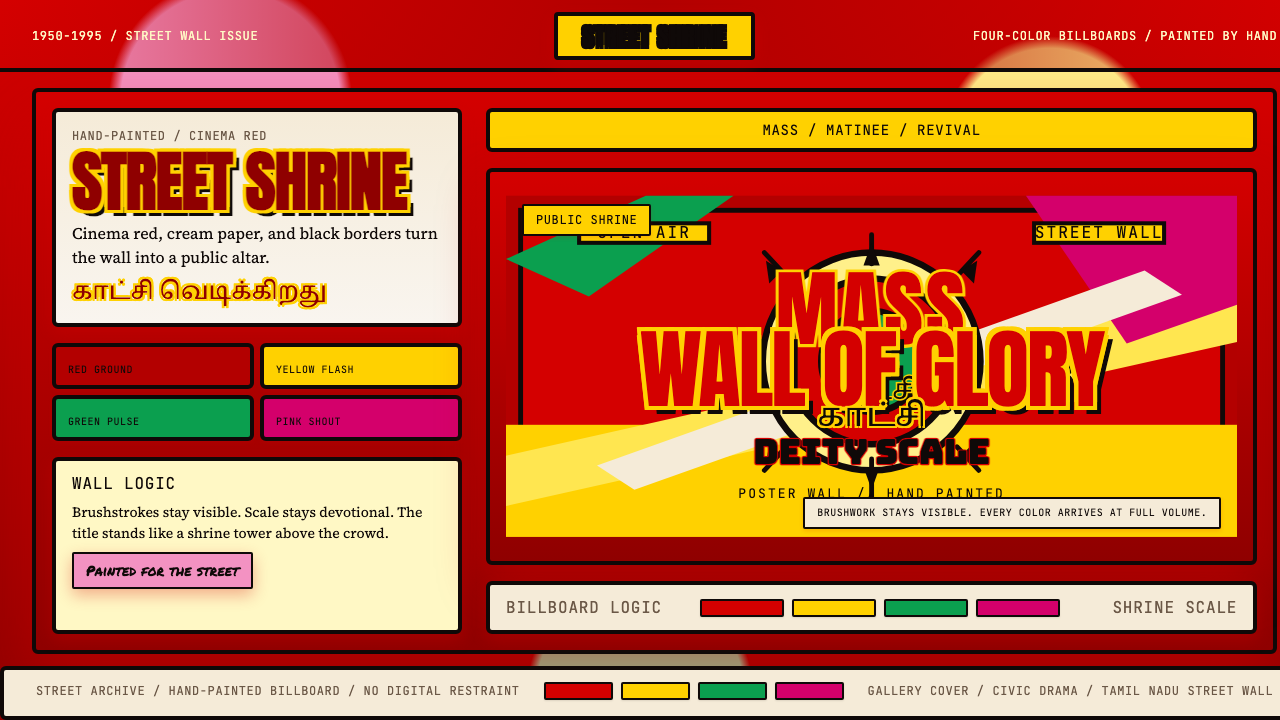 Tamil Cinema Poster (MGR era)The wall becomes a shrine. Red, yellow, green, and pink crash into cream pane…