What is Tamil Cinema Poster (MGR era)?
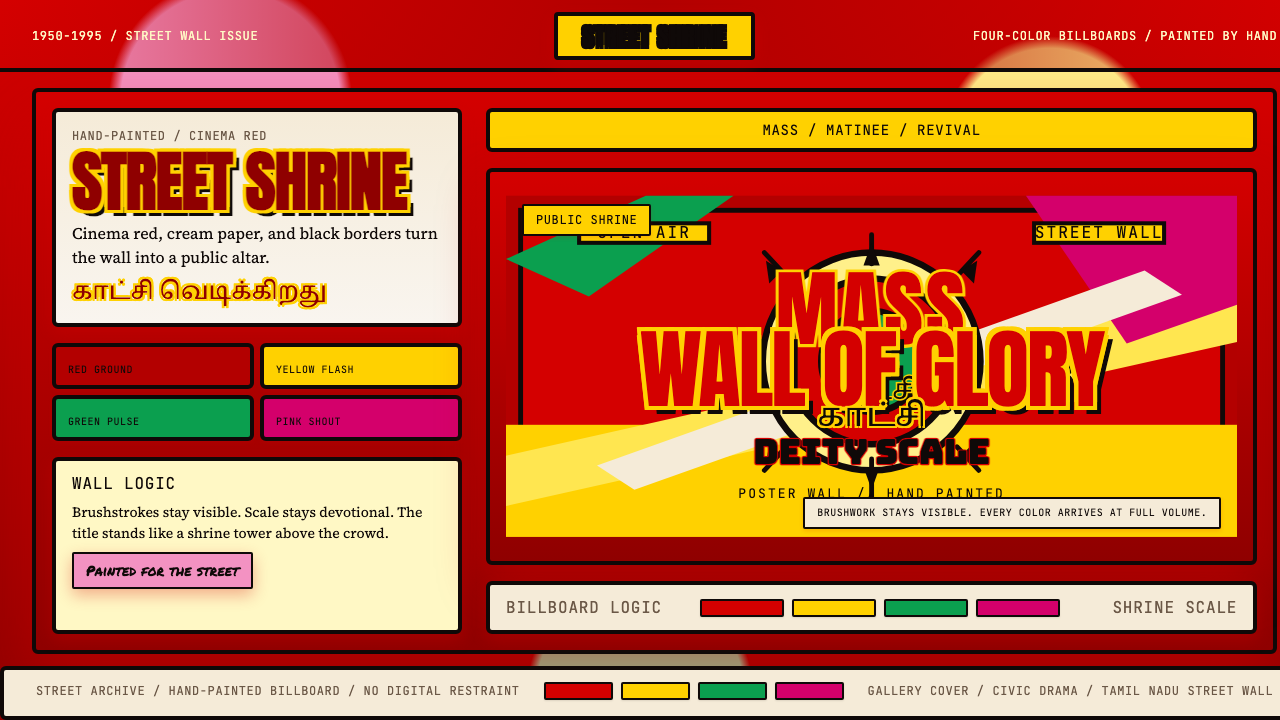
Every wall a shrine, every actor a god — Tamil cinema's hand-painted billboards forged one of the twentieth century's most jubilant and unapologetically loud visual languages.
Tamil Cinema Poster (MGR era) in brief
Tamil Cinema Poster (MGR era) is a maximalist graphic tradition developed by hand-painters across Tamil Nadu between the 1950s and the 1990s, reaching its most exuberant expression during the golden decades of M. G. Ramachandran's screen dominance. The style is defined by a collision of at least four fully saturated colors — a blazing cinema-red ground, electric yellow, vivid green, and hot pink — set against cream-paper panels and framed with heavy black outlines. Text and image compete for attention at equal volume, and that competition is the point.
The visual system is iconographic at its core: the film star is not a person but a divine presence, rendered in the conventions of Hindu temple portraiture — frontal gaze, heroic scale, and an aura of sacred light suggested by halo-like compositions. This conflation of cinematic celebrity and religious imagery was not accidental. Kollywood stars, particularly MGR, operated as political figures with devout mass followings, and the poster functioned simultaneously as advertisement, political banner, and object of communal devotion.
Unlike modernist poster traditions that sought to reduce and rationalize, the MGR-era aesthetic operates by accumulation. More color is better than less. More lettering is better than silence. The hand-painted quality — visible brushwork, slight imprecision in letterforms, the warmth of pigment on rough-cast walls — is not a flaw to be corrected but the medium's signature. Every surviving example is unique; the style carries within it the memory of the craftsman's hand.

Where does Tamil Cinema Poster (MGR era) come from?
The story begins not in a design school but on the streets of Chennai (then Madras), Madurai, and Coimbatore in the early 1950s, when the Tamil film industry was expanding rapidly and needed ways to announce new releases to largely non-literate mass audiences. Printed lithographic posters existed, but they were expensive, slow to produce, and small. The solution that emerged was the hand-painted billboard: enormous canvases — sometimes thirty feet across — executed directly on whitewashed compound walls or on cloth-and-wood hoardings erected at street intersections and cinema entrances across the state.
The craftsmen who created these works were professional sign-painters, many of them trained in the traditions of South Indian decorative arts, temple banner painting, and festival decoration. Their visual vocabulary merged several distinct streams: the frontal, hieratic portraiture of Hindu temple iconography, in which divine or royal figures are shown in full-face with symbolic attributes; the Soviet socialist-realist poster aesthetic, which had filtered into South Asian political imagery through the Indian communist and Dravidian political movements of the 1940s and 1950s; and the raw commercial energy of Western film publicity, itself already lurid and attention-seeking. The result of this collision was something wholly indigenous — a style that did not exist anywhere else on earth.
The Dravidian political context is inseparable from the visual language. MGR was not merely a film star; he was the face of the AIADMK party and eventually Chief Minister of Tamil Nadu. His films carried explicit political messaging, and his posters were simultaneously campaign materials. The aesthetic of the MGR poster — the heroic scale, the divine glow, the colors associated with prosperity and auspiciousness in South Indian tradition — served a political as much as a cinematic function. The painter C. Madhavan and workshop traditions in Madurai and Chennai developed codified conventions for representing MGR: specific color combinations signaled specific emotional registers.
The tradition reached its technical apex in the 1960s and 1970s, when large workshops employed dozens of painters working in relay — one specialist handling backgrounds, another skin tones, another lettering, another the elaborate decorative borders. Individual painters achieved reputations and fan followings of their own. Veera Santhanam, among others, was celebrated for the luminous quality of his flesh tones and the particular energy of his hand-lettered Tamil script. The tradition began its decline with the spread of offset lithography in the 1980s and digital printing in the 1990s, but it never entirely disappeared: a small community of practitioners continued working into the 2010s, and the style has attracted renewed documentary attention and revival efforts from that decade onward.
What defines the Tamil Cinema Poster (MGR era) look?
Color Saturation and Simultaneity
The defining characteristic is the use of four or more fully saturated colors at once, without hierarchy or apology. A cinema-red ground (associated with both drama and auspiciousness in Tamil culture) underlies cream-paper content panels; electric yellow, vivid green, and hot pink are deployed across lettering, decorative borders, and secondary figure elements. No single color moderates the others. The effect is additive — each hue amplifies rather than balances its neighbors — producing an overall field of energy that reads from great distances and under bright tropical sunlight.
Iconographic Portraiture
The central figure — almost always the lead actor — is rendered in a frontal or three-quarter gaze derived from Hindu temple portraiture. The scale is heroic: the face occupies a disproportionately large area of the composition, often spanning the full width of the billboard. Skin tones are idealized and luminous, rendered with careful gradation by skilled painters. A halo-like treatment of the background behind the head — lighter values, radiating compositional lines, or aureole-shaped decorative frames — elevates the figure toward the divine. Expression is direct and commanding rather than naturalistic or introspective.
Heavy Black Outlining
Every major element — figures, lettering, panel borders, decorative motifs — is defined by a thick black outline. This convention has both practical and aesthetic functions: practically, it ensures legibility at distance and in varied lighting conditions; aesthetically, it flattens depth and gives the composition a graphic, almost stained-glass quality. The outlines do not describe shadow or form modelling; they are boundary declarations. Even fine interior details are separated from their ground by visible black separation lines, giving the work its characteristic crispness within its overall maximalism.
Cream Panel Insets
Against the assertive colored grounds, cream or off-white rectangular panels serve as the breathing space for title text, billing information, and supporting imagery. These panels do not use a pure, clinical white — the warmth of the cream tone references the paper and cloth grounds on which early posters were painted, and it harmonizes with the warm-toned skin tones of the central figures. The cream panels are often framed with decorative double-line borders or ornamental corner treatments rendered in contrasting saturated hues, maintaining the overall festive register while organizing information.
Hand-Lettered Display Typography
Title lettering in both Tamil script and Roman characters is hand-painted rather than typeset, giving each letterform a weight and individuality that commercial type cannot reproduce. Tamil characters are drawn at monumental scale, with exaggerated stroke contrast — swelling curves and tapered terminals — that makes them readable from moving vehicles. Roman lettering follows similar conventions, often condensed and stacked vertically to fit panel proportions. The letters themselves are frequently filled with secondary color fields or graduated tones, and outlined in black, so that each word operates as a self-contained graphic object rather than a stream of text.
Decorative Borders and Festive Ornament
The composition is typically enclosed by one or more layers of decorative border — geometric interlace, stylized floral motifs, stepped patterns derived from South Indian temple architecture, or bands of repeated dots and dashes. These borders are not structural in any modernist sense; they are celebratory punctuation. Their visual vocabulary draws on the kolam (floor-pattern) tradition, festival garland arrangements, and the decorative programs of gopuram (temple tower) sculpture. The border signals that this image is an occasion, not merely a notice.
Narrative Compression
Where Western film posters of the same era tended toward a single dominant image, Tamil cinema posters of the MGR period regularly contain multiple narrative scenes arranged in smaller vignette panels around the central portrait — a fight sequence here, a romantic scene there, a landscape establishing the film's setting. This narrative compression, borrowed partly from temple narrative sculpture and partly from illustrated calendar art (known as bazaar art or Ravi Varma prints), means the poster functions as a visual summary of the entire film. A viewer who had not yet seen the movie could form a complete picture of its story and mood from the billboard alone.

Who shaped Tamil Cinema Poster (MGR era)?
MGR was the actor whose persona gave the entire poster tradition its defining character. Born in Sri Lanka and raised in Tamil Nadu, he became the dominant star of Tamil cinema from the early 1950s through the 1970s, known for roles as a righteous hero who championed the poor. His films were unambiguously moralistic, his screen presence was physical and commanding, and his political ambitions — he founded the AIADMK party in 1972 and served as Chief Minister of Tamil Nadu from 1977 until his death in 1987 — were inseparable from his cinema identity. Poster painters developed a specific iconographic repertoire for MGR: his characteristic tilted cap, his athletic stance, the glow of near-sacred light around his head. He is, in the most literal sense, the reason the style exists as it does.
MGR's great rival on screen, Sivaji Ganesan represented an entirely different acting philosophy — psychologically intense, theatrical, and trained in classical performance traditions rather than action choreography. Though his persona required different poster conventions (more formal, more emotionally volatile compositions), his enormous fame through the 1960s and 1970s meant that painters working in his tradition refined the style's capacity for expressive facial rendering and emotional range. The competition between MGR's and Sivaji's fan bases was also a competition between poster painters, which drove technical excellence and visual innovation across the tradition.
One of the most celebrated hand-painters in the Tamil cinema tradition, Santhanam was renowned for the luminous quality of his portraiture — particularly his rendering of skin tones under the flat, direct tropical light convention of the style. He worked in Madurai and developed a following among filmmakers who specifically sought out his workshops for key poster commissions. His name attached to a billboard functioned somewhat like an auteur credit. The attention paid to individual painters like Santhanam reflects the degree to which this commercial tradition was also understood, by its own participants, as an artistic one.
Madhavan was a prominent figure in the Chennai workshop tradition who helped systematize the visual conventions for representing Tamil film stars during the height of the MGR era. His workshop trained multiple generations of painters and established production methods that balanced speed — a large billboard might need to be executed within days of a film's announcement — with the quality of finish expected of prestige productions. His work represents the workshop-based, collaborative dimension of the tradition, as opposed to the individual-artist model. Many Chennai cinema billboards of the 1960s and 1970s passed through his workshop.
How do you use Tamil Cinema Poster (MGR era) today?
Tamil Cinema Poster (MGR era) is a high-energy, maximalist system that rewards deliberate overstatement. Applying it correctly means committing fully to its logic of accumulation: more saturated color, more declared hierarchy, more celebratory frame — not as decoration layered over a restrained layout, but as the organizing principle from which the entire composition is built. The single most common failure is attempting to blend this system with modernist restraint, producing something that looks neither festively loud nor cleanly minimal.
For presentation slides, the style works most powerfully on title and divider pages. A cinema-red or deeply saturated full-bleed ground with cream-panel insets for the title creates immediate visual authority. The cover benefits from a large, centered or slightly asymmetric typographic treatment — the title in massive display weight, framed by decorative border elements at the corners or edges. Content slides should be treated as structured panels: use distinct background blocks (cream, red, yellow) to separate content zones rather than relying on subtle grid lines. Data slides gain character when chart elements — bars, donut segments, progress rings — are rendered in the primary colors of the palette, with heavy black outlines giving them the bounded, object-like quality of the poster's figure elements.
For web interfaces, the style is most at home in promotional landing pages, event microsites, and entertainment-sector dashboards where high visual energy is appropriate and even expected. Approach the layout as a series of full-width banded sections, each carrying a distinct background color from the palette, with cream or off-white text panels as information containers. Navigation and interactive elements benefit from the style's heavy outlining convention: bordered buttons with no radius or very slight radius, outlined card components, text links that carry visible underline weight. Pricing or tier differentiation works well when each tier is assigned one distinct saturated hue from the palette, treated as an identity rather than a gradient.
For editorial and marketing work, the style enables a poster-scale boldness that cuts through visual noise. Feature headlines and section titles can be set at a scale most editorial designers would consider excessive — in this system, excess is correct. Marketing one-pagers work well with the alternating-panel convention: a red band followed by a cream band followed by a yellow band, each containing a distinct content block. The festive border convention translates naturally to section dividers and call-out boxes. Illustration assets that follow the flat, outlined, high-saturation conventions of the style will integrate more naturally than photography; if photography is used, it works best when treated as a silhouetted figure against a solid color ground rather than as a realistic scene.
The most common mistake when working with this style is treating the palette as a selection problem — picking one or two colors from the system and applying them cautiously. The MGR-era poster draws its power from simultaneity: all the saturated colors are present at once, and their collective pressure is the effect. A second common error is using the style's ornamental elements — the decorative borders, the corner treatments — as accent details on an otherwise plain layout. In the source tradition, ornament is structural: it frames, organizes, and declares the sacred register of the composition. Applied as decoration alone, it reads as costume rather than system.

Tamil Cinema Poster (MGR era) — FAQ
Is this style appropriate for serious or professional contexts, or only for entertainment?
The style's origins are in cinema publicity and political campaigning — both of which require the highest possible visual authority, just directed at mass rather than elite audiences. The MGR-era poster is not frivolous; it is maximally serious in its intentions, deploying every visual register available to demand attention and project power. In contemporary use, the style works well wherever that combination of celebratory energy and commanding authority is appropriate: product launches, festival-scale events, cultural institutions, entertainment platforms, and any context where the goal is to be remembered rather than merely noticed. It struggles in contexts that require understated credibility — legal, financial, or medical professional services, for example — where its exuberance reads as lacking gravity.
How should photography be handled when working in this style?
The MGR-era poster tradition was hand-painted, not photographic, so photography requires deliberate adaptation. The most faithful approach is to treat photographic portraits as the hand-painters treated their subjects: extract the figure from its original background, place it against a solid saturated color ground, and add a heavy outline treatment to the silhouette edge. This gives the photograph the bounded, object-like quality of the painted figure. Realistic, context-rich photography — candid scenes, documentary images, environmental portraits — resists the style because it imports naturalistic depth into a system built on flat declaration. High-contrast, strongly lit studio portraits adapt most readily because their graphic simplicity is already close to the painting tradition's conventions.
Can this style be used in a restrained or 'quiet' version for contexts that cannot handle full maximalism?
A reduced version is possible, but it requires conscious choices about which elements carry the style's identity and which can be scaled back without losing recognition. The non-negotiable elements are the color logic (cream panels against saturated grounds), the heavy black outlining, and the display-scale typography. The most reducible elements are the decorative borders and the narrative vignette panels — these can be stripped away for a cleaner composition that still reads as belonging to the tradition. Using only two saturated colors rather than four, and limiting ornamental borders to a single framing element, produces a version that is legible in moderately formal contexts without becoming unrecognizably generic. Going further than this — removing the outlining, softening the colors to pastels, or switching to fine-weight type — exits the style entirely.
What distinguishes this style from other South Asian or Bollywood poster traditions?
Several features are distinctive to Tamil Nadu and the Dravidian cultural context specifically. First, the degree of religious iconographic overlay: the deification of the star is more explicit, more formal, and more structurally central in Tamil cinema poster conventions than in most Hindi film publicity of the same era. Second, the color density: Tamil posters of the MGR period use saturated colors at a simultaneity and intensity that exceeds most North Indian or Bengali film poster traditions, which tended toward more gradient-based rendering and more limited palettes. Third, the political dimension: the direct conflation of cinema poster and political campaign material — using identical visual conventions for both — is particularly strong in the Tamil context because of the Dravidian movement's deep integration of cinema and politics. Bollywood posters of the 1950s to 1970s have their own distinct conventions, typically more gestural and romantic in figure treatment, less iconographic and less politically coded.
How does the style handle dark or night-mode interfaces?
The MGR-era poster tradition was conceived for daylight visibility on outdoor walls — its entire logic is calibrated for maximum legibility under bright tropical sun. A direct dark-mode inversion is therefore somewhat against the style's grain. That said, a workable dark variant exists: replace the cream panel grounds with a deep charcoal or near-black, maintain the cinema-red and other saturated hues as accent colors, and keep the heavy black outlines as reversed-out white or cream outlines instead. This preserves the outline structure and the color logic while shifting the atmospheric register from festive daylight to something closer to a cinema-interior or festival-night feeling. The key constraint is that the saturated colors must remain fully saturated — desaturating them to accommodate a dark ground produces a muddy, unrecognizable result.
Related design styles
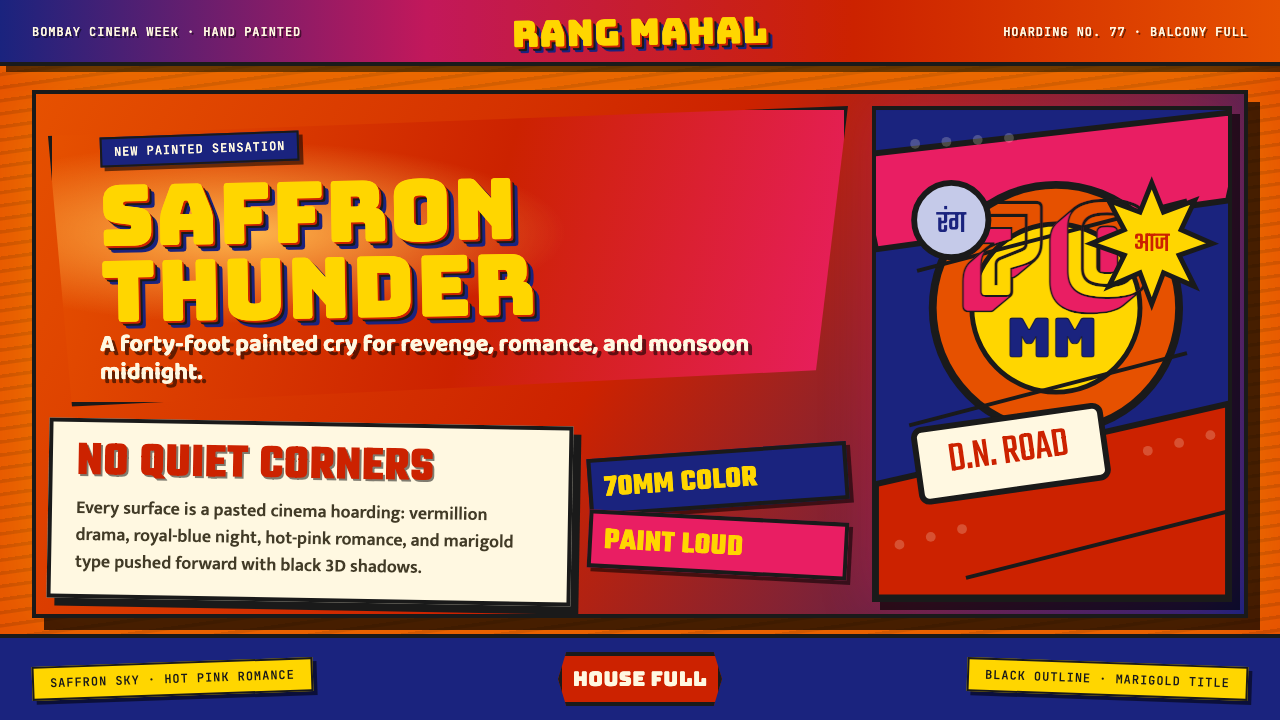 Bollywood Poster Art (1970s)Subtlety is unaffordable. Saffron fields, Bungee shadows, diagonal hoarding d…
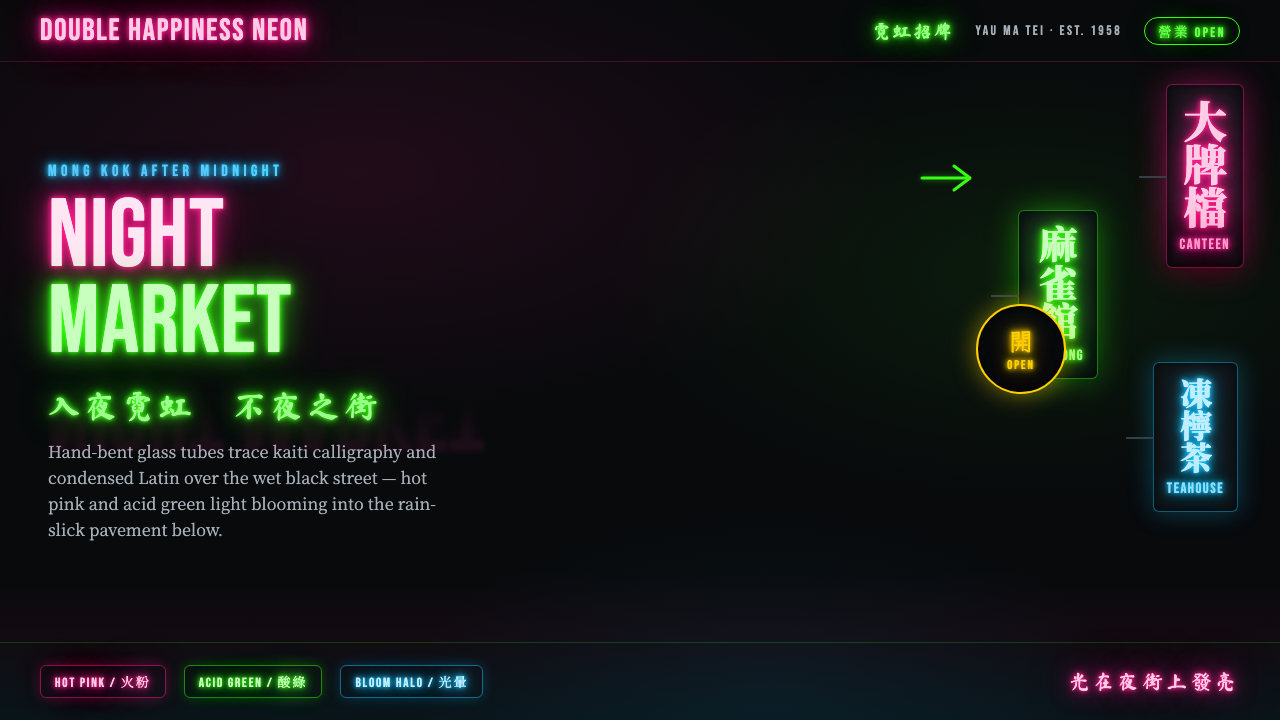 Hong Kong Neon SignboardsLight only reads against the wet black night. Hand-bent pink and green tubes…
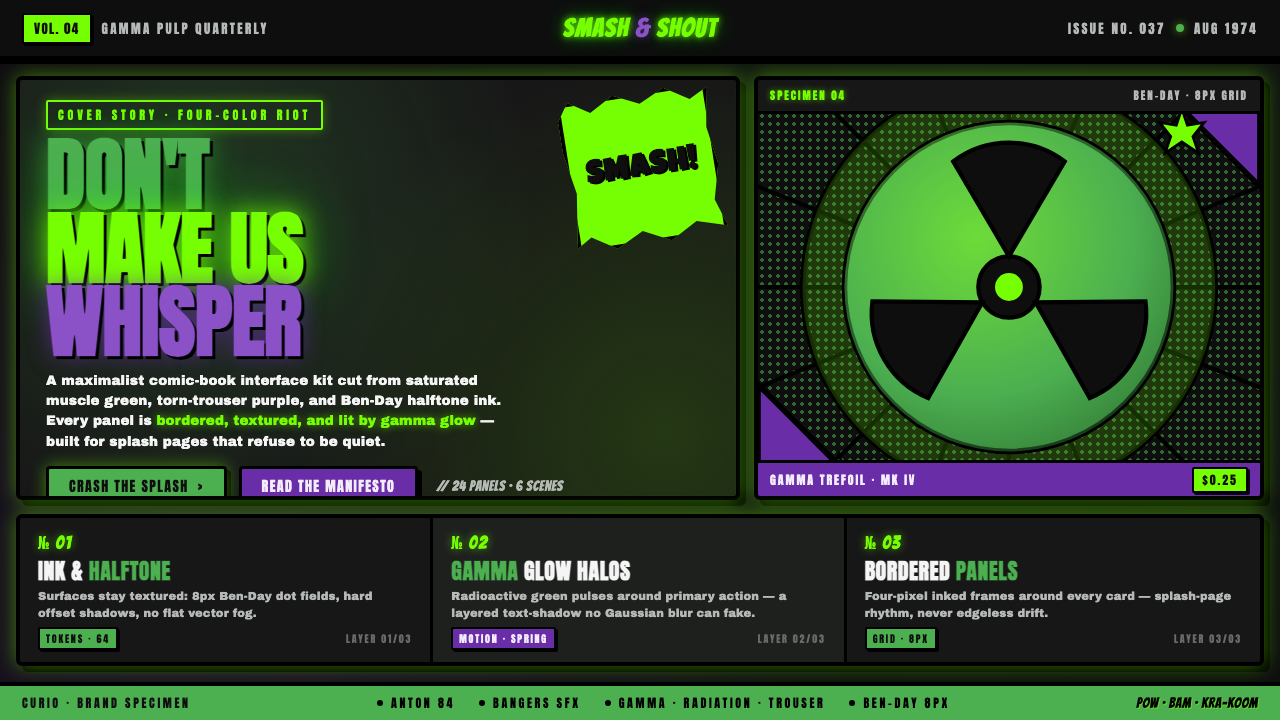 Hulk Gamma GreenDon't make us whisper. Muscle green, trouser purple, inked panels, Ben-Day ha…
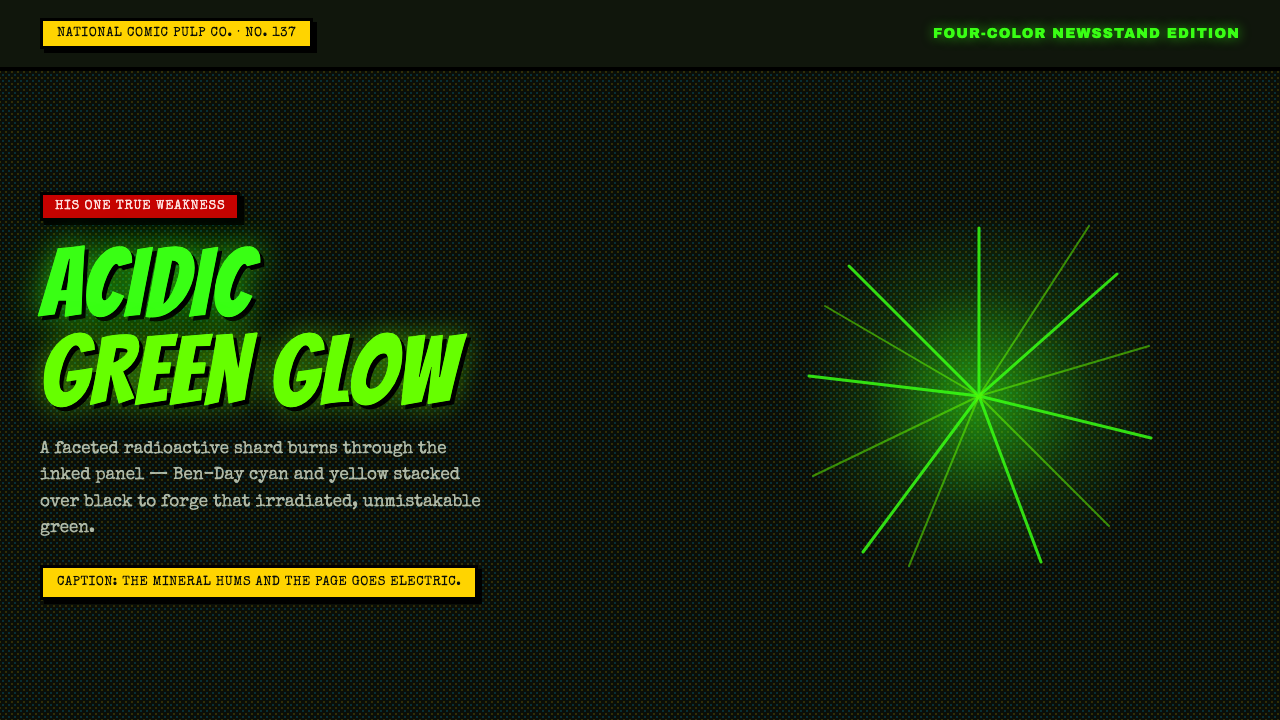 Kryptonite GreenRadioactive pulp glows hard. Neon green shard, black gutters, Ben-Day grit.
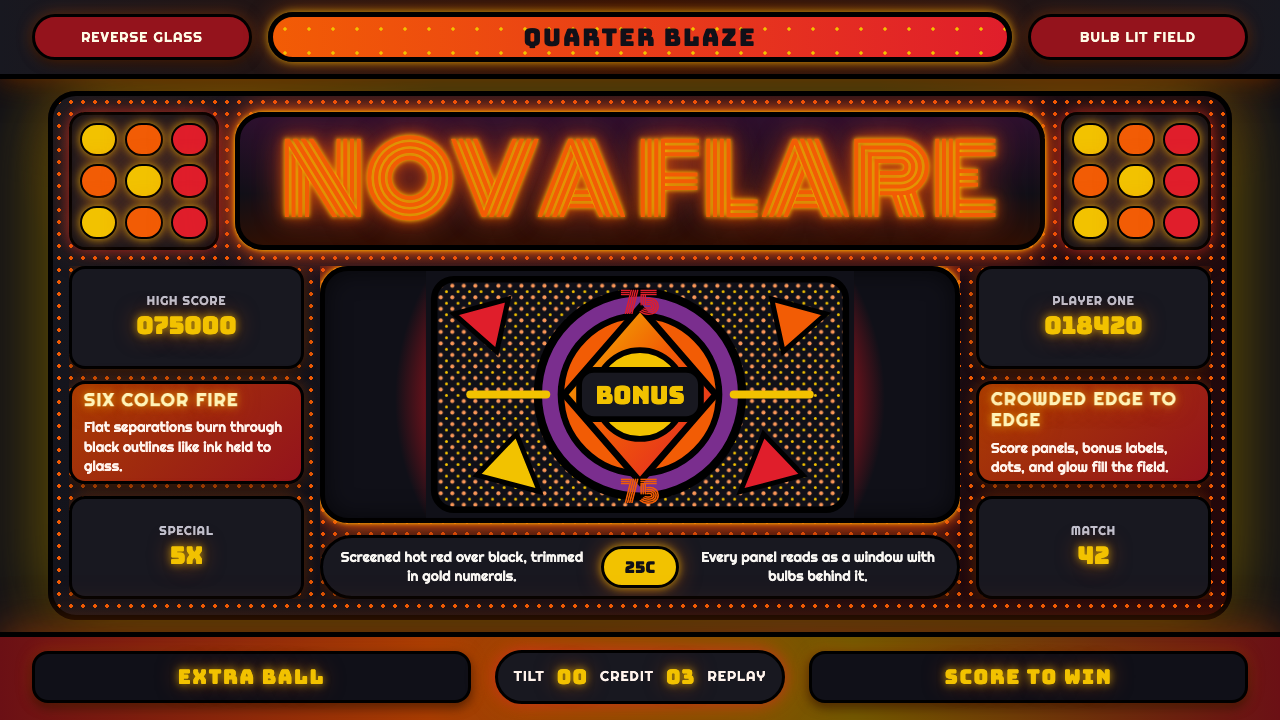 Pinball BackglassGlows like paid light. Monoton type, black outlines, orange-red halftones cro…
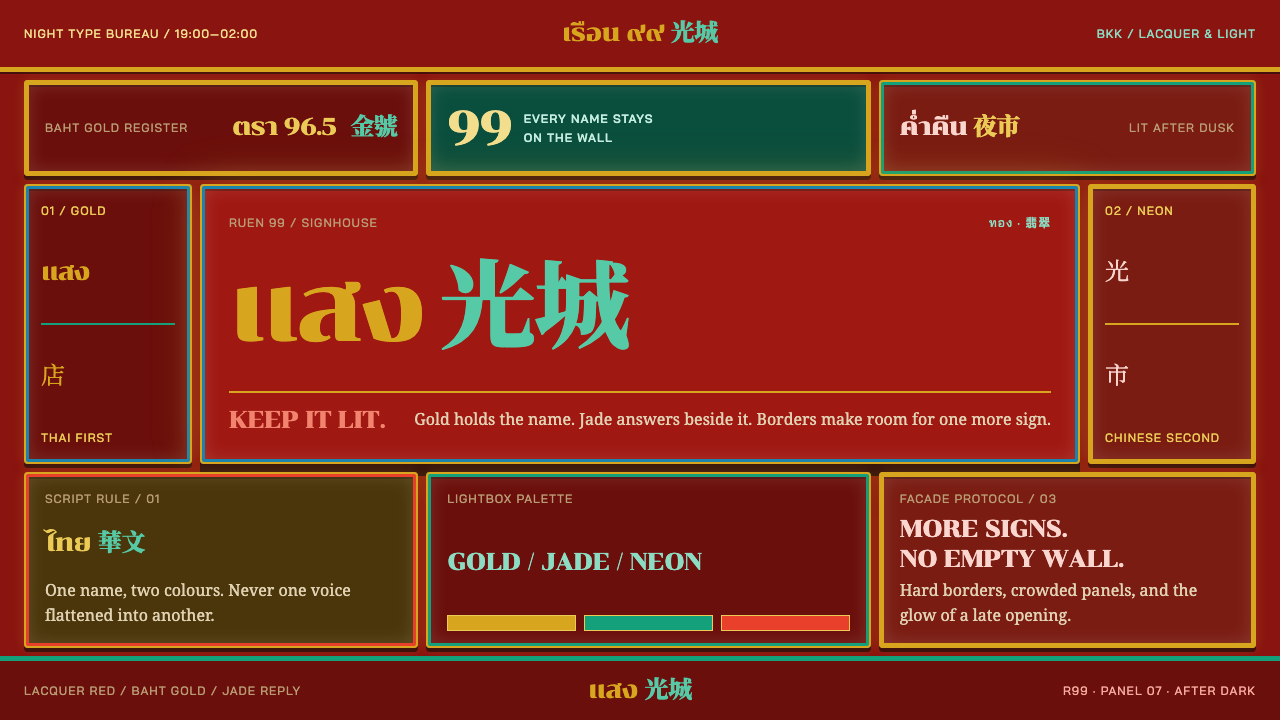 Yaowarat Chinatown SignsDensity becomes a language. Baht gold and jade scripts stack inside hard-edge…