What is Filipino Jeepney (Chrome & Streamer)?
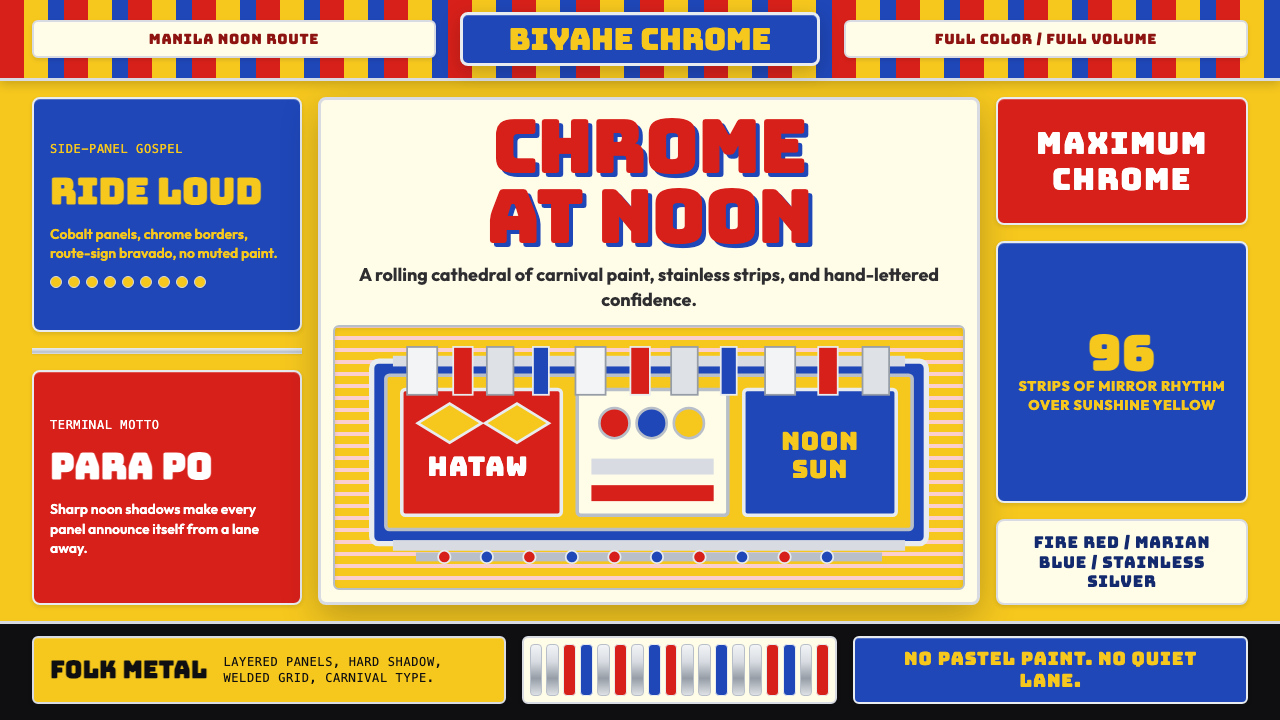
The Filipino jeepney is a rolling cathedral of chrome and carnival paint — post-war surplus transformed into the most exuberant folk design vehicle on earth.
Filipino Jeepney (Chrome & Streamer) in brief
The Filipino jeepney is simultaneously a mode of public transport, a competitive folk art form, and one of the most visually dense design systems ever applied to a vehicle. Beginning with stripped American military jeeps left behind after World War II, Filipino fabricators transformed utilitarian surplus into rolling masterpieces layered with chrome strips, hand-painted murals, stainless-steel ornaments, religious icons, provincial slogans, and cascading streamers that catch the wind like a carnival on wheels.
As a design language, the jeepney aesthetic is defined by abundance rather than restraint. Where modernist sensibilities subtract, the jeepney tradition adds — every available surface is a canvas, every edge an opportunity for chrome trim, every roof panel a place for a painted saint or a hometown dedication. The visual logic is cumulative: each individual element — a mirrored horse ornament, a hand-lettered route sign in bold slab type, a garland of colored plastic beads — contributes to a whole that is louder, brighter, and more joyful than any single component could be alone.
This design system channels the noon-sun intensity of the jeepney tradition into a coherent visual language: fire-engine reds, Marian blues, sunshine yellows, and chrome-mirror surfaces layered with hand-lettered bravado and the oscillating rhythm of stainless-steel mane-streamers catching the Manila heat. It is a style built for visibility, celebration, and the assertion that beauty belongs in everyday public life — not in galleries, not in elite spaces, but on the road where everyone can see it.
Where does Filipino Jeepney (Chrome & Streamer) come from?
The jeepney story begins in 1945, when American forces withdrew from the Philippines and left behind hundreds of Willys MB and Ford GPW military jeeps — vehicles that had been the backbone of Allied logistics throughout the Pacific theater. Rather than allow useful machines to rust, Filipino entrepreneurs and mechanics immediately began buying, trading, and repurposing them. The first adaptations were simple: remove the canvas top, extend the wheelbase, add wooden bench seating in the rear. Within months, converted jeeps were running informal passenger routes through Manila's bomb-damaged streets.
The transformation from utilitarian vehicle to folk art masterpiece was rapid and largely organic. By the early 1950s, fabricators in Manila and the surrounding provinces were competing to produce the most elaborate and eye-catching jeepneys — the quality of the customization was, quite literally, an advertisement for the route. A more beautiful jeep attracted more passengers. The Sarao Motors workshop in Las Piñas, established by Leonardo Sarao in 1953, became the most celebrated of these fabrication houses. Sarao developed the elongated hood and the characteristic stainless-steel horse ornament mounted at the front — a design signature so influential that it became the generic image of the jeepney nationwide. At its peak in the 1970s and 1980s, Sarao Motors was producing several hundred jeepneys per year and had become a Philippine cultural institution.
The iconography of the jeepney draws from multiple overlapping traditions. Catholic devotional imagery — the Virgin Mary, the Santo Niño, the Sacred Heart — appears alongside provincial emblems, pop-culture heroes, and personal dedications to family members. The hand-lettering tradition is particularly rich: route signs, owner names, and personal slogans are rendered in bold condensed lettering styles that blend the visual grammar of American mid-century signage with Filipino vernacular typography. The chrome ornamentation tradition draws from both Spanish colonial craft and from the decorative metalwork of neighboring Indonesian and Malaysian maritime cultures.
Anastacio Francisco and Eduardo Sarao, who continued the Sarao Motors tradition after Leonardo's founding generation, refined the jeepney's proportions and ornamentation into increasingly codified forms. The elongated front hood with chrome louvers, the side panels painted with landscapes or portraits, the roof rack draped in colored pennants, and the rear bumper dense with reflectors and chrome lettering — these elements became the canonical vocabulary of the mature jeepney form. Contemporary artists like Patrick Cabral have worked to document and reinterpret jeepney aesthetics in fine-art contexts, arguing for recognition of the jeepney as a major expression of Philippine national identity. The Philippine government's ongoing jeepney modernization program, which has sought to replace older smoke-belching vehicles with electric alternatives, has sparked fierce cultural debate about what is lost when utilitarian folk art is replaced by standardized modern transport.
What defines the Filipino Jeepney (Chrome & Streamer) look?
Color
The jeepney palette is built on saturated primaries that perform at full intensity under tropical noon sun. Fire-engine reds, deep Marian blues named for the Virgin's robes, and pure sunshine yellows form the core triad — not softened, not muted, not graded, but applied at their most vivid. These primaries are layered rather than alternated: a red panel might carry yellow lettering bordered in chrome-silver, while the roof adds a band of royal blue trimmed in gold-adjacent metallic paint. Chrome and polished stainless steel act as a fourth element, not a neutral ground but an active visual surface that reflects everything around it, multiplying the intensity of every adjacent color.
Chrome and Metalwork
Chrome is not decoration on a jeepney — it is structure, identity, and hierarchy. The front hood louvers, side mirror brackets, bumper accents, and roof finials are all chrome-plated or fabricated in polished stainless steel, creating a framework of mirrored surfaces that catch light and announce the vehicle's presence from a distance. The stainless-steel horse ornament pioneered by Sarao Motors at the front grille became such a recognizable icon that it functions almost as a brand logo for the entire tradition. Streamers — long strips of stainless steel or colored Mylar that extend from the roof rack and shimmer in the wind — add kinetic dimension, turning the static surface decoration into a moving, light-catching performance.
Hand-lettering and Typography
Jeepney lettering is a distinct folk-typographic tradition with its own mastery. Route names, owner dedications, and personal slogans are rendered in bold condensed letterforms that blend American mid-century signage aesthetics with Filipino vernacular expression. The letters are typically outlined in a contrasting color, then filled with another, then sometimes shadowed in a third — a technique that maximizes visibility at speed and in bright sunlight. Condensed proportions allow long text to fit across narrow panels without reducing legibility. The hand-painted quality means no two jeepneys carry identical lettering, and the quality of the lettering work is itself a mark of the fabricator's skill and the owner's investment in their vehicle.
Surface Density and Layering
The jeepney aesthetic operates on the principle that density is virtuous. Unlike design traditions that use negative space as a compositional tool, the jeepney treats every available surface as an opportunity. Religious imagery overlaps with route information; chrome trim frames landscape paintings; stickers and decals add biographical details between the larger murals. The layers have a roughly hierarchical order — structural chrome and lettering at the top level, painted murals in the middle register, smaller icons and personal items filling the gaps — but the overall effect is accumulative rather than organized. What would read as visual noise in another context reads here as richness, personal expression, and cultural density.
Religious and Folk Iconography
Catholic devotional imagery is inseparable from the jeepney visual tradition. The Virgin Mary — particularly the Marian blue robes that give the tradition its most characteristic color — the Santo Niño, and the Sacred Heart appear on nearly every vehicle, positioned at the dashboard, the hood, or the rear panel in a place of prominence. These are not merely decorative; they are protective, a visual prayer for the safety of driver and passengers on Manila's chaotic roads. Alongside the sacred imagery are secular folk motifs: horses (the Sarao tradition's signature animal, representing speed and freedom), eagles, regional flowers, and occasional portraits of pop stars or local heroes. The mixing of sacred and popular, devotional and entertaining, is entirely unremarkable within the tradition.
Kinetic Ornament
Unlike design systems that exist only as static surfaces, the jeepney aesthetic is explicitly designed for motion. The streamers — strips of stainless steel, Mylar, or colored fabric that trail from the roof rack — are purely kinetic elements with no function except to move, catch light, and signal the vehicle's passage through a crowded street. Hanging ornaments, beaded curtains in the doorway, and rotating hood ornaments all participate in this kinetic logic. The fully loaded jeepney in motion is a different visual object from the same vehicle at rest: the streamers extend, the reflectors and chrome multiply the sun, and the hand-painted murals gain a cinematic quality as they pass. The style is designed to be experienced at the pace of a moving city.
Regional and Personal Identity
Each jeepney is unique in ways that declare both the owner's provincial origin and personal biography. Regional flowers, provincial seal motifs, and hometown dedications situate the vehicle within a geography. Family names, saints' days, children's names, and personal nicknames turn the surface into autobiography. The jeepney does not aspire to brand consistency or legible system — it aspires to individuality, to making one vehicle distinguishable from the thousands of others on Manila's roads. This is a design tradition where the goal is to be unmistakably yourself, not unmistakably a member of a visual system.
Who shaped Filipino Jeepney (Chrome & Streamer)?
Leonardo Sarao founded Sarao Motors in Las Piñas in 1953, establishing what would become the Philippines' most celebrated jeepney fabrication house. His most enduring design contribution was the elongated front hood with chrome louvers and the stainless-steel horse ornament mounted at the front grille — a signature so widely imitated that it became the generic visual identity of the entire jeepney tradition. Sarao Motors at its peak employed hundreds of craftsmen and operated as something closer to a folk-art studio than an automotive factory; vehicles were hand-fabricated, hand-painted, and treated as individual creative works. Leonardo Sarao was eventually recognized as a National Living Treasure by the Philippine government, an honor that acknowledged the jeepney as genuine folk art rather than mere transport.
Anastacio Francisco was among the master fabricators and painters who worked alongside and in competition with the Sarao tradition, developing the mural-painting conventions that define jeepney side panels. His work demonstrated how the side panel could function as a complete pictorial statement — landscapes, religious scenes, or genre portraits rendered with enough craft and ambition to hold their own as paintings independent of the vehicle they decorated. Francisco's legacy represents the fine-art aspiration within a folk-art tradition: the desire not just to decorate a transport vehicle but to make something genuinely beautiful that would be seen and admired on the streets of Manila.
Eduardo Sarao continued the family fabrication tradition at Sarao Motors into the second generation, refining the workshop's production methods while preserving the handcraft quality that distinguished Sarao vehicles from cheaper imitators. Under Eduardo's stewardship, Sarao Motors codified many of the design elements that had been intuitive in the founding generation — the proportions of the hood extension, the placement of the horse ornament, the arrangement of chrome trim lines — into teachable standards that junior craftsmen could learn and apply. This codification process turned what had been one man's design sensibility into a school, and the Sarao aesthetic became the dominant reference point against which all other jeepney fabricators measured their work.
Patrick Cabral is among the contemporary Filipino artists who have worked to translate jeepney aesthetics into fine-art and digital contexts, arguing for the tradition's recognition as a major expression of Philippine visual culture. His work functions as cultural advocacy as much as artistic practice: by rendering jeepney imagery in gallery-appropriate formats, he makes the case that the folk-art knowledge embedded in the tradition — the hand-lettering mastery, the compositional boldness, the chromatic intensity — deserves the same critical attention as any canonical art movement. Cabral's practice exemplifies the ongoing conversation in Philippine cultural life about which traditions count as art and which are dismissed as mere craft or commerce.
Sarao Motors functioned not as a single designer but as a collective workshop where dozens of specialized craftsmen — metalworkers, painters, chrome fabricators, letterers — contributed to each vehicle. This collaborative workshop model is itself significant: the jeepney aesthetic was never the product of a single authorial vision but of an ongoing conversation between multiple skilled hands, each adding their expertise to a shared object. The letterer who painted the route sign did not consult with the muralist who painted the rear panel; the chrome fabricator was not directed by the man who chose the hood ornament. The coherence of the final vehicle emerged from shared cultural norms and competitive pressure rather than unified design direction.
How do you use Filipino Jeepney (Chrome & Streamer) today?
The jeepney aesthetic is a maximalist system, and applying it well requires committing to its logic rather than borrowing its surface elements. Picking up the chrome finish while dropping the color density, or using the route-sign lettering style while keeping a restrained palette, produces a diluted result that reads as pastiche. Authentic application means accepting — and designing within — the tradition's fundamental premise: more is more, every surface is an opportunity, and restraint signals absence rather than sophistication.
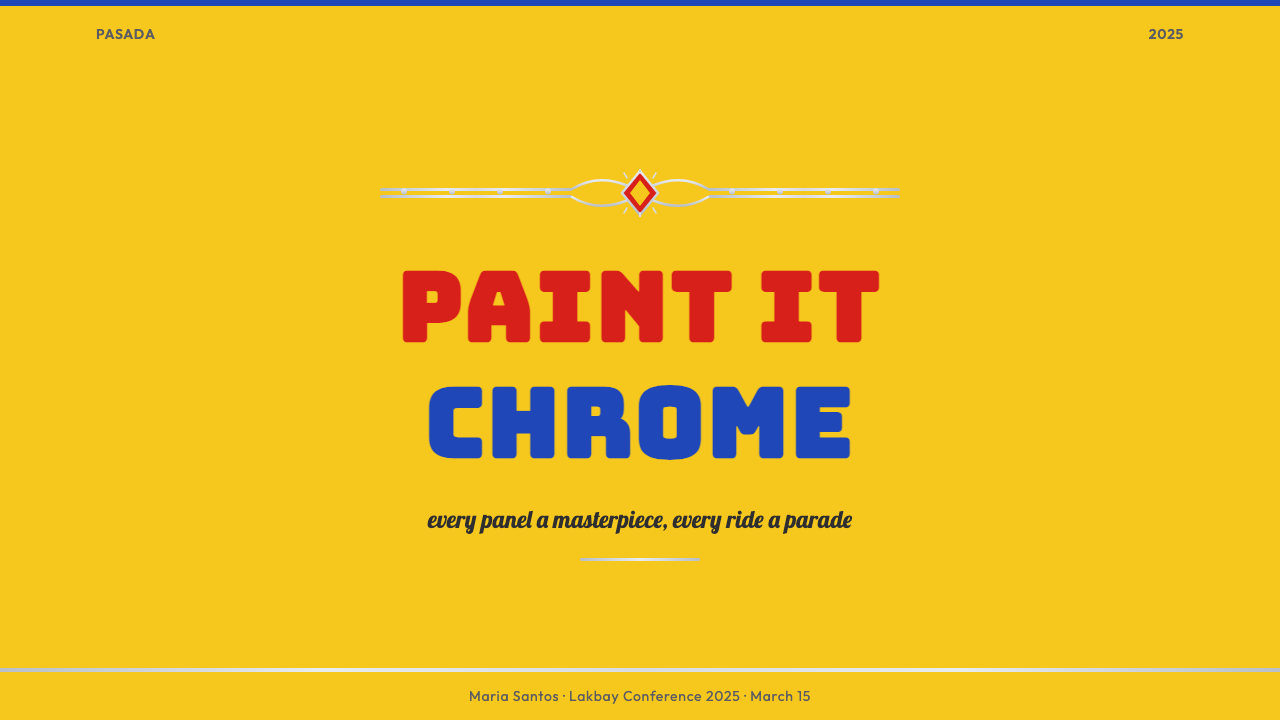
For presentation slides, the jeepney style works most powerfully on cover slides and section dividers where visual impact is the primary goal. A cover built in this tradition uses a richly saturated ground color — deep Marian blue or fire-engine red — with hand-lettering-inspired type at large scale, chrome-colored accent lines framing key text, and a bold central image (a horse, a saint, a landmark) treated as a mural element. Content slides require more discipline: reserve the full density for covers and transitions, and use a simplified version — bold color, clear lettering hierarchy, minimal chrome accents — for the information-dense slides where readability must prevail. Data slides work well when charts are given bold color fills from the primary palette and framed with the style's characteristic thick borders.
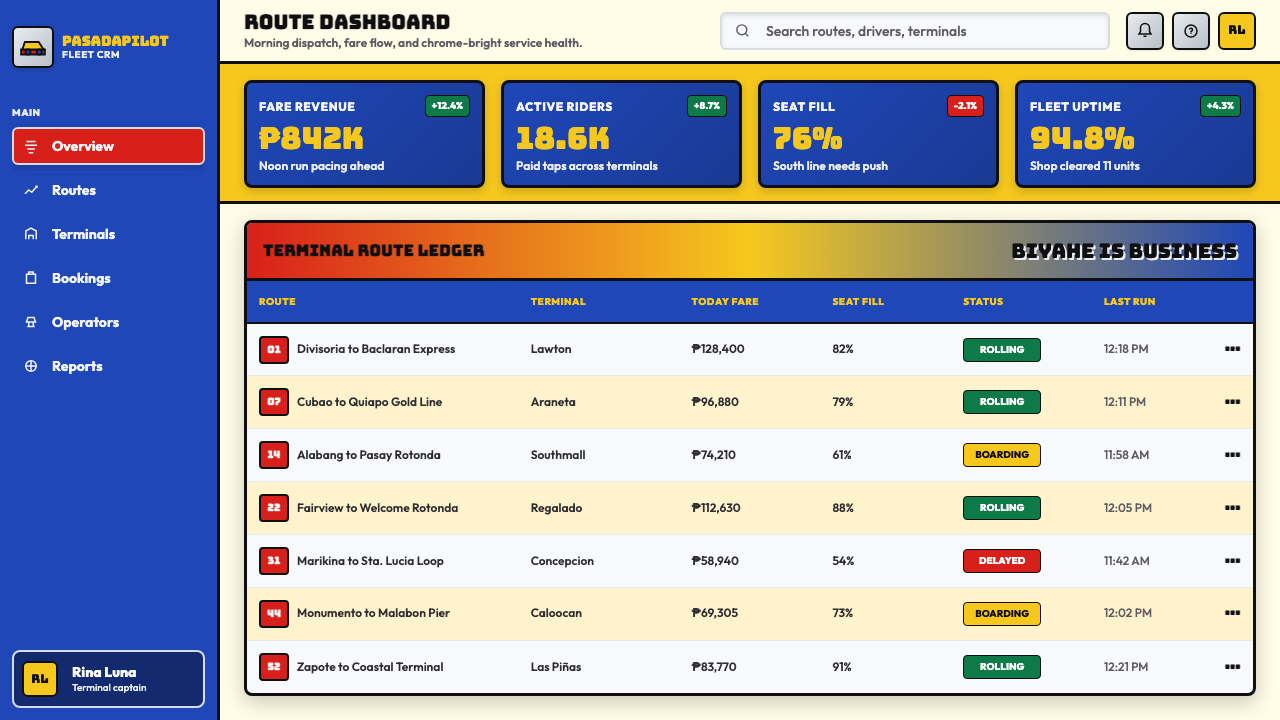
For web and app interfaces, the jeepney aesthetic maps naturally onto contexts celebrating cultural identity, festive commerce, or Filipino-specific consumer brands. A food delivery app, an events platform, or a travel service targeting Filipino audiences can draw on the style's warmth, energy, and visual abundance to signal cultural familiarity. Dashboard interfaces require the most discipline: use the jeepney palette and typographic boldness for headers and category labels, but simplify the information display panels themselves to maintain usability. The style is less suited to clinical or productivity-first interfaces where the density can overwhelm rather than celebrate.
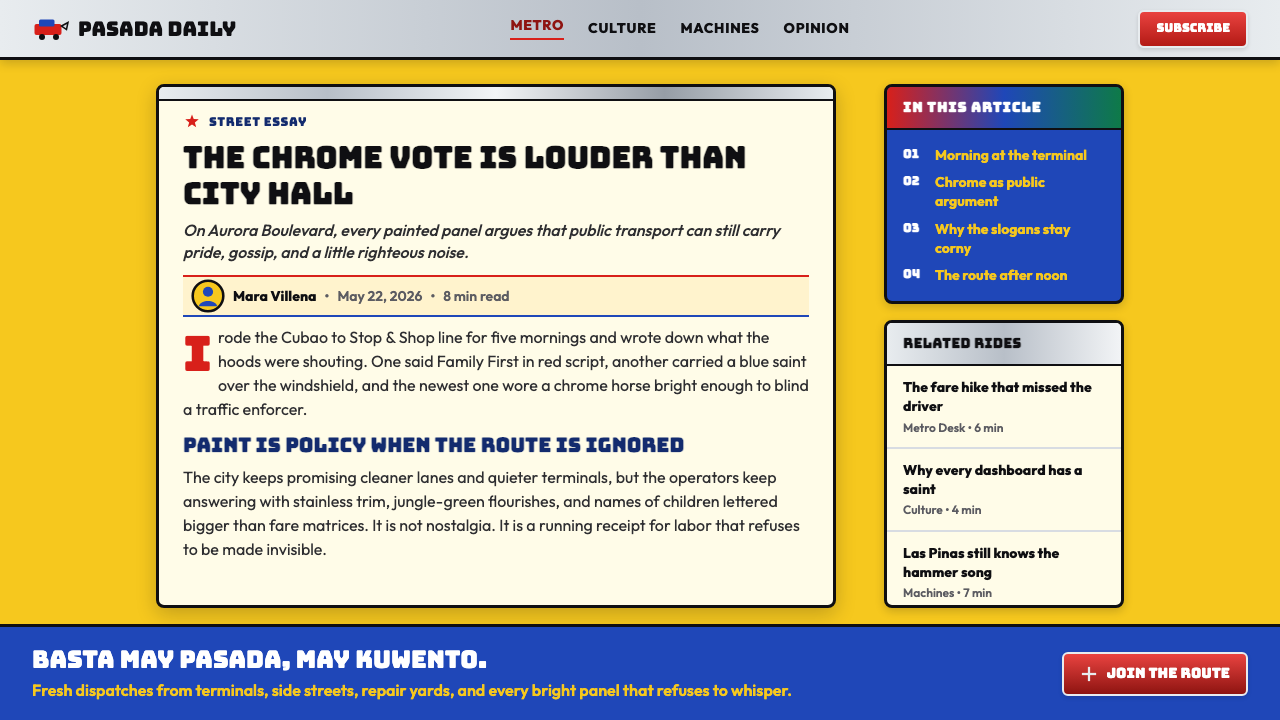
For editorial and marketing work, the jeepney tradition's poster-like boldness is its greatest asset. Full-bleed cover images that layer text over saturated color, bordered panel compositions that echo the jeepney's side panels, and hand-lettering-inspired headlines all transfer naturally to print and digital editorial. The tradition's mixing of the sacred and the commercial — patron saints alongside product names — has precedents in festival and folk-fair marketing materials worldwide and can be deployed with knowing irony in contemporary campaigns targeting audiences who understand the reference. Event posters, festival branding, and cultural institution marketing are natural homes for this aesthetic.
The most common mistake when applying the jeepney aesthetic is treating chrome and color as ornamental additions to an otherwise conventional layout, rather than as the structural logic of the composition. Chrome does not frame a layout that already exists — chrome is part of how the layout is organized. Color is not applied to areas defined by a neutral grid — color defines the areas. A second common mistake is using the visual density without the cultural content: jeepney surfaces are dense because they carry biography, devotion, and regional identity, not because density is a style preference. Applying the surface density without this content logic produces something that reads as decorative overload rather than expressive richness.
Filipino Jeepney (Chrome & Streamer) — FAQ
Is the jeepney aesthetic appropriate for brands not connected to Filipino culture?
It can be, with care. The jeepney aesthetic is a living folk tradition with specific cultural meaning, not a neutral style toolkit. Using it without acknowledgment risks both cultural appropriation and aesthetic inauthenticity — the style's density and iconography carry meaning that is lost when the tradition is stripped down to chrome accents and saturated colors. That said, the visual logic of layered color, kinetic ornamentation, and surface-as-biography has been successfully translated into contexts far from the Philippines, particularly in festival branding, streetwear, and pop-culture visual identities that explicitly celebrate folk-art maximalism. The key is whether the application treats the source tradition with understanding or merely borrows its most visible surface features.
How does this style handle dark backgrounds versus light ones?
The jeepney tradition is not built around background color in the way that modernist design systems are — the surface is the ground. That said, the style's primaries behave differently in different contexts. On a warm cream or yellow ground, reds and blues read with full intensity and the chrome reflects with a warm cast. On a deep navy or black ground, the chrome becomes starker, the yellows become neon-adjacent, and the reds take on a more ceremonial, religious-icon quality. Both can be authentic to the tradition — Manila's night-time jeepney fleet, lit by neon signs and headlights, is a distinctly different visual experience from the noon-sun version, but both are recognizably jeepney. The key is maintaining the density and the layering regardless of which ground you choose.
What distinguishes the jeepney aesthetic from other folk maximalism traditions?
Several features set the jeepney tradition apart from other maximalist folk-art systems such as Mexican painted trucks, Pakistani jingle trucks, or Bangladeshi rickshaws. The chrome-and-stainless-steel metalwork tradition is particularly distinctive — most other folk-vehicle traditions rely primarily on paint, while the jeepney treats polished metal as an equal expressive medium. The Catholic Marian devotional iconography, including the specific blue that references the Virgin's robes, is unique to the Philippines' particular blend of Spanish colonial and indigenous religious traditions. The hand-lettering style combines American mid-century signage aesthetics with Filipino vernacular typography in a way that reflects the Philippines' specific post-colonial cultural position. And the kinetic streamer tradition — the cascading stainless-steel or Mylar strips — has no direct parallel in other folk-vehicle traditions worldwide.
Can this aesthetic work for digital products, or is it primarily suited to print and physical media?
The jeepney aesthetic translates to digital contexts with some adaptation. The chrome finish, which depends on reflectivity and physical shine in the original tradition, can be approximated digitally through gradient metallic effects, but these should be used boldly rather than subtly — a barely-visible chrome texture reads as stylistic confusion rather than cultural reference. The hand-lettering-inspired type works particularly well digitally, especially for headers and navigation labels where legibility and personality can coexist. The color density and layering translate directly. The kinetic streamer element — the style's most physically specific feature — can be approximated through animation: elements that trail, shimmer, or oscillate on scroll or hover capture something of the original kinetic logic. The biggest digital challenge is maintaining the tradition's surface density without creating an interface that is genuinely unusable; information hierarchy must be preserved even while visual richness is maximized.
How does the jeepney modernization controversy affect using this aesthetic?
The Philippine government's jeepney modernization program — which has phased out older vehicles in favor of cleaner, standardized modern minibuses — has intensified the cultural significance of the traditional jeepney aesthetic. For many Filipinos, the traditional jeepney is now an emblem of what is being lost rather than simply a piece of everyday infrastructure, and using the aesthetic carries a layer of cultural and political resonance that did not exist a decade ago. This can be a strength in certain contexts: cultural institutions, preservation campaigns, diaspora-facing brands, and projects celebrating Philippine folk heritage can invoke the aesthetic with the additional meaning of honoring something under threat. In purely commercial contexts without this awareness, the use risks seeming oblivious to a live cultural debate. Understanding the current stakes is part of using the tradition responsibly.
Related design styles
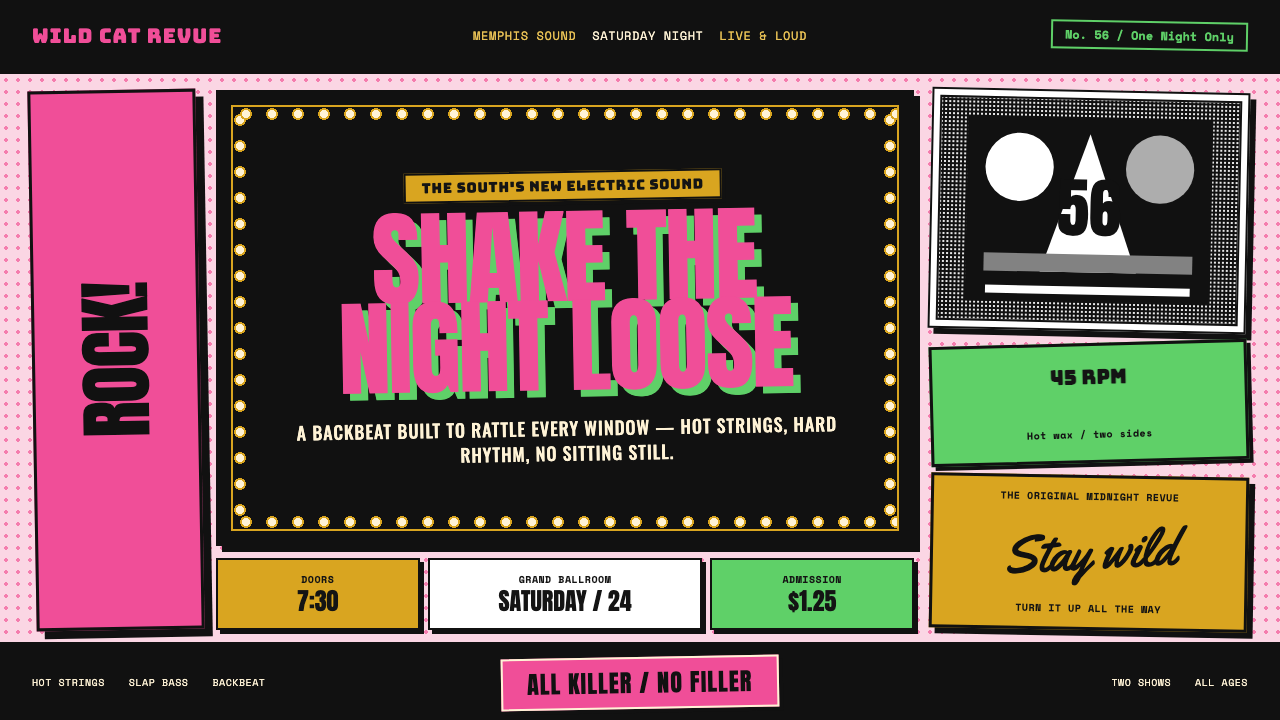 Elvis Presley (1956)Rock learned to shout. Bubblegum pink, acid green and jailhouse type land wit…
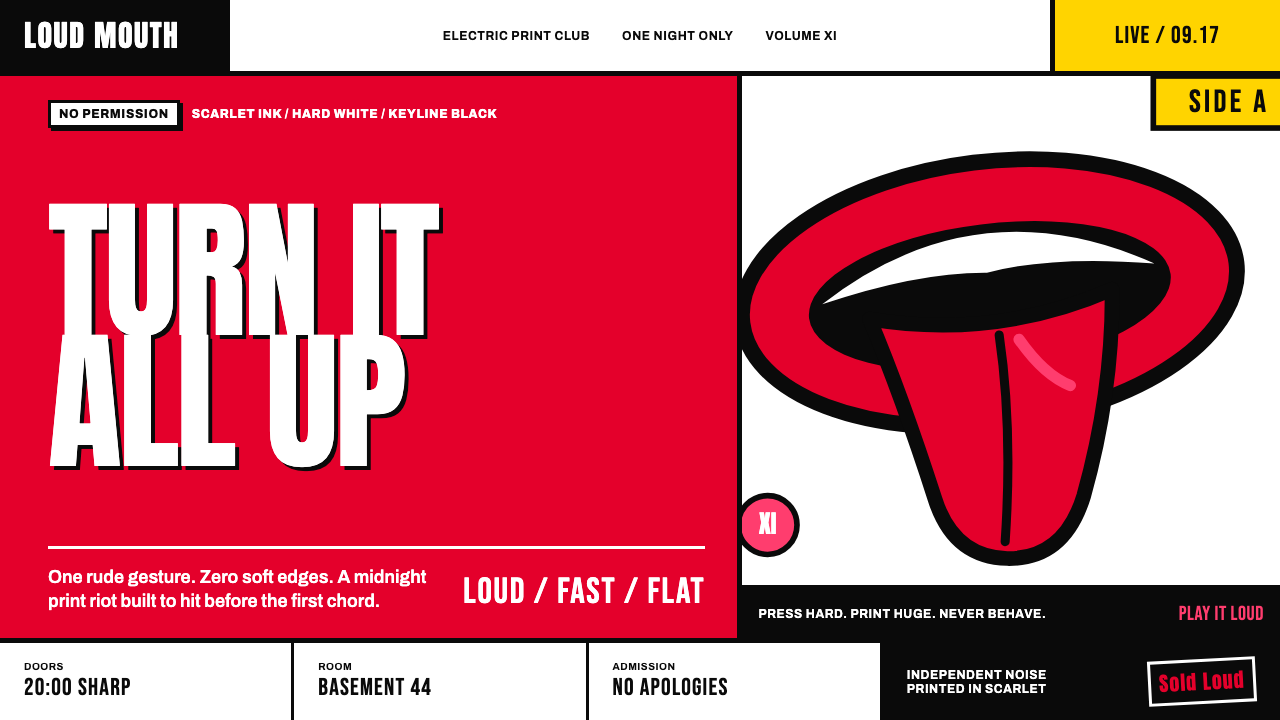 Rolling Stones Tongue (1971)Flat ink shouts loud. Scarlet curves, black keylines, and cropped poster scal…
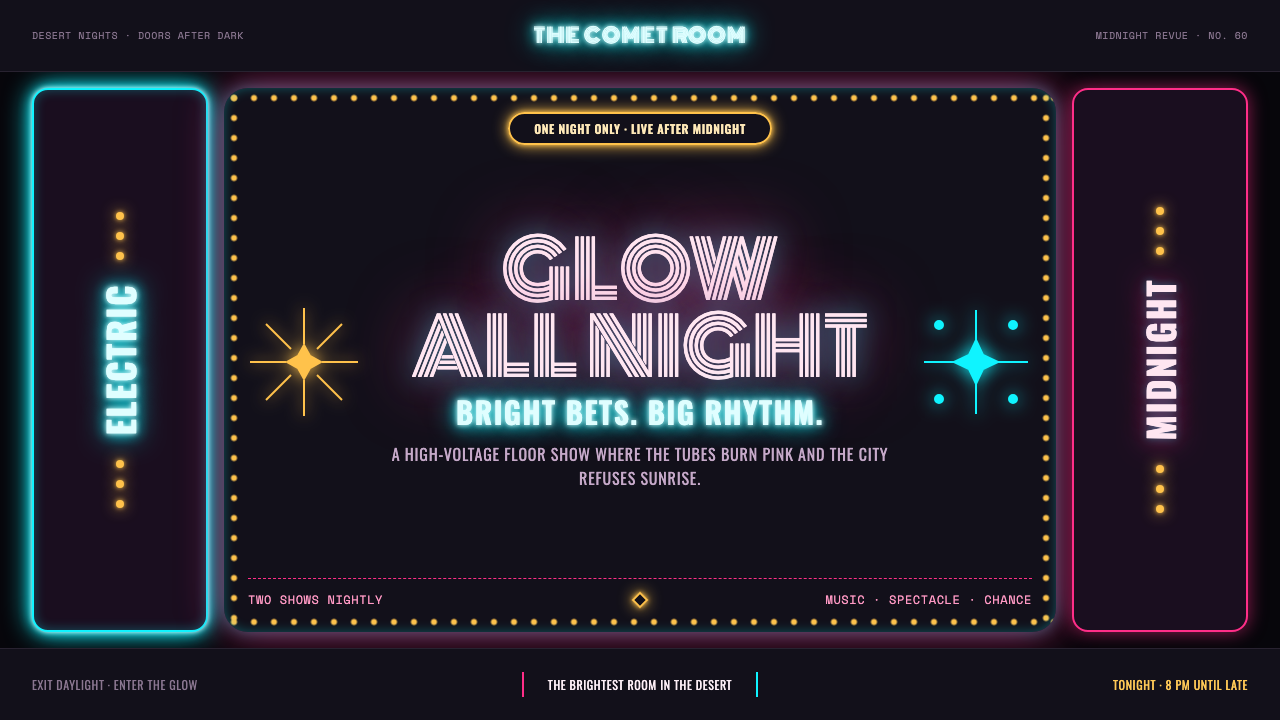 Las Vegas Neon (1960)Night refuses to dim. Hot-pink tubes, cyan bloom and amber bulbs turn black i…
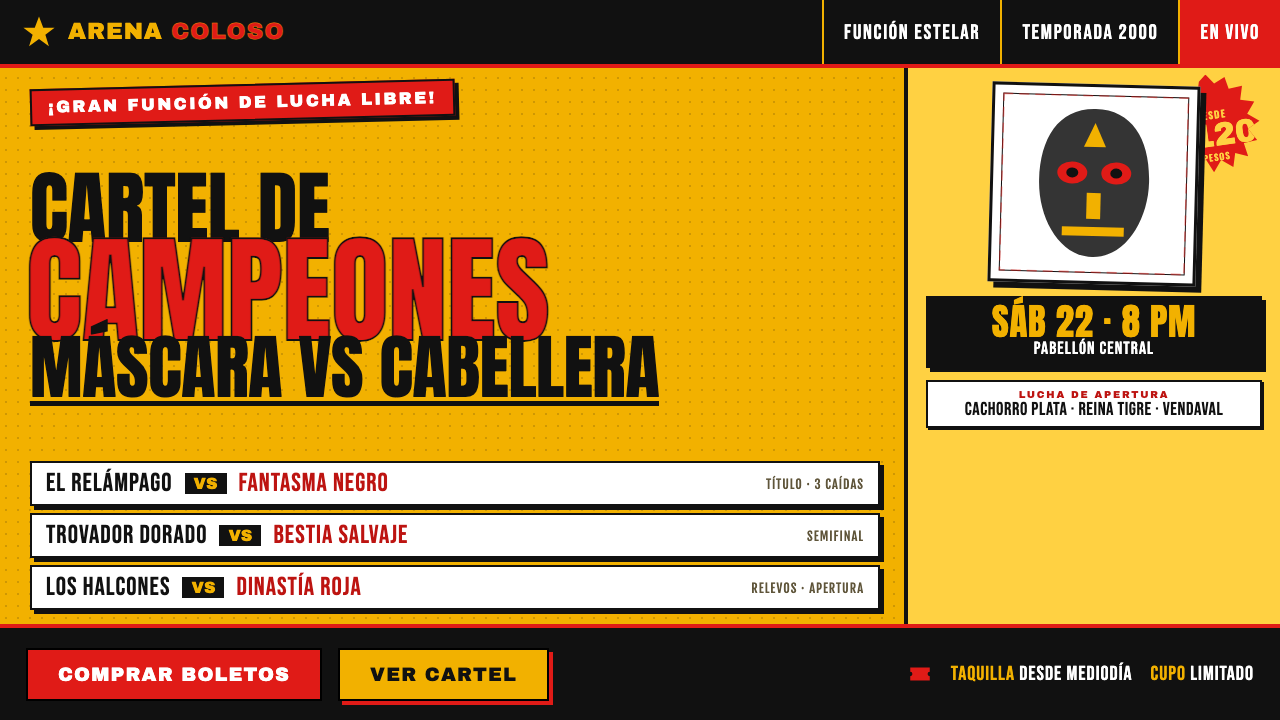 Lucha Libre Fight CartelTwo inks, maximum volume. Blood red on chrome-yellow, fat condensed type, sta…
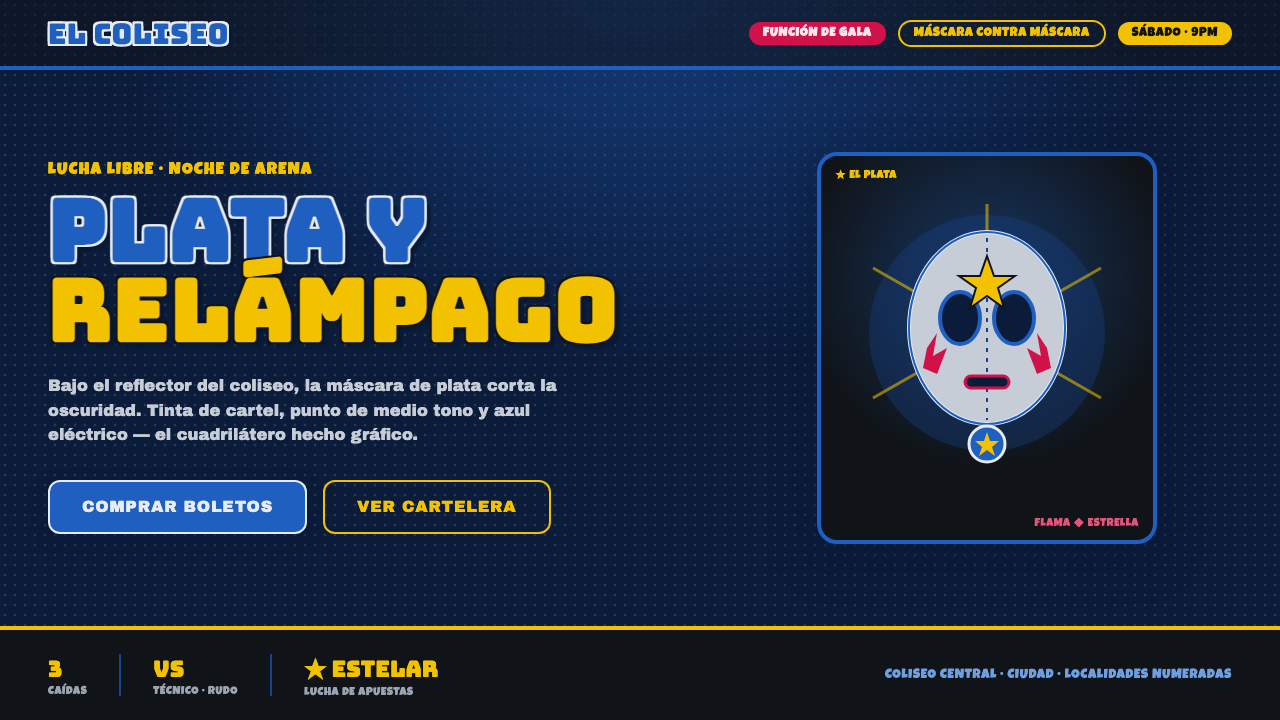 Mexican Lucha Mask GraphicComic-book lucha, lit from above. Silver-blue mask out of arena-night dark, h…
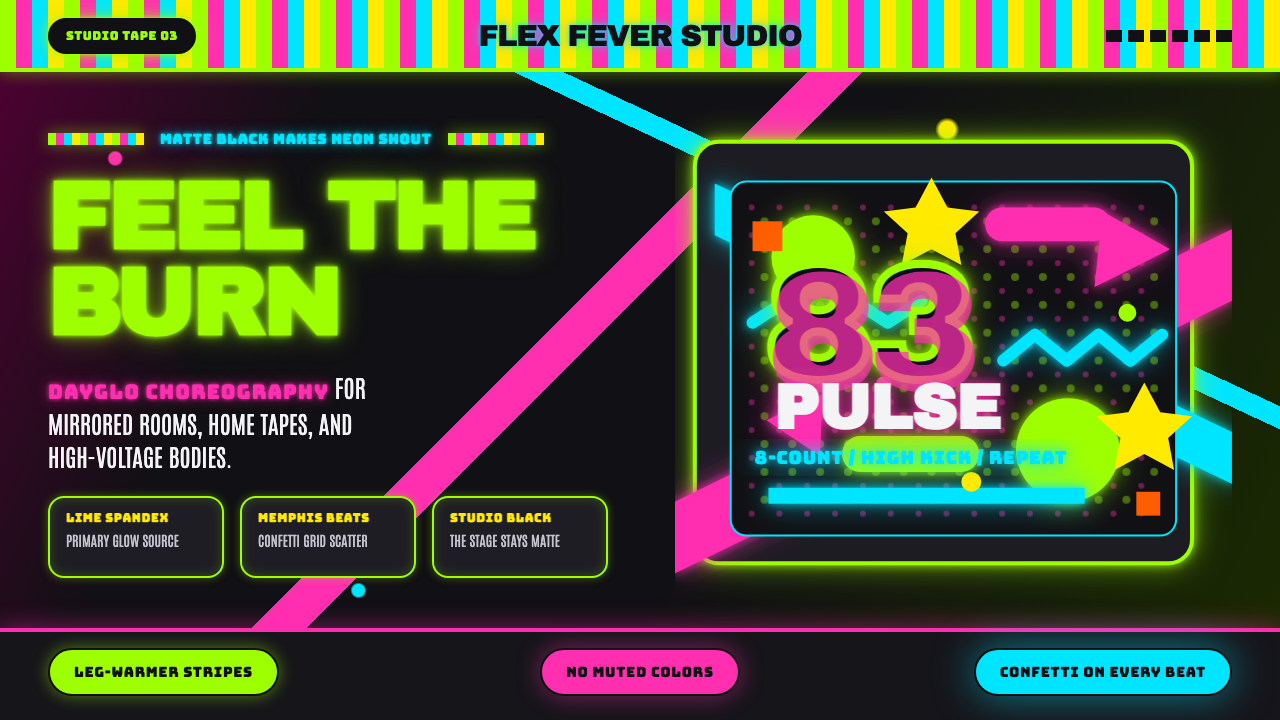 80s Aerobics Fluoro SpandexNeon refuses restraint. Lime spandex, pink-cyan confetti, and black-stage typ…