What is Populuxe Atomic Age?
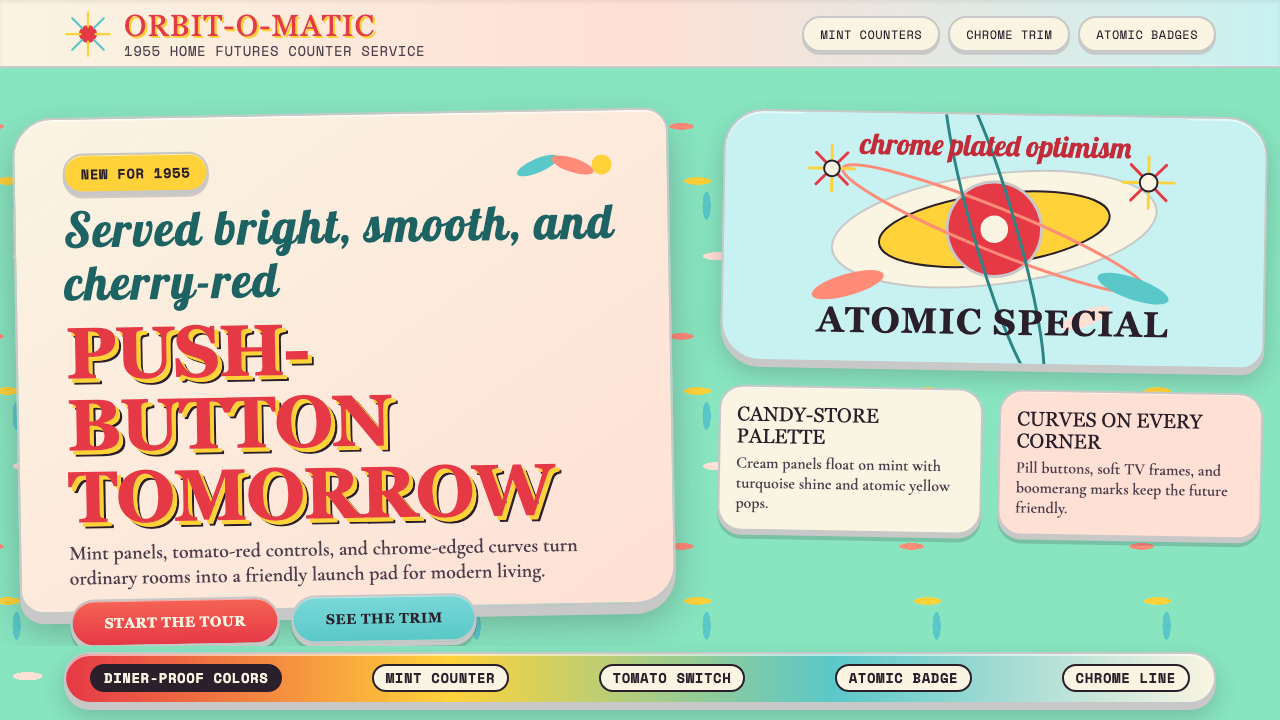
Populuxe is the grin on the face of the American future — chrome fins, atomic starbursts, and Formica in every color the postwar boom could imagine.
Populuxe Atomic Age in brief
Populuxe is the exuberant, commercial visual language of American consumer culture between 1954 and 1964 — a decade when the postwar economic boom, Cold War optimism, and the mass production of automobiles, appliances, and suburban housing converged into a single, gloriously excessive aesthetic. The term was coined retrospectively by cultural historian Thomas Hine in his 1986 book of the same name, combining 'popular,' 'luxury,' and a Latin suffix suggesting abundance. Hine identified a sensibility that was not quite high modernism and not quite kitsch, but something genuinely its own: the belief, held with total sincerity, that chrome-trimmed push-button convenience was the rightful inheritance of every American family.
Visually, Populuxe is defined by softened, biomorphic curves — the kidney bean, the boomerang, the amoeba — combined with explosive radial motifs that reference atomic science and space exploration. Surfaces are richly colored in palettes that would have been considered garish by European modernist standards: mint green and turquoise paired with coral and tomato red, atomic yellow alongside charcoal and warm cream. Chrome appears as trim, edging, and hardware. The overall effect is one of cheerful abundance: nothing is bare, nothing is neutral, and optimism is the only permissible mood.
Populuxe is often confused with Mid-Century Modern, and the two movements share a historical moment, but they are temperamentally opposite. Mid-Century Modern is disciplined, restrained, and indebted to European Bauhaus and Scandinavian craft traditions. Populuxe is its louder, sweeter, more democratic sibling — designed not for the museum but for the roadside diner, the suburban kitchen, the automobile showroom, and the television advertisement. Where Mid-Century Modern aspires toward timelessness, Populuxe celebrates its own moment with unabashed enthusiasm.

Where does Populuxe Atomic Age come from?
The roots of Populuxe lie in the immediate postwar United States — specifically in the economic conditions that followed the end of World War II in 1945. Wartime manufacturing had built extraordinary industrial capacity; when that capacity redirected toward consumer goods, it produced an unprecedented flood of automobiles, refrigerators, washing machines, and suburban homes. The GI Bill sent millions of veterans to college and into homeownership; the interstate highway system, begun under the Federal Aid Highway Act of 1956, connected those suburbs to commercial strips lined with motels, diners, and service stations. Populuxe is the aesthetic of that infrastructure — the visual language that merchants, manufacturers, and architects developed to capture the attention and desires of this newly mobile, newly prosperous mass consumer.
The atomic and space contexts were equally formative. The United States detonated its first hydrogen bomb in 1952; the Soviet Union launched Sputnik in 1957. For much of the decade, the future felt like a scientific fact — something that scientists and engineers were actively building, and that ordinary Americans would soon inhabit. This produced a design vocabulary that borrowed freely from the imagery of atomic science: the starburst as an atom diagram, the orbit ellipse as a decorative motif, the rocket tail fin translated into car design. These were not metaphors of anxiety but of confidence — the atomic age was thrilling, and Populuxe dressed accordingly.
The geographic centers of the style were Detroit, Los Angeles, and the new suburban developments like Levittown on Long Island. Detroit, as the capital of the American automobile industry, drove the most extravagant formal experiments: the 1957 Chevrolet Bel Air, designed under Harley Earl, introduced chrome-framed tailfins that transformed a piece of machinery into a fantasy object. Los Angeles contributed Googie architecture — the roadside vernacular of jutting roofs, acute angles, boomerang shapes, and neon signs developed by architects like John Lautner and Douglas Honnold to attract customers from speeding automobiles. Levittown and its successors provided the domestic stage on which these consumer goods performed.
Raymond Loewy, the most prominent American industrial designer of the period, gave the aesthetic a theoretical and commercial framework. His concept of the Most Advanced Yet Acceptable product — abbreviated MAYA — held that consumers would only adopt innovation up to the limit of their comfort with novelty. The Populuxe decade was, in part, a sustained experiment in finding that limit: how much fin, how much chrome, how much turquoise could be absorbed before it tipped from exciting into alienating. The answer, it turned out, was quite a lot — and then, by the mid-1960s, rather suddenly, not very much at all.
What defines the Populuxe Atomic Age look?
Color
The Populuxe palette is warm, saturated, and deliberately celebratory. Mint green, turquoise, and aqua anchor the cool register; coral, tomato red, and atomic yellow provide the hot counterpoint; charcoal and warm cream serve as neutrals. These colors appear in high-contrast pairings — turquoise against coral, yellow against charcoal — with no attempt at restraint. The palette was directly linked to consumer goods of the era: the same colors that appeared on a 1958 Frigidaire refrigerator or a Howard Johnson's restaurant façade governed the typography and graphic design of the period.
Shape and Biomorphic Curves
Where Bauhaus geometry was mathematical and angular, Populuxe geometry is biological and flowing. The kidney bean, the boomerang, the teardrop, and the amoeba are the foundational forms — shapes that suggest motion and organic life rather than mechanical precision. These forms appear in furniture silhouettes, countertop edges, swimming pool plans, and graphic layouts alike. The curves are never tentative; they are wide, confident arcs that consume space freely, communicating abundance and forward momentum.
Starburst and Radial Motifs
The starburst — a central point from which multiple straight rays or pointed spikes radiate outward — is the signature decorative motif of the Atomic Age. It references both the scientific diagram of an atom and the visual drama of an explosion, carrying connotations of energy, discovery, and modernity. Eight-pointed and twelve-pointed starbursts appear on everything from kitchen clocks to television backdrops to promotional graphics. Related motifs include the orbit ellipse, the boomerang in flight, and the converging chevron — all suggesting speed, trajectory, and technological optimism.
Typography
The typographic voice of Populuxe is round, bold, and friendly — the opposite of modernist geometric strictness. Cooper Black, with its heavy rounded strokes and soft terminals, became the defining display face of the era: thick enough to read from a moving car, approachable enough to sell milkshakes. Brush Script and similar informal scripts appeared on diner signs and packaging, conveying handmade warmth within a mass-produced context. Futura Bold appeared in more aspirational contexts — aerospace advertising, institutional graphics — bringing a space-age geometry to headlines. These three voices — round serif, script, geometric sans — often coexisted in the same visual environment.
Chrome, Gloss, and Surface Richness
If Bauhaus demanded material honesty, Populuxe celebrated material extravagance. Chrome trim was applied to automobiles, appliances, and furniture hardware as a signifier of quality and modernity — not because chrome was structurally necessary, but because it caught light brilliantly and signaled prosperity. Formica, the laminated plastic surface material, allowed color and pattern to appear on kitchen counters, table tops, and diner banquettes at low cost and in high durability. The surfaces of Populuxe objects are meant to be seen and touched: glossy, reflective, and assertively present in ways that matte modernist materials are not.
Optimism as Visual Principle
Populuxe is not merely a collection of forms and colors — it is an emotional stance rendered visual. Every design choice reinforces the message that things are good, getting better, and about to become spectacular. Rounded corners soften aggression; bright colors signal vitality; upward-pointing fins suggest ascent; starbursts announce energy. The style has no vocabulary for doubt, fatigue, or difficulty. This makes it tonally distinct from both the Bauhaus (which was built on rational principles and political urgency) and from later postmodern irony. Populuxe means it.
Pattern and Repetition
Repetitive geometric and biomorphic patterns appear extensively in Populuxe — on Formica surfaces, wallpapers, upholstery fabrics, and tiled floors. The boomerang pattern, the atomic dot cluster, the overlapping ellipse, and the checker grid in two-tone colors are characteristic. Unlike modernist patterns that tend toward rigorous mathematical repetition, Populuxe patterns feel hand-drawn and slightly playful even when printed by machine. The scale of the pattern relative to the object is often deliberately oversized — a tablecloth pattern whose motifs are nearly as large as the dishes placed on it.

Who shaped Populuxe Atomic Age?
Loewy was the most commercially successful industrial designer in American history, responsible for the visual identity of products ranging from the Lucky Strike cigarette pack to the Studebaker automobile to the NASA Skylab interior. His MAYA principle — Most Advanced Yet Acceptable — provided the theoretical underpinning for the Populuxe decade's constant negotiation between novelty and familiarity. Loewy understood that mass-market consumers wanted to feel modern without feeling disoriented, and his designs consistently hit that threshold with commercial precision. His 1953 Studebaker Starliner coupe and his work on the Pennsylvania Railroad's locomotives demonstrate his ability to bring streamlined, aspirational form to objects of everyday American life.
Saarinen was the Finnish-American architect who most elegantly bridged the gap between Mid-Century Modern discipline and Populuxe exuberance. His TWA Flight Center at Idlewild Airport (completed 1962) is a single continuous concrete shell whose swooping organic curves suggest flight itself — a building that is simultaneously a serious structural achievement and an unabashed piece of Atomic Age theater. His Tulip Chair and Pedestal series, designed for Knoll in the mid-1950s, applied the same biomorphic logic to furniture: a single curving form that eliminated the 'slum of legs' underneath chairs and tables. Saarinen's work demonstrates how the Populuxe formal vocabulary could be applied with genuine rigor.
Lautner was the Los Angeles architect who pushed Googie — the roadside commercial vernacular that is Populuxe's architectural expression — to its most dramatic extreme. Trained under Frank Lloyd Wright, Lautner brought a genuine structural intelligence to forms that lesser architects applied only as costume. His Chemosphere house (1960), a octagonal pod cantilevered over a Hollywood hillside on a single concrete column, is the most extreme domestic expression of Atomic Age optimism: a home that looks like it landed from the future. His commercial work, including coffee shops and gas stations along Southern California's commercial strips, defined the visual landscape of the Populuxe decade for motorists.
Nelson served as design director of Herman Miller from 1947 to 1972, and in that role he occupied a unique position between modernist restraint and popular accessibility. His Ball Clock (1947) — a sculptural wall clock whose twelve spheres radiate from a central spindle like an atom diagram — became one of the most reproduced objects of the Populuxe era, appearing in living rooms, offices, and television set dressings throughout the 1950s. His Marshmallow Sofa (1956), with its grid of circular cushions in bright colors, applied biomorphic Populuxe color sensibility to a structurally rational frame. Nelson demonstrated that the era's visual enthusiasms could be channeled through serious design thinking.
Hine was the cultural critic and historian whose 1986 book 'Populuxe' gave the era its name and its first serious analytical framework. Before Hine, the aesthetic of the 1950s was either dismissed as commercialized kitsch or subsumed into broader accounts of Mid-Century Modern. Hine argued that the exuberance of the period — the fins, the colors, the starbursts — was a genuine cultural expression of postwar American confidence and collective aspiration, and that it deserved to be understood on its own terms rather than measured against European modernist standards. His critical rehabilitation of the style made possible its subsequent influence on postmodern design and its current digital-era revival.
How do you use Populuxe Atomic Age today?
Populuxe translates into contemporary design work with surprising fidelity — its visual language is specific enough to be immediately recognizable but broad enough to accommodate modern formats from presentation decks to web interfaces to social media graphics. The key is committing fully to the aesthetic's emotional register: half-hearted Populuxe, with one starburst dropped onto an otherwise neutral layout, reads as costume rather than conviction. When the style works, it works because every element — color, shape, type, texture — is pulling in the same direction.
For presentation slides, Populuxe excels on covers and section dividers where bold visual impact matters most. A cover slide benefits from a large biomorphic shape in a warm saturated tone anchoring one quadrant, with an oversized headline set in a rounded, heavy typeface against a contrasting ground — coral on charcoal, or turquoise on cream. Content slides should be cleaner but not neutral: a starburst or boomerang used as a modest accent in a corner, a consistent warm-tone accent color applied to data labels and headings, and text set in generous sizes that maintain the era's confident readability. Data visualization takes well to the palette — bar charts in the Populuxe range of turquoise, coral, and atomic yellow carry warmth and optimism that standard corporate blues and grays cannot.
For web interfaces, Populuxe works particularly well in contexts where personality and warmth are competitive advantages: consumer-facing landing pages, food and hospitality brands, entertainment platforms, and any product that wants to signal friendliness and accessibility over authority and precision. A dashboard or pricing page in this style uses rounded card shapes, a warm cream or off-white background field, and reserves the saturated accent colors for interactive states and primary calls to action. Navigation should be typographically warm — rounded, medium-weight letterforms — rather than the tight geometric sans-serifs that read as cool and efficient.
For editorial and marketing applications, the style suits campaigns that need to stand out in saturated media environments. A Populuxe-derived editorial spread uses the biomorphic shape as a structural frame — a kidney-bean shaped image crop, a boomerang dividing a two-column layout — rather than standard rectangular containers. The color works best when applied in large fields rather than small accents: a full-bleed coral section header, a turquoise pull-quote block, an atomic yellow background for a feature callout. The typography should mix scale dramatically — an oversized display face next to tight body text — to reinforce the era's characteristic contrasts.
The most common mistake when applying Populuxe is treating it as a retro novelty layer rather than a coherent visual system. Designers often import one or two elements — a starburst graphic, a turquoise color field — while keeping the underlying layout and typographic logic modern-neutral, producing a pastiche that reads as dated rather than deliberate. A second common error is palette restraint: Populuxe earned its character through generous color commitment, and pulling the saturation or the warmth back toward contemporary safe tones drains the life from the style. If the color palette feels slightly too much — that is usually the right amount.

Populuxe Atomic Age — FAQ
Is Populuxe just another word for kitsch?
Not exactly, though the line between them is worth examining. Kitsch describes objects or aesthetics that try to achieve an emotional effect through borrowed sentiment — cheap imitations of valued styles. Populuxe, by contrast, was the sincere commercial aesthetic of its own moment: it was not imitating anything but expressing a genuine cultural mood. Thomas Hine's analytical contribution was to argue that the style's sincerity and internal coherence distinguished it from kitsch. That said, poorly applied Populuxe — a single starburst dropped onto a contemporary neutral layout — can slide toward kitsch precisely because it loses the sincerity that made the original work. The style requires commitment to function.
How do Populuxe and Mid-Century Modern coexist in the same project?
Carefully, and with a clear hierarchy. The two movements share a historical moment and some formal vocabulary — biomorphic curves appear in both, as does a preference for warm wood tones and specific mid-century furniture forms. But their emotional registers are different: Mid-Century Modern is restrained and confident in a quiet way, while Populuxe is exuberant and confident loudly. A successful hybrid uses Mid-Century Modern as the structural logic — clean grids, disciplined typographic hierarchy, restrained negative space — and Populuxe as the accent register: the color choices, the occasional starburst or boomerang motif, the rounded edge on a card or button. Reversing the hierarchy — using Populuxe as the structure and Mid-Century Modern as accent — tends to produce a muddy result where neither voice is clear.
Does Populuxe work in dark-mode interfaces?
Yes, but it requires a different palette strategy than the light-mode original. The historic Populuxe palette was built on cream and warm white grounds — charcoal and dark tones appeared as accents rather than backgrounds. Inverting to a dark ground changes the emotional register from 'cheerful diner' to something closer to 'neon-lit evening strip' — more dramatic, more Vegas, less family breakfast. On a dark background, turquoise and atomic yellow both carry well as primary accent colors; coral tends to lose its warmth and slide toward orange. The starburst and biomorphic shape vocabulary translates intact, and if anything gains in visual drama against a dark field. The key is to avoid treating dark Populuxe as simply a color inversion — rebuild the palette actively for the dark context rather than mechanically flipping light tones to dark.
What contexts are wrong for Populuxe?
The style struggles in contexts that require trust signals built on gravity, sobriety, or precision. Financial services, medical interfaces, legal platforms, and enterprise software where users need to feel that errors are unlikely and consequences are being taken seriously — these are poor fits. Populuxe's visual message is fundamentally 'everything is great and getting better,' which is reassuring in consumer and entertainment contexts but potentially counterproductive when users need to feel that complexity is being handled with care. The style also underperforms in luxury positioning that depends on restraint and quietness as signals of quality — the visual exuberance that makes a roadside diner compelling makes a premium watch brand feel cheap.
Is the Populuxe revival in contemporary design authentic or ironic?
Both, and the distinction matters. The most interesting contemporary work in the Populuxe register tends to be genuinely affectionate — designers who find real pleasure in the warmth, optimism, and visual generosity of the style and apply it with conviction rather than winking distance. The ironic version — where the starburst and the coral color are deployed as quotation marks around a fundamentally postmodern sensibility — tends to produce work that is clever but hollow. The original Populuxe worked because it was sincere; contemporary work in the style succeeds in proportion to how much of that sincerity the designer can recover. Audiences are perceptive about the difference, even when they cannot name it.
Related design styles
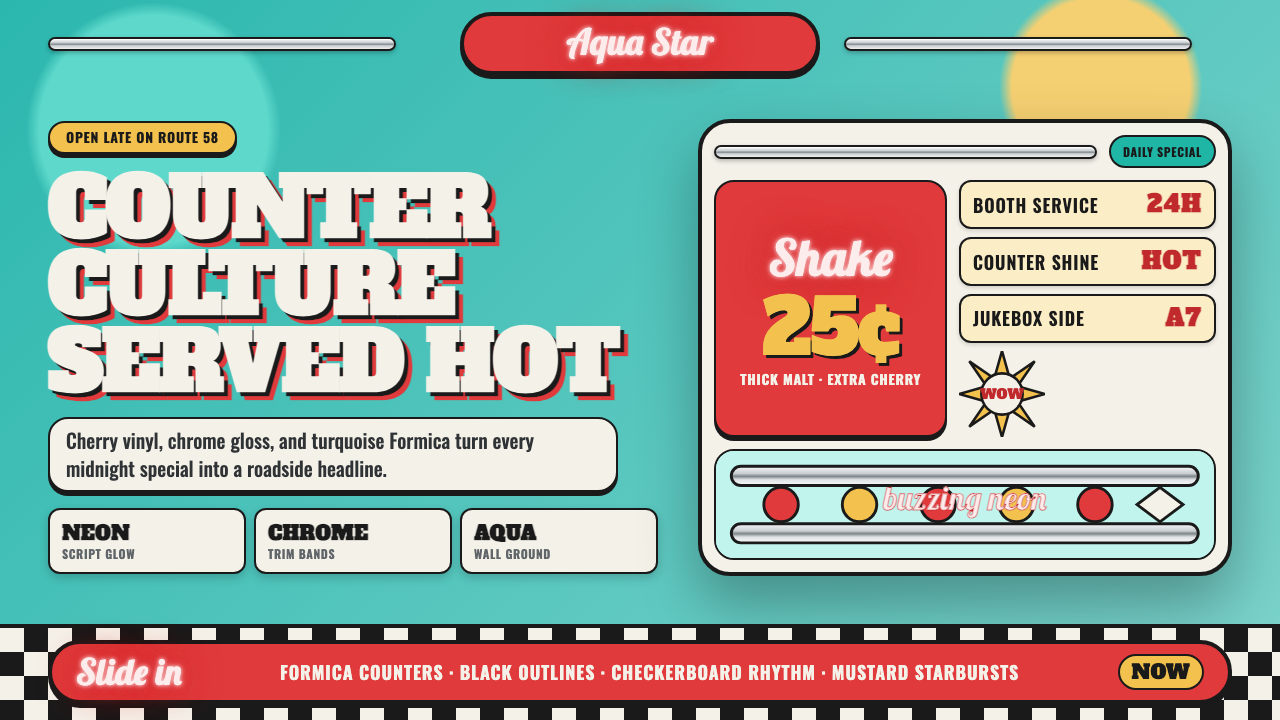 1950s Diner AquaRoadside optimism shouts. Aqua walls, cherry vinyl, chrome bands, and neon sc…
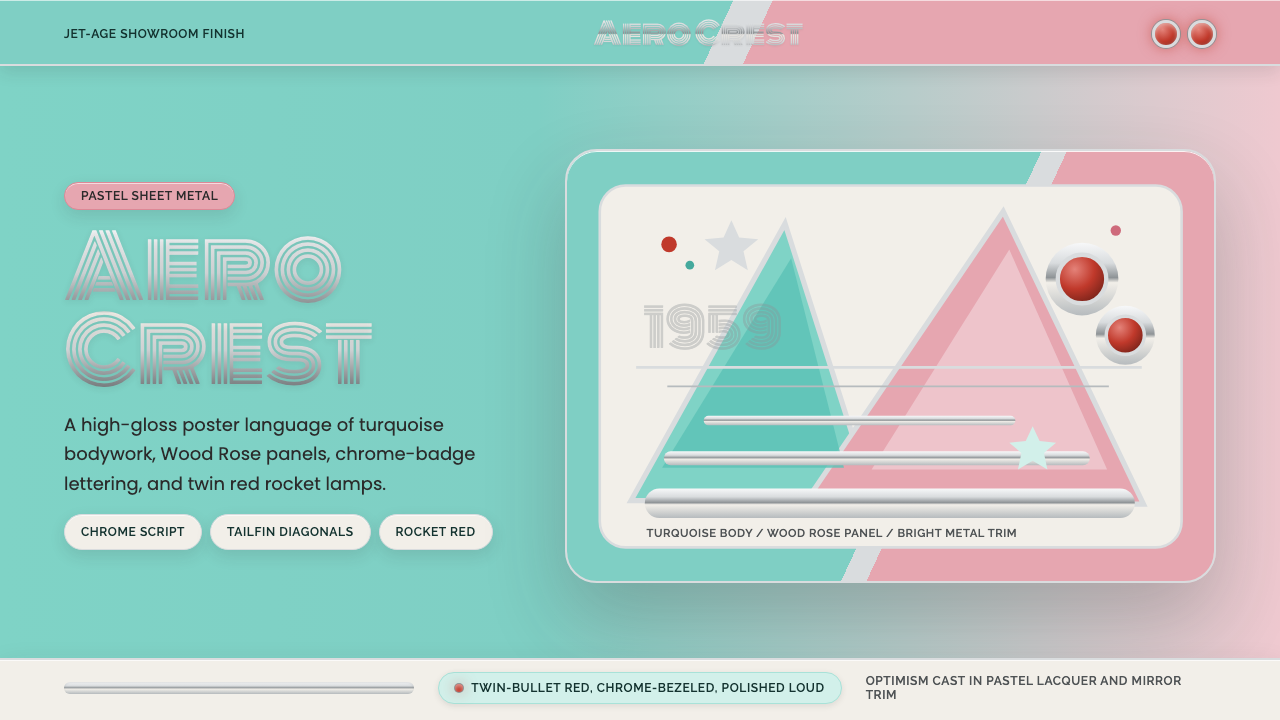 Cadillac TailfinShowroom optimism. Pastel aqua, Wood Rose panels, chrome Monoton, and rocket…
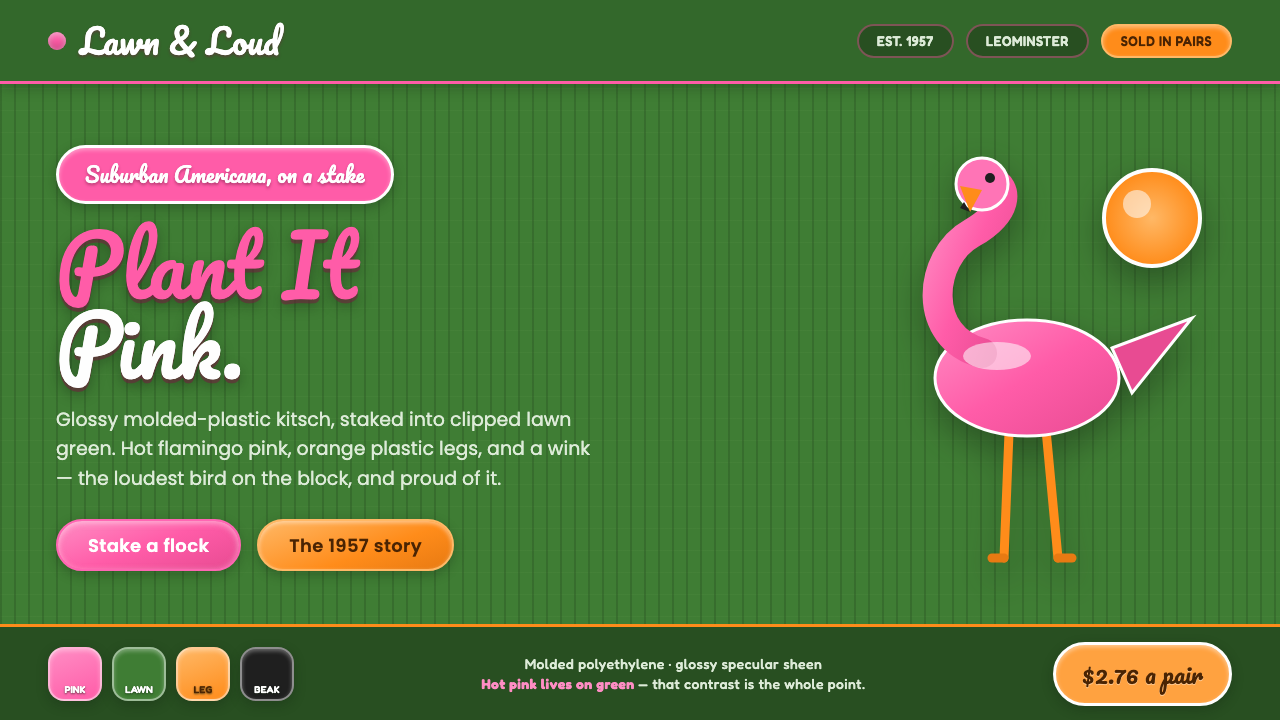 Pink Flamingo Lawn OrnamentLoud on purpose. Hot flamingo pink staked into lawn green, glossy molded plas…
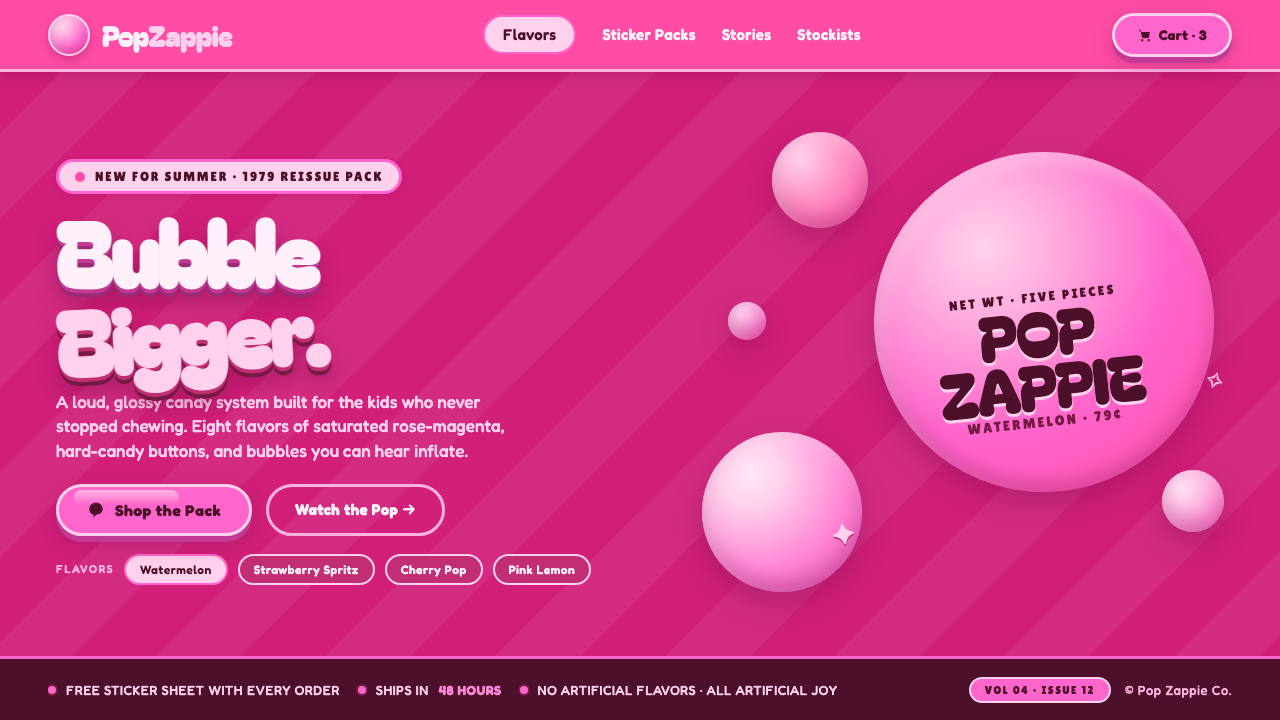 Watermelon Bubblegum Pink80s candy maximalism. Neon pink on rose-magenta, sugar-shine highlights, infl…
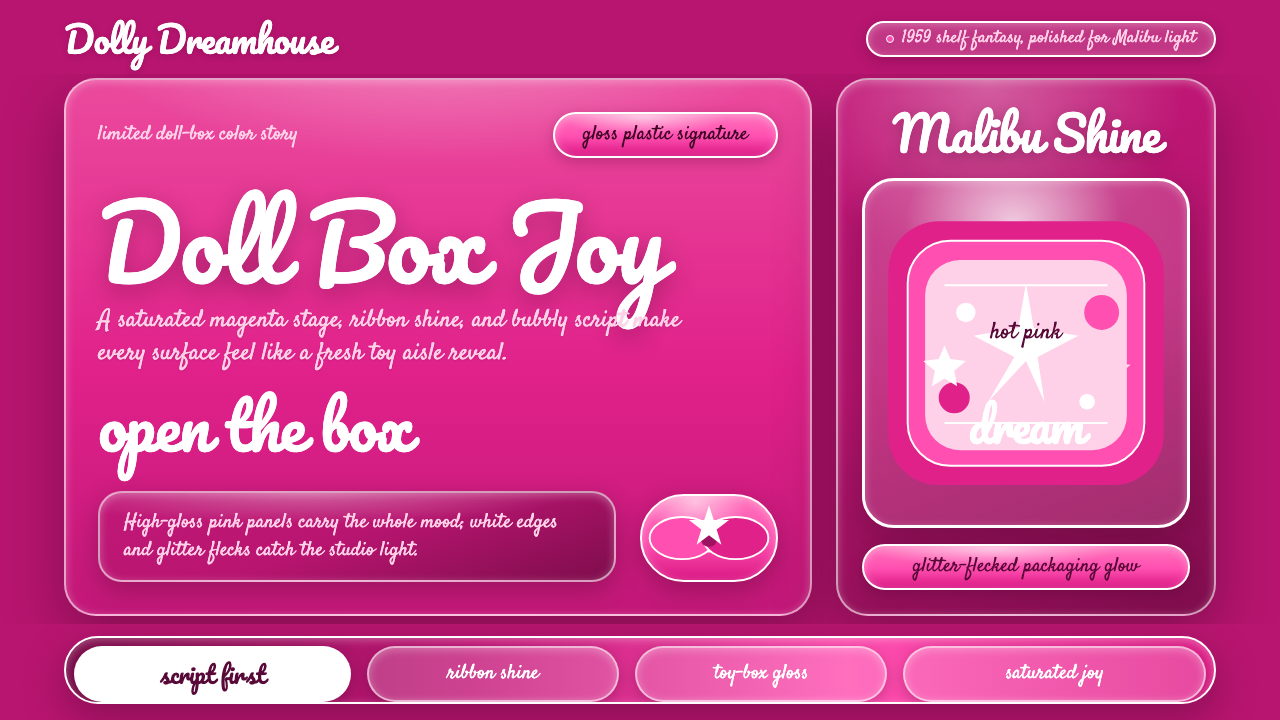 Barbie Hot Pink (Pantone 219)Saturated joy in plastic. Hot magenta, cursive script, gloss streaks, and gli…
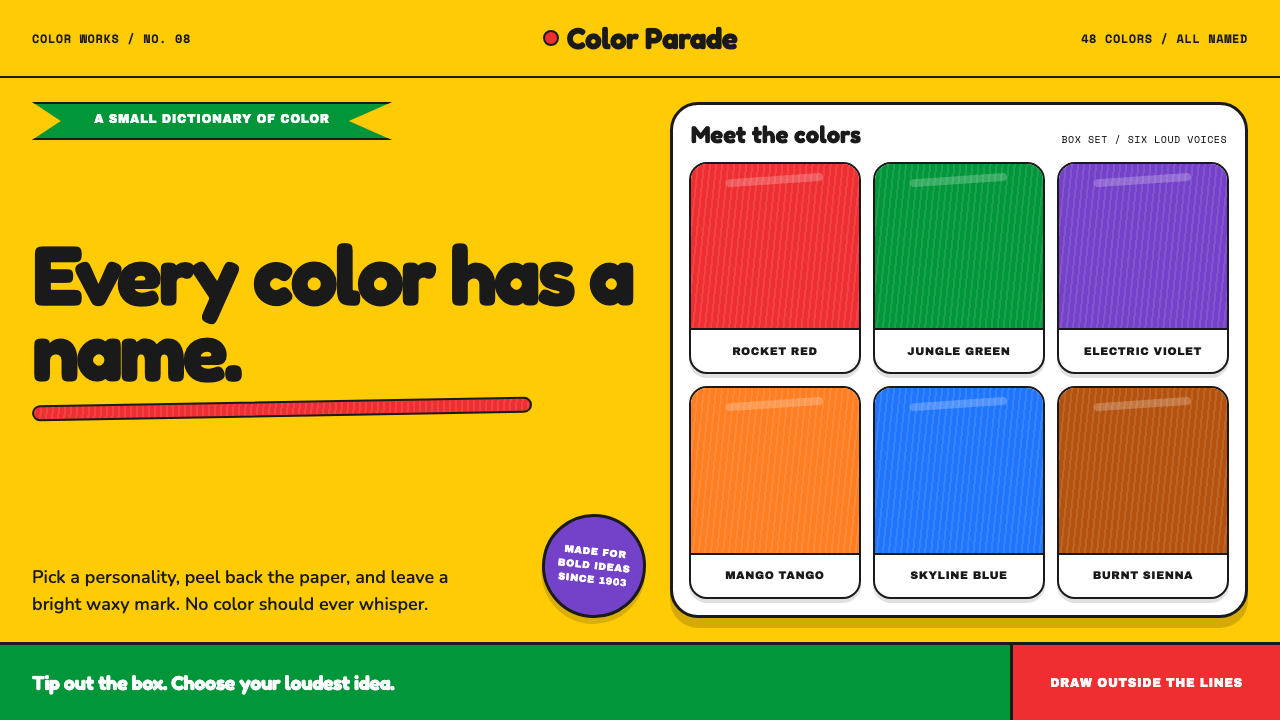 Crayola (1903)Color never whispers. Golden yellow, a green slash, and waxy swatches make ev…