What is Looney Tunes (Warner Bros.)?
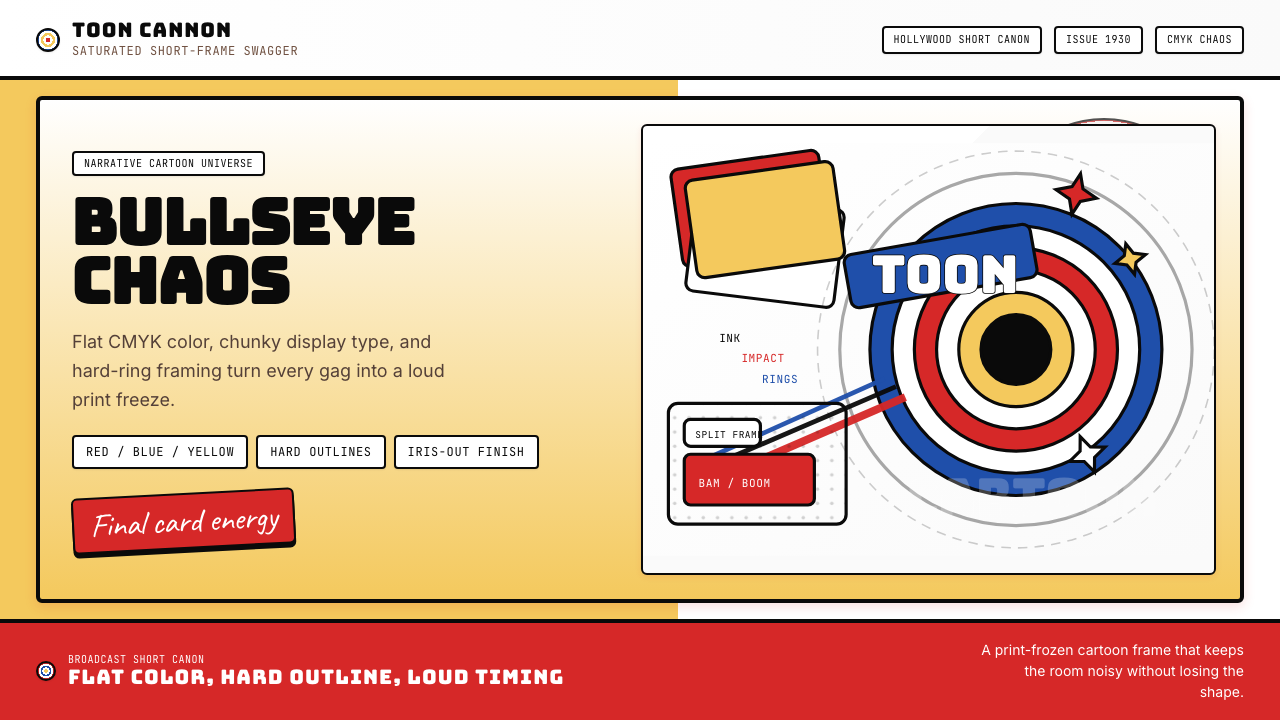
Looney Tunes weaponized cartoon chaos into a design language — bull's-eye rings, bungee-bold type, and CMYK-primary color blocks that feel like a 1940s Warner Bros. short frozen mid-gag.
Looney Tunes (Warner Bros.) in brief
Looney Tunes is the visual universe born from Warner Bros.' animated short film series, which began production in 1930 in Hollywood. At its commercial and artistic peak through the 1940s and 1950s, the studio produced hundreds of short films featuring characters including Bugs Bunny, Daffy Duck, Porky Pig, Tweety, Sylvester, and the Road Runner. The aesthetic that emerged from those films — saturated cartoon-primary colors, chunky display letterforms, dynamic action lines, concentric bull's-eye rings, and flat color fills without shadow or texture — became one of the most recognizable visual signatures in American popular culture.
Where Bauhaus reduced design to geometry and function, Looney Tunes maximized it for entertainment and impact. The guiding logic is exaggeration rather than restraint: colors pushed to maximum saturation, type treated as a physical object capable of stretching or bouncing, shapes simplified into bold readable silhouettes, and every compositional decision oriented toward immediate visceral recognition. The result is a design language that communicates energy, comedy, and speed at a glance.
As a contemporary design style, Looney Tunes draws directly on that mid-century animated frame — its palette of hot red, cobalt blue, and hot yellow against pure white or dense black, its circus-poster confidence with letterforms, and its complete indifference to subtlety. It is unambiguously populist: this is design that wants to be seen across a movie theater lobby, on the side of a lunch box, or in the corner of a television screen.

Where does Looney Tunes (Warner Bros.) come from?
Warner Bros. launched its animation division in 1930, initially as a vehicle to produce musical shorts that could showcase its record-label catalogue — the 'Looney Tunes' name itself was a direct parody of Disney's 'Silly Symphonies.' The early shorts were produced cheaply and quickly, with a house style that leaned on bold outlines, flat fills, and limited palettes that could survive the reproduction constraints of early theatrical printing and movie-poster lithography. These production realities shaped the aesthetic from the beginning: what looked good on a 1930s lobby card needed to be high-contrast, color-blocked, and immediately legible from a distance.
Through the late 1930s and into the 1940s, the studio assembled the group of directors — Chuck Jones, Friz Freleng, and Tex Avery — who defined the style's visual and comedic maturity. Avery in particular pushed the visual language toward hyperbole: characters whose eyes would fly out of their heads, whose bodies would flatten under anvils and immediately re-inflate, whose physical distress was drawn with swooping speed lines and explosive starbursts. Jones brought a more architectural sense of composition — his frames are notably balanced even in their chaos, with strong horizontal staging and carefully controlled pacing. Freleng contributed a musical sense of timing that synchronized visual gags with orchestral accents, reinforcing the style's relationship between rhythm and image.
The voice performances of Mel Blanc — who voiced virtually every major character from Bugs Bunny to Daffy Duck to Porky Pig — gave the series a sonic identity that reinforced its visual one. Blanc's exaggerated, distinctly urban American vocal characterizations matched the visual exaggeration: nothing was underplayed. The iconic closing bull's-eye sequence — concentric pink and white rings irising in to reveal Porky Pig's stuttering sign-off 'Th-Th-Th-That's all folks!' — became the series' visual trademark, and it is from this motif that much of the contemporary design language derives its most distinctive single element.
The Looney Tunes visual vocabulary was consolidated and broadcast internationally through television syndication beginning in the 1950s and accelerating through the 1960s and 1970s. Merchandise, promotional materials, and licensed products extended the aesthetic into print, packaging, and retail across decades. By the time Warner Bros. began systematically licensing the style for brand extensions and theme parks in the 1980s and 1990s, the core visual grammar — saturated CMYK primaries, bull's-eye rings, chunky bungee letterforms, explosive action marks — had become stable enough to function as a coherent design system applicable far beyond animated film.
What defines the Looney Tunes (Warner Bros.) look?
Color
The palette is built from the four pure CMYK printing primaries — red, cobalt blue, hot yellow, and pure white — used at full saturation with no dilution, no pastels, and no neutrals beyond black and white. Color blocking is the fundamental compositional strategy: large flat fields of a single hue are placed against each other or against white without gradation. The colors do not mix; they collide. Black is used heavily for outlines and structural containment — every colored form is bounded by a thick ink line, a convention borrowed directly from commercial lithography and comic-book printing.
Typography
Letterforms in the Looney Tunes idiom are chunky, rounded, and physically assertive — the style sometimes called 'bungee' in contemporary design, after the visual sense that letters are stretched or compressed under pressure. Type is treated as a drawn object rather than a typeset element: characters may bulge, lean, arc across a curve, or be outlined with a thick stroke that makes them readable against any background. Scale contrast is extreme — display type is often many times larger than any supporting text, functioning more like a graphic element than a communication device.
The Bull's-Eye Ring
The concentric ring motif — derived from the closing iris of the 'That's all folks!' end card — is the Looney Tunes style's most singular graphic element. Typically rendered in alternating pink and white (or red and white, or black and white), the rings function as a frame, a focal point, and a brand signature simultaneously. In contemporary applications the motif is used as a containing shape for portraiture, as a background pattern, or as a compositional anchor that draws the eye to a central point. Its circular geometry provides a strong contrast against the otherwise angular or chaotic compositions typical of the style.
Action Marks and Speed Lines
Motion in the Looney Tunes visual language is always visible: speed lines sweep behind a running figure, starburst explosions mark moments of impact, and motion blur arcs indicate the path of a thrown object. These graphic conventions were developed in the animation cels themselves and passed directly into print design and merchandise. As design elements they function as energy amplifiers — placed around text or objects, they convey velocity, impact, and comic-book dynamism. They are almost always black, drawn with variable line weight from thick at the source to thin at the terminus.
Flat Fills and Zero Gradients
Every colored area in the canonical Looney Tunes style is a flat, unmodulated fill — the same color from edge to edge, with no shading, no highlight, and no shadow that is not itself a distinct flat shape of a different color. This flatness is a direct inheritance from cel animation, where each color on a character was a separate painted layer requiring physical separation. The result is a graphic system of hard-edged color areas that reads at any scale and at any reproduction fidelity, from a cel frame to a printed shopping bag to a full-size theme park banner.
Outline and Containment
Unlike Bauhaus, which relies on the geometric edge of a shape to define its boundary, Looney Tunes outlines virtually everything. Thick black contour lines wrap characters, lettering, graphic elements, and even color blocks. The outline weight is generous and consistent, functioning as a visual glue that unifies the composition across color contrasts. This convention also ensures legibility: any color reads against any other color when separated by a black line, which gives the style a structural flexibility that allows it to combine colors that would otherwise clash violently.
Exaggeration as Principle
If the Bauhaus principle is restraint, the Looney Tunes principle is amplification. Every design decision leans toward more: more contrast, more saturation, more scale difference, more graphic density. This is not carelessness — it is a deliberate commitment to the visual logic of comedic exaggeration, which requires that every element be pushed past the point of naturalism to the point of instant legibility. The style works because exaggeration, at this register, becomes its own form of clarity: there is no ambiguity about what the composition is communicating.

Who shaped Looney Tunes (Warner Bros.)?
Jones directed over three hundred Looney Tunes and Merrie Melodies shorts between 1938 and 1962, and is widely credited with bringing compositional sophistication to the series. His cartoons — including the Road Runner and Wile E. Coyote series, Rabbit of Seville, and What's Opera Doc? — are distinguished by a precise sense of staging, timing, and graphic economy. Jones understood that restraint in a character's stillness made the subsequent explosion of movement more readable, a principle that translates directly into design: the negative space in a Looney Tunes composition is as deliberate as any filled area.
Avery joined the Warners animation unit in 1935 and is credited with developing Bugs Bunny's irreverent, fourth-wall-breaking personality, though he directed many of those early formative shorts at a different studio. His defining contribution to the visual language was the grammar of hyperbolic reaction: eyes that pop from the skull, jaws that drop to the floor, characters who run off a cliff and hang suspended before looking down. These visual conventions — which passed directly into the broader Looney Tunes style vocabulary — are now standard shorthand for exaggeration in design, illustration, and animation across cultural contexts.
Freleng was one of the studio's earliest and longest-serving directors, working on the series from the early 1930s through the 1960s and returning in later revival efforts. His cartoons are notable for their musical sophistication — he came from a background as a musician and synchronized visual gags to orchestral arrangements with unusual precision. He is responsible for establishing many of the recurring visual relationships between characters, particularly Tweety and Sylvester, that became central to the series' brand identity. His timing-driven approach influenced how the style uses rhythm — beats, pauses, and accents — as a compositional tool.
Known as the 'Man of a Thousand Voices,' Blanc was the primary voice actor for virtually every major Looney Tunes character from the late 1930s until his death in 1989. His vocal creations — the Brooklyn-inflected cool of Bugs Bunny, the sputtering aggression of Daffy Duck, the gentle stutter of Porky Pig — gave each character a sonic identity that reinforced its visual design. Blanc's work demonstrates how the Looney Tunes style is not purely visual: the exaggeration principle extends to every sensory channel. His voice work was so definitive that it influenced how subsequent designers conceived the characters as total identity systems rather than purely graphic ones.
Clampett directed at Warners from 1937 to 1946 and is credited with some of the most formally adventurous cartoons in the series' history. His films pushed character design toward maximum distortion — figures that could warp, stretch, and multiply in ways that challenged any stable sense of an agreed visual form. This radical mutability influenced the way contemporary designers understand the Looney Tunes style as inherently flexible: the characters and motifs are not fixed icons but elastic systems that can absorb transformation and still be recognized. His work represents the full-throttle outer limit of what the visual language can do.
How do you use Looney Tunes (Warner Bros.) today?
Looney Tunes is among the most energetic and immediately communicative styles available to contemporary designers, but it requires discipline precisely because its loudness is a feature rather than a flaw. Applying it correctly means understanding that the exaggeration is systematic: every design decision — color, type scale, line weight, compositional density — should be calibrated to the same register of amplification, not mixed with quieter approaches that will simply look incomplete rather than balanced.
For presentation slides, the style excels at cover pages, section dividers, and high-impact announcement moments where the goal is immediate engagement rather than information density. A cover built in this style uses the bull's-eye ring as a structural frame or focal element, bold bungee-style type at very large scale, and a palette of two or three solid primaries against white or black. Content slides are harder to execute well: keep the design's energy primarily in the headings and accent elements, and give the body content a quieter container — a clean white panel with black text — so the eye has a resting point. Data visualizations benefit from the flat color and bold outlines: bar charts become graphic objects in their own right when rendered with thick strokes and solid primary fills, and category labels can use the display lettering style without compromising legibility.
For web interfaces, the style is particularly well-suited to entertainment platforms, gaming products, children's services, and consumer-facing applications where personality and delight are product values. Dashboards built in this idiom should use the primary palette for interactive states and metric highlights, with a white or very light background for reading areas. Pricing pages work with the style's poster-like boldness — tier cards can use full-color fills with white reversed type, separated by the characteristic thick black outlines. Navigation and wayfinding benefit from the style's strong typographic character: wordmarks and section labels in display-style letterforms, with active states indicated by color fills rather than subtle underlines.
For editorial and marketing applications, the style's natural territory is anywhere that wants to be noticed first. Print and digital advertising, event promotional materials, social media assets, and packaging all benefit from the full-saturation palette and graphic boldness. A common and effective approach is to use the concentric ring motif as a containing shape for a hero image or product shot, framed by large display type and flanked by action marks. Marketing pages can alternate between bold full-color sections and clean white reading sections, using the primary palette for calls to action and the display type for headings. The style adapts well to seasonal and campaign contexts where the visual energy can shift without losing brand recognition.
A common mistake when applying this style is treating it as an excuse for visual chaos — piling on every motif simultaneously and assuming that more is always better. In the original animated films, the chaos was rigorously choreographed: every exaggerated element appeared in a specific sequence, at a specific scale, for a specific duration. The same discipline applies in design. Choose one or two of the signature elements per composition — the rings, or the speed lines, or the bungee type, not all three at once — and give each enough space to read clearly. A second common error is using the palette timidly: half-saturated versions of the primaries read as neither the Looney Tunes style nor anything else, landing in an uncertain middle ground that loses the style's entire communicative power. Commit fully or choose a different approach.

Looney Tunes (Warner Bros.) — FAQ
How is Looney Tunes different from other retro cartoon styles like 1930s rubber-hose animation?
Rubber-hose animation — exemplified by early Fleischer and Disney shorts — is characterized by limbless, boneless characters with fluid, looping movement and rounded, organic forms. Its color palette was typically limited and often pastel. Looney Tunes, by contrast, is harder-edged, more primary in its color use, and more graphically confrontational. Characters have defined anatomy (even if exaggerated), compositions are more aggressive, and the black outline is heavier and more structural. Rubber-hose reads as gentle and whimsical; Looney Tunes reads as anarchic and urban. They share a mid-century American cartoon origin but communicate very different emotional registers.
Can Looney Tunes work for professional or corporate contexts, or is it always casual?
The style is inherently populist and energetic rather than authoritative, so it carries a strong casual signal by default. However, there are professional contexts where this is exactly the right register: gaming companies, entertainment platforms, children's educational products, sports brands, and consumer packaged goods all regularly commission work in this visual territory without it feeling inappropriate. The question is not whether the style is 'professional' but whether its values — exuberance, approachability, humor, boldness — align with the product's values. A cybersecurity firm or a private bank would likely find the style a mismatch; a casual dining chain or an esports platform would not.
How do I use the bull's-eye ring without it feeling like a Warner Bros. trademark violation?
The concentric ring as a geometric motif predates Looney Tunes — it appears in target graphics, circus imagery, and Victorian decorative arts. What makes the specific Looney Tunes variant distinctive is the combination of the motif with the specific pink-and-white alternating color palette, the Porky Pig figure at center, and the 'That's all folks!' logotype. Using concentric rings in your own color palette, at your own proportions, without the character or the specific logotype, is well within the territory of working with a geometric motif rather than reproducing a trademark. The further you move the color palette and proportions from the canonical version, the more clearly the design becomes a reference rather than a reproduction.
What digital contexts work best for this style, and where does it fall flat?
The style performs best in contexts with short dwell times and high competition for attention: social media assets, app store screenshots, landing page heroes, push notification thumbnails, and email headers. These are contexts where the style's fundamental promise — immediate, high-contrast legibility at any scale — is exactly what is needed. It performs poorly in contexts requiring extended reading, fine information hierarchy, or sustained emotional intimacy: long-form article layouts, mental health or wellness applications, financial reporting interfaces, or any product where the user experience depends on calm and trust. The style has no middle ground; it is either the right choice or the wrong one depending on the emotional contract the product is trying to establish.
How does this style handle dark mode or dark backgrounds?
The canonical Looney Tunes palette is light-ground — the animation cels were painted on transparent acetate that, when filmed, produced a white or colored background behind the characters. A dark inversion is entirely viable and has strong precedent in the style's own history: nighttime sequences, outer-space settings, and certain character introductions all used deep backgrounds against which the saturated primaries read with even more intensity. On a black or very dark background, the yellow and white elements become the dominant compositional anchors, and the thick black outlines need to be replaced with white or a contrasting color outline. The essential requirement in a dark version is to preserve the hard edges and full saturation — soft shadows and low-contrast pastels on dark backgrounds are the antithesis of this style's logic.
Related design styles
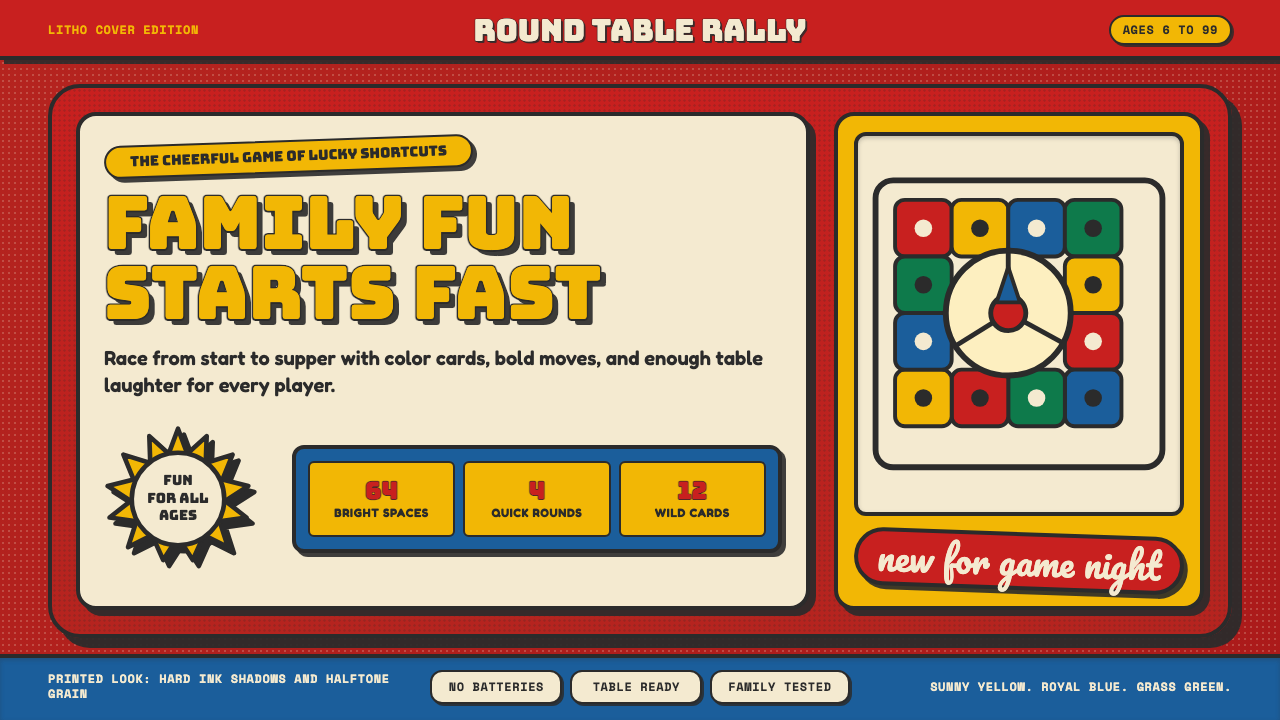 Vintage Board Game BoxShelf appeal shouts. Fire-engine red, Bungee lockups, yellow bursts, and ink…
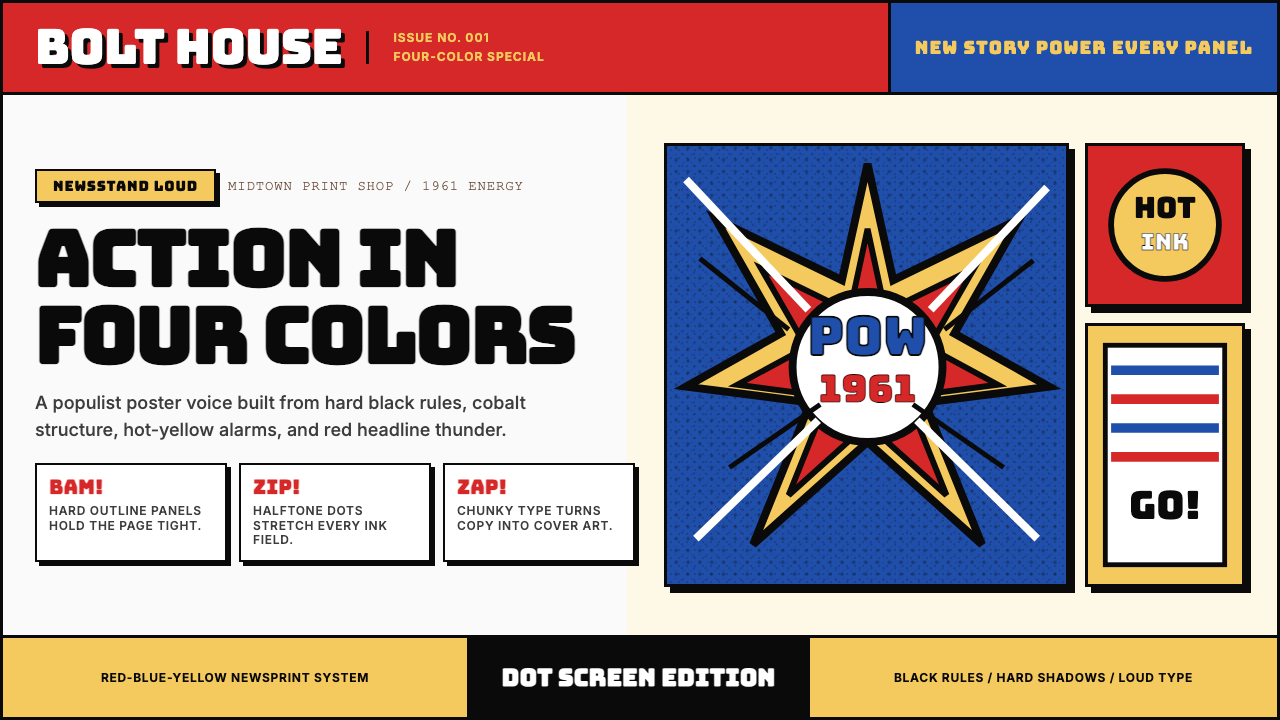 Marvel Comics (Kirby Era)Populist color hits hard. Red-blue-yellow panels, black rules, and halftone d…
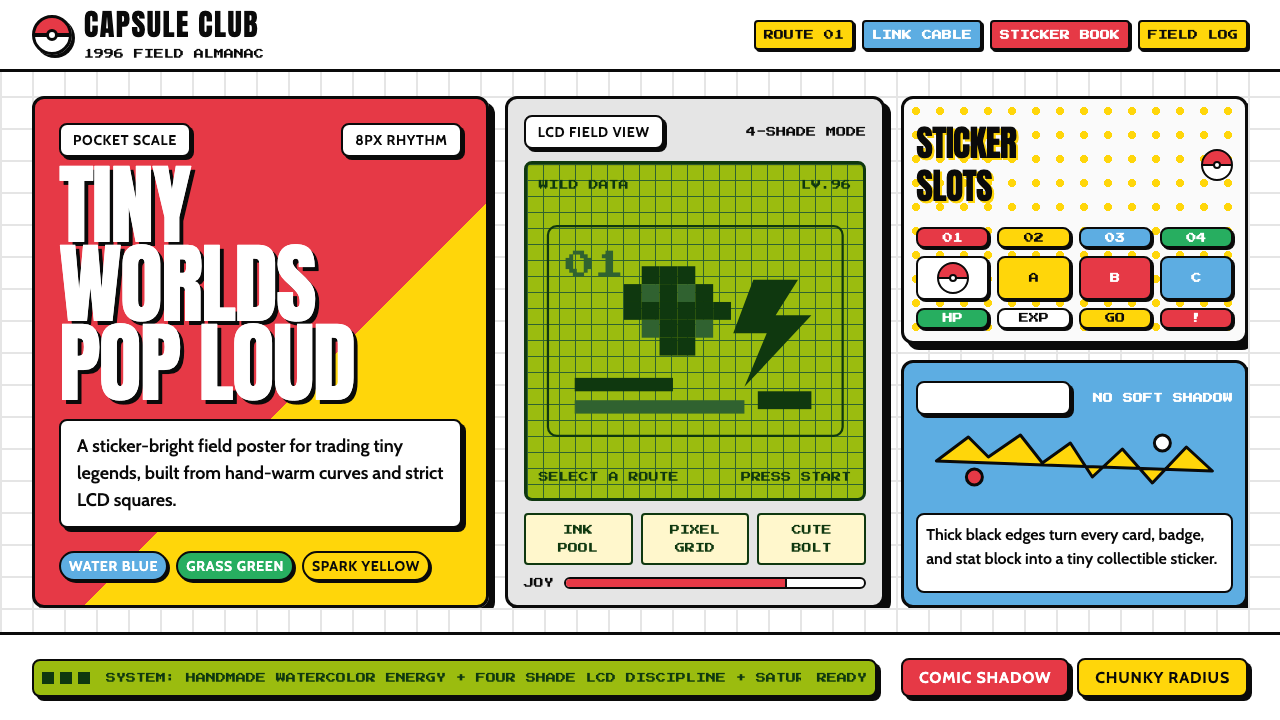 Pokémon Game BoyKawaii meets cartridge logic. Capsule red, LCD green, Anton heft, and 8px gri…
 SpongeBob Bikini Bottom (1999)Undersea suburbia shouts with joy. Banana yellow and cyan bounce inside fat,…
 Atari 2600 (Woodgrain)Woodgrain meets raw pixels. Walnut panels frame Bungee type and CMYK raster b…
 Converse Chuck TaylorPopulist and loud. Saturated red circles, Bungee type, black stitch lines on…