What is Marvel Comics (Kirby Era)?
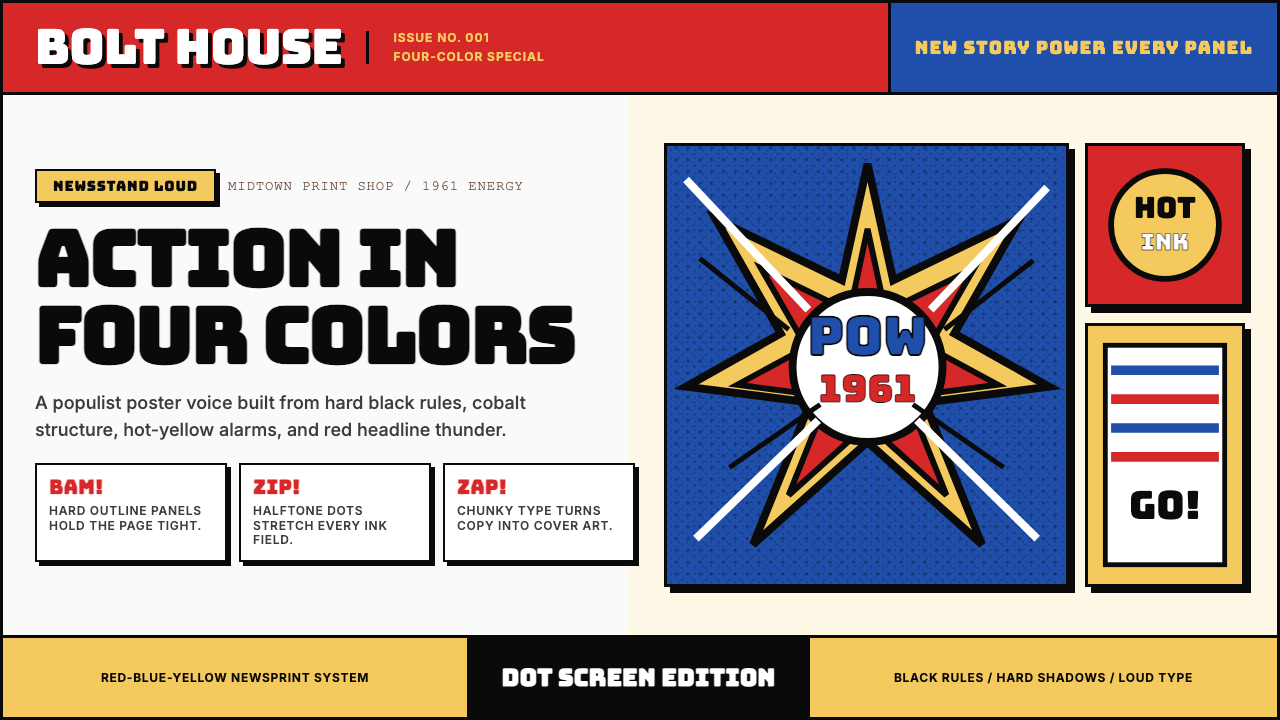
Jack Kirby's Silver Age Marvel turned four-color newsprint into a kinetic mythology — saturated primaries, explosive action lines, and a thunder-god boldness that redefined what American popular imagery could be.
Marvel Comics (Kirby Era) in brief
Marvel Comics' Kirby Era aesthetic is the visual grammar of the American Silver Age superhero — a bold, populist design system born in the early 1960s from the collision of limited four-color printing, deadline-driven storytelling, and Jack Kirby's irrepressible graphic instinct. The palette is built on saturated primary red, cobalt blue, and luminous yellow laid onto white newsprint, mediated through the dot-screen halftone process that gave every color a characteristic grain and warmth. Black ink defines everything: panel borders, figure outlines, and the heavy display lettering that headlines each cover.
What distinguishes Kirby-era Marvel from other comic styles of the period is its sense of kinetic force. Action lines radiate from points of impact, figures are caught mid-leap at the peak of exertion, and panel compositions are rarely static — they angle, they tilt, they burst outward at the reader. The design language communicates urgency before a single word is read. This energy is not accidental; it is a formal system, one in which diagonal composition, compressed panel grids, and the contrast between dense ink and open white space all work together to create forward momentum.
The style is also defined by what it does not do: it does not soften, it does not whisper, it does not recede. Marvel red blazes across the top of every cover as a wordmark; characters in crisis are rendered with maximum expression; color never fades to a tint to create mood. Everything operates at full saturation, full volume, full presence. It is a design system made for the newsstand, for split-second attention, for readers who might flip past thirty competing covers before stopping on the one that reaches out and grabs them.

Where does Marvel Comics (Kirby Era) come from?
The story begins not with a rebrand brief but with a publishing crisis. By the late 1950s, the company then operating as Timely Comics — later Atlas — was on the verge of collapse. Its distributor had failed, and publisher Martin Goodman had slashed the line to a skeleton crew. Into this precarious situation stepped editor and writer Stan Lee, who in 1961 was given loose instructions to try something new. Lee partnered with Jack Kirby, an industry veteran who had already co-created Captain America two decades earlier, and together they produced Fantastic Four #1 — the first issue of the Marvel Age. The visual idiom they established in those pages would define a decade.
Jack Kirby's graphic sensibility had been shaped by years of working within the hard constraints of newsprint production. He understood, intuitively, that colors printed through a dot-screen on cheap paper would shift and muddy if not handled with directness — so he designed for clarity at the limit. His figures are massive and simplified, their musculature exaggerated to read as shape before it reads as anatomy. His panel compositions favor diagonal force lines, explosive negative-space bursts, and sharp geometric contrast between light areas and areas of dense black ink. The 'Kirby Krackle' — clusters of black dots suggesting cosmic energy or raw power — emerged as his signature visual device, a shorthand for forces too large for conventional rendering.
Stan Lee's contribution to the system was tonal and typographic as much as narrative. His voice — exclamatory, inclusive, self-aware — set the register for the cover lettering and caption boxes that frame every image. Marvel's display lettering is bold and rounded, a comic-book tradition that Lee and letterer Artie Simek pushed to maximal impact: words like 'DOOM' or 'MARVEL' fill their allotted space completely, leaving no visual slack. The Marvel wordmark itself — red, all-caps, heavy — became an anchor element on every cover, a branding decision that made the entire line instantly recognizable across a cluttered newsstand.
The Silver Age coincided with the full maturation of the CMYK offset printing process for mass-market comic books. Colorists working within a restricted palette of flat tones — the Ben-Day dot system allowed only a limited number of hue and value combinations — developed instinctive strategies for making those constraints produce drama rather than limitation. Sky blue behind a red figure on a yellow ground creates a primary triad of maximum simultaneous contrast. These are not accidental color decisions; they are the accumulated craft knowledge of an industry that had spent three decades learning how to make cheap printing look spectacular.
The Kirby Era's influence radiated far beyond comics. By the late 1960s, its visual language had been absorbed by underground poster art, record cover design, and the broader vernacular of American popular culture. When Marvel Studios began adapting the characters into film in the 2000s, design teams reached back to the Silver Age aesthetic as a touchstone for marketing materials, title sequences, and visual identity — ensuring that a graphic system born in a Manhattan editorial office in 1961 remained legible and potent more than six decades later.
What defines the Marvel Comics (Kirby Era) look?
Saturated Primary Palette
The Kirby Era palette is built entirely on the primary triad — red, blue, and yellow — deployed at full saturation with no softening to pastels or mid-tones. White newsprint serves as the fourth element, providing breathing room and allowing colors to operate at maximum intensity against each other. Black is not a neutral but an active structural color, used for heavy outlines, panel borders, and areas of deep shadow that anchor the composition. The effect is one of simultaneous contrast: the eye is continuously activated by colors fighting for dominance, which reads as energy and urgency.
Halftone Dot Texture
Every color area in Silver Age Marvel printing is composed of a pattern of small dots rather than a solid fill — the artifact of the Ben-Day halftone process used in mass-market newsprint production. This dot screen gives flesh tones their warm grain, skies their vibrating quality, and shadows their atmospheric depth. Applied deliberately as a design element today, the halftone pattern signals an era, a production method, and a particular kind of democratic, low-cost beauty. It is the visual equivalent of vinyl crackle — an imperfection that became a character.
Kinetic Composition and Action Lines
Kirby-era layouts reject the static rectangle. Figures burst through panel borders, compositions tilt at dramatic angles, and radial action lines emanate from points of impact to communicate speed, force, and explosion. The 'Kirby Krackle' — dense clusters of irregularly sized black dots — represents energy fields, cosmic power, or raw impact in a way that photorealistic rendering could never achieve. Even typography participates in the kinetics: sound-effect lettering ('KRAKOOM', 'THOOM') is treated as an illustration element, warping and scaling to match the energy of the action it describes.
Heavy Display Lettering
The lettering tradition of Silver Age Marvel is characterized by thick-stroked, rounded sans-serif capital letters that fill their space completely. Cover headlines leave no visual slack; the title of a story or the name of a character is set as large as legibility permits, then larger still. Caption boxes and speech balloons use a slightly lighter weight but maintain the same rounded, hand-crafted character. The Marvel wordmark — blocky, red, all-caps — appears as an indelible anchor at the top of every cover, establishing brand identity before any other visual element registers.
Exaggerated Heroic Figure
Human and superhuman figures in the Kirby tradition are anatomically exaggerated toward clarity and expressiveness rather than realism. Musculature reads as simplified geometric mass — a shoulder is a sphere, a forearm a cylinder, a fist a compact block. Poses are chosen for maximum symbolic legibility: the triumphant figure stands wide, the villain looms large and dark, the crowd cowers small. These are ideographic gestures, readable at reduced scale on a rotating newsstand rack, that carry the narrative argument of an entire issue in a single frozen image.
Panel Grid as Narrative Engine
The panel grid in Silver Age Marvel is not merely a container for images — it is a timing device and a pacing mechanism. Pages typically organize into four to six panels with clear left-to-right, top-to-bottom reading order, but Kirby frequently broke this convention with splash pages, half-page compositions, and panels that bleed into each other at climactic moments. The grid compresses time: a rapid sequence of small panels accelerates pace, while a single large image arrests it. The interplay between gridded regularity and deliberate breaks from the grid is where much of the style's dramatic energy lives.
Populist Boldness
The Kirby Era aesthetic is constitutively anti-precious. It does not whisper refinement or suggest taste through restraint — it announces itself. The design language was optimized for readers who might encounter it in a spinning rack at a corner store, in a barbershop waiting area, or being passed among children on a school bus. Every visual decision — the screaming red, the oversized type, the maximum-contrast color blocking — is calibrated for a democratic, distracted, mass audience. This is not a limitation of the style; it is the source of its power and its enduring legibility.

Who shaped Marvel Comics (Kirby Era)?
Jack Kirby is the central visual architect of the Marvel Silver Age. Born Jacob Kurtzberg in New York in 1917, he co-created Captain America for Timely Comics in 1941 before producing the foundational Marvel output of the 1960s alongside Stan Lee: Fantastic Four, Thor, the Avengers, the X-Men, and Black Panther, among many others. His visual innovations — the Kirby Krackle, explosive panel compositions, the massive simplified figure style — became the visual standard for the American superhero genre. His later work at DC Comics produced the Fourth World mythology, which extended his cosmic visual language into entirely new territory. Kirby remains the single most influential draftsman in the history of superhero comics.
Stan Lee's contribution to the Kirby Era Marvel aesthetic was as much tonal and typographic as it was narrative. As editor and writer, he developed the Marvel voice — exclamatory, self-referential, inclusive, always in direct address to the reader — that shaped everything from cover headline lettering to caption box prose. His editorial instinct for maximum impact calibrated the size and weight of display type, the density of cover copy, and the balance between image and text. The 'Stan Lee Presents' box, the hyperbolic cover blurbs, and the letters pages he wrote and curated were as much part of the visual system as Kirby's linework.
Steve Ditko co-created Spider-Man and Doctor Strange with Stan Lee, contributing a visual approach that complemented and contrasted with Kirby's heroic monumentalism. Where Kirby's figures were massive and simplified, Ditko's were more angular, neurotic, and expressionistically distorted — particularly in the hallucinatory Doctor Strange sequences, where reality itself warped into impossible geometries. Ditko's work expanded the Marvel visual vocabulary beyond the pure action idiom into psychological and surreal territory, demonstrating that the four-color system was capable of more registers than pure kinetic energy.
Artie Simek was the primary letterer on Marvel's most significant Silver Age titles, and his contribution to the visual system is often underestimated. Lettering in the Kirby Era is not a neutral support function — it is a design element that must integrate with figure composition, panel rhythm, and cover hierarchy. Simek's rounded, pressure-sensitive hand lettering set the tonal register for the entire line: his sound effects are illustrations in their own right, his caption boxes carry visual weight, and his balloon placement guides the reading eye through dense action sequences. The consistency of his lettering across hundreds of issues gave the Marvel line its graphic coherence.
Don Heck was a key illustrator during the early Silver Age, co-creating Iron Man and the Wasp with Stan Lee and serving as a primary artist on early Avengers issues. His style was somewhat more realistic and less explosively kinetic than Kirby's, providing a different register within the Marvel visual system — demonstrating that the Kirby Era palette and panel conventions were not solely dependent on one artist's approach but constituted a shared grammar that multiple hands could speak. Heck's work illustrates how the Marvel house style was not monolithic but a flexible framework held together by color, lettering, and panel grid conventions rather than a single drawing style.
How do you use Marvel Comics (Kirby Era) today?
The Kirby Era Marvel aesthetic is among the most legible and transferable of any twentieth-century popular visual style, precisely because it was designed for maximum impact across degraded media conditions. Applying it to contemporary work requires understanding its underlying logic — primary color at full saturation, heavy black outlines, bold display type, kinetic composition — rather than simply adding dot-screen texture as a surface effect. Texture without structure produces nostalgia; structure without texture produces a pastiché that reads as generic retro. The two must work together.
For presentation slides, the style performs exceptionally well on cover pages and section openers. A cover built on this idiom uses a full-bleed background in one saturated primary, a white or contrasting-primary title treatment in the heaviest available display weight, and a single dominant illustration or graphic element that operates at the scale of the entire slide. Content slides are best treated as panel compositions: a strong typographic hierarchy with a very large leading number or label, dense body information in a clearly defined column, and a ruled border or bold color stripe that signals the slide's position in the deck's sequence. Data visualizations take on the quality of infographic panels — bar charts in pure primaries on white, with black axis labels and bold numeric callouts.
For web interfaces, the aesthetic suits applications where authority and excitement are both required — marketing landing pages, product launch announcements, event sites, and brand identity systems for entertainment, sports, or media companies. The approach requires committing to a restricted palette: one dominant primary as the brand color, black for all structural and typographic elements, white as the primary background, and a second primary held in reserve for interaction states or strong calls to action. Hard-bordered card components replace soft shadows; bold sectional dividers replace subtle separators. Navigation benefits from the Marvel convention of typographic boldness — wordmarks and section labels at outsized scale, no decorative icon sets.
For editorial and marketing material — posters, social cards, covers, print ads — the Kirby idiom is naturally suited. A poster built on this system commits to one primary background color, white type at maximum size, and a central illustration rendered in the simplified, exaggerated style characteristic of the period. Marketing emails that use this aesthetic work best when they resist the temptation to soften: full-width color bands in pure primaries, large display type that fills the available container, and a single call-to-action button in a contrasting primary color rather than a ghost button or muted variant. The style's natural rhythm is declarative — it states rather than suggests.
The most common mistake when applying this aesthetic is reaching for it as pure decoration — adding halftone dots to an otherwise conventional layout and calling it done. Authentic application requires adopting the structural commitments: primary color only, heavy black outlines on any key graphic element, display type at a scale that feels too large by conventional standards, and a willingness to let bold color areas occupy large portions of the composition without intermediate tones to cushion them. A secondary mistake is using the full primary triad simultaneously at equal weight — Kirby-era covers typically lead with one dominant color and use the others as accents, creating hierarchy rather than competition. Restraint within the bold palette is what separates coherent Kirby-inspired work from visual noise.

Marvel Comics (Kirby Era) — FAQ
Is this style the same as general retro comics, or does it refer to something specific?
It refers to something specific: the visual system produced by Jack Kirby, Stan Lee, and their collaborators at Marvel Comics between approximately 1961 and 1970 — the Silver Age of American superhero comics. It is distinct from the Golden Age style of the 1940s, which used a darker and muddier color palette; from the DC Comics house style of the same period, which was more conservative in composition; and from the underground comix movement of the late 1960s, which used similar printing constraints but for subversive rather than populist ends. When Curio references this style, it means the specific formal system: saturated CMYK primaries, Kirby-dynamics, halftone dot field, and the heavy display lettering of that particular era and publisher.
Can this aesthetic work in a digital product without feeling like costume design?
Yes, but the distinction between structural adoption and costume adoption is crucial. A digital product that uses the Kirby Era's underlying logic — primary-only color system, bold black typographic hierarchy, hard-bordered component structure, high-contrast composition — will read as coherent and purposeful even to users unfamiliar with the reference. A product that applies surface markers — dot-screen texture, speech-bubble UI elements, sound-effect typography — without the underlying structure will read as a theme rather than a language, which limits its usability and longevity. The test is whether the design decisions serve the product's information hierarchy or merely signal the style.
How do I handle the halftone dot pattern — is it period-accurate or a modern approximation?
In original Silver Age Marvel printing, halftone dots were not an artistic choice but a production artifact of the offset printing process. They appear in color areas because flat color on newsprint was produced by printing dots rather than solid ink. Contemporary applications can approximate this effect through various means — dot-pattern overlays, halftone filters, textured color areas — but the goal should be verisimilitude, not literal replication. A slightly irregular, warm-toned dot pattern at the right scale reads as authentic; a perfectly uniform, digitally-precise dot grid reads as retro-kitsch. The dot should feel like it belongs to the printing process, not like it was added after the fact.
Does the Kirby Era style conflict with accessibility standards for color contrast?
Primary red and primary blue on white generally pass contrast requirements for large display text but may fall short for small body text — this is a genuine tension that requires case-by-case handling. The style's heavy reliance on black ink for critical information (outlines, captions, labels) is actually an accessibility asset: black on white or black on primary-yellow produces excellent contrast. Problems arise when red or blue text is used at small sizes on white, or when yellow text appears on a white ground. The practical solution is to reserve pure primary colors for graphical elements, backgrounds, and large-scale display type, while ensuring that all functional text — navigation, labels, body copy — falls on black or near-black against light backgrounds.
What separates a design that genuinely references this era from one that just looks generic superhero?
The difference lies in structural specificity. Generic superhero visual language tends to borrow isolated surface markers — a shield motif, a cape silhouette, a starburst — without adopting the underlying design grammar. Authentic Kirby Era application is identifiable by the convergence of several specific formal decisions: the full-saturation primary palette with no tertiary colors, heavy black outlines on all graphical elements at consistent weight, display type at a scale that dominates the composition rather than decorating it, panel or grid structure that creates genuine reading sequence, and composition that prioritizes kinetic diagonal force over static balance. When all of these operate together, the result is unmistakably specific; when only one or two are present, the result is superficial.
Related design styles
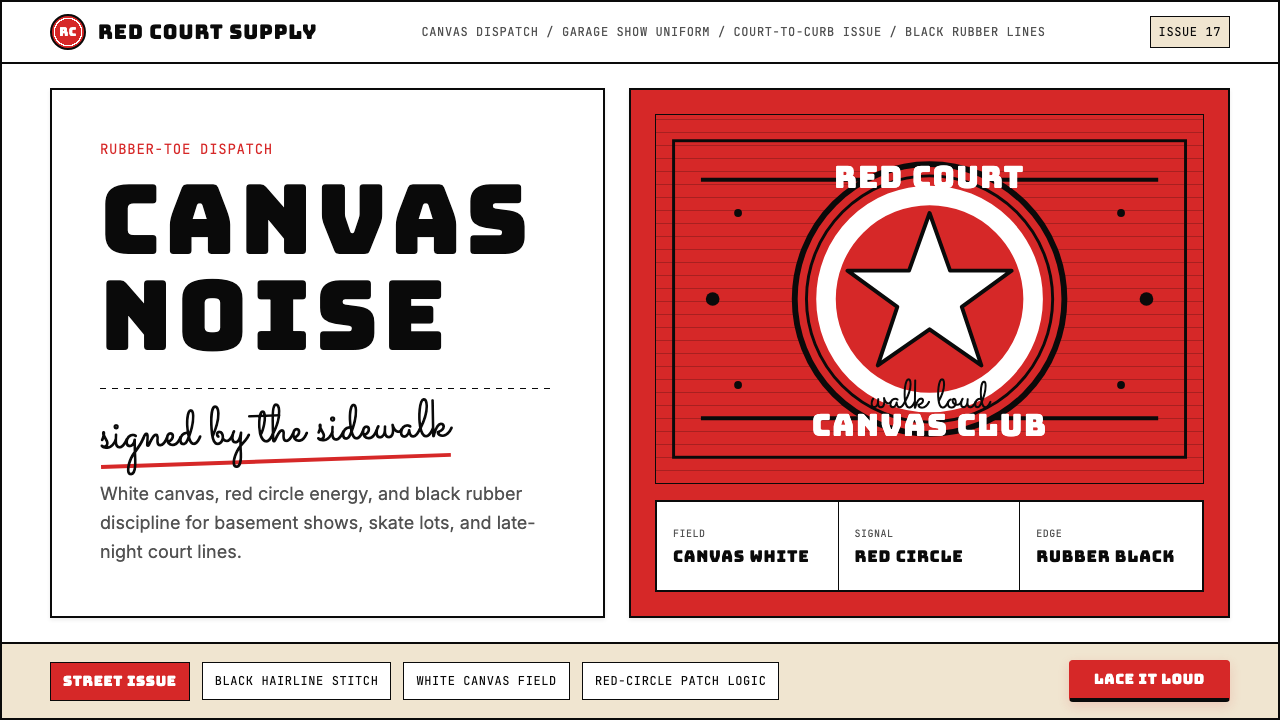 Converse Chuck TaylorPopulist and loud. Saturated red circles, Bungee type, black stitch lines on…
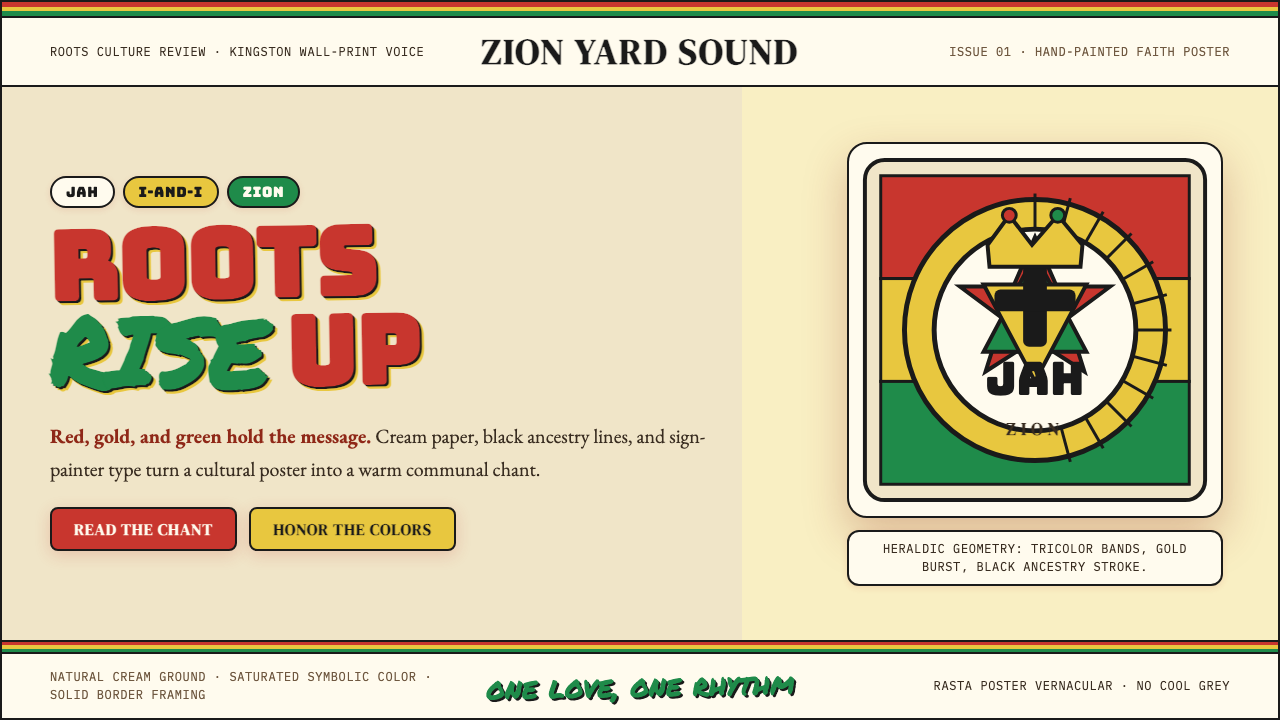 Caribbean Rastafarian (Jamaica)Warm faith, loud color. Red-gold-green bands and black poster type carry the…
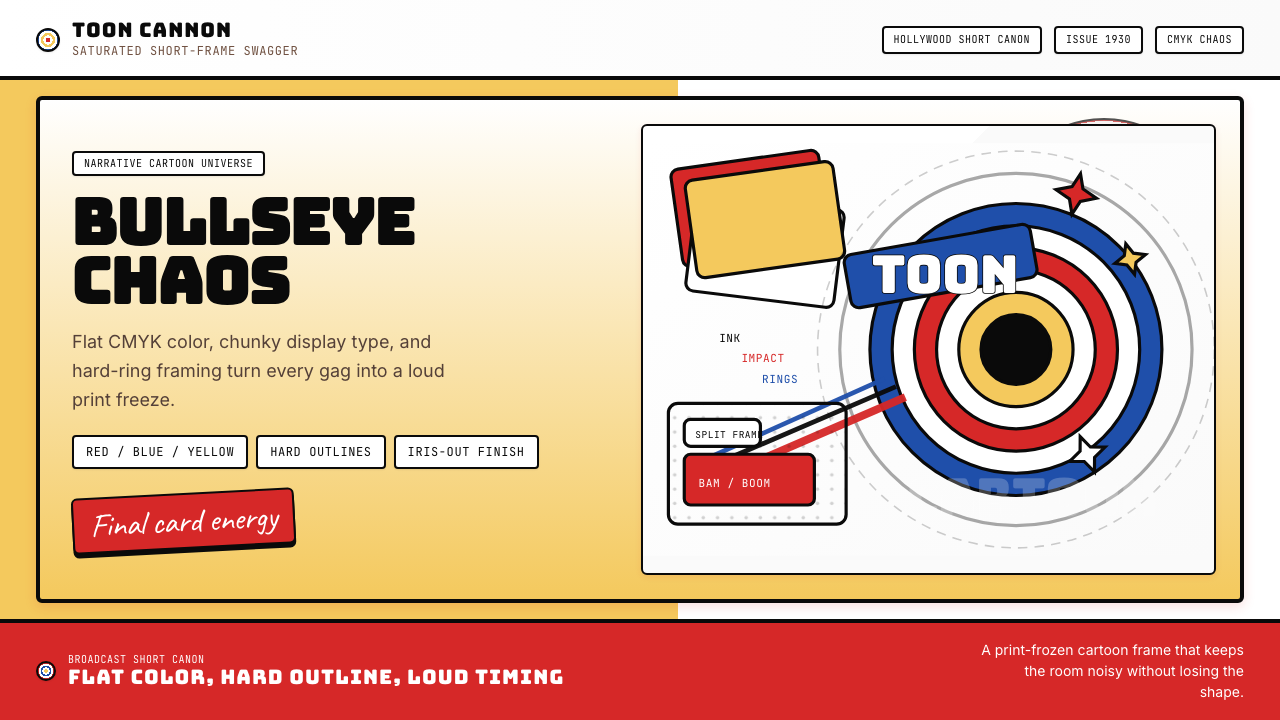 Looney Tunes (Warner Bros.)Pure cartoon chaos. Bull's-eye rings, Bungee type, and red-blue-yellow blocks.
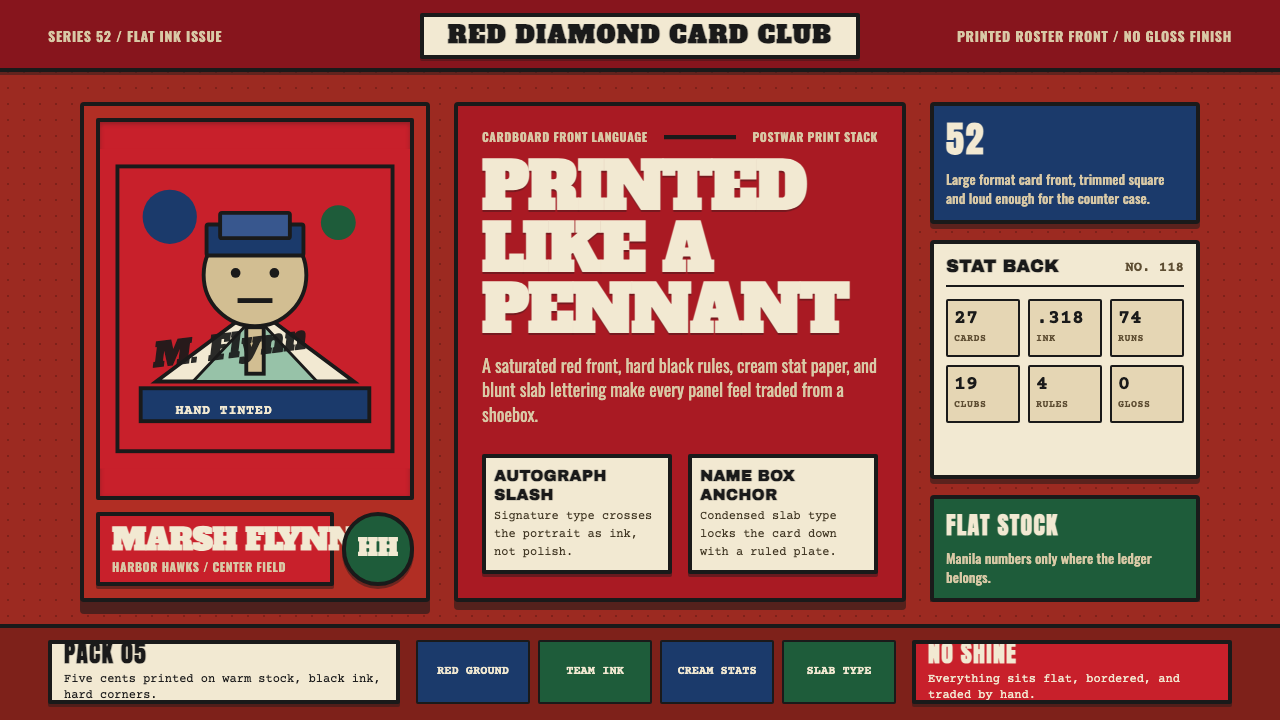 Topps Baseball CardCardboard heat. Brick-red slab panels, cream stats, and condensed type feel p…
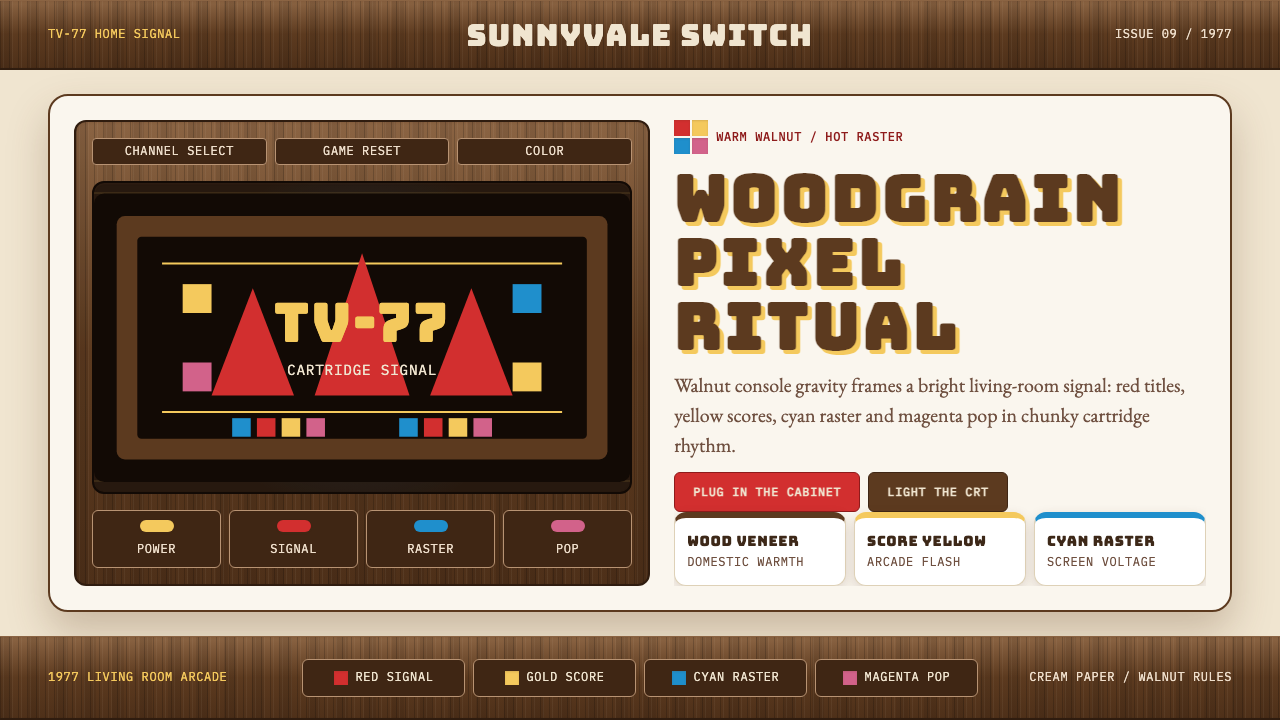 Atari 2600 (Woodgrain)Woodgrain meets raw pixels. Walnut panels frame Bungee type and CMYK raster b…
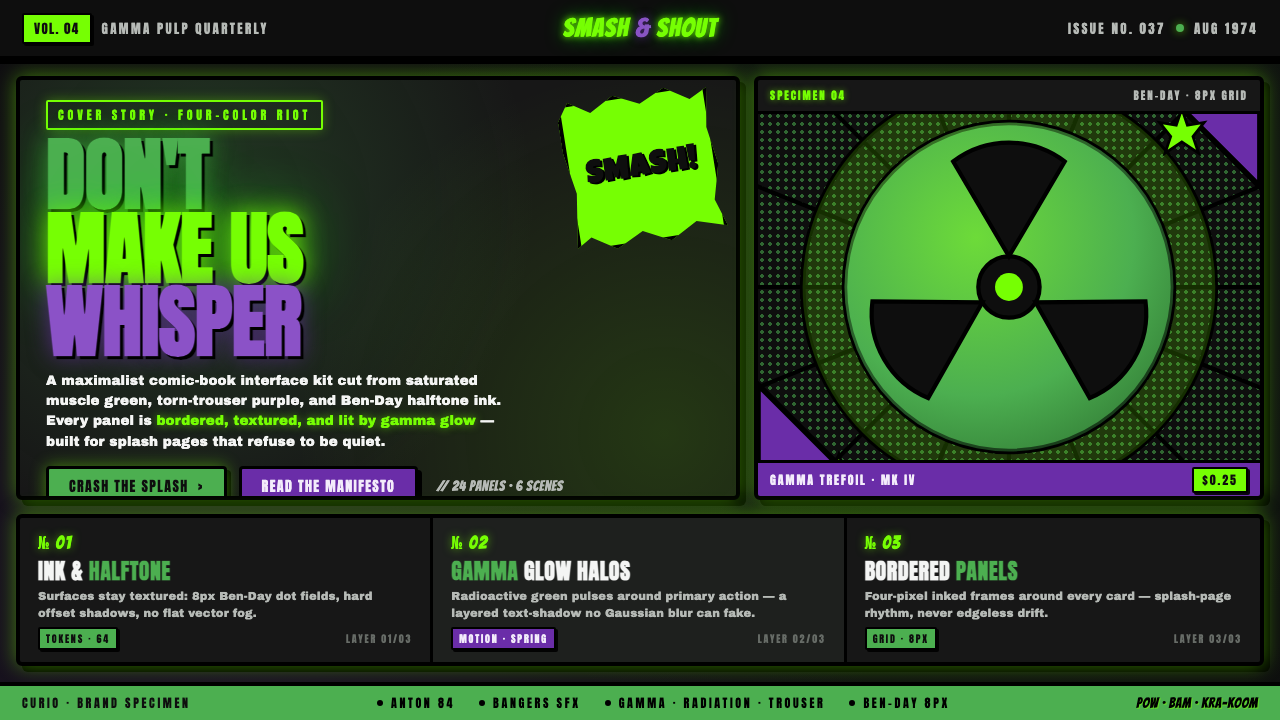 Hulk Gamma GreenDon't make us whisper. Muscle green, trouser purple, inked panels, Ben-Day ha…