What is McDonald's Golden Arches?
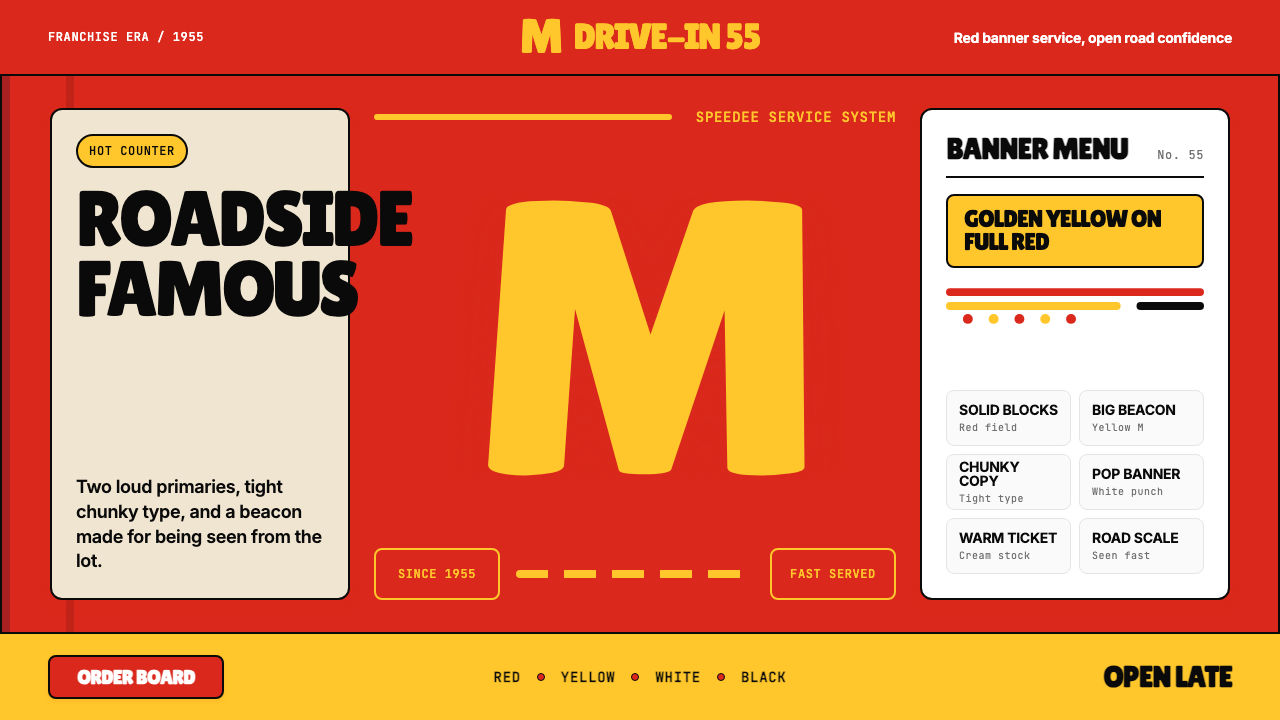
Two colors, one letter, and seventy years of franchise muscle — McDonald's Golden Arches is the most recognizable fast-food visual system ever built.
McDonald's Golden Arches in brief
McDonald's Golden Arches design system is a study in the power of absolute simplicity deployed at industrial scale. Its visual vocabulary is deliberately narrow: a saturated red field, a blazing golden yellow, and a single bold letterform — the M — that doubles as both brand signature and architectural landmark. This is not minimalism for aesthetic fashion; it is minimalism enforced by the operational reality of feeding millions of people a day across thirty-eight thousand locations on six continents.
The system speaks entirely in primary-weight signals. Every element — the red background behind menu boards, the golden arch over the drive-through, the chunky confident type on the exterior signage — is calibrated for maximum legibility at distance and maximum recall under distraction. The design does not ask for the viewer's attention; it commands it. Roadside, in a strip mall, on a highway sign cluster, the golden M resolves before any other surrounding detail does.
What distinguishes the Golden Arches system from other populist brand aesthetics is its consistency across media and scale. The same yellow and red that appear on a paper bag appear on a stadium-scale billboard, a mobile app button, and a sesame-seed-bun product photograph. There is no 'premium' variant and no 'casual' variant — the system is the system. That uniformity is itself the message: predictability, reliability, and the reassurance of knowing exactly what you are getting before you walk through the door.

Where does McDonald's Golden Arches come from?
The story of the Golden Arches begins not in a boardroom but at a burger stand. In 1940, brothers Richard and Maurice McDonald opened their first restaurant in San Bernardino, California. Eight years later, they reinvented it as the Speedee Service System — a kitchen organized like an assembly line, with a limited menu, standardized portions, and prices low enough to attract working families. The first visual identity was rudimentary, built around a cartoon chef named Speedee. The arches themselves appeared not on paper but in architecture: in 1952, the brothers asked designer Stanley Meston to sketch a building concept using a pair of yellow parabolic arches rising from each side of the building — visible from the road, functional as structural supports, and arresting enough to make passing drivers look.
Ray Kroc, a milkshake machine salesman, visited the San Bernardino restaurant in 1954 and recognized immediately what the brothers had built. In 1955 he signed a franchise agreement and opened his own McDonald's in Des Plaines, Illinois — the outlet now considered the founding moment of the modern franchise empire. Kroc's genius was not culinary but operational and visual: he understood that if the system was going to replicate itself across America, every outpost had to look, feel, and taste identical. The arches, the red-and-white tile exterior, the bright lit interior — these were not decoration but operational code, signals to the customer that the deal was the same here as it was a thousand miles away.
The stylized M that consumers recognize today emerged gradually. When the company incorporated the two architectural arches into its logo in the early 1960s, graphic designer Jim Schindler merged the two parabolic arches into a single interlocking M shape — both a legible letter and an abstraction of the building's silhouette. The golden color had already been associated with the arches through the yellow paint of the physical structures; now it became a signature hue with almost mythological status in brand identity circles. By 1968, the Golden Arches M had replaced Speedee as the company's primary mark.
The current visual system — sometimes referred to internally as the Speedee system in homage to the brand's roots, though externally it is simply 'McDonald's' — reached its mature state through a series of refinements in the late twentieth and early twenty-first centuries. A significant modernization in the early 2000s moved the interiors from hard primary-color plastics toward warmer, more contemporary materials, while the exterior signage and brand identity retained the foundational red-and-gold duality. The most recent design cycle, reaching its current form around 2018–2024, reembraced bold color confidence: deeper reds, more saturated yellows, and a typographic voice that reads as assertive and populist rather than corporate-neutral.
What defines the McDonald's Golden Arches look?
Two-Color Dominance
The palette is built on exactly two heroes: a saturated, warm red and a hot, luminous golden yellow. These two hues are deployed in high contrast against each other and against white or cream grounds. No tertiary palette exists in the core system — tertiary colors appear only in food photography and promotional materials, and even there they are suppressed in favor of the two primaries. The narrowness of the palette is a deliberate constraint: it makes every application instantly identifiable and eliminates the decision fatigue that plagues multi-color brand systems.
The Golden M as Wordmark and Icon
The Golden Arches M occupies an unusual position in brand identity: it functions simultaneously as a letterform (the initial of McDonald's), an abstract geometric shape (two interlocking arches), and an architectural reference (the physical arches that defined the early restaurant buildings). This triple function means the mark carries meaning at every scale, from the tiny favicon on a mobile browser tab to the towering illuminated sign at a highway rest stop. It is one of very few logotypes that loses no legibility or recall power as it scales downward.
Chunky, Confident Typography
McDonald's type voice is heavy, round-cornered, and unpretentious. The letterforms are wide rather than narrow, with generous ink weight that makes them readable at distance and at speed — on highway signs, on paper bags, on the menu board seen from across a crowded restaurant. Kerning is tight; leading is controlled. There is no typographic whimsy, no handwritten accent, no italic lean. The tone is direct and populist: these words mean exactly what they say, and they say it loudly.
Product Hero Photography
Where imagery enters the system, it arrives as full-bleed, saturated product photography: a burger shot from a slight elevation against a clean background, sesame seeds in sharp focus, lettuce and tomato vivid. The lighting is directional and warm, giving food surfaces a glow that reads as freshness and appetite. This photography style is not documentary — it is idealized portraiture of food. It plays against the flat graphic elements of the brand by introducing the one category of naturalistic imagery the system allows, while the surrounding red and yellow frames anchor the image firmly in the brand language.
Populist Scale and Directness
Everything in the Golden Arches system operates at a scale calibrated for the widest possible audience rather than for the connoisseur. Type is large. CTAs are unambiguous. Promotions are announced in bold numerals. There is no layered reading experience — no secondary message that rewards close attention, no typographic detail that only a trained eye catches. The design assumption is that the viewer is at speed, at distance, or in a distracted environment. Meeting the viewer in that condition, rather than asking them to slow down and look carefully, is the system's defining populist commitment.
Red-Gold Contrast as Structural Logic
The relationship between the saturated red and the golden yellow is not merely aesthetic preference — it is a structural hierarchy. Red tends to serve as the ground: the background field, the container, the frame. Gold tends to serve as the figure: the logo, the headline accent, the call to action. When this figure-ground relationship is maintained consistently, the system produces instant visual order regardless of how complex the content within it becomes. Applications that reverse or blur this hierarchy typically feel off-brand, not because of the colors themselves but because the logical relationship between them has been violated.
Architectural Brand Extension
Uniquely among major brand systems, the Golden Arches originated in physical architecture before it became a graphic mark. The two parabolic arches were load-bearing structural elements of the 1950s restaurant buildings before they were ever abstracted into a logo. This architectural origin gives the brand an unusual spatial quality: it occupies the built environment naturally, as a beacon on a skyline, rather than as a flat graphic applied to a surface. This is why the M works as well in three dimensions — as an illuminated sign, as a sculptural object at store entrances — as it does in two.

Who shaped McDonald's Golden Arches?
Richard McDonald, alongside his brother Maurice, invented the Speedee Service System in 1948 that became the operational blueprint for modern fast food. Richard's primary contribution was to the kitchen layout and menu discipline: he reduced the menu to nine items and organized the kitchen as a production line, achieving a consistency and speed that no table-service restaurant could match. The physical restaurant design — including the decision to add those first parabolic yellow arches — emerged from his insistence that the building itself should function as an advertisement visible from the highway.
Ray Kroc transformed a single successful burger stand into a global industrial franchise system. His insight — that the real product was not the hamburger but the repeatable system that produced it — drove every visual and operational decision he made after 1955. Kroc's insistence on absolute uniformity across all franchise locations was the engine that made the Golden Arches meaningful: the M means the same thing in Illinois as it does in Tokyo because Kroc treated visual consistency as a form of quality control, not as a marketing exercise. His 1977 autobiography, 'Grinding It Out,' documents how deeply he believed that the built and visual environment of each restaurant was inseparable from the product itself.
Jim Schindler was the McDonald's construction and engineering chief who, in the early 1960s, solved the problem of how to translate the two separate architectural arches of the physical building into a single unified graphic mark. By merging the two parabolic arches into an interlocking M shape, Schindler created what became one of the most recognized marks in the world — not by inventing it from scratch but by recognizing that the architecture the brothers had already built contained the logo within it, waiting to be extracted. This kind of design thinking, finding the graphic within the existing form, is a recurring pattern in the most durable brand identities.
Maurice McDonald served as the operational and financial counterpart to his brother Richard's spatial and menu innovations. His meticulous cost controls and staffing systems were what made the Speedee Service System economically viable and replicable — the invisible foundation beneath the visible brand. Maurice was skeptical of Ray Kroc's franchise ambitions and eventually sold the business to him in 1961, famously declining to keep the company name for their own original restaurant as part of the sale. The irony is that the McDonald name — the most valuable word in fast food — was built into global dominance by someone other than its originators.
Stanley Meston was the architect commissioned in 1952 to design the prototypical McDonald's restaurant building that introduced the parabolic golden arches. Working from a sketch by Richard McDonald, Meston developed the red-and-white tiled structure with its soaring parabolic arches into a building that was deliberately designed to be seen at forty miles per hour from a passing car. His design formalized the idea that the restaurant building was itself an advertisement — a principle that later drove the entire architecture of roadside commercial signage in mid-century America and that echoes in every drive-through design that followed.
How do you use McDonald's Golden Arches today?
McDonald's Golden Arches style is one of the most instructive references in popular brand aesthetics precisely because it works through constraint, not through sophistication. Applying it well in contemporary design — for slides, web interfaces, or print — requires understanding that the system's power comes from committing fully to its two-color logic, its scale-first typography, and its refusal to pursue refinement at the expense of legibility. Picking up just the colors without the typographic weight, or borrowing the boldness without the structural red-gold hierarchy, produces something that looks vaguely familiar but lands with none of the original's force.
For presentation slides, the Golden Arches vocabulary translates most effectively when the cover slide commits to a full-bleed colored ground — deep red carrying large golden type, or a field of gold carrying red and white. Interior content slides work best treated as high-contrast informational posters: one dominant visual element per slide, headlines large enough to read from across a room, body text that does not compete with the headline. Data slides in this vocabulary should use the two primary colors as the full chart palette — one color for the primary data series, the other for secondary comparisons — with white or near-white as the background and no decorative chart furniture.
For web UI and digital product design, the Golden Arches system is well suited to consumer-facing applications that need to communicate immediately and require zero learning curve: food ordering flows, promotional landing pages, loyalty program dashboards, and pricing displays. Navigation should be bold and typographic; primary calls to action demand the saturated golden yellow button on a red or white ground, or vice versa. Cards and containers benefit from high-contrast bordered edges rather than soft shadows — the hard edge reads as decisive, not corporate. Avoid the temptation to add neutral gray tones as a softening agent; the system loses its character the moment it starts hedging.
For editorial and marketing applications — promotional posters, social media cards, email headers, event graphics — the Golden Arches style supports a mode of visual communication that is unapologetically loud and immediate. A full-bleed red background with a single golden headline and one product image is often more effective than a more elaborately composed layout. Marketing pages work in alternating blocks: red ground with golden and white type, then a white ground with red and golden accents, creating rhythm without visual complexity. The style is particularly effective for countdown promotions, limited-time offers, and any content where urgency is the primary message — the palette and scale already communicate acceleration and appetite.
The most common mistake when attempting this style is treating the two colors as interchangeable or using them at equal visual weight simultaneously. Authentic applications of the Golden Arches vocabulary maintain a clear figure-ground relationship: one color is the background or container, the other is the active foreground element. A second common mistake is softening the typographic weight to make it feel more refined — round, lightweight type reads as a different brand entirely. A third mistake is adding a third or fourth color to add visual interest; the system's strength is its refusal to do this. If the two-color constraint feels limiting, the right response is to use scale, white space, and photography more aggressively — not to introduce additional hues.

McDonald's Golden Arches — FAQ
Can the Golden Arches aesthetic be applied to premium or luxury positioning?
With significant tension. The Golden Arches system is fundamentally populist — its entire visual logic is built around accessibility, immediacy, and the widest possible audience. These values are structurally incompatible with luxury design, which depends on exclusivity, restraint, and signals of scarcity. A design that borrows the red-gold palette and scales it down with lighter type and more white space can approach a premium register, but at that point it is departing from the core system significantly. The honest answer is that there are better reference systems for premium positioning — the Golden Arches DNA, even when refined, tends to read as approachable and democratic, which may or may not be an asset depending on the product.
How does the Golden Arches style handle dark mode or dark backgrounds?
The canonical Golden Arches system is built around red as a dominant ground color, which already reads as relatively dark and saturated compared to neutral backgrounds. Transitioning to a true dark background — deep charcoal or black — requires care. The golden yellow advances strongly against dark grounds, which can make it feel even bolder than intended. Red on dark tends to read as dramatic or aggressive rather than inviting. A dark variant works most cohesively when it commits to black as the ground, uses golden yellow as the primary active element, and introduces red only as a secondary accent or hover state. The system reads clearly but shifts from its characteristic warmth toward something cooler and more intense.
Is this style appropriate for industries beyond food and retail?
The red-gold high-saturation vocabulary is strongly associated with food, energy, and speed — industries where appetite stimulation and urgency are primary communication goals. Applying it in industries like finance, healthcare, legal services, or enterprise software creates an immediate tonal mismatch: the palette signals excitement and appetite, while those industries need to signal trust, calm, and precision. That said, for consumer products where energy and immediacy are assets — sports, gaming, youth fashion, event promotion — the vocabulary transfers usefully. The key question is not whether the style is technically possible in a new industry but whether its emotional register matches what the product needs to communicate.
What makes the Golden Arches M so durable as a mark across sixty-plus years?
Three properties account for its durability. First, geometric simplicity: the M is reducible to two arches — a shape a child can draw from memory and that survives reduction to very small sizes without becoming illegible. Second, architectural origin: because the shape was physically built at full scale before it was abstracted into a logo, it carries a spatial authority that purely graphic marks rarely achieve. Third, color commitment: the golden yellow is not merely a brand color but a chromatic identity strong enough to function even when the letterform is absent. Most people can identify a golden M on red from peripheral vision alone. The combination of a simple shape, a distinctive color, and sixty years of repetition at enormous global scale has created a mark where recognition is nearly automatic.
How should designers avoid making the style feel like parody or pastiche?
The trap is treating the style as a visual joke or a retro reference rather than as a serious design system. Pastiche typically emerges when designers cherry-pick the most obvious surface elements — the colors, a retro typeface — without committing to the structural logic underneath. Authentic application requires commitment to the full system: the red-gold figure-ground hierarchy maintained throughout, the typographic weight appropriate to the context, the layout governed by legibility at distance, and food photography (if present) treated with the same saturated warmth as the original. When every element follows the same logic, the result reads as a coherent design language. When elements are mixed with irony or combined with incompatible aesthetics, the result reads as costume rather than design.
Related design styles
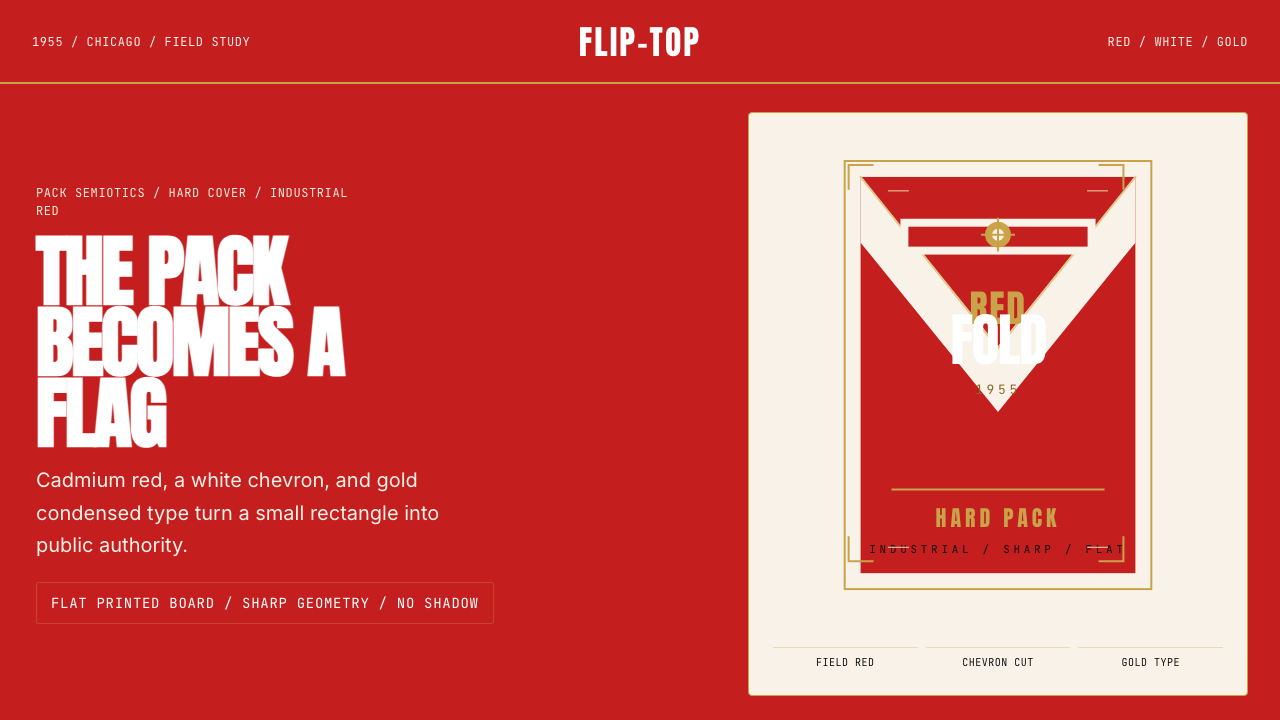 Marlboro Red Flip-Top (1955)Authority in one fold. Cadmium red, white chevron, and gold type read like a…
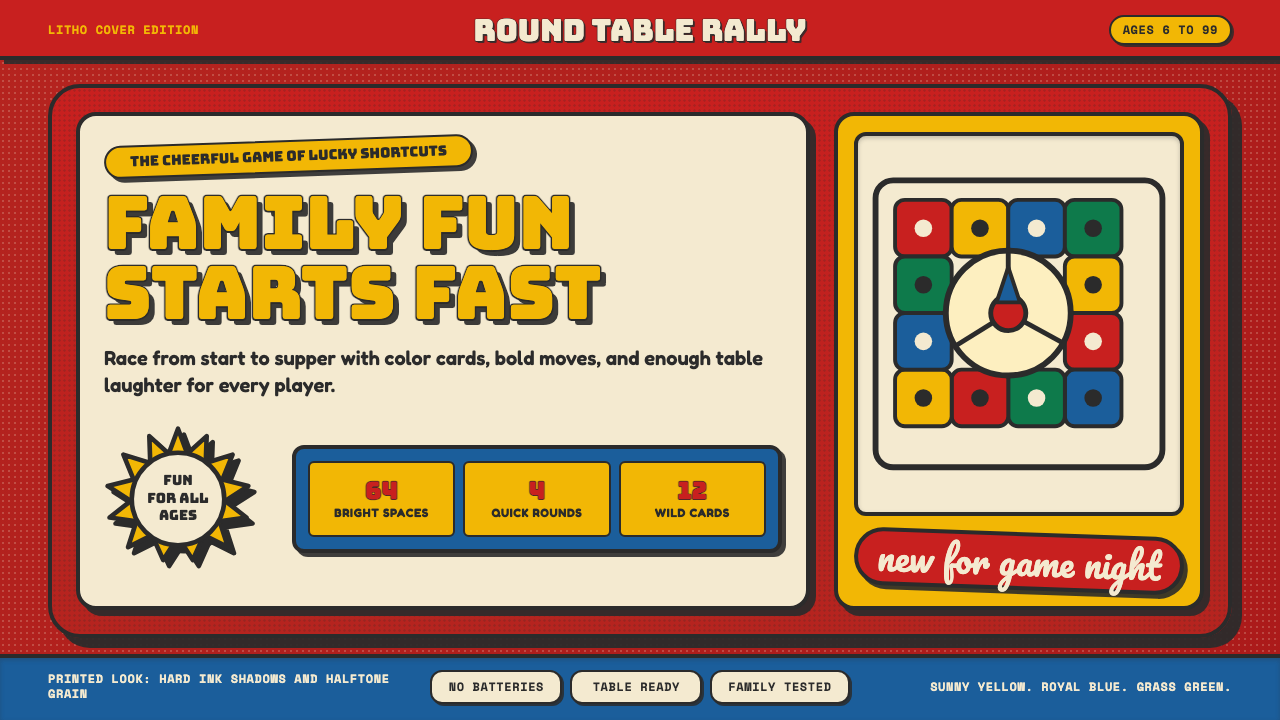 Vintage Board Game BoxShelf appeal shouts. Fire-engine red, Bungee lockups, yellow bursts, and ink…
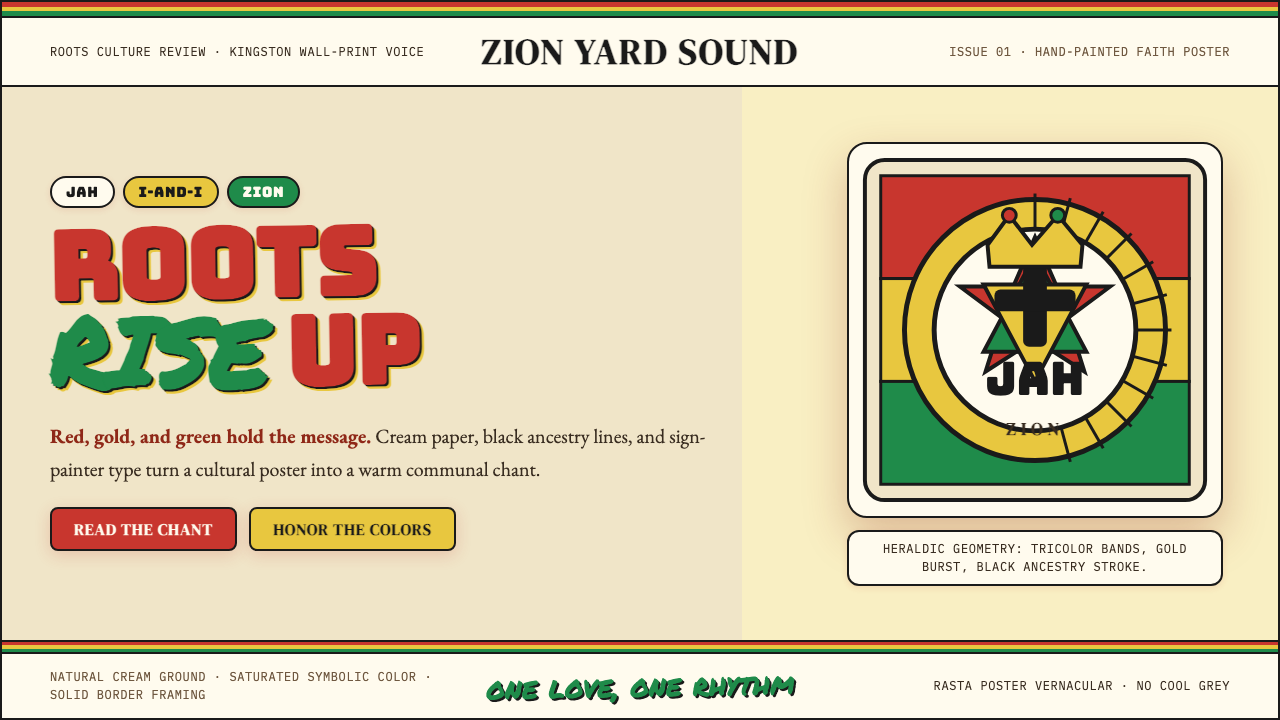 Caribbean Rastafarian (Jamaica)Warm faith, loud color. Red-gold-green bands and black poster type carry the…
 Converse Chuck TaylorPopulist and loud. Saturated red circles, Bungee type, black stitch lines on…
 Looney Tunes (Warner Bros.)Pure cartoon chaos. Bull's-eye rings, Bungee type, and red-blue-yellow blocks.
 Marvel Comics (Kirby Era)Populist color hits hard. Red-blue-yellow panels, black rules, and halftone d…