What is Caribbean Rastafarian (Jamaica)?
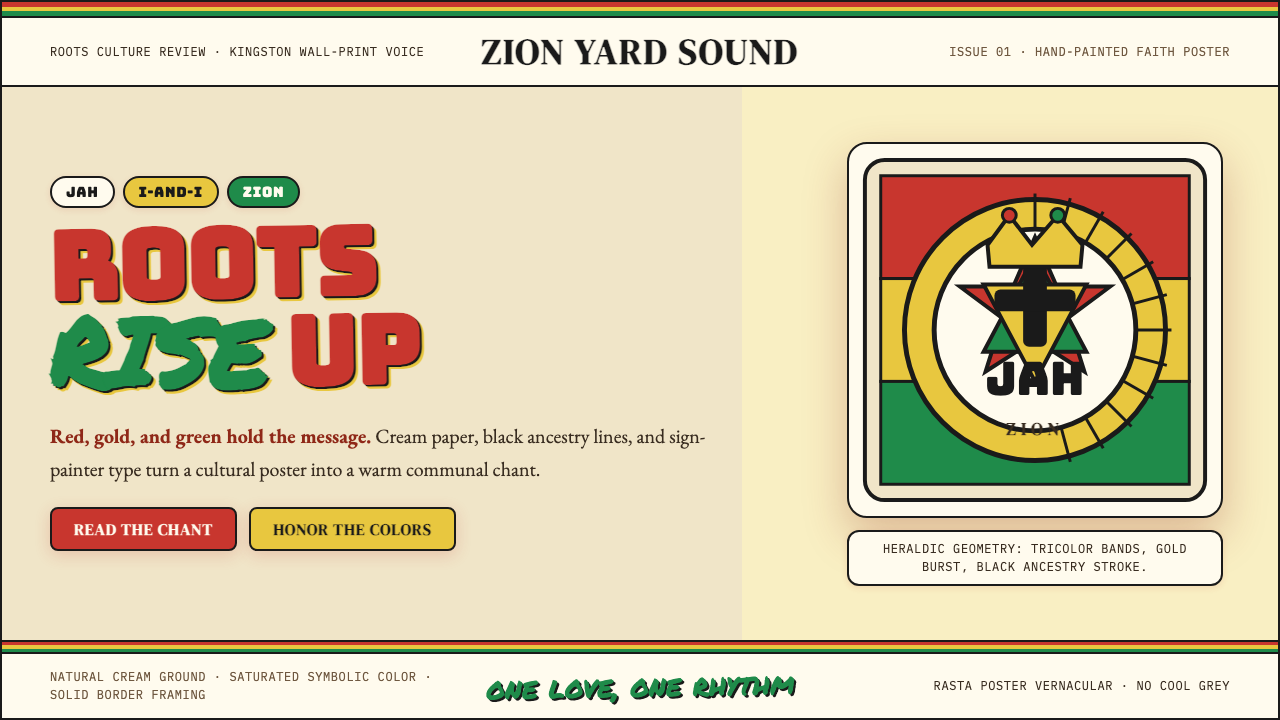
Red, gold, and green — worn as faith, broadcast as sound, and painted by hand on Kingston walls.
Caribbean Rastafarian (Jamaica) in brief
Caribbean Rastafarian design is the visual language of a spiritual and political movement born in 1930s Jamaica, one that fused African heritage, biblical prophecy, and post-colonial resistance into a coherent and immediately recognizable aesthetic. The tricolor palette — saturated red for the blood of martyrs, deep gold for the wealth of the African continent, and lush green for the promised land of Zion — operates less like a design choice and more like a creed worn on the skin of every artifact it touches.
At its heart, this is a vernacular tradition: the hand-painted reggae poster, the screen-printed album sleeve, the enamel badge sold at the market gate. The visual system was not designed in a studio but assembled over decades in the yards and recording studios of Kingston's Trench Town, then amplified to global scale by the reggae movement of the 1970s and the singular graphic work of Neville Garrick, art director for the Wailers. What makes it a coherent style — rather than mere association with a music genre — is its strict internal grammar: tricolor banding always in a prescribed order, lion-of-Judah heraldry as a central emblem, chunky display lettering in deep black, and a warm cream or natural-linen ground evoking unbleached cloth.
Words themselves become graphic elements in Rastafarian design. Terms like 'Jah,' 'I-and-I,' 'Babylon,' and 'Zion' recur as visual motifs, set in oversized type or hand-lettered with the weight of proclamation. Ethiopian Orthodox iconography — the Star of David, the Coptic cross, the Lion of Judah — provides heraldic structure. The overall impression is loud, communal, sun-warmed, and deeply serious: a visual system where every color carries theological weight and every motif carries historical memory.

Where does Caribbean Rastafarian (Jamaica) come from?
The Rastafari movement emerged in Jamaica in the early 1930s, in the aftermath of Marcus Garvey's Pan-African prophecy and following the 1930 coronation of Ras Tafari Makonnen as Emperor Haile Selassie I of Ethiopia — an event that early adherents interpreted as the fulfillment of biblical prophecy. Leonard Howell, one of the movement's founding figures, preached the divine kingship of Selassie and the eventual return of the African diaspora to the motherland. The aesthetic that grew around these beliefs drew on the colors of the Ethiopian flag, the heraldry of the Ethiopian imperial house, and the visual traditions of African churches encountered through the diaspora.
The visual grammar consolidated through the 1940s and 1950s in the yards and communities of West Kingston. Rastafarian symbols — the lion, the Ethiopian cross, the tricolor — appeared on painted murals, hand-sewn banners, and hand-lettered signs. This was craft practice, not commercial design: the people making these objects were members of the community, and the aesthetic evolved through collective use rather than authorship. The irregular stroke of sign-writing, the slightly imprecise geometry of hand-painted bands, and the deliberate weight of letter-forms chosen for legibility from a distance all became intrinsic to the style's character.
The global reach of the aesthetic owes an enormous debt to reggae music and, specifically, to the visual program developed around Bob Marley and the Wailers beginning in the early 1970s. Neville Garrick, who joined the Wailers' orbit in 1975 and served as art director through the late reggae golden era, was instrumental in codifying the style for mass-reproduction. Album covers such as those for 'Rastaman Vibration' (1976) and 'Survival' (1979) brought the tricolor heraldry, dense hand-lettered display type, and Pan-African symbolism to audiences across Europe, the Americas, and Japan. Garrick understood that the aesthetic had to work at record-store scale — as a twelve-inch square object viewed from across a room — and his choices reinforced the tradition's boldness and legibility.
After Marley's death in 1981, the visual tradition entered a second life as a globally recognized cultural marker, simultaneously celebrated and commercialized. The 1980s and 1990s saw the tricolor applied to everything from sportswear to tourism campaigns, often stripped of its theological content. Yet within Rastafarian communities and among graphic artists working from within the tradition, the visual system retained its original gravity — maintained through album artwork, political murals, street graphics, and festival visual design across Jamaica, the United Kingdom, West Africa, and the broader Caribbean diaspora. Contemporary designers working consciously in this idiom treat it as a form of cultural stewardship, attending carefully to the sourcing of symbols and the preservation of the style's communal, hand-made character.
What defines the Caribbean Rastafarian (Jamaica) look?
Tricolor Palette
The defining characteristic of Rastafarian visual design is the mandatory triad of red, gold, and green — always deeply saturated, rarely muted or pastelized. Red carries the weight of sacrifice and the blood of those who resisted colonial oppression. Gold speaks to the inherent wealth and dignity of Africa. Green signifies the promised land, the fertile earth, and hope for return. Black, when present as a fourth color, represents African ancestry and is used primarily for typography and heraldic outlines. These colors are not decorative choices; they are theological statements, which is why they appear in a prescribed band order rather than freely composed.
Heraldic Iconography
The Lion of Judah — drawn in a muscular, almost heraldic pose, often bearing the Ethiopian imperial flag — functions as the central emblem of Rastafarian design, equivalent in structural weight to a coat of arms. Flanking or supporting imagery includes the Star of David (shared with Ethiopian Orthodox tradition), the Coptic cross, and the map silhouette of the African continent. These symbols are never purely decorative; each carries a specific doctrinal meaning and is handled with corresponding reverence. The lion in particular is drawn with dense, flame-like mane rendering, occupying the visual center of any composition it appears in.
Hand-Painted Vernacular Letterforms
The typographic character of Rastafarian design is rooted in the tradition of Jamaican sign-writing — hand-painted lettering executed with wide flat brushes on wood, canvas, and plaster. The resulting letterforms are chunky, slightly irregular, and built for maximum legibility at a distance. Headlines and proclamatory text appear at an imposing scale in deep black or in one of the tricolor hues, with each letter given physical weight and presence. The slight imprecision and variation from letter to letter is not a defect but a mark of authenticity — it signals the human hand and the communal, non-commercial origin of the tradition.
Natural Ground and Warmth
Where Bauhaus uses clinical white or cool cream, Rastafarian design favors grounds that evoke unbleached linen, aged parchment, or sun-warmed earth. This warm neutral functions as a fourth visual element, softening the intensity of the saturated tricolor and connecting the design to the natural, organic world that the movement honors. Aged paper textures, canvas-like grain, and the warmth of wood grain all appear as background treatments. The total effect is tactile and warm — designed objects that feel like they could be worn or carried, not framed.
Proclamatory Density
Rastafarian design communicates with the urgency of a sermon and the directness of a protest banner. Compositions are dense with meaning — every available surface carries text or symbol, and negative space is used sparingly if at all. Words function as graphic objects: 'JAH,' 'ZION,' 'I-AND-I' appear at enormous scale, integrated with imagery rather than captioning it. This density is not visual chaos but organized fervor: the hierarchy is clear (lion first, headline second, supporting text third), but the intensity is uniformly high. The viewer is meant to feel addressed, called upon.
Pan-African Symbology
Beyond the immediate Rastafarian canon, the design tradition draws on a wider Pan-African symbolic vocabulary: the kente-derived geometric band patterns of West African textile traditions, the map of Africa as a recurring motif, references to specific African nations (Ethiopia above all, but also Ghana and other postcolonial states), and the portraits of historical figures such as Marcus Garvey and Haile Selassie treated in a near-iconic manner. This breadth of reference gives the style its depth — it is not a single movement's visual language but a visual coalition of African and diaspora identity.
Reggae Poster Composition
The compositional logic of Rastafarian design follows the conventions of the reggae event poster: a commanding central figure or emblem, a bold headline above or below it, tricolor banding as a structural frame, and supporting information — dates, venues, names — arranged in secondary tiers below. This vertical, poster-first logic gives the style its characteristic readable-from-a-distance quality. Even when adapted to digital formats — social cards, presentation covers, website headers — the best applications preserve this poster DNA: one dominant visual, one dominant statement, surrounded by structured supporting elements.

Who shaped Caribbean Rastafarian (Jamaica)?
Garvey, a Jamaican-born Pan-African nationalist, is considered a prophet figure within Rastafarianism — his 1920s declarations calling for the unification of African peoples and the rise of a Black king in Africa were retrospectively interpreted as foreseeing the coronation of Haile Selassie. Garvey's Universal Negro Improvement Association used visual materials — flags, badges, uniforms, and printed publications — that established an early African-diaspora design vocabulary the Rastafari movement would inherit and develop. His portrait appears as a recurring motif in Rastafarian visual culture, treated with the gravity of a saint's image.
Marley's global reach made him simultaneously the movement's most effective ambassador and the world's most visible embodiment of Rastafarian visual identity. His dreadlocks, the tricolor woven into his stage dress, and the imagery on his album covers created an international visual shorthand for the entire aesthetic. Beyond his personal iconography, Marley sanctioned an album art direction — primarily through Neville Garrick — that produced some of the most influential Rastafarian graphic design ever made, works that still define what the style looks like to audiences encountering it for the first time.
Garrick studied at UCLA and returned to Jamaica to work with the Wailers, becoming the primary visual architect of the Rastafarian aesthetic's global form. His album covers, stage designs, and graphic materials solved the practical problem of translating a hand-made community tradition into a mass-reproducible form without losing its spiritual weight. His compositional decisions — the scale of the lion relative to the headline, the banding geometry, the interplay of photography and hand lettering — established conventions that graphic designers worldwide still reference. Garrick also designed the stage sets for Marley's world tours, extending the visual system into three-dimensional space.
Howell is widely recognized as the first figure to systematically preach Haile Selassie's divinity in Jamaica and to establish the first Rastafarian community, the Pinnacle, in the hills of St. Catherine parish in 1940. The Pinnacle community developed many of the symbolic and sartorial practices that would define Rastafarian identity — including the cultivation of dreadlocks and the wearing of the Ethiopian colors. Howell's community was suppressed by Jamaican authorities, but its survivors dispersed into Kingston's yards and carried the visual and spiritual tradition with them, seeding the movement that would eventually become globally visible.
As the movement's divine king figure, Haile Selassie's likeness functions as an icon in the original religious sense within Rastafarian design — not merely a portrait but a devotional image. Photographs of Selassie in full imperial regalia, and painted or printed reproductions of these photographs, appear throughout Rastafarian visual culture: on murals, on merchandise, on record sleeves, and on the walls of community gathering spaces. The formal qualities of these images — frontal pose, direct gaze, surrounding regalia and insignia — follow conventions derived from both Western royal portraiture and Ethiopian Orthodox icon painting, giving Rastafarian visual culture one of its most distinctive and solemn registers.
How do you use Caribbean Rastafarian (Jamaica) today?
Applying Caribbean Rastafarian design well requires understanding that this is not an abstract aesthetic system but a visual language freighted with specific cultural and theological meaning. The style works best when there is genuine alignment between its values — African heritage, spiritual conviction, communal pride, anti-colonial dignity — and the content it is being used to represent. It is particularly powerful for: event and concert visual materials where a sense of celebration and community is primary; editorial projects exploring Caribbean culture, reggae history, or Pan-African themes; cultural brand identities where warmth, authenticity, and a hand-crafted character are desired attributes; and social and political communications that benefit from the style's tradition of clear, urgent visual statement.
For presentation slides, the style has exceptional cover-page impact. A cover built on this aesthetic places a large lion or heraldic emblem at center, frames it with a tricolor band across the top or bottom edge, sets the title in heavy display lettering against a warm cream or linen-toned ground, and uses the deep black of the letterforms to anchor the whole composition. Content slides should simplify considerably: strip away the heraldic imagery, retain the warm ground color, use the tricolor only as accent bands or data-category colors, and let one strong typeface in two weights carry the information hierarchy. Data slides work well with a warm-background approach — bar charts and flow diagrams take on the tricolor as category colors, with black for labels and structural lines.
For web interfaces and dashboards, the style suits contexts where warmth and cultural specificity are as important as information clarity. A dashboard built in this idiom uses a warm off-white or parchment-toned background, reserves the tricolor for status indicators and section headers, and relies on heavy black type for data labels and navigation. Interactive states — hover, active, selected — should use the gold as a highlight rather than the red or green, which carry stronger cultural associations. Pricing and feature-comparison pages benefit from the style's declarative quality: each tier presented as a bold panel, differentiated by the tricolor used as a stripe or header band, with section names set in the bold display weight.
For editorial and marketing applications, the style's natural home is magazine and poster formats. An editorial spread draws on the reggae-poster compositional logic: a central image (portrait or icon) occupies roughly half the spread, with headline text set large in the upper or lower register, tricolor banding used as a structural frame, and pull quotes handled in the chunky, proclamatory letterform tradition. Marketing materials for events, festivals, or cultural initiatives benefit from a full-application approach — saturated tricolor ground with deep black type, high contrast, and an assertive compositional boldness that communicates from across a room or a social feed.
A common mistake when applying this style is treating the tricolor as a generic 'Jamaican' or 'reggae' decoration — applying it superficially without attending to proportion, order, or symbolic weight. Authentic work respects the sequence (red before gold before green, reading top to bottom or left to right in banded applications) and uses the colors at their full, unreduced saturation rather than in muted or gradient form. A second mistake is mixing the Rastafarian palette with unrelated color families — pastels, cool blues, or pure black grounds — that undermine the warm, sun-lit character essential to the tradition. The style also loses coherence when the typographic weight is reduced: thin or light type weights feel out of place; the tradition demands heft and legibility at distance.

Caribbean Rastafarian (Jamaica) — FAQ
Is it appropriate to use Rastafarian visual elements outside of cultural or reggae-adjacent contexts?
This requires careful thought. The tricolor band and the warm palette can be borrowed with relative openness because they have entered broad cultural circulation. The heraldic symbols — the Lion of Judah, the Coptic cross, the imperial portraits — carry active religious and political meaning and should not be used decoratively in contexts unrelated to African or Caribbean cultural identity. The distinction the Rastafarian tradition itself draws is between 'overstanding' (deep cultural comprehension) and superficial use: if you are working with these symbols without understanding what they mean to the communities that originated them, the results will feel hollow, and in some contexts, extractive. Consultation with designers from within the tradition is advisable for any significant application.
How does this style differ from generic 'tropical' or 'island' design?
Generic tropical design uses greens and yellows for their natural associations — palm fronds, sunshine, leisure — with no fixed palette order, no heraldic structure, no textual depth, and a light, holiday-oriented emotional register. Rastafarian design uses the same green and yellow (as gold) with entirely different intent: they are theological colors in a prescribed sequence, accompanied by red and black and framed by symbols of African sovereignty and spiritual conviction. The emotional register is serious, communal, and declaratory rather than breezy or escapist. Conflating the two produces work that is neither: it loses the lightness of tropical design and the gravity of Rastafarian design simultaneously.
Can the style work in a dark or nighttime-themed layout?
Yes, and there is precedent in the tradition itself — night-time concert posters and some album covers use deep black or very dark grounds effectively. The key shift when working on a dark ground is that the gold takes on even more visual weight and can easily dominate; the red becomes more intense; the green shifts in character depending on its exact hue. On a deep black ground, the warm parchment quality of the standard Rastafarian palette is lost, which changes the emotional temperature significantly. Dark-ground applications work best for contexts with a nocturnal or urban edge — nightclub events, late-concert promotions — where the loss of warmth is acceptable or even desirable. For most other uses, the warm light ground is the more authentic and appropriate choice.
How should photography be used within this visual system?
Photography enters the Rastafarian design tradition primarily through portraiture — images of movement figures, musicians, and community members treated with the weight of devotional imagery. Photographic reproductions in this tradition are typically high-contrast, often with a warm duotone treatment that integrates the image into the overall palette rather than leaving it as a neutral color photograph sitting on a colored ground. Silhouetted figures against a solid tricolor field, or photographs printed in two colors using black and one of the tricolor hues, are both historically grounded approaches. Landscape photography is less central to the tradition than portraiture; when it appears, it is typically of the Jamaican or Ethiopian landscape treated with a similar warm, high-contrast handling.
What makes a Rastafarian-inspired design feel authentic versus appropriative?
Authenticity in this context has several components. First, purpose alignment: the style is most authentic when it serves content or a community connected to the values the aesthetic embodies — African heritage, spiritual search, musical culture, post-colonial identity. Second, symbol literacy: understanding what each emblem means and using it with that understanding, rather than treating the lion or the cross as decorative shapes. Third, handmade character: the tradition values slight irregularity, density, and warmth over computational perfection — a design that looks like it was produced with a flat brush rather than an algorithm will feel more at home in this lineage. Fourth, color integrity: using the palette at its full saturation in the correct order, without diluting it into a 'reggae-inspired' pastiche. The difference between authentic work and appropriation is usually legible in the care taken with these four dimensions.
Related design styles
 Converse Chuck TaylorPopulist and loud. Saturated red circles, Bungee type, black stitch lines on…
 Marvel Comics (Kirby Era)Populist color hits hard. Red-blue-yellow panels, black rules, and halftone d…
 McDonald's Golden ArchesRoadside famous. Saturated red, hot yellow, and chunky type shout from 1955.
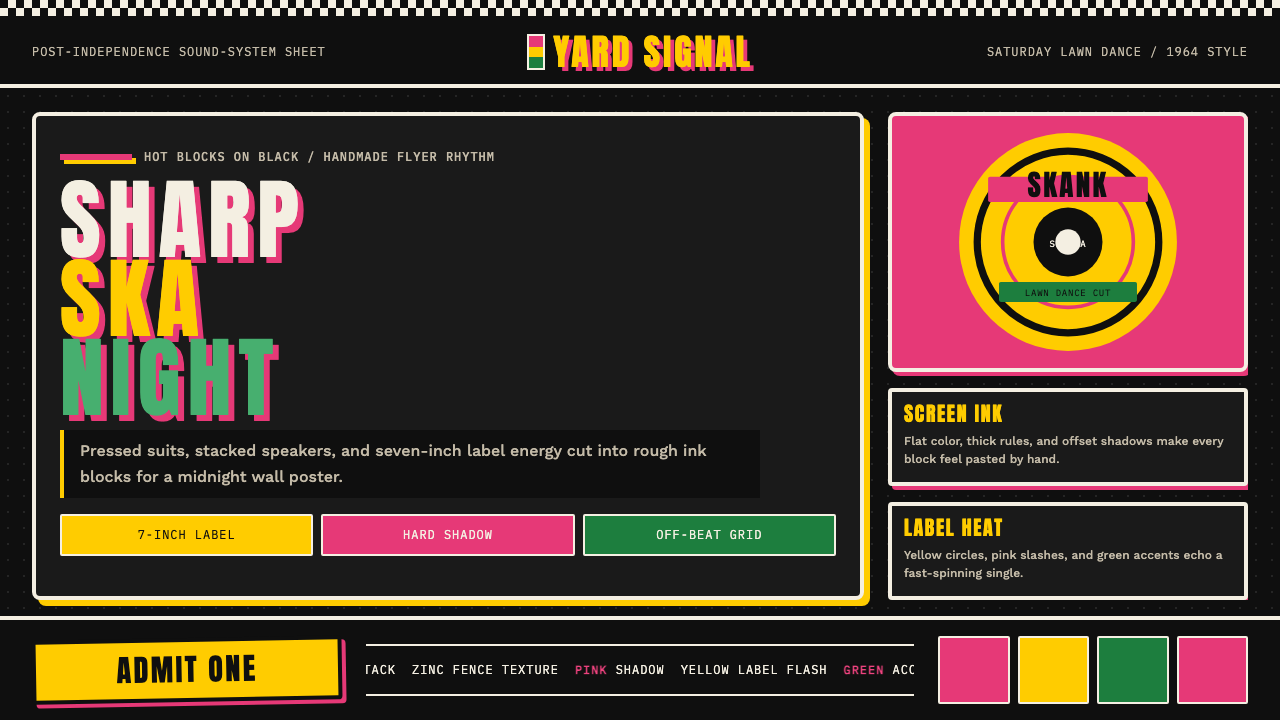 Rude Boy Jamaica Ska (1960)Street swagger hits hard. Hot pink and yellow blocks, checker trim, chunky ty…
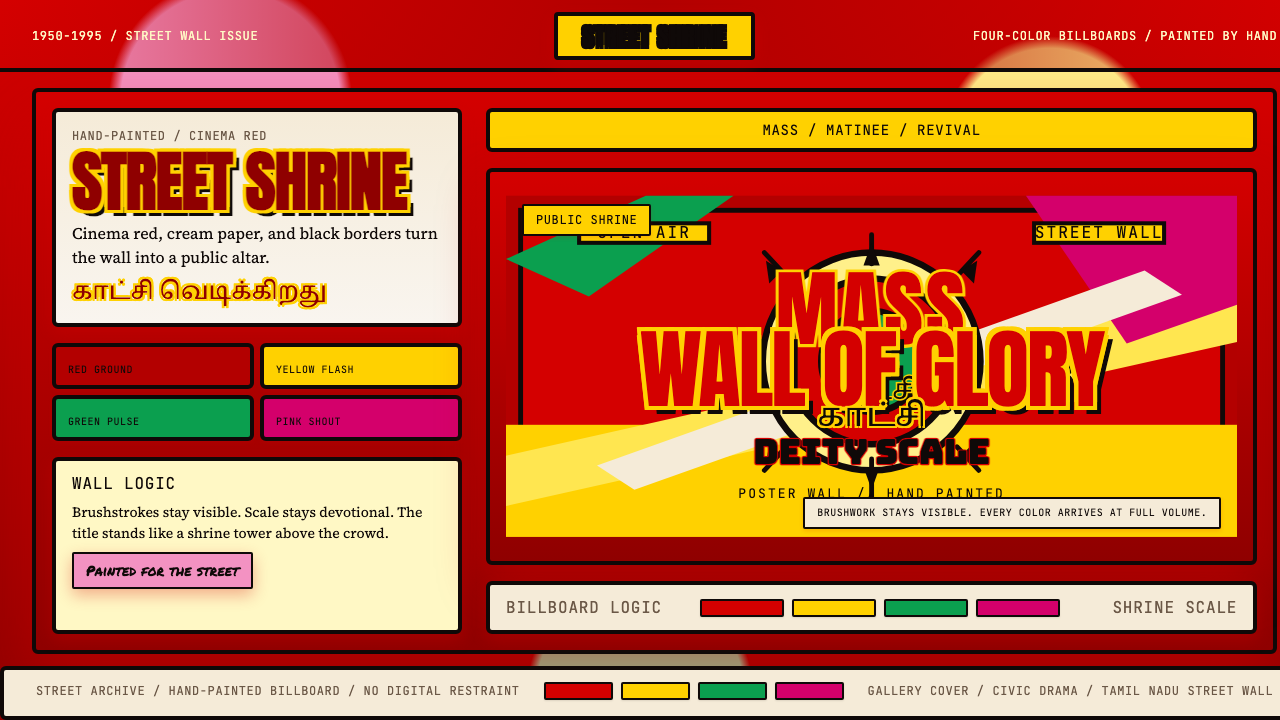 Tamil Cinema Poster (MGR era)The wall becomes a shrine. Red, yellow, green, and pink crash into cream pane…
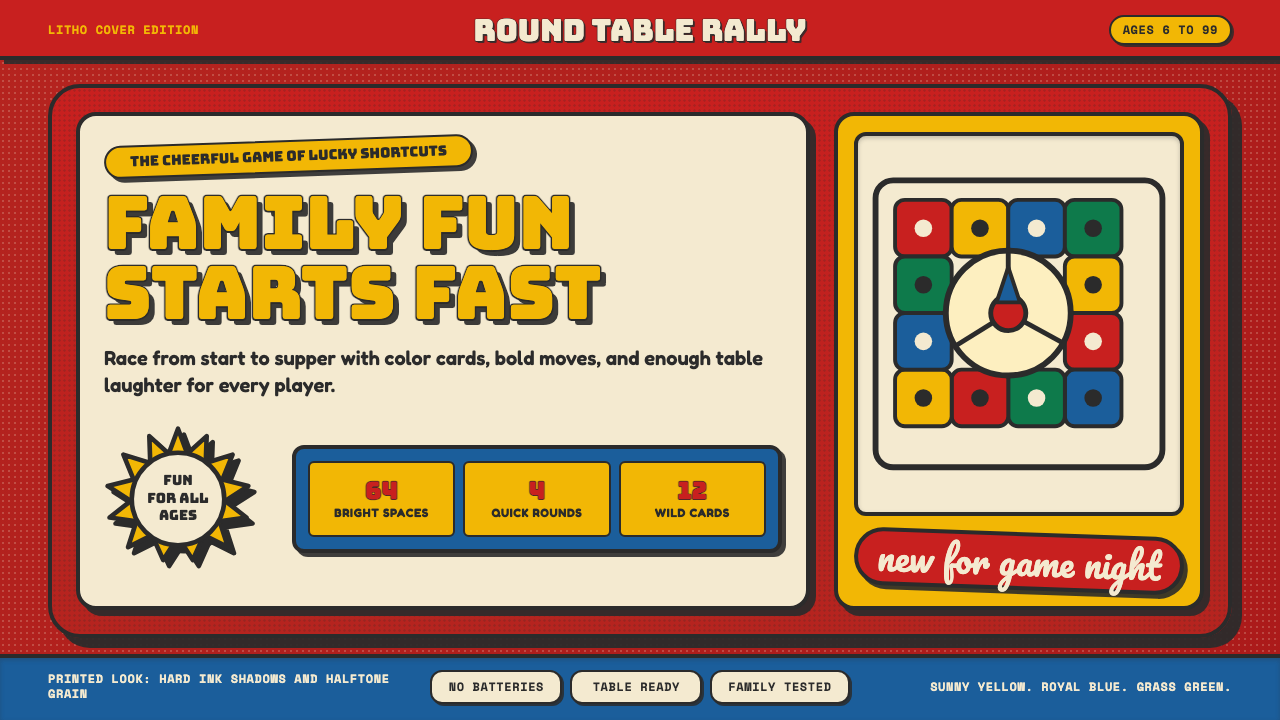 Vintage Board Game BoxShelf appeal shouts. Fire-engine red, Bungee lockups, yellow bursts, and ink…