What is Rude Boy Jamaica Ska (1960)?
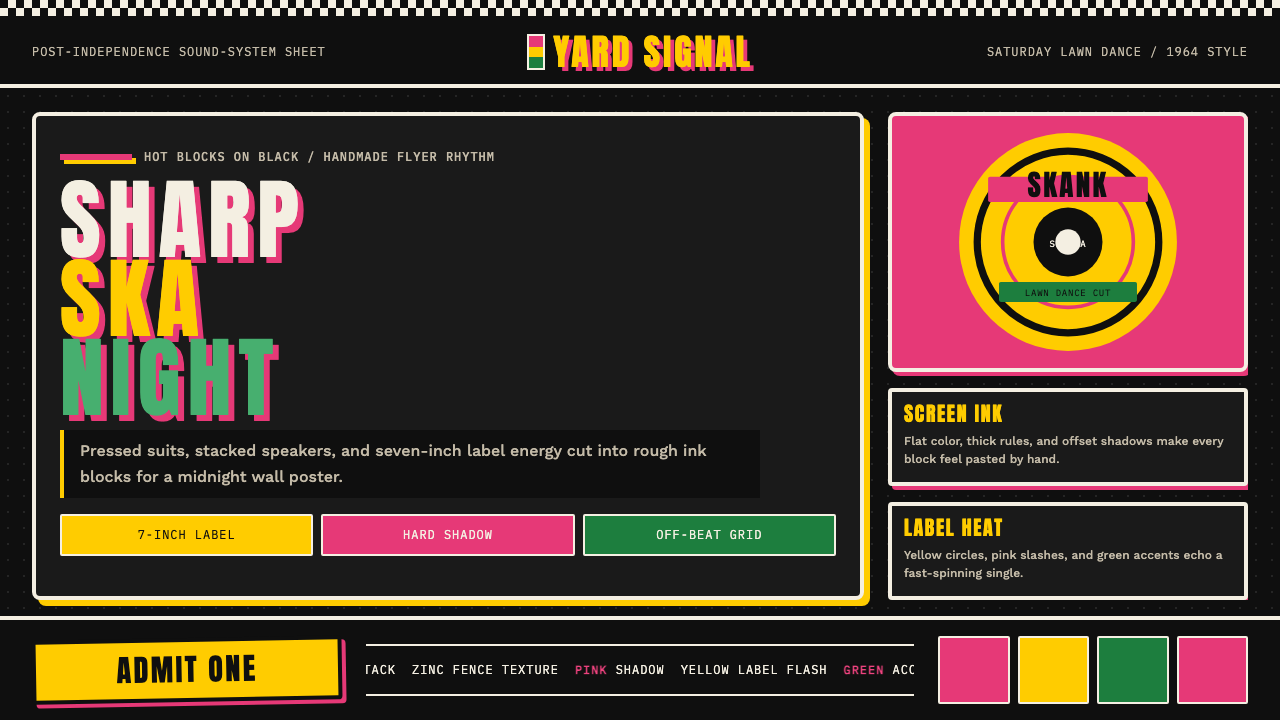
Rude Boy style is Kingston street energy turned graphic — black grounds, tropical color blocks, checker trim, and hand-lettered type that feel wheat-pasted to a Trench Town wall at midnight.
Rude Boy Jamaica Ska (1960) in brief
Rude Boy Jamaica Ska (1960) is a design aesthetic rooted in the visual culture of post-independence Kingston, Jamaica. It draws directly from the hand-painted sound-system signage, riso-printed dance-hall flyers, and seven-inch record labels that defined the street life of Trench Town and Orange Street in the early 1960s. The style pairs a deep black field with punchy color blocks — tropical yellow, hot pink, and occasionally orange — applied with the blunt confidence of someone who has a spray can and something to say.
The graphic vocabulary is deliberately rough and working-class in origin. Halftone dot patterns, ink mottle, hard-offset drop shadows, and chunky hand-lettered headline type are not errors to be corrected but marks of authenticity to be preserved. Circular label graphics echo the Studio One and Treasure Isle 45s that powered the ska sound-system parties, and checker patterns — borrowed from the sharp two-tone suits worn by the original Rude Boys — appear as borders, dividers, and decorative trim.
In the early 1980s, the UK 2-Tone movement led by Jerry Dammers and The Specials revived and codified this aesthetic for a new audience, tightening the black-and-white checker graphic into a globally recognized symbol of multi-racial youth solidarity. The 2-Tone chapter stripped some of the tropical warmth from the palette but preserved the hard-contrast energy, giving the style a second canonical form alongside the original Jamaican ska era.
Where does Rude Boy Jamaica Ska (1960) come from?
Jamaica gained independence from Britain in August 1962, and the cultural energy that had been building in the Kingston yards and tenement yards of Trench Town finally had a national context to define itself against. The Rude Boy was a figure who emerged from this charged moment: young, male, poorly employed or unemployed, and intensely invested in style as a mode of self-assertion. The sharp suit — narrow lapels, high-waisted trousers, pointed shoes — was not an affectation but a statement of dignity in the face of structural exclusion. The sound system was the social institution around which this culture organized, and its visual apparatus — hand-lettered banners, printed flyers, record labels — was the first graphic medium of the movement.
The sound systems operated by Clement 'Coxsone' Dodd (Studio One) and Duke Reid (Treasure Isle) were competitive enterprises, and their competition drove visual innovation as much as musical innovation. Each operator needed signage that was readable at distance and in low light, that communicated authority and excitement, and that could be produced cheaply and quickly. The result was a vernacular graphic language of high-contrast color, bold letterforms, and dynamic composition — not because anyone had studied design theory, but because those qualities worked in the actual environment where the signs would be seen.
Prince Buster, another key figure in the ska era, operated his own sound system (Voice of the People) and record label, producing sleeve art and promotional materials that showed how the circular format of the record label — a natural constraint — became a compositional motif replicated across posters, flyers, and signage. The label graphic, with its concentric bands of text, its central hole, and its bold typographic hierarchy, gave the style one of its most distinctive structural elements.
The UK 2-Tone moment of 1979 to 1981 was a deliberate retrieval act. Jerry Dammers of The Specials recognized in Jamaican ska a visual and musical language of defiant working-class style that had direct resonance in Thatcher-era Britain. He codified the black-and-white checker as the 2-Tone emblem, introduced the cartoon figure of Walt Jabsco — based on a Peter Tosh promotional photograph — as a mascot, and through the artwork of albums and singles released on the 2-Tone label created a second canonical body of work that extended and formalized the original aesthetic for screen printing and mechanical reproduction.
What defines the Rude Boy Jamaica Ska (1960) look?
Color
The palette is anchored by pure black as the dominant ground, against which tropical yellow and hot pink are deployed as high-voltage color blocks. Orange appears occasionally as a third accent. The color logic is not symbolic in the Bauhaus sense — it is visceral, designed to be seen from across a dark yard at a Saturday night lawn dance. Colors are applied in solid, flat fills without gradient or transition, and they hit the black ground with maximum contrast. White is used sparingly for text or thin trim lines; the background never relaxes to grey.
Typography
Headlines are chunky, condensed, and visually aggressive — letterforms that read like they were drawn with a wide brush or a thick marker in a single confident pass. The weight is heavy and the spacing is tight, almost to the point of letters touching. Lowercase is often avoided in display settings in favor of all-caps compositions that fill the available space with authority. Body text, where it appears, is set small and dense, treated as a block of texture rather than something meant to be read word by word. The typeface personality is vernacular and hand-influenced rather than refined or geometric.
Checker and Stripe Trim
The two-tone checker — alternating black and white squares — is the single most recognizable motif of the style and carries its deepest cultural weight. Used as a border band, it frames compositions the way a sharp suit frame the body. Horizontal stripe sequences, often in the same high-contrast color pairs, appear as section dividers and background fills. The checker is never decorative in a frivolous sense — it announces cultural allegiance, the same way the original Rude Boys wore their suits to declare where they stood.
Record Label Circle
The circular format of the seven-inch single label is a recurring structural motif — used as a container for portraits, logo marks, and typographic compositions. Text arranged in concentric arcs around a central point, with a bold central element, mirrors the physical label of a Studio One or Treasure Isle pressing. The circle also appears as a pure graphic shape: a color disc punched against the black ground, used as a focal point or a crop mask for imagery.
Texture and Print Distress
The aesthetic actively reproduces the marks of cheap, fast reproduction: halftone dot patterns visible to the naked eye, ink coverage that bleeds or thins at the edges, slight mis-registration between color layers, and grain that suggests a newsprint or riso-printed surface. These are not glitches — they are the style's way of keeping faith with its origins. A version of this aesthetic that is too clean, too vector-precise, loses the street credibility that makes it legible as Rude Boy rather than as a corporate approximation of Rude Boy.
Hard-Offset Shadow
Drop shadows, where used, are rendered as solid flat shapes offset at a sharp angle — never soft, never blurred, never graduated. The shadow color is typically a darker version of the surface color or a contrasting color from the palette, reinforcing the multi-layered, printed-feel of the composition. This hard shadow treatment gives type and graphic shapes a dimensional quality without introducing any illusion of realistic lighting; it reads as a printing registration effect rather than a lighting effect.
Iconography and Silhouette
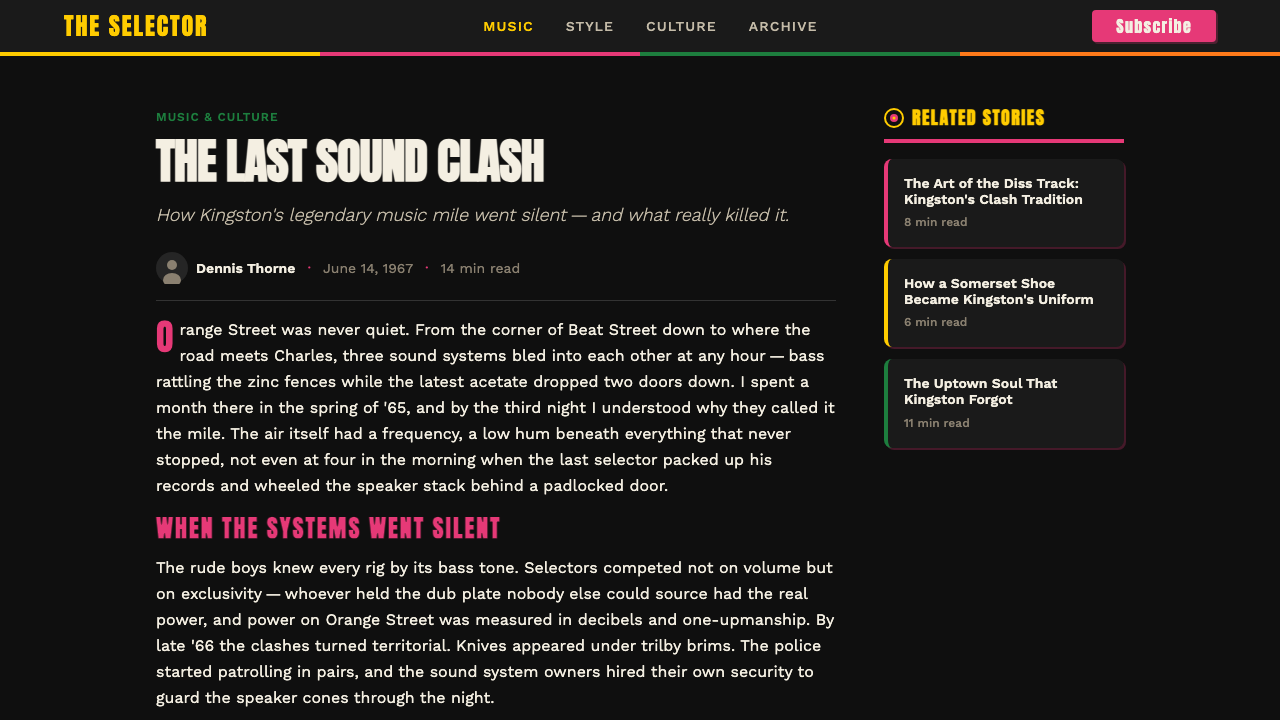
Human figures appear in the style as high-contrast silhouettes or bold two-tone portraits — the sort of image achievable by photocopier or screen print without a full halftone range. Sharply dressed figures, raised fists, and dancing poses are common subjects. Instruments — particularly the upright bass, trombone, and trumpet associated with ska — appear as iconic graphic elements. The imagery is bold enough to read on a flyer seen through a car window at speed.
Who shaped Rude Boy Jamaica Ska (1960)?
Dodd founded Studio One in Kingston in 1963 — the label and recording studio that became the incubator of ska, rocksteady, and early reggae. His sound system, Downbeat, was one of the dominant forces in Kingston's outdoor dance culture through the late 1950s, and the graphic identity of Studio One — circular labels, bold typography, high-contrast sleeve designs — defined the visual language that the broader Rude Boy aesthetic drew from. Dodd recorded virtually every significant Jamaican musician of the era, and his studio's output gave the style its canonical reference point.
Arthur 'Duke' Reid ran the Treasure Isle label and the Trojan sound system — Coxsone Dodd's principal rival and the source of the 'Trojan yellow' color association that became part of the aesthetic. Reid's persona — he was known to appear at dances dressed in regal attire and carrying firearms — embodied the theatrical self-presentation that the Rude Boy subculture translated into graphic terms. Treasure Isle's recording and visual output ran parallel to Studio One and together they defined the golden age of ska's graphic identity.
Cecil Bustamente Campbell, known as Prince Buster, was a vocalist, producer, and sound-system operator who ran the Voice of the People system and his own record label. He is credited with helping to coin the term 'rude boy' and with producing some of the era's most visually distinctive single sleeves and promotional materials. His music and persona — aggressive, sharp, self-created — were a direct template for the style's attitude. When the UK 2-Tone movement named its record label Madness after a Prince Buster song, it acknowledged how central his contribution was to the entire aesthetic lineage.
Dekker was the first Jamaican artist to achieve significant UK chart success, with '007 (Shanty Town)' in 1967 and 'Israelites' in 1969. His promotional photographs and record packaging crossed from Jamaican vernacular design into UK commercial print production, and in doing so they served as one of the first bridges between the grassroots visual language of Kingston and wider international audiences. The way his image was presented — sharp-suited, confident, photographed in high contrast — became a visual template repeated across the ska and early reggae era.
Dammers founded The Specials and the 2-Tone record label in Coventry in 1979, and in doing so he became the principal designer of the style's second canonical phase. He commissioned the Walt Jabsco figure — a cartoon Rude Boy based on a Peter Tosh photograph — as the label's mascot, established the black-and-white checker as the movement's unifying graphic element, and oversaw the design of covers, posters, and promotional materials that brought the original Jamaican visual language into 1980s British graphic production. His work as a design orchestrator, not just a musician, is inseparable from the style's global legibility.
How do you use Rude Boy Jamaica Ska (1960) today?
Rude Boy Jamaica Ska is a style with a strong social and cultural identity, which means it communicates most effectively when the content it frames has genuine energy and attitude behind it. It is not a neutral container — applying it to something timid or corporate-cautious produces a tonal mismatch that reads as costume rather than character. Used correctly, it brings urgency, confidence, and a deliberately rough authenticity that cuts through polished digital surfaces.
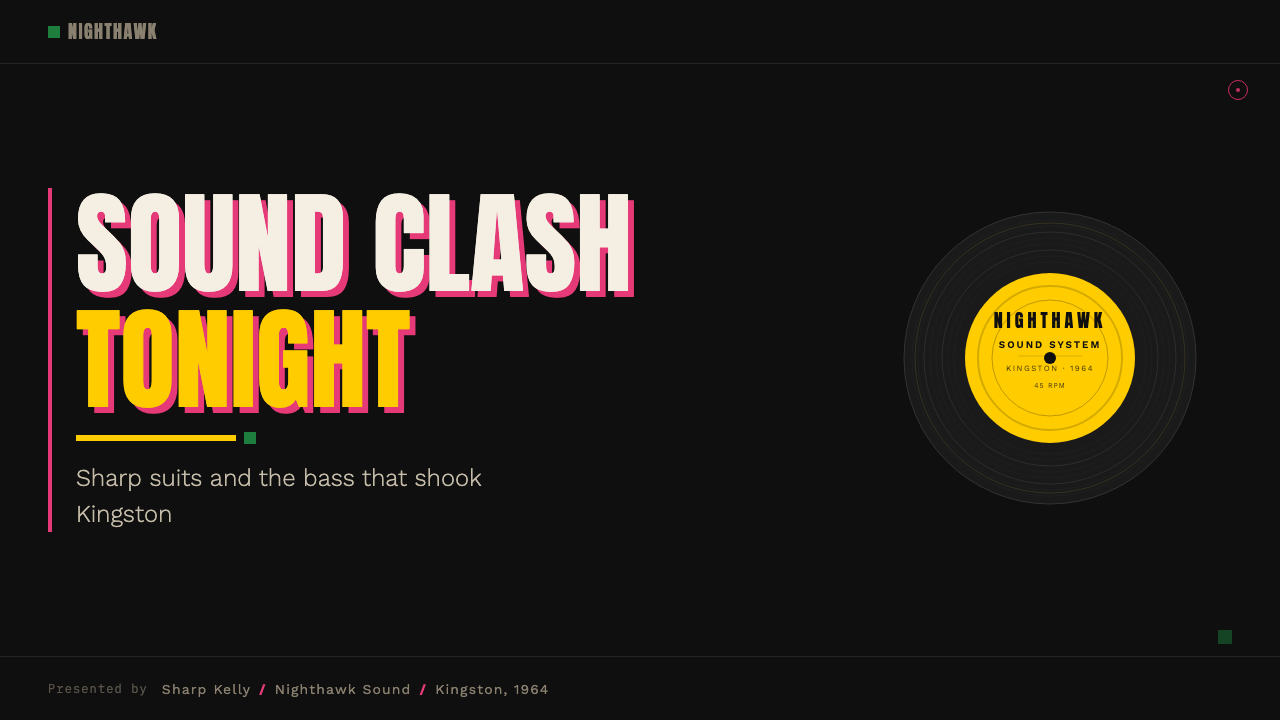
For presentation slides, this style works best as a full-commitment approach: a cover built like a concert poster, with a large color block occupying one zone of the slide, a bold all-caps title set in heavy condensed letterforms, and a checker border band running along one edge. Content slides should maintain the black ground and use color sparingly — one accent block to anchor a key point, the rest handled through type size and weight hierarchy. Data slides benefit from treating charts as graphic objects in their own right, with bars and segments rendered in the flat primary palette against the black field. Avoid softening the aesthetic with rounded corners, drop shadows that blur, or any element that introduces a corporate-clean quality the style is working against.
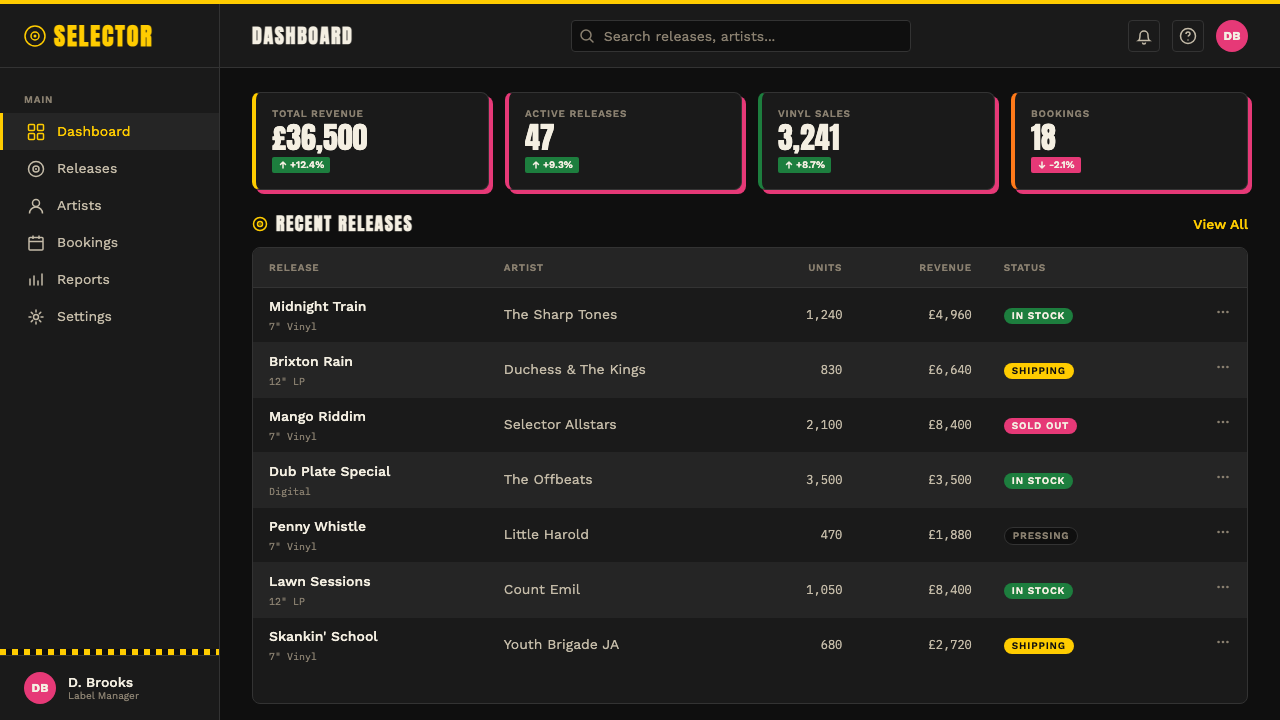
For web interfaces, this style is well-suited to music platforms, event listings, cultural brands, and any product with a subcultural or youth-facing positioning. Dashboard and utility interfaces are less natural territory — the style's rough texture and high contrast can work against legibility at small type sizes and dense information densities. Where it does work in UI, the approach is to treat the black ground as the default state, use the accent color palette for interactive and highlighted elements only, and build navigation as a typographic exercise in the same condensed heavy register as the headline type. The checker trim translates well as a tab indicator or a progress bar rather than as a full background pattern.
For editorial and marketing work, the style is most powerful in full-page or large-format contexts — event posters, magazine spreads, social media cards — where the high contrast and color block approach can operate at the scale it was designed for. A single large color field, a bold headline, a record-label circle used as a photo crop or logo container, and a checker trim band is a complete composition. Copy should be kept short and punchy; long paragraphs are aesthetically at odds with the style's graphic directness. The texture and distress elements — halftone grain, ink bleed — are best added as a layer over the entire composition rather than applied selectively to individual elements.
A common mistake when applying this style is treating it as purely a color and pattern system — deploying the yellow and pink and checker mark on an otherwise clean, geometric digital layout and expecting the result to read as Rude Boy. The style's identity depends as much on its texture, its typography weight, and its deliberate roughness as on its color palette. A version that uses the right colors but in clean vector fills, with refined typefaces and smooth shadows, produces something that looks like a brand inspired by Rude Boy culture rather than something that feels like it. The texture is not decoration — it is the cultural signal.
Rude Boy Jamaica Ska (1960) — FAQ
Is this the same as reggae visual style?
Related but distinct. Rude Boy Jamaica Ska style is rooted in the early 1960s ska era and its UK 2-Tone revival, before reggae developed as a separate genre. Reggae visual culture — associated with Rastafari, the red, gold, and green palette, and artists like Bob Marley — has a different set of references and a warmer, more spiritual tonality. Ska and Rude Boy imagery are sharper, more urban, and harder in contrast; the suit is the emblem rather than the ital garment. There is lineage connecting them, but treating them as interchangeable flattens the distinct cultural identities of each.
How should checker patterns be used without overwhelming the layout?
The checker works best as a border or trim element rather than as a full background. Used as a band along one edge of a composition — the bottom of a poster, the top of a slide, the side of a card — it frames and activates the design without competing with the primary content. When used at full scale as a background, the pattern dominates and makes text difficult to read; the historical sources used it at this scale only in situations where the text was large and widely spaced. Scale the check squares to the context: smaller checks at finer trim scale, larger checks only when the checker itself is the hero element.
Can this style work on a light or white background?
It can, but with significant trade-offs. The black ground is not arbitrary — it is what makes the tropical accent colors punch at the intensity the style depends on. On a white or cream ground, the same colors at the same saturation read as playful or retro rather than as street-urgent. If a light ground is necessary, one approach is to treat individual compositional zones as deep-black fields within a lighter surround, preserving the high-contrast interior while working within a lighter overall frame. Full inversion — white text on a black field alongside a white-ground layout — can bridge the two modes. Avoid light-ground interpretations that also soften the texture and lighten the type weight; those decisions compound to produce something that looks like a nostalgia brand rather than the original aesthetic.
How does the 2-Tone revival differ visually from the original Jamaican ska era?
The 2-Tone era tightened and systematized what was looser and more vernacular in the original ska period. Jamaican ska-era graphics were made by hand under production constraints — cheap inks, limited color registration, hand-lettered type — and those constraints produced organic irregularity. The 2-Tone revival had access to UK commercial print production, which meant cleaner registration, more consistent color, and more deliberately controlled graphic design. The checker became more geometrically precise, the Walt Jabsco figure introduced a cartoon character that the original era did not have, and the overall palette shifted to a starker black-and-white emphasis with less of the tropical yellow and pink warmth. Both phases are canonical; using them together produces a hybrid that is richer than either alone.
Is it appropriate to use this style for a brand or project without Jamaican cultural roots?
The style has crossed cultural contexts multiple times in its history — the 2-Tone revival was a British appropriation that became canonical, and since then the aesthetic has been used by brands, musicians, and designers worldwide with varying degrees of cultural awareness. The honest answer is that the appropriateness depends on how it is used and what is acknowledged. Using the visual system as pure form — pattern, color, type — without any engagement with the cultural context that produced it can read as hollow. Using it with genuine understanding of its origins, or in contexts where that history is part of the story, produces more honest work. Citing the sources — in project notes, in press, in how you talk about the design — is the minimum form of acknowledgment that separates informed use from extraction.
Related design styles
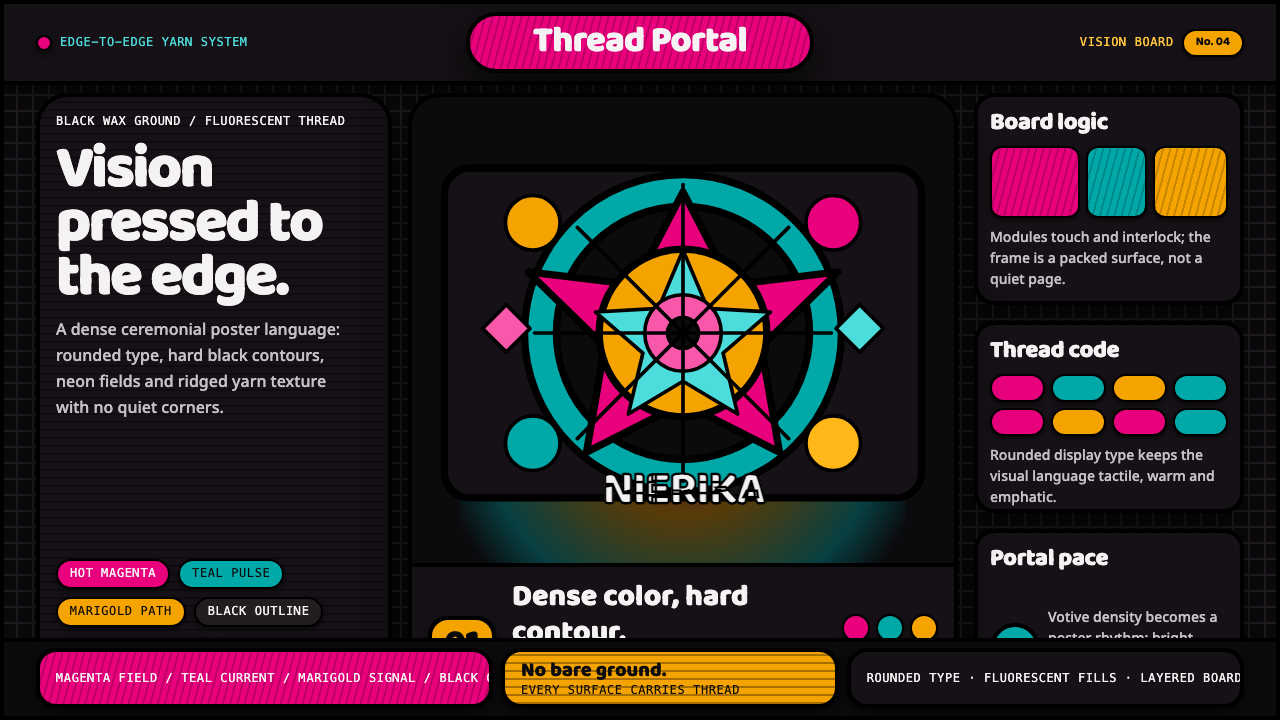 Huichol Yarn NierikaCeremonial density glows. Neon yarn colors lock into black-contoured, edge-to…
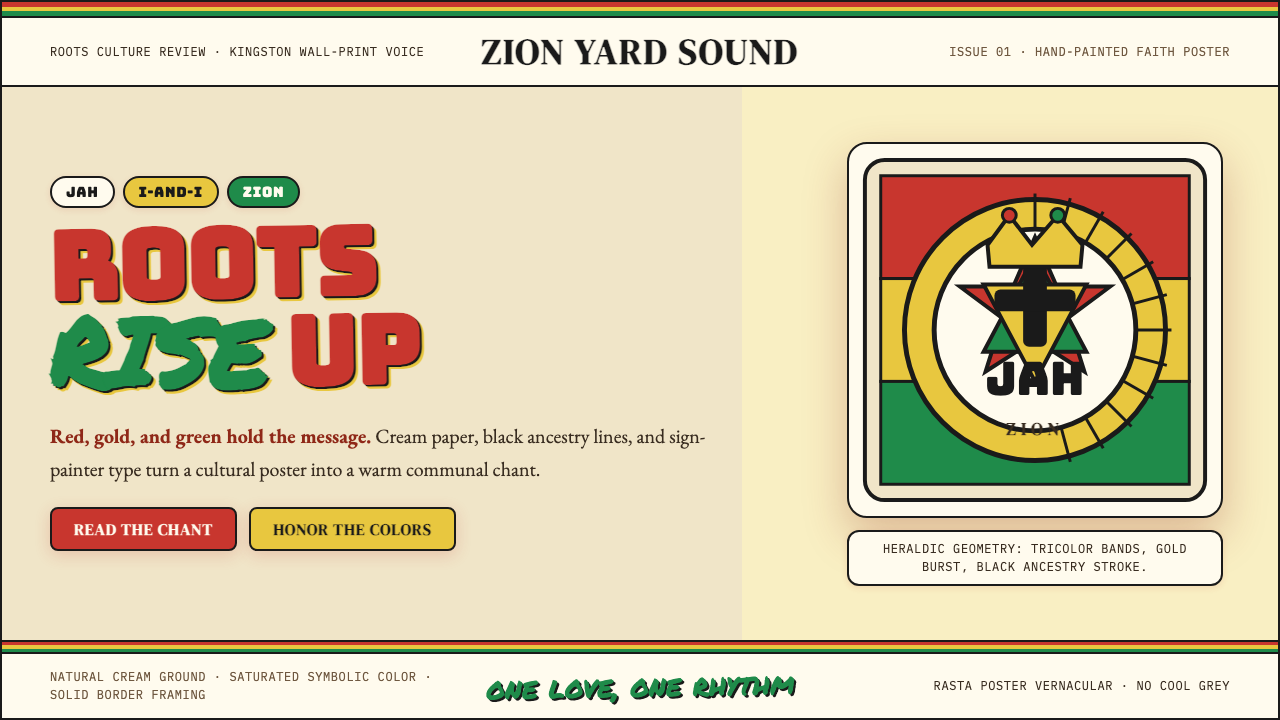 Caribbean Rastafarian (Jamaica)Warm faith, loud color. Red-gold-green bands and black poster type carry the…
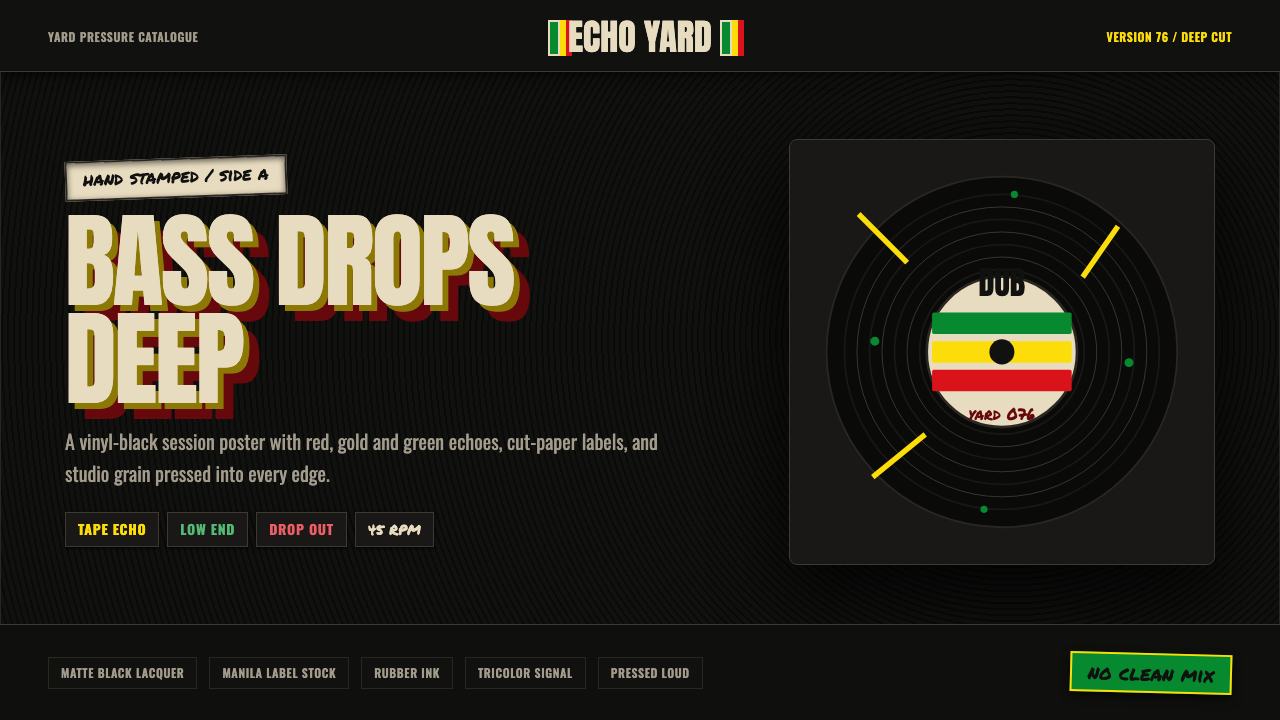 Dub SoundsystemStudio-dark and heavy. Vinyl grooves, manila stamp, green-gold-red echo type.
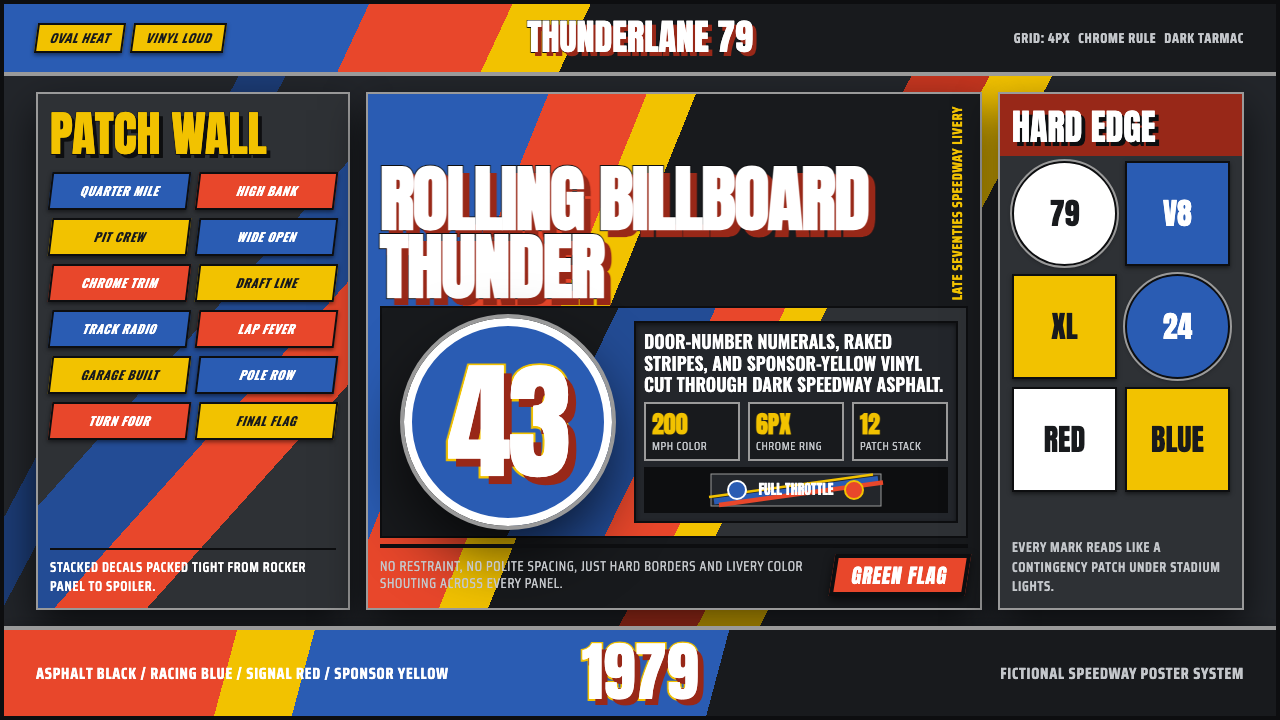 NASCAR Stock CarLoud as a rolling billboard. Blue, red, and sponsor yellow collide in a hard-…
 Varsity LettermanEarned, not printed. Navy wool ground, school-gold chenille and block varsity…
 Algerian Casbah Poster (1954–1962)Every surface is a manifesto. Blood red, warning yellow, and stencil type hit…