What is Jamaican Dancehall 1990 Poster?
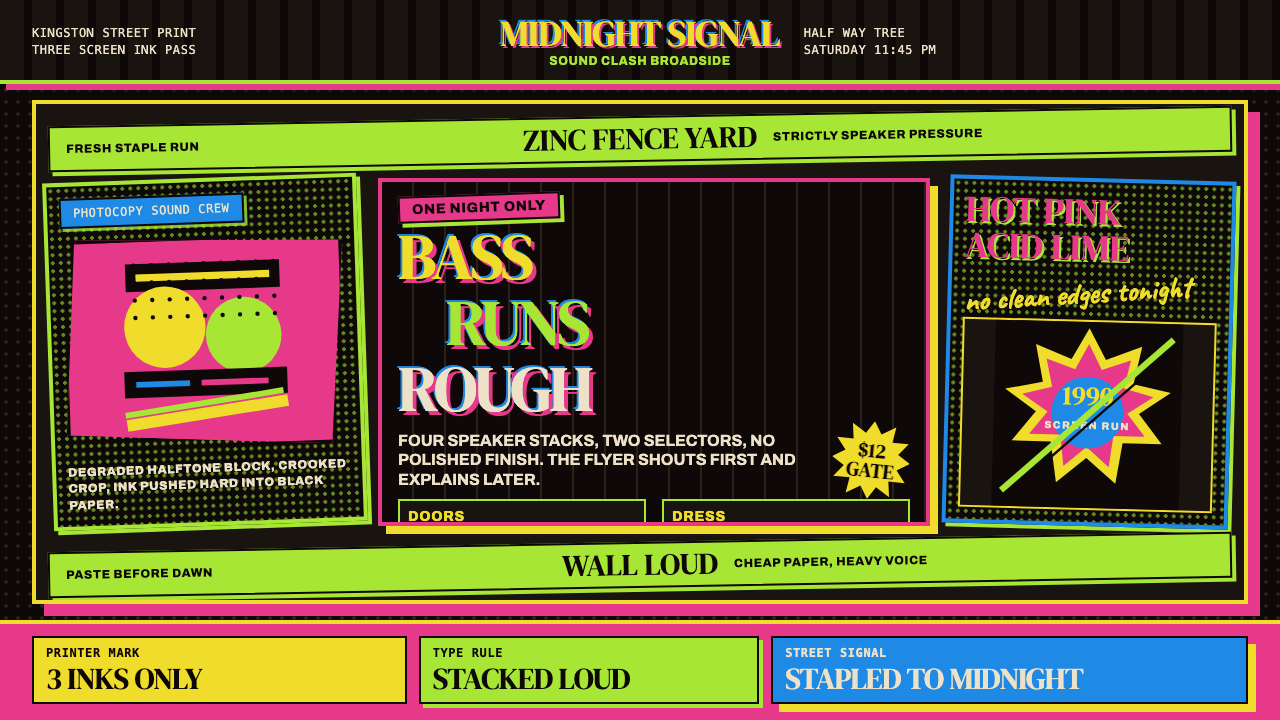
Kingston's midnight streets ran on fluorescent ink — dancehall poster culture of the late 1980s and early 1990s turned cheap newsprint and three screaming colors into the most urgent graphic language Jamaica ever produced.
Jamaican Dancehall 1990 Poster in brief
Jamaican Dancehall 1990 Poster is a graphic style rooted in the hand-printed event flyers that plastered Kingston's telephone poles, zinc fences, and bus-stop walls between roughly 1985 and 1995. Sign painters and screenprinters working in neighborhoods like Half Way Tree, Greenwich Farm, and Trench Town produced hundreds of these flyers each week using the cheapest available materials — low-grade newsprint, fluorescent inks mixed in three-color separations, and hand-cut stencils — to announce selector nights, sound-system clashes, and dancehall concerts headlined by artists like Beenie Man.
The visual logic of this style is confrontational by necessity. A flyer had to do its job from twenty feet away, on a cluttered wall, at night, competing with dozens of identical-sized sheets nailed beside it. That competition produced a specific set of solutions: type stacked in heavy wedge-serif letterforms at sizes that seem almost cartoonish by print standards, color combinations of acid lime against hot pink against electric blue against black, and portrait photographs of performers reproduced through photocopiers so many times that they dissolve into high-contrast ghostly shapes — half recognizable face, half halftone dot field.
What distinguishes this style from generic retro pastiche is its structural honesty. Every visual decision traces back to a production constraint: the limited ink colors reflect three-pass screenprint economics, the heavy type is legible at distance on degraded paper stock, the halftone dots are artifacts of cheap reproduction rather than decorative choices. The aesthetic is the process made visible. Contemporary applications that capture this authentically preserve that sense of material pressure — things look like they were made fast, printed cheap, and stapled to something real.
Where does Jamaican Dancehall 1990 Poster come from?
The roots of Jamaican dancehall poster culture lie in the sound-system tradition that had shaped Kingston's street life since the 1950s. Rival sound systems — mobile discotheques run by selectors who sourced exclusive imported records — competed for audiences at outdoor parties called lawn dances or yard sessions. Promoting these events required visible, immediate announcement, and by the 1970s a loosely organized craft of sign-painting and poster-printing had grown up around the dancehall economy to serve that need.
The golden era of the poster form coincided with the rise of dancehall as a distinct musical genre in the mid-1980s. Dancehall's split from roots reggae was partly ideological — faster rhythms, deejays toasting over pre-recorded riddims rather than live bands, and lyrics that addressed the immediate experience of Kingston's inner-city youth — and partly economic, driven by the cassette culture and sound-system sound-clash circuit that made the music intensely local and competitive. The poster culture matched that energy: Jeff Cassell, operating out of the Half Way Tree area, and Sangie Burchell, associated with the Greenwich Farm scene, became known for fluorescent work that could be read across a darkened lot.
The visual vocabulary that emerged drew on multiple practical sources. Jamaican sign-painting had its own tradition of heavy lettering and bold color, inherited partly from the hand-lettered shop fronts and church announcement boards that had lined Kingston's commercial streets for generations. The shift to screenprinting allowed larger runs at lower cost but imposed the three-color constraint that became a defining feature. Promotional photographs of performers — artists like Maxine Walters, who bridged the older lovers rock scene into dancehall — were sourced from whatever prints were available and reproduced on the cheapest office photocopiers, a process that stripped highlight detail and created the characteristic degraded halftone texture.
The style's lifespan was bounded by economic shifts. By the mid-1990s, digital desktop publishing had reached Kingston's print shops, and the hand-produced fluorescent poster began giving way to computer-set type and inkjet color. The production constraints that had shaped the aesthetic dissolved, and with them went some of the raw visual pressure that had made the earlier work so forceful. What remained was a defined period of approximately a decade — the post-Yellowman era through the early dancehall mainstream — whose graphic output has since become recognized internationally as a coherent and historically significant design moment.
What defines the Jamaican Dancehall 1990 Poster look?
Color Palette
The palette is built from the maximum contrast available in fluorescent screenprint inks: acid lime green, hot magenta pink, and electric cyan blue deployed against a black or very dark ground. A fourth presence — the unprinted newsprint stock itself, showing through as a warm off-white — acts as a passive neutral. These colors do not harmonize; they compete. Their relationship is adversarial rather than complementary, and that tension is the point. The darkness of the ground makes each fluorescent color vibrate with an intensity impossible to achieve on white stock.
Typography
Type is the loudest element on the page, and it is meant to be. Wedge-serif letterforms — condensed, with triangular bracketed serifs that thicken toward the terminals — dominate, set at sizes that fill the upper half of the sheet. Text is stacked vertically in tight blocks with almost no leading between lines, creating dense typographic masses rather than readable columns. The stacking is often deliberately imperfect: slight angle shifts, inconsistent spacing, and mixed weights within a single headline give the impression of letters assembled by hand in urgent conditions rather than set by machine.
Photographic Degradation
Portrait photographs of performers are central to the composition but are never reproduced cleanly. Multiple generations of photocopying strip away the midtone information and leave behind a binary field of near-black and near-white, with visible halftone dot patterns at the transitions. The faces that emerge are simultaneously recognizable and ghostlike — iconic enough to identify an artist, degraded enough to carry the energy of something reproduced too many times. This quality of worn reproduction is structural, not incidental: it signals urgency, underground economics, and the raw texture of street communication.
Hard Shadow
Shadows, where they appear on type or on framing elements, are hard-edged offset duplicates of the source shape — typically cast in a contrasting fluorescent color rather than black. A hot-pink headline might carry a lime-green shadow offset at a steep diagonal; an electric-blue border might sit on a magenta duplicate. This treatment has practical roots in multi-pass screenprinting where registration shifts between plates produce unintended but striking misalignment effects. The aesthetic borrowed and exaggerated those accidents into a deliberate compositional device.
Stacked Information Architecture
The flyer format demands that multiple layers of information — headline act, supporting selectors, venue, date, time, ticket price — be communicated at different scales on a single sheet. The solution is hierarchical stacking: the most important information runs largest across the top, each subsequent tier drops in scale but not in visual weight. Dividing lines between tiers are heavy rules or repeated asterisk patterns rather than white space. This dense, layer-cake approach to information layout is one of the style's most immediately recognizable features and its most directly useful quality for contemporary design applications.
Border and Frame Energy
The edges of the composition are rarely left quiet. Heavy border rules, often doubled or tripled, frame the sheet and reinforce the sense that this object has been produced as a complete, self-contained announcement. Within the border, subsidiary frames — boxes, panels, and ruled separators — organize the information tiers. These frames are often drawn at slightly imperfect alignments, and their thickness varies in ways that suggest hand-production. The overall effect is of a sheet that is densely packed to the very edge, with no wasted margin.
Material Authenticity
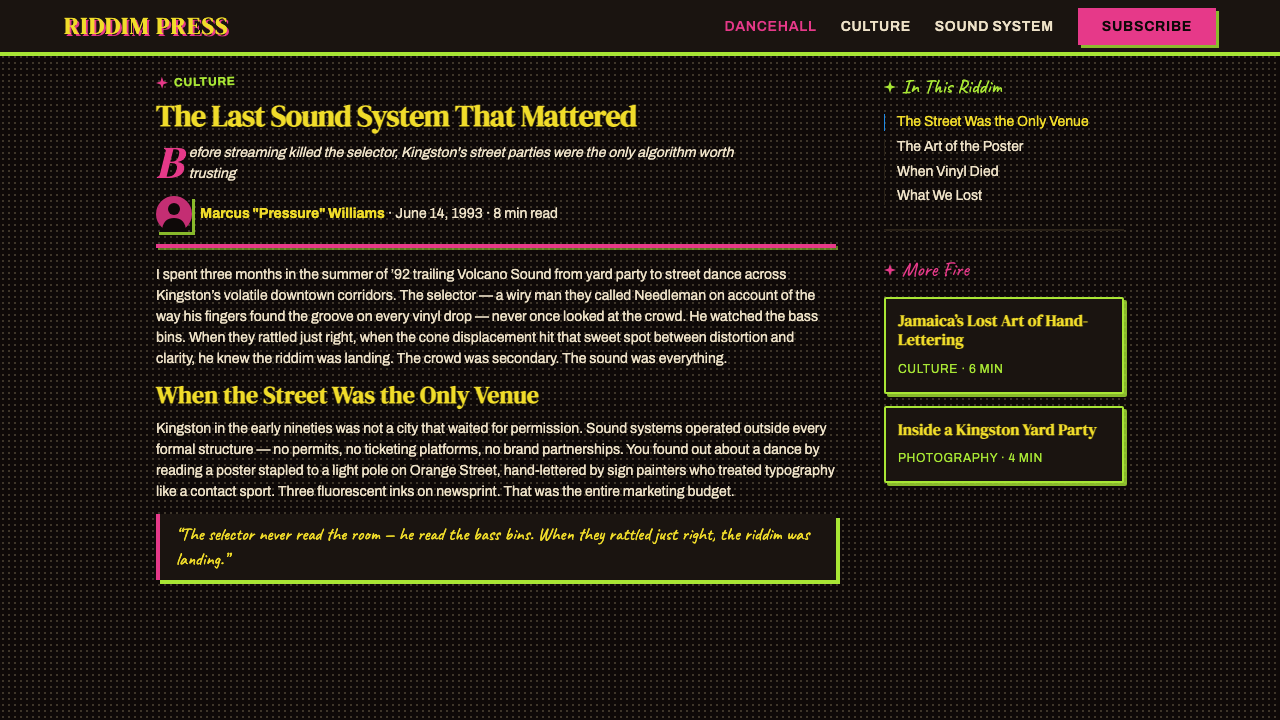
The style carries the memory of its substrate. Even when applied digitally, authentic-feeling dancehall poster design references the texture of newsprint — a faint grain or slight warmth in unprinted areas — and the slight bleed and spread of ink on an absorbent surface. These qualities are not decoration; they are evidence of process. Stripped of them, the work becomes graphic exercise rather than lived document. The distinction matters practically: when the material texture is present, the boldness reads as urgent; when it is absent, the same composition can read as merely loud.
Who shaped Jamaican Dancehall 1990 Poster?
Cassell was among the most prolific of the Half Way Tree-area printers who defined the visual standard for Kingston dancehall promotion during the late 1980s and early 1990s. Working with the three-color fluorescent screenprint format that had become the lingua franca of the scene, he produced flyers that set a high bar for typographic boldness and compositional density. His output is often cited as the clearest surviving example of the style at the height of its commercial function — not art produced for exhibition but communication produced under real conditions for a real audience.
Associated primarily with the Greenwich Farm and related Kingston neighborhoods, Burchell represented a slightly different regional inflection of the same poster tradition — one that some observers describe as even more aggressively compressed in its typographic approach. The geographical diversity of Kingston's dancehall poster makers is itself historically significant: the style was not produced by a single studio or workshop but emerged from a distributed craft community spread across the city's working-class neighborhoods, each with its own clients and its own subtle variations on the shared vocabulary.
As one of the dominant performing artists of the dancehall era, Beenie Man's image appeared across hundreds of promotional flyers throughout the late 1980s and into the 1990s. His presence on these materials illustrates how the poster system functioned as a visual identity infrastructure for the music itself: the graphic treatment applied to an artist's promotional photograph — the degree of photocopy degradation, the color of the hard shadow applied to the name, the hierarchical placement within the stacked composition — communicated status and scale of event in a shared visual language that Kingston audiences could read instantly.
Walters occupies an interesting transitional position in the visual record of Kingston's dancehall poster culture: she was prominent enough during the period that bridges lovers rock and the early dancehall mainstream that her promotional materials span two graphic eras, showing how the poster style evolved as the music itself shifted. Her inclusion on flyers alongside the new generation of deejay performers illustrates the collaborative and competitive nature of the dancehall promotion circuit, where a bill might include both established names with strong visual equity and newcomers whose identity was still being established through the graphic treatment applied to their images.
How do you use Jamaican Dancehall 1990 Poster today?
The Jamaican Dancehall 1990 Poster style is one of the most energetically specific historical aesthetics available to contemporary designers — which is both its strength and its limitation. It works exceptionally well when the content has inherent urgency, event-character, or street-level rawness, and it flatly refuses to cooperate with content that needs to project calm authority or institutional trust. Knowing which is which before reaching for the style is the first practical requirement.
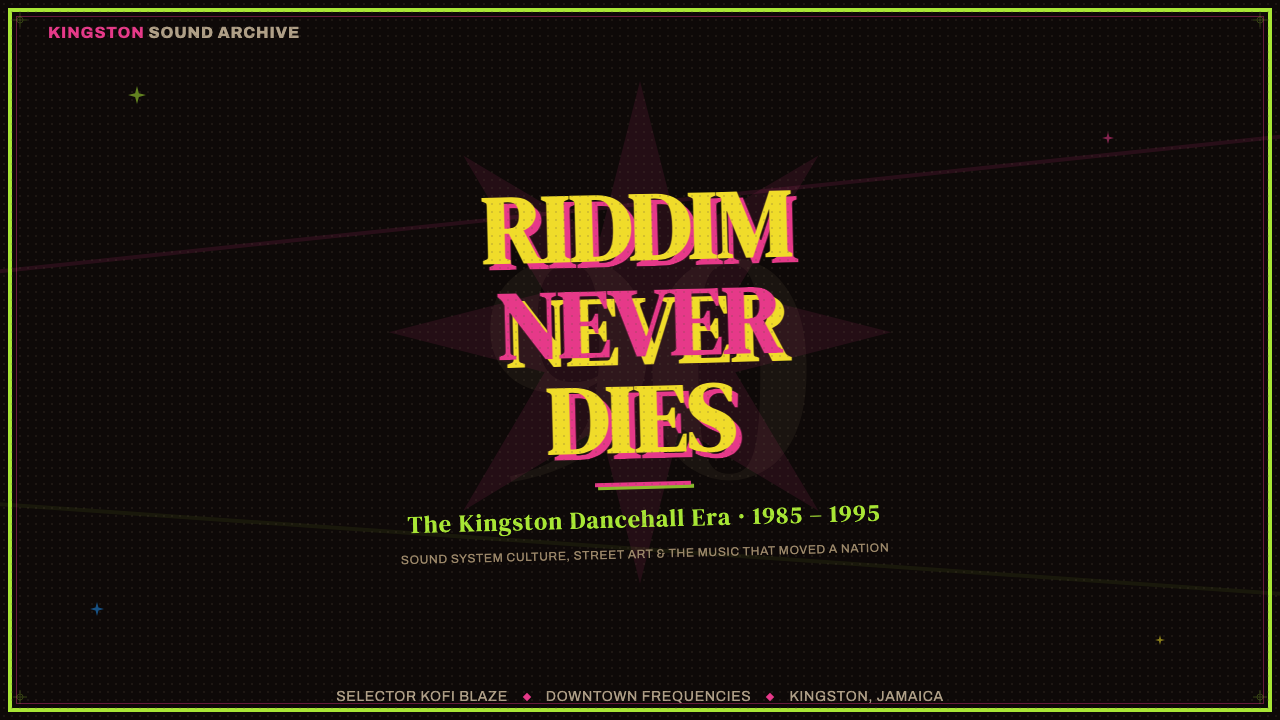
For presentation slides, the style is strongest on covers and section openers where bold announcement is appropriate. A cover built in this register might dedicate the upper two-thirds to a stacked title in oversized compressed type, with the presenter's name or event details occupying a smaller-scale block below — separated by a heavy rule rather than white space. The background should sit very dark, the type should arrive in one fluorescent color, and a second fluorescent color should provide a hard-offset shadow on the most important line. Internal content slides are harder: the style's extreme visual weight makes it difficult to sustain across dense informational layouts. The most successful approach treats each content slide as a poster of its own — one headline, one supporting detail — and accepts that information density will be lower than in a neutral style.
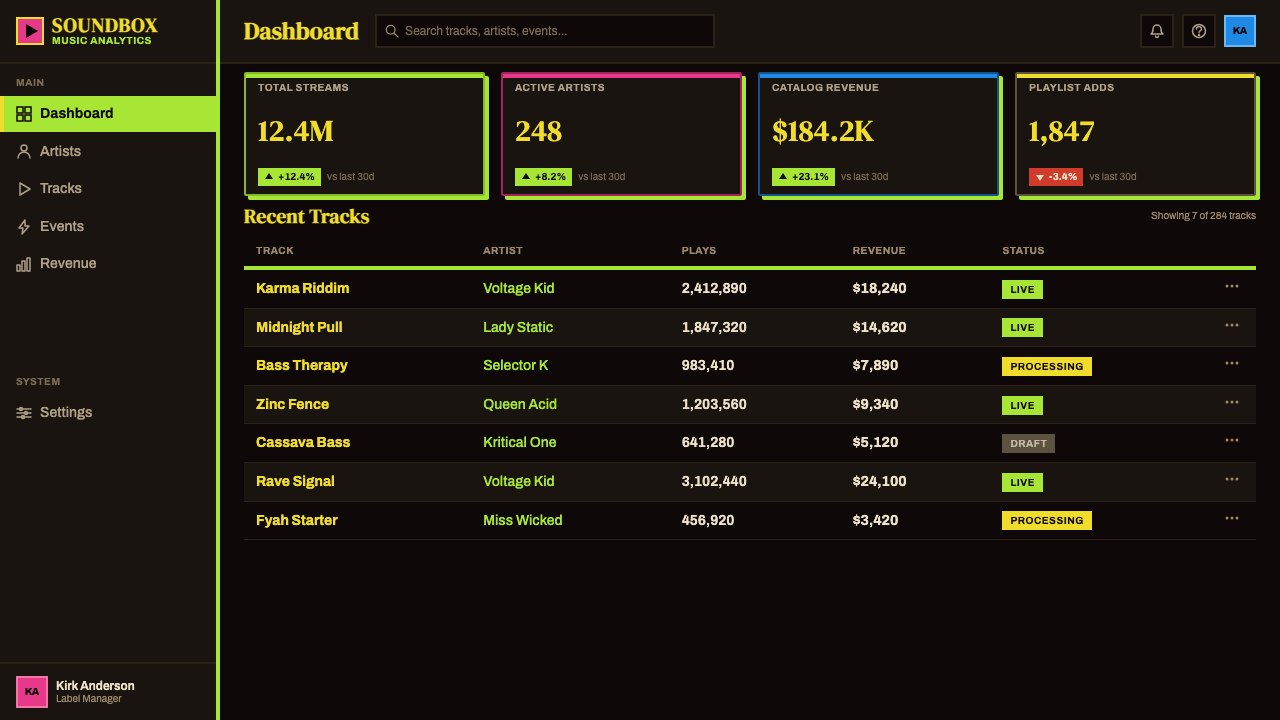
For web interfaces, the appropriate contexts are event-driven and announcement-heavy: landing pages for product launches, countdown pages, limited-release pages, and any situation where the page has a single overriding message that the user should receive before anything else. Dashboard and analytics environments are generally incompatible — the constant visual intensity makes sustained data reading exhausting. If the interface must sustain this style across multiple pages, the approach should be to reserve the full fluorescent intensity for hero and announcement zones, then pull back to a much quieter dark-ground treatment for navigation and utility areas.
For editorial and marketing applications, the style has a specific sweet spot in music, fashion, and cultural event promotion — contexts where the visual language has an authentic historical relationship with the audience. Applied to a music festival campaign, a streetwear brand, or a nightlife editorial, it can feel grounded and referential rather than appropriated. Applied to a software product, a financial service, or a healthcare context, it loses its rootedness and becomes surface styling. Marketing uses should also consider the reproduction chain: the style was designed for a very specific printing technology, and its particular qualities — the fluorescent color relationships, the halftone grain, the material texture — are most legible in contexts where the final output can carry them, whether digital screen or physical print that references newsprint's weight and absorbency.
A common and costly mistake is attempting to use the full poster palette — all three fluorescent colors at maximum saturation — simultaneously across an entire composition. The historical originals used this kind of total saturation for maximum competition-level urgency; sustained across a web page or a slide deck, it produces not urgency but exhaustion. The more functional contemporary approach is to select one fluorescent as the dominant, use the second as accent at reduced visual weight, and keep the third in reserve for a single highest-priority element. The dark ground is non-negotiable: this style does not translate to a white or light-gray background without losing most of its structural logic. And the halftone texture, where used, should feel earned — present in photographic elements and in areas of genuine tonal complexity, not scattered decoratively across flat color fields.
Jamaican Dancehall 1990 Poster — FAQ
Is this style appropriate for brands that have no connection to Jamaican culture?
It depends on the distance and depth of the application. The Jamaican Dancehall 1990 Poster style carries clear cultural specificity — it emerged from a particular community, economy, and musical tradition. Applying it superficially to unrelated brands risks coming across as appropriative or at minimum tone-deaf. However, design history has always involved styles traveling beyond their origins, and the key variable is intentionality and depth. A brand that references the style explicitly, understands its origins, and applies it with genuine engagement is in a different position from one that simply deploys fluorescent type on black without any such awareness. The question to ask honestly is: does the application honor the context that produced the style, or does it strip out that context entirely to borrow only the visual surface?
How do you achieve the photocopy-degraded texture digitally without it looking like a cheap filter?
The difference between authentic-feeling degradation and filter-effect pastiche comes down to specificity and restraint. Real photocopier degradation has a particular character: it eliminates midtones selectively, leaving bright highlights and deep shadows but collapsing the transitional zones into noise. It also introduces a specific kind of grain that is coarser than film grain and slightly directional, as though the image has been physically dragged across a platen. To achieve this digitally, the approach is to start with high-contrast source imagery, apply a threshold treatment that collapses the tonal range before adding texture, and then introduce grain that is coarser and less uniform than typical photographic noise. The result should feel like the texture is intrinsic to the image, not painted on top of it. Restraint matters too: the effect should be applied most heavily to photographic content and much more lightly, or not at all, to type and flat graphic elements.
Can this style work for a dark-mode digital product, or is it too specific?
The dark ground is actually one of the style's most transferable qualities into dark-mode digital design, since the historical originals were already built on near-black backgrounds. What transfers well: the high-contrast type hierarchy, the limited fluorescent accent palette, the hard-shadow component treatment, and the dense information stacking when content calls for it. What does not transfer cleanly: the photocopy texture (which reads as a defect in polished UI contexts rather than an aesthetic choice), the deliberate type irregularity (which signals broken rendering in a digital product), and the full-bleed border-to-border density (which works as a poster but creates a claustrophobic UI). A dark-mode product that borrows from this lineage selectively — taking the color logic, the type boldness, and the hard-shadow components while smoothing out the material roughness — can produce something that feels energetic and specific without the associations of a literal dancehall flyer.
What is the relationship between this style and broader reggae or Rastafarian visual culture?
They are related but emphatically distinct. Roots reggae visual culture — associated with Rastafarian iconography, the red-gold-green palette, and the imagery of Marcus Garvey-era Pan-Africanism — developed through the 1970s alongside the music of artists like Bob Marley and Burning Spear. Dancehall, which emerged in the mid-1980s as a deliberate generational break from roots reggae, produced a correspondingly different visual language. Where roots design tends toward natural materials, earthy warmth, and spiritual symbolism, dancehall poster culture is urban, synthetic, and intensely secular — fluorescent inks rather than earthy pigments, electric blue rather than Rastafarian gold, photocopied celebrity portraits rather than hand-painted spiritual imagery. Using the two interchangeably would be a significant misreading of Jamaican cultural history.
How does the deliberate imperfection in this style differ from Swiss grid-based precision, and when would you choose one over the other?
Swiss grid design and Jamaican Dancehall 1990 Poster are almost perfect aesthetic opposites, and that clarity makes the choice relatively simple. Swiss design communicates rationality, institutional confidence, and information mastered and organized. Dancehall poster design communicates urgency, raw energy, and information that needs to be seen right now before the moment passes. The choice is fundamentally a question of what relationship you want the design to establish with its reader. A product that is asking for sustained trust — a financial tool, a professional services firm, a long-form educational resource — benefits from the clarity and authority of a grid-based system. A product that is asking for immediate engagement — a music release, a limited-time offer, an event announcement — can use the urgency and visual intensity that the dancehall poster vocabulary delivers at its most effective. Mixing elements of both in the same composition is possible but requires careful calibration: the two systems' underlying assumptions about what design is supposed to do are genuinely incompatible, and naive blending typically produces work that achieves neither precision nor energy.
Related design styles
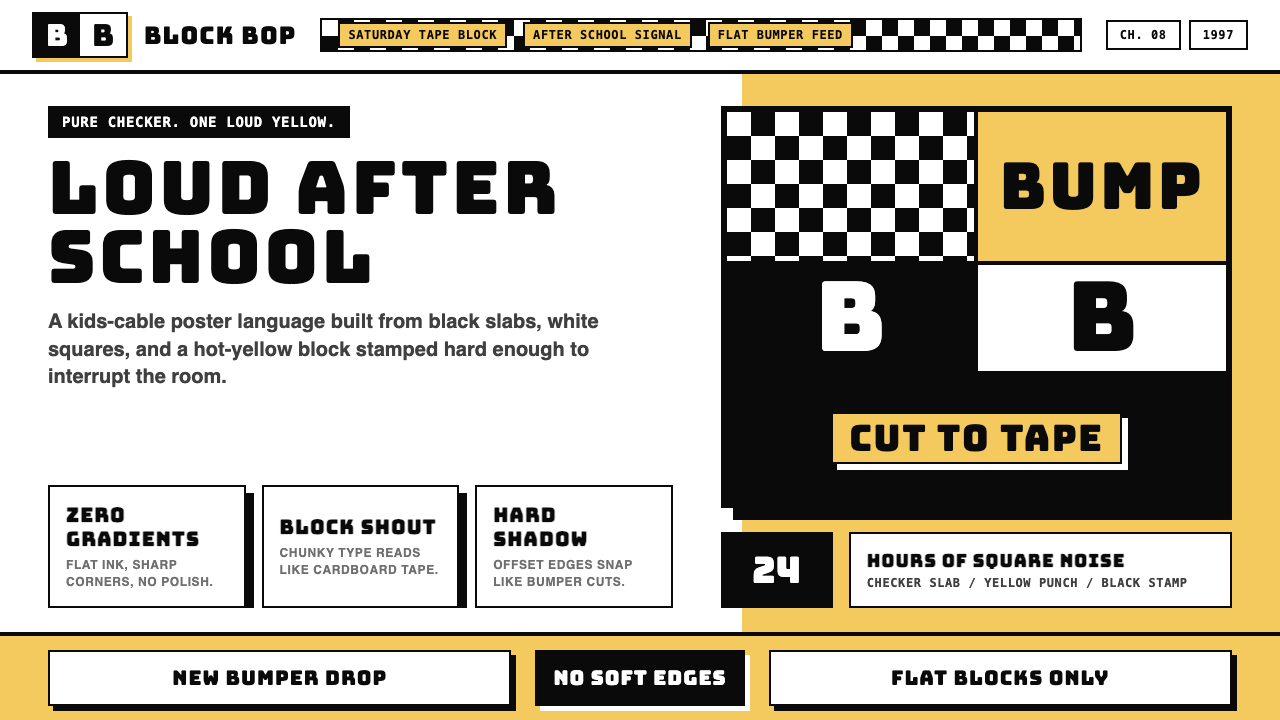 Cartoon Network 90s BlocksKids-cable noise, squared. Black-white checkerboards crash into hot-yellow Bu…
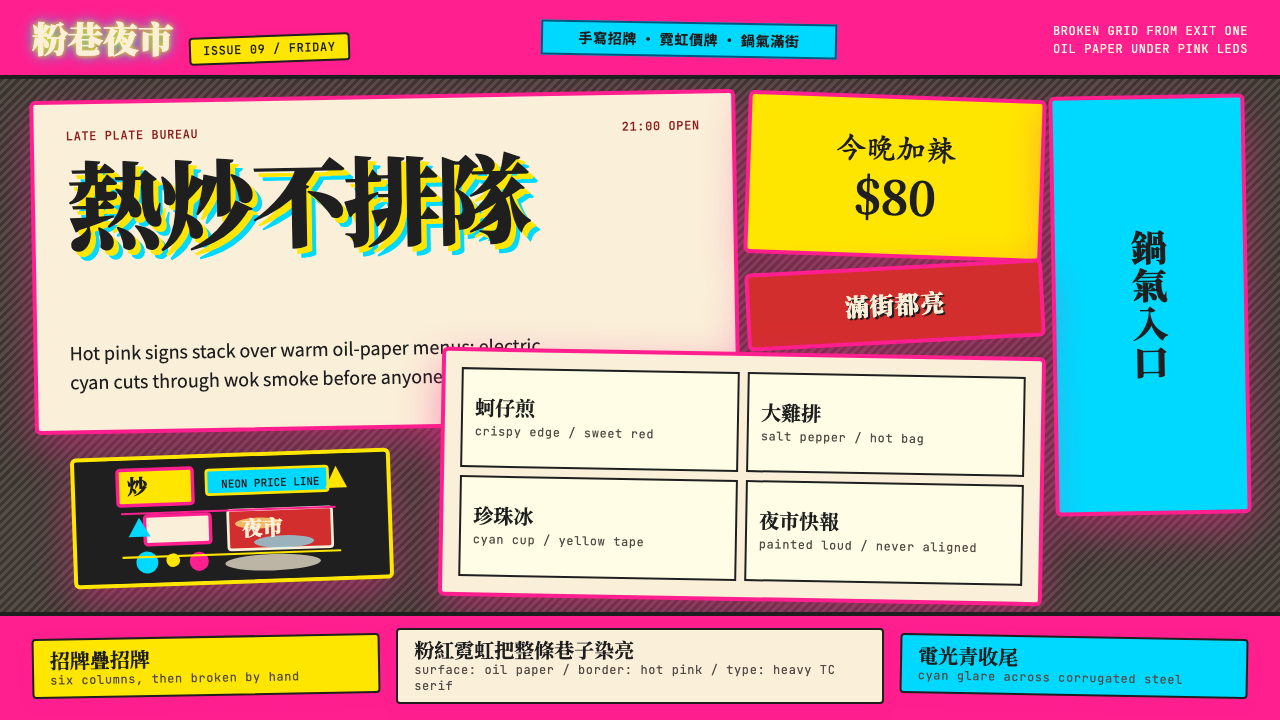 Taipei Shilin Night Market NeonLoud by design. Hot pink, neon yellow, and stacked TC serif signs break the g…
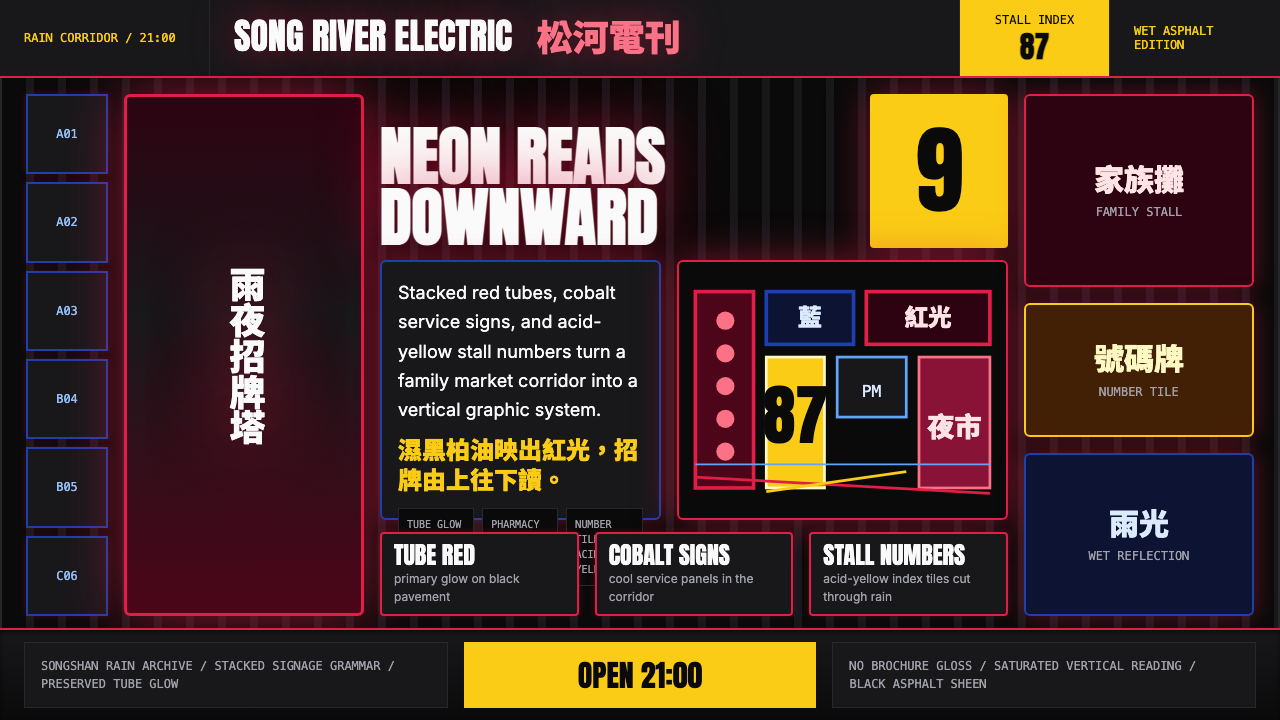 Taiwanese Raohe Night Market NeonTaipei night reads vertically. Neon red, cobalt panels, and acid-yellow numbe…
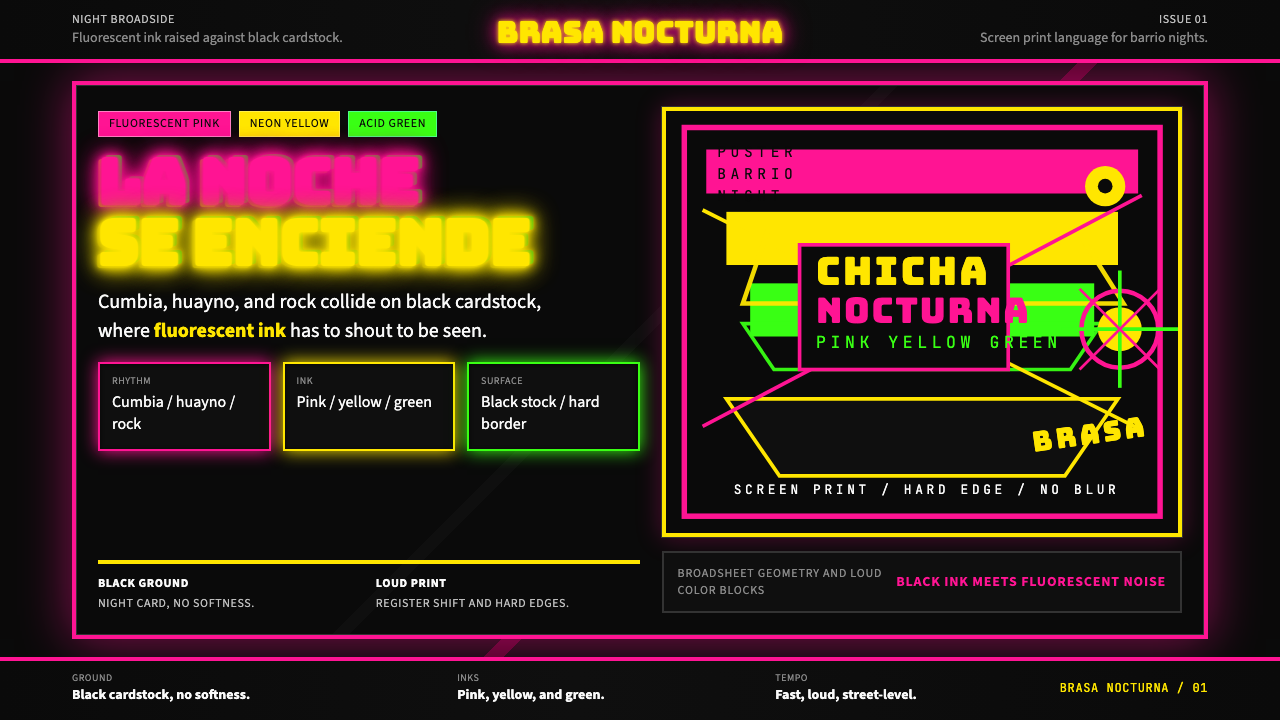 Peruvian Chicha Fluorescent PosterStreet-night fury. Pink, yellow, and green stack on black cardstock in hard b…
 TMNT (1987 Saturday-Morning)Saturday-morning chaos, full blast. Sewer green, bandana brights and clogged…
 Varsity LettermanEarned, not printed. Navy wool ground, school-gold chenille and block varsity…