What is Cartoon Network 90s Blocks?
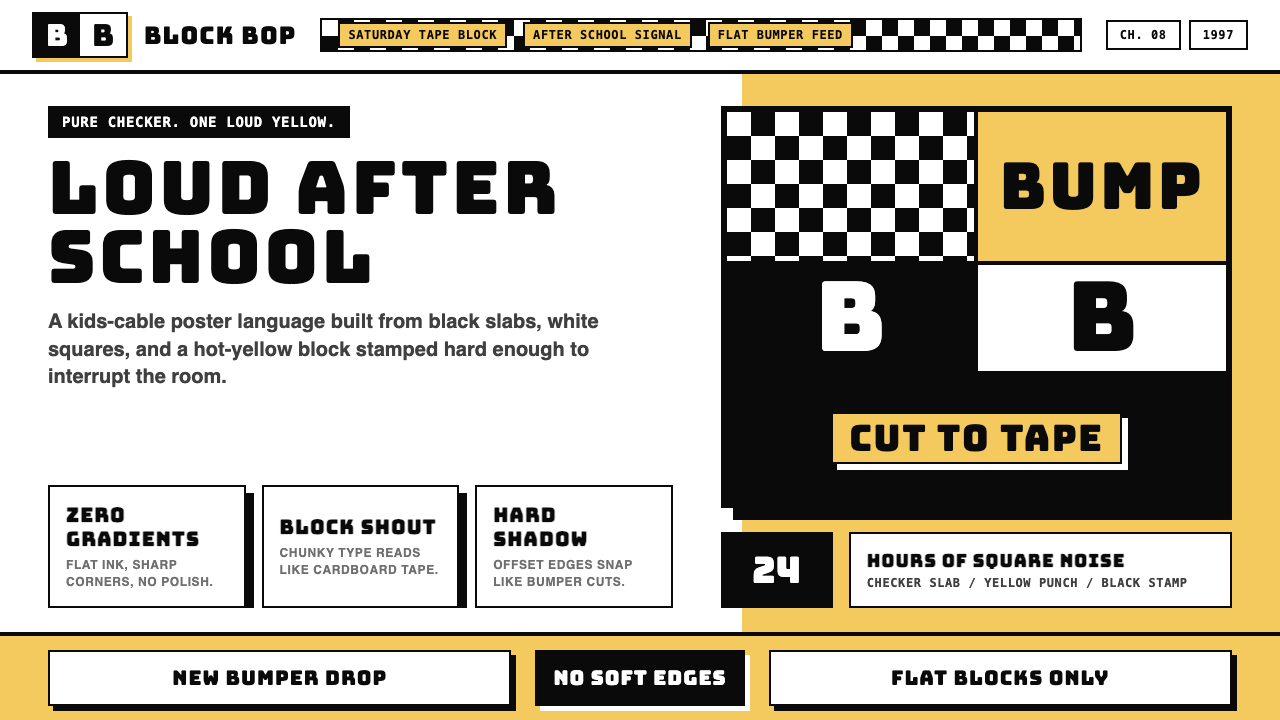
Cartoon Network's 1990s identity weaponized the bluntest tools in the visual kit — black-and-white checkerboard, saturated primary blocks, and slab letterforms so chunky they look stamped rather than typed.
Cartoon Network 90s Blocks in brief
Cartoon Network 90s Blocks is a pop-culture graphic style derived directly from the on-air identity that Cartoon Network broadcast throughout the 1990s and early 2000s. Its core grammar is immediately legible: a high-contrast checkerboard of pure black and pure white squares serves as the signature ground or accent pattern; against this, single blocks of fully saturated color — hot yellow, cobalt blue, signal red, lime green, or hot pink — are placed with the bluntness of a rubber stamp. Over everything sits a wordmark or headline in a typeface so wide and heavy that it reads as a physical object rather than a linguistic sign.
The style belongs to a specific moment in American popular culture when cable television was fighting for children's attention and brand recognition had to work at the resolution of a cathode-ray tube screen seen from across a living room. Every element was therefore pushed to the point of no subtlety: maximum contrast, zero gradients, corners so sharp they could be cut with scissors. This was not a failure of sophistication — it was a deliberate calibration to the medium's constraints and the audience's age.
Used today, the style functions as an immediately recognizable nostalgic signal. It carries connotations of Saturday-morning ritual, after-school television, and a particular strain of American countercultural humor that ran through shows like Dexter's Laboratory, Johnny Bravo, The Powerpuff Girls, and Courage the Cowardly Dog. Designers reach for it when they want to invoke that specific warmth of 1990s kids-cable memory, or when a project calls for an energy that is loud, confident, and deliberately unbothered by restraint.

Where does Cartoon Network 90s Blocks come from?
Cartoon Network launched on October 1, 1992, as a division of Ted Turner's Turner Broadcasting System, headquartered in Atlanta, Georgia. Its initial programming was drawn entirely from the Hanna-Barbera and MGM animation libraries that Turner had acquired — Yogi Bear, The Flintstones, Tom and Jerry — but the channel needed a visual identity powerful enough to carve shelf space from two dominant incumbents: Disney Channel and Nickelodeon. The solution was a brand system built around the most reductive possible visual unit: the square.
The original identity design used a simple black-and-white checkerboard as its organizing motif, with the letters 'CN' locked into a two-square block. The system was deliberately system-agnostic — it reproduced cleanly in any color combination, at any scale, on the limited broadcast graphics technology of the early 1990s. When color blocks were introduced as bumpers and interstitials throughout the decade, they followed the same logic: one flat saturated color per block, no blending, no gradients. The checkerboard and the color slab were interchangeable modules in a visual kit that any production team could operate without specialized design expertise.
The cultural context mattered as much as the technical constraints. The early 1990s were a moment of post-MTV visual maximalism in American media — the music channel had established that graphic boldness and rapid-cut energy were not only acceptable but expected in youth-targeted television. Cartoon Network absorbed this lesson and pushed it further into pure geometric flatness, partly because animation cel aesthetics already privileged flat color and sharp outlines, and partly because the network's countercultural positioning relative to the more polished Disney and Nickelodeon brands called for something rougher and more deliberately 'undesigned-looking.'
The creative ecosystem that grew up around the network in the mid-1990s reinforced the aesthetic. Mike Lazzo, the executive credited with shaping the network's experimental sensibility, championed shows that broke with the smooth production values of competitor networks. Genndy Tartakovsky's Dexter's Laboratory and Samurai Jack used hard-edged color fields and deliberate stylization drawn from mid-century Modernist animation. Craig McCracken's The Powerpuff Girls deployed flat primary-color character design that read like Pop Art applied to children's television. Adult Swim, launched as a late-night block in 2001, extended the checkerboard identity into something more deadpan and conceptually strange. Together, these productions gave the graphic style a body of associated cultural material so dense that it now functions as a complete aesthetic shorthand — the black-and-white checker alone is enough to trigger the entire referential system.
What defines the Cartoon Network 90s Blocks look?
Checkerboard Ground
The alternating black-and-white square grid is the style's most distinctive and non-negotiable element. It operates both as background fill and as a secondary graphic object — appearing behind type, bordering a color slab, or cropped to a strip as a dividing element. The squares are always equal in size and always in pure black and pure white, never softened to gray or tinted. The pattern carries an optical vibration at smaller scales that reads as raw visual energy, which is precisely the effect it was designed to produce in short-format broadcast contexts.
Saturated Color Blocks
Color in this style is applied in single, undivided, fully saturated slabs. Hot yellow, signal red, cobalt blue, lime green, and hot pink are the characteristic hues — all pushed to maximum chroma, never tinted or toned down. Each color block occupies a clearly bounded rectangular area with no bleed, no gradient transition, and no inner shadow. The blocks are combinatorial: two or three colors might appear on the same composition, but they never blend — they simply abut, creating hard seams that emphasize the stacked-cardboard quality of the overall design.
Chunky Display Letterforms
Type in this style is exhibition-weight — meaning letterforms are so wide and heavy that they function more like geometric shapes than linguistic characters. The defining quality is mass: each letter feels as though it has physical weight, its strokes thick enough to cast a shadow if the characters were made of cardboard. These are rounded or squared display sans-serifs, with minimal contrast between thick and thin strokes. Letterspacing is tight to negative, pushing letters into each other to reinforce the impression of a solid block. All-caps settings are standard for headlines; mixed case appears only in secondary text.
Hard-Edge Flat Construction
Every element in a correctly executed composition is flat, opaque, and hard-edged. There are no drop shadows with feathered edges, no glows, no translucency, no inner highlights simulating three-dimensional surfaces. Where an offset shadow is used for type or a block element, it is a solid duplicate shifted at an angle — itself a flat shape, not a lighting simulation. This absolute flatness is not minimalism in the contemporary sense; it is a direct inheritance from animation cel production, in which flat color fields were a technical requirement, and from the broadcast graphics technology of the era.
Brick-Stack Composition
Layouts in this style organize elements in stacked horizontal or vertical bands, like courses of bricks or layers of cardboard. A typical composition might consist of a checkerboard strip at top, a wide color-block band containing the headline, and a white or black band below for secondary information — with no decorative transitions between zones, only a hard line where one color ends and another begins. This banded structure scales well to both landscape and portrait formats and produces the same visual impact whether the output is a television bumper, a social media card, or a presentation slide.
Zero Ornament, Maximum Signal
Unlike many nostalgic or retro design styles, Cartoon Network 90s Blocks carries no decorative detail beyond its primary visual vocabulary. There are no halftone dots, no distressed textures, no decorative borders with chamfered corners, no illustrated mascots or character art beyond the design system itself. The style's energy comes entirely from the collision of its three core elements — checkerboard, color block, chunky type — not from surface embellishment. Adding decorative elements to a composition in this style is the most reliable way to dilute it.
CN Wordmark Logic
The original CN logo — two letterforms locked into a checkerboard-derived two-square format — encodes the style's entire compositional logic in miniature. Type and pattern are not separate layers but a single integrated object. Contemporary applications of the style often import this same logic: a letterform or short word is dropped directly into a color block or checkerboard field, with no padding or separation, so that the type and the ground become a single graphic unit. This fusion of letterform and pattern is the style's most distinctive structural move.

Who shaped Cartoon Network 90s Blocks?
Ted Turner founded Cartoon Network as a vehicle for the enormous Hanna-Barbera and MGM animation library he had acquired, and his competitive instinct drove the channel's aggressive brand differentiation from Disney and Nickelodeon. The checkerboard identity system was, in part, a product of his mandate that the channel be unmistakable at a glance — a constraint that pushed the design team toward maximum contrast and minimum visual complexity. Turner's broader media empire context also meant the channel launched with the expectation of scrappy resource efficiency, which the modular, template-based visual system was designed to satisfy.
As a programming executive, Mike Lazzo shaped the editorial culture that gave the Cartoon Network visual style its particular flavor of self-aware strangeness. He championed original productions that deliberately pushed against the grain of mainstream children's television, and his influence extended to the Adult Swim late-night block, which inherited the checkerboard identity but stripped it to its most deadpan, conceptually minimal expression. Lazzo's programming philosophy — that the audience was smart enough to appreciate work that did not explain itself — is embedded in the visual system's refusal of decoration.
Tartakovsky's shows — Dexter's Laboratory, The Powerpuff Girls (as character designer), and later Samurai Jack — became the most visually sophisticated expressions of the Cartoon Network aesthetic. His work synthesized the channel's flat-color, hard-edge visual grammar with influences from mid-century American Modernist animation and Japanese visual culture, producing show designs that looked simultaneously like Cartoon Network bumpers and like genuine animation art. Tartakovsky demonstrated that the blocky visual system was not a creative limitation but a formal constraint that, when mastered, produced work of considerable artistic distinction.
McCracken created The Powerpuff Girls, whose character and production design became one of the clearest articulations of what the Cartoon Network style could achieve at the level of a full animated series. The show's visual vocabulary — primary-color character palettes, hard outlines, flat fills, and a background design language drawn from Modernist graphic design — demonstrated that the channel's brand aesthetic was not just a bumper style but a complete visual framework capable of sustaining half-hour narrative television. McCracken's success helped establish the visual system's credibility as an artistic choice rather than a budget constraint.
The Hanna-Barbera production library — acquired by Turner in 1991 — provided not just the programming content that filled Cartoon Network's schedule but a direct visual precedent for the channel's design system. Hanna-Barbera's 1960s and 1970s television animation was itself a system of simplified flat color and hard outlines developed in response to the economic constraints of weekly broadcast production. The limited animation style that the studio pioneered — static backgrounds, simplified character movement, bold flat color — is a direct ancestor of the Cartoon Network 90s Blocks aesthetic. The channel's identity design was, in this sense, a graphic distillation of the very animation tradition it was built to broadcast.
How do you use Cartoon Network 90s Blocks today?
Cartoon Network 90s Blocks is a high-energy, high-specificity style — meaning it works extremely well in contexts where its cultural associations are desirable, and it fails conspicuously in contexts where they are not. The designer's first task is to determine whether the audience will read the checkerboard-and-saturated-block vocabulary as charming nostalgia, as energetic boldness, or as juvenile inappropriateness. For youth-targeted brands, gaming companies, entertainment products, and any project that explicitly wants to invoke 1990s American popular culture, the style is one of the most immediately effective tools available.
For presentation slides, the style produces exceptional cover pages when applied with structural discipline. A cover built in this mode works best with a single wide color block anchoring the lower two-thirds of the slide, a checkerboard strip running along one edge, and the title set in the heaviest available display weight — white or black depending on the color block beneath. Content slides should strip back to a near-white or black ground with color used only for section headers or call-out blocks; applying the full checkerboard treatment to every slide in a deck quickly becomes visually fatiguing. Data slides benefit from the style's flat-color logic: bar charts and progress indicators can be given the same saturated block treatment as the brand elements, with each data category assigned its own primary-palette color. The key is that data elements should look like they belong to the same visual system as the slide furniture, not like a chart pasted in from a spreadsheet application.
For web interfaces — particularly dashboards, event landing pages, gaming platform interfaces, and youth-brand product pages — the style offers a ready-made hierarchy system. The checkerboard pattern works well as a background accent or section divider rather than a full-page wallpaper; as a full background it competes with content for visual attention. Color blocks should be used for primary call-to-action zones, navigation backgrounds, and section headers, with a near-white or black main content area providing the visual relief the eye needs to read smaller text comfortably. Button states, alerts, and interactive indicators are natural candidates for the saturated accent colors. Pricing pages in this style benefit from assigning one color block per pricing tier, creating a visual differentiation that requires no additional iconography.
For editorial and marketing work — social media content, event posters, merch graphics, and youth-targeted advertising — the style is at its most native. A social card in this style is structurally very simple: a color block as ground, a checkerboard strip as a secondary element, and display type that fills most of the available space. The style's strength in this context is that it competes well in feed environments where most content uses photography and soft gradients — a hard-edged flat-color composition stands out by contrast. For physical print applications such as posters and merchandise, the style's flat construction and hard edges mean it reproduces with perfect fidelity at any scale, with no loss of impact between a mobile screen and a large-format print.
The most common mistake when applying this style is treating the checkerboard as wallpaper — tiling it across every background regardless of context. The pattern has very high visual noise at full coverage; it works as an accent, a strip, or a contained element, not as a page-filling ground competing with a text-heavy composition. A close second mistake is using all available accent colors simultaneously at full saturation in a single composition. Each color block should be treated as a primary character in the layout; combining four or five saturated hues at equal intensity produces visual chaos rather than energy. Choose one or two dominant colors per composition and allow the black-and-white checker to provide the contrast.
A third common error is choosing a typeface that is merely bold rather than genuinely display-weight and wide. The style's typographic energy depends on letterforms that are close to square in their overall proportions, with strokes heavy enough that the white counter spaces inside letters become as visually active as the strokes themselves. A standard bold weight of a neutral sans-serif will look underpowered next to the saturated color blocks; the type must feel like it is competing with the blocks for dominance, not retreating behind them.

Cartoon Network 90s Blocks — FAQ
Is this style the same as general 1990s nostalgia design?
No — Cartoon Network 90s Blocks is a specific, well-defined visual system, not a catch-all category for anything that feels retro from that decade. General 1990s nostalgia design often incorporates elements like halftone textures, distressed typography, neon gradients, and grunge textures, none of which appear in this style. The Cartoon Network system is unusually pure: checkerboard pattern, flat saturated color blocks, and display-weight type are the complete vocabulary. Introducing halftones, textures, or gradient-neon elements creates a mixed-nostalgia composition that fails to read as authentically CN. If the goal is a specific Cartoon Network reference, keep the system tight.
Can the style work in a restrained, professional context like a B2B product?
With significant adaptation, yes — but the result will necessarily move away from the core style. The elements of the system that can be selectively imported into a more professional context are the hard-edge flatness, the block-based layout logic, and the use of a single saturated accent color alongside black and white. The checkerboard pattern specifically tends to read as playful or childlike in B2B contexts and is usually the first element to be dropped or reduced to a very small accent. The display-weight typography can be retained if tightened in its proportions. The risk is that selective adoption produces something that looks like a diluted or confused version of the style rather than a professional design with CN-derived influences. If the B2B context requires authority and trust signals, a style with more heritage behind it — Bauhaus, Swiss International Style — may serve better than a 1990s cable-television brand system.
What is the relationship between this style and Adult Swim?
Adult Swim launched in 2001 as Cartoon Network's late-night programming block and inherited the channel's checkerboard visual identity while developing a distinct sub-aesthetic. Where the main Cartoon Network identity was saturated, loud, and energetic, Adult Swim stripped the same checkerboard vocabulary back to its most reduced form — black and white only, with the checkerboard used in a more fragmented, almost glitchy way, and typography that was deliberately flat and low-key rather than display-weight and punchy. Adult Swim's aesthetic is the same source material processed through a deadpan, ironic sensibility. Designers sometimes combine both registers — the saturated Cartoon Network energy and the flat Adult Swim restraint — but this requires careful calibration to avoid producing something that reads as neither.
Does this style work for dark or night-mode interfaces?
Yes, and in some respects the style is more at home on a black ground than it is on white. The original Cartoon Network identity used black and white in equal measure, with pure black as a fully active design element, not merely a text color. On a black ground, the saturated color blocks advance with particular aggression, and the white checkerboard squares read as light-emitting rather than paper-colored — which suits digital screen contexts well. The practical consideration for dark interfaces is that hot yellow, which is very legible and energetic on white, can become visually dominant to the point of instability on black; in dark-mode applications, red or cobalt tends to hold its structural role more reliably. The checkerboard in a dark implementation usually works best when the two alternating values are pure black and pure white, without tinting either toward gray.
How do I avoid the style looking like a cheap parody of itself?
The difference between an authentic application of Cartoon Network 90s Blocks and a cheap parody of it is structural discipline. A parody version typically piles on every element simultaneously — full-coverage checkerboard, all five accent colors, multiple display typefaces, checkerboard borders around checkerboard content — until the composition collapses into visual noise. Authentic application treats the system as a kit with rules: one or two dominant colors per composition, the checkerboard used as an accent rather than a wallpaper, a single typeface family at varying weights, and empty black or white space given the same importance as the color blocks. The CN design system was always a system — constrained, modular, and rule-governed. Applying it successfully requires the same discipline that the original broadcast designers applied to bumpers that had to communicate in under three seconds.
Related design styles
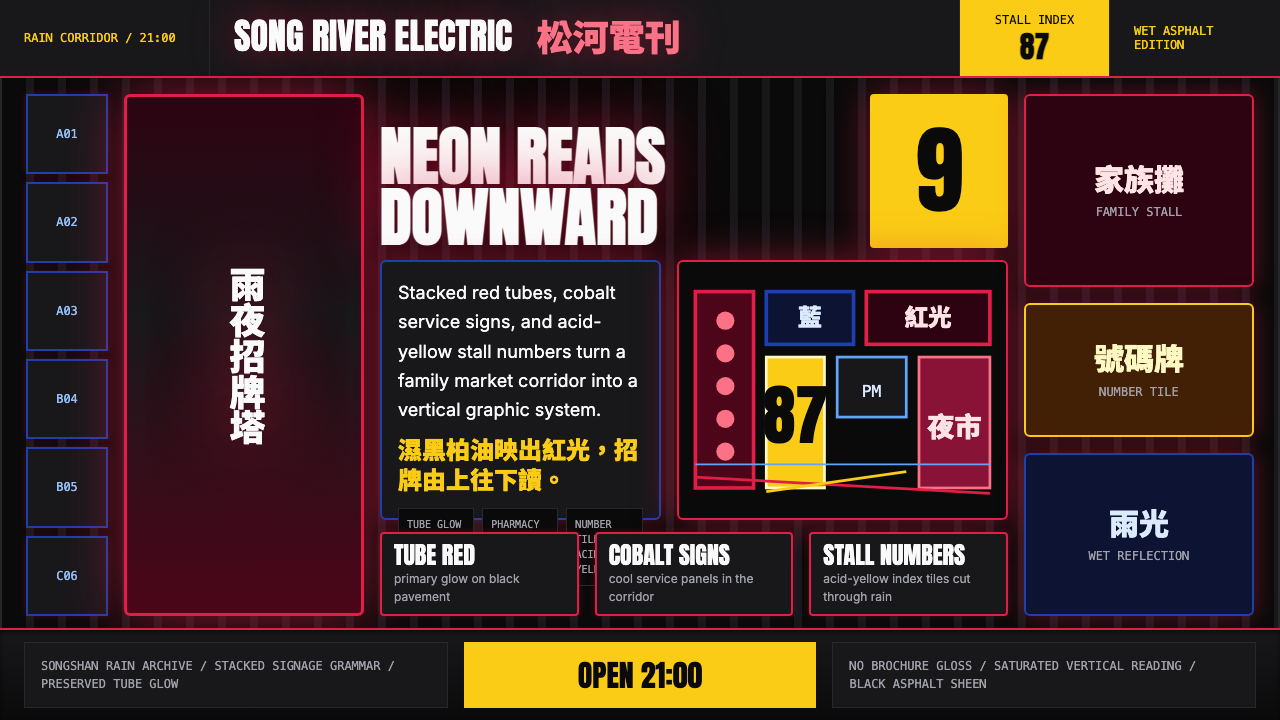 Taiwanese Raohe Night Market NeonTaipei night reads vertically. Neon red, cobalt panels, and acid-yellow numbe…
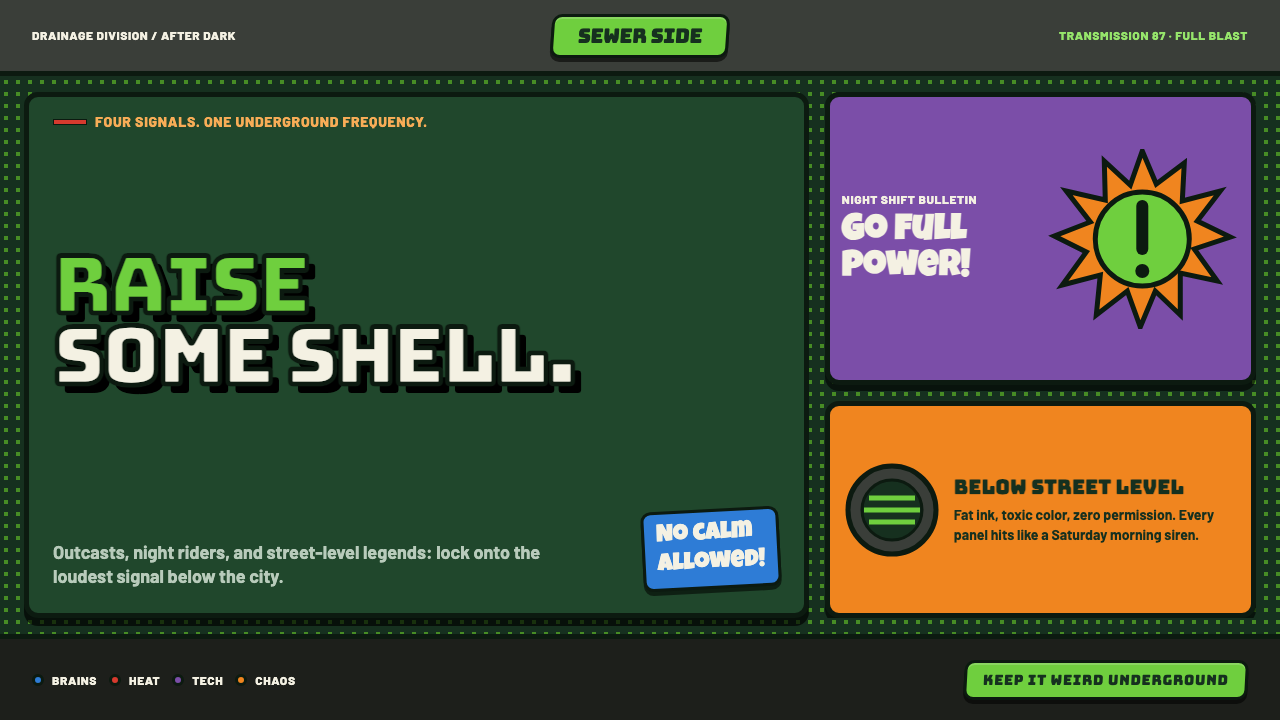 TMNT (1987 Saturday-Morning)Saturday-morning chaos, full blast. Sewer green, bandana brights and clogged…
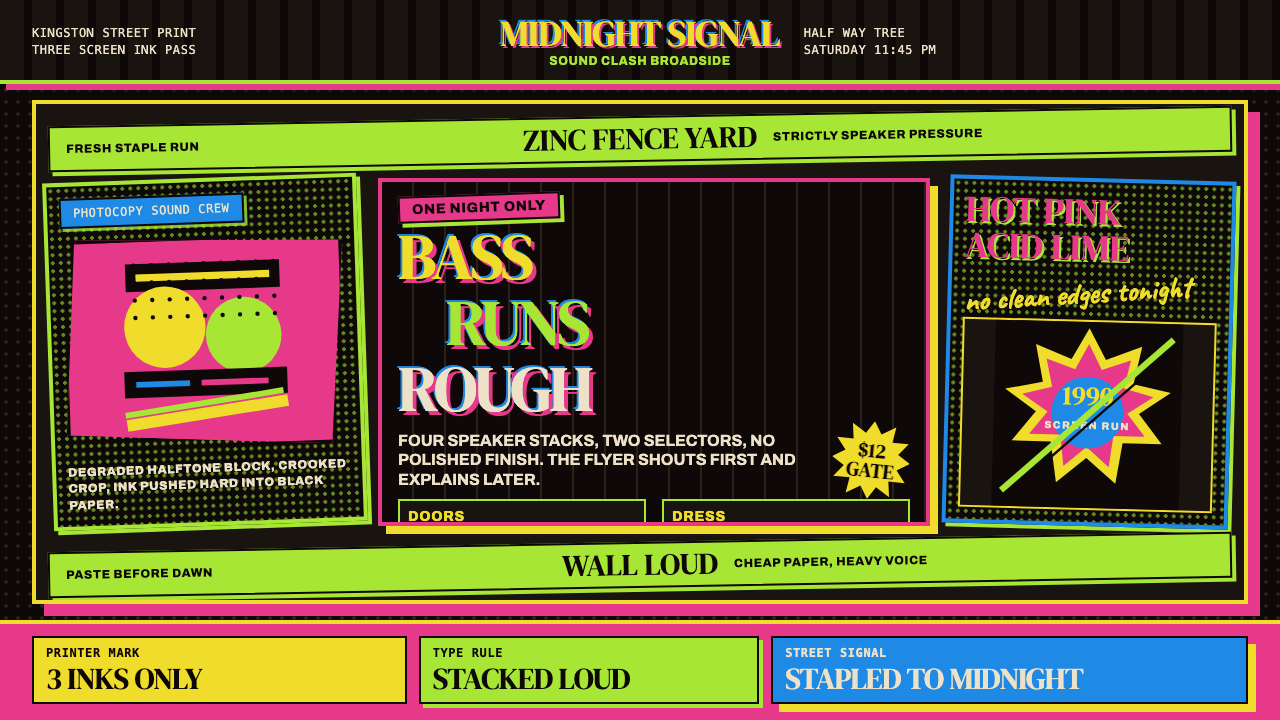 Jamaican Dancehall 1990 PosterMidnight volume. Acid lime and hot pink type stack like screenprint ink on bl…
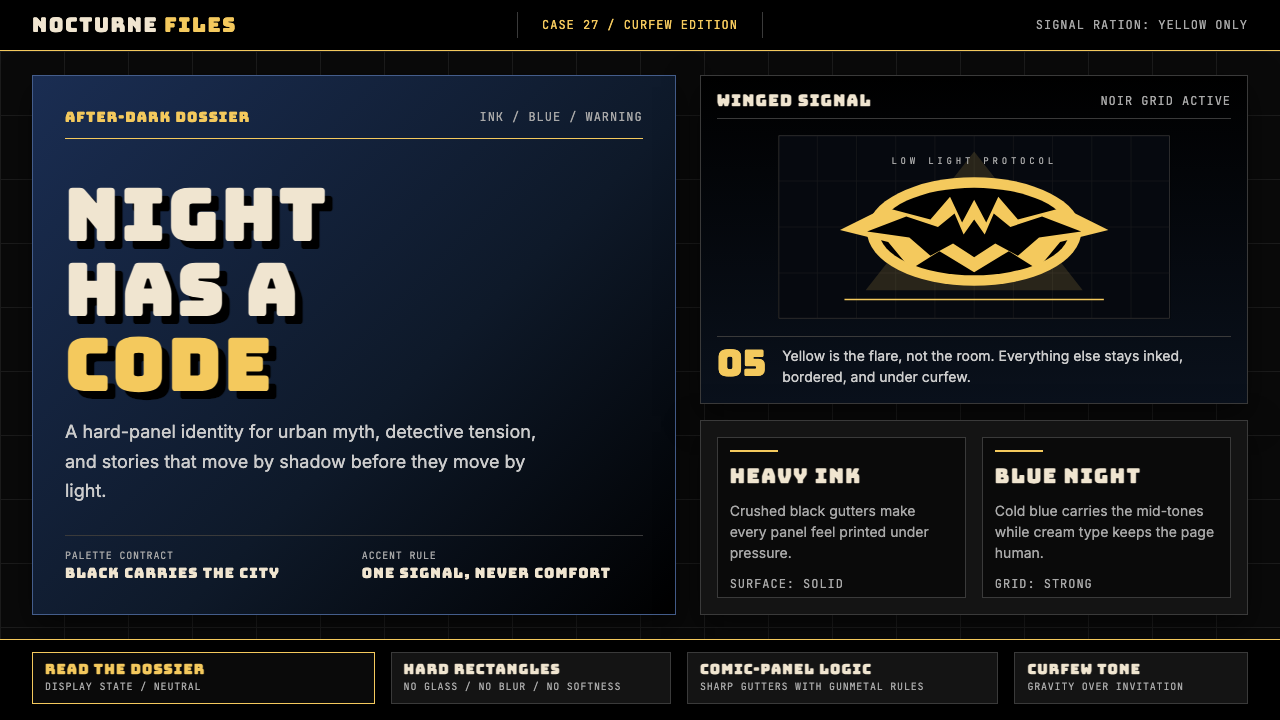 DC Comics Batman NoirGravity, not cheer. Black panels, Gotham blue, and one bat-yellow signal cut…
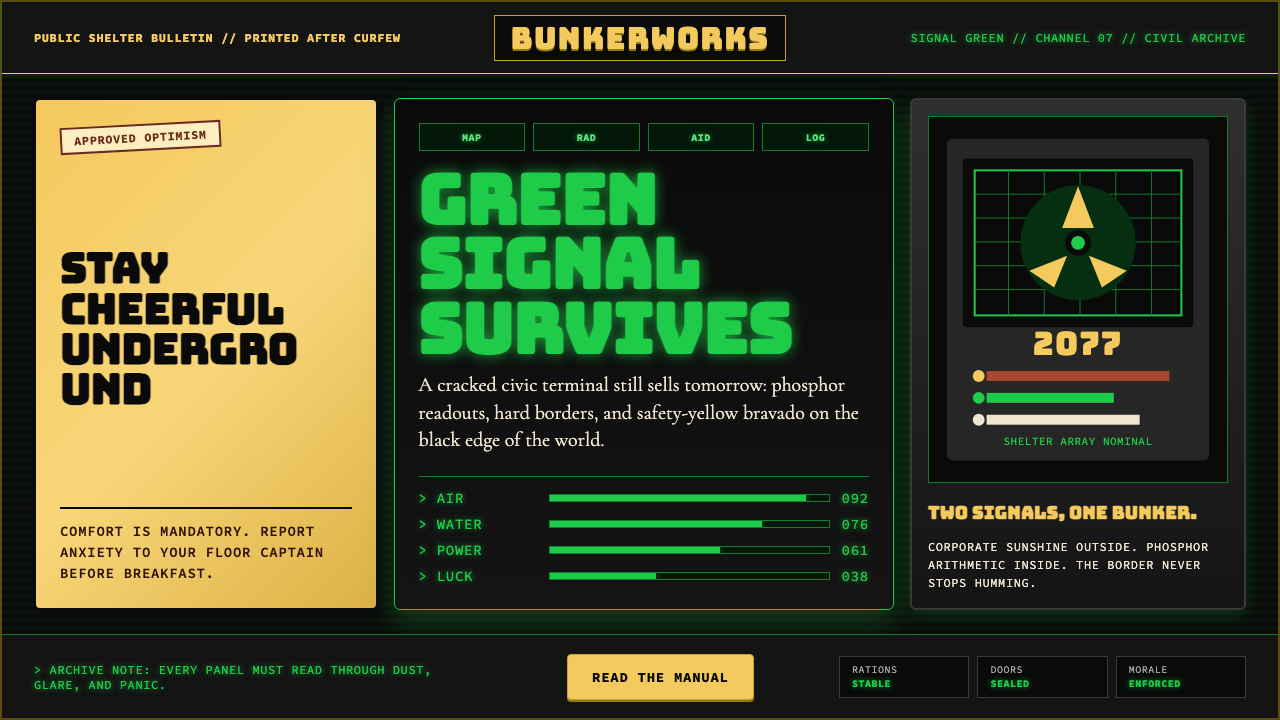 Fallout Vault-Tec Pip-BoyIrradiated optimism. Vault yellow and CRT green lock into a bordered bunker g…
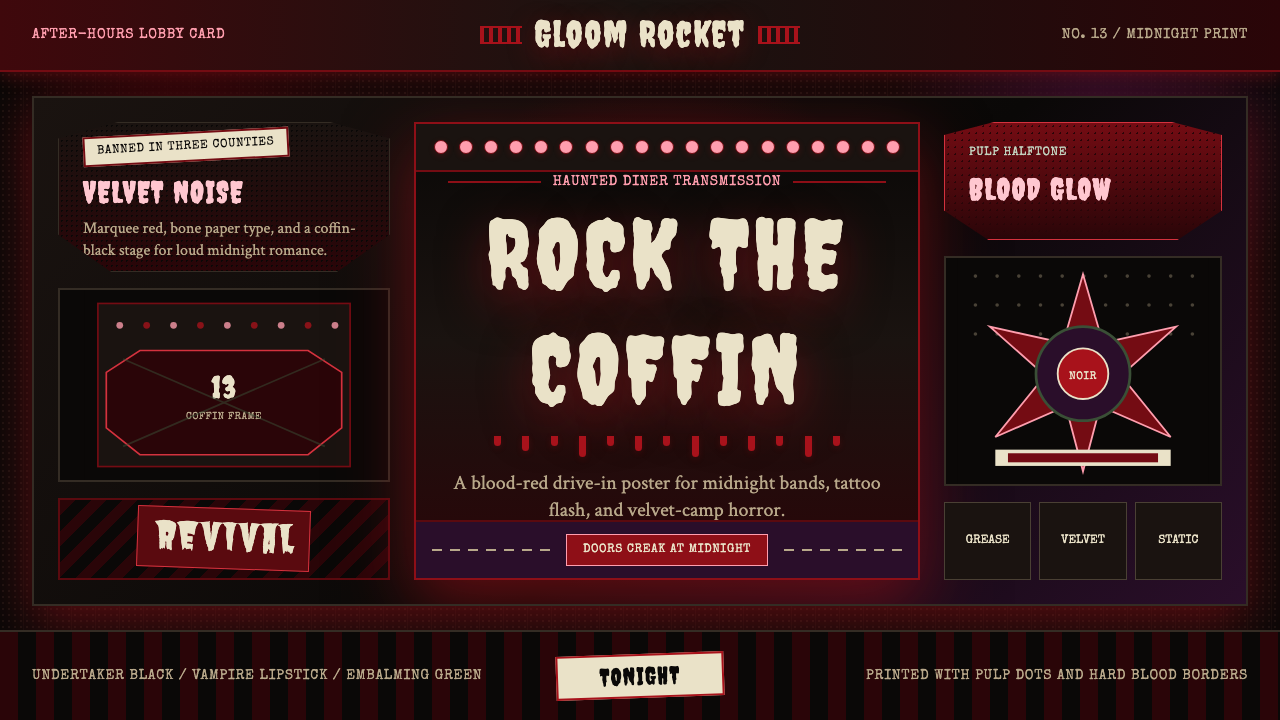 Gothabilly Horror RevivalHaunted swagger. Blood-red marquee type, coffin frames, and pulp halftone on…