What is DC Comics Batman Noir?
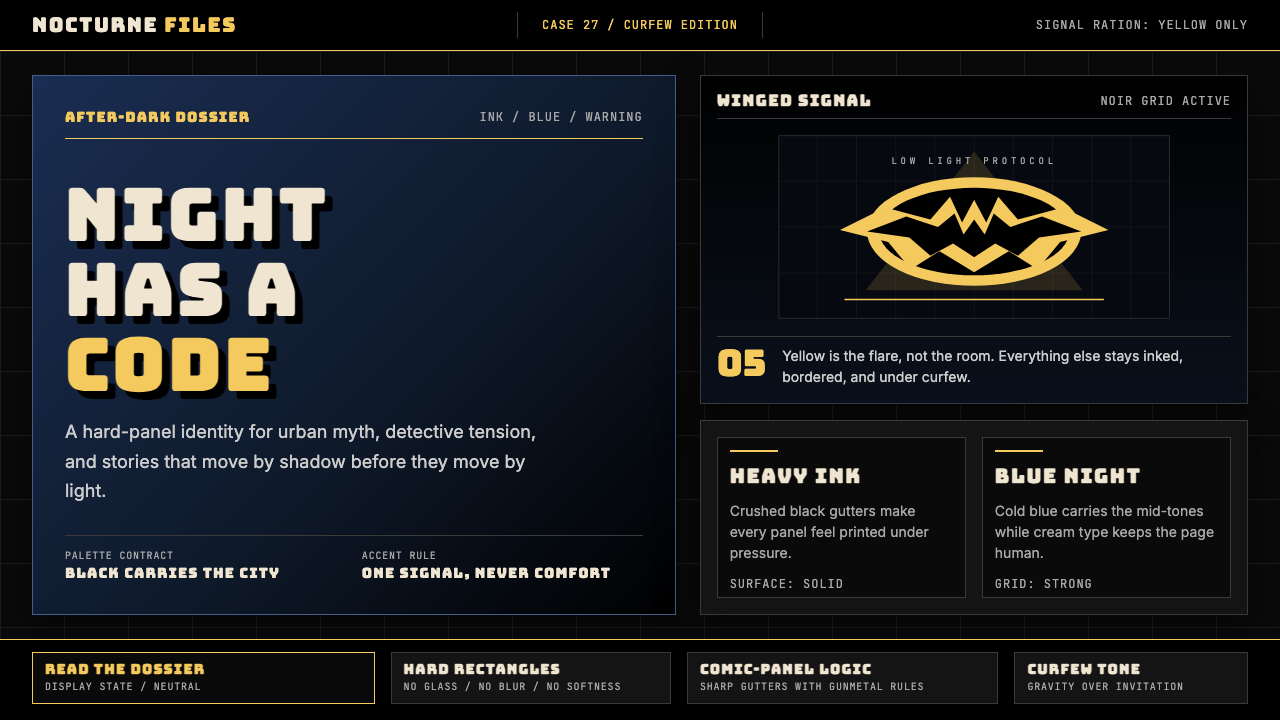
Batman's visual identity is chiaroscuro made canonical — deep black, Gotham-night blue, and a single rationed bat-yellow signal that cuts through the dark like a warning flare.
DC Comics Batman Noir in brief
DC Comics Batman Noir is the visual language built across eight decades of Batman publishing and film adaptation: a palette of near-absolute black, Gotham-night blue, and gunmetal grey, punctuated by a single saturated yellow used only at moments of maximum narrative weight. The system fuses the thick ink and exaggerated shadow of pulp-comic illustration with the chiaroscuro lighting logic of film noir — where darkness is not an absence but an active, menacing presence.
Typography in this world is chunky and slab-footed, communicating mass and physical force rather than elegance or approachability. Layouts are organized like comic-book panels: strict rectangular divisions, hard corners, deep black gutters, and a compositional logic that moves the eye across the frame in deliberate, dramatic beats. Nothing drifts or softens at the edges — every boundary is a decision, every shadow is a weight.
The system is not simply dark. It is hierarchically dark: black and very deep blue carry the dominant mass; gunmetal grey and aged cream hold mid-tone supporting roles; and a single bat-yellow, deployed sparingly, carries the entire system's emotional signal. This chromatic restraint is what separates the style from generic dark design — the yellow earns its force precisely because it appears so rarely.

Where does DC Comics Batman Noir come from?
Batman made his debut in Detective Comics #27 in May 1939, created by artist Bob Kane and writer Bill Finger. The character's visual foundation was established almost immediately: a full-black costume with a scalloped cape, a cowl with pointed ears, and an emblem that would eventually stabilize as a yellow oval surrounding a black bat shape. Kane drew on the visual vocabulary of the pulp-magazine era — heavy ink washes, deep cast shadows, and the exaggerated physical drama of the adventure-comic page. Finger, whose contributions were long uncredited, shaped the character's world as Gotham City: a noir-inflected urban landscape of rain-slicked streets, corrupt institutions, and nocturnal menace.
The 1940s and 1950s saw the style migrate across media. The black-and-white film serials of 1943 and 1949 translated the ink-shadow logic directly into cinematic chiaroscuro. The comics of that era, working under the four-color printing constraints of newsprint, developed a distinctive shorthand: deep blue used as a substitute for absolute black in lit areas, and pure black reserved for the deepest shadow. This blue-and-black relationship, born of production necessity, became a defining characteristic of the aesthetic — so much so that it persists in digital Batman design today, long after printing constraints disappeared.
The pivotal formal statement came in 1986 with Frank Miller and Klaus Janson's The Dark Knight Returns — a four-issue limited series that reimagined Batman as a middle-aged, near-obsessive vigilante in a dystopian near-future. Miller and Janson's visual approach was deliberately brutal: scratchy, hatched inks; compositions that fragment across irregular panel grids; color by Lynn Varley that deepened the noir atmosphere with acid-washed skies and industrial grey urban surfaces. The series established a formal benchmark that all subsequent Batman design — in comics, animation, and film — has either followed or consciously responded to.
The cinematic tradition extended and codified the aesthetic further. Tim Burton's 1989 Batman film brought production designer Anton Furst's vision of Gotham as a city of industrial Gothic excess — all vertical stone, exposed machinery, and perpetual night. Christopher Nolan's Dark Knight trilogy (2005–2012) shifted toward a more photorealistic noir approach, grounding the visual system in practical architecture and real-world shadow rather than fantastical exaggeration, but retaining the fundamental chromatic logic: darkness dominant, colour rationed, yellow present only as signal. Each film cycle absorbed the comic's visual DNA and returned it to print design as an expanded, culturally entrenched reference point.
What defines the DC Comics Batman Noir look?
Chromatic Hierarchy
The palette operates in strict tiers. Black and deep Gotham-night blue claim the largest surface area — walls, backgrounds, negative space, and shadow volumes. Gunmetal grey and aged off-white carry structural mid-tones for surfaces, type areas, and secondary containers. Bat-yellow appears last and least, reserved exclusively for the emblem, the signal, and the single most important call-to-action in any composition. This rationing is the system's core discipline: every other colour gains its force by contrast with the yellow's scarcity.
Ink-Weight Typography
Letterforms carry physical mass — thick strokes, pronounced serifs with a slab or wedge character, and tight tracking that packs words into dense, compressed blocks. Headlines occupy the full visual weight of a panel or section header, treated as a drawn element rather than a typeset element. Smaller body text is set in dense columns, its compactness reinforcing the sense of information delivered under pressure. There is no light, wispy, or hairline letterform anywhere in the authentic system.
Panel-Grid Composition
Layouts are structured like comic-book pages: hard rectangular frames, clearly delineated gutter space between elements, and a reading sequence that choreographs the eye through the composition with deliberate, sequential tension. Elements do not float freely — they are contained in panels or anchored to a structural grid. Full-bleed black areas serve as panel borders writ large, and overlapping or broken-panel compositions appear only as intentional dramatic emphasis, not as decoration.
Hard Shadow and Chiaroscuro
Shadow in this style is not ambient or diffuse — it is directional, hard-edged, and cast at sharp angles that describe a single, definite light source. Large areas of an image or layout may be entirely consumed by shadow, with subject forms emerging partially from the dark. This chiaroscuro logic, borrowed directly from film noir cinematography, creates compositions where what is hidden is as visually active as what is revealed. Soft shadows, ambient occlusion, or layered gradient darkening are all foreign to this system.
Urban Gothic Texture
Where texture appears, it reads as worn, industrial, and structural — aged stone, scored metal, rain-streaked concrete, ink-soaked paper grain. These are not decorative patterns overlaid for visual richness but rather surface qualities that reinforce the setting's nocturnal, post-industrial character. Texture is applied with restraint and always serves narrative atmosphere. Smooth, clean, modern surfaces exist in this world only when the design calls for an explicit contrast against the surrounding dark texture.
Emblem and Signal Logic
The bat emblem functions not as a logo in the conventional corporate sense but as a signal — a projected warning in yellow-on-black that commands attention and carries narrative authority. This signal logic extends to the broader design system: every yellow element in a Batman Noir composition should feel earned and purposeful, as if it were a signal flare rather than a colour choice. The emblem shape itself — stylized bat wings contained within an oval — demonstrates how a complex silhouette can be reduced to its most legible geometric form without losing character.
Cinematic Framing
Compositions favor extreme angles and unconventional viewpoints: low Dutch angles that loom and threaten, extreme low shots that place the viewer below the subject, high overhead shots that render figures small against vast dark architecture. These are the framing choices of noir cinematography, transplanted from the camera into the layout. They communicate power imbalance, psychological tension, and environmental scale without relying on any explicit narrative content. Even a static product page or slide can carry cinematic weight when framed through this logic.

Who shaped DC Comics Batman Noir?
Bob Kane is the credited co-creator of Batman, whose 1939 debut in Detective Comics #27 established the character's foundational visual signature. Kane drew on multiple sources — Douglas Fairbanks's swashbuckling films, Leonardo da Vinci's ornithopter sketches, and the pulp magazine tradition of high-contrast ink illustration — to arrive at the black-caped, cowled figure that has remained visually consistent across eight decades. Though Bill Finger's writing contributions were equally foundational and went uncredited for most of the character's history, Kane's drawing decisions fixed the chromatic and silhouette logic that all subsequent Batman design inherits.
Bill Finger co-created Batman but received no formal credit until 2015, when DC Entertainment officially recognized his contributions. Finger wrote the early stories that established Gotham City as the character's defining environment — a city visually and narratively indebted to 1930s noir cinema, with its rain-slicked streets, corrupt civic institutions, and architectural Gothic excess. Finger also introduced many of Batman's most iconic adversaries and the psychological depth that separates Batman from sunlit superhero archetypes. The darkness of Gotham as a designed visual world is inseparable from Finger's narrative framework.
Frank Miller's The Dark Knight Returns (1986, pencils and story) and Batman: Year One (1987, story, with art by David Mazzucchelli) are the two most formally influential Batman works of the modern era. Miller brought the scratchy, expressionist inks of crime noir illustration into superhero comics, flattening the page into high-contrast compositions where black masses and grey mid-tones do most of the visual work. His narrative reinvention of Batman as a psychologically driven, morally complex figure was inseparable from the visual reinvention: the harshness of the line and the weight of the shadow were arguments about character, not just stylistic choices. All cinematic Batman design from 1989 onward is downstream of Miller's formal decisions.
Jim Lee's tenure as penciller and co-publisher at DC shaped the contemporary Batman visual standard that most digital-era designers encounter first. His line work balances the expressionist weight of Miller-era Batman with a more anatomically detailed, kinetically dynamic rendering style — heavy cross-hatching in shadow areas, dramatic foreshortening in action sequences, and meticulous attention to the costume's sculptural qualities. Lee's Batman is the version that most strongly informs the character's appearances in video games, collectible figures, and commercial illustration, making his visual interpretation the default reference for most contemporary Batman Noir design work.
Anton Furst served as production designer on Tim Burton's 1989 Batman, for which he won the Academy Award for Best Art Direction. Furst's Gotham City was an architectural argument: a city built by adding one corrupt layer on top of another until the original street level was buried under decades of industrial and municipal excess. The resulting visual — vertical, claustrophobic, nocturnal, and lit almost entirely by artificial sources — set the cinematic standard for Gotham that persisted through subsequent film cycles. Furst's design translated the comics' black-ink-and-shadow logic into three-dimensional space with a rigor that few production designers have matched since.
How do you use DC Comics Batman Noir today?
Batman Noir is a high-intention style with a narrow range of appropriate contexts — it communicates authority, gravity, nocturnal drama, and controlled menace. Applied correctly, it produces work that commands immediate attention and signals seriousness without the clinical coldness of minimal design. Applied carelessly, it produces layouts that feel oppressive, illegible, or tonally confused. The discipline required is not technical complexity but chromatic restraint: the system only works when black and deep blue dominate, grey and off-white provide structure, and yellow appears no more than once or twice per composition as a genuine signal.
For presentation slides, the style is most effective on hero covers and section dividers. A cover built in Batman Noir should commit to a near-full-bleed dark ground, with the headline set in heavy, slab-inflected type that sits high in the composition — leaving the lower register for a single yellow accent or graphic element. Content slides should be treated with more restraint: a dark background with cream or light-grey type is readable and atmospheric, but the composition must maintain clear text hierarchy through scale contrast rather than colour variety. Data visualization slides gain dramatic impact when chart elements — bars, areas, segments — are rendered in the primary blue-grey palette with a single yellow series used to highlight the key finding.
For web interfaces and dashboards, the style is well-suited to products that need to communicate authority, vigilance, or performance monitoring — security platforms, trading dashboards, analytics tools, or any product where the user's primary task requires focus and the environment should actively support that focus rather than competing with it. The approach: commit to a very deep background, reserve near-white or light-grey for body text and data labels, use the Gotham blue as a structural mid-tone for panel backgrounds and card surfaces, and allow yellow only for interactive states and primary action buttons. Navigation should be typographic and minimal; icon use should be reduced to a single-weight line style with no fill. Pricing pages benefit from the style's natural tier-differentiation logic — a highlighted plan reads immediately in yellow against darker peer cards.
For editorial and marketing design, Batman Noir supports strong poster-logic layouts where a single dominant image or graphic element commands the full-width composition and typography is set at dramatic scale. Magazine covers, event posters, campaign hero images, and announcement graphics all suit the style. Marketing copy should be set short and declarative — the style's compression and weight do not support long, flowing body text. A common and effective approach for editorial content pages is to use the dark ground only for pull-quotes and full-width breaks, reverting to a near-white or cream ground for article body text, where the Gotham-blue drop caps or section headers carry the stylistic signature without sacrificing readability over long passages.
The most common mistake when applying Batman Noir is distributing yellow too liberally. Once yellow appears in more than two or three locations in a composition, it loses its signal force and the palette collapses into generic dark design. A second frequent error is using navy or midnight blue as the only dark, without introducing true near-black — the system requires both, in a hierarchy where near-black dominates and the blue is the lighter of the two darks. A third mistake is importing soft, glowing light effects — halos, bloom, ambient gradients — which are visually incompatible with the style's hard-edge chiaroscuro logic and immediately undermine the noir atmosphere the palette depends on.

DC Comics Batman Noir — FAQ
Is Batman Noir just a dark theme, or is there a genuine design logic behind it?
It is a complete visual system with specific rules, not a generic dark theme. The key distinction is chromatic hierarchy: the system requires near-black and deep blue at dominance, grey and off-white as structural mid-tones, and yellow appearing only as a rationed signal. A generic dark theme might use any dark background with white text and coloured accents. Batman Noir's specific blue-black relationship, its hard-edge shadow logic, its ink-weight typography, and its panel-grid composition are all historically derived from pulp-comic and film-noir conventions — they are not arbitrary aesthetic preferences but a consistent formal system with traceable origins and internal logic.
How is Batman Noir different from general noir or dark cinematic design?
General noir design — derived from the 1940s and 1950s American crime film tradition — typically uses desaturated grey scales, occasional warm amber or sepia tones, and photographic textures. Batman Noir is a specific comics-inflected version: it adds the flat, ink-rendered quality of print illustration to the noir shadow logic, introduces the deep Gotham blue as a distinct mid-dark tone that photographs would not typically include, and most distinctively, introduces the bat-yellow as an active signal color against the dark. The emblem logic — a designed graphic element that functions as a narrative warning — is also specific to the Batman system and has no equivalent in traditional noir cinema.
Can this style work for brands outside superhero or entertainment contexts?
Yes, but context alignment is critical. The style's core values — authority, vigilance, controlled power, nocturnal seriousness — transfer well to security technology, professional sports, premium automotive, high-end audio equipment, and certain financial or trading platforms. It is poorly suited to food brands, healthcare, children's products, wellness services, or any product whose emotional promise depends on warmth, lightness, or organic quality. The test is not whether the brand is associated with superheroes, but whether the brand genuinely wants to communicate the values the style carries. When the alignment is real, the style's cultural weight works in the brand's favour rather than overshadowing it.
What is the most common way designers misread the yellow in this palette?
The most common misreading is treating yellow as a general accent colour rather than as a signal element. In the authentic system, yellow appears once — as the emblem, the searchlight, the one critical action — and its power derives entirely from its scarcity against the surrounding dark. When designers use yellow for headlines, subheadings, multiple interactive states, decorative dividers, and iconography simultaneously, the colour loses its urgency. A related mistake is using a warm, golden, or amber yellow rather than the saturated, slightly electric bat-yellow. The authentic system uses a yellow that reads as artificial light — a signal flare or a beacon — not as organic warmth.
How should imagery and photography be handled within this design system?
Photography and illustration should be treated as high-contrast monochromatic or duotone elements rather than as full-colour windows into a scene. In practice, this means converting photographic images to a blue-black duotone or pushing them into extreme contrast so that mid-tones collapse and the image reads primarily as silhouette and shadow. Colour photography placed directly into a Batman Noir layout without treatment will look discordant — the naturalistic colour rendering is visually incompatible with the system's flat, ink-logic chiaroscuro. Where full colour photography is necessary for content reasons, it should be framed within a hard rectangular container that separates it explicitly from the surrounding designed system, rather than bleeding into the dark ground.
Related design styles
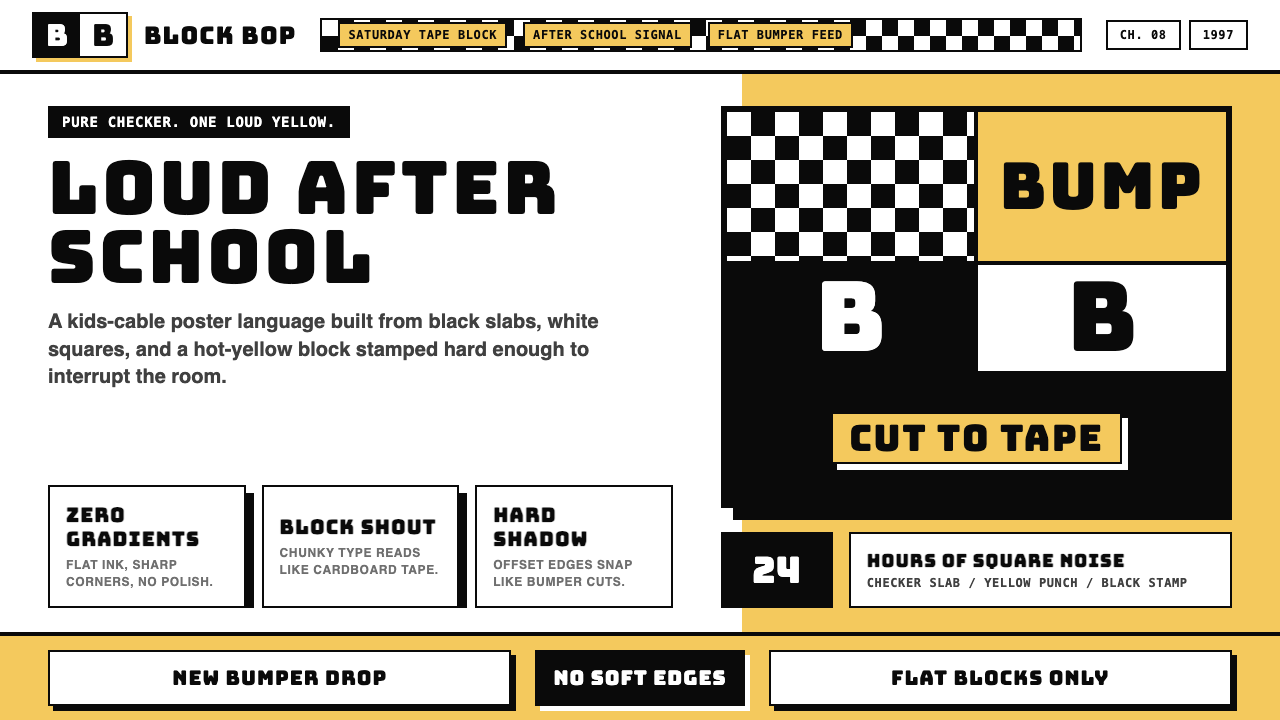 Cartoon Network 90s BlocksKids-cable noise, squared. Black-white checkerboards crash into hot-yellow Bu…
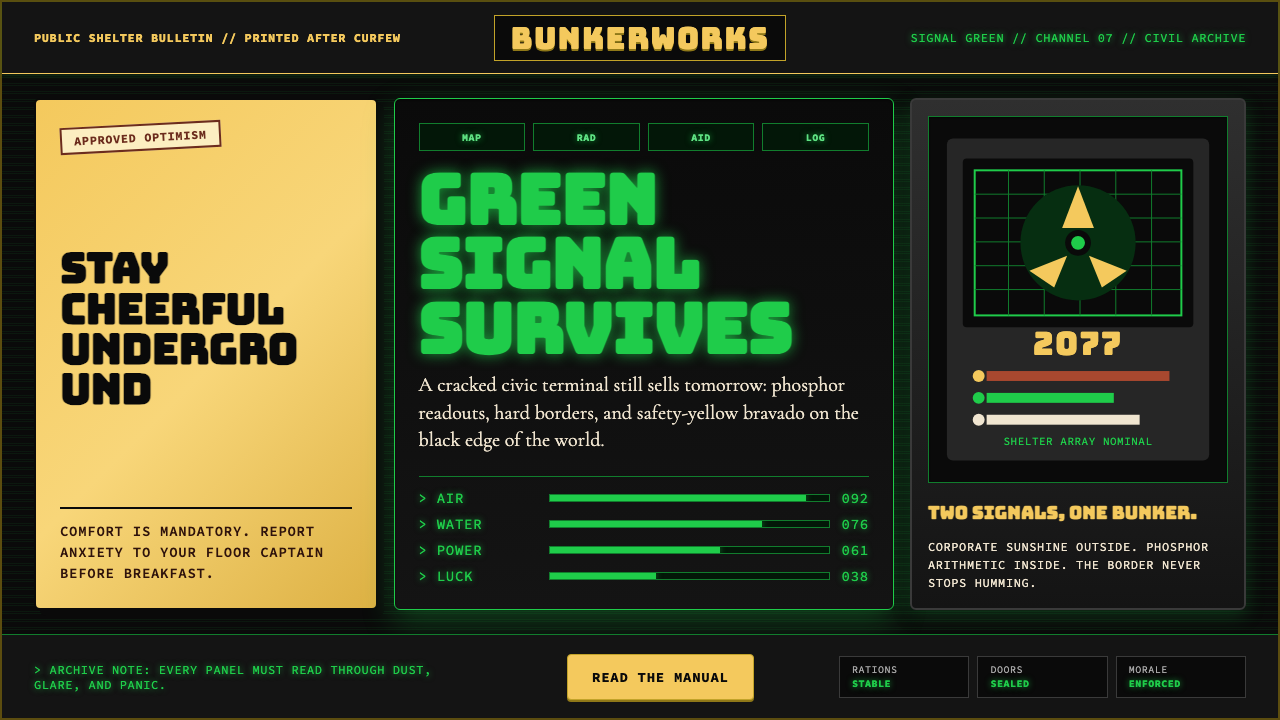 Fallout Vault-Tec Pip-BoyIrradiated optimism. Vault yellow and CRT green lock into a bordered bunker g…
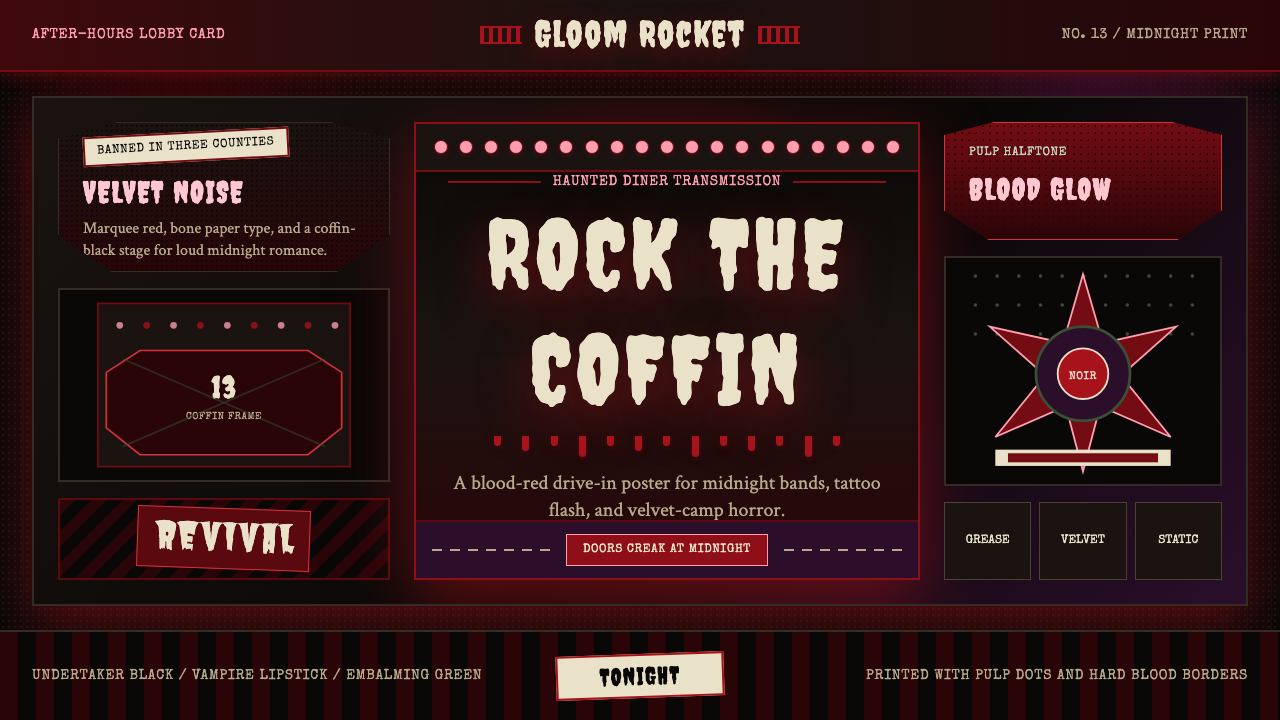 Gothabilly Horror RevivalHaunted swagger. Blood-red marquee type, coffin frames, and pulp halftone on…
 Miami Vice Pastel Teal (1984)Pastel noir, not nostalgia. Teal glow and flamingo pink slice black with geom…
 Stranger Things (1983)Red light breaks the void. A spurred serif blooms through VHS static and cold…
 Thriller (1982)Stillness turns electric. Leather red and rhinestone gold ignite a neon pavem…