What is Gothabilly Horror Revival?
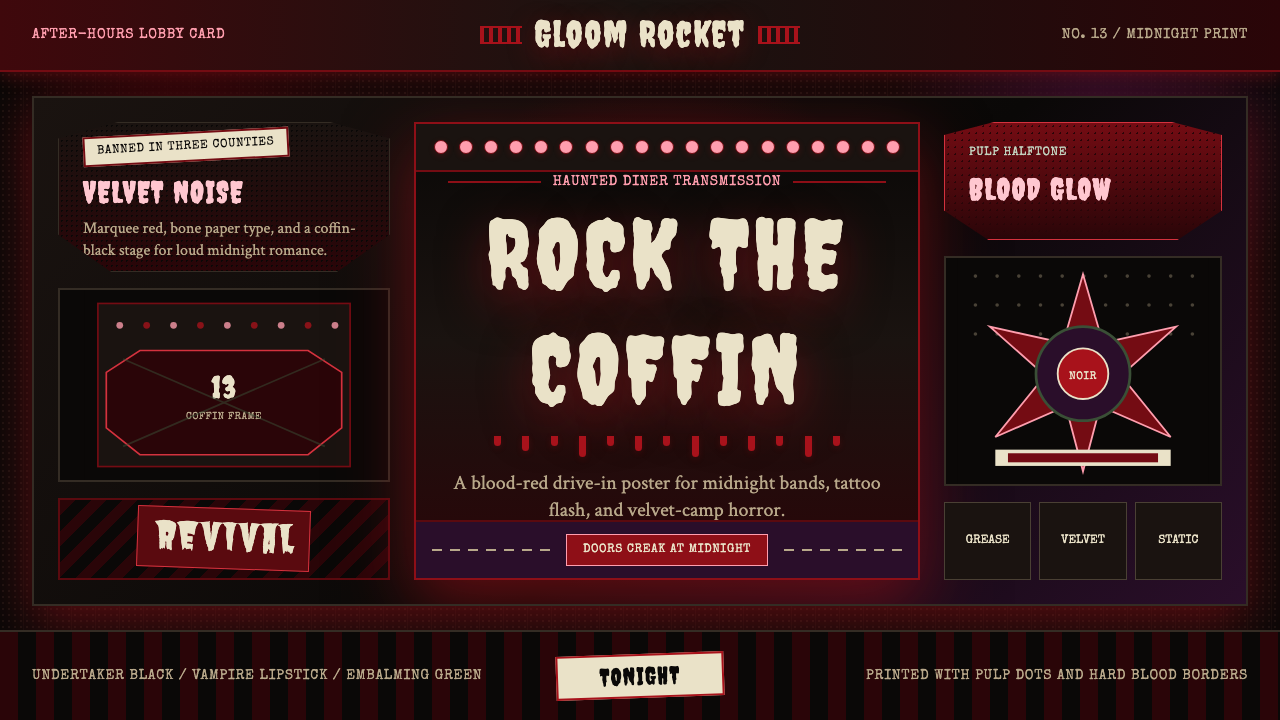
Gothabilly is rockabilly's haunted twin — the moment a 1950s diner gets possessed by horror-film iconography, drip-blood ornament, coffin-black velvet, and blood-red marquee type.
Gothabilly Horror Revival in brief
Gothabilly Horror Revival is a design aesthetic that fuses two apparently incompatible American subcultures: the grease-and-chrome swagger of 1950s rockabilly and the campy, theatrical horror-film tradition that ran from Universal Studios monster pictures through the drive-in B-movie era. The result is a visual register of extreme contrast — very dark grounds (near-black or deep charcoal) lit by blood-red and bone-white accents, with hand-lettered marquee type and pulp-halftone textures that evoke rotting posters peeled off a roadside movie-house wall.
Where most dark aesthetics aim for sleek menace or ethereal gloom, Gothabilly is deliberately theatrical and camp. It celebrates excess: too much drip ornament, type that looks almost too lurid, coffin-shaped frames that make no pretense of subtlety. The horror elements are drawn from the Universal and AIP (American International Pictures) visual vocabulary — Frankenstein's bold slab serif, the B-movie title card tradition of distressed hand-lettering, halftone dot patterns that simulate cheap pulp-magazine printing. The rockabilly DNA shows in the gestural energy, the pin-up silhouettes, and a fundamental joy in transgression that keeps the mood from tipping into pure dread.
Digitally, the style translates into a toolkit of atmospheric surface treatments: coarse grain overlays that imply age and slight decay, marquee-style lettering with theatrical inline strokes or exaggerated slab serifs, ornamental dividers that drip or drape rather than rule straight across, and a color logic so high-contrast that it functions almost like a woodblock print. It is a style that announces itself loudly and rewards audiences who already love the source material.
Where does Gothabilly Horror Revival come from?
The ancestral root of Gothabilly is psychobilly, a genre that emerged in Britain and the United States in the late 1970s and early 1980s, cross-wiring the stripped-back energy of punk rock with classic rockabilly rhythm patterns. The Cramps, formed in New York in 1976 and fronted by Lux Interior and Poison Ivy, are generally credited as the proto-psychobilly originators. Their visual identity — B-movie poster art, graveyard imagery, quiff-and-leather pin-up iconography set against horror-film subject matter — established the template that Gothabilly would later refine and intensify.
Through the 1990s, the Gothabilly aesthetic took shape on the West Coast of the United States, particularly in California and Texas, where a goth-tinged rockabilly scene developed its own costume culture, poster art tradition, and visual shorthand. Bands like Tiger Army, founded in Oakland in 1995 by Nick 13, wove together traditional rockabilly instrumentation with goth atmosphere and horror imagery, generating both a music and a visual identity that could be printed on promotional material, merchandise, and club flyers. HorrorPops, the Danish band led by Patricia Day, extended the aesthetic into a more self-aware burlesque register, while Voltaire, the darkwave musician and cartoonist, contributed the comic-book dimension that gave Gothabilly its satirical edge alongside its menace.
The visual language drew heavily on two American print traditions: the pulp magazine illustration of the 1930s through 1950s, with its halftone printing artifacts, sensational hand-lettered headlines, and monster-movie poster art conventions; and the rockabilly and hot-rod culture graphic tradition, with its brush-script lettering, pin-up figure drawing, and a palette anchored by saturated red and black. The goth subculture contributed the Victorian funerary aesthetic — coffin shapes, drip ornament derived from candle wax imagery, cemetery gate ironwork — which provided formal structure and a layer of art-historical legitimacy to what might otherwise have stayed purely subcultural.
By the 2000s, Gothabilly had established a recognizable design vocabulary that circulated not only through music culture but through tattoo art, burlesque costuming, Halloween retail design, and the broader dark-lifestyle market. Its adoption by digital designers accelerated in the 2010s, as high-resolution screens made the texture and ornamental detail of the style viable at screen resolution and the nostalgia economy created sustained appetite for mid-century aesthetics. The revival element in the name acknowledges that Gothabilly is always already a revival — a self-conscious return to a specific moment in American popular culture filtered through multiple layers of subsequent subcultural processing.
What defines the Gothabilly Horror Revival look?
Color
The palette is built on extreme polarity: near-black or deep charcoal grounds, blood-red as the primary accent, and bone-white or aged-cream for type and ornamental highlights. Secondary accents draw from sickly greens, deep purples, and jaundiced yellows — colors associated with old horror-film tinting and four-color pulp printing. The overall effect is high-drama and maximally saturated within a very controlled range. Color rarely appears in smooth gradients; instead it shifts in abrupt jumps that echo the dot-gain artifacts of vintage offset printing.
Typography
Type is the aesthetic's loudest instrument. Display lettering draws from two main sources: theatrical marquee letterforms with exaggerated slab serifs and inline strokes that recall illuminated movie-house signage; and distressed hand-lettered styles that suggest worn B-movie title cards. Both carry visible imperfection — ink trap artifacts, uneven stroke weight, letterforms that look as though they were painted by hand rather than set by machine. Body text, when it appears, is typically set in condensed serifs to contrast with the display drama above. Tracking is generous to maximize the marquee effect.
Ornament and Decoration
Gothabilly is one of the few contemporary design styles that treats ornament as a primary — not secondary — visual element. Drip motifs derived from candle wax, blood, and graveyard icicle imagery frame compositions vertically and horizontally. Coffin-shaped frames replace conventional rectangles as image containers. Crosshatched and etched textures evoke Victorian woodblock illustration and classic monster-movie credit sequences. Skull imagery, spider webs, and bat silhouettes function as compositional punctuation. The ornament is never delicate or filigree — it is bold, solid, and printed at maximum opacity.
Texture and Surface
Flat digital surfaces are avoided in favor of heavily textured grounds that suggest age, analog reproduction, and material deterioration. Common treatments include halftone dot overlays that simulate cheap pulp-magazine printing, grain and noise layers that imply photographic film or degraded offset, and paper-crinkle or torn-edge effects that evoke vintage ephemera. These textures are typically applied at high opacity so they actively interrupt the underlying image or color field rather than functioning as a subtle atmosphere. The net effect suggests that the piece was printed on poor-quality materials forty years ago and has been slowly rotting ever since.
Composition and Frame
Layouts favor strong vertical or symmetrical axes — centered compositions that echo vintage poster design and carnival banner conventions — rather than the asymmetric grids of modernist design. The frame itself is an expressive element: coffin-shaped outer borders, arched theatrical openings, or tombstone silhouettes define the picture plane. Negative space is minimal; the impulse is toward dense, packed composition where every zone of the layout carries some decorative or typographic element. Despite the density, hierarchy is maintained through extreme scale contrast between headline type and everything else.
Imagery and Iconography
Figurative imagery is drawn from two pools: the pin-up tradition of 1950s American illustration, with its exaggerated feminine silhouettes, hourglass proportions, and coy-but-confident expression; and classic horror-film iconography — Frankenstein's creature, Dracula, werewolves, mummies — rendered in the graphic shorthand of B-movie poster art rather than realistic illustration. Both sources are typically treated as high-contrast silhouette or limited-tone duotone rather than full-color photographic rendering. The tension between glamour and horror is the aesthetic's central subject matter.
Mood and Camp Sensibility
Gothabilly never takes itself entirely seriously. The horror elements are presented with evident relish and a wink — the excess of ornament, the sheer luridness of the color, the improbability of the subject matter all signal that the designer knows exactly how over-the-top it all is and considers that a virtue. This camp sensibility, theorized by Susan Sontag as a love of the exaggerated and theatrical, is what distinguishes Gothabilly from straightforward horror design. The goal is not to frighten but to delight through theatrical excess, subcultural in-joke, and aesthetic commitment to the gloriously overwrought.
Who shaped Gothabilly Horror Revival?
Lux Interior, born Erick Lee Purkhiser, was the co-founder and vocalist of The Cramps, the New York band widely recognized as the originators of the psychobilly and proto-Gothabilly aesthetic. From 1976 until his death in 2009, Interior and The Cramps maintained a visual identity rooted in B-movie horror poster art, graveyard imagery, and 1950s rockabilly performance conventions pushed to theatrical extremes. Their album artwork, stage design, and promotional photography established most of the visual vocabulary that subsequent Gothabilly artists would codify and extend.
Nick 13 founded Tiger Army in Oakland, California in 1995, creating one of the most visually coherent Gothabilly projects of the style's formative decade. Tiger Army's visual identity married traditional rockabilly graphic conventions — brush-script lettering, flame motifs, hot-rod color palettes — with cemetery imagery, gothic architecture details, and a generally more elegiac tone than the raw camp of earlier psychobilly. Nick 13 also produced a body of solo work that pushed the style toward classic country and Americana aesthetics, demonstrating Gothabilly's capacity to absorb adjacent traditions without losing its distinctive dark signature.
Patricia Day led HorrorPops, the Copenhagen-based band that brought a distinct burlesque-goth dimension to the Gothabilly aesthetic during the early 2000s. Day's visual persona and the band's art direction contributed a more fashion-conscious, self-aware campness to the style — one that drew on pin-up model photography, burlesque costuming, and an explicitly feminine perspective on the tradition's more macho rockabilly roots. HorrorPops' album artwork and music videos demonstrated that Gothabilly's visual language was flexible enough to accommodate gender critique and humor without losing its horror-film intensity.
Voltaire — born Aurelio Voltaire Hernandez — is a darkwave musician, singer-songwriter, and cartoonist whose visual work helped define the more satirical, comic-book-influenced strain of Gothabilly design. His self-illustrated album covers and animated short films brought the aesthetic into direct dialogue with underground comics and editorial cartooning traditions, adding a graphic wit and narrative dimension that distinguished his work from the more purely visceral horror-camp of earlier psychobilly. Voltaire's output demonstrated that Gothabilly's visual language could support extended narrative and character illustration, not only poster-art spectacle.
Though not a designer herself, Bettie Page was the most reproduced visual source in Gothabilly's pin-up dimension. The pinup model and actress, photographed prolifically in the early 1950s, provided the aesthetic with its signature female silhouette: dark bangs, hourglass form, and a combination of confident sexuality with playful theatricality. Page's images — especially the fetish and bondage-themed photographs shot by Irving Klaw — introduced the camp dimension of performed transgression that became central to Gothabilly's tone. Her visual legacy circulates through the style as both quotation and archetype.
How do you use Gothabilly Horror Revival today?
Gothabilly Horror Revival is one of the most immediately recognizable design styles available, which means it functions best in contexts where the audience self-selects and the brand has already committed to a particular subcultural position. Applied correctly, it signals authenticity to a community that is acutely sensitive to imitation; applied carelessly, it reads as Halloween-retail pastiche. The foundation is always the palette: near-black ground, blood-red accent, bone-white type. Everything else — the ornament, the texture, the letterform choices — builds from that base.
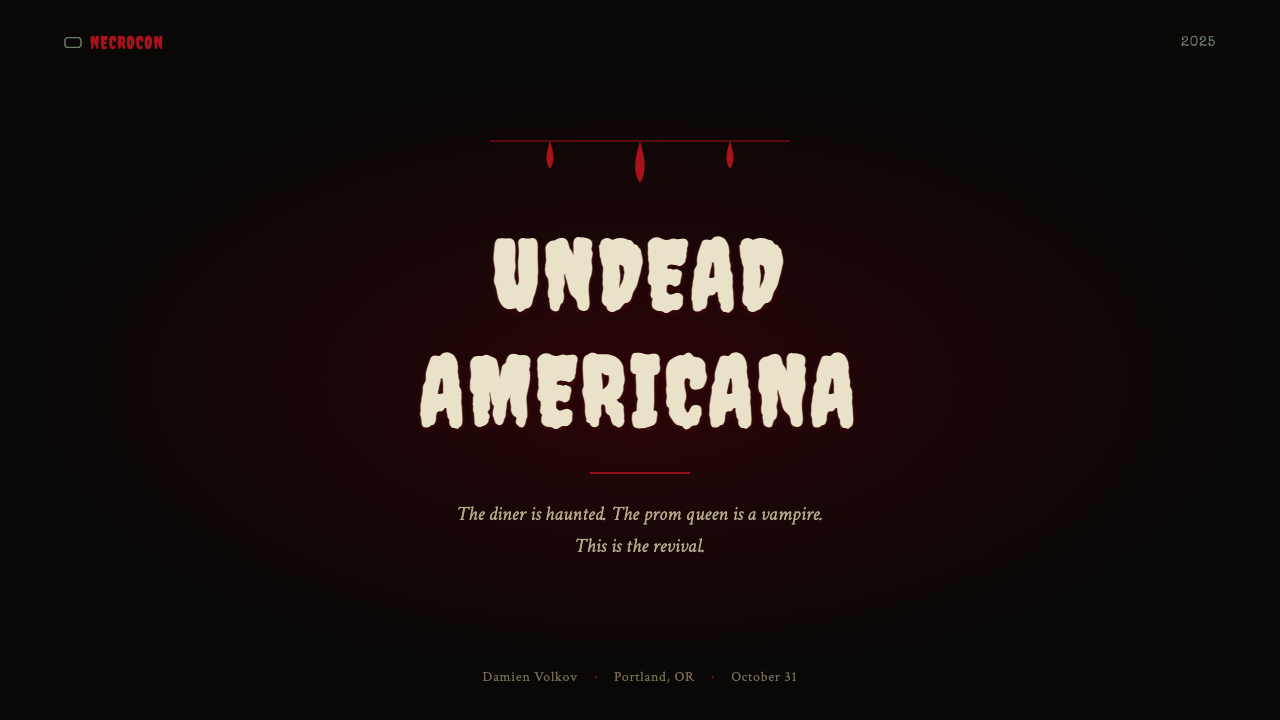
For presentation slides, Gothabilly creates exceptional impact on covers and divider slides but requires restraint on content-heavy pages. A Gothabilly cover works through extreme contrast: the title in a large, exaggerated slab serif centered on a near-black ground, with drip or coffin-frame ornament scaled generously enough to read at projection size. Section-divider slides can carry the full decorative treatment. Content slides should pull back dramatically — bone-white ground, condensed serif body text, a single blood-red accent for key callouts — to let the information breathe. Data visualization benefits from the palette's high contrast: data series mapped to blood-red and bone-white on dark grounds produce charts that are both dramatic and highly legible.
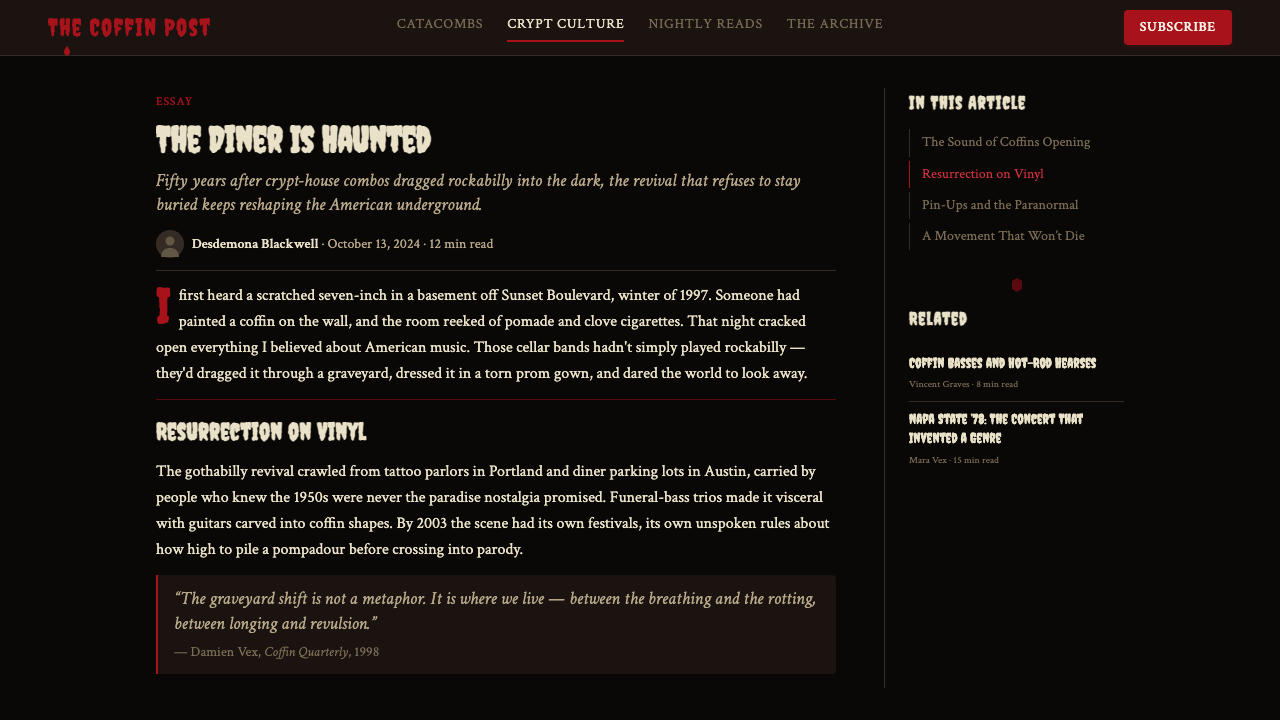
For web interfaces, the style is well-suited to event ticketing pages, music streaming contexts, dark-lifestyle e-commerce, and entertainment platforms — anywhere the user experience is supposed to feel like entering a particular subcultural space rather than a neutral utility. Applied to a product-detail page or landing page, the approach is: near-black background, marquee-style display type for the product name, a single blood-red call-to-action, and sparse body text in a condensed serif. Navigation should be minimal and type-only; ornamental elements should be reserved for section transitions and feature callouts rather than repeated as a continuous background pattern.
For editorial and marketing work, the style produces its strongest results in contexts where the audience is already familiar with the visual references: event posters, music editorial, Halloween-adjacent seasonal campaigns, and dark-lifestyle brand identity. An editorial layout works by treating the page as a classic horror-movie poster: dominant display type with heavy decorative treatment, a strong central image in high-contrast duotone, supporting information in condensed serif at a scale small enough to contrast dramatically with the headline. Marketing materials should commit fully to the palette and resist the impulse to lighten or soften the aesthetic for broader audience accessibility — diluted Gothabilly almost always reads as Halloween store signage rather than subcultural authenticity.
A common mistake when applying Gothabilly is overloading every surface with ornament and texture simultaneously. The style's visual density is its signature, but density becomes noise when every layer competes for attention at the same visual priority. The discipline is to choose one primary decorative element per composition — drip ornament, coffin frame, or halftone texture — and let the other supporting elements operate at lower intensity. Similarly, type choice is frequently mishandled: using an ornate blackletter or overly generic spooky typeface instead of the marquee-slab and distressed-brush lettering that characterize the actual historical reference produces results that look like costume-store packaging rather than authentic Gothabilly design.
Gothabilly Horror Revival — FAQ
What separates Gothabilly from generic Halloween-themed design?
The difference is specificity of reference and the presence of a camp sensibility. Generic Halloween design borrows horror iconography — skulls, bats, pumpkins — without any underlying subcultural logic. Gothabilly draws from a specific intersection of 1950s rockabilly visual culture and the B-movie horror film aesthetic, channeled through goth subculture and psychobilly music from the 1970s onward. The camp dimension is also essential: Gothabilly knows it is theatrical and revels in that knowledge. It references specific source material (The Cramps, drive-in movie poster conventions, Universal Studios creature design) rather than generic spookiness, and that specificity is what separates authentic design from costume-store pastiche.
Can Gothabilly work in light-mode or light-background contexts?
It can, but it requires significant adaptation and the result should be considered a Gothabilly-adjacent style rather than authentic Gothabilly. The style's dark ground is not simply a preference — it is structural, because the blood-red and bone-white accents only achieve their high-drama contrast value against near-black. On a light or white ground, the red accent weakens considerably, the bone-white disappears entirely, and much of the ornamental detail loses its punch. A workable light adaptation uses aged-parchment or warm grey grounds rather than pure white, maintains the blood-red as a strong accent, and pulls back significantly on texture to avoid visual cacophony. The theatrical excess that defines the style is harder to sustain at low contrast.
How should data visualization be handled within a Gothabilly design system?
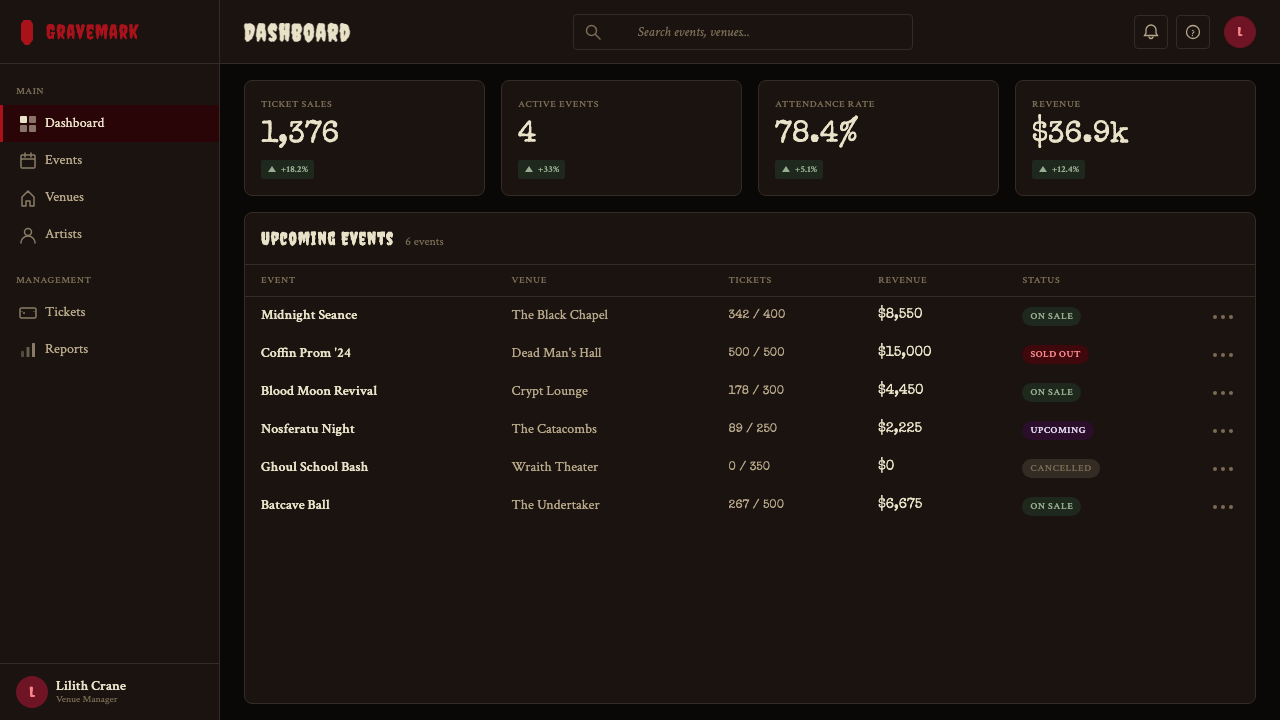
The high-contrast palette actually serves data visualization well if the mapping is kept simple. The most effective approach restricts each chart to two data colors maximum — blood-red for the primary series and bone-white or aged-cream for the secondary — against the near-black ground. The resulting charts are dramatic and highly legible, with the dark ground ensuring that both accent colors read at maximum luminance. Avoid introducing additional hues from the secondary palette (the sickly greens and deep purples) into data visualization, as they introduce ambiguity about relative importance. Typography within charts should use the condensed serif rather than display marquee lettering — axis labels and annotations need clarity over theatricality. Chart containers can be coffin-framed or ornamentally bordered if the context is decorative-editorial, but in functional dashboard contexts the ornament should be minimized.
Is Gothabilly appropriate for professional or corporate contexts?
Only for specific industries and brands. Gothabilly is the right tool for music-industry clients, entertainment and events platforms, tattoo studios, dark-lifestyle retail, Halloween-adjacent seasonal campaigns, and any brand whose identity is deliberately positioned within or adjacent to the subcultures that produced the style. For general corporate, financial, healthcare, or consumer-goods contexts, the style signals the wrong values — the theatrical excess and horror iconography read as unprofessional or alarming rather than authoritative and trustworthy. The test is whether the brand's existing identity already includes a dark, subcultural, or theatrically excessive dimension. If it does, Gothabilly amplifies that dimension. If it does not, applying the style creates friction between the design and the underlying brand promise.
What is the difference between Gothabilly and Horror Punk aesthetically?
Horror Punk, associated primarily with The Misfits and their graphic descendents, draws from a harder-edged punk graphic tradition — photocopied flyer aesthetics, aggressive hand-lettering, a rawer and less crafted visual energy. Its color range tends toward monochrome with occasional stark accents, and its ornamental vocabulary is simpler: skulls as emblems rather than architectural elements, straight-edged borders rather than coffin shapes or drip ornament. Gothabilly, by contrast, has significantly more craft investment — the marquee lettering is more refined, the ornamental treatment more complex, the pin-up illustration dimension entirely absent from Horror Punk. Gothabilly also incorporates the 1950s rockabilly visual heritage more explicitly, including gesture toward chrome, hot-rod graphics, and a warmer, more theatrically lit sense of production values.
Related design styles
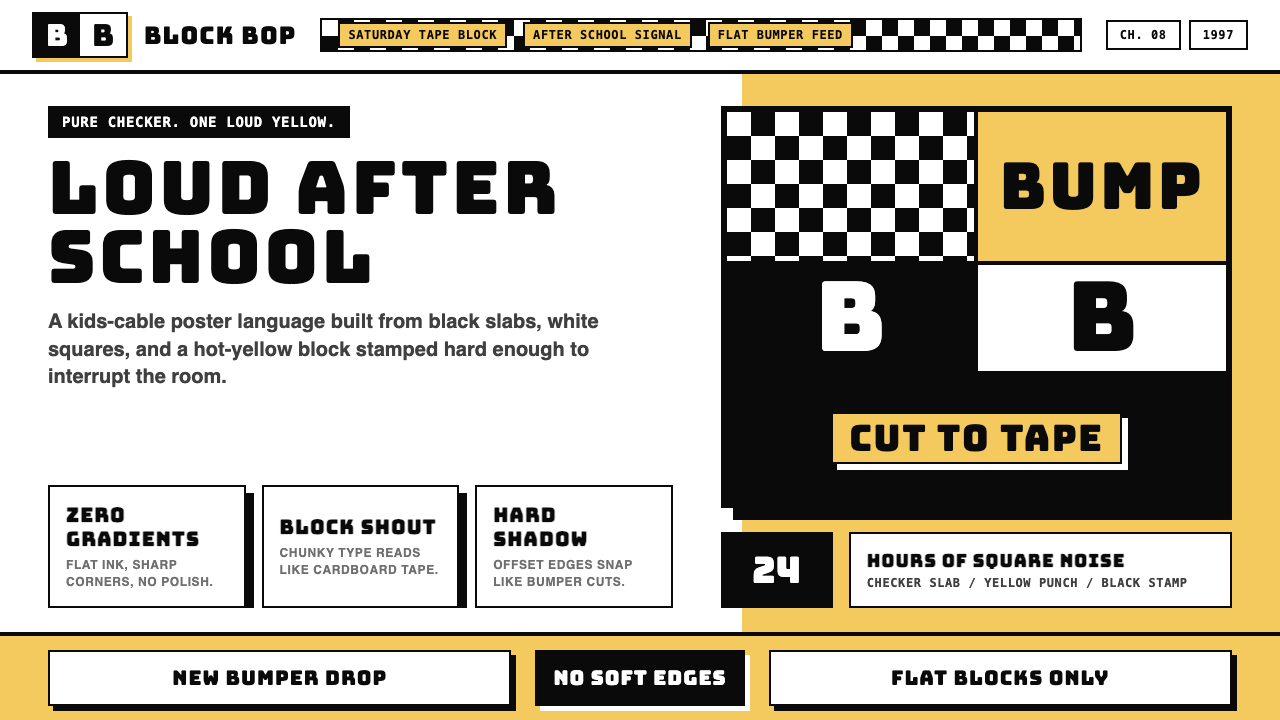 Cartoon Network 90s BlocksKids-cable noise, squared. Black-white checkerboards crash into hot-yellow Bu…
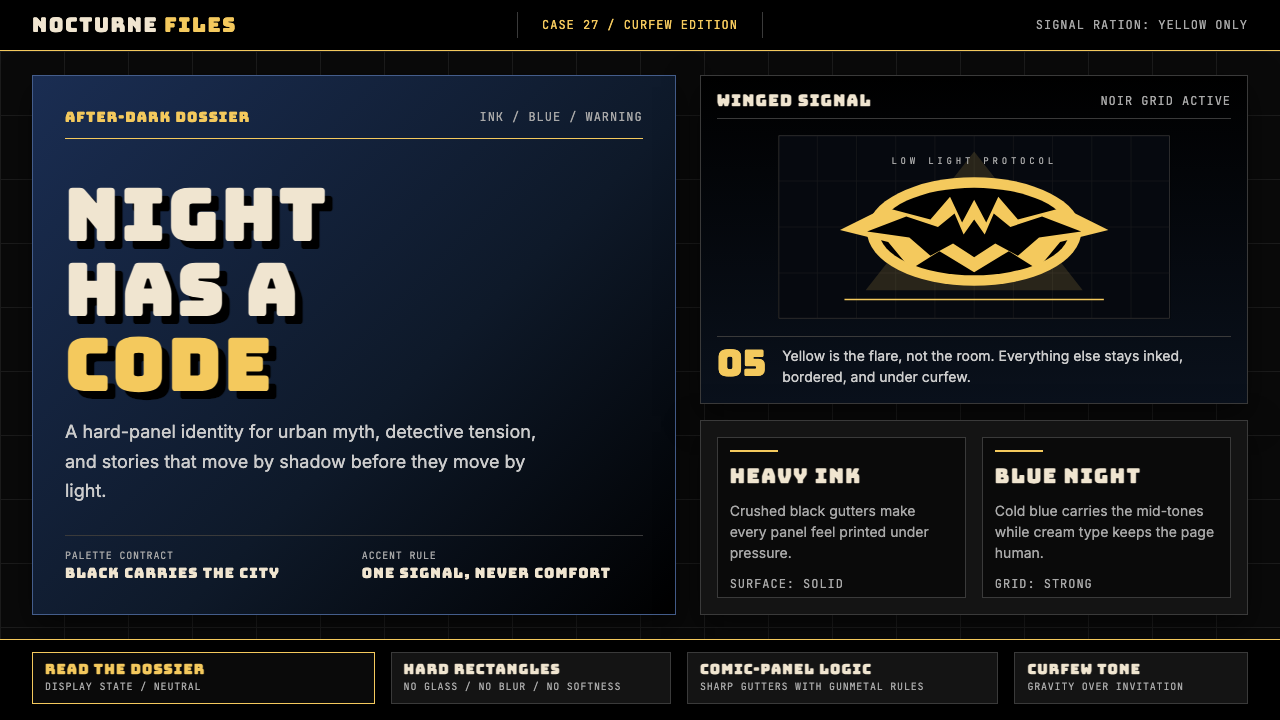 DC Comics Batman NoirGravity, not cheer. Black panels, Gotham blue, and one bat-yellow signal cut…
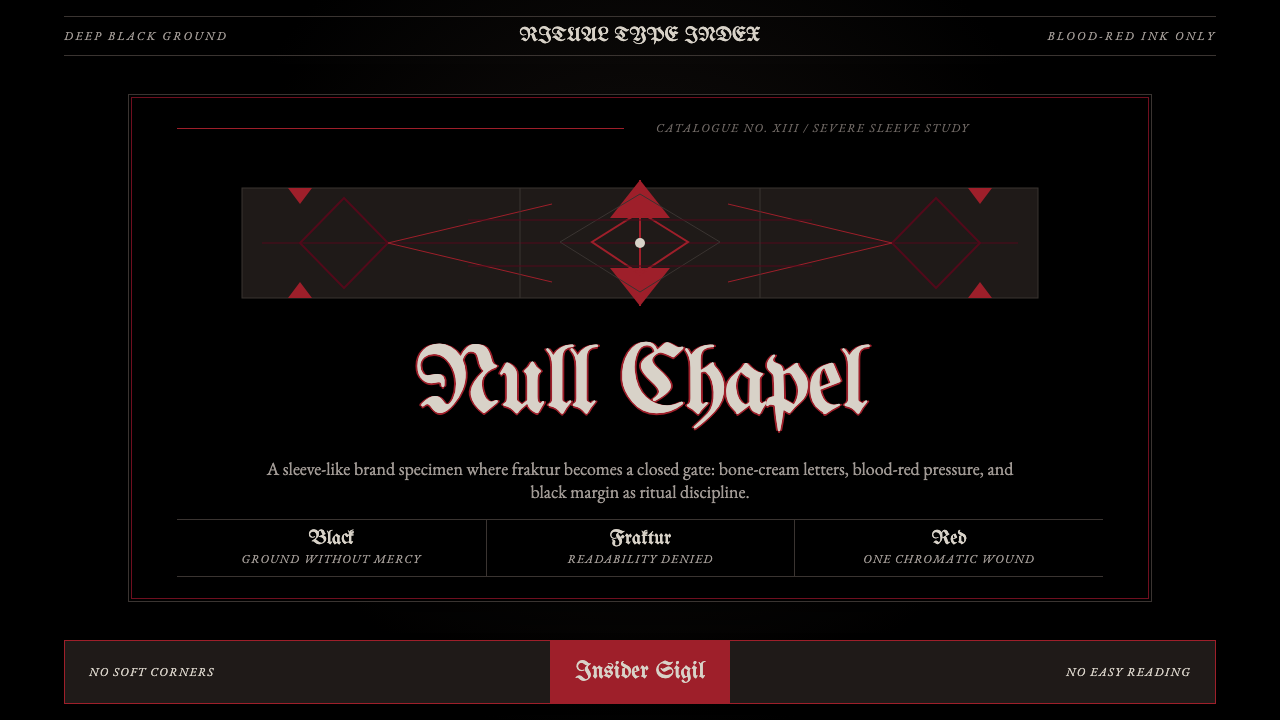 Death Metal BlackletterUnreadable by design. Bone fraktur on black, cut by one blood-red geometric s…
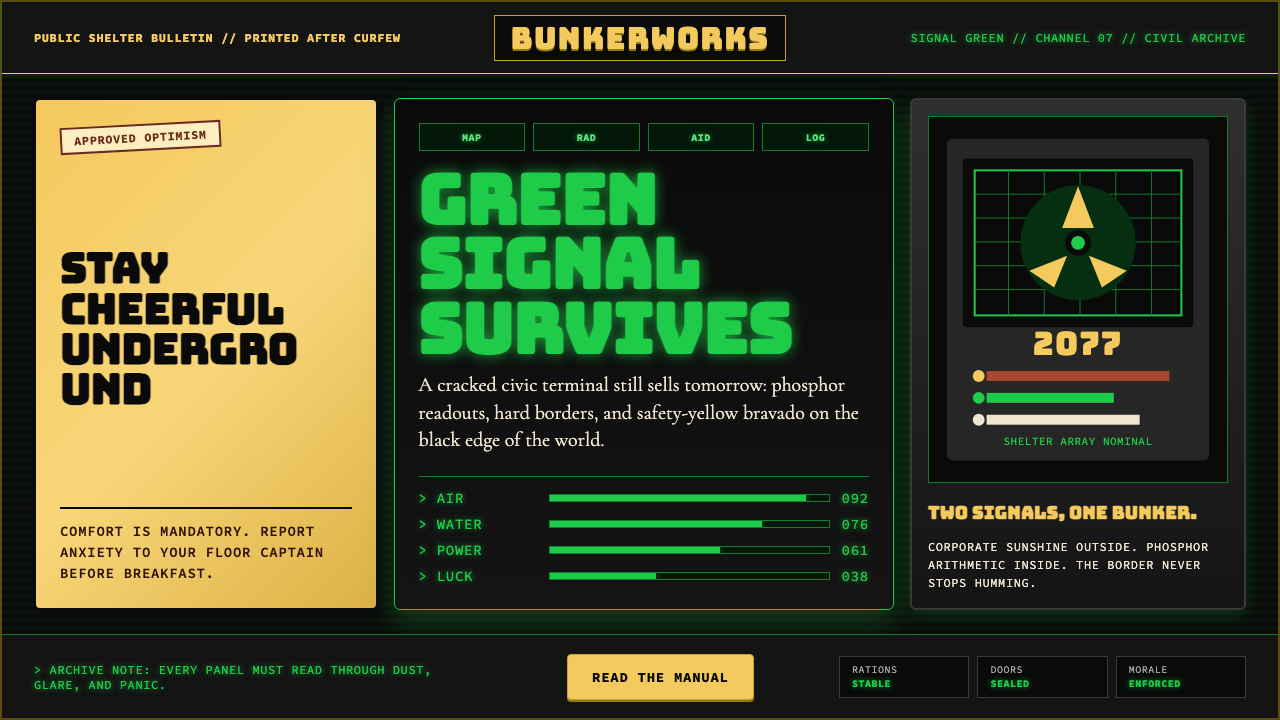 Fallout Vault-Tec Pip-BoyIrradiated optimism. Vault yellow and CRT green lock into a bordered bunker g…
 Miami Vice Pastel Teal (1984)Pastel noir, not nostalgia. Teal glow and flamingo pink slice black with geom…
 Stranger Things (1983)Red light breaks the void. A spurred serif blooms through VHS static and cold…