What is Taiwanese Raohe Night Market Neon?
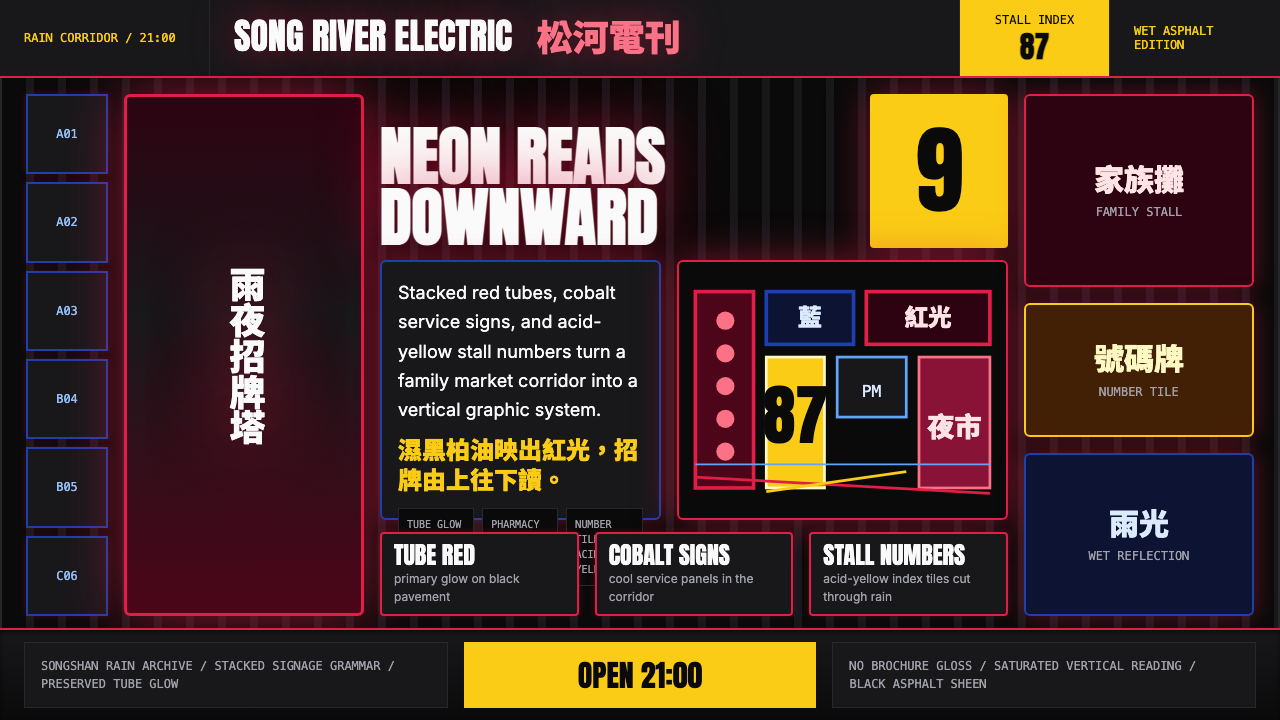
Taipei's night markets don't illuminate — they saturate: neon tubes stacked vertically on wet asphalt, cobalt placards humming beside acid-yellow numbers, red so deep it bleeds into the rain.
Taiwanese Raohe Night Market Neon in brief
Taiwanese Raohe Night Market Neon is a design style derived from the vernacular visual language of Taiwan's night market corridors — the stacked hand-painted tube signs, the cobalt-panel pharmacy boards, the acid-yellow stall numbers, and the deep wet-black asphalt that absorbs and reflects all of it back. Where most design systems strive for clarity, this one strides toward saturation, layering, and the productive chaos of commercial necessity compressed into a narrow lane.
The style is dark-ground by definition. Its palette leans on a deeply saturated red that owes more to traditional vermilion lacquerware than to any Western stop-sign convention, paired with a cold cobalt that reads almost pharmaceutical, and punctuated by an acid yellow so sharp it functions as punctuation rather than fill. These colors do not co-exist politely — they push against one another the way competing stall signs fight for vertical real estate on a narrow facade.
Crucially, this is not the nostalgic, softened version of Taiwanese street culture that appears in heritage branding. It is the electric, unmediated thing: the typographic stack read top-to-bottom, the neon glow that halos outward on wet surfaces, the layering of scripts and numerals that assumes a viewer who reads on the move, quickly, from a distance.
Where does Taiwanese Raohe Night Market Neon come from?
The visual culture of Taiwan's night markets traces its roots to the post-war boom of the 1950s and 1960s, when street vending became a primary economic survival mechanism for internal migrants who had moved from rural southern Taiwan to Taipei. Raohe Street Night Market — one of Taipei's oldest, dating to the late Qing dynasty as a riverside trading post — expanded dramatically during the economic acceleration of the 1970s and 1980s. As more stalls competed for attention in increasingly compressed corridors, signage evolved in a specific direction: vertical, bright, layered, and legible from a moving crowd.
The 1980s were the defining decade for the neon proliferation that gave the style its name. Taiwan's economic miracle — the period of sustained export-led growth that transformed the island from an agricultural society into an industrial powerhouse — produced a merchant class with disposable capital and a taste for conspicuous illuminated advertisement. Glass tube neon, imported craft techniques from Japan and Hong Kong, and locally produced enamel signage all converged. Pharmacies and herbal medicine shops favored cobalt-blue painted panels with white characters; food stalls and ceremonial goods vendors preferred the deeper reds and warm yellows coded to auspiciousness in Chinese visual tradition. The result was not planned; it accreted.
Taiwan New Wave cinema documented this visual environment with unprecedented specificity. Edward Yang's films — particularly his Taipei trilogy spanning the 1980s and early 1990s — photographed the Songshan and Wanhua districts at night in ways that foregrounded the neon-lit street as a character in itself. Tsai Ming-liang's work in the 1990s took this further, lingering on the rain-slicked surfaces and the haloing of neon light as a kind of urban melancholia. Post-martial-law street photography from the same era, freed from earlier restrictions on public image-making, produced an archive of night market images that design researchers and practitioners would later treat as primary sources.
From the 2000s onward, Taiwan developed an active movement around the preservation of traditional signage, particularly hand-painted glass tube neon — a craft that was rapidly disappearing as LED signage became cheaper and more durable. Organizations and individual craftspeople in Taipei began documenting, restoring, and commissioning new works in the old tradition. Chang Wan-li, a neon sign craftsman who continued hand-bending glass tubes in the traditional method, became a figure associated with this revival. Jam Wu and other contemporary Taiwanese designers began incorporating the vernacular visual codes of the night market into digital and print work — not as retro pastiche, but as an authentic continuation of a living tradition. This crossover from craft preservation into digital design practice is what established Raohe Night Market Neon as a recognizable, intentional style.
What defines the Taiwanese Raohe Night Market Neon look?
Dark Ground and Wet Asphalt
The foundational surface is always deeply dark — not the clean matte black of a studio backdrop but a black that implies moisture, reflection, and accumulated use. This wet-ground logic means that color does not sit on the surface so much as it glows within it, creating the haloing and bloom effect central to the style. Lighter elements appear to emit rather than to be lit from without.
Saturated Red as Structural Anchor
The red in this system is not a neutral attention-getter — it carries the cultural weight of auspiciousness, ceremony, and vitality drawn from Chinese visual tradition, compressed into the urgency of a commercial sign. It functions as the dominant structural element, typically occupying the largest or most vertically prominent position in a composition. Against a dark ground, this red does not merely pop; it radiates.
Cobalt as Cold Counterpoint
A cold, saturated blue — borrowed from the enamel panels of traditional pharmacy signage — acts as the primary foil to the red. Where the red is warm, ceremonial, and expansive, the cobalt reads as authoritative, medicinal, and precise. It is the color of information rather than emotion. When set against the dark ground, it vibrates against the red without the visual collision becoming unreadable — a property exploited in stall corridors where both appear within meters of each other.
Acid Yellow as Punctuation
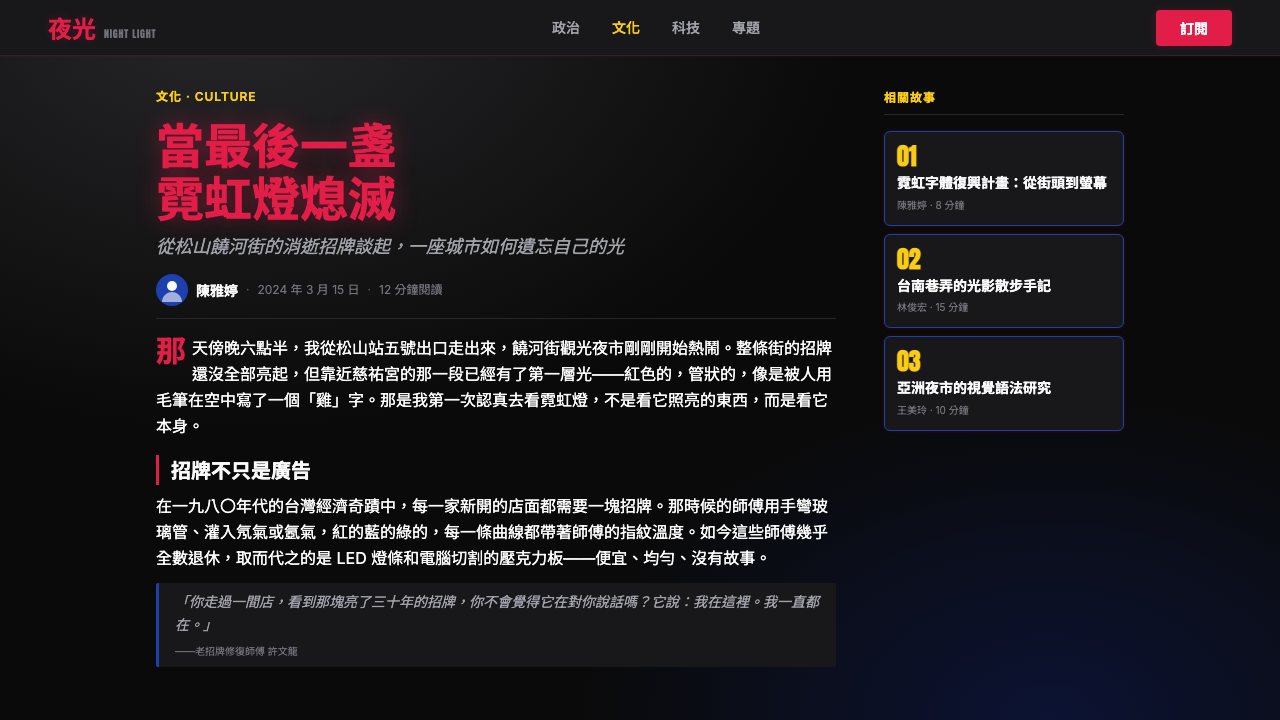
Acid yellow in this system functions less as a body color and more as visual punctuation — the number tile on a stall, the price stamp on a menu board, the narrow band of luminescence at the edge of a sign. It is the sharpest element in the palette, the one that reads first from a distance. Its quantity in any composition is deliberately limited; if it appears too freely, it loses its role as the eye's stopping point and the composition collapses toward visual noise.
Vertical Typographic Stacking
Text in this system reads vertically or in compressed horizontal bands stacked atop one another — an organizing logic inherited from traditional Chinese signage that orients reading from top to bottom and from right to left, as well as from the practical necessity of fitting maximum information onto narrow stall facades. This vertical rhythm is not merely decorative; it is the spine of the layout. Numbers, characters, and icons can all participate in the stack, with hierarchy established by scale and luminosity rather than grid position.
Neon Glow and Light Bloom
The visual signature most associated with this style is the glow that emanates from lit elements against the dark ground — a soft corona of color that extends beyond the literal edge of a letter or shape. This bloom is not imprecision; it is the authentic optical behavior of glass-tube neon reflected on wet surfaces, translated into a design principle. In practice, it means that hard-edged elements sit within atmospheric halos, and the boundary between figure and ground is never entirely sharp. This softened edge is what distinguishes the style from other dark-palette design systems.
Layering and Visual Compression
Night market signage does not have the luxury of generous white space — every surface competes, and legibility is achieved through contrast and luminosity rather than breathing room. This compression becomes a stylistic value in itself: elements overlap, colors push against one another at their edges, and the overall composition maintains a density that reads as abundance rather than clutter, because each layer has distinct color identity. The style resists the minimalism reflex; restraint, when it appears, is selective and purposeful.
Who shaped Taiwanese Raohe Night Market Neon?
The Taipei-born director Edward Yang is the most significant visual chronicler of the urban environment from which this style emerges. His films of the 1980s and early 1990s — set in the rain-wet lanes and neon-saturated commercial districts of Songshan and Wanhua — established a visual vocabulary for how the night market corridor looks, feels, and functions as a compressed social world. His compositional instinct for depth and layering within narrow spaces directly parallels the typographic stacking that defines the Raohe Neon style. Researchers and designers working in this tradition regularly cite his cinematography as a primary visual reference.
Tsai Ming-liang's films — many shot on location in Taipei's older commercial districts and night market peripheries during the 1990s and 2000s — extended the visual record of this environment into the register of urban melancholia. Where Yang documented the social density of the night market at its peak, Tsai photographed the same environments in decline, in rain, and in the small hours when the signs continue to glow but the crowds are gone. This quality of isolated luminescence against empty wet darkness is a direct visual precursor to the more atmospheric applications of the Raohe Neon palette in contemporary design.
Chang Wan-li is one of the last surviving craftspeople in Taiwan who continues to hand-bend glass tubes for traditional neon signs using methods that have remained largely unchanged since the mid-twentieth century. As LED lighting displaced glass tube neon across Taiwan's commercial districts from the 2000s onward, Chang's workshop became a site of active craft preservation — attracting apprentices, documentary filmmakers, and design researchers seeking to understand the material properties of the original signs. His practice grounds the Raohe Neon design style in a specific, recoverable material tradition rather than treating it as a purely visual abstraction.
Jam Wu is among the Taiwanese designers most closely associated with translating the vernacular visual language of the night market into contemporary graphic and digital practice. His work draws on the specific typographic conventions of traditional Taiwanese commercial signage — the compressed Chinese characters, the hand-lettered numerals, the grid logic of stacked panels — and applies them to contemporary brand identity, poster design, and digital interfaces. His practice is important because it demonstrates that the Raohe Neon aesthetic is not merely documentary but actively generative: a living style that can be extended to new surfaces and contexts without losing its identity.
The lifting of martial law in Taiwan in 1987 removed restrictions that had previously limited public image-making in commercial and street environments. In the years immediately following, a generation of Taiwanese documentary photographers worked extensively in Taipei's night market districts — Raohe, Shilin, Ningxia, Wanhua — producing a body of work that captured the signage environment at its most dense and saturated, before urban renewal and LED conversion began transforming the visual character of these areas. This photographic archive — distributed across galleries, publications, and archival collections — functions as the closest thing to a primary source document for the Raohe Neon design style.
How do you use Taiwanese Raohe Night Market Neon today?
Raohe Night Market Neon is a high-commitment style — it demands a dark ground, high saturation, and layering discipline. Applied halfway, it collapses into muddy darkness or garish novelty. Applied fully and with understanding, it delivers the most viscerally immediate visual impact of any contemporary design palette: the viewer's attention is not requested, it is seized.
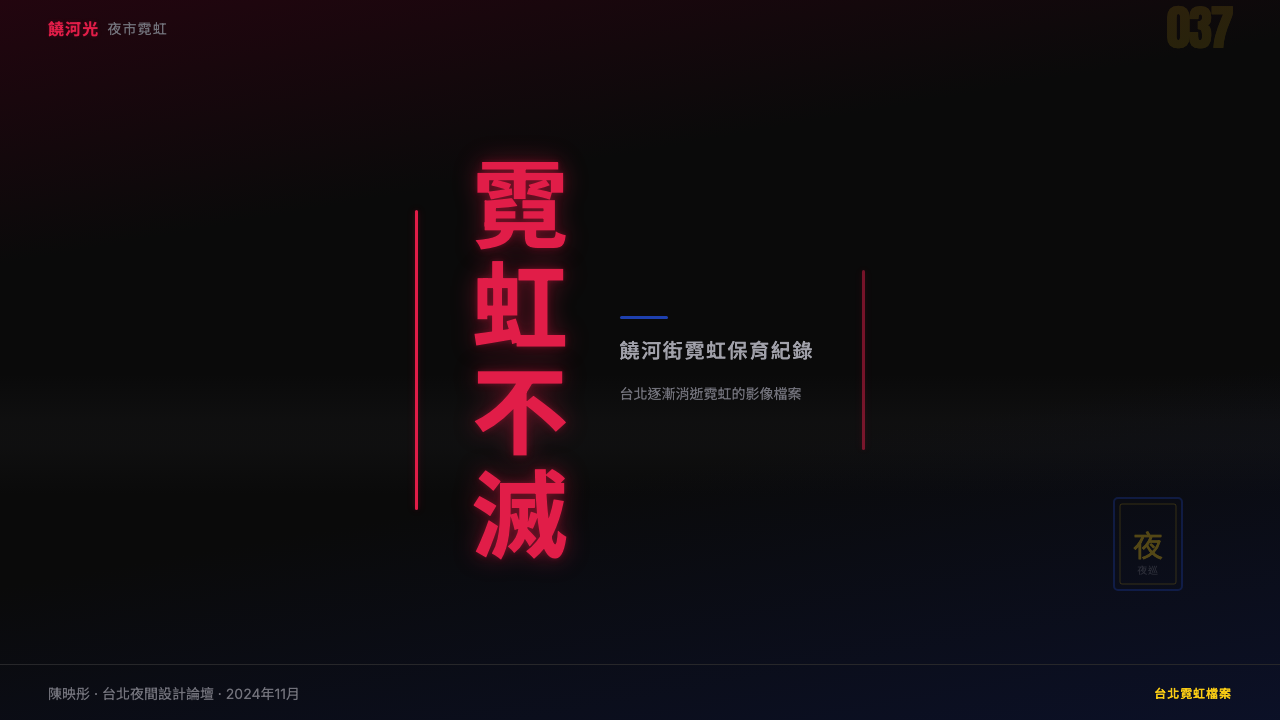
For presentation slides, this style works best in contexts where atmosphere and conviction matter as much as data clarity — a product pitch, a brand manifesto, a cultural initiative. Cover slides benefit from the full system: deep dark ground, vertically oriented or stacked title treatment in the saturated red or a warm white that glows against the dark, a narrow acid-yellow element as a structural accent. Content slides should pull back from the full density — a dark-ground slide with the body text in a near-white is readable and atmospheric — but the dark ground should be maintained throughout the deck for visual coherence. Data slides are where the palette earns its keep: bar charts and comparative visuals where each element carries one of the palette's saturated tones become instantly legible by color-identity alone.
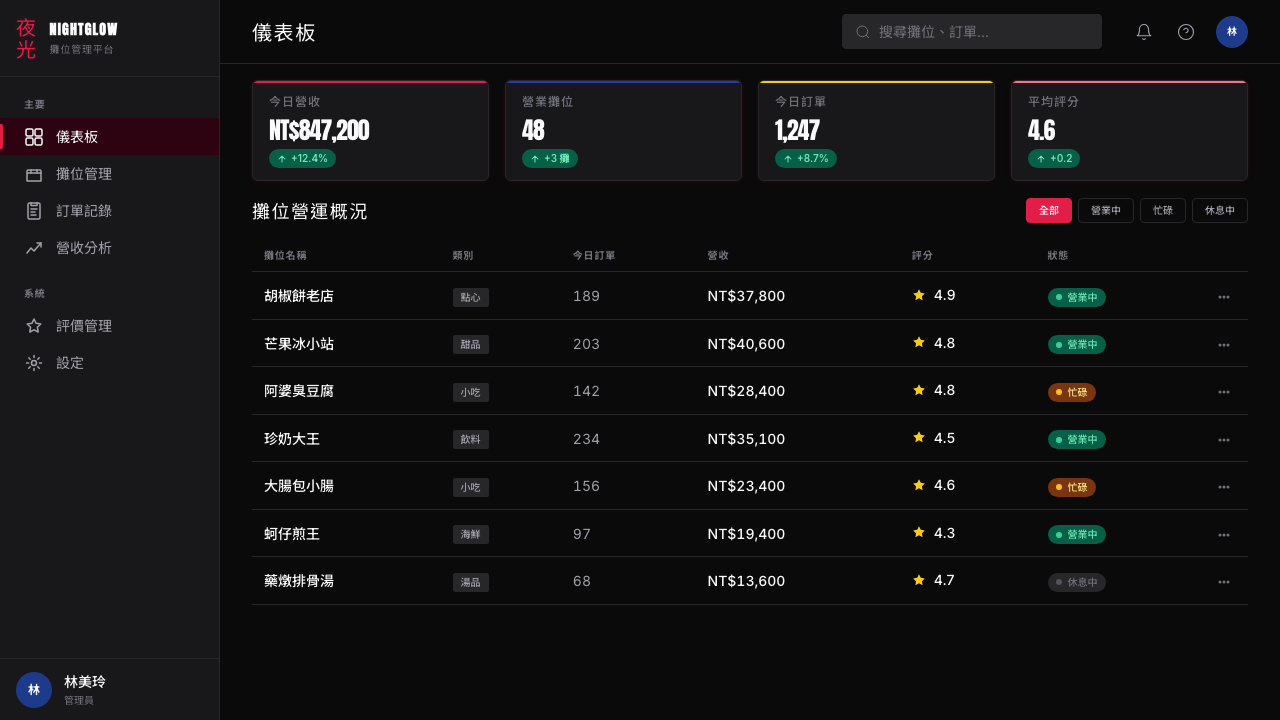
For web interfaces and digital product design, this style is best matched to platforms where edge and intensity are brand values — cultural platforms, music discovery tools, entertainment dashboards, late-night food delivery. The dark ground should be consistent across UI surfaces; the red and cobalt serve hierarchical functions — red for primary calls to action, cobalt for informational states and secondary actions — while acid yellow is reserved for the single most important status or alert state. Navigation should be lightweight and typographic against the dark, with no drop shadows that create the soft-glow illusion the background already handles at the element level.
For editorial and marketing work, the style gives poster work and social media visuals an intensity that competes for attention in densely visual feeds. A marketing cover built on this system — dark ground, stacked type in saturated red with acid-yellow numerals — does not need photography to command attention. When photography is included, it works best either as a silhouette against the dark ground or as a color-washed image reduced to near-monochrome in one of the palette's dominant tones. The style supports bilingual typographic layouts naturally: the vertical stacking logic accommodates Chinese and Latin scripts simultaneously without either reading as a caption for the other.
The most common mistake when applying this style is treating it as a color-swap operation on an existing light-ground design — replacing white backgrounds with black and hoping the colors carry the system. They will not. The style's logic is built from the ground up on the behavior of light on dark surfaces, and every compositional decision follows from that premise. A secondary failure mode is using all three saturated colors at equal weight: without one color clearly dominant, the palette becomes competitive noise rather than structured saturation. Identify the primary color for each composition — typically the deep red — and treat cobalt and acid yellow as measured accents within that dominant field.
Taiwanese Raohe Night Market Neon — FAQ
Is this style only appropriate for Taiwanese or broadly East Asian subject matter?
No. The Raohe Night Market Neon style is a visual system, not a cultural label to be applied only to content about Taiwan. Its palette, typographic logic, and layering principles are transferable to any subject matter that benefits from intensity, edge, and atmosphere — a global music platform, a fashion brand, a nightlife-adjacent service, or any product where the dark-ground glow aesthetic aligns with the brand's values. The style's Taiwanese origin enriches it historically and culturally, but it is no more restricted to Taiwanese content than Bauhaus is restricted to German content.
How does this style differ from other dark-neon aesthetics like cyberpunk or synthwave?
Cyberpunk and synthwave are primarily Western science-fiction-derived aesthetics with a specific technological and dystopian valence — neon in those traditions signals a future gone wrong, alienation, or retro-futurist nostalgia. Raohe Night Market Neon is grounded in the specific material reality of a commercial tradition: the palette colors are defined by the actual pigments of Taiwanese pharmacy enamelwork and traditional lacquer, and the typographic logic comes from vernacular Chinese signage conventions. Where cyberpunk leans into purples and acid greens with a sci-fi atmosphere, Raohe Neon uses a vermilion red, cobalt blue, and acid yellow that carry cultural meaning specific to the Taiwan context. The result is warmer, more human, and less retrofuturist.
Can this style work in a light-ground version for contexts where a dark background is impractical?
A light-ground adaptation is possible but requires significant recalibration. The system's core mechanism — light glowing from within a dark field — cannot be directly reproduced on a light ground. What can be preserved is the color identity (the saturated red, cobalt, and acid yellow) and the typographic stacking logic. On a light ground, these become bold, assertive elements without the atmospheric glow. The result reads closer to traditional Chinese commercial graphic design than to night market neon specifically. If the glow and bloom effects are central to the intended application, a dark ground is not optional — it is the system itself.
How should Chinese and Latin type be handled together in this system?
The vertical stacking logic of the Raohe Neon system accommodates mixed-script typography naturally, because traditional Taiwanese signage frequently combined Chinese characters, Arabic numerals, and occasionally romanized text in a single sign. The hierarchy principle holds: scale and luminosity determine reading order, not script convention. Chinese and Latin text can occupy the same band in a stacked composition — the Chinese characters typically carrying the larger body weight and the Latin functioning as secondary identification or transliteration. Avoid the common error of treating the Latin as a caption line below the Chinese; in the night market tradition, mixed scripts share the sign face as equals, just at different scales.
Is this style suited to minimalist or sparse compositions, or does it require visual density?
Spare compositions are possible but work differently in this system than in light-ground minimalist styles. On a dark ground, a single bold red element surrounded by empty dark space does not read as minimal — it reads as isolated and tense, a spot of light in the dark, which can be dramatically effective for a cover or hero image. The glow effect means that even a single element carries atmospheric weight. Where sparse compositions struggle in this system is when the dark field becomes simply empty rather than atmospherically charged — this happens when the ground is a flat, matte dark rather than one that carries the suggestion of depth and moisture that is central to the style's character.
Related design styles
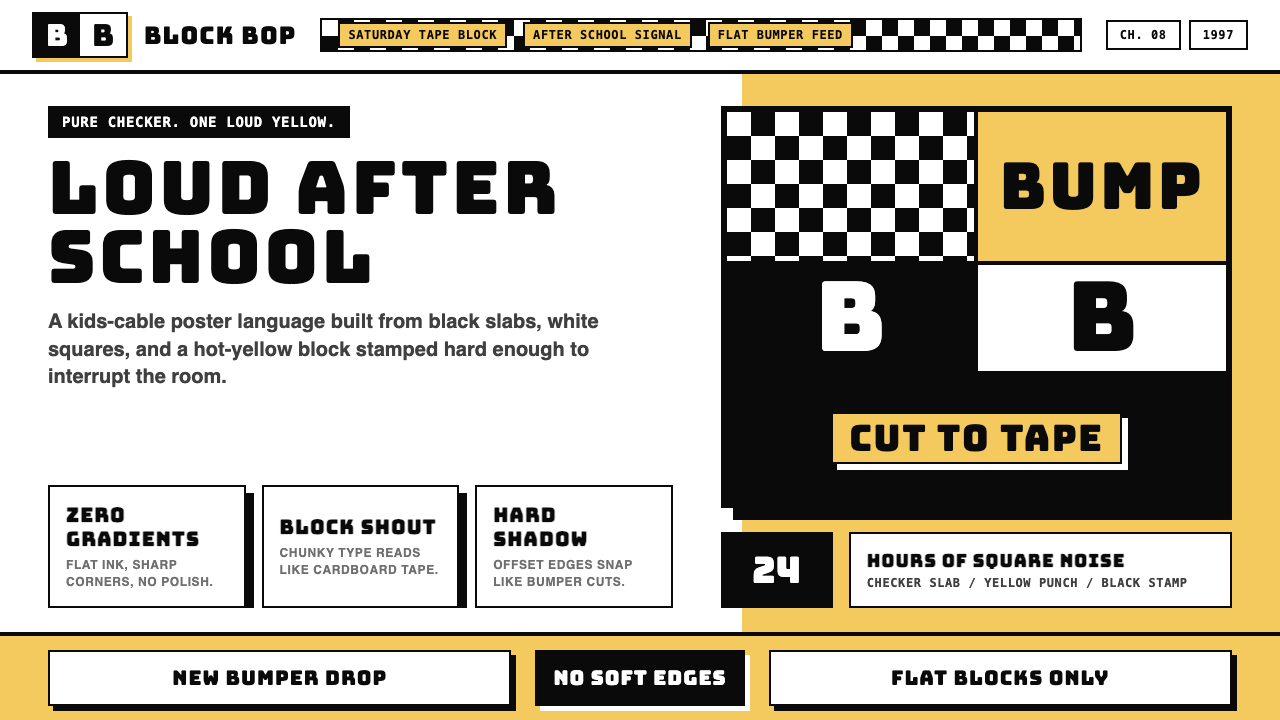 Cartoon Network 90s BlocksKids-cable noise, squared. Black-white checkerboards crash into hot-yellow Bu…
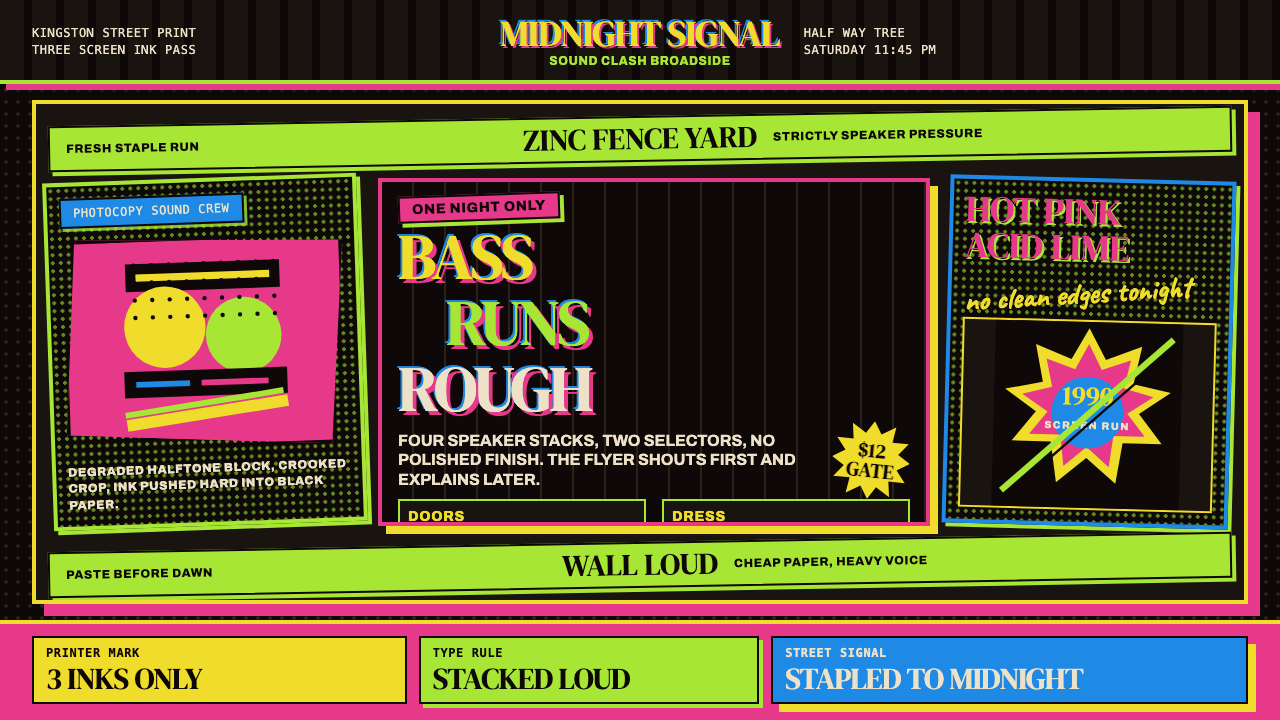 Jamaican Dancehall 1990 PosterMidnight volume. Acid lime and hot pink type stack like screenprint ink on bl…
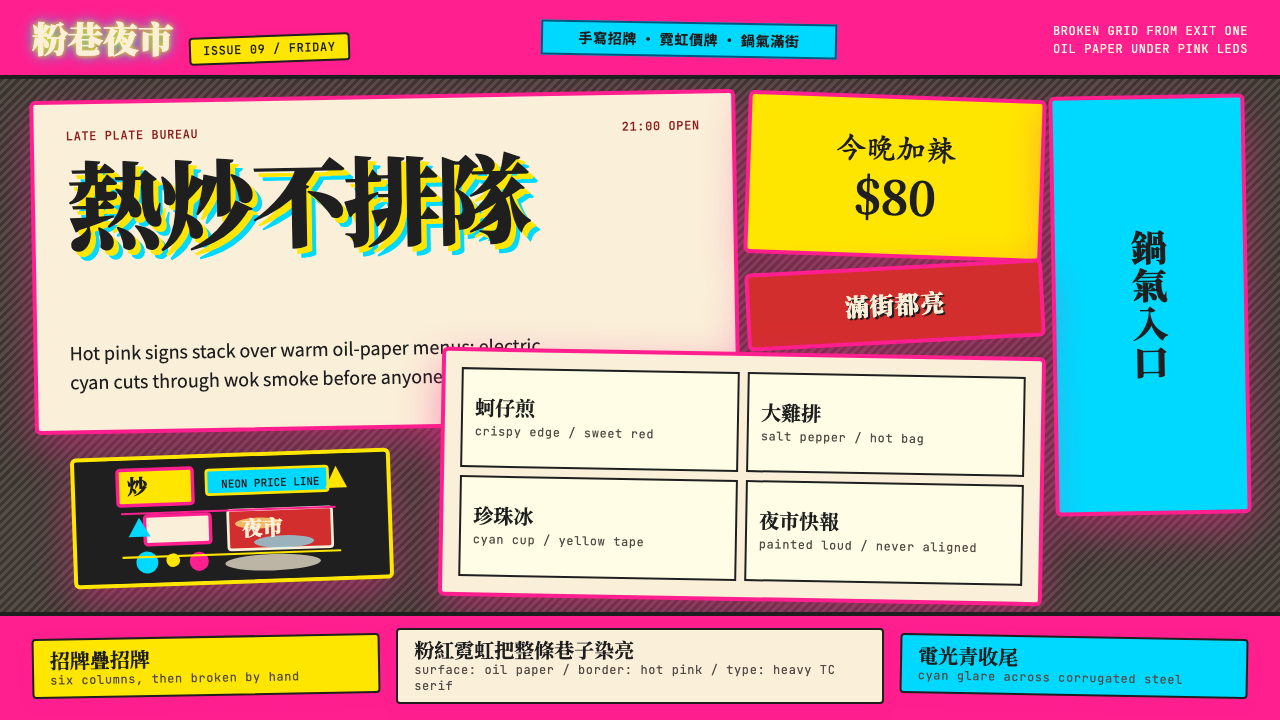 Taipei Shilin Night Market NeonLoud by design. Hot pink, neon yellow, and stacked TC serif signs break the g…
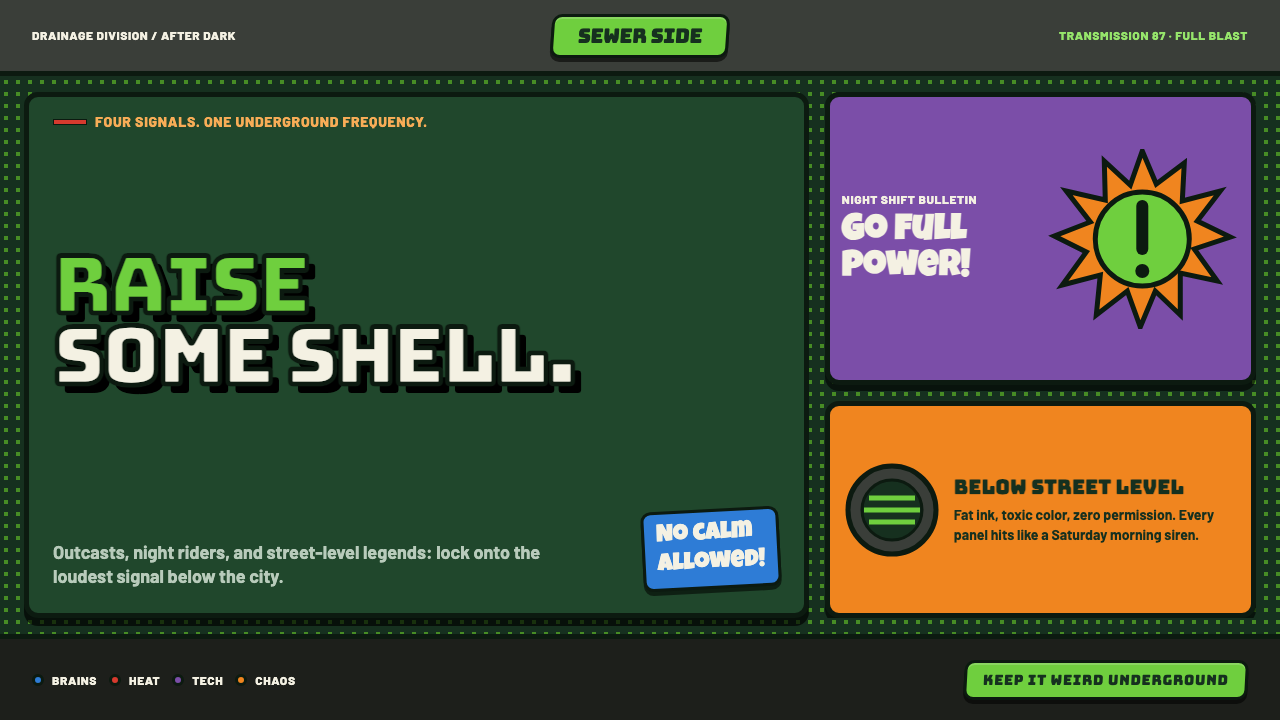 TMNT (1987 Saturday-Morning)Saturday-morning chaos, full blast. Sewer green, bandana brights and clogged…
 Akira Neo-TokyoNight moves fast. Firebrick trails cut crushed black, teal grids, and condens…
 Cowboy Bebop Jazz-NoirCool at 3 AM. Bungee type, jazz yellow, red cuts, and cyan rules hit deep bla…