What is Taipei Shilin Night Market Neon?
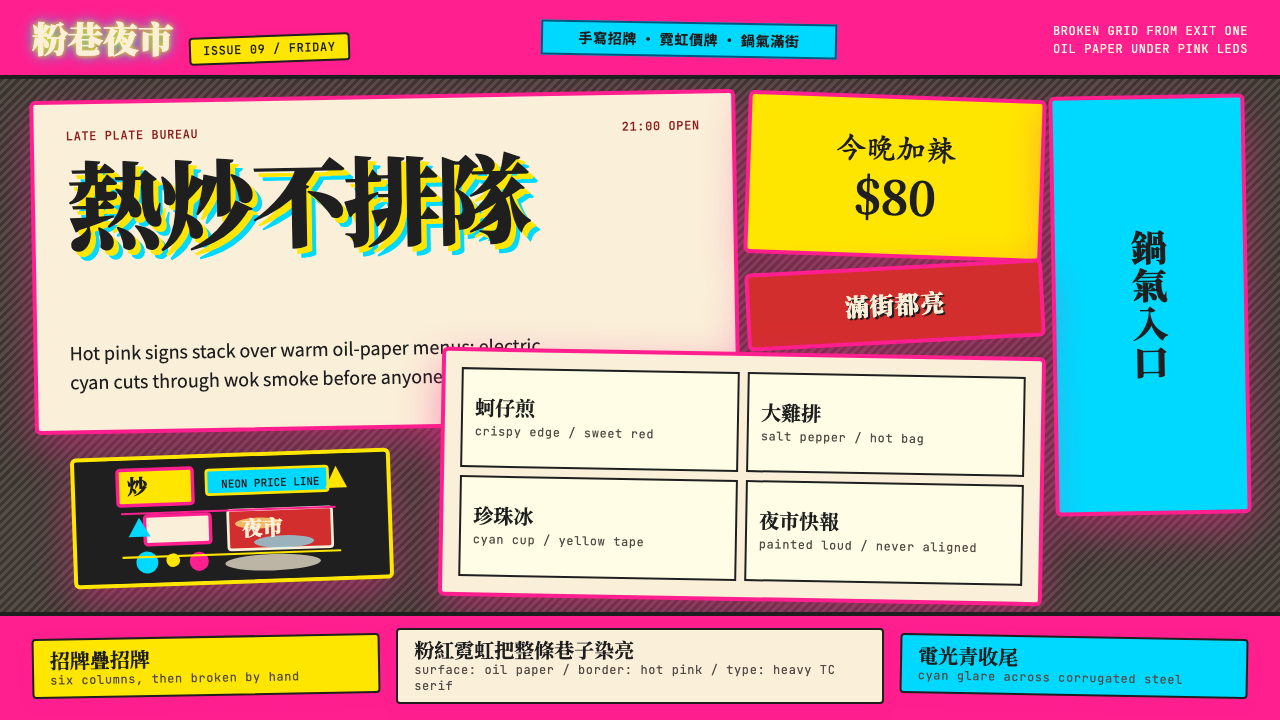
Taipei's Shilin Night Market is the loudest visual argument in East Asia — a wall-to-wall collision of hot pink, electric cyan, and hand-painted Traditional Chinese characters where every surface competes to outshout the one beside it.
Taipei Shilin Night Market Neon in brief
Taipei Shilin Night Market Neon is a design system rooted in the unfiltered visual language of Taiwan's most famous street market. It captures the aesthetic of an actual place operating at full intensity on a Friday night — stalls packed shoulder to shoulder, neon tubes buzzing in colors that have no polite equivalent in a Pantone swatch book, Traditional Chinese display type stacked in weights and angles that professional typographers are trained to avoid. The system is not a nostalgic reconstruction; it is a direct translation of a living, daily commercial vernacular.
The organizing principle — if it can be called that — is productive chaos. Nothing aligns because the stalls themselves never aligned. Signs were painted by whoever was cheapest and fastest that week, light sources are wherever the extension cord reached, and the price tag covers half the product name without apology. Within this apparent disorder, there is a logic: attention hierarchy is established entirely by brightness, scale, and color temperature. The hottest pink wins. The largest character wins. The sign hanging closest to eye level wins. This is not accidental; it is the result of decades of informal A/B testing by hundreds of independent vendors.
As a design system, Taipei Shilin Night Market Neon embraces what restrained design movements fear most: density, contradiction, and the refusal to whisper. It is the counterargument to Swiss minimalism, the antidote to Silicon Valley neutral gray. For designers working on projects where energy, immediacy, and cultural specificity are virtues rather than liabilities, this system offers a coherent framework drawn from one of the most visually alive environments in the world.
Where does Taipei Shilin Night Market Neon come from?
Shilin Night Market was founded in 1899 during the Japanese colonial period, originally as a small trading post near what is now the Jiantan MRT station in the Shilin District of Taipei. Like most of Taiwan's historic markets, it began as a practical infrastructure for a neighborhood — a place where residents could buy produce, prepared food, and everyday goods after working hours. The colonial government periodically attempted to regulate or relocate it, but the market had the resilience of something that fills a genuine need: it persisted, grew, and eventually became the largest and most-visited night market in Taiwan.
The visual language that now defines the Shilin aesthetic did not emerge until the postwar decades. The Japanese occupation ended in 1945, and Taiwan's subsequent political isolation under the Republic of China government — and particularly the economic pressures of the following decades — created the conditions for a highly localized commercial visual culture. Vendors could not afford professional signage, which meant signs were typically hand-lettered by local artisans using whatever paints were available and whatever display weights caught the eye. Traditional Chinese characters in their full-form complexity became the dominant letterform, used in sizes and weights that reflected the competitive urgency of the stall environment rather than any typographic convention.
The full visual intensity that the system captures — the wall of neon, the overlapping illuminated signs, the hot pink and cyan that have become iconic — emerged primarily in the 1990s, as Taiwan's manufacturing economy brought affordable LED and neon tubing into mass commercial circulation. By the end of that decade, the aesthetic was fully formed: a layered environment of competing light sources and hand-painted characters that photographers and designers began documenting as a subject in its own right. The post-1990 Taiwan localism aesthetic, which the market exemplifies, represents a conscious pride in vernacular commercial culture at a time when global homogenization threatened to dissolve it.
Contemporary figures such as baker Wu Pao-chun, designer Chen Wei, and artist Lin Sheng-Wen have drawn explicitly on this visual tradition in their work, helping to establish Shilin-style density and chromatic intensity as a legitimate aesthetic register within Taiwanese creative culture rather than something to be overcome in favor of international modernism. Their influence — along with a broader wave of Taiwanese cultural pride in the 2010s and 2020s — has accelerated the transformation of the night market visual language from pure commercial vernacular into a designed system consciously employed to signal local identity, energy, and authenticity.
What defines the Taipei Shilin Night Market Neon look?
Color Temperature and Intensity
The palette is built on extreme warmth: a hot pink that sits closer to magenta than to rose, an electric cyan that cuts through the warmth like a cold edge, and a neon yellow that functions as a price-tag signal rather than a compositional accent. These are not subtle, graduated hues — they are colors that behave the way actual neon tubing behaves, which is to say they bleed at their edges, they overpower what is next to them, and they read from the end of a crowded street. The overall temperature of the system is warm-dominant, cooled by cyan intrusions at key moments of contrast.
Typography as Structure
Traditional Chinese characters in bold display weights are not decorative elements in this system — they are the primary structural material. The stroke complexity of full-form characters means that a single large character occupies visual space the way a photograph might in a Western layout. When multiple characters appear at large scale, they create a texture of interlocking geometric density that needs no additional graphic support. Body text, where it appears, is set in a contrasting upright sans-serif that registers as quieter precisely because the display characters are so dominant.
Anti-Grid Composition
Where Bauhaus and Swiss International Style impose the grid as an organizing discipline, this system treats the grid as something to violate. Signs are layered at slight angles. Price tags appear in the corners of other signs rather than in designated information zones. Text wraps around objects and other text. The composition logic is cumulative and additive — each element is placed where it will best compete for attention given what is already there — rather than organized top-down from a master structure. The result is visual density that reads as authentic energy rather than designed chaos.
Illumination as Hierarchy
In physical night markets, light itself establishes hierarchy: the brightest stall draws the first glance. The design system translates this into digital and print contexts through the use of glowing, high-saturation colors against dark grounds — a simulated luminance that replicates the felt experience of neon without requiring actual tubing. The hierarchy is simple: things that glow outrank things that do not. This makes the system unusual among historical commercial styles in that luminosity, not size or position, is the primary organizational tool.
Surface Layering
The defining textural quality of the Shilin aesthetic is the palimpsest — surfaces on which new signs overlay old ones, where tape and paper add to printed surfaces, where nothing is ever entirely removed because removal costs money and the new layer works just as well. In design terms, this means composition is built vertically as much as horizontally: foreground, midground, and background are all active zones, each contributing information. Transparency, overlap, and partial occlusion are tools rather than errors.
Vernacular Type Scale
In professional typography, scale relationships are deliberate: a headline might be twice the size of body text, with intervening levels for subheadings and captions. In night-market vernacular, scale is determined by what fits and what is most urgent. The result is a system where scale jumps are extreme — a character three times the expected size sitting next to one at expected size — and where the contrast between scales is itself expressive. The largest element shouts; the smallest element mutters. The gap between them is not a failure of hierarchy but the hierarchy itself.
Chromatic Contradiction
Where most design systems seek color harmony — palette members that sit comfortably together — this system is built on controlled discomfort. Hot pink and cyan are not harmonious; they vibrate when placed next to each other, creating the perceptual buzz associated with neon juxtaposition. Neon yellow against pink creates a slightly acrid visual tension. These tensions are not bugs to be resolved; they are the mechanism by which the system signals urgency and energy. A harmonized version of this palette would lose precisely what makes it characteristic.
Who shaped Taipei Shilin Night Market Neon?
Wu Pao-chun is Taiwan's most celebrated artisan baker, whose work bridges street-food vernacular and high craft. His visual brand draws explicitly on the warm, dense, hand-crafted aesthetic of Taiwan's market culture — hot-colored packaging, hand-lettered elements, materials that suggest physical warmth and immediate appetite. His success in international competitions while maintaining a distinctly Taiwanese commercial visual language helped legitimate the idea that vernacular market aesthetics were not something to grow out of but a genuine design tradition worth developing.
Chen Wei is a Taiwanese designer and visual artist whose work has engaged directly with the chromatic intensity and layered density of Taiwan's commercial street environments. Working across branding, print, and installation, Chen has helped formalize the vocabulary of Taiwanese street vernacular — bright saturated colors, dense typographic layering, a refusal of the compositional restraint associated with mainland Chinese or Japanese contemporary design — as a consciously chosen aesthetic position rather than an untrained default.
Lin Sheng-Wen represents the generation of Taiwanese artists and designers who came of age during the post-1990 localism movement and built their practice on the materials and visual logic of Taiwan's street and market culture. Working at the intersection of fine art and commercial visual culture, Lin's engagement with neon, hand-painted signage, and the specific color language of Taiwanese night markets helped position these elements as subjects of serious aesthetic inquiry rather than merely background to be documented.
No single figure codified the Shilin night-market aesthetic — it was developed collectively and anonymously by the itinerant sign painters who worked the markets across Taiwan from the 1950s through the 1990s. These craftspeople painted in Traditional Chinese characters using techniques inherited from prewar commercial calligraphy, adapting weight, color, and scale to the specific conditions of each stall: available light, sign dimensions, the vendor's budget, and the competition from the stall next door. Their accumulated decisions constitute the visual grammar of the system.
The broader movement of Taiwanese designers, writers, and cultural figures who embraced localism after 1990 provided the intellectual framework that allowed the Shilin aesthetic to be understood as a designed system rather than commercial noise. By reframing Taiwanese commercial vernacular as a form of cultural heritage rather than a sign of underdevelopment, this generation created the critical vocabulary — rooted in pride in local visual culture — that made the night-market aesthetic legible as a conscious design tradition worth learning from and building upon.
How do you use Taipei Shilin Night Market Neon today?
Taipei Shilin Night Market Neon is a high-commitment style: it does not sit quietly in the background and it does not work at half-intensity. Before applying it, a designer needs to ask whether the project genuinely calls for energy, density, and cultural specificity, or whether the client is drawn to the aesthetic without fully understanding what it demands of a layout. Used correctly, it is among the most immediately recognizable and emotionally direct visual languages available. Used incorrectly, it reads as visual clutter that signals effort without communicating content.
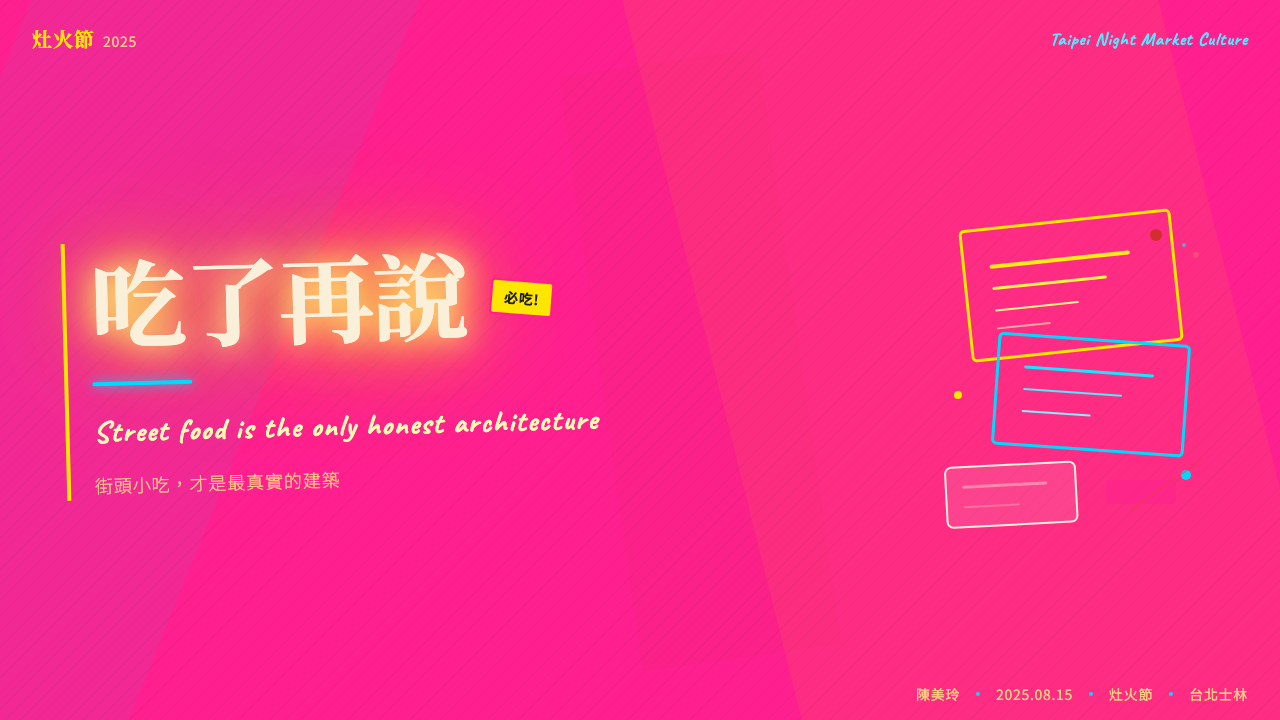
For presentation slides, the system works best on covers and divider pages where full-intensity color and typographic density can be deployed without compromising legibility of detailed content. A cover built on this system might use a hot pink or deep midnight ground, stack two or three large Traditional Chinese characters at an angle, and layer English text in a contrasting weight and color at a different scale. Content slides, by contrast, should pull back significantly — treating the night-market palette as an accent used at headers, divider bars, and data highlight moments rather than wallpapering every slide. The contrast between high-density cover pages and relatively quieter content pages mirrors the actual experience of walking into a night market from the outside: maximum impact at the threshold, navigable within.
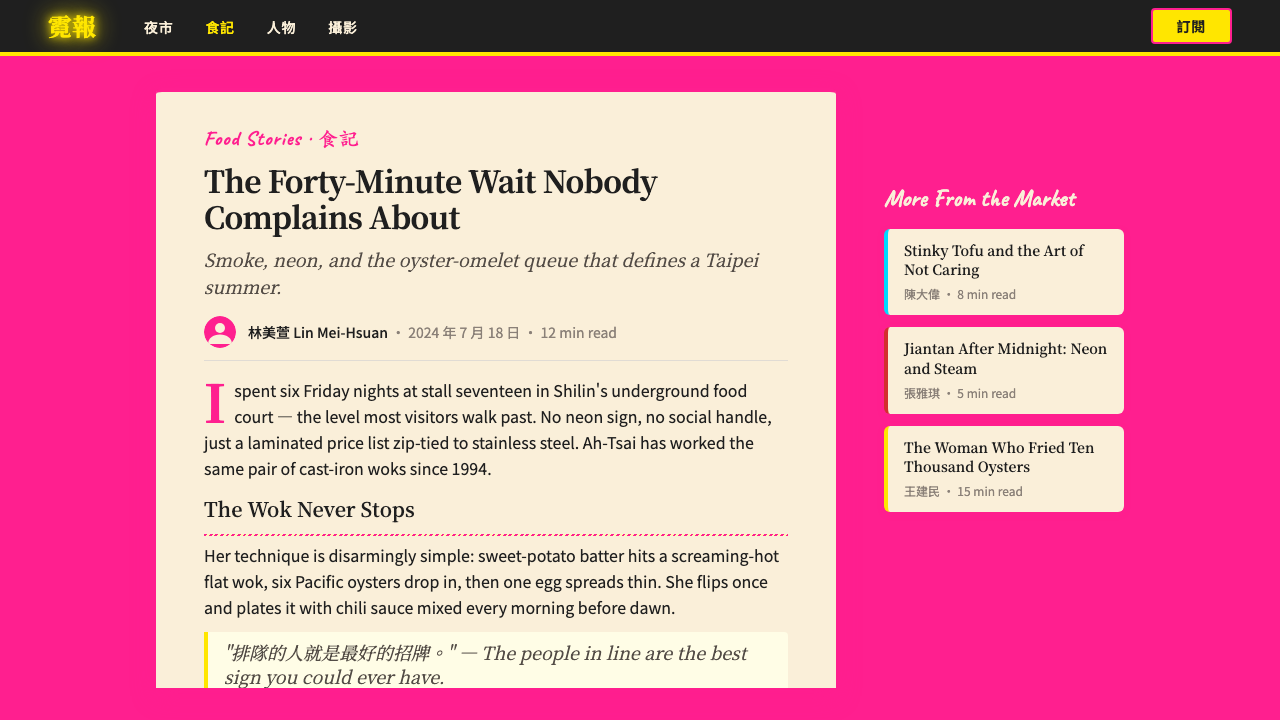
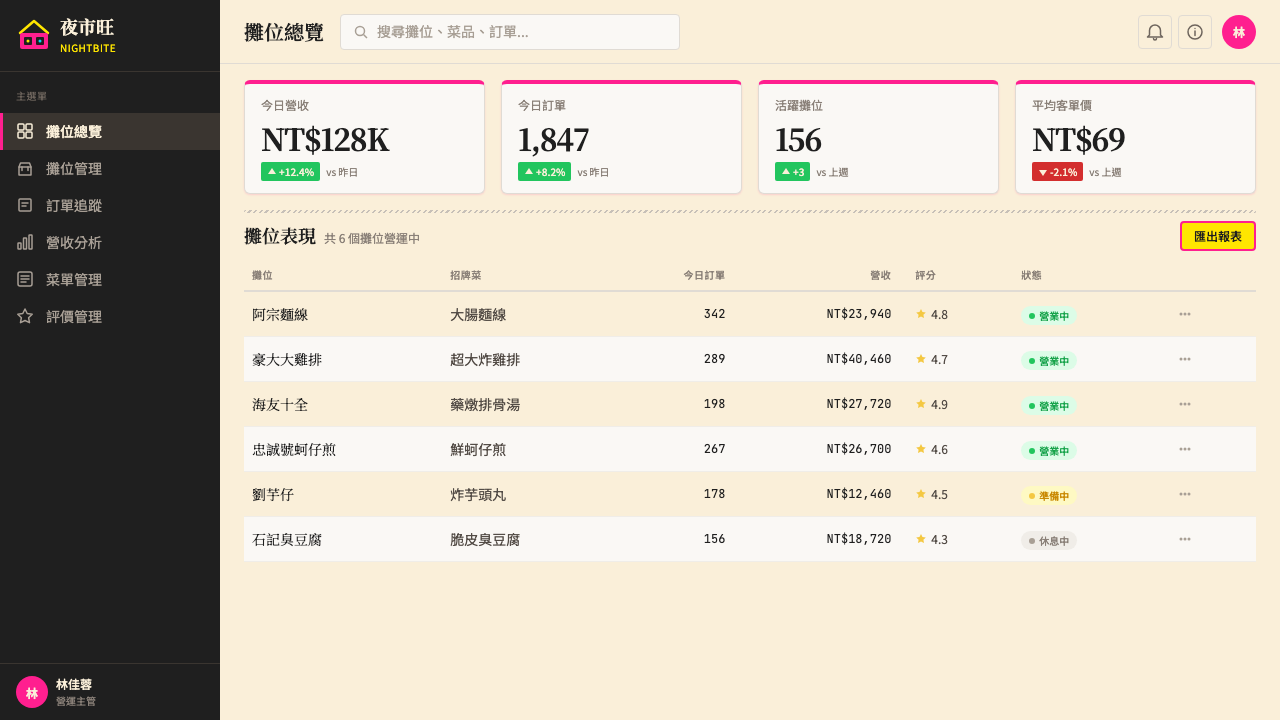
For web interfaces and digital product design, the system suits contexts where energy, immediacy, and local cultural identity are primary values: event landing pages, food and beverage brands, entertainment platforms, cultural tourism sites, and any digital product positioned as the antithesis of corporate restraint. Dashboard and analytical interfaces are generally a poor fit — the chromatic intensity makes data discrimination difficult, and the anti-grid composition conflicts with the information architecture demands of complex data products. Where it does appear in interface design, it should be used in high-visibility moments: hero sections, calls to action, category navigation — with quieter zones reserved for actual content.
For editorial and marketing work, the system has a natural home in food writing, cultural journalism, travel editorial, and any content that aims to communicate the felt experience of a place rather than just its facts. A spread built on this system might anchor on a large-scale Traditional Chinese character that bleeds off the page, use a hot-pink pull quote at a scale that competes with the headline, and allow photographs of the actual night market environment to blend with typographic elements rather than sitting in clean designated image zones. Marketing pages for food brands, cultural events, and entertainment venues can use the style's poster-quality boldness to great effect, particularly when the brand is specifically Taiwanese or positioning itself within East Asian street culture.
The most common mistake when applying this system is treating it as a color palette choice rather than a compositional philosophy. Designers often take the hot pink, electric cyan, and neon yellow but apply them within a conventional grid structure, with standard type hierarchies, at moderate densities — the result is a confused visual that has the colors but not the character. The second most common mistake is using the palette at full intensity across every element simultaneously, which produces the opposite problem: an undifferentiated field of competing stimuli with no navigable hierarchy. The system requires both commitment to density at key moments and strategic restraint in supporting zones — precisely the balance that the actual stall operators of Shilin have been negotiating for over a century.
Taipei Shilin Night Market Neon — FAQ
Is this style only appropriate for Taiwanese or East Asian brands?
Not necessarily, but cultural context matters. The system draws on a very specific visual tradition rooted in the commercial street culture of Taipei's night markets. When used by a brand with a genuine connection to that tradition — a Taiwanese food company, a cultural tourism platform, a Taiwan-based creative agency — it carries authentic weight. When used by a brand with no connection to that context, it risks reading as cultural appropriation or as a decorative borrowing that has not earned the density it borrows. The question is not whether a non-Taiwanese brand can use it, but whether the project's narrative earns the cultural reference.
How do I use Traditional Chinese characters in this system if my content is in English?
There are two honest approaches. The first is to use Traditional Chinese characters as pure structural and visual elements — a large character as a section marker, an evocative word or phrase as a hero element — with the understanding that the character's visual complexity is doing compositional work that does not depend on the reader parsing its meaning. The second is to use the system's color language, compositional logic, and typographic density without importing the Chinese characters at all, leaning instead on the anti-grid composition, the chromatic intensity, and the layered visual density as the primary carriers of the aesthetic. Avoid using Chinese characters as inauthentic decoration — a character whose meaning is unknown to both the designer and the intended audience is a risk worth evaluating.
Can this style work at small scale — business cards, icons, app icons?
At small scale, the system's complexity becomes a liability. The layered, overlapping density that reads as energetic vitality at poster or screen scale becomes unreadable noise at business card or icon dimensions. The chromatic intensity, however, scales down well: a small icon or badge using the hot pink and cyan against a dark ground retains the night-market energy signature even when the typographic layering must be eliminated. The practical advice for small-scale applications is to extract the color language and the luminosity principle — the idea that certain elements should appear to glow — while simplifying everything else to a level appropriate for the format.
How does this system relate to other East Asian commercial aesthetics — Japanese advertising, Korean street style?
The three traditions share some surface features — high-saturation colors, dense typographic environments, layered commercial signage — but their underlying logics are distinct. Japanese commercial advertising in its dominant postwar form tends toward high production value, carefully controlled composition, and a tension between kawaii softness and precise technical execution; it rarely permits the kind of unresolved visual conflict that defines the Shilin aesthetic. Korean street design in the contemporary sense has been heavily influenced by K-pop visual culture and favors a sleek, high-tech chromatic range — neon, yes, but ordered and branded rather than chaotic and vernacular. The Shilin system is distinctive precisely in its embrace of genuine commercial disorder: the signs were not designed to coexist with each other, and that non-designed coexistence is what the system attempts to capture and formalize.
What is the right way to handle the dark ground that appears in so many night-market images?
The night sky and the dark gaps between illuminated signs are as much part of the night-market aesthetic as the lights themselves — they are what make the lit elements appear to glow rather than simply sit. In design terms, a near-black or very deep midnight ground is not merely a background choice but a structural requirement of the system: without the darkness, the chromatic intensity of the hot pink and cyan cannot reach its full effect, because there is no contrast deep enough to make them appear luminous. For projects where a dark ground is not appropriate for other reasons — client branding, category convention, reading environment — the system can be adapted to lighter grounds, but the designer should expect to compensate by increasing the saturation and scale of the colored elements to recover some of the lost luminosity contrast.
Related design styles
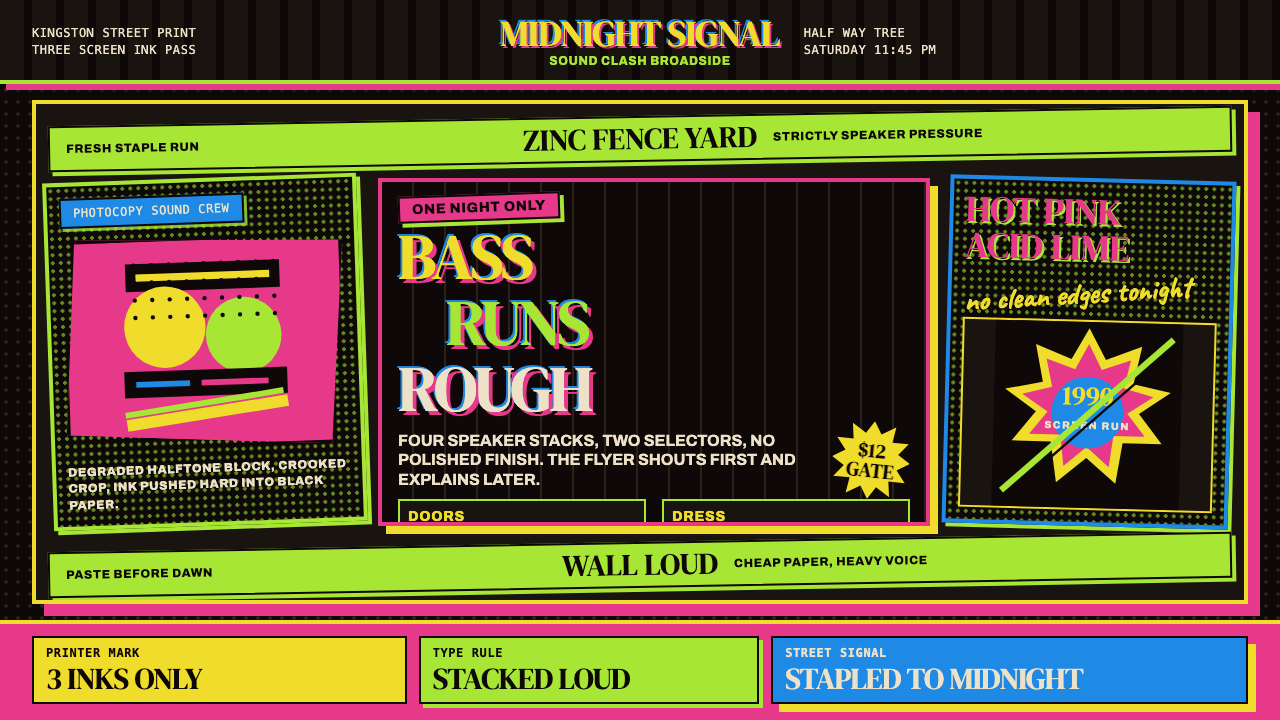 Jamaican Dancehall 1990 PosterMidnight volume. Acid lime and hot pink type stack like screenprint ink on bl…
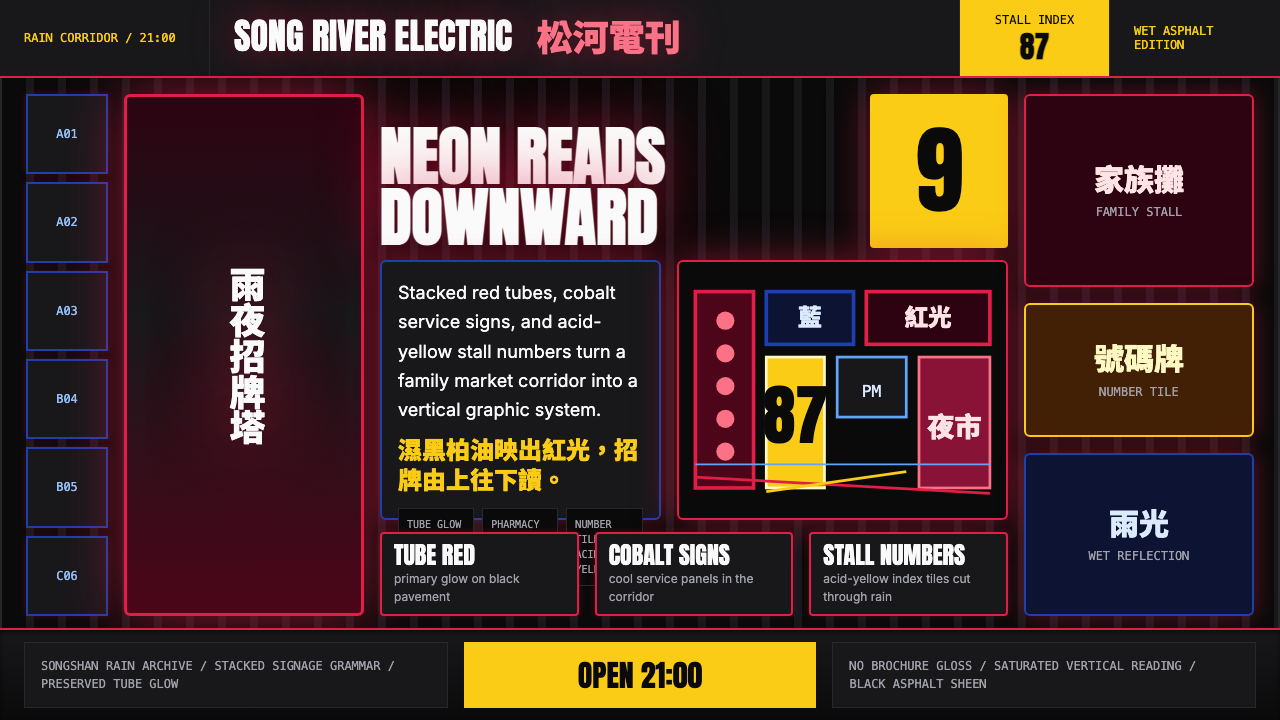 Taiwanese Raohe Night Market NeonTaipei night reads vertically. Neon red, cobalt panels, and acid-yellow numbe…
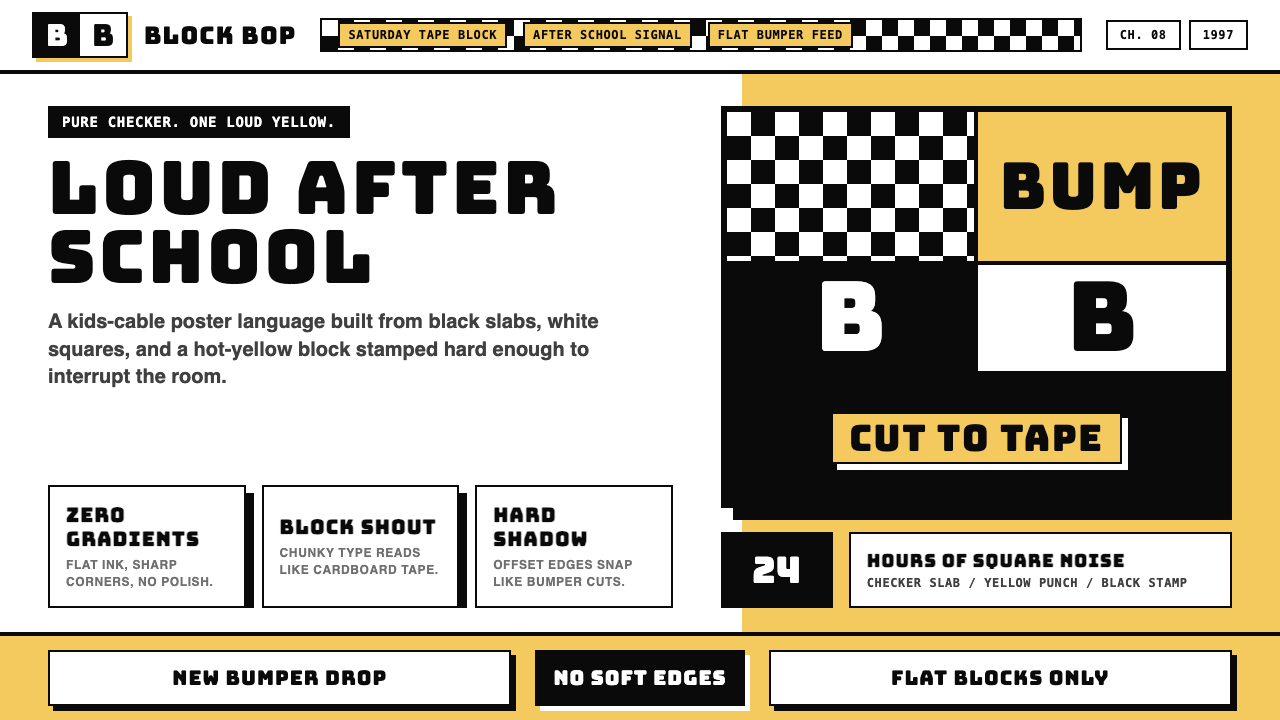 Cartoon Network 90s BlocksKids-cable noise, squared. Black-white checkerboards crash into hot-yellow Bu…
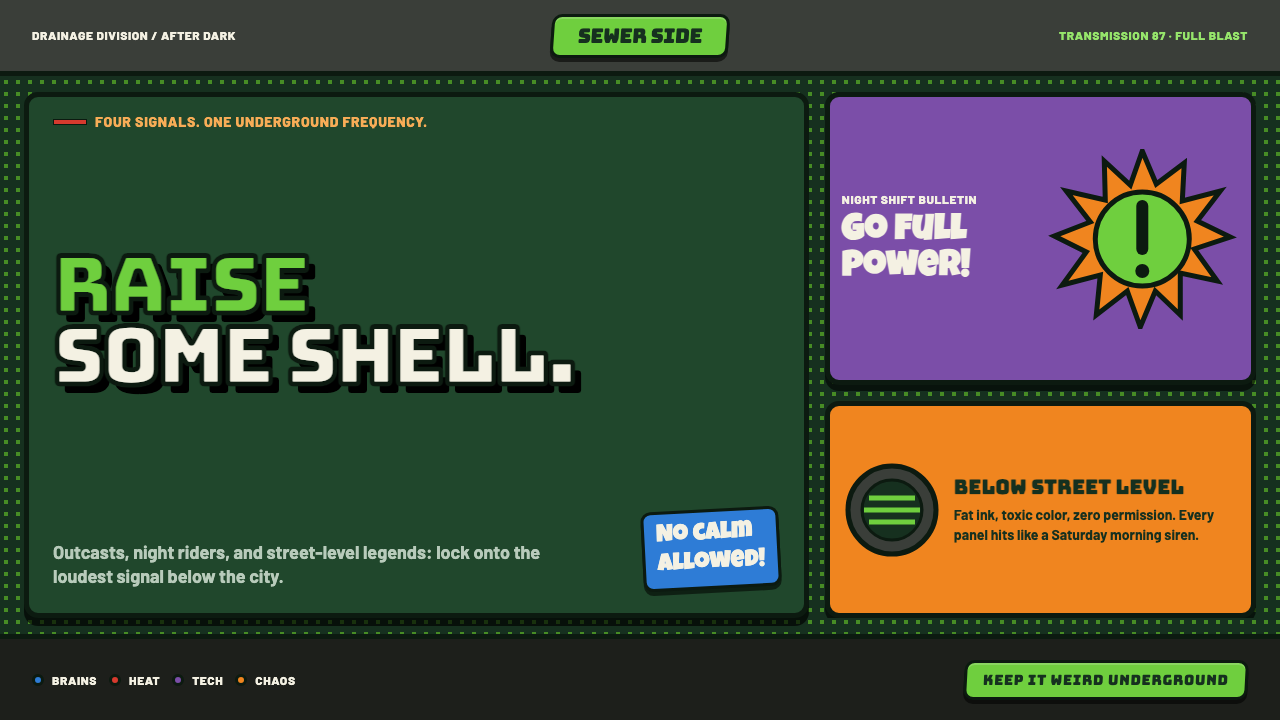 TMNT (1987 Saturday-Morning)Saturday-morning chaos, full blast. Sewer green, bandana brights and clogged…
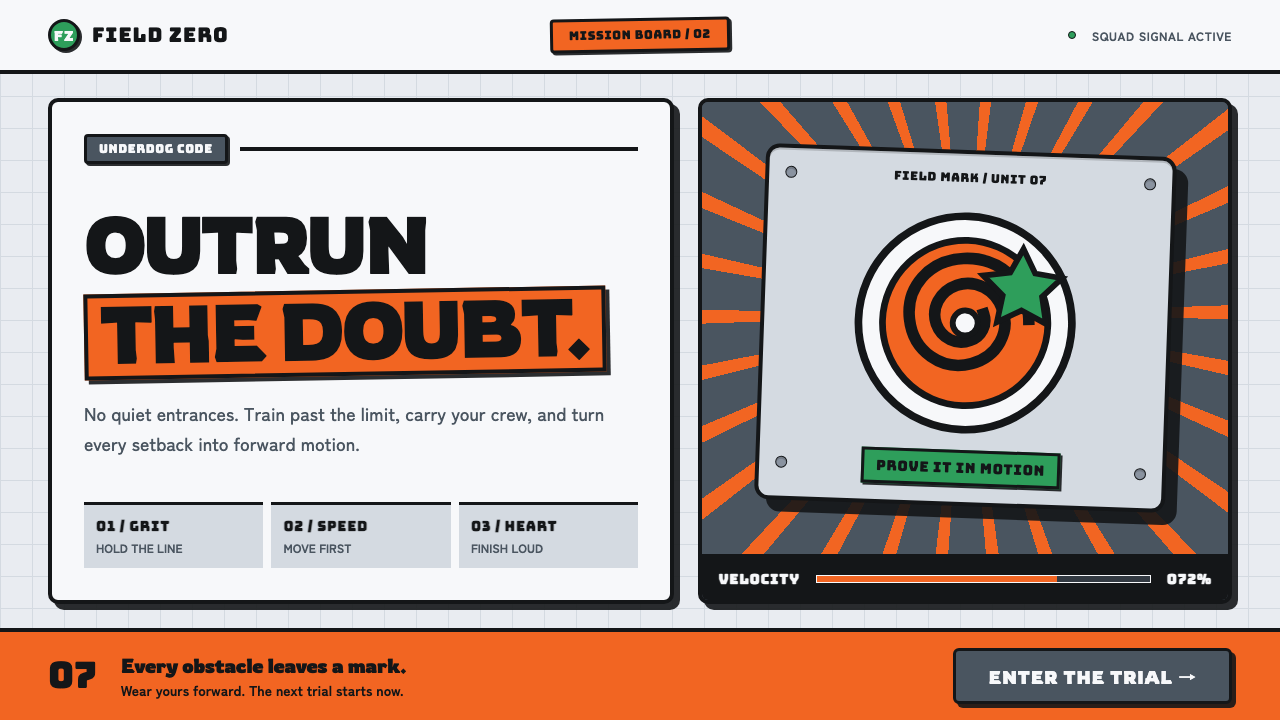 Naruto (2002 anime era)Underdog energy refuses the background. Hazard orange strikes steel-gray grid…
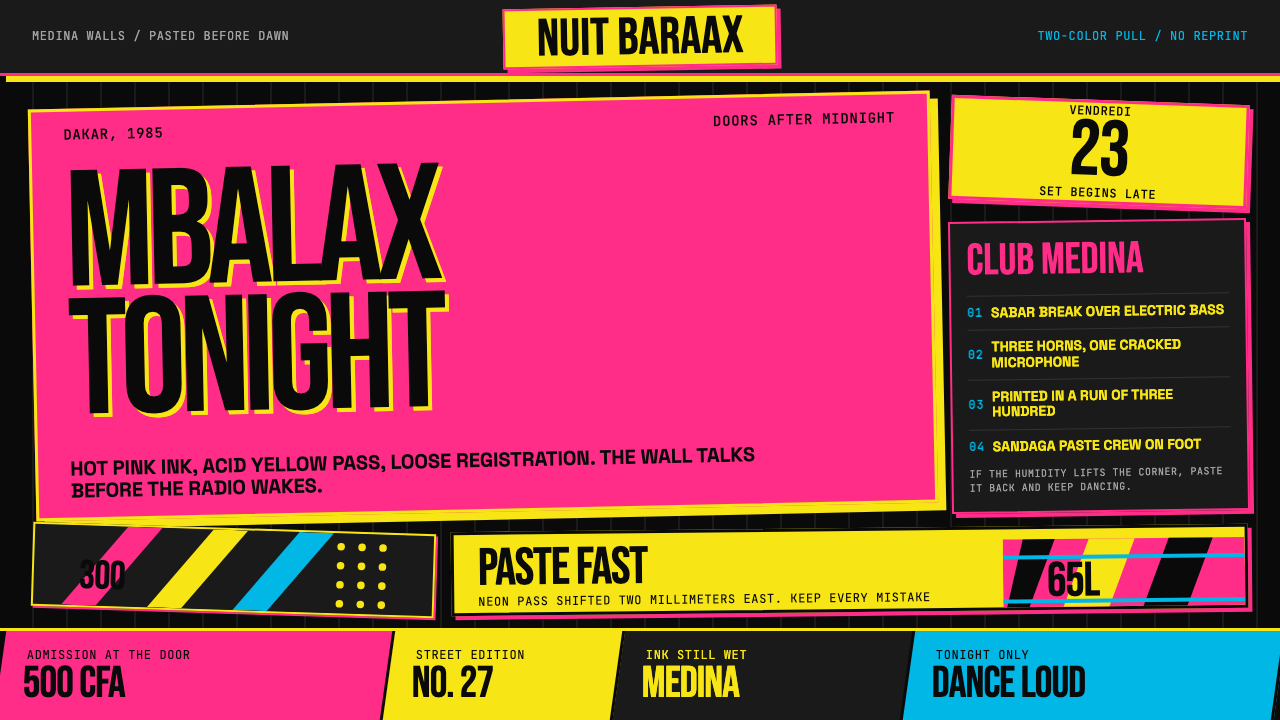 Senegalese Mbalax Poster (Dakar 1985)Street urgency, screen-printed loud. Hot pink and acid yellow drift over blac…