What is Keith Haring Pop?
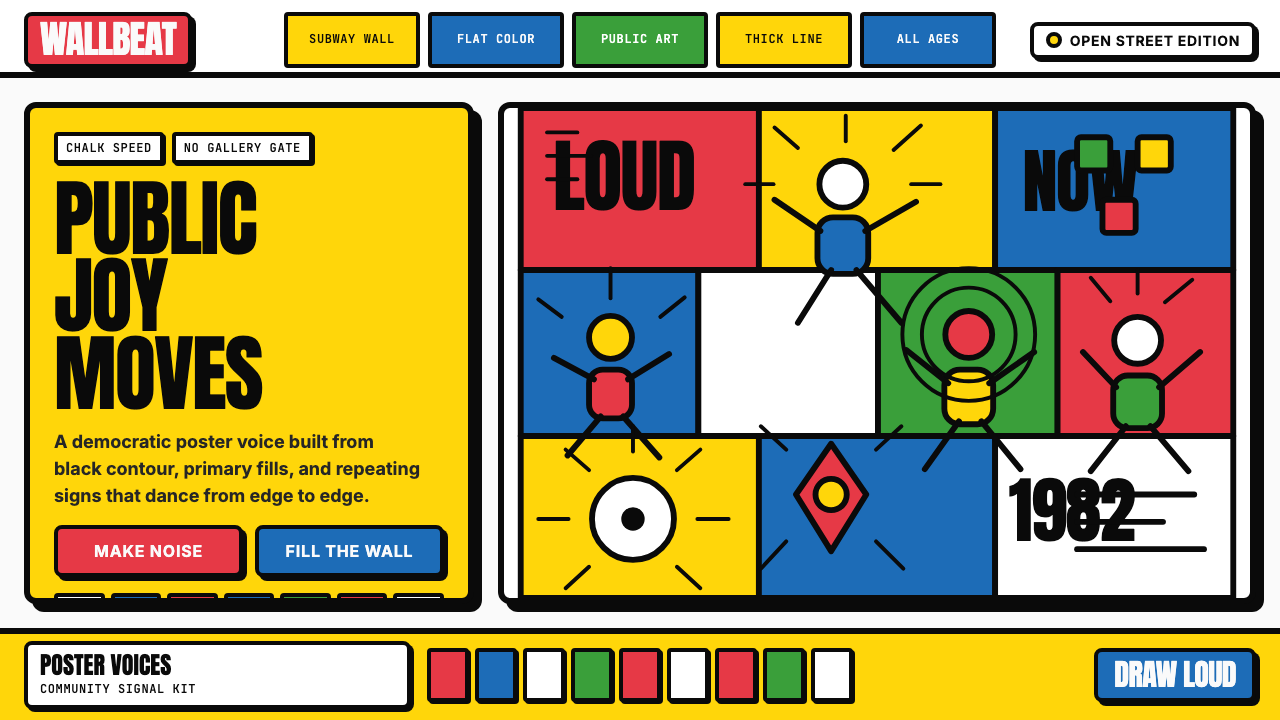
Keith Haring turned New York's blank subway panels into a democratic gallery — thick black contours, dancing figures, and shouting primary colors that refused to stay on the wall.
Keith Haring Pop in brief
Keith Haring Pop is the visual language born in the New York City subway system in the early 1980s and carried forward through murals, T-shirts, nightclub interiors, and hospital wards worldwide. Its defining characteristics are inseparable from its origin: chalk on black paper, drawn fast, in public, for everyone. Thick black contour lines enclose flat, solid color — cadmium red, cobalt blue, chrome yellow, Kelly green — with no shading, no gradient, and no perspective. Every figure radiates movement lines. Every composition fills the frame edge to edge.
The visual system operates through repetition and rhythm. A single dancing figure becomes a crowd. A barking dog becomes a warning. A radiant baby becomes an icon of pure joy. Because each element is built from the same thick stroke weight and the same restricted palette, the system is infinitely scalable — from a dime-sized badge to a ten-story mural — without losing legibility or energy. This scalability was not an accident; it was a consequence of designing in the subway, where a drawing had to read from across a platform at a glance.
What separates Keith Haring Pop from generic cartoon or illustration styles is its structural integrity. The thick outline is not decoration — it is the load-bearing element. Remove it and the color fields collapse. The flat fills are not laziness — they are a political commitment to democratic legibility over technical virtuosity. The whole system is built to be understood immediately, by anyone, regardless of education or cultural background. That is the design intention, not a side effect.

Where does Keith Haring Pop come from?
Keith Haring arrived in New York City in 1978 from Kutztown, Pennsylvania, enrolling at the School of Visual Arts after a brief stint at the Ivy School of Professional Art in Pittsburgh. The city he entered was in fiscal crisis, physically deteriorating, and artistically incandescent. The East Village was a collision zone of punk, hip-hop, graffiti writing, and neo-expressionist painting. Haring absorbed all of it while developing something distinct: a graphic vocabulary simple enough to draw at speed on the curved black paper panels that the MTA placed over expired subway advertisements.
Between 1980 and 1985, Haring made thousands of these subway drawings — sometimes dozens in a single day — always in white chalk on black paper, always unsigned, always illegal. The subway context was fundamental. The drawings were ephemeral by design: transit workers would remove them, and Haring would return to draw more. The practice trained a visual language that was fast, scalable, immediately communicative, and structurally dependent on the contrast between the thick chalk line and the dark ground. When he moved his work to canvas and then to mural scale, the formal decisions were already fully formed.
The East Village art scene provided the social infrastructure. Tony Shafrazi, the gallerist who had once spray-painted Picasso's Guernica as a protest action, became Haring's primary commercial dealer and helped translate his subway currency into the international art market without sacrificing the style's democratic energy. Andy Warhol, whom Haring met in the early 1980s, recognized in his younger colleague the same commitment to mass-reproducibility and cultural accessibility that had driven Warhol's own Pop Art project. The two became close friends and mutual influences. Jenny Holzer, whose text-based street art also occupied public space as political intervention, was another peer whose example reinforced Haring's conviction that the street was a more honest gallery than any white cube.
The AIDS crisis, which devastated the communities Haring belonged to and eventually took his own life in 1990, gave the work an urgency and a political dimension that sharpened its visual language rather than softening it. Haring created public health murals, collaborated with AIDS activist organizations, and used his visual system — already built for instant comprehension — as a tool for outreach to populations who were simultaneously stigmatized and underinformed. The icons he developed for this work, including figures of support and solidarity, became some of the most recognized graphic symbols of 1980s activist visual culture. His Pop Shop, opened in New York in 1986 and in Tokyo in 1988, made his imagery available on affordable merchandise, deliberately undercutting the gallery market and extending the democratic logic of the subway drawings into commercial space.
What defines the Keith Haring Pop look?
Thick Contour Line
The single most defining formal element is the heavy, even-weight black outline that encloses every shape. This line does not thin or taper — it maintains consistent weight around curves, corners, and interior details alike. It reads clearly at any scale, from a button badge to a building facade, because its visual weight is calibrated to the contrast it creates against the color fill inside and the background outside. The outline is structural, not decorative: without it, the system loses its coherence entirely.
Flat Saturated Color
Color fills are applied as uniform, unmodulated fields — no shading, no highlight, no internal texture. The palette draws from a concentrated set of primary and near-primary hues: red, blue, yellow, green, with occasional orange, all at high saturation. These are joyful, assertive colors that announce themselves without apology. Color functions to distinguish figure from figure and figure from ground; it does not model light or suggest three-dimensional form. The flatness is a feature, not a limitation — it is what allows the compositions to remain legible at a distance and in motion.
Radiant Movement Lines
Haring codified a visual language of motion through short, energetic lines radiating outward from figures and objects — what became his signature glyph for excitement, emanation, and life. A figure running radiates lines from its heels. A baby glowing with health radiates lines from its whole body. A barking dog radiates lines from its open mouth. These are not naturalistic speed lines borrowed from comics but a consistent symbolic vocabulary: more lines mean more energy. The device transforms what might be static icons into kinetic presences.
Edge-to-Edge Composition
Haring rarely left significant empty space. Compositions fill the available field completely, with figures and pattern elements pressed to the edges. When multiple figures appear — and they often do, in crowds, in chains, in stacked grids — they interlock and overlap in ways that create dense, rhythmic surface patterns rather than isolated characters in open space. This density was partly a product of the subway context (a single blank panel had to hold attention as a commuter walked past) and partly a philosophical stance: every inch of a public surface that can carry meaning should carry meaning.
Symbolic Icon System
Over time, Haring developed a consistent set of recurring symbols — the radiant baby, the barking dog, the crawling figure, the TV set with devil horns, the flying saucer, the dolphin, the angel — each with a specific emotional register and deployable in combination to produce narrative meaning. This is not illustration but iconography: a visual language with grammar. The icons are legible cross-culturally because they are built from universal gestural forms rather than culturally specific references. A figure with arms raised reads as joy or surrender or celebration in almost any context.
Comic-Book Shadow Offset
Where shadow appears in Haring-derived work, it is a hard, solid-color block offset at a consistent diagonal — a technique borrowed from comic book production and street signage rather than from fine art painting. The shadow is the same uniform density as the fill color, simply shifted a fixed distance in one direction. This produces a pop-out effect that gives flat elements a sense of presence without introducing any gradient or blur. It emphasizes the printed, graphic nature of the work: this is a designed artifact, not a rendering of the physical world.
Democratic Accessibility
Unlike many historical art styles, Keith Haring Pop is defined as much by its values as by its formal properties. The visual decisions — simple forms, bold colors, thick outlines, no technical complexity — are not stylistic preferences but deliberate commitments to reach the widest possible audience without requiring art literacy. This means the style is inherently anti-elitist: it refuses visual vocabulary that signals sophistication or insider knowledge. When applied in contemporary design, this principle translates to maximizing legibility, minimizing assumed knowledge, and treating every viewer as equally capable of receiving the message.

Who shaped Keith Haring Pop?
Haring (1958–1990) arrived in New York in 1978 from Pennsylvania and spent the first years of his career making unsanctioned chalk drawings on the blank black panels the MTA placed over expired subway advertisements. By the early 1980s he had become one of the most recognizable visual artists working in public space anywhere in the world. He created major murals in New York, Berlin, Melbourne, Amsterdam, and dozens of other cities, often in direct response to political events — a mural in West Berlin painted in 1986 ran directly along the Berlin Wall. His Pop Shop, opened in 1986, made his imagery available on affordable objects as a deliberate challenge to the gallery economy. Haring died of AIDS-related complications in 1990 at the age of thirty-one. The Keith Haring Foundation, established before his death, continues to support AIDS-related and children's causes.
Warhol (1928–1987) was the dominant figure of American Pop Art and, by the time Haring arrived in New York, the central social hub of the city's art world. Haring and Warhol became close friends in the early 1980s, collaborating on paintings and sharing a commitment to the idea that high art and popular culture were not opposites but partners. Warhol's example — the Factory, the celebrity portraits, the Campbell's Soup Cans — demonstrated that an artist could engage directly with mass-market imagery and commercial reproduction without surrendering artistic seriousness. Haring absorbed and extended this lesson, applying it to a visual language that was even more graphic and accessible than Warhol's screenprint aesthetic.
Shafrazi became Keith Haring's primary commercial dealer and the gallerist most responsible for translating Haring's street credibility into sustained art-market success. Shafrazi himself was not a conventional gallery figure — he was known for having spray-painted 'KILL LIES ALL' on Picasso's Guernica at MoMA in 1974 as a Vietnam War protest, an act that positioned him firmly within the tradition of art-as-political-intervention. His gallery on Mercer Street in SoHo became the institutional home for much of the East Village art scene in the early 1980s, representing Haring alongside Jean-Michel Basquiat and other artists who shared the same commitment to rawness, scale, and cultural urgency.
Holzer is a New York-based conceptual artist whose text-based interventions in public space — printed on posters, LED signs, and electronic billboards — share with Haring's subway drawings the foundational conviction that public space is a legitimate and important site of artistic and political communication. Where Haring used image, Holzer used language, but the tactical logic was identical: occupying the infrastructure of mass communication to deliver messages outside the conventional gallery circuit. Holzer and Haring were part of the same East Village community and the same moment of rethinking what public art could do. Her work reinforced the idea, crucial to Haring's legacy, that art could be simultaneous with everyday life rather than cordoned off from it.
Basquiat (1960–1988) was Haring's closest peer in the early 1980s East Village scene and, like Haring, a figure who moved from unsanctioned street art to gallery recognition in a very short period. Where Haring's visual language was built on simplified graphic form and legibility, Basquiat's was dense, text-heavy, and deliberately difficult — but both operated from the same premise that the street and the gallery were equally valid sites of production. Their mutual influence and friendship embodied the productive tension of the moment: the question of whether the art market could absorb work that came from communities it had historically excluded, and what would be gained and lost in that absorption.
How do you use Keith Haring Pop today?
Keith Haring Pop is one of the most immediately legible historical styles available to contemporary designers, but its apparent simplicity is a trap. The system's power comes from the consistency of its structural commitments — uniform line weight, unreduced color saturation, edge-to-edge density, kinetic energy in every figure. Applying it correctly means understanding those commitments, not just borrowing the visual surface. A design that uses thick outlines and primary colors but breaks the compositional density or introduces gradient fills is not Keith Haring Pop — it is a pastiche that loses the energy while keeping the palette.
For presentation slides, the style works powerfully on cover pages and section dividers. A cover built on this system should feel like a mural panel: bold figure or icon at large scale, background field saturated with a single strong color, title in a solid sans-serif at high contrast. The figures or icons can suggest the theme of the presentation without illustrating it literally. For content slides, the approach requires discipline: one or two figures used as visual anchors, text set in a clean sans-serif without decorative treatment, data visualized as flat geometric shapes colored within the primary palette. The style does not suit dense text slides — it demands visual breathing room balanced against visual boldness.
For web UI and digital dashboards, Keith Haring Pop works best as a framing language rather than a full system. A dashboard that applies the style wholesale will feel overwhelming; one that uses it for hero sections, onboarding flows, empty states, and celebration moments will feel energetic and purposeful. Pricing and feature pages benefit from the style's poster-like boldness: a full-width banner with a large Haring-style icon and a saturated background reads as confident and accessible simultaneously. Navigation and body text should remain in a clean, neutral register — the Haring energy as accent, not as ambient noise.
For editorial and marketing work, the style is exceptionally strong at communicating joy, urgency, and democratic values. A campaign built on this visual system signals: we are for everyone, we are not precious, we want to be understood. Social media graphics, event posters, newsletter headers, and advocacy materials all benefit from the high contrast, the strong iconic forms, and the sense of movement. The common mistake is using the style decoratively — adding a thick-outlined cartoon figure to an otherwise conventional layout — without committing to the structural principles that give the style its coherence. If the composition still follows conventional hierarchy rules (centered, symmetrical, lots of white space), the Haring elements will look pasted on rather than integrated.
A persistent error when applying this style is mistaking variety for energy. Haring's compositions feel alive because every element within them is consistently built and consistently energetic — not because they contain many different kinds of things. Using too many different icon styles, mixing the Haring vocabulary with unrelated illustrative approaches, or applying the thick outline to some elements but not others will produce visual incoherence rather than the joyful density the style is capable of. Commit fully to the system — uniform line weight everywhere, color fills with no gradient anywhere, figures that radiate movement rather than sit still — and the energy will follow.

Keith Haring Pop — FAQ
Is Keith Haring Pop the same as graffiti or street art?
Not exactly. Keith Haring Pop shares with graffiti the premise that public space is a valid site for visual communication, and Haring's early subway drawings were technically illegal. But the formal vocabulary is distinct: graffiti writing developed from lettering traditions and emphasizes stylized text, territorial marking, and insider coding. Haring's work is fully image-based, built for immediate cross-cultural legibility rather than community recognition. It also differs from most street art in its structural consistency — the same handful of icons, the same line weight, the same restricted palette — which gives it the coherence of a designed system rather than the improvised quality of much street work. Think of it as public art with a graphic design logic rather than as graffiti with refined technique.
Can this style work for serious or solemn subject matter, or is it inherently joyful?
Haring himself used the visual system for urgent and tragic subject matter — AIDS awareness campaigns, anti-apartheid murals, anti-nuclear imagery — without abandoning its formal properties. The thick contour line, the flat color, and the radiating movement lines are formally neutral: they do not require joyful content. What the style communicates inherently is energy, directness, and democratic access — not exclusively happiness. The challenge is that saturated primary colors and dancing figures carry cultural associations with cheerfulness, so applying the style to somber subjects requires intentional choices about which elements to foreground. A muted color palette within the system's structural logic, or figures depicted in postures of grief or solidarity rather than celebration, can shift the emotional register substantially while preserving the system's legibility.
How do you use this style without it looking like a cheap imitation of Haring's actual work?
The distinction lies in applying the structural principles rather than copying the specific icons. Haring's radiant baby, his barking dog, his crawling figure — these are his intellectual property and cultural property simultaneously. Using them directly in commercial design work is ethically and legally problematic, and it also produces work that looks derivative rather than inspired. The correct approach is to develop original iconography that follows the same structural grammar: built from simple closed shapes, enclosed in heavy even-weight outlines, filled with flat saturated color, and animated with radiating movement lines. An original icon designed according to these rules will feel like it belongs to the system without replicating any specific Haring image. The formal logic is transferable; the specific images are not.
Does the style translate well to dark-background layouts?
Yes, with adjustments. Haring's own subway drawings were white chalk on black paper — technically a dark background — so the dark inversion is historically grounded, not a contemporary invention. On a dark ground, the white or light-colored outline becomes the primary structural element instead of the black line, and the color fills read differently: yellows and oranges tend to advance strongly against dark backgrounds, while blues and greens recede more than they would on white. The key adjustment is choosing a color to anchor the composition — one dominant hue per panel or section — rather than distributing multiple saturated colors equally across the dark field. Dark-background versions of the style often work best as contrast sections within a primarily light-ground design, rather than as the dominant mode throughout an entire piece.
What kinds of products or brands are a poor fit for this style?
The style signals energy, accessibility, playfulness, and democratic values. It struggles in contexts where the desired brand signals are authority, exclusivity, precision, or understated luxury. A private wealth management firm, a pharmaceutical brand emphasizing clinical precision, a high-fashion label, or a professional services firm positioning on experience and discretion would all find the Haring visual vocabulary actively working against their intended positioning. The style is also a poor fit for contexts requiring visual complexity or information density — it is built for immediacy, not for nuanced multi-layered communication. Finally, it requires a certain cultural awareness: the style carries specific associations with 1980s New York, AIDS activism, and urban public art, and applying it in contexts that are ignorant of or disrespectful to that history risks producing work that feels exploitative rather than inspired.
Related design styles
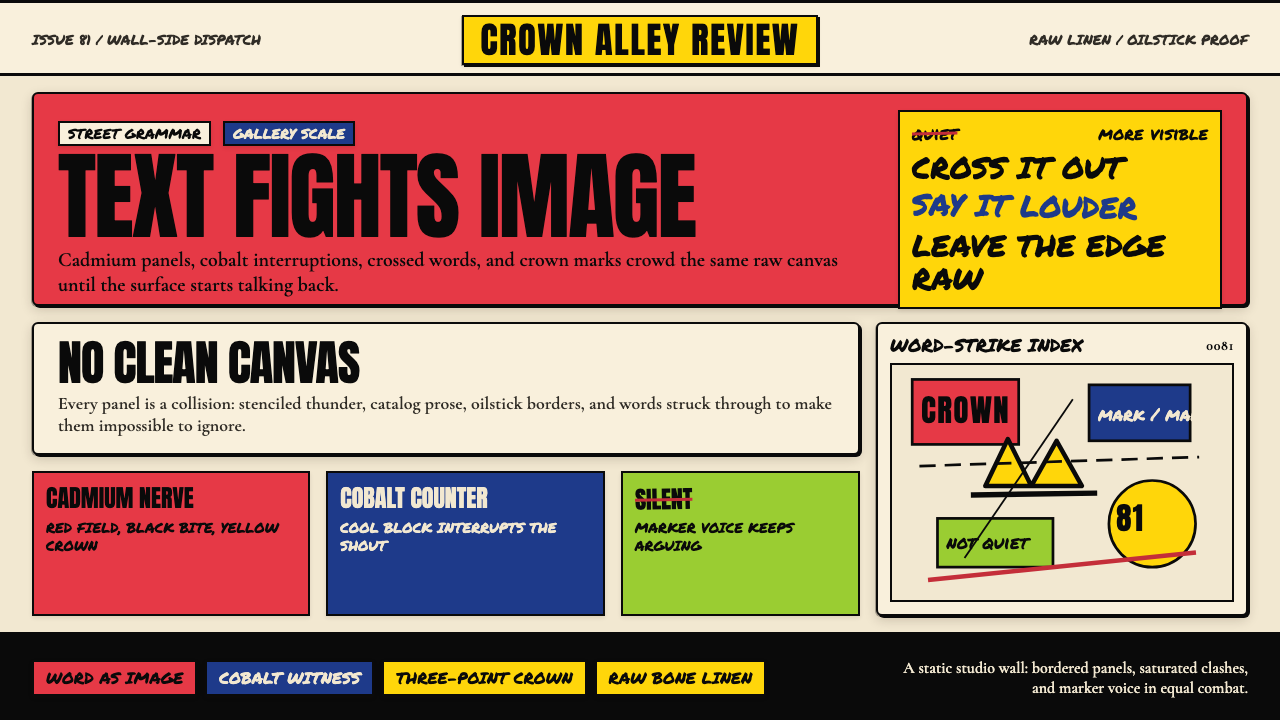 Basquiat Neo-ExpressionismExplodes off raw linen. Cadmium red, cobalt blue, Anton blocks, and struck ma…
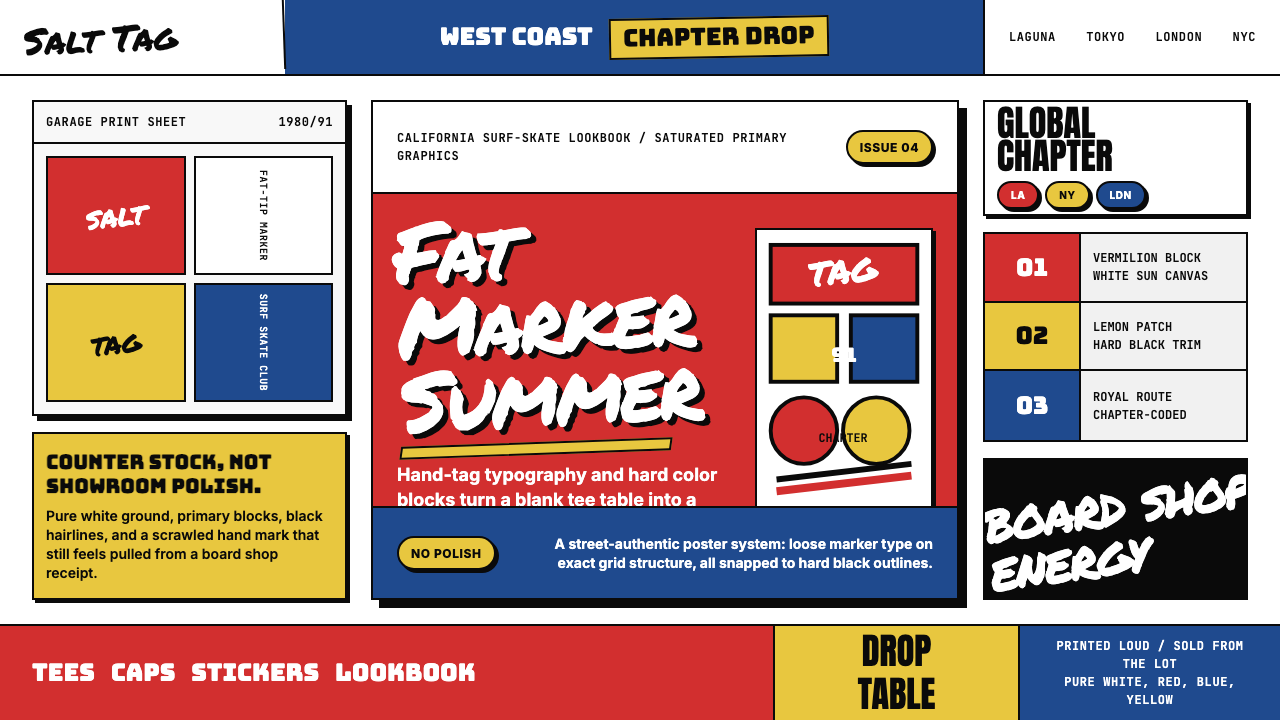 Stüssy StreetwearStreetwear starts rough. Vermilion blocks, marker script, and black hairlines…
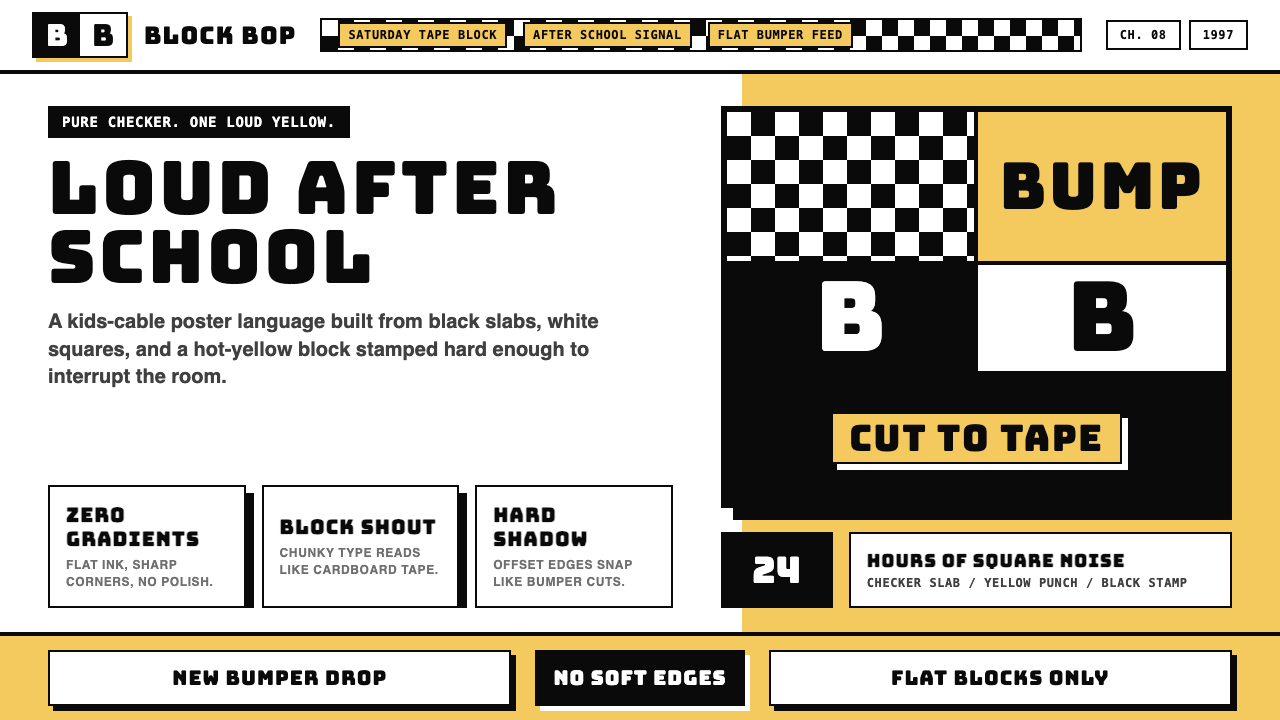 Cartoon Network 90s BlocksKids-cable noise, squared. Black-white checkerboards crash into hot-yellow Bu…
 Corita Kent SerigraphJoy printed at full volume. Flame red, hot pink, and misregistered type flood…
 Dragon Ball (1984)Adventure lands with comic force. Gi-orange panels, amber spheres and crisp h…
 Jamaican Dancehall 1990 PosterMidnight volume. Acid lime and hot pink type stack like screenprint ink on bl…