What is Stüssy Streetwear?
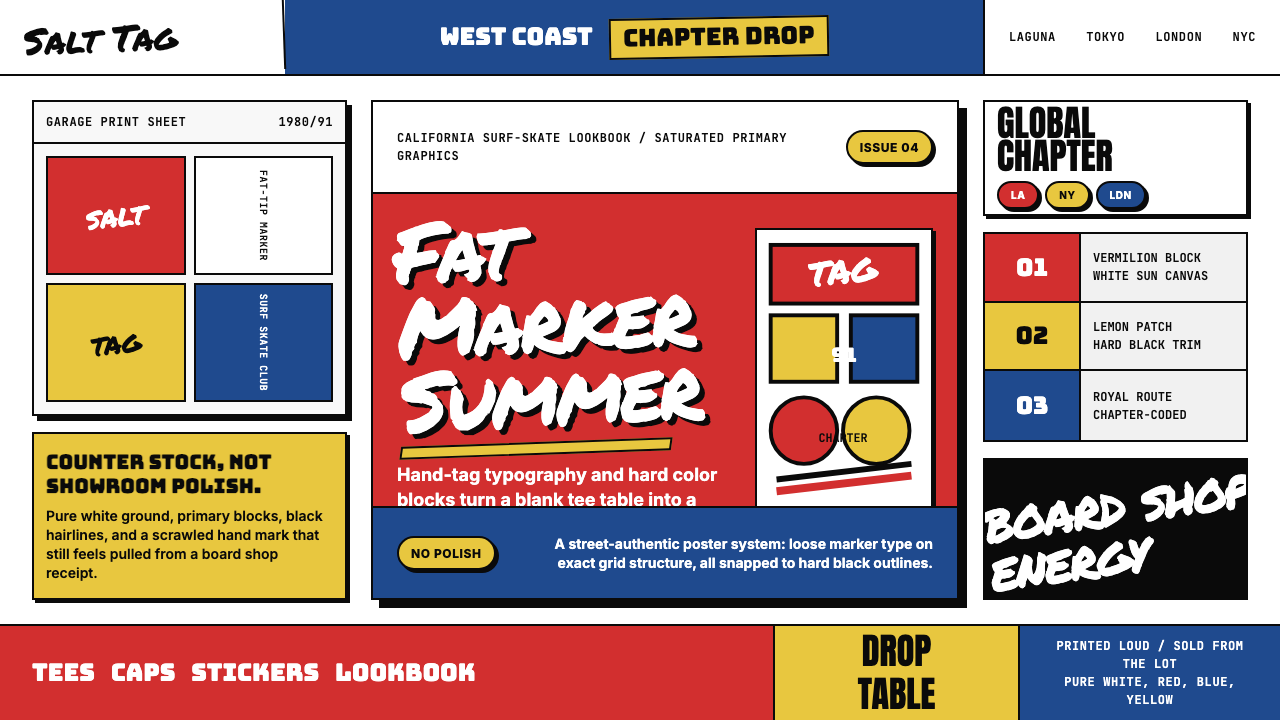
Streetwear was born the moment a Laguna Beach surfboard shaper scrawled his own graffiti tag onto a T-shirt and accidentally invented a global counterculture.
Stüssy Streetwear in brief
Stüssy Streetwear is the foundational visual language of California street culture, developed from 1980 onward by Laguna Beach surfboard shaper Shawn Stüssy. Its defining markers are a hand-graffiti signature logo rendered in thick, irregular marker strokes; saturated blocks of vermilion red and royal blue placed against stark white; and the relaxed, unpolished energy of surf and skate photography. Nothing about the aesthetic reaches for refinement or luxury — it carries the swagger of the street, deliberately rough-hewn and self-assured.
The visual system draws from three overlapping worlds: the hand-painted signage of California surf shops, the tag culture of urban graffiti, and the saturated primary graphics of skateboard deck art. These sources give the style its characteristic tension — it feels simultaneously handmade and graphic, casual and boldly composed. Color is used in broad, confident strokes rather than as delicate accent; type leans into imperfection rather than away from it; and negative space is occupied by attitude rather than by careful grid logic.
Stüssy aesthetics stand in direct opposition to the polished minimalism that dominated fashion and design in the same era. Where contemporaries sought sleekness, Stüssy embraced rawness. Where luxury brands refined their marks to geometric precision, the Stüssy signature retained every wobble of the original marker stroke. This deliberate retention of human imperfection became not a flaw but the brand's most powerful signal: authentic street credibility cannot be manufactured by committee.

Where does Stüssy Streetwear come from?
The story begins on the beaches of Laguna Beach, California, in 1980. Shawn Stüssy was earning a living shaping custom surfboards, a craft that required both artistic sensibility and physical skill. As a promotional gesture, he began signing his boards with the same loose, graffiti-influenced signature he used on everything — a looping, marker-weight scrawl that owed more to New York subway tags than to corporate logowork. He then transferred that signature to printed T-shirts and shorts to sell alongside his boards. The shirt business quickly eclipsed the boards.
By the mid-1980s, Stüssy had partnered with Frank Sinatra Jr. — not the singer's son, but a businessman from New York who brought distribution acumen and an understanding of urban markets. Together they formalized the brand and expanded from surf shops into the broader streetwear distribution network that was emerging around skateboard culture and hip-hop. This move bridged two coasts: the laid-back California surf identity and the harder-edged energy of New York street culture. The visual language absorbed both, producing something neither purely coastal nor purely urban.
The brand's cultural apex came in the late 1980s and through the 1990s, when Shawn Stüssy assembled what became known as the International Stüssy Tribe — an informal global network of creatives, DJs, skaters, and tastemakers in cities from Tokyo to London to New York to Los Angeles. Each chapter had its own local flavor, but the visual DNA remained consistent: the hand-tag signature, the bold color blocking, the no-apologies street attitude. The Tribe model predated and directly influenced the way Supreme and other second-generation streetwear brands built community-as-brand-equity.
Shawn Stüssy stepped back from day-to-day involvement in the company in 1996, but the visual language he established had already become the blueprint for streetwear as a category. The brand's influence can be traced through the entire lineage of streetwear-turned-luxury: from Supreme's box logo logic, to Palace's irreverent graphic sensibility, to the broader streetwear-as-high-fashion moment of the 2010s and 2020s. The original Stüssy aesthetic — raw, signature-centric, primary-color saturated — remains the ur-text of the genre.
What defines the Stüssy Streetwear look?
Hand-Graffiti Signature
The Stüssy wordmark is not a constructed logotype — it is a direct transcription of Shawn Stüssy's personal marker signature, with all the weight variation, irregular baseline, and looping energy that implies. The thick strokes swell and taper in a way no geometric type would allow. This handmade quality is the style's most irreducible element: it signals authenticity in a way that any cleaned-up or digitally regularized version would immediately destroy. When applying this aesthetic, type choices should lean toward script or brush letterforms that retain visible human gesture rather than toward engineered precision.
Saturated Primary Color Blocking
Stüssy's palette is built on maximum-saturation primaries: a hot vermilion red and a deep royal blue are the two dominant anchors, deployed as solid rectangular blocks against pure white. The colors do not blend or gradient — they collide. This approach comes directly from the visual language of surf and skateboard graphics, where screen-printed inks had to read clearly from a distance and in motion. The boldness is functional as much as expressive: these are colors that claim space and assert presence.
Relaxed Street Photography
Product imagery in the Stüssy tradition is never aspirational in the luxury sense. Models are often friends, skaters, or members of the Tribe — photographed in natural light on real streets, at actual skate spots, or in the casual environments where the clothes actually live. The photography is documentary in spirit: slightly grainy, candidly composed, with visible evidence of real activity. This is the visual opposite of studio-lit fashion photography, and the contrast is intentional — it argues that the clothes belong to real life, not to a brand's fantasy of it.
Thick Outlines and Bold Graphic Marks
Supporting graphics in the Stüssy visual system — beyond the signature itself — share a common structural logic: thick black outlines, flat fills, and a deliberate visual weight that prevents anything from appearing fragile or tentative. This graphic sensibility is inherited from the screen-printing constraints of early skate and surf deck art, where fine lines were impractical and bold marks were the only reliable language. Even when applied digitally, the style should preserve this sense of physical weight.
Anti-Refinement Attitude
Where most design systems move toward polish and precision over time, the Stüssy aesthetic treats roughness as a feature, not a bug. Intentional irregularity — the slightly uneven letterform, the ink that bleeds a little at the edge, the composition that feels assembled rather than constructed — carries the cultural signal that this is street-made, not boardroom-approved. This does not mean careless execution; it means that the signs of human making are preserved rather than engineered away. In application, this principle argues against over-kerning, over-aligning, and over-systematizing.
Cross-Cultural Tribe Identity
The International Stüssy Tribe model introduced a visual concept that was novel in the early 1990s: a single graphic identity that could absorb local cultural inflection while remaining recognizably itself. Tokyo chapters had a different energy from London or New York chapters, but all flew the same signature. This gave the aesthetic a globalist dimension that preceded globalized streetwear by a decade. Design applications informed by this principle allow for local color or typographic variation within a stable core identity — the signature stays constant while the surrounding context adapts.
White as Active Ground
Pure white is not neutral in the Stüssy visual system — it is an active structural element. The generous white space around color blocks and the signature is what gives those elements their visual pressure. A crowded layout would dissipate the energy; the white amplifies it by giving the bold marks room to resonate. This is white as backdrop for collision, not white as breathing room or minimalist restraint. The distinction matters: adding more elements to fill the white space is the fastest way to undermine the style.

Who shaped Stüssy Streetwear?
The founder and originating creative force behind the brand, Shawn Stüssy began his career as a surfboard shaper in Laguna Beach and brought that craft background directly into his approach to apparel graphics. His personal signature, applied to boards and then to garments, became one of the most recognized marks in global streetwear. He built the International Stüssy Tribe network in the late 1980s and 1990s, creating a template for community-led brand-building that influenced virtually every major streetwear brand that followed. He stepped back from day-to-day operations in 1996, leaving the visual system he created to carry the brand forward.
Not the famous singer's son, but a New York-based businessman who partnered with Shawn Stüssy in the mid-1980s to formalize and scale the brand. Sinatra brought an understanding of East Coast urban markets and the distribution networks connecting surf, skate, and hip-hop retail. His partnership was instrumental in transforming Stüssy from a local California operation into a nationally and then internationally distributed brand. The cross-coastal collaboration he enabled gave the visual language its dual identity — surf-origin Californian swagger combined with New York street credibility.
Less a single person than a collective identity, the International Stüssy Tribe was an informal global network of creatives — DJs, artists, skaters, photographers, and cultural tastemakers — assembled by Shawn Stüssy across cities including Tokyo, London, New York, and Los Angeles. Each city chapter contributed local cultural energy while operating under the common visual flag of the Stüssy signature. The Tribe model proved that a brand could maintain visual coherence across radically different cultural contexts without homogenizing them. It is the direct ancestor of the collaborative, community-rooted brand-building approach that defines contemporary streetwear.
Founded in New York in 1994 by James Jebbia, Supreme built its entire visual and cultural model on foundations that Stüssy had established. The box logo logic — a single wordmark, maximum contrast, no ornamentation — is a direct descendant of the Stüssy signature principle. Supreme's limited-release community strategy mirrors the Tribe model. Tracing Supreme's visual DNA back to Stüssy is not speculation but industry history: Jebbia worked in retail environments shaped by Stüssy, and early Supreme product photography and layout sensibility show the direct influence clearly. Supreme's eventual luxury-market valuation proved that what Stüssy started was not a subcultural moment but a structural shift in how fashion brands are built.
How do you use Stüssy Streetwear today?
Stüssy streetwear aesthetics translate most naturally to design contexts where authenticity, boldness, and subcultural credibility are the target values. The style is well-suited to brand identity work, event collateral, limited-edition merchandise, and any visual communication that wants to signal street origin without the studied formality of a designed brand system. Applying it correctly means understanding that the roughness is the point — every instinct to clean up, regularize, or systematize should be interrogated before acting.
For presentation slides, the Stüssy visual language works best for cover moments and section dividers rather than dense information layouts. A cover built in this style leads with a single bold color block — vermilion or royal blue — occupying a substantial portion of the slide, with the presentation title set in a thick script or brush-weight typeface against the contrasting white field. Section dividers can mirror this logic at smaller scale. Body slides should pull back: use clean sans-serif type for legibility, reserve the bold color and heavy marks for the one element on each slide that needs to command attention. Data slides work when chart elements are given the same bold, flat, high-saturation treatment as the brand marks — bars become color blocks, and labels use the same weighted typographic approach.
For web interfaces, the style is most effective for brand-forward contexts: landing pages for streetwear or culture brands, event microsites, artist or musician portfolio pages, and editorial platforms targeting younger audiences. The implementation approach starts with a white or near-white base, introduces large color-block sections in the primary palette, and uses heavy typefaces with visible weight and character. Navigation and interactive elements should feel typographic rather than icon-driven. The temptation to add hover animations, transitions, and micro-interactions that smooth everything out should be resisted — the aesthetic belongs to a more direct, physical-feeling web language. Dashboards and utility interfaces are generally a poor match for this style; its expressiveness works against the neutrality those contexts require.
For editorial and marketing work, the Stüssy aesthetic supports strong, poster-like visual hierarchy. Feature spreads benefit from the color-block approach: a full-bleed vermilion or blue field behind a headline, with photography treated either as a full-bleed image or as a hard-edge crop against white. Pull quotes and callouts can use the heavy typeface treatment at large scale. Marketing materials — social cards, campaign posters, event announcements — are where this style performs at its highest, because the visual language was literally born in the format of printed T-shirts and analog event flyers. Keep the layout elements few and the color choices decisive.
A common mistake when applying this aesthetic is mistaking surface markers for the underlying logic. Designers often add a graffiti-style typeface, some red blocks, and consider the job done — but the result reads as costume rather than character. The actual logic of Stüssy aesthetics is about conviction: every element that appears on the page should have earned its presence, and the white space between those elements should feel charged rather than empty. A second frequent error is over-complicating the color story: the style depends on the violence of a single dominant color meeting white, and introducing a third or fourth color immediately dissolves the tension that gives the system its energy.

Stüssy Streetwear — FAQ
What makes Stüssy aesthetics different from other streetwear visual languages?
Stüssy is specifically a signature-centric aesthetic — the entire visual system derives its authority from a single handmade mark rather than from a constructed logomark or graphic system. This gives it a different character from brands like Supreme (which uses typographic geometry), Palace (which uses irreverent illustration), or Off-White (which uses industrial marking conventions). The Stüssy visual language is more personal and more explicitly craft-origin; it reads like something made by a specific human being rather than by a brand team. That distinction is what makes it authentic rather than merely stylish.
Can the Stüssy aesthetic work for luxury or premium positioning, or does it belong strictly to street contexts?
The aesthetic can operate at a premium level when the premium is communicated through scarcity and cultural cachet rather than through material refinement. The Tribe model and the limited-drop mentality that Stüssy pioneered are exactly the mechanisms by which Supreme achieved luxury valuations while maintaining a deliberately unrefined visual language. The key insight is that for this aesthetic, rarity and community belonging are the luxury signals — not polish, not restraint, not quiet sophistication. A premium application of this style should have fewer elements, more decisive color choices, and better-quality physical production values, but it should never become cleaner or more geometric. The roughness is the value.
How should photography be handled when working with the Stüssy visual language?
Photography in the Stüssy tradition should feel documentary rather than produced. The ideal is imagery that looks like it could have been shot by a participant rather than a hired photographer: natural or available light, real locations, subjects who are clearly comfortable in the space rather than posed. Technical perfection is not a goal — in fact, a slight grain or evidence of real conditions is an asset. In layout, photography works best either full-bleed (where the image takes the whole field) or as a hard-edge crop set directly against white or a color block, with no drop shadows, no vignettes, and no soft masking. The image should feel placed, not floated.
Is this aesthetic appropriate for digital-only contexts, or does it need print to feel right?
The Stüssy aesthetic was born in physical print — screen-printed garments, photocopied flyers, offset-printed lookbooks — and that origin gives it a particular physical quality that requires deliberate translation to digital contexts. On screen, the risk is that the bold marks become too clean: vectors are too perfect, screens are too smooth. The solution is to preserve the psychological quality of the print origin rather than trying to simulate it with filters. This means choosing typefaces with visible ink-on-paper character, using hard edges rather than anti-aliased softness where possible, and treating interactive elements as physical objects — buttons that feel pressed, not hovered. Digital applications of this aesthetic work best on mobile, where the screen size and touch interaction mirror the scale and physicality of the original printed garment.
How does the Stüssy aesthetic age, and does it risk looking dated?
The aesthetic has proven remarkably durable precisely because it was never chasing contemporary design trends — it was expressing a subculture with its own self-referential visual logic. Elements that appear to date a design are usually borrowed from mainstream design trends of a specific era; elements rooted in a consistent subculture tend to read as timeless within that subculture's context. Stüssy's visual markers have been in continuous circulation since the early 1980s and have survived multiple cycles of fashion history. The risk of appearing dated is highest when the style is applied superficially — when it is used as period costuming for the early 1990s rather than as a living aesthetic logic. Applied with understanding of its underlying principles rather than its surface signatures, the aesthetic remains as vital as the street culture it emerged from.
Related design styles
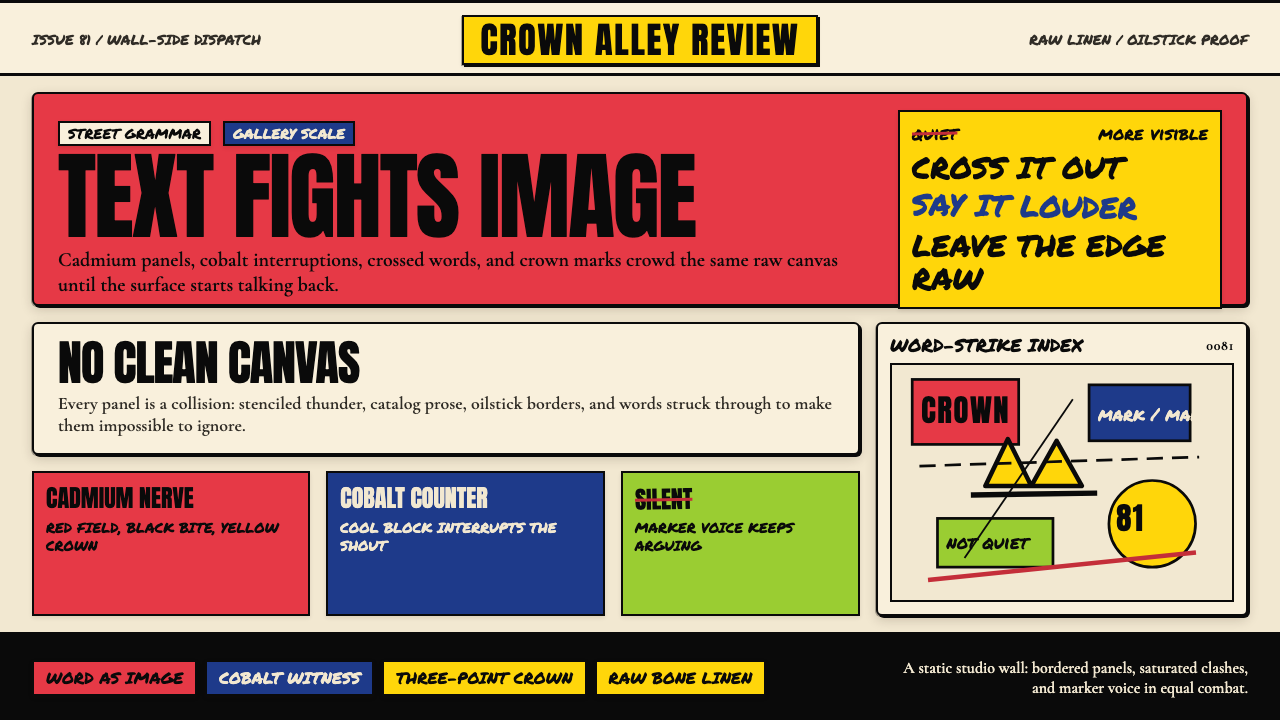 Basquiat Neo-ExpressionismExplodes off raw linen. Cadmium red, cobalt blue, Anton blocks, and struck ma…
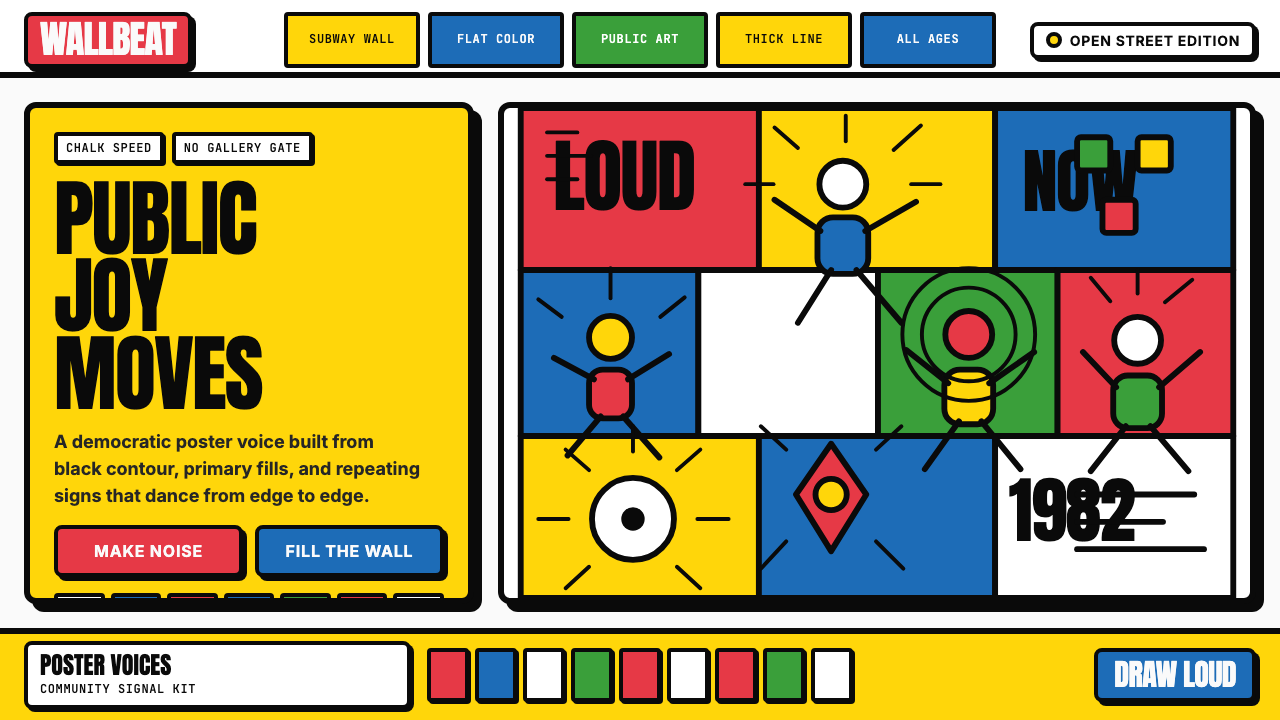 Keith Haring PopJoy refuses the gallery. Thick black contours pack primary color into a danci…
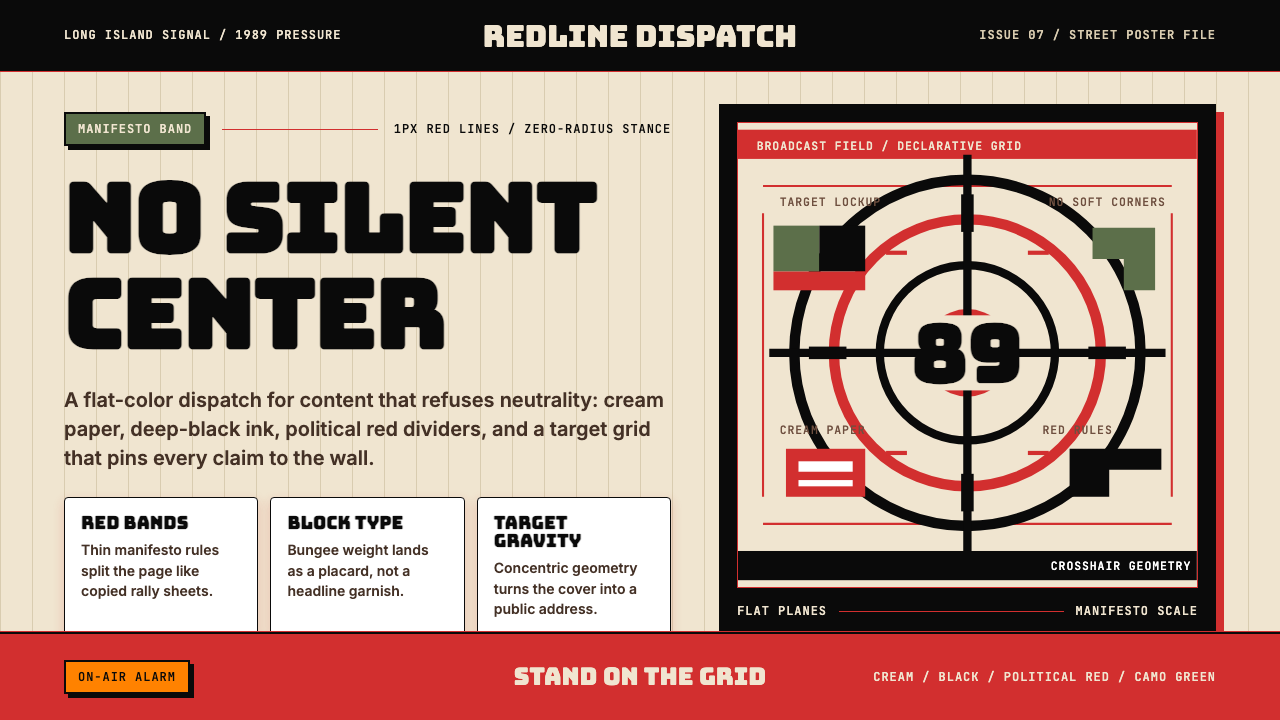 Public Enemy — Fight the PowerTakes a side loudly. Red bands, black ink, and target geometry hit like a ral…
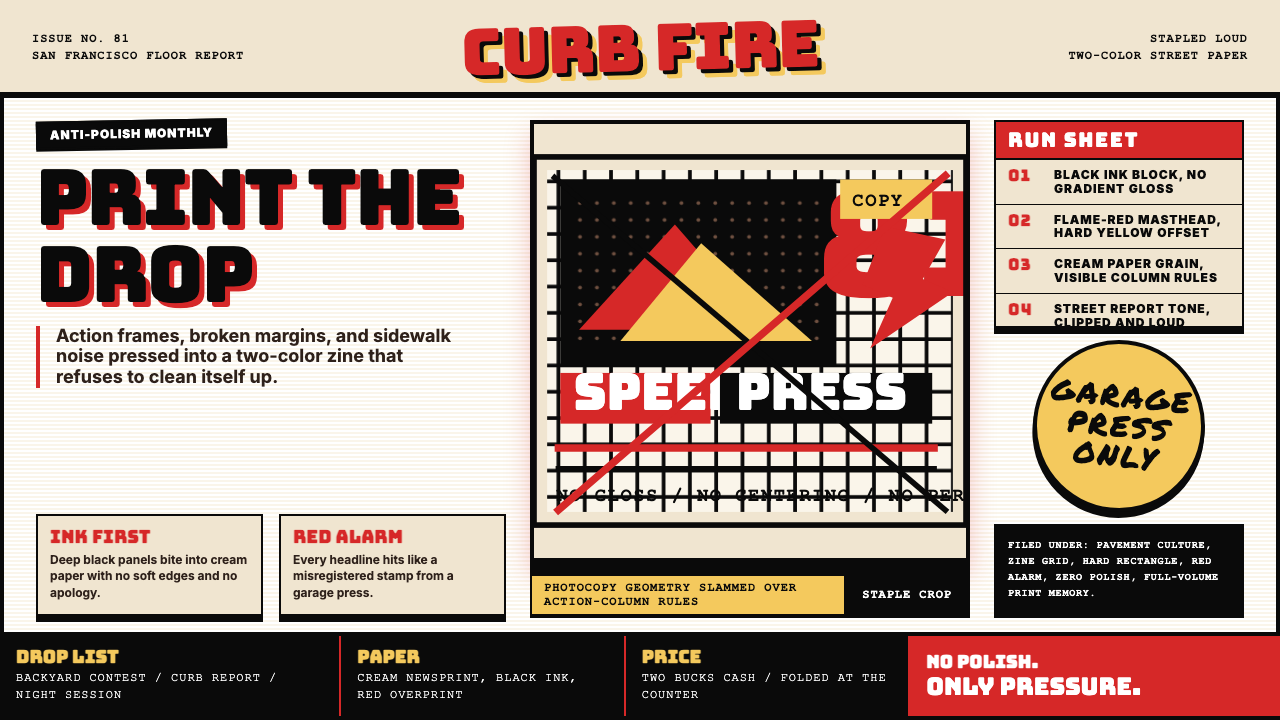 Thrasher Skate Zine (1981)Loud without polish. Flame red type, black ink blocks, and cream zine grids h…
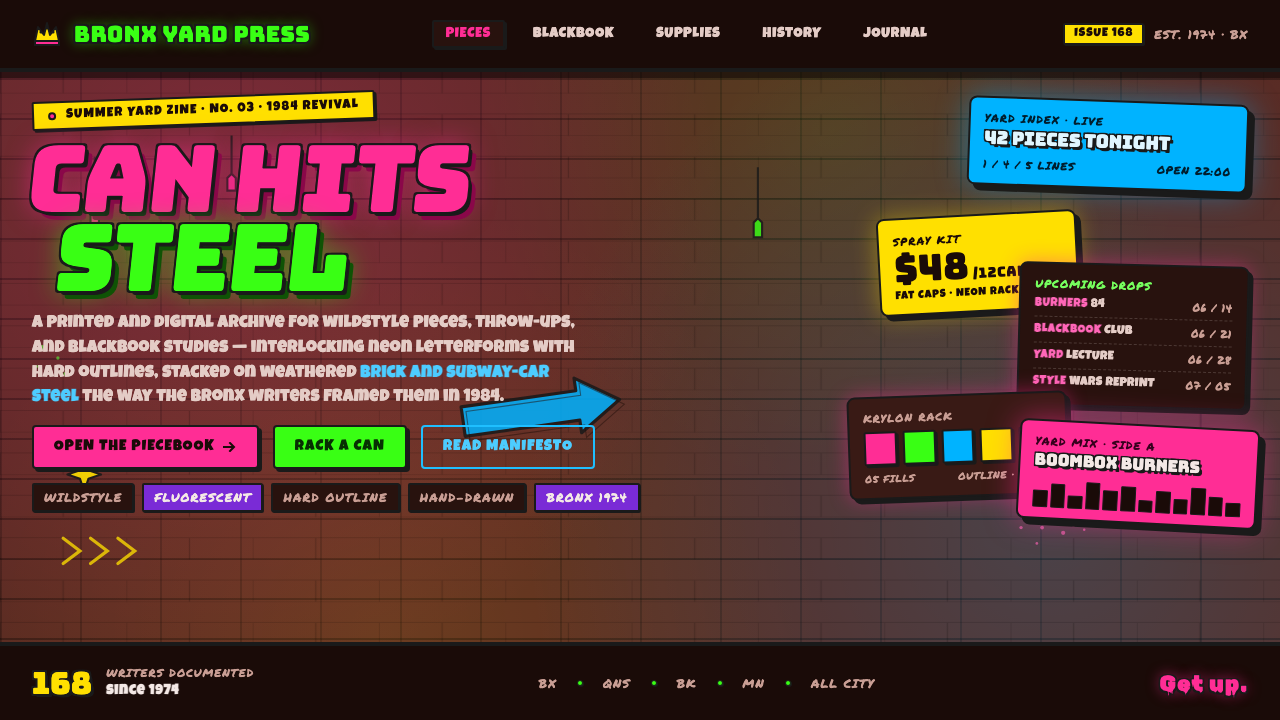 Wildstyle GraffitiBronx walls, sprayed loud. Neon pink-and-green fills, hard black outlines, Bu…
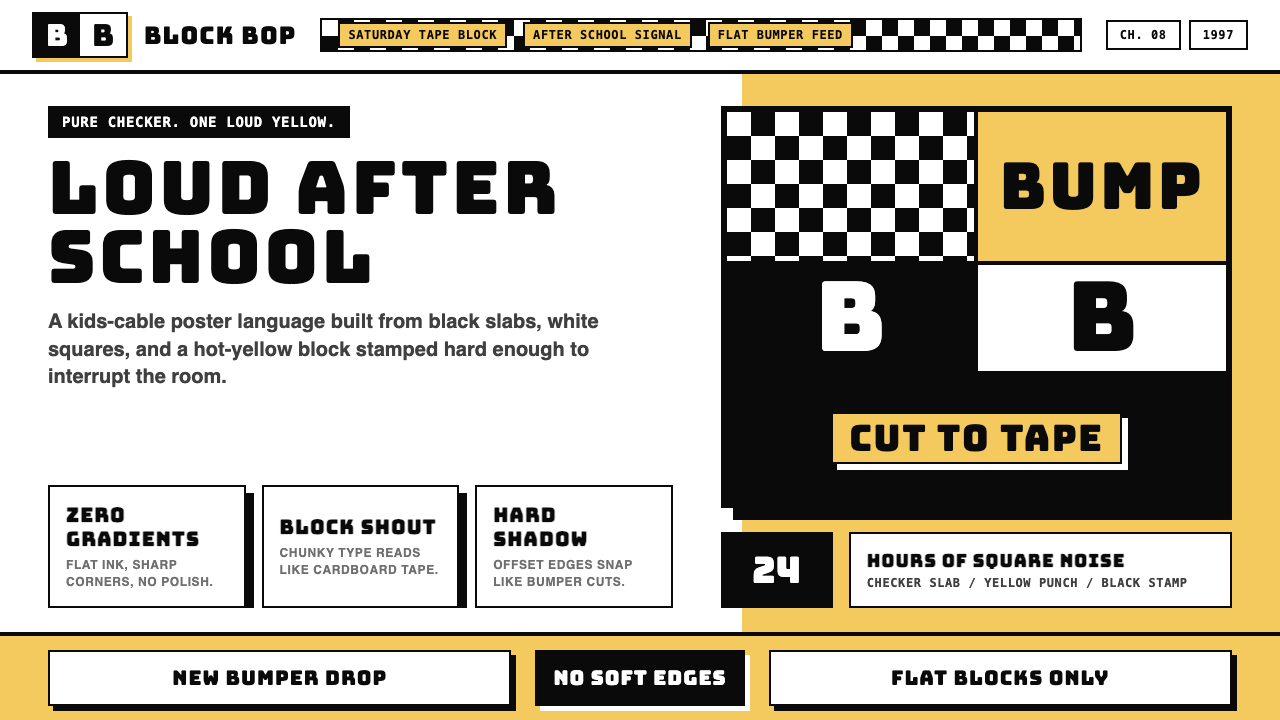 Cartoon Network 90s BlocksKids-cable noise, squared. Black-white checkerboards crash into hot-yellow Bu…