What is Public Enemy — Fight the Power?
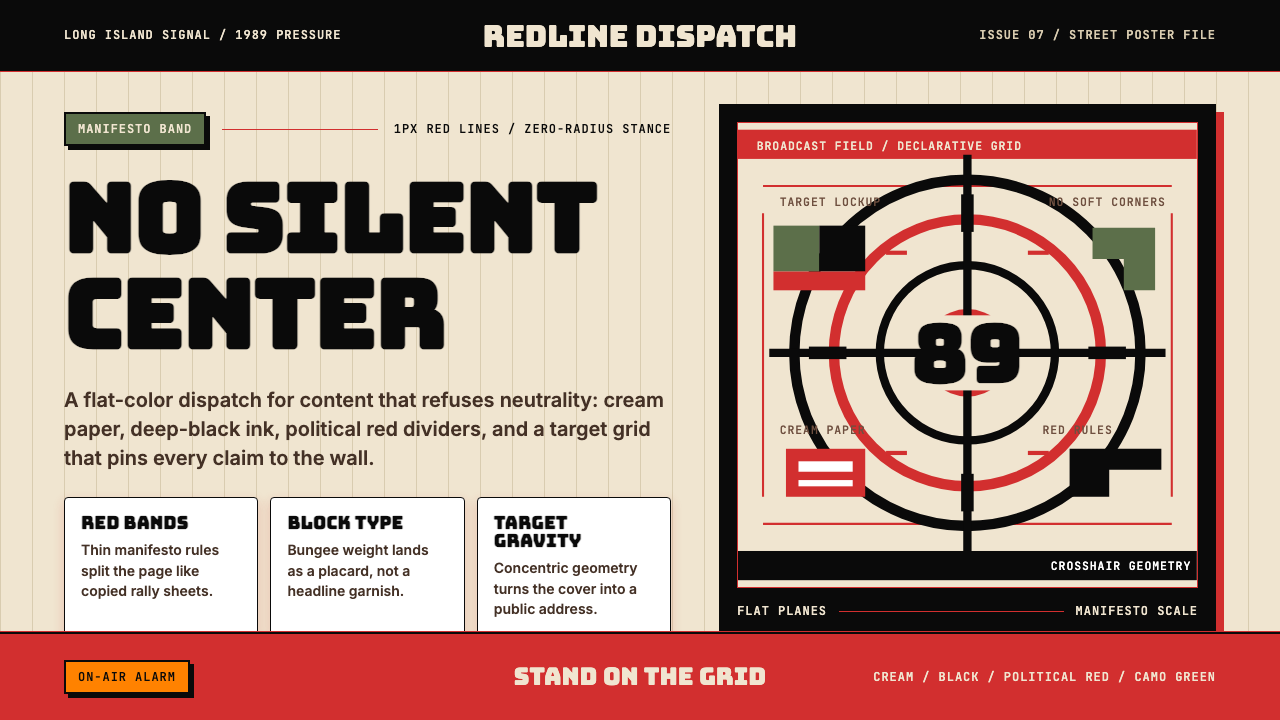
Public Enemy's crosshair logo, saturated red on deep black, and monumental display type turned a rap record into a visual manifesto that still commands every room it enters.
Public Enemy — Fight the Power in brief
Public Enemy — Fight the Power is a design system drawn from the visual identity surrounding the group's landmark 1989 single, which formed the sonic and aesthetic backbone of Spike Lee's film Do the Right Thing. The style is built on a small number of decisions made with absolute conviction: deep black fields, saturated red bands and accents, chunky zero-radius display type, and the crosshair-encircled B-boy silhouette logo that functions simultaneously as emblem, warning, and rallying image.
Where most design systems earn authority through elegance or refinement, this one earns it through weight and directness. Every element behaves like a placard or a broadside — nothing decorates, everything declares. The visual vocabulary descends not from commercial branding but from the revolutionary political poster tradition: high contrast, flat color, compressed information, maximum impact at a distance.
As a contemporary design system it is precise and surprisingly disciplined. The palette is narrow — red, black, and selective military-green accents — and every departure from it reads as a mistake rather than a creative choice. Type is monumental in scale, set without irony, and allowed to fill the frame. Buttons carry no radius. Dividing lines are thin, exact, and red. The system speaks loudly, but it does not ramble.

Where does Public Enemy — Fight the Power come from?
Public Enemy formed on Long Island, New York in 1985, built around the partnership between rapper Chuck D — whose baritone delivery gave the group its gravitas — and the court-jester counterpoint of Flavor Flav, whose oversized clock and theatrical antics underscored rather than undermined the group's seriousness. The DJ Terminator X completed the sonic architecture. From the beginning, the group positioned itself within a tradition of Black political speech, citing the Black Panther Party, Malcolm X, and the broader currents of Black nationalist thought as reference points both lyrical and visual.
The visual system that defined the group emerged partly from necessity and partly from conviction. The Def Jam Recordings environment of the mid-1980s operated with limited budgets but high graphic ambition, producing sleeves and promotional materials in which bold typography and stark contrast had to substitute for expensive photography or illustration. Into this environment came the crosshair-target logo, designed to place the B-boy figure — already a hip-hop icon — inside the crosshairs of a gunsight. The image spoke plainly about surveillance, targeting, and the violence directed at Black men in America, without requiring a single word of explanation.
Fight the Power was composed in 1989 at Spike Lee's direct request for a theme song for Do the Right Thing, his film set in the Bedford-Stuyvesant neighborhood of Brooklyn on the hottest day of the summer. The film, which climaxes in a race riot, demanded a soundtrack that matched its urgency. The resulting track — and the visual campaign surrounding it — amplified the existing Public Enemy aesthetic into something more concentrated: the red and black palette intensified, the typography grew heavier, the political-poster reference became explicit. The film's opening sequence, featuring Rosie Perez dancing to Fight the Power before graphics in the group's visual style, essentially made the design system a character in the film itself.
The broader movements feeding into this visual system were well-established. Black Power revolutionary imagery — the raised fist, the targeting reticle, the confrontational portrait — had been circulating in American political culture since the 1960s. The Public Enemy aesthetic did not invent these devices; it translated them into the register of late-1980s hip-hop, combining the political poster's directness with the energy of a concert flyer and the precision of a logo system. The military-camo green accents echoed both actual military surplus fashion circulating in hip-hop communities of the period and the long history of resistance movements adopting martial imagery.
What defines the Public Enemy — Fight the Power look?
Color System
The palette is built on three non-negotiable anchors: deep black as the dominant field, saturated red as the structural accent and emotional trigger, and selective military-camo green as a secondary presence. White appears sparingly, only as reversed type or breathing space. The red is not decorative — it divides, marks, and warns. Nothing bleeds between these colors; transitions are hard cuts, never gradients. Saturation is deliberately at maximum: the palette reads across a crowded room, from a moving car, in direct sunlight.
Typography
Display type is chunky, compressed, and monumental — the kind of letterforms that need no delicacy and want none. It is set at large sizes with minimal tracking, filling the frame rather than floating in it. Body text, where it appears, is secondary and subservient, never competing with the headline for dominance. All caps is the default register for primary statements. There are no script faces, no decorative serifs, no flourishes. The letterforms communicate the same way the music does: at volume, without apology.
Logo and Iconography
The crosshair-target B-boy logo is the system's visual center of gravity. A silhouetted break-dancer is placed precisely within the concentric rings and cross lines of a gunsight — a composition that transforms a symbol of hip-hop cultural freedom into an image of surveillance and targeting. The icon is always flat, always high-contrast, and always read as a unified mark rather than an assemblage of parts. Secondary iconography follows the same logic: geometric, unambiguous, and legible at any scale.
Layout and Geometry
Layouts are organized by horizontal red rules — thin, precise, and structural — that divide the page the way a manifesto is divided into clauses rather than the way a magazine is divided into sections. The grid is tight and deliberate; negative space is used sparingly, and when it appears it reads as silence between statements rather than as aesthetic breathing room. Compositions favor asymmetry without apology: heavy type blocks anchor one side while the logo or a red band claims the other. Nothing is centered for the sake of comfort.
Flatness and Zero Ornament
Every surface is flat. No gradients simulate depth, no soft shadows suggest ambient light, no textures import the physical world into the design. Depth — where it exists — comes from the visual weight of large flat shapes against each other, not from lighting effects. Buttons carry no radius and no shadow; they sit on the page like stenciled rectangles. This flatness is not a modernist aesthetic preference — it is the production logic of the political broadside: reproducible at any size, at any print quality, with no information lost in compression.
Military and Tactical Accents
Military camouflage green appears as a third-color accent, used selectively to signal solidarity with resistance movements and to break the binary tension of red-and-black without introducing softness. The tactical reference extends beyond color: the crosshair in the logo, the grid-like precision of layouts, and the sense that every element has been placed with operational rather than decorative intent. The aesthetic is combat-ready — not aggressive for aesthetic reasons, but purposeful in the way that any tool designed for high-stakes deployment is purposeful.
Emotional Register
The system communicates at a specific emotional temperature: urgent, uncompromising, and fully committed to its position. There is no irony, no softening, no invitation to interpret the message as optional. This is the rarest quality to replicate correctly, because it requires the designer to genuinely commit to the design choices rather than treating them as stylistic options. A version of this system applied half-heartedly — with gradients introduced for modernity, or rounded corners added for approachability — loses not just visual coherence but the entire communicative logic the system is built on.

Who shaped Public Enemy — Fight the Power?
Born Carlton Douglas Ridenhour, Chuck D is the primary lyrical and intellectual force behind Public Enemy. His delivery — dense, metronomic, and politically explicit — set the template for what conscious rap could achieve. He was equally invested in the group's visual presentation, understanding from the beginning that in hip-hop the image and the music had to operate as a single argument. His political education, which drew on Black nationalist thinkers including Malcolm X and the Black Panther Party, shaped the iconographic choices that made the group's visual identity as legible as a political party's campaign materials.
William Jonathan Drayton Jr., known as Flavor Flav, functions within the Public Enemy visual system as its necessary counterweight. His theatrical costume — the oversized clock, the baseball cap worn sideways, the court-jester energy — does not undermine the group's seriousness but provides a point of human scale against which Chuck D's political gravity can be measured. In design terms, Flavor Flav is the unexpected accent color: his presence stops the system from becoming so severe that it alienates rather than recruits. Every effective propaganda aesthetic needs an element that invites rather than demands.
Norman Lee Rogers, who performed as Terminator X, was Public Enemy's DJ and sonic architect. His role in the group's visual identity is less direct but structurally important: the turntablist as figure — hands on records, body angled over equipment — became part of the visual shorthand of the era's political rap imagery, appearing in promotional photographs and artwork as a symbol of mastery over the machinery of sound reproduction. The precision and technical control implied by his performance practice mirrors the controlled aggression of the group's design system.
Director Spike Lee commissioned Fight the Power for Do the Right Thing and in doing so became the amplifier through which the Public Enemy visual system reached its widest audience. His decision to open the film with the song — and to shoot the opening sequence against graphics and imagery drawn from the group's visual world — transformed a music video aesthetic into cinematic visual language. Lee's own work across films, commercials, and his production company 40 Acres and a Mule Filmworks was consistently concerned with the visual representation of Black American life, and his partnership with Public Enemy represented a convergence of two aesthetics that shared deep structural assumptions about boldness, confrontation, and legibility.
How do you use Public Enemy — Fight the Power today?
The Public Enemy — Fight the Power system is correctly applied when the design's position is genuine and specific. It suits any context that requires a declaration rather than a suggestion: a product launch that is genuinely disrupting its market, a publication with a defined editorial standpoint, a social campaign that cannot afford to be misunderstood. It fails when applied to content that is merely trying to appear bold — the visual system has a high tolerance-detection threshold, and a half-committed application reads immediately as costume rather than conviction.
For presentation slides, the system works with particular force on covers and section openers. A cover built in this system leads with a large-scale red band or full-bleed black field, sets the title in a heavy, condensed display face at maximum size, and places the logo or a geometric red accent at a deliberate asymmetric position. Content slides should retain the structural logic: a thin red rule to separate header from body, type set in two clear scales only, and data visualizations treated as flat geometric objects — bar charts and proportional blocks in the red-and-black palette, with no three-dimensional effects or gradient fills. The data does not need decoration; it needs to be legible.
For web interfaces and dashboards, the system translates effectively when information density is high and hierarchy needs to be immediately readable. Use the full-bleed black background for primary navigation and high-priority alert states; reserve the red accent for interactive elements, active states, and genuinely critical notifications. Pricing and comparison pages benefit from the system's binary clarity: feature availability as flat red checkmarks or black crossed circles, tier names in heavy type at large scale, call-to-action buttons as solid-color blocks with no border radius and no shadow. The system does not accommodate ghost buttons or outline-only states — those suggest optionality, and this system does not traffic in optionality.
For editorial and marketing applications, the system handles long-form content by establishing hierarchy through weight and scale rather than decorative elements. Article layouts in this system use a wide type measure with the headline set at a scale that dominates the page, a pull quote formatted in red — tightly set, full-cap — and section breaks marked by the thin red rule. Marketing pages work as a sequence of manifestos: each full-width block states one claim, in large type, on alternating black and red fields. Photography, where used, should be treated as high-contrast — effectively duotone in the system's colors — and never as a full-color naturalistic image sitting in a layout. The image should be working as hard as the type.
The most common mistake when applying this system is treating the red as a decoration rather than a structural element. In authentic applications, red appears where the layout needs to be cut, marked, or divided — not where something needs to look energetic. A second common error is softening the type choices: adding letter-spacing for elegance, choosing a geometric sans that is refined rather than blunt, or setting the headline at a comfortable rather than commanding size. The system's effectiveness is entirely dependent on the designer resisting the impulse to make things more comfortable. Comfort is the opposite of what this system is for.

Public Enemy — Fight the Power — FAQ
Is this system only appropriate for activist or political content?
No — but it is only appropriate for content with a genuine, specific position. A fintech product that is genuinely replacing a predatory lending system, a health platform that takes an unambiguous stance on a medical issue, a news publication with a declared editorial line: these can all use the system honestly. What does not work is applying it to neutral, undifferentiated, or ambiguous products. The visual system broadcasts a position; if there is no position to broadcast, the system becomes incoherent. The question to ask is not whether the content is political, but whether the content has a conviction worth designing around.
Can the system work on a light or white background?
Yes, but the inversion changes the system's emotional register significantly. A white-ground version — black type, red structural lines, minimal use of any dark field — reads as political-poster restraint rather than rallying urgency. It is cleaner and potentially more versatile for extended reading contexts, but it loses the compressed intensity that a deep black field provides. If using a light background, resist the temptation to soften the palette or introduce warmth: the type should remain monumental, the red should remain saturated, and the structural rules should remain thin and exact. The white ground is a choice, not a compromise.
How does this system relate to other high-contrast political design traditions?
The Public Enemy visual system sits in a lineage that includes Soviet Constructivism, Black Panther Party graphic design, Situationist International propaganda, and the DIY xerox broadside culture of 1980s activism. All of these traditions share structural assumptions: flat color, heavy type, maximum contrast, zero ornament, and a production logic that prioritizes reproducibility over refinement. The Public Enemy aesthetic is distinguished from European Constructivism by its specifically African-American cultural references — the B-boy figure, the hip-hop typography conventions — and from earlier Black Power imagery by its engagement with late-1980s mass media and recording-industry production values. It is politically descended but visually evolved.
What is the most important thing to get right when applying this system?
Commitment. The system has no tolerance for hedging. Every individual decision — type size, color application, layout structure — needs to be made at full intensity, because the system's coherence depends on each element reinforcing every other. A single soft decision — a rounded button, a gradient in a background, a display face set at a restrained size — propagates through the layout as doubt, and the system reads as uncertain. This is the opposite of what it communicates. The practical implication is that this system should not be applied incrementally or used as a light influence on an otherwise neutral layout. It is a commitment, not a seasoning.
Does the system age well, or does it read as period-specific to the late 1980s?
The system ages well because its foundational logic — maximum contrast, flat color, structural typography, zero ornament — is not tied to any specific production technology or media environment. The same principles that made Public Enemy's visual identity effective on a record sleeve in 1989 make it effective on a digital screen today. What does feel period-specific is the particular letterform conventions of late-1980s hip-hop display type — but these can be updated by choosing contemporary typefaces that share the same properties of weight and compression without the historical connotation. The aesthetic system is durable; the specific historical references within it are optional.
Related design styles
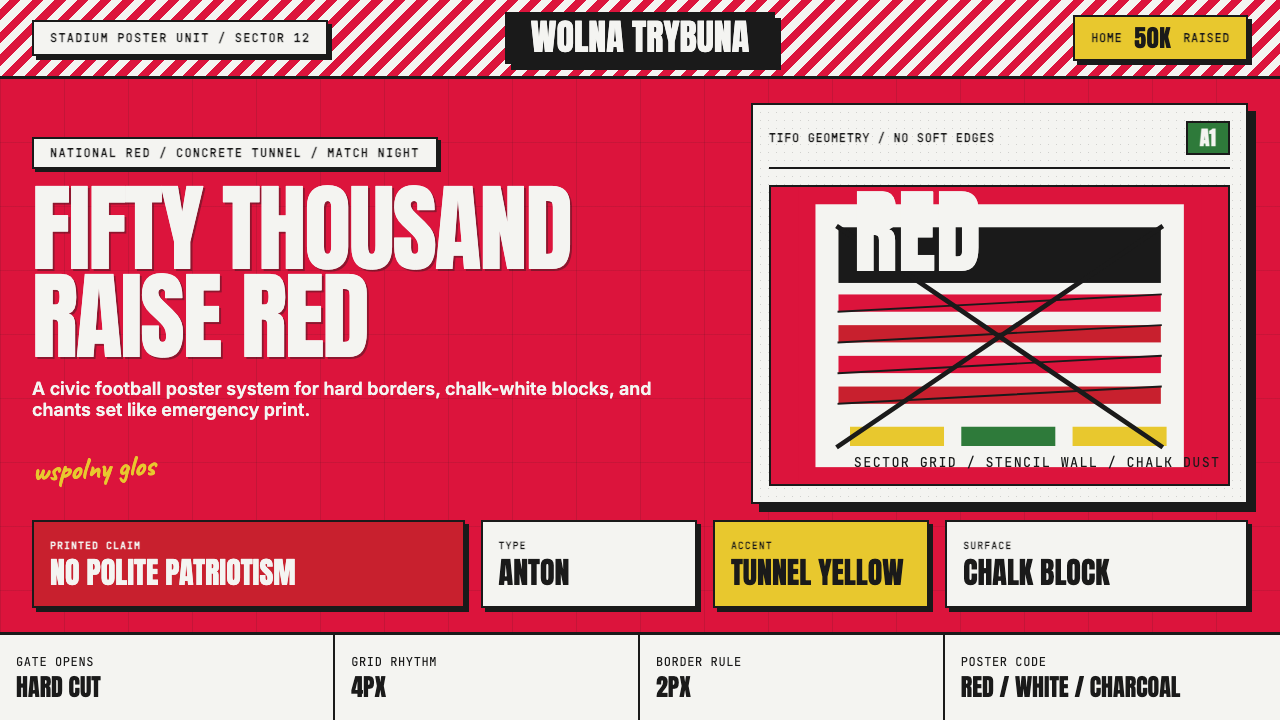 Polish Solidarity Stadium GraphicDefiance fills the stands. Stadium red, Anton stencil type, and chalk-white b…
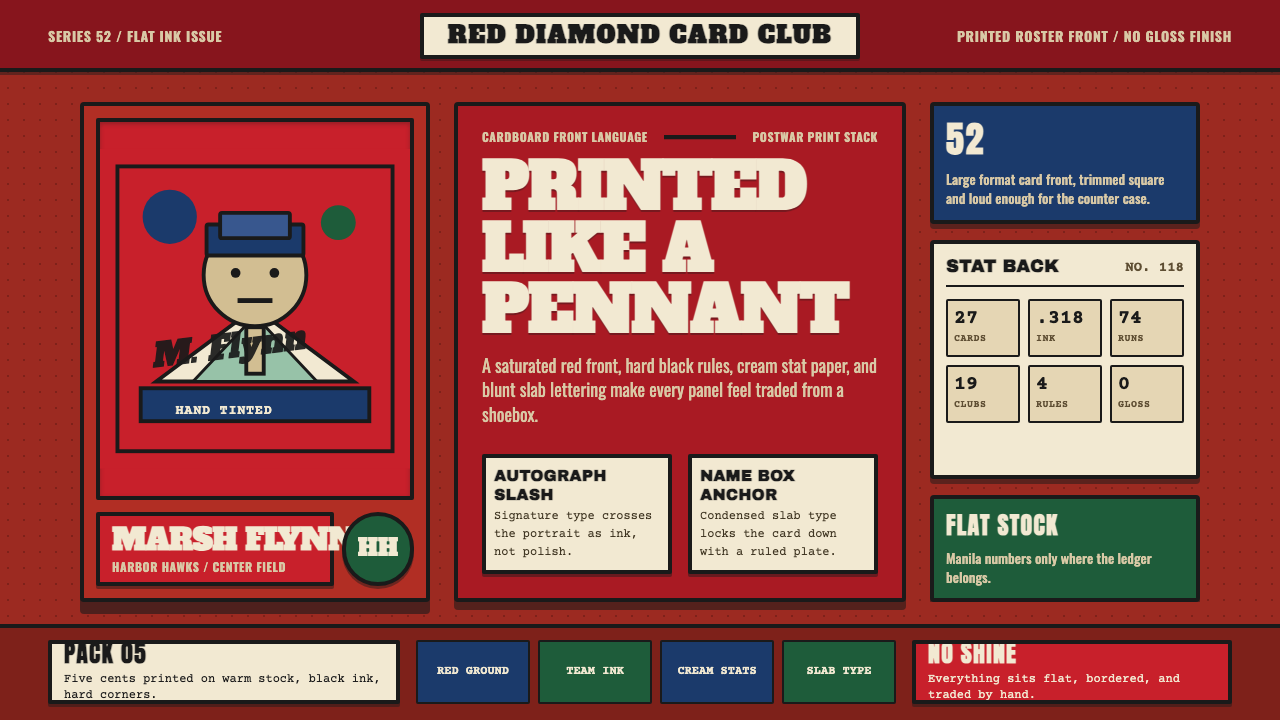 Topps Baseball CardCardboard heat. Brick-red slab panels, cream stats, and condensed type feel p…
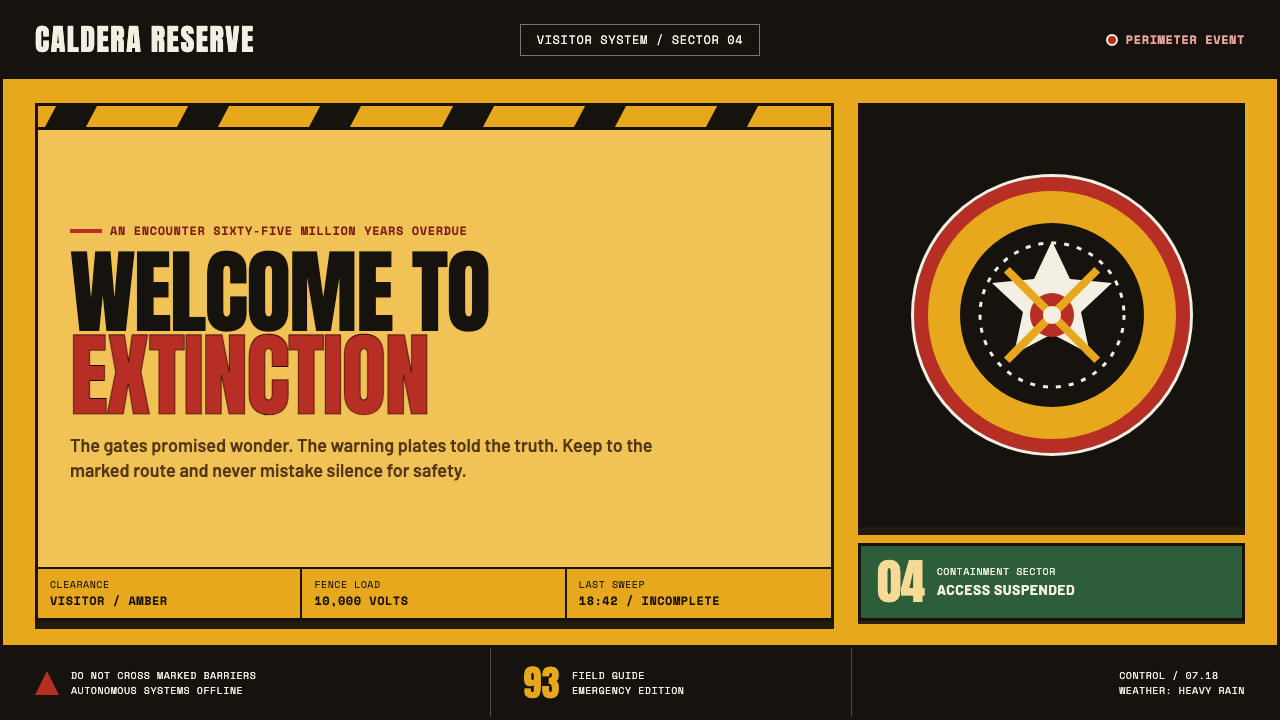 Jurassic Park (1993)Warm welcome, lethal edge. Amber plates, red rings and black chevrons turn aw…
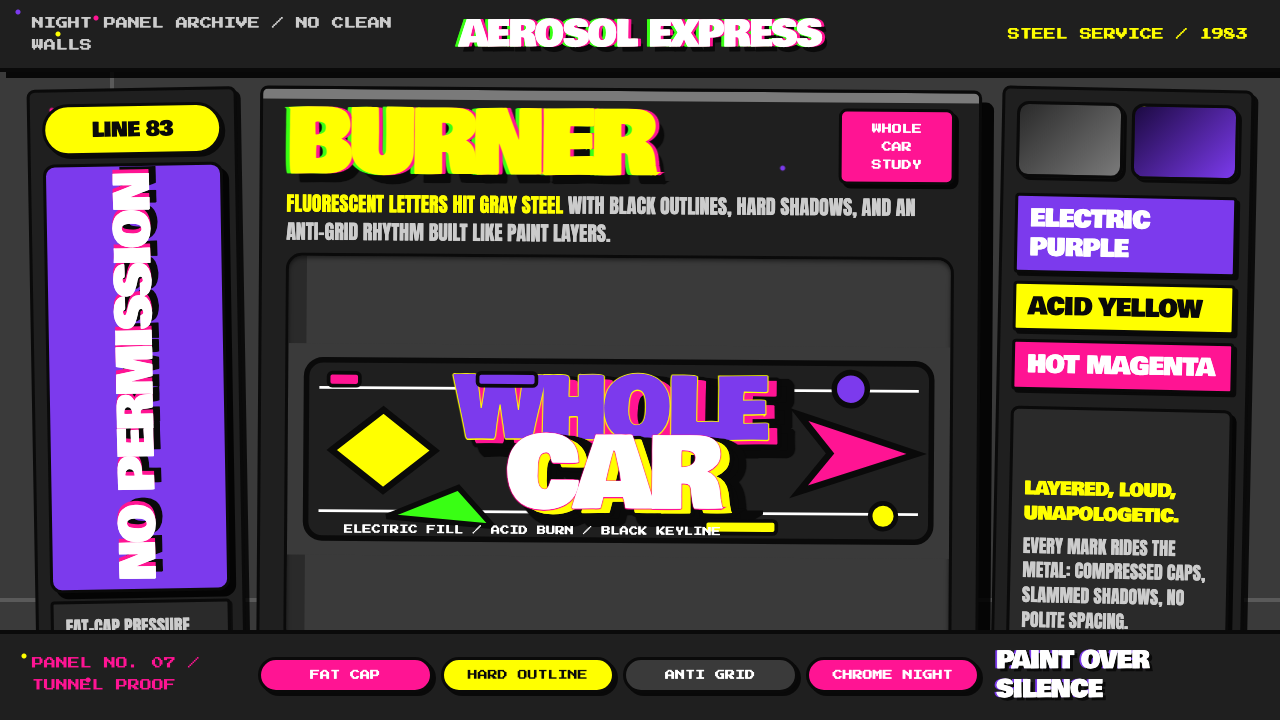 NYC Subway Graffiti (1983)Bombed steel gets loud. Electric purple and acid yellow stack as hard-outline…
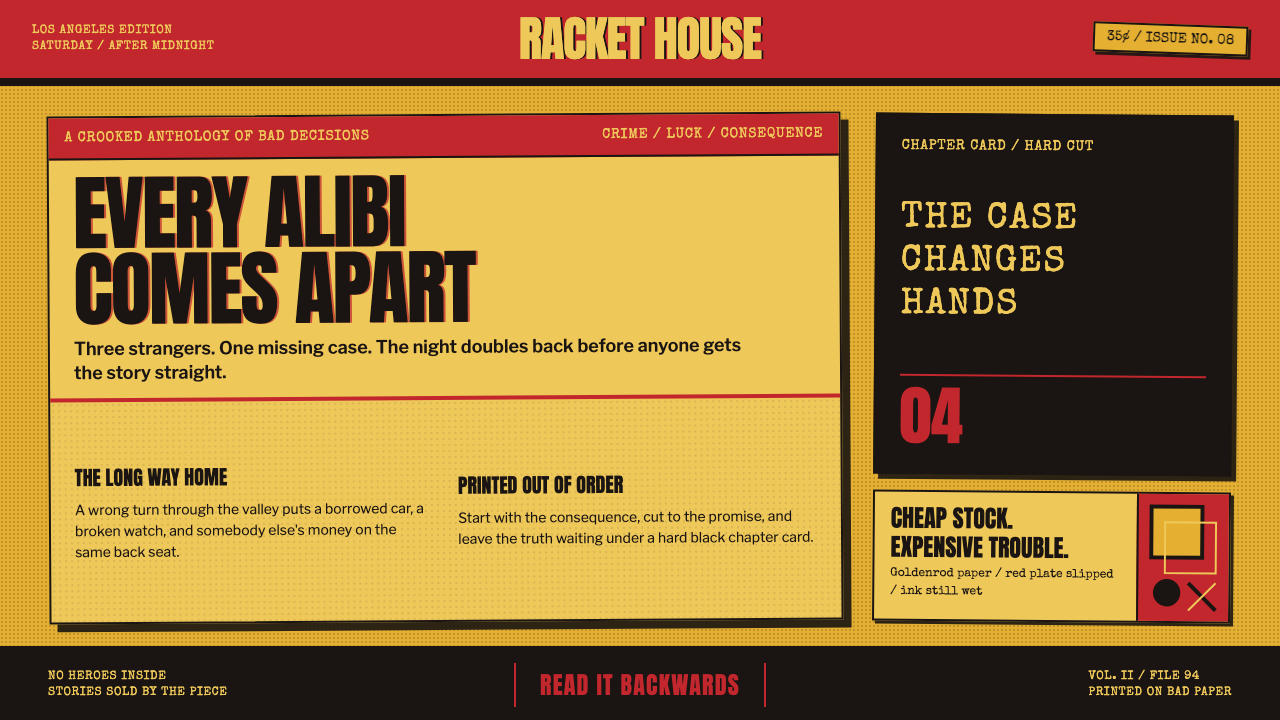 Pulp Fiction (1994)Cheap print, dangerous rhythm. Goldenrod stock, pulp red, and black chapter c…
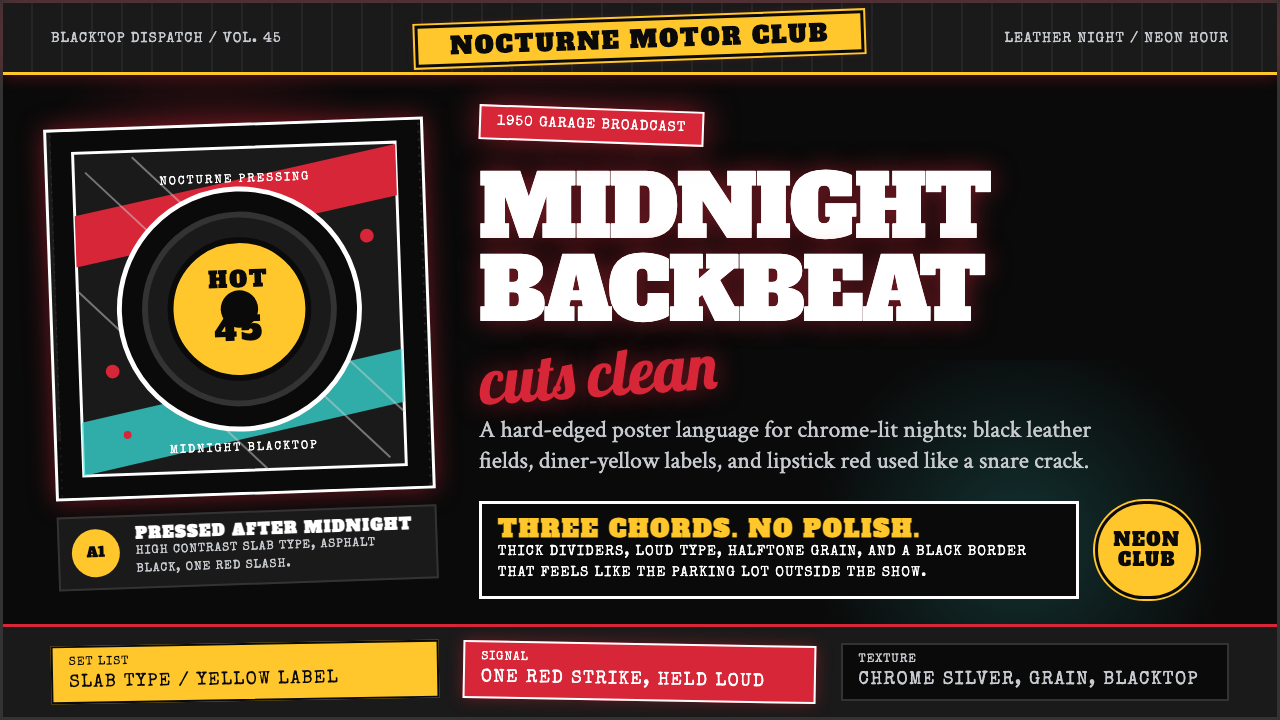 Rockabilly Greaser (1950)Loud after midnight. Asphalt black, chrome-yellow circles, and one lipstick-r…