What is Polish Solidarity Stadium Graphic?
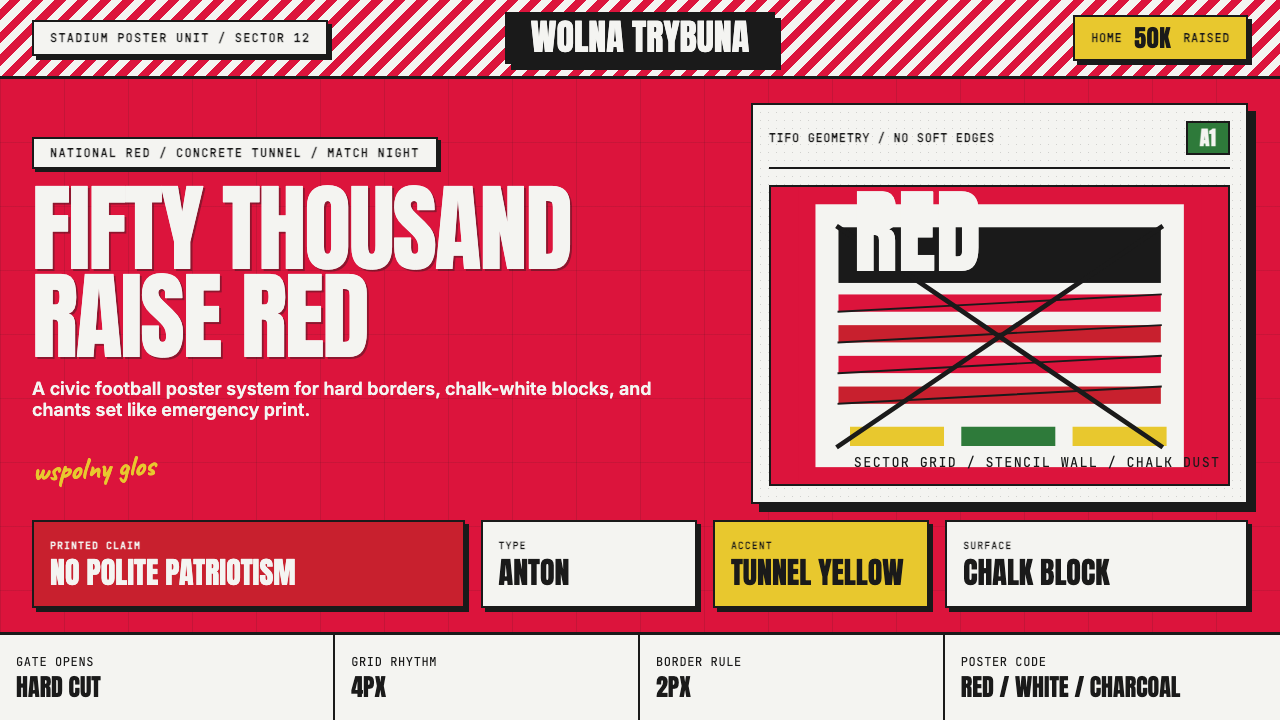
Where Cold War defiance meets modern football frenzy, the Polish Solidarity Stadium Graphic channels a nation's history of resistance into raw visual thunder.
Polish Solidarity Stadium Graphic in brief
Polish Solidarity Stadium Graphic is a visual language born from the collision of two potent traditions: Poland's legendary underground poster culture of the 1980s, rooted in the Solidarność resistance movement, and the raw graphic energy of contemporary football ultras stadium choreography. The result is a style that feels simultaneously political and tribal, historical and alive — as though the stands of Stadion Narodowy in Warsaw had been plastered with handmade protest placards the night before a crucial match.
At its core, this design system is defined by maximum emotional intensity delivered through minimal means. A dominant stadium red saturates the page completely, evoking national flags, blood, and passion in equal measure. Chalk-white surfaces carve out breathing space for content, while charcoal stencil typography punches through both like spray-painted slogans on a concrete tunnel wall. The textures are deliberately rough — stencil edges that blur slightly, ink that appears to bleed into coarse paper, halftone dot patterns that recall underground photocopied leaflets.
This is not a polished corporate aesthetic. Its power comes from authenticity and urgency. Every visual choice echoes the handmade quality of resistance materials — the kind of graphic that gets printed in a basement at midnight and posted before dawn. Applied to modern contexts, this rawness functions as a badge of genuine conviction, separating it sharply from the slick, algorithm-optimized visuals that dominate contemporary digital communication.
Where does Polish Solidarity Stadium Graphic come from?
The immediate visual ancestry of this style runs through the Polish Poster School — one of the most distinctive national traditions in twentieth-century graphic design — and specifically through the political and cultural posters produced in and around the Solidarność upheaval of 1980. The movement that began in the Gdańsk Shipyard in August 1980, organized under the independent trade union Solidarność, generated an enormous body of unofficial visual communication that had to be produced quickly, cheaply, and covertly. Screen printing, stenciling, and photocopying were the technologies of resistance, and their physical marks became the aesthetic signature of defiance.
Tomasz Sarnecki's celebrated High Noon poster from 1989 — depicting Gary Cooper as a lone marshal striding forward, with a Solidarność badge in place of a sheriff's star — is perhaps the single most iconic artifact connecting American popular culture to Polish political resistance. It was printed in vast quantities and distributed through underground networks during the semi-free elections, demonstrating that poster design could function as a mass-mobilization tool with the urgency and clarity of a film still. The boldness of the composition, the single dominant figure against a flat background, and the strategic use of symbolic color all feed directly into the stadium graphic tradition.
Jerzy Janiszewski, who designed the original Solidarność logotype in 1980, produced something equally remarkable: a wordmark in which the letters support and lean on one another like comrades in a crowd, with the Polish flag rendered as a banner above. This typographic gesture — letters as a community rather than a purely visual sequence — influenced how subsequent Polish graphic designers thought about type as a vehicle for collective identity rather than individual expression. The stadium context amplified this logic: tifo choreography is, by definition, a collective act, and the graphic systems supporting it must communicate mass solidarity at a glance.
The modern football design layer emerged particularly forcefully around UEFA EURO 2012, which Poland co-hosted with Ukraine. The tournament required a visual identity robust enough to work at every scale, from pitch-side hoardings to television graphics to ultras merchandise, and the resulting host-brand language — developed partly through the Warsaw studio Mamastudio — synthesized international contemporary sports design with the sharp, stencil-informed aesthetic of the Polish poster tradition. Edgar Bąk's contribution to this graphic ecosystem brought a rigorous conceptual approach that kept the visual language from sliding into mere nostalgia, grounding it instead in formal geometry and disciplined reduction. The Ekstraklasa rebranding in 2015 consolidated this aesthetic direction for domestic football, creating a coherent visual framework within which individual club identities — with all their partisan energy — could coexist.
What defines the Polish Solidarity Stadium Graphic look?
Dominant Color Field
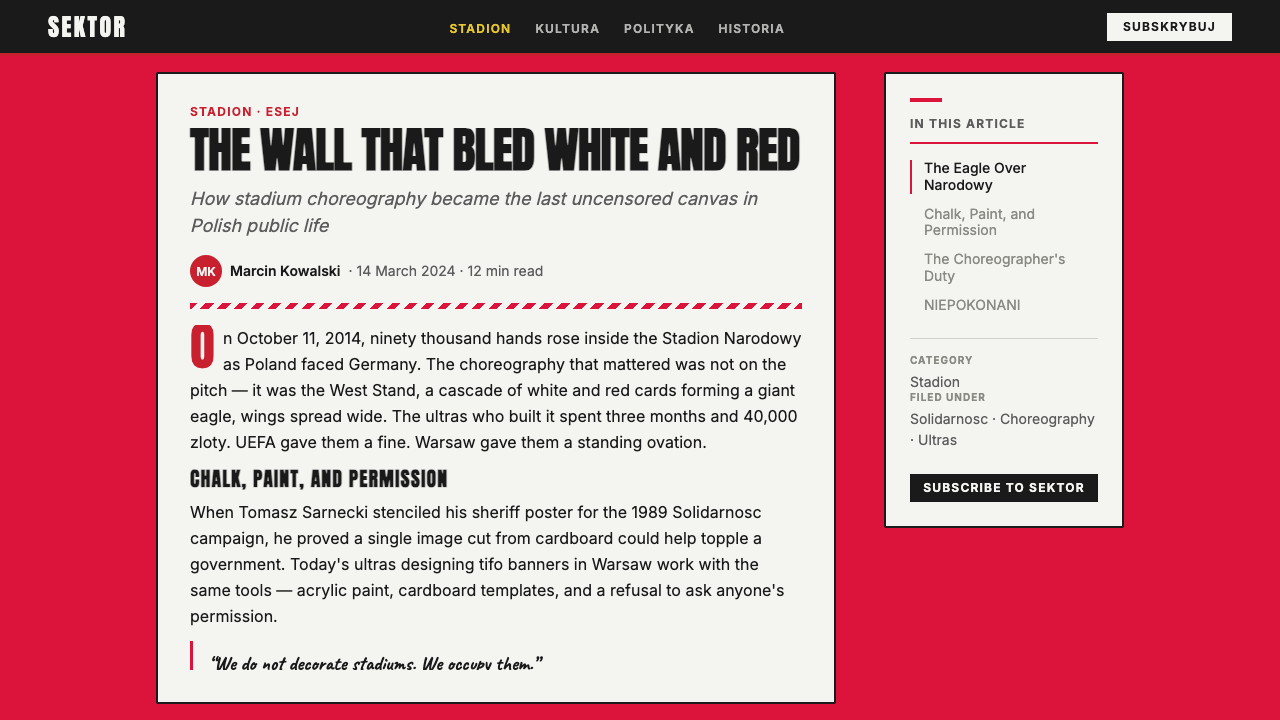
The palette is built on a single overwhelming chromatic statement: full-saturation stadium red that functions not as an accent but as the primary surface on which everything else is placed. This is red as environment, not highlight. Chalk-white appears as the secondary structural color, carving out card surfaces and content areas from the red ground with the crispness of freshly printed stencil on dark concrete. A deep charcoal — neither pure black nor grey — handles all typographic weight and structural lines, carrying the gritty residue of underground print culture.
Stencil Typography
Type in this system is deliberately blunt and physical. Letterforms are constructed on the logic of the stencil — condensed, uppercase, with deliberate gaps and bridges that allow the template to hold together structurally. Headlines do not suggest refinement; they declare. The letterforms carry visible weight that makes them feel stamped rather than set, printed by hand pressure rather than digital precision. Body text, where it appears, uses the same unapologetically utilitarian logic at smaller scale, maintaining the system's character without competing with headline dominance.
Rough Texture and Print Memory
Where most contemporary design systems smooth away evidence of their production, this one deliberately preserves and amplifies it. Halftone dot patterns evoke the photocopied pamphlet; ink bleeds suggest screen printing on absorbent paper; stencil edges carry slight imprecision rather than digital cleanliness. These are not decorative gestures — they are traces of a specific historical production context, reminding viewers that this visual language was originally made under conditions of urgency and limited resources. The rough texture is the aesthetic proof of authenticity.
Mass Scale and Legibility
Stadium graphics must communicate across distances that would defeat refined or detailed design. This system is calibrated for mass-scale legibility: composition is reduced to large, high-contrast blocks, typography is oversized relative to any conventional measure, and detail is eliminated in favor of immediate impact. The informational content of any single graphic element must be graspable in the half-second a viewer might have before the crowd shifts. This demand for extreme legibility at scale, inherited from both the political poster and the stadium tifo, shapes everything from letter spacing to the ratio of type to image.
Collective Identity Over Individual Expression
The visual logic of this system is constitutively plural. Its gestures — the mass of red, the block typography, the tifo-scale composition — are not designed for a single viewer seated at a comfortable distance but for thousands acting and feeling together. This is reflected in how the style handles space: rather than the intimate negative space of contemplative design, it uses compressed, charged space where elements press against each other with the density of a packed terrace. The individual disappears into the collective; the graphic becomes the crowd.
Symbolic Charge of National Iconography
The red and white duochrome is not arbitrary — it mirrors the Polish national flag with the directness of a declaration rather than the subtlety of an allusion. Eagle silhouettes, shield motifs, and badge compositions draw on heraldic vocabulary that carries centuries of cultural weight. When these forms appear in this system, they are never decorative citations; they carry the full emotional freight of national identity consciously mobilized, of a people that has had to fight for its right to exist and remembers the cost. This symbolic intensity is what distinguishes the style from generic sports branding.
Hard-Edge Contrast Without Gradient
Transitions between colors and surfaces happen at hard edges rather than through gradients or blending. The boundary between stadium red and chalk-white is a cut, not a fade. This formal decision connects the style to both the screen-printed poster tradition — where ink sits on top of paper with physical abruptness — and to the way tifo panels are made: flat sections of color placed together, not blended. The absence of gradient is also a political statement: ambiguity and softening are luxuries of comfortable positions, and this aesthetic does not allow for them.
Who shaped Polish Solidarity Stadium Graphic?
Sarnecki was the Polish graphic designer whose High Noon poster became an emblem of the Solidarność electoral campaign in 1989. By transposing an American Western film image — Gary Cooper's lone marshal walking toward danger — onto the political landscape of Poland's semi-free elections, he demonstrated that poster design could bridge popular culture and political urgency without sacrificing either. The boldness of the central figure against a flat white ground, the deliberate isolation of the Solidarność badge replacing the sheriff's star, and the controlled use of a single dominant color established formal principles that flow directly into the stadium graphic tradition. His work remains one of the most studied examples of politically engaged design in the late twentieth century.
Janiszewski designed the original Solidarność logotype in 1980, working from within the Gdańsk Shipyard strike during the movement's founding moment. His wordmark — in which letterforms support and lean on each other like figures in a collective — was produced under extraordinary conditions and has since become one of the most studied examples of typographic design as political act. The logo's illegibility to international audiences was irrelevant: its visual content was internal, communicating to a community that read it as an image of solidarity before reading it as a word. This approach to type as communal gesture rather than pure readability vehicle shaped subsequent Polish graphic thinking deeply.
Mamastudio is a Warsaw-based design studio whose work on the UEFA EURO 2012 visual identity — the tournament co-hosted by Poland and Ukraine — brought the formal sensibility of the Polish poster tradition into dialogue with contemporary international sports design. Their approach demonstrated that the aggressive directness of stencil-influenced typography and saturated national color fields could function effectively at the scale and complexity demands of a major international tournament, from official communications to street-level fan experiences. Their work represents the most visible modern bridge between the historic Solidarność aesthetic and current Polish sports visual culture.
Edgar Bąk is a Warsaw-based graphic designer known for rigorous conceptual work that resists decoration without abandoning warmth. His contributions to the Polish sports design ecosystem brought a formal discipline that anchored the tradition's emotional energy in clear structural thinking rather than nostalgic pastiche. Bąk's work demonstrates how the stencil-and-red aesthetic can be pushed toward conceptual clarity rather than mere stylistic quotation — a distinction that matters for a tradition in danger of becoming a costume rather than a living language. His recognition in international design communities has helped establish contemporary Polish graphic design as a distinct voice in European visual culture.
The Polish Poster School is less a single institution than a sustained cultural tradition in which successive generations of Polish designers used the poster form — one of the few creative outlets permitted or at least tolerated under socialist governance — to develop a distinctively expressive national graphic language. Designers such as Henryk Tomaszewski, Waldemar Świerzy, and Jan Lenica established the idiom: painterly surfaces, strong symbolic imagery, condensed emotional intensity. Their legacy created a design culture comfortable with bold color and political courage, and that comfort — transmitted through art schools in Warsaw, Kraków, and Łódź — is what made the Solidarność moment graphically so powerful and what continues to inform the stadium graphic tradition today.
How do you use Polish Solidarity Stadium Graphic today?
Applying the Polish Solidarity Stadium Graphic style requires a clear-eyed understanding of what makes it work: it is a system of extremes — maximum saturation, maximum contrast, maximum typographic weight — that earns its intensity through historical grounding and formal discipline. Used carelessly, it becomes aggressive without meaning. Used with attention to its structural logic, it produces visual work with genuine emotional authority.
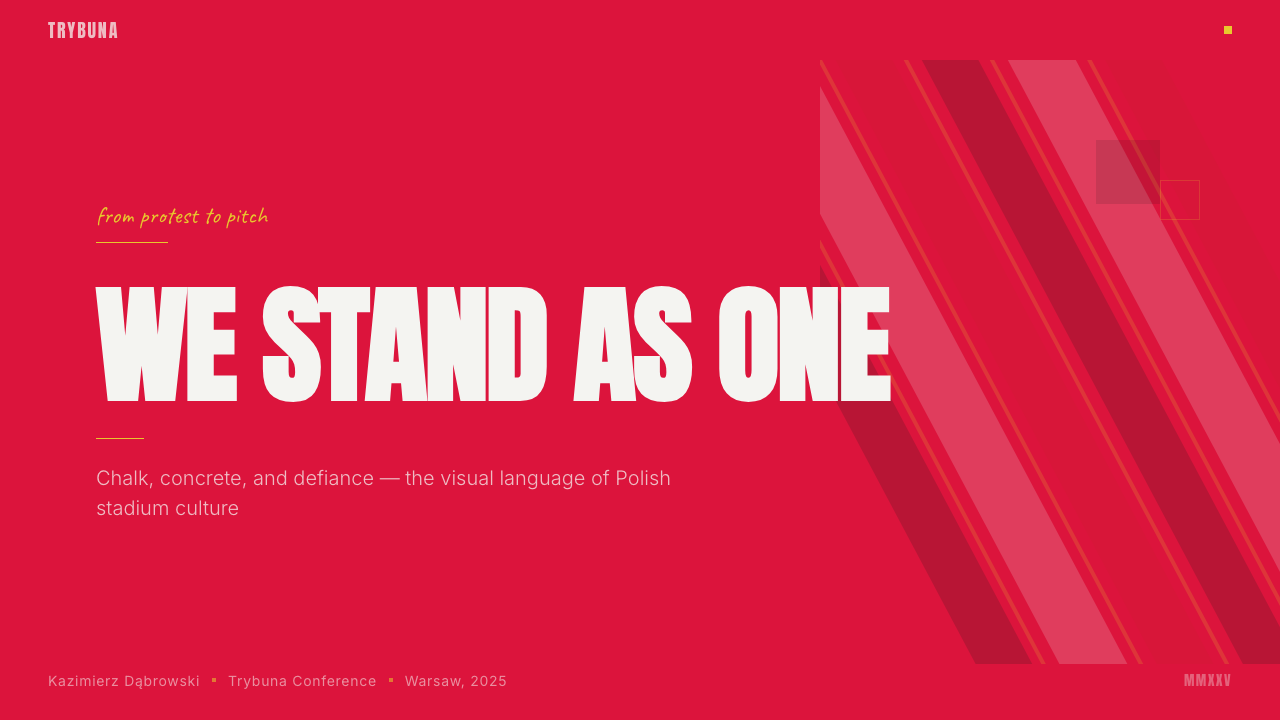
For presentation slides, this style excels at moments requiring declared conviction rather than reasoned argument. Cover slides benefit from a full-bleed stadium red ground with a single large stencil-weight headline in chalk-white — the composition should feel like a placard, not a title card. Content slides must work harder to remain functional: establish a chalk-white content area within the red environment, use the charcoal typographic system at a legible weight and scale, and resist the temptation to introduce red text on white ground except for single-word emphasis. Data slides in this system function best when charts are treated as graphic objects — bold strokes, flat color fills, no soft gradients, axis labels in a utilitarian condensed style.
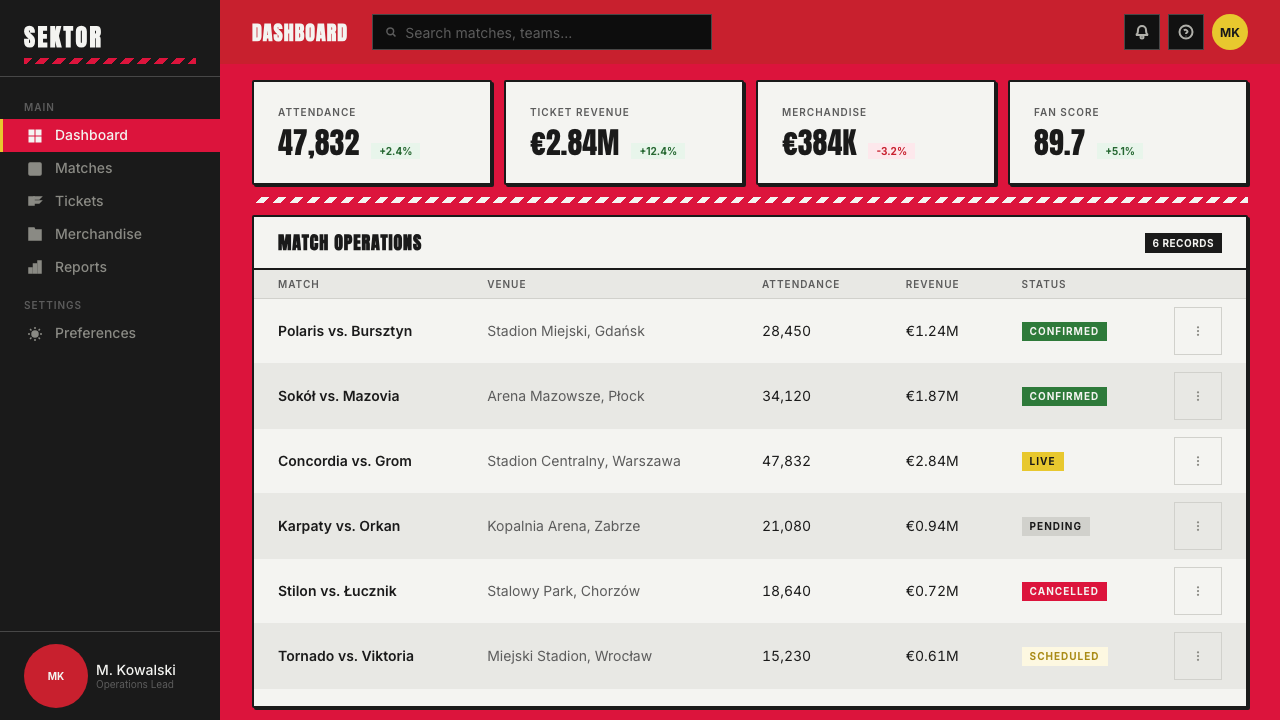
For web and digital interfaces, this style is well-suited to contexts requiring strong brand assertion and emotional identification: supporter communities, activist platforms, cultural institutions with a political dimension, or brands whose identity is built on clear value positions rather than neutral service. Navigation should be typographic and bold; hero sections should commit fully to the red ground rather than attempting a softer color dilution; card components use hard-edge white panels against the red field. Interactive states are best signaled through color reversal — white on red becoming red on white — rather than through hover shadows or opacity shifts.
For editorial and marketing applications, this style carries inherent graphic weight that works for headlines, campaign materials, and event communications. A poster or social graphic in this system should reduce its message to the fewest possible words at the largest possible size — prolific body text fights the style's nature. Marketing sequences work well as bold alternations: full-red page followed by full-white page, with the charcoal type system providing continuity. The rough texture elements — halftone, ink bleed, stencil imprecision — should be introduced sparingly; used on every element they become a cacophony rather than a signature.
The most common mistake when working with this style is treating the red as an accent color rather than the primary field. When the background remains neutral and red is applied only to buttons, links, or highlights, the system loses its essential character — the feeling of total environmental immersion that distinguishes it from generic sports branding. A related error is smoothing the rough texture elements into digital cleanliness; the imprecision is not a limitation to be corrected but the quality that makes the style's historical claims legible. Finally, overloading the composition with too many typographic levels undermines the mass-scale legibility that is the style's structural raison d'être — when in doubt, fewer elements, larger, bolder.
Polish Solidarity Stadium Graphic — FAQ
Is this style exclusively suited to Polish or Eastern European contexts?
The historical roots are unmistakably Polish, but the formal vocabulary — stencil typography, saturated national color fields, hard-edge composition, rough print texture — has proven universally communicable. What the style requires is not national affiliation but contextual alignment: it works for any brand or project where collective identity, historical grounding, and declared conviction are genuine values rather than marketing positions. Football clubs across Europe, activist campaigns, cultural events with a political dimension, and heritage brands with authentic community roots have all adapted this visual language credibly without claiming Polish identity. The caveat is honesty: using the aesthetic as pure visual style without any underlying community commitment tends to read as hollow.
How does this style relate to other football or sports visual systems?
Contemporary sports design tends toward either hyper-polished global neutrality — smooth gradients, the same handful of condensed sans-serif typefaces, photographic hero imagery — or toward a deliberately rough vernacular that signals authenticity. This style belongs firmly in the second category, but it is distinguished from generic sports roughness by the depth of its historical backing. Where many sports brands invoke street culture or DIY aesthetics as stylistic gestures, this visual language carries documented connection to a specific resistance movement, a national poster tradition, and the actual social rituals of Polish football ultras culture. This historical specificity gives it a kind of moral weight that pure aestheticization cannot replicate.
Can the style work effectively in digital-first contexts without losing its print heritage?
Yes, but it requires deliberate translation rather than literal transfer. The rough texture elements — halftone patterns, ink bleed effects, stencil imprecision — must be used as intentional references rather than simulated reality; a halftone pattern on a screen is never identical to a halftone on newsprint, and attempting exact simulation produces an uncanny effect. The more productive approach is to preserve the structural logic of the print tradition — hard edges, flat color fields, blunt typographic weight — while allowing the texture elements to serve as punctuation rather than foundation. Digital implementations work best when they commit fully to the color and typographic system and use the rough texture as a knowing wink at the tradition, rather than attempting comprehensive reproduction of physical print qualities.
What happens when the red-and-white palette conflicts with another brand's established colors?
This is the style's most significant practical constraint. The red-and-white duochrome is so central to the system's identity — so tied to the Polish national flag and the Solidarność legacy — that substituting a different primary color fundamentally alters the character of the work. A dark-green-and-white version might be structurally competent but loses the political and historical resonance entirely. The more honest approach is to acknowledge that this specific style is not right for every brand, and to use its structural lessons — stencil typography, hard-edge contrast, mass-scale legibility, rough texture — in conjunction with a different color system rather than forcing the original palette onto an incompatible context.
How should this style handle photographic imagery?
Photography in this system works best when it is treated as a graphic element rather than a documentary window. The most historically consistent approach is to convert photographic images to high-contrast duotone — using the system's charcoal and chalk-white, or charcoal and red — so that photographic content reads as a flat, graphic shape rather than a naturalistic representation. Silhouetting figures against the red ground, as in political poster tradition, is highly effective. Full-color, naturalistic photography tends to fight the system's chromatic severity and dilute the stencil energy; if full-color imagery is required, it works better contained within a white card element rather than set directly against the red field.
Related design styles
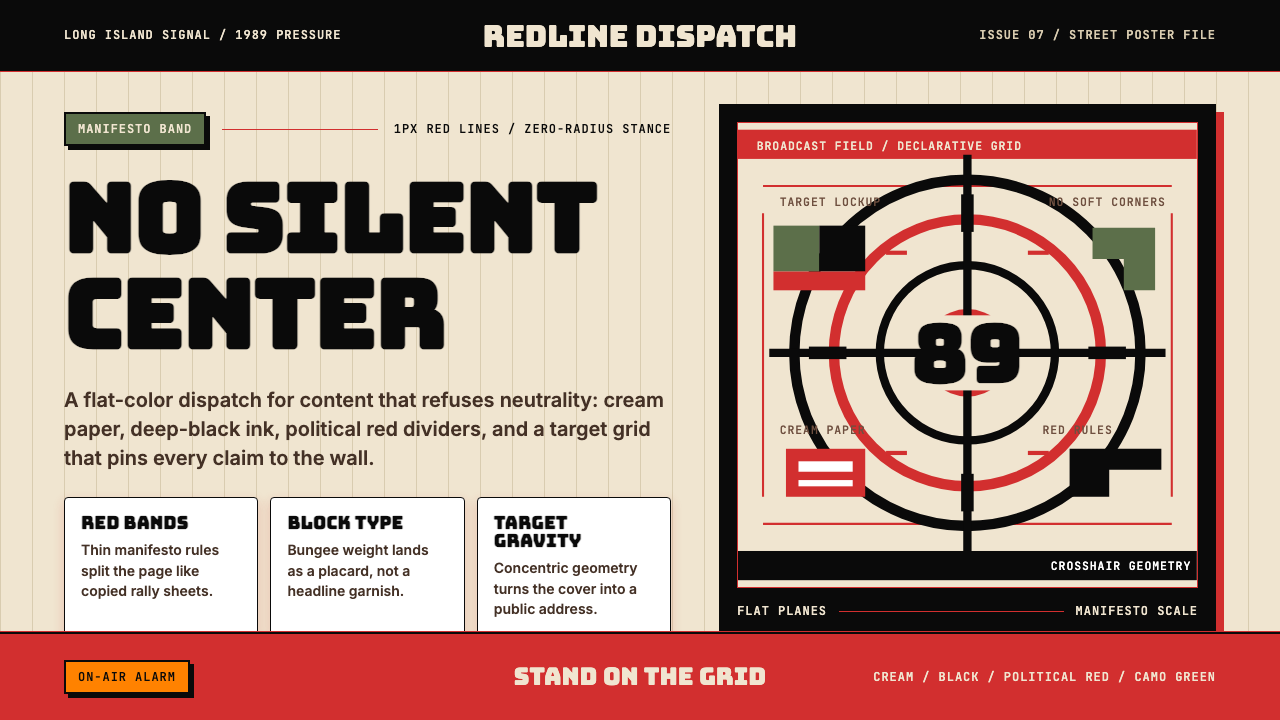 Public Enemy — Fight the PowerTakes a side loudly. Red bands, black ink, and target geometry hit like a ral…
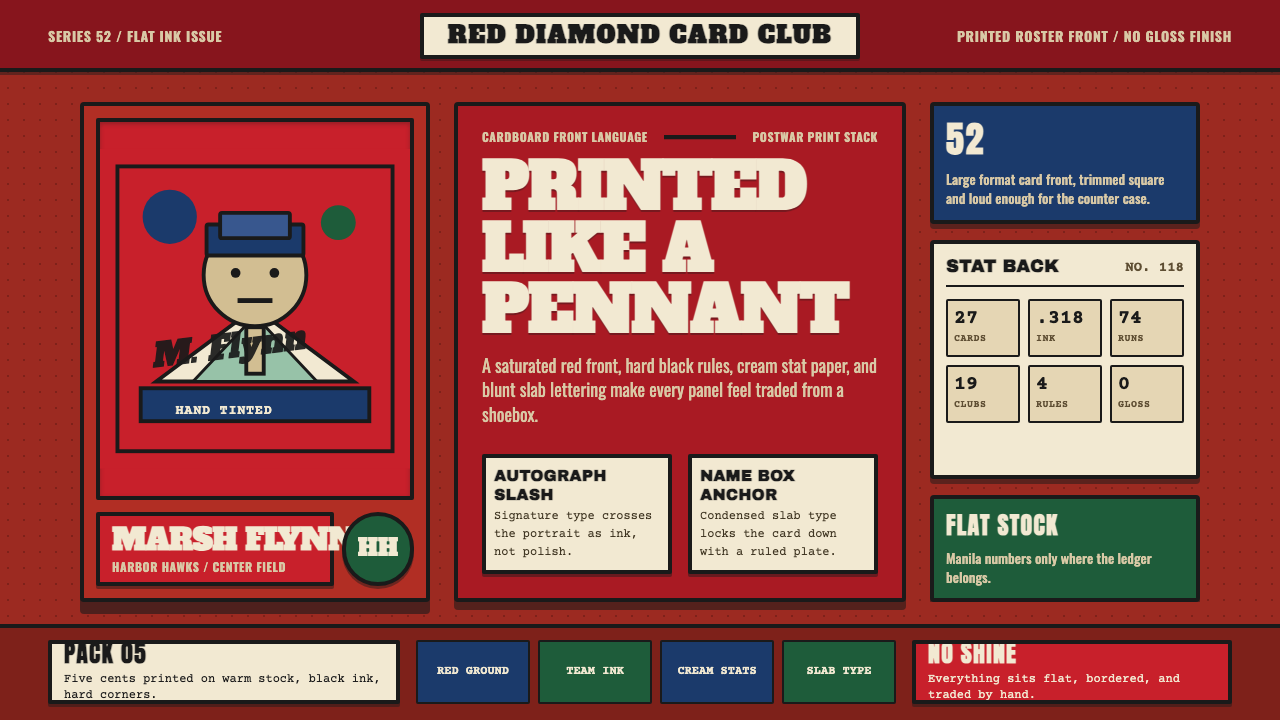 Topps Baseball CardCardboard heat. Brick-red slab panels, cream stats, and condensed type feel p…
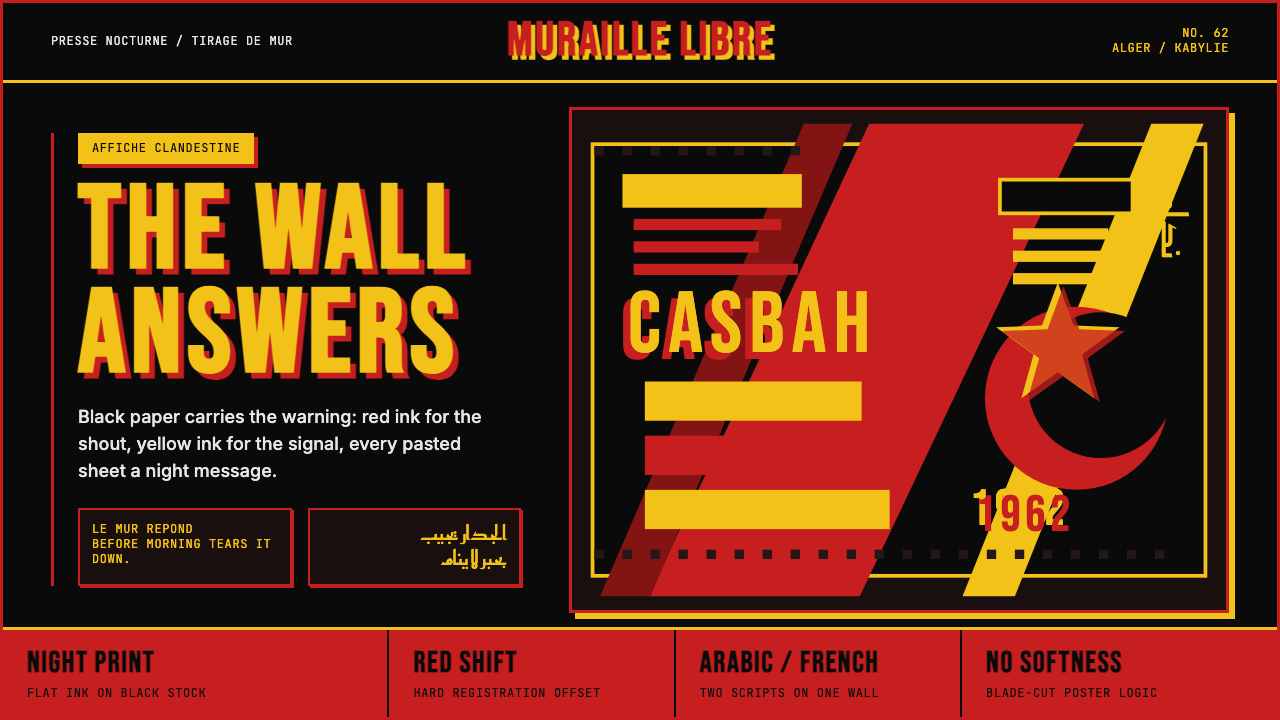 Algerian Casbah Poster (1954–1962)Every surface is a manifesto. Blood red, warning yellow, and stencil type hit…
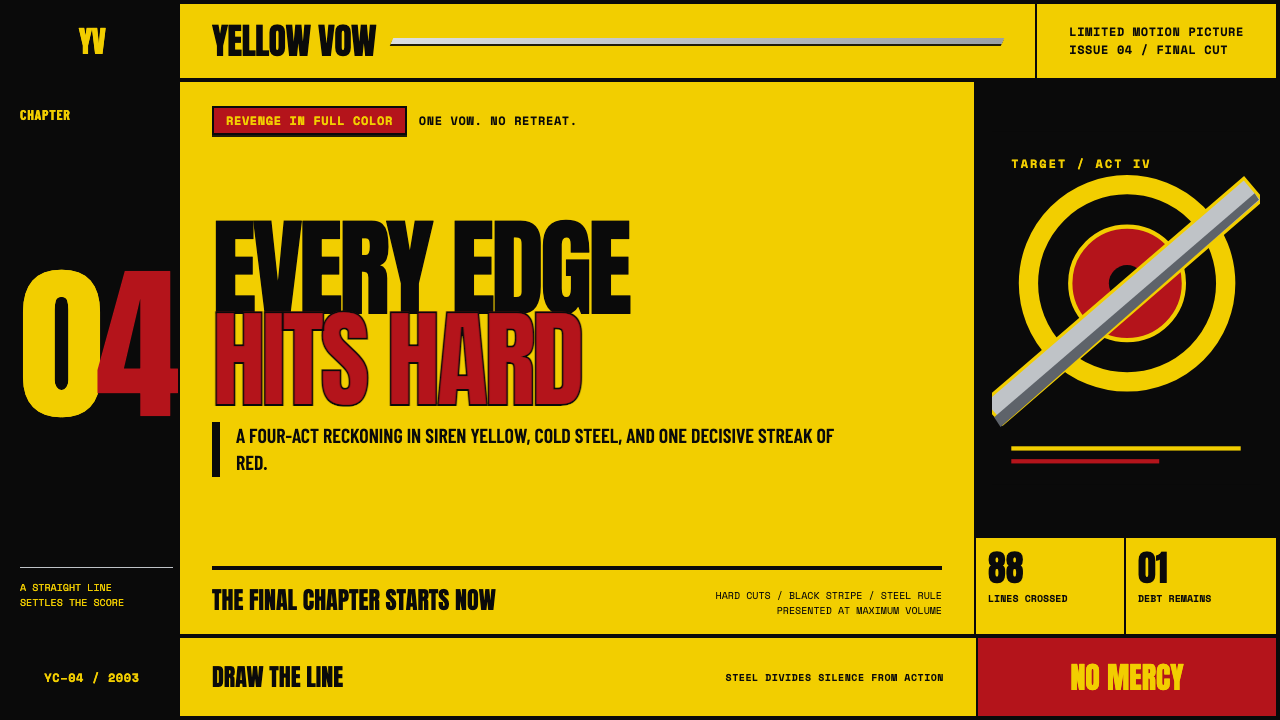 Kill Bill (2003)Revenge lands at full volume. Chrome yellow, slab type, and steel rules cut t…
 Naruto (2002 anime era)Underdog energy refuses the background. Hazard orange strikes steel-gray grid…
 Polish Milk Bar (PRL)State-issued warmth. Burnt orange enamel, stencil caps, and hard tile grids.