What is Solidarność Poland 1980?
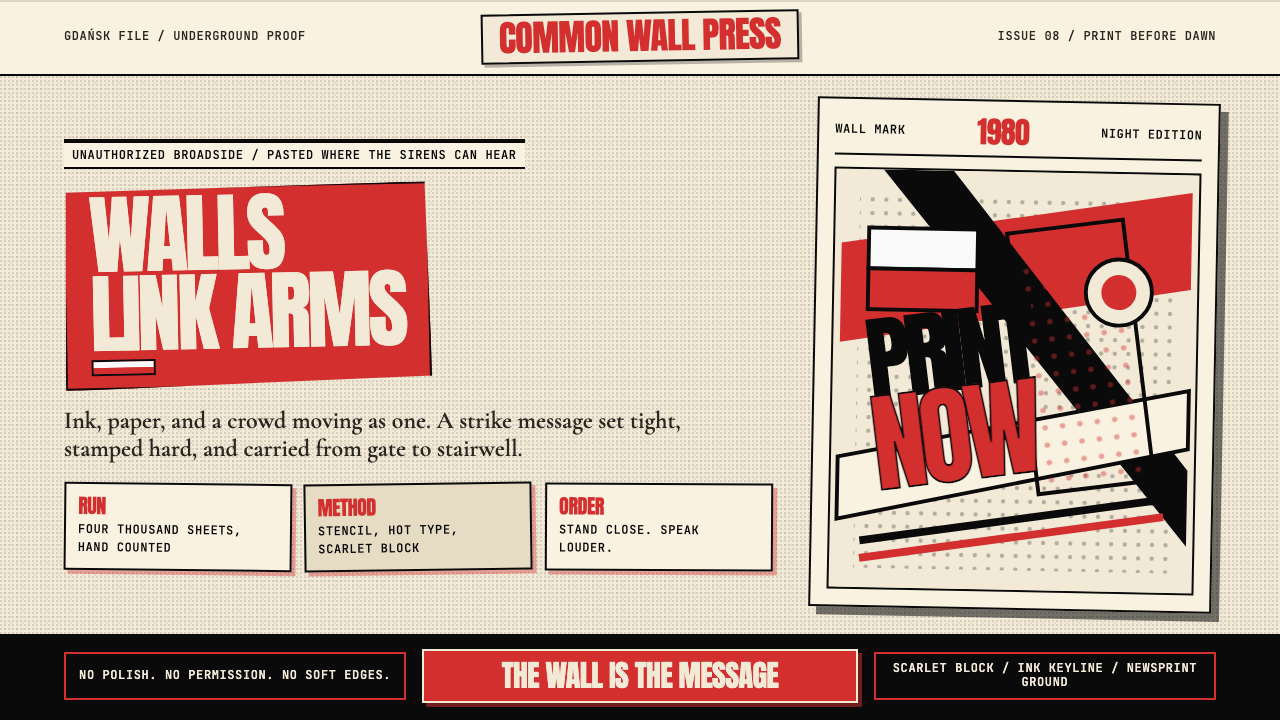
Jerzy Janiszewski painted scarlet letters that linked arms like striking workers — and within months, one handmade logo had become the most politically charged typographic act of the twentieth century.
Solidarność Poland 1980 in brief
Solidarność Poland 1980 is a graphic design language born inside a political emergency. Its immediate origin is the logo painted by Jerzy Janiszewski on a strike-committee banner at the Gdańsk Lenin Shipyard in August 1980: scarlet hand-lettered characters packed so tightly they lean on one another, with the cross-stroke of the final letter flying a miniature Polish flag. From that single image a broader visual vocabulary expanded — one rooted in the traditions of the Polish Poster School but charged with the urgency of underground resistance.
The aesthetic is built on a handful of uncompromising decisions: a scarlet that reads as alarm and conviction simultaneously, ink-black that communicates with the gravity of a press statement, and an off-white newsprint ground that anchors the whole in the material reality of the samizdat page. Typography is expressive and human rather than engineered; letterforms carry the slight irregularity of the hand and the speed of the brush. The grid, where it exists at all, is organic — structured by the logic of a wall poster or a broadsheet, not by a design manual.
What distinguishes this style from other politically motivated aesthetics of the period is its combination of folk warmth and graphic severity. The crowded, interlocking letterforms suggest solidarity in the most literal sense — bodies pressed together, supporting one another. The color choices evoke the Polish national palette without any need for explicit symbolism. The halftone textures of newsprint reproduction add documentary weight to compositions that might otherwise read as pure agitprop. The result is a visual language that communicates urgency, community, and defiance in the same gesture.

Where does Solidarność Poland 1980 come from?
The immediate context was the summer of 1980 in Poland. A wave of strikes, beginning at the Gdańsk Lenin Shipyard in August, rapidly spread across the country. Workers demanded not just economic concessions but independent trade unions — a direct challenge to the communist state. The Inter-Factory Strike Committee (MKS) needed a visual identity quickly. Janiszewski, a young graphic design student, produced the now-iconic logotype in a single afternoon: the word 'Solidarność' in hand-lettered red, with the characters pressed together so closely that the composition read as a crowd rather than a word. Within weeks the logo appeared on banners, leaflets, badges, and walls across Poland. Within months, it had reached the front pages of Western newspapers.
The deeper visual roots of the style lie in the Polish Poster School (Polska Szkoła Plakatu), a movement that had developed in Poland from the 1950s onward. Figures like Henryk Tomaszewski, Roman Cieślewicz, and Jan Lenica had built an internationally admired tradition of poster art that combined fine-art sensibility with populist communicative directness. Their posters used photomontage, hand-drawn lettering, bold silhouette, and surrealistic juxtaposition to produce images that rewarded both rapid reading at distance and close attention. The Solidarność aesthetic absorbed this tradition without citation, treating its strategies as common visual property available to anyone with a brush and a political conviction.
The samizdat press — the underground network of self-published texts and pamphlets that operated throughout the Soviet bloc — provided the material substrate for the style. Printing was clandestine and equipment was improvised; newsprint, mimeograph, and offset litho all left their traces in the aesthetic. The halftone grain of photocopied images, the slight misregistration of two-color printing, the coarse texture of uncoated paper — these technical artifacts of underground publication became expressive properties absorbed into the visual language. The style thus carries within it the evidence of its own production conditions.
By 1981, when the Polish communist government imposed martial law and forced Solidarność underground, the visual system had already achieved the robustness of a living folk tradition. It did not require a design office or professional production to reproduce. Anyone with red paint, a rough letterform, and access to a wall could participate. This radical reproducibility — not despite the style's irregularity but because of it — proved to be one of its most important properties. The aesthetic survived a decade of suppression and resurfaced intact for the Round Table Talks of 1989 and the free elections that followed, demonstrating that visual languages built for resistance have a durability that those designed for calm institutional communication rarely achieve.
What defines the Solidarność Poland 1980 look?
Scarlet as Signal
The defining color is a warm, vivid scarlet — not the cool primary red of offset process printing, but the hotter, slightly orange-shifted red of hand-mixed paint and ribbon ink. This red functions simultaneously as alarm, national symbol, and emotional call to presence. It is deployed in large flat masses — filling letterforms, flooding background panels, cutting bold horizontal bands — and it is never graduated or softened. Against the off-white of newsprint or the stark white of a poster ground, this scarlet achieves a physical intensity that cooler reds cannot replicate.
Ink-Black and Newsprint Ground
The palette beyond scarlet is starkly two-tone: a deep, saturated ink-black and an off-white that carries the memory of newsprint, uncoated paper, and mimeograph sheets. The black is used for photomontage imagery, dense text blocks, and strong keyline borders — it brings documentary gravity to the composition. The off-white ground is never a pure designer white; it has the slight warmth and texture of cheap reproduction paper, grounding the work in the material conditions of its production. Together, these three tonal registers — scarlet, black, newsprint cream — constitute the complete chromatic vocabulary of the style.
Expressive Hand Lettering
Typography in this tradition is emphatically not mechanical. The letterforms are brush-painted or hand-drawn, carrying the slight irregularity, variation in stroke weight, and gestural energy of the human hand working at speed. Letters lean into one another, their spacing compressed to the point of physical contact, conveying solidarity in a literal as well as political sense. Serifs, when they appear, are of the rough cut-in kind associated with hot-metal newspaper setting — blunt, authoritative, direct. This typographic warmth distinguishes the style from the geometric precision of Swiss or Bauhaus traditions and is one of its most emotionally accessible properties.
Photomontage and Halftone Texture
Following the Polish Poster School tradition, imagery enters the visual system primarily through photomontage: black-and-white photographs cut, combined, and reproduced at high contrast against the flat graphic elements. The halftone dot patterns of newsprint reproduction — a consequence of offset or screen printing on coarse paper — are treated not as technical imperfections to be minimized but as expressive properties in their own right. The grain, the dot spread, the tonal compression of cheap reproduction all contribute to the documentary roughness that gives the style its visual credibility. This halftone texture distinguishes authentic evocations of the style from clean digital reproductions.
Poster Logic and the Wall as Medium
The organizing principle of layouts is the wall poster: maximum legibility at a distance, information hierarchies resolved in seconds rather than minutes, and a visual center of gravity that operates before conscious reading begins. Compositions are rarely symmetrical; they are weighted toward decisive asymmetry, with a dominant element — a word, a face, a color block — commanding attention before supporting elements register. Borders, when they appear, are thick ruled lines functioning as frames that separate this message from the surrounding visual field, not as decorative additions. The layout announces itself rather than inviting the viewer to explore.
Raw Production Marks as Aesthetic
Unlike design movements that seek to conceal their production methods, this aesthetic embraces the marks of its own making as positive visual content. The slight bleed of red ink past the edge of a letterform, the visible brush stroke in a filled shape, the registration variance of two-color screen printing, the physical imprecision of rubber-stamp reproduction — these are not flaws. They are evidence of human hands, material urgency, and the specific conditions of clandestine production. In contemporary applications of the style, deliberately preserving or simulating these marks is essential to maintaining authenticity; over-refinement produces a polished pastiche that communicates nothing of the original emotional register.
National Symbolism Without Illustration
The style carries a strong sense of Polish national identity without relying on explicit patriotic illustration. The scarlet-and-white palette directly echoes the Polish national flag; the serif letterform tradition connects to centuries of Polish print culture; the reference to folk hand-painting bridges the fine-art poster tradition to popular craft. These associations operate subliminally — through color, material, and form — rather than through pictorial symbols. This approach allows the visual language to be reused in contemporary contexts without the specific political references, while retaining the underlying emotional resonances of urgency, community, and resilience that the original context produced.

Who shaped Solidarność Poland 1980?
Janiszewski was a graphic design student in 1980 when he created the Solidarność logo in a single afternoon at the Gdańsk shipyard, working on the strike committee banner at the direct request of the workers. The logo's decisive formal idea — letters packed so tightly they support each other, with the flag of Poland carried on the final stroke — came entirely from his interpretation of the political moment. He donated the design to the movement, refusing any payment or copyright claim, so that it could be freely reproduced by anyone who needed it. The logo went on to become one of the most recognized political symbols of the twentieth century and one of the few typographic marks that carries the full weight of a historical event in its form alone.
Tomaszewski is the central figure of the Polish Poster School, whose half-century of work between the 1940s and 1990s established the visual idiom that the Solidarność movement inherited. His posters combined hand-drawn lettering, painterly color application, and imagery that operated at the edge of figuration and abstraction, communicating through intuition rather than diagram. His teaching at the Warsaw Academy of Fine Arts shaped generations of Polish designers and embedded an approach to visual communication that prized individual gesture, formal wit, and emotional directness over systematized production. The humanist typographic warmth of the Solidarność style traces directly to the tradition he cultivated.
Cieślewicz was among the most technically inventive of the Polish poster generation, distinguished by his mastery of photomontage as a fine-art form. Working in Poland through the 1960s and later from Paris, he developed a visual language that used high-contrast photographic fragments, optical pattern, and collage to create images of extraordinary psychological intensity. His formal strategies — particularly the use of tightly cropped black-and-white photography against flat graphic fields — fed directly into the samizdat aesthetic that Solidarność publications employed. His work demonstrated that documentary photography and expressive design could occupy the same compositional space without either subordinating the other.
Lenica brought a surrealist and expressionist sensibility to the Polish Poster School that distinguished him from the more politically direct work of his contemporaries. His posters — particularly for theatre and opera — used organic, metamorphic letterforms and figurative imagery that seemed to grow and mutate across the picture surface. Though his own work was less overtly political than that of Tomaszewski or Cieślewicz, his formal experiments with letterforms that behave like living things directly prefigured the way the Solidarność logo would be read: as characters that are also bodies, type that is also crowd. His influence is felt in the expressive, breathing quality of hand-lettered forms across the broader stylistic family.
One of the defining characteristics of the Solidarność visual tradition is the extent to which it was produced by anonymous designers, printers, and activists operating without institutional support. The underground press network that sustained the movement from 1981 through 1989 generated an enormous body of typographic and graphic work whose creators are largely unrecorded. These anonymous practitioners — working by night on duplicating machines in apartments and church basements — constituted a distributed design workforce that collectively developed and refined the visual language of the movement. Their contribution is not legible through individual authorship but through the consistency and vitality of a graphic system that survived a decade of suppression without institutional maintenance.
How do you use Solidarność Poland 1980 today?
Solidarność Poland 1980 translates well into contemporary design work when the intended message involves urgency, conviction, or solidarity — whether literal or metaphorical. The style's emotional register is serious and engaged; it works in contexts where the audience is being called to attention or action, not being entertained or reassured. Correctly applying it requires understanding what the visual language is actually doing: using scarlet to arrest attention and signal commitment, using rough typographic texture to communicate human presence, and using the density and compression of composition to suggest collective force.
For presentation slides, the style performs strongly on both cover and feature content pages. A cover built in this aesthetic works through bold asymmetry: a large scarlet block or scarlet lettering commands the primary field, while a black-on-newsprint-white secondary text area grounds the composition. The title should feel hand-lettered in spirit even if set digitally — condensed, tight-spaced, weighted toward the heavy end. Content slides adopt a broadsheet logic: a clear primary headline at large scale, a secondary information column, and a thick black rule separating structural zones. Data slides are best handled through high-contrast bar and area charts in the primary palette — black, scarlet, and newsprint white — with chart elements treated as bold graphic objects rather than polished data visualizations.
For web interfaces, this style suits contexts where conviction and community are core brand values: advocacy platforms, cooperative or union-affiliated products, cultural institutions with a social mission, and editorial platforms covering politics, labor, or social movements. Dashboard layouts work well when structured around a strong typographic hierarchy with scarlet used exclusively for primary calls to action or critical alerts. Navigation should feel editorial — large, confident type with minimal graphic embellishment. Pricing or membership pages respond well to the style's poster logic: each tier defined by a bold scarlet-highlighted headline, dense but legible body text, and a visual language that treats joining as an act of affiliation rather than a commercial transaction.
For editorial and marketing work, the style supports content with genuine political or social substance. Magazine spreads and article layouts using this aesthetic should lead with large, manually-weighted headline type, use a dense columnar body text structure that recalls broadsheet newspaper layout, and rely on high-contrast black-and-white photography or photomontage rather than color photography. Marketing materials for social enterprises, nonprofits, or mission-driven brands benefit from the style's combination of emotional directness and visual authority — but only when the organizational values genuinely align with the aesthetic's origins. The style communicates authentically for causes; it communicates inauthentically for consumer products unrelated to solidarity or collective action.
A common mistake when applying this style is treating the scarlet as a general accent color to be used liberally throughout a layout, rather than as a loaded signal deployed sparingly for maximum impact. In the original posters and banners, scarlet dominates compositionally but is the only non-neutral color present; distributing it across many small elements dilutes its force and produces something closer to generic red-and-black branding than to the Solidarność aesthetic. A related error is over-polishing the typographic and surface elements: digital tools make it easy to produce technically perfect letterforms and perfectly registered color blocks, but the style's emotional power depends on the visible evidence of human production. Retaining controlled roughness — in letterform, in texture, in edge quality — is not a stylistic indulgence but a structural requirement.

Solidarność Poland 1980 — FAQ
How is Solidarność Poland 1980 different from Soviet Constructivist design?
Both share a commitment to bold political communication, geometric visual structure, and strong typographic presence — and the Polish Poster School was certainly aware of Constructivist precedents. But the differences are fundamental. Soviet Constructivism was a state-sponsored avant-garde, developed within institutions by trained designers with access to professional printing equipment. Solidarność design emerged from underground conditions: hand-painted, hand-printed, improvised. Constructivism is angular, mechanical, and grid-governed; its emotional temperature is utopian and expansive. Solidarność is compressed, hand-made, and deliberately rough; its emotional temperature is urgent and resistant. The most telling formal difference is typographic: Constructivism favors clean geometric sans-serif letterforms; the Solidarność tradition is built on expressive hand-lettering and the serifs of hot-metal newspaper type.
Can this style work for commercial brands, or does using it feel appropriative?
The question of cultural and political appropriation is worth taking seriously here. The Solidarność aesthetic is not merely historical style — it is the visual language of a specific political struggle that involved real sacrifice. Using it for commercial purposes that bear no relationship to the values of labor solidarity, collective action, or democratic resistance risks producing work that feels cynical or hollow. That said, the style can work honestly for organizations whose actual mission aligns with its values: cooperatives, trade unions, nonprofit advocacy organizations, social enterprises, and media platforms covering labor and politics. The test is whether the organization can claim the aesthetic's values as genuinely its own, not whether it can technically reproduce the visual forms.
How do you apply halftone texture in digital work without it looking like a cliché filter?
The key is using halftone texture structurally rather than decoratively. In the original samizdat and poster work, the halftone was a consequence of the printing process applied to photographic imagery — it appeared on images, not on flat color blocks or typographic elements. In contemporary digital work, applying a blanket halftone overlay across an entire composition will read as a nostalgia filter rather than as an authentic structural choice. Instead, use halftone treatment selectively: on photographic elements to simulate offset reproduction on coarse paper, on tonal transitions between color fields, or on specific elements where documentary texture serves the meaning. The grain should feel like evidence of a process, not like a visual effect applied after the fact.
Is the style suited to light and delicate content, or does it always read as heavy and confrontational?
The style's natural gravity is heavy, urgent, and confrontational — those are structural properties of the design language, not just its historical associations. Attempting to deploy it for delicate, intimate, or soft content will almost always produce a mismatch between form and content that reads as unresolved. The style is genuinely not suited to wellness brands, personal narratives focused on vulnerability or interiority, children's content, fine dining, or any context where the emotional goal is comfort and ease. Within its appropriate range, however, there is more tonal variation than the bluntest applications suggest: the expressive hand-lettering tradition within the Polish Poster School includes wit, irony, and visual warmth alongside its political severity. The style can accommodate intellectual humor and cultural complexity — it is not limited to the single emotional note of protest.
What is the most important single thing to get right when applying this style?
The scarlet. Its weight, its warmth, and its restraint. The entire visual system is organized around the principle that one color carries the full emotional and communicative burden — and that this is only possible when every other color decision defers to it. Scarlet that is too cold reads as corporate red. Scarlet used on too many elements loses its alarm function. Scarlet rendered without the slight warmth and material richness of mixed paint becomes just another accent color in a red-and-black palette. Get the red right — warm, vivid, structurally dominant, and sparing — and the rest of the visual language will organize itself around it. Fail to get it right, and no amount of hand-lettering texture or halftone grain will produce the correct emotional result.
Related design styles
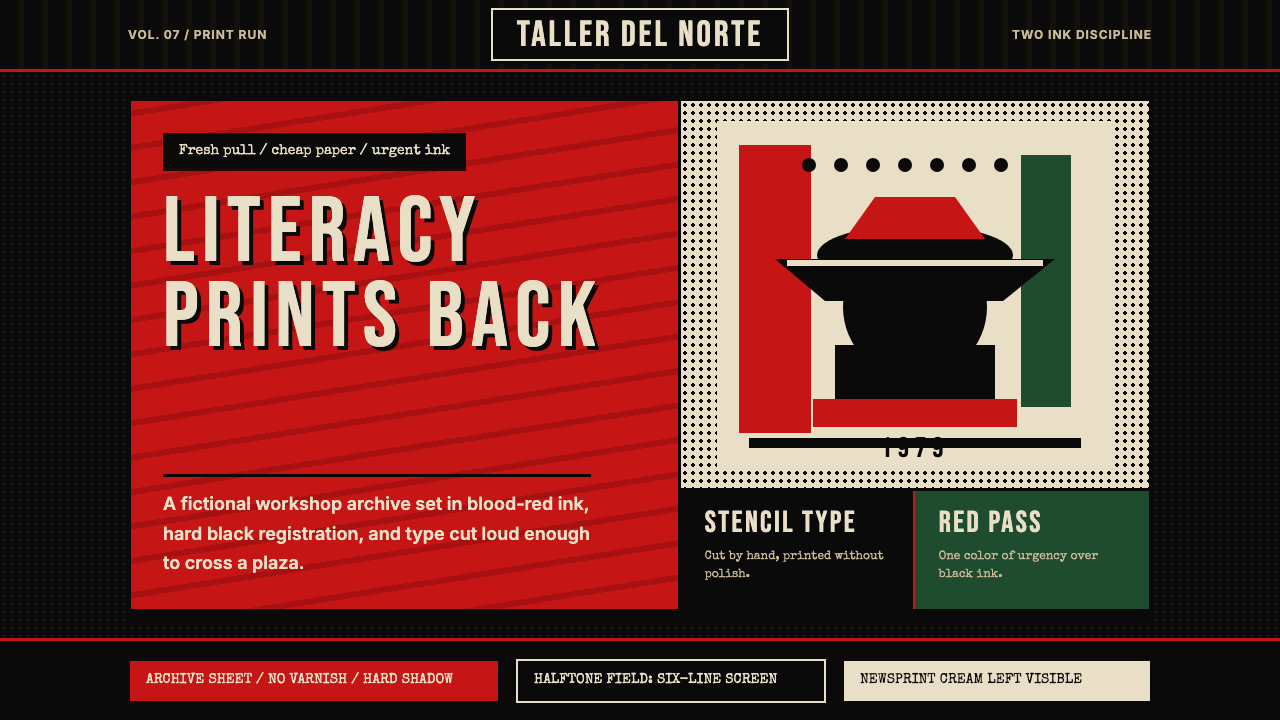 Nicaraguan Sandinista FSLN 1979Urgency in two inks. Blood red, jet black, halftone dots, and cut-stencil typ…
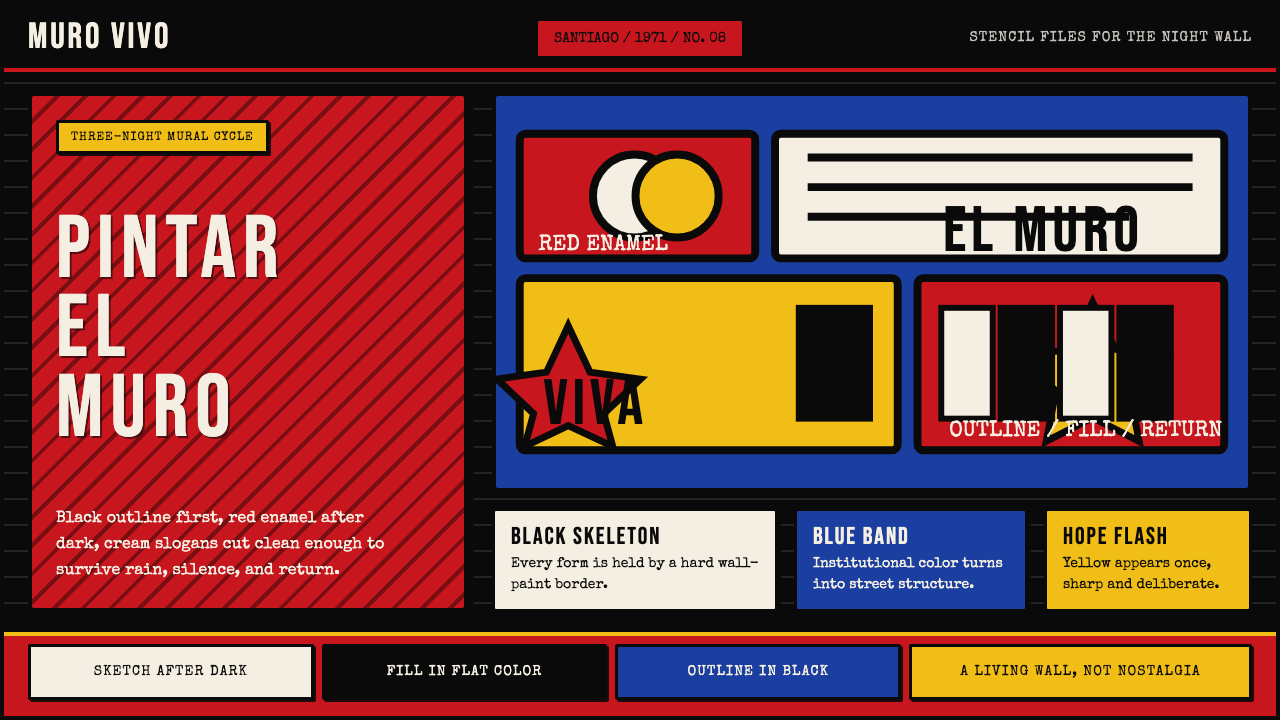 Chilean BRP Ramona Parra 1971Resistance stays alive. Blood red panels, black outlines, and stencil type re…
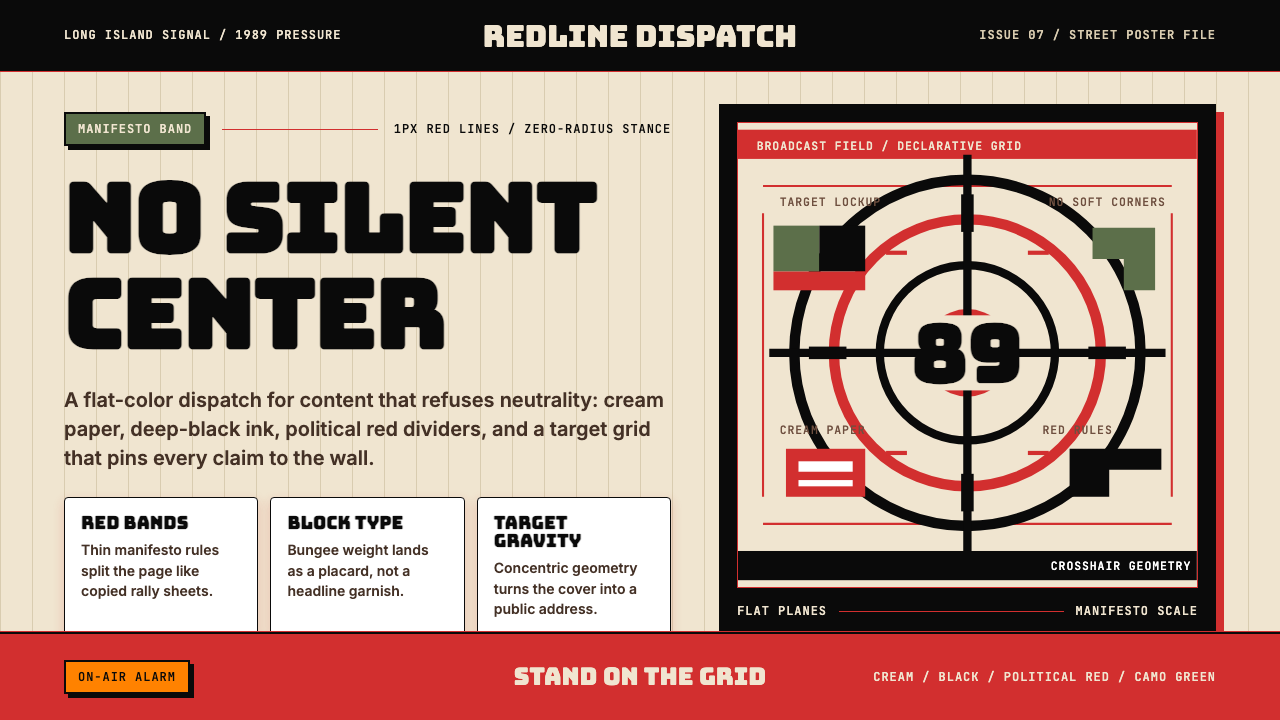 Public Enemy — Fight the PowerTakes a side loudly. Red bands, black ink, and target geometry hit like a ral…
 Attack on Titan (2013)Dread becomes duty. Stone-gray bands, engraved caps and one steel-blue crest…
 Manga Panel LayoutCinema in ink. Black panels, screentone dots, speed lines, and one red strike.
 N'Ko ScriptIdentity writes itself. Forest green and gold baselines anchor joined N'Ko le…