What is Nicaraguan Sandinista FSLN 1979?
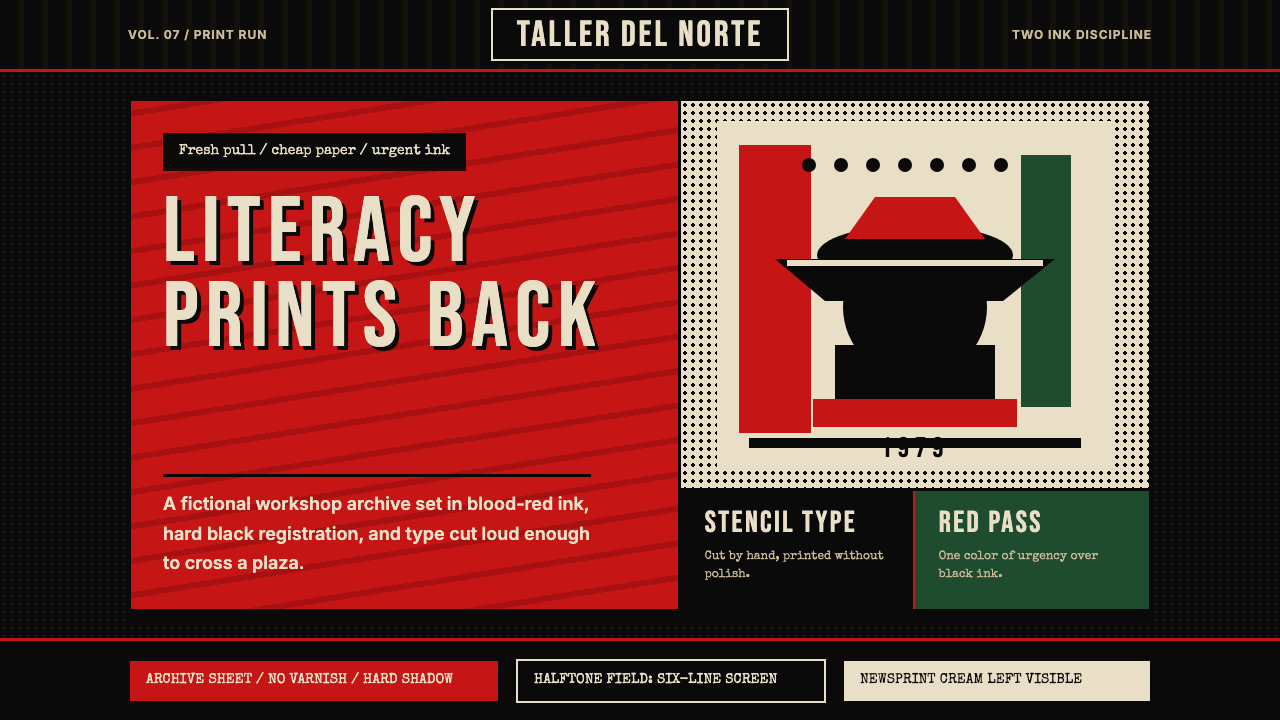
Blood red over jet black on cheap newsprint — the Sandinista silkscreen workshops of 1979 turned political urgency into a visual language that still crackles with revolutionary heat.
Nicaraguan Sandinista FSLN 1979 in brief
The Nicaraguan Sandinista FSLN 1979 style is a visual system rooted in the revolutionary silkscreen workshops that flourished under the first Sandinista government from 1979 to 1990. It is defined by a ruthlessly restricted two-color palette — blood red and jet black — applied to cheap, slightly yellowed newsprint grounds. Every surface reads like a freshly pulled print: flat color blocks with visible ink bleed at the edges, halftone dot-matrix portraits, hand-cut stencil lettering, and the unmistakable silhouette of Augusto César Sandino's wide-brimmed hat against a stark horizon.
What makes this aesthetic distinctive is its honesty about the material conditions under which it was produced. The imperfections are not affectations — misregistered color layers, rough stencil edges, uneven ink coverage — they are the direct record of workshop printers working at speed under political pressure. The visual system carries the urgency of its origins: it communicates not through elegance but through directness, contrast, and the unmistakable authority of the stencil mark.
Compared to the cooler rationalism of European political modernism or the monumental grandeur of Soviet constructivism, the Sandinista silkscreen tradition is raw and human-scaled. It was made for walls, telephone poles, and community gathering spaces — surfaces that demanded legibility at a distance and durability in tropical heat — and those production demands shaped every aesthetic choice.
Where does Nicaraguan Sandinista FSLN 1979 come from?
The aesthetic roots of this style reach back further than July 1979. Augusto César Sandino, the guerrilla leader who fought against U.S. military occupation of Nicaragua from 1927 until his assassination in 1934, had already become a visual icon by the time the FSLN was founded in his name in 1961. The Sandino silhouette — wide-brimmed campesino hat, angular jaw, simple line — was already in circulation as a political emblem before the revolution. When the Sandinistas marched into Managua on July 19, 1979, ending forty-three years of Somoza family dictatorship, they inherited and immediately amplified this visual tradition.
The institutional engine of the movement's visual culture was the Ministry of Culture, directed by the poet-priest Ernesto Cardenal. Cardenal's ministry established the Talleres de Cultura Popular — popular culture workshops — in cities across Nicaragua, including Managua, Estelí, Matagalpa, and León. These workshops trained working-class and campesino printers in silkscreen technique and supplied them with the materials to produce political posters at scale. The workshops operated on a principle of collective authorship: many of the most powerful images have no individual attribution, only the stamp of the workshop and the movement.
The Cruzada Nacional de Alfabetización — the National Literacy Crusade of 1980 — became one of the most intensive deployments of this visual system. The crusade sent thousands of young volunteers into rural areas to teach reading, and the silkscreen workshops produced an enormous volume of literacy campaign materials: instructional posters, mobilization broadsides, and portrait sheets of revolutionary heroes. The visual constraint was imposed partly by economics — the country had few resources — and partly by ideology: a poster that required expensive four-color printing was a poster that could only be made in a few places. Two-color silkscreen could be reproduced anywhere there was a frame, a squeegee, and a screen.
The artistic lineage of Camilo Minero, the Salvadoran-born muralist who worked extensively with the Sandinista cultural brigades, represents the transnational dimension of the movement's visual culture. Central American political printmaking of the late 1970s and 1980s was a regional conversation, not an isolated national phenomenon: artists and techniques circulated across borders, and the Nicaraguan workshops were in dialogue with Cuban printmaking institutions, Chilean exile graphic traditions, and the broader Latin American poster movement that had been building since the Cuban Revolution of 1959.
What defines the Nicaraguan Sandinista FSLN 1979 look?
Two-Color Discipline
The defining constraint of this visual system is the hard limit of two colors: blood red and jet black, always over a cream or off-white newsprint ground. No intermediate tones are mixed; no gradients soften the transitions. The red carries all the symbolic weight — revolution, sacrifice, urgency — while black handles structure, silhouette, and type. This enforced economy is not a poverty of means but a declaration: the message is clear enough not to need more.
Halftone Dot-Matrix Portraits
Photographic source material — portraits of Sandino, fallen compañeros, literacy campaign participants — is translated into large-format halftone screens. The dots are coarse and visible, functioning as both a reproduction technique and a visual texture. At reading distance, the portrait resolves; at close range, the grid of dots is exposed. This dual legibility connects the human subject to the mechanical process of reproduction, embedding the image in its political and material context.
Hand-Cut Stencil Typography
Text is rendered through hand-cut stencils rather than typeset metal or digital composition. The letterforms are simplified to their most readable essentials — enclosed counters are bridged, curves are approximated by straight cuts, and individual character spacing is eyeballed rather than measured. The resulting type has the authority of a proclamation painted on a wall: slightly imperfect, urgently legible, impossible to mistake for commercial production.
Flat Silhouette and the Sandino Icon
Figurative imagery is reduced to clean silhouette — most iconically, the Sandino figure: wide sombrero, upright posture, often set against a rising sun or stark horizontal ground line. No internal detail is rendered; the silhouette works through outline alone. This reduction is not simplification for simplicity's sake but a formal response to the silkscreen medium, where every additional color layer adds cost, complexity, and registration risk.
Ink Bleed and Registration Imperfection
Where the ink meets the paper ground, the edge is never perfectly sharp — a slight halo of color bleeds into the grain of the newsprint, and where red and black layers overlap, a narrow zone of disturbance reads as deep maroon. Color registration between passes is intentionally imperfect: the two layers may offset by a visible margin, creating a sense of layering and physical depth that a single clean print cannot achieve. These imperfections are the signature of the human hand in the mechanical process.
Diagonal Composition and Urgency
Where European modernism favored horizontal stability, the Sandinista poster tradition reaches for diagonal thrust. Raised fists, upward-pointing rifles, marching columns, and rising sun rays all drive the eye along diagonals that suggest movement and momentum. This compositional energy is not chaos — it is directed urgency, always resolving toward a focal point of text or silhouette that carries the message.
Newsprint Ground as Active Element
The unprinted surface — the cream or buff color of cheap newsprint — is not a neutral background but an active third tone in the composition. Where the silkscreen leaves the paper bare, the warm ground shows through, providing contrast against the black without requiring a third ink pass. The slight warmth of aged newsprint also contributes to the emotional register of the style: it suggests something printed and distributed in haste, under pressure, meant to be read and passed along.
Who shaped Nicaraguan Sandinista FSLN 1979?
Sandino never lived to see the revolution that bore his name, but his image — particularly the silhouette of his wide campesino sombrero — became the most reproduced icon of the 1979 movement and remains the visual anchor of this entire design system. As a historical figure, Sandino organized a guerrilla campaign against U.S. Marine occupation from 1927 to 1933, refusing to sign a peace treaty and maintaining armed resistance until the Marines withdrew. His assassination in 1934, ordered by the Somoza-family patriarch Anastasio Somoza García, made him a martyr whose image carried enormous political charge for subsequent generations of Nicaraguan and broader Latin American leftists.
Cardenal was simultaneously one of Latin America's most celebrated poets and the Sandinista government's Minister of Culture from 1979 to 1987. He directed the institutional apparatus that made the silkscreen workshops possible: funding, organizing, and legitimizing the Talleres de Cultura Popular as a serious cultural project rather than mere propaganda production. His own identity as a liberation theologian — a Catholic priest who believed revolutionary politics and spiritual practice were compatible — gave the cultural ministry a moral and aesthetic authority that pure political commissioning could not have achieved. Cardenal understood that the workshops were not just printing political messages but training a generation in visual literacy and collective cultural production.
As the public face and political leader of the FSLN through the 1979 revolution and the subsequent government years, Ortega became one of the most depicted human subjects in the Sandinista visual canon. His portrait — typically rendered in the coarse halftone style characteristic of the workshops — appeared on posters alongside Sandino's silhouette as a living continuation of the revolutionary tradition. The visual pairing of the historical martyr and the living comandante was a deliberate compositional strategy that the workshops returned to repeatedly, connecting present struggle to historical legitimacy.
Born in El Salvador, Minero worked extensively with Sandinista cultural brigades in Nicaragua and represents the transnational character of Central American political printmaking in this era. He trained in muralism and silkscreen at institutions in Cuba and Mexico before bringing those skills to Nicaragua, where he helped professionalize the workshop technique while maintaining its raw, handmade character. His work exemplifies how the Sandinista visual tradition was not invented in isolation but assembled from a living network of Latin American revolutionary art practices that circulated across national borders throughout the late twentieth century.
How do you use Nicaraguan Sandinista FSLN 1979 today?
The Nicaraguan Sandinista FSLN 1979 style carries an unmistakable political charge, and that charge is both its greatest asset and the first thing a designer must reckon with honestly. It is a style that communicates collective urgency, grassroots production, and ideological commitment. Applied with awareness, it is extraordinarily effective for projects where those values are authentic to the context — social movements, nonprofit campaigns, community-organized events, activist zines and publications, and any communication that wants to position itself explicitly as being made by and for the people it addresses. Applied carelessly or ironically, it reads as cultural appropriation of a still-living political tradition.
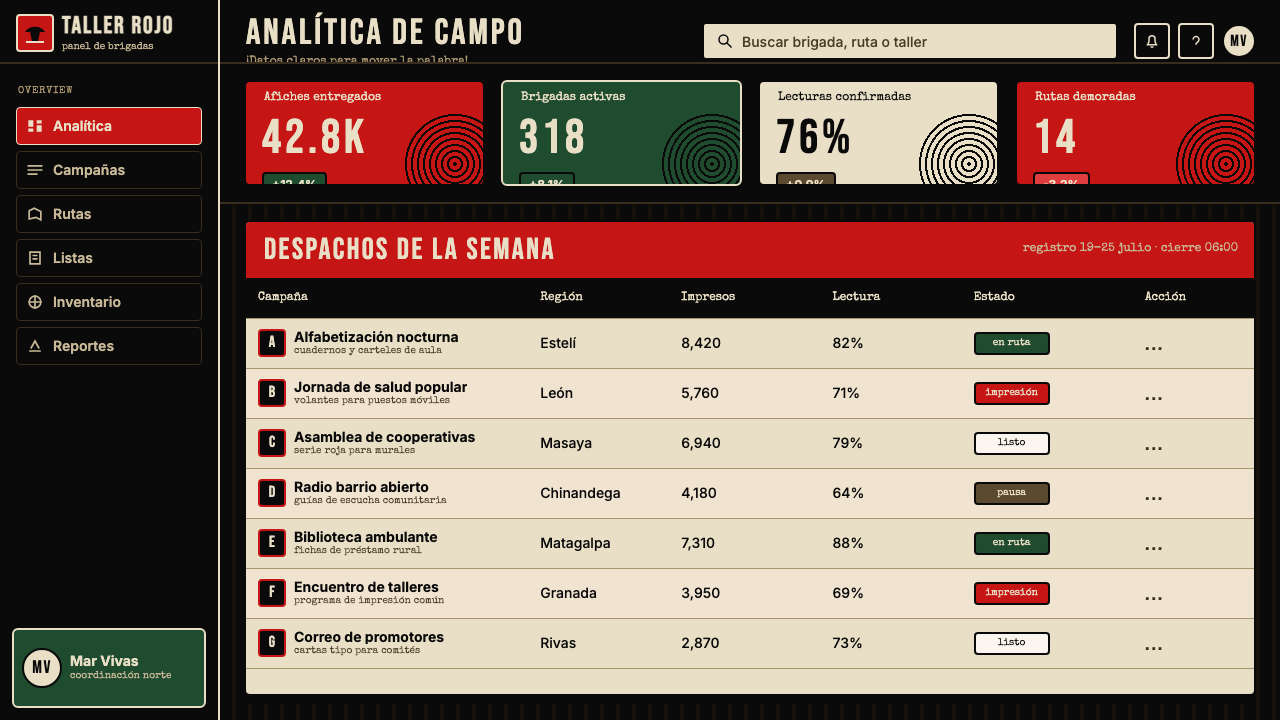
For presentation slides, the style works with particular strength in contexts that call for a manifesto register rather than a corporate one. A cover slide in this system is built around a single bold silhouette or halftone portrait, a short declarative headline in stencil-weight type, and the two-color restriction held without exception. Content slides should lean into the newsprint quality: treat white slide backgrounds as the off-white of cheap paper, use red exclusively for emphasis and calls to action, and keep body text in heavy black. Data slides in this system become proclamation graphics — bar charts with heavy red bars against black type, numbers treated as visual objects rather than data decorations.
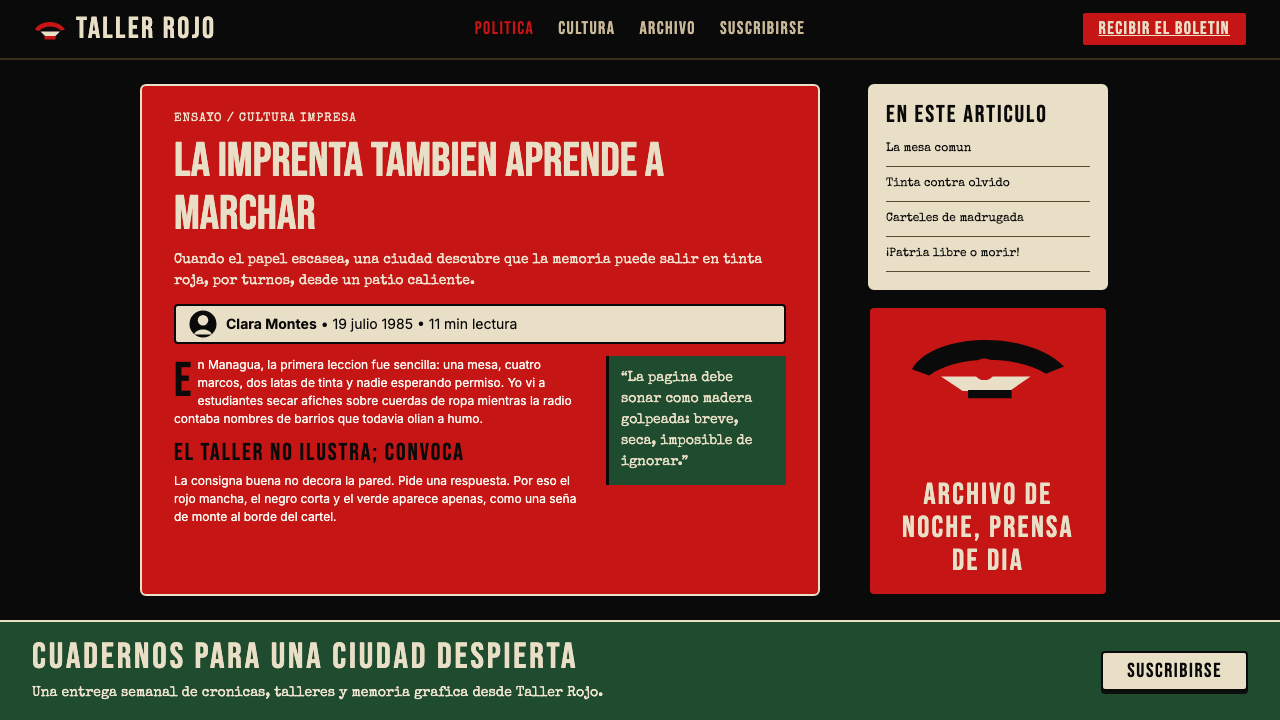
For web interfaces, the style is best suited to advocacy and campaign sites, community platforms, and culturally specific projects where the rawness is a feature rather than a bug. Navigation should be typographic, set in heavy block letterforms with no icon decoration. Hero sections work well as full-bleed halftone image fields with bold stencil-weight text overlaid in red or reversed white. Interactive states — hover, active, focus — can use registration-shift effects, simulating the slight misalignment of a second silkscreen pass. The restriction to red and black must be held: introducing a third color immediately dissolves the visual tension that gives the style its power.
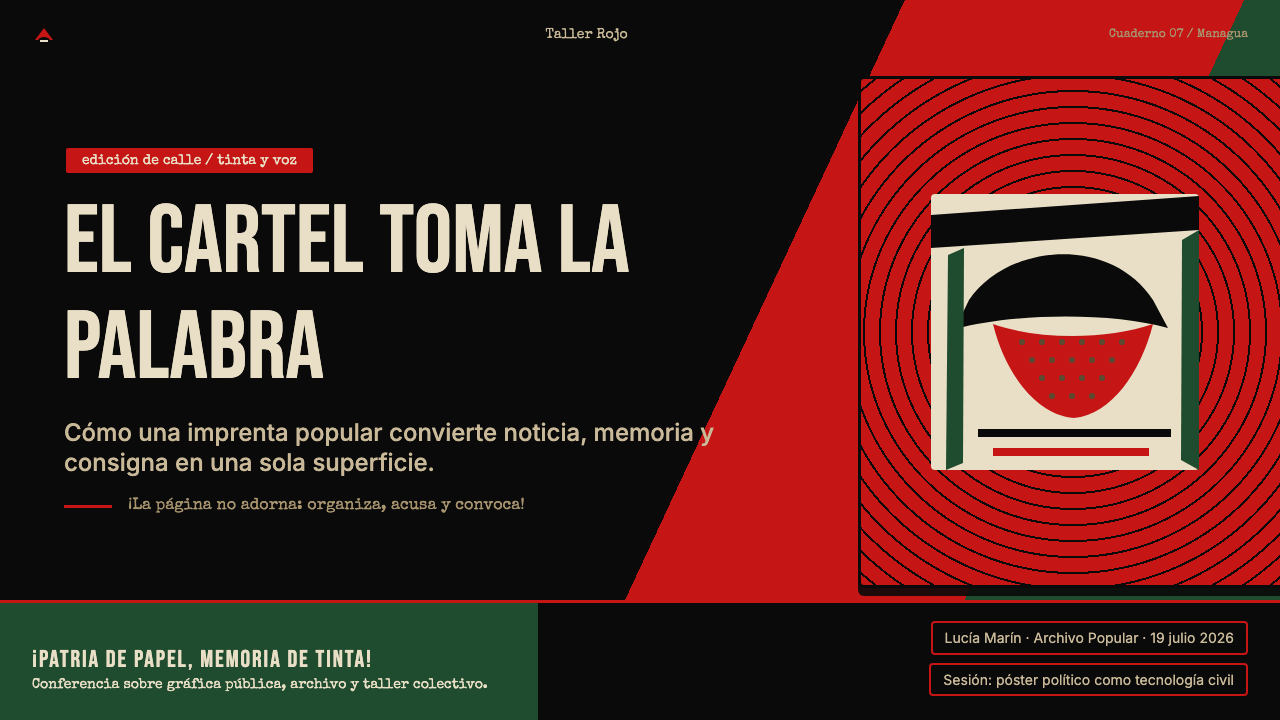
For editorial and marketing work, the style is particularly well-suited to book covers, event posters, zine spreads, and any printed piece where the physical material of production can echo the original newsprint ground. A Sandinista-derived layout uses bold, asymmetric type placement, bleeds the halftone imagery to the edge of the page, and allows generous areas of unprinted ground to read as an active compositional element. In marketing contexts, the style signals authenticity, community grounding, and political seriousness — associations that are powerful for the right organizations and potentially alienating for the wrong ones.
A common mistake when applying this style is treating the imperfections as a texture filter applied over otherwise conventional design. Ink bleed, registration shift, and rough stencil edges are not decorative overlays — they are the result of specific production logic. If those imperfections are added digitally without the underlying compositional discipline — the two-color restriction, the halftone translation of photography, the stencil simplification of type — the result is costume, not commitment. The style works only when the constraints are adopted structurally, not applied cosmetically.
Nicaraguan Sandinista FSLN 1979 — FAQ
Is this style only appropriate for explicitly political or leftist projects?
Not exclusively, but the political genealogy is close enough to the surface that it will always inflect the message. The style has been adopted by cultural institutions, music venues, independent bookshops, food cooperatives, and street art projects that share its aesthetic values — rawness, handmade quality, collective production, urgency — without necessarily endorsing any specific political platform. What matters is that the organization or project can honestly claim a relationship to those values. Using the style purely for aesthetic novelty, without any substantive connection to grassroots or community-facing work, tends to produce results that read as hollow or ironic rather than powerful.
How do I introduce visual hierarchy without adding more colors?
The Sandinista visual tradition manages hierarchy through four levers, none of which require additional color. Scale is the most powerful: a headline rendered at many times the size of body text dominates without any color shift. Density is the second: areas of heavy ink coverage — large filled shapes, bold text blocks — read as heavier and more urgent than areas of fine detail or bare ground. Reversal is the third: text in white reversed out of a black or red field sits at a different visual tier than text printed directly in black on the cream ground. And silhouette quality is the fourth: a clean, simple shape with no internal detail reads at a hierarchy above a complex or detailed element, because the eye resolves it first.
Can this style work in digital interfaces, or is it inherently print-based?
The style translates to digital interfaces, but it requires deliberate translation rather than direct copy. On screens, ink bleed and registration shift must be simulated — and they should be used sparingly, as accent elements rather than global textures. The two-color discipline, the halftone treatment of imagery, the stencil weight of type, and the use of the light ground as an active compositional element all carry across to digital without loss. The chief adjustment is that screens offer true black and saturated red at no additional production cost — which the workshop printers did not have — and this abundance can tempt overuse. Holding the same restraint that economic necessity imposed on the original workshops is the key discipline for digital translation.
What distinguishes authentic Sandinista-derived work from generic revolutionary pastiche?
The distinction lies in structural commitment versus surface decoration. A pastiche borrows the red-and-black palette, adds some distressed texture, and places a raised-fist icon somewhere on the composition. Authentic derivation begins with the two-color discipline as a structural constraint — not a visual flavor — and then works through every design decision in light of that constraint. Type is simplified to stencil weight because additional typographic complexity would require phototypesetting or digital tools the workshops did not have. Photography becomes halftone because full photographic reproduction is a four-color process. The imperfections exist because they are inevitable products of the medium. When the constraints drive the decisions rather than the aesthetic imitating the outcomes, the result has the integrity of the original.
How should the Sandino silhouette be used, given its specific historical meaning?
The Sandino silhouette — wide sombrero, upright figure — is one of the most politically loaded icons in Latin American visual culture, and its use outside of explicitly Nicaraguan or FSLN contexts requires care. In design work that draws on this style without claiming to represent the Sandinista movement, the silhouette is best treated as a compositional archetype rather than appropriated directly: a bold human silhouette in a wide-brimmed hat, set against a horizon, communicates the compositional values of the style without deploying the specific historical symbol. For work that is explicitly in dialogue with Nicaraguan history or Latin American revolutionary culture, the direct use of the icon can be entirely appropriate — but that dialogue should be substantive, not decorative.
Related design styles
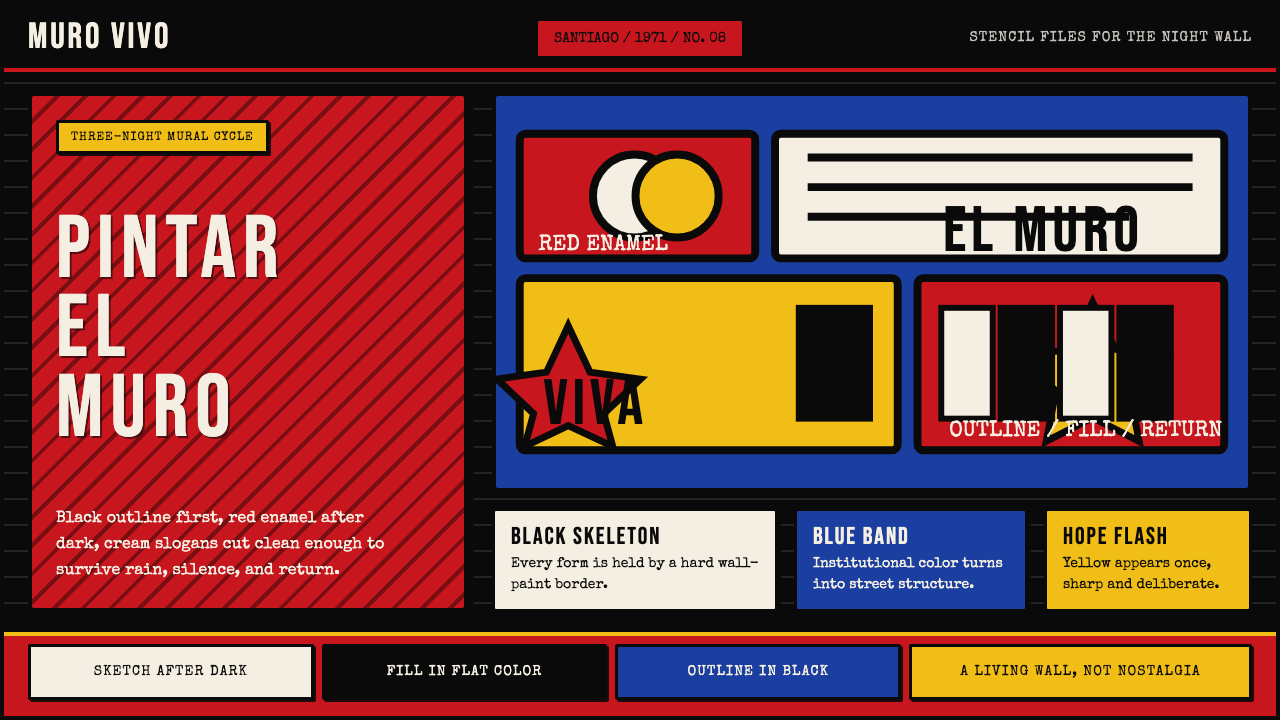 Chilean BRP Ramona Parra 1971Resistance stays alive. Blood red panels, black outlines, and stencil type re…
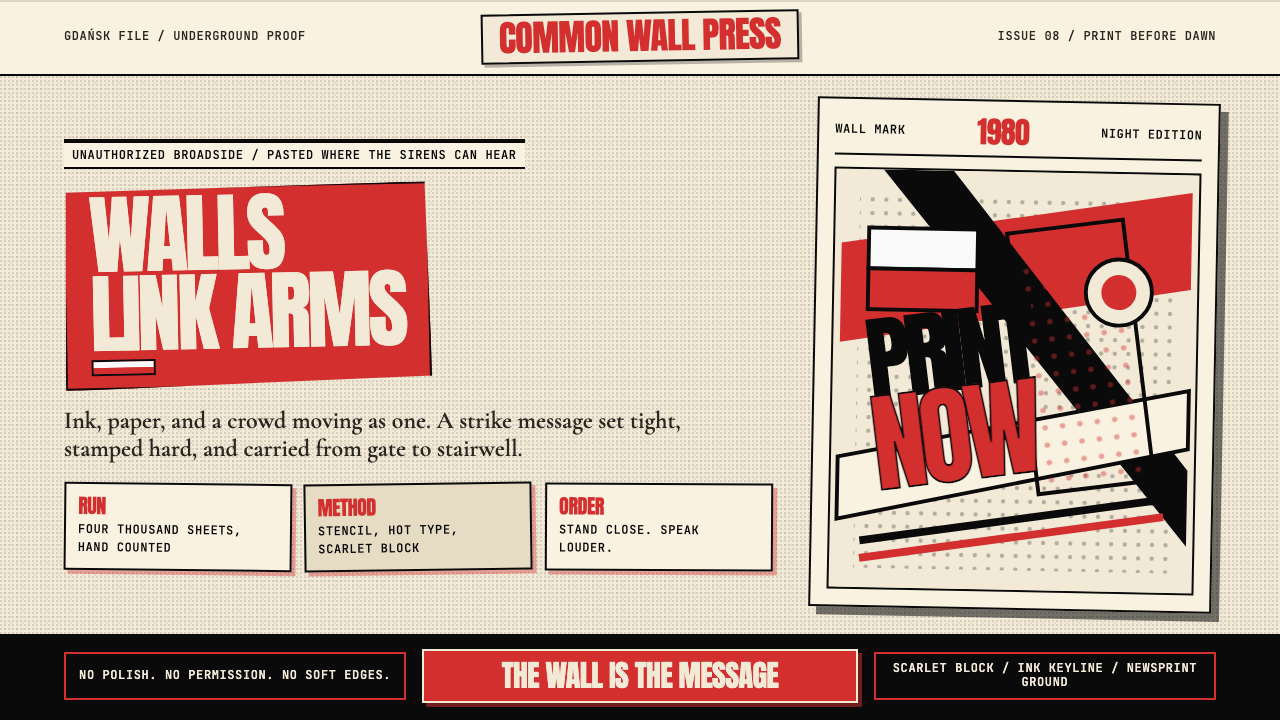 Solidarność Poland 1980Urgency becomes type. Scarlet blocks, ink keylines, and halftone cream hit li…
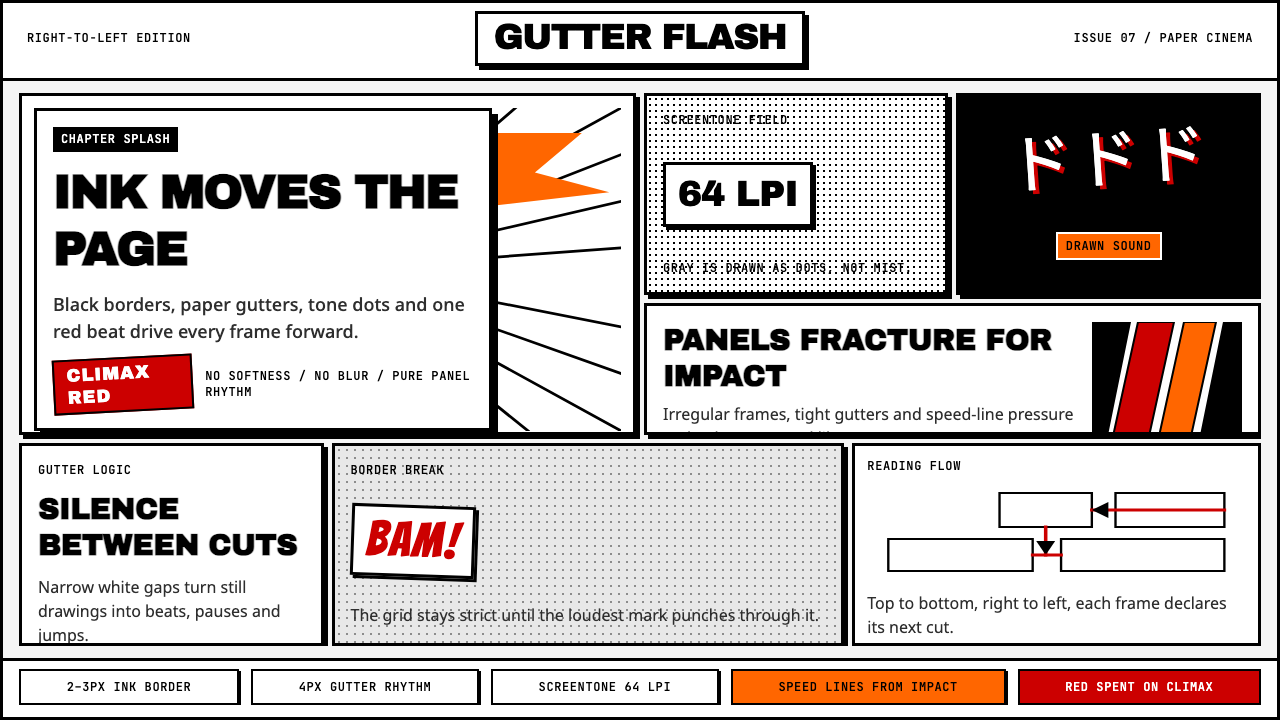 Manga Panel LayoutCinema in ink. Black panels, screentone dots, speed lines, and one red strike.
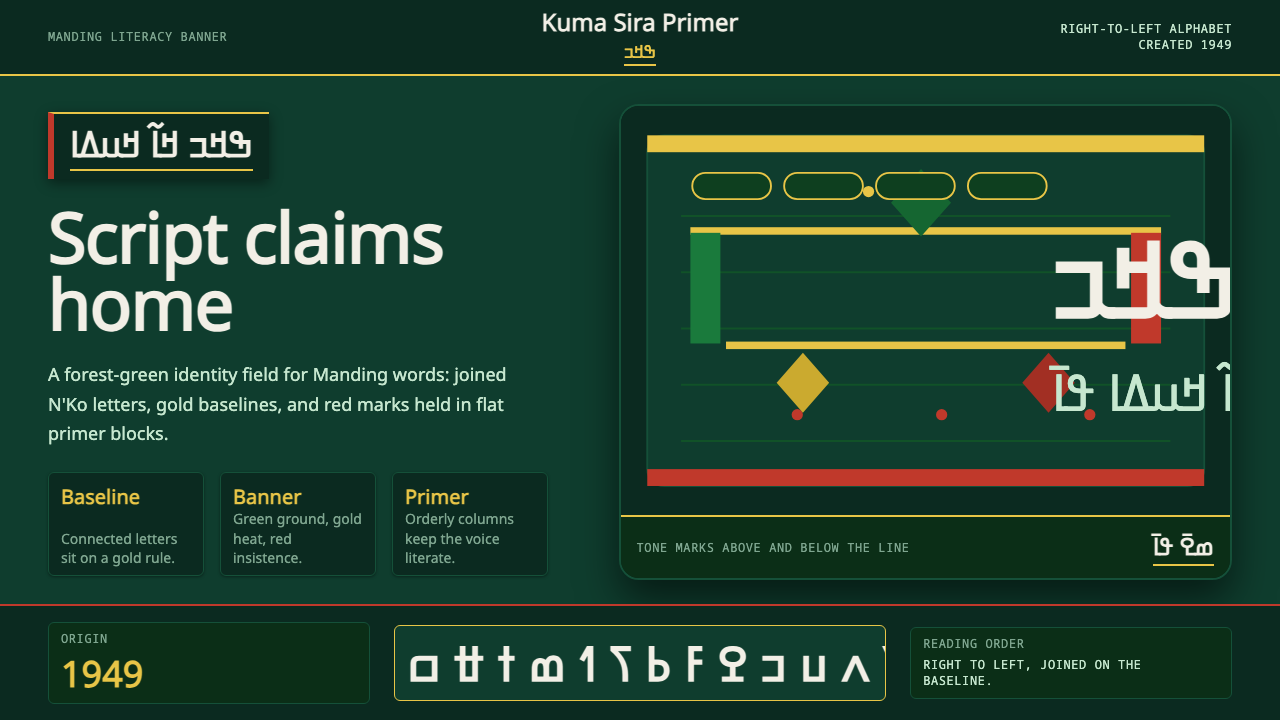 N'Ko ScriptIdentity writes itself. Forest green and gold baselines anchor joined N'Ko le…
 Thrasher Skate Zine (1981)Loud without polish. Flame red type, black ink blocks, and cream zine grids h…
 Tunisian Jasmine Revolution (2010)Raw urgency wins. Red browser grids and mono hashtags compress 3am protest in…