What is Grunge (Carson 1993)?
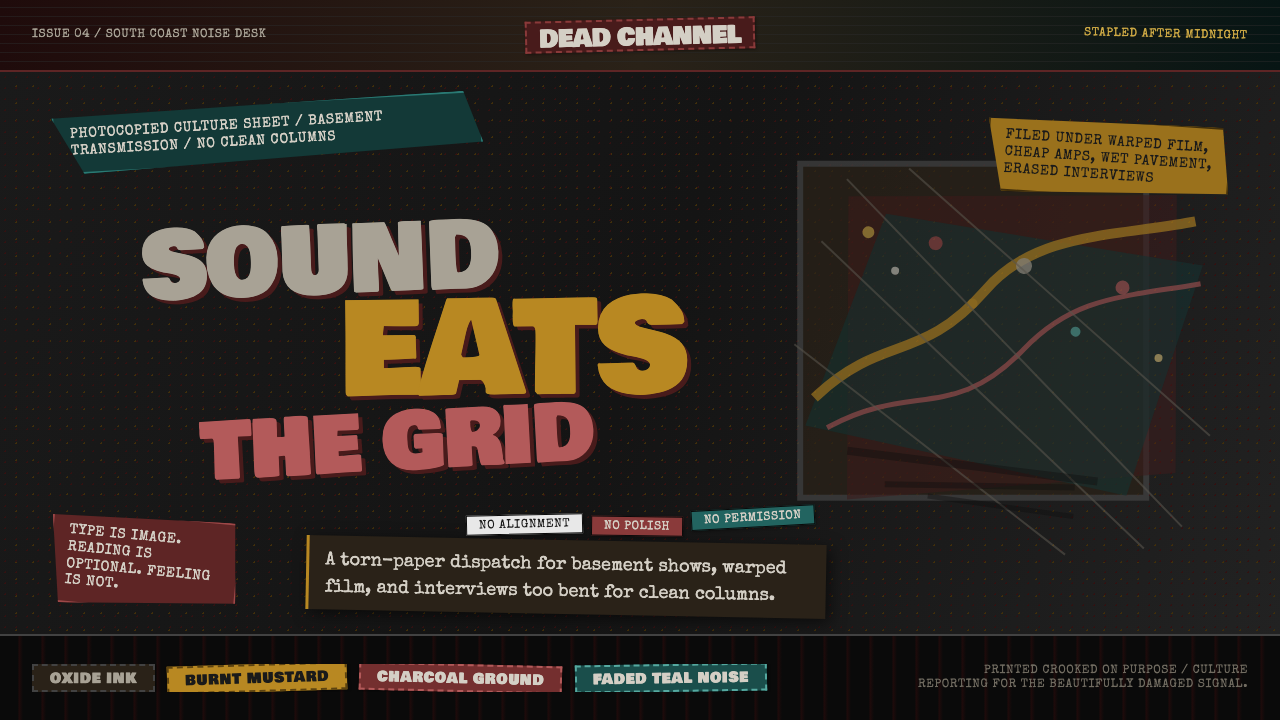
David Carson blew up the rulebook at Ray Gun magazine, proving that deliberate illegibility, shredded grids, and photocopy grain could carry more emotional truth than any clean modernist layout.
Grunge (Carson 1993) in brief
Grunge typography — as crystallized in David Carson's work at Ray Gun magazine between 1992 and 1995 — is a postmodern design language built on the deliberate destruction of the conventions that Swiss International Style and American corporate modernism had spent forty years perfecting. Where modernist typography sought neutrality, clarity, and the invisible hand of the designer, Carson's approach made the designer's hand grotesquely visible: type stacked at odd angles, layered over itself, set in multiple conflicting weights within a single sentence, or replaced entirely by symbol fonts chosen for their opacity rather than their meaning.
The visual palette of this style is drawn from the material conditions of its production: the muddy, warm darks of photocopied pages, the halftone grain of magazine printing pushed past its comfortable resolution, ink that bleeds and spreads at the edges of letterforms. Color is used expressively rather than symbolically — deep oxbloods and rusted ochres sit against charcoal and near-black grounds, with occasional bursts of acid color that feel less like design decisions and more like accidents of the darkroom. Nothing is refined; refinement is the enemy.
Critically, this style is not chaos for its own sake. Carson and his contemporaries — Neville Brody in London, Vaughan Oliver at 4AD Records, Rudy VanderLans at Emigre magazine — were each making an argument: that the conventions of readability and visual order were cultural impositions, not natural laws, and that breaking them could produce a different kind of communication, one that spoke to the body and the gut before it reached the rational mind. The grunge aesthetic is, at its core, a graphic philosophy of emotional priority.

Where does Grunge (Carson 1993) come from?
The context for Carson's work at Ray Gun is inseparable from the American alternative music and skateboarding cultures of the late 1980s and early 1990s. Carson had come to graphic design through surfing journalism — he studied sociology, worked as a professional surfer, and came to typography sideways, without the formal Swiss-influenced training that dominated American design schools at the time. This outsider formation was decisive. He had no deep investment in the rules he was breaking, and the audiences he was designing for — readers of Surfer magazine, then Beach Culture, then Ray Gun — were young, subcultural, and deeply suspicious of anything that looked polished or corporate.
Ray Gun, founded in 1992 by Marvin Scott Jarrett as a music magazine covering alternative and indie acts, gave Carson an extraordinary degree of creative autonomy. The magazine's subject matter — Sonic Youth, PJ Harvey, Beck, Nirvana, Kurt Cobain — was itself invested in noise, rawness, and the rejection of mainstream production values. Carson designed the magazine to look like it felt: unstable, loud, densely layered, occasionally unreadable. His most notorious act was setting an entire Bryan Ferry interview in Zapf Dingbats — a symbol font — because he found the interview too boring to deserve legible type. The gesture, which appalled many designers and delighted many readers, crystallized what the style was doing.
The technological conditions of the early 1990s were equally formative. The desktop publishing revolution — driven by the Macintosh, Adobe PostScript, and applications like PageMaker and QuarkXPress — had placed professional typographic tools in the hands of designers for the first time, and those tools arrived with none of the craft constraints that had governed hot-metal or phototypesetting. You could now scale a typeface to three hundred percent, overlap two text blocks, set type on a curve, and print it on a photocopier, all in an afternoon. Carson and the broader grunge typographic movement were, in part, an expression of this new freedom — an answer to the question of what happens when you give someone all the rules and all the tools to break them simultaneously.
Beyond Carson, the movement had a broader geography. In London, Neville Brody had been systematically deconstructing the conventions of magazine typography at The Face and Arena throughout the 1980s, developing custom typefaces that interrogated the structural logic of letterforms. At 4AD Records in London, Vaughan Oliver was creating sleeve artwork of hallucinatory complexity, layering photographic textures, handwritten elements, and abstracted imagery into dense, darkly beautiful objects. In the Bay Area, Rudy VanderLans and Zuzana Licko's Emigre magazine served as both a critical journal and a showcase for experimental type design, publishing the typefaces — blurred bitmaps, hand-distressed forms, geometric hybrids — that the grunge typographic movement drew on. These figures were not a school or a movement in any organized sense; they were parallel responses to the same cultural pressure: the exhaustion of high modernism and the new possibilities of digital production.
What defines the Grunge (Carson 1993) look?
Color
The palette is built on deep, impure darks — charcoal and near-black grounds that read warmer than true black — layered with oxblood reds, burnt mustard yellows, and occasionally a rusted, aged orange. These colors are not clean: they carry a sense of having been photocopied, bleached, or left in the sun. Acid greens or electric blues appear rarely and always feel like intrusions, as if a marker has bled through from the page behind. Contrast is high but not crisp — the relationship between figure and ground has the soft, slightly uncertain edge of ink on newsprint.
Typography
Type in this style is treated as raw material rather than a communication vehicle. A headline might be set in a degraded serif that appears to have been photocopied several generations past legibility; body text may shift typeface mid-paragraph without explanation. Letterforms are scaled to extremes — a single character might occupy a third of the page while a block of text is rendered nearly too small to read. Type runs at diagonals, overlaps other type, bleeds off the edge of the frame, or sits in a dense, textured mass that functions more as visual field than readable prose. The key principle is that type carries emotional and visual weight independent of its linguistic content.
Grid (or its absence)
Where modernist design uses the grid as an invisible organizing structure, grunge typography makes the grid's destruction legible. Elements are placed with apparent disregard for alignment; columns are broken by images or text blocks that refuse to respect their boundaries. Yet there is a compositional logic underneath the chaos — Carson and his peers had absorbed enough formal training to understand balance and tension, and their apparently random layouts are in fact carefully tuned to feel unstable without becoming visually incoherent. The sensation is of a grid that existed and has been deliberately torn.
Texture and Grain
Surface texture is a defining characteristic rather than an incidental quality. Halftone grain — the dot pattern visible when print reproduction is pushed to its limits — appears as a deliberate formal element, not a production defect. Ink bleed softens and thickens letterforms at their edges. Paper texture reads through backgrounds, suggesting the physicality of offset or screen printing. Photocopier artifacts — streaks, fade gradients, the blurred edge where toner didn't quite adhere — are embraced and sometimes amplified. The effect situates the design unmistakably in the world of physical production rather than the clean unreality of the digital screen.
Image Treatment
Photography in this style is treated with the same freedom as type — cropped aggressively, layered with type or other images, reproduced in high-contrast black and white or pushed to extreme color saturation. Photographic subjects bleed into each other, boundaries dissolve, and the overall effect is more collage than composition. Found imagery — photocopied textures, fragments of earlier printed materials, distressed photographic surfaces — is used alongside original photography without distinction. The image is not a window into reality but a raw material to be worked.
Emotional Register
The emotional register of grunge typography is deliberately unsettled. It does not want to comfort or orient the reader; it wants to disturb, energize, or create a specific kind of unease that corresponds to the music and subcultures it was born alongside. Tension is built through visual instability — elements that seem about to fall off the page, type that threatens to become unreadable, compositions that refuse the eye a clear resting point. This emotional priority — feeling over legibility, energy over clarity — is the deepest structural principle of the style.
Anti-Refinement
Refinement — the careful polishing of details, the obsessive adjustment of kerning, the smooth edge and the perfect color match — is not merely absent from this style but actively opposed. The rough edge is preferred to the clean edge, the approximate to the precise, the first draft energy to the finished surface. This is a formal position, not laziness: the argument is that excessive refinement produces work that is aesthetically pleasing but emotionally inert, and that the rawness of the unfinished carries an authenticity that polish destroys.

Who shaped Grunge (Carson 1993)?
Carson served as art director of Ray Gun magazine from its founding in 1992 until 1995, producing one of the most influential bodies of editorial design work in the history of American print media. His approach — layered, distressed, frequently illegible, always emotionally charged — was informed by his background outside design schools and by the music he was covering. After Ray Gun, Carson's influence spread into advertising, motion graphics, and international brand work; his 1995 monograph The End of Print became one of the best-selling graphic design books ever published. He remains the most recognizable name associated with postmodern typography.
Brody was art director of The Face magazine in London throughout the 1980s and subsequently Arena, developing a personal visual language that deconstructed typographic conventions through custom letterforms, industrial imagery, and layouts that challenged the reader's orientation. His 1988 monograph The Graphic Language of Neville Brody was a commercial sensation that brought postmodern typography to a wide international audience. Brody founded the FontShop type foundry and later co-founded Fuse, an experimental type publication, which distributed new typefaces alongside critical essays questioning the nature and purpose of letterforms. His influence on the generation that included Carson was substantial and direct.
Oliver was the in-house designer and creative director at 4AD Records in London from the early 1980s, creating sleeve artwork for bands including the Pixies, Cocteau Twins, Dead Can Dance, and Throwing Muses. His work is the parallel development in album design of what Carson was doing in magazine publishing: densely layered photographic and typographic material, a palette of muted and degraded color, handwritten and distressed elements, and a wilful refusal to separate decoration from structure. Oliver's sleeves were objects in their own right — works that rewarded extended looking and resisted easy interpretation. His influence on the visual culture of alternative music was incalculable.
VanderLans co-founded Emigre magazine in 1984 with Zuzana Licko, and together they turned it into the central critical and typographic forum for experimental digital design throughout the late 1980s and 1990s. Emigre published the typefaces — distressed bitmap faces, deconstructed serifs, hybrid geometric forms — that the grunge typographic generation drew on as raw material, and its critical writing provided an intellectual framework for practices that might otherwise have seemed merely rebellious. Emigre Fonts, the type foundry they operated alongside the magazine, made experimental typefaces commercially available for the first time to a broad audience of designers.
Licko co-founded Emigre and designed many of the typefaces that defined the visual vocabulary of experimental digital typography in the 1990s. Her early bitmap faces — designed for the low-resolution screens and printers of the mid-1980s — treated the pixel as a unit of construction rather than a limitation, producing letterforms that were deliberately coarse and machine-like. Later typefaces, including Matriz and Mrs Eaves, explored the opposite territory: the reworking of historical forms through a digital sensibility. Licko demonstrated that the conditions of digital production could generate a genuinely new typographic aesthetic rather than merely approximating print conventions.
How do you use Grunge (Carson 1993) today?
Applying Grunge (Carson 1993) in contemporary design requires understanding what the style actually does — it uses visual instability, texture, and emotional charge to create impact in contexts where a conventionally refined layout would feel dishonest or inadequate. The style is most effective when the content itself has edge: music and entertainment brands, fashion editorial, cultural institutions that position themselves as anti-mainstream, or any product aimed at audiences that are skeptical of corporate polish. Applied to the wrong content — a fintech dashboard, a healthcare onboarding flow — it will read as affectation rather than authenticity.
For presentation slides, the style is best suited to cover pages and section breaks rather than dense content slides. A cover built in this manner typically places a large, textured or degraded type element as the visual anchor, with a secondary layer of smaller text running at an angle or offset from the grid baseline. Section breaks can carry a full-bleed texture or halftone grain treatment behind minimal text. Content slides, where legibility matters most, should pull back significantly from the full grunge vocabulary — maintaining the dark ground and warm color palette while ensuring that body text and data remain readable. Data slides can use the color palette and rough compositional energy while preserving clarity in the actual numbers and labels.
For web interfaces, this style translates most naturally to editorial and cultural contexts: music streaming platforms, arts organization websites, magazine-style layouts, portfolio sites for creative practitioners. Dashboard and pricing page applications are possible but require careful calibration — the texture and instability that define the style must be applied at the decorative layer (backgrounds, illustration zones, hero areas) rather than at the functional layer (navigation, form inputs, data tables). A grunge-inspired web UI might carry a dark, textured background with rough typographic heading treatments while maintaining high legibility in its interactive and informational elements.
For editorial and marketing work, the style's native territory, the approach is most effective when it serves as the primary visual language rather than an accent layer. A poster or campaign built entirely in this mode — degraded type, layered imagery, high-contrast dark palette with oxblood and ochre — reads as committed and coherent. Where it fails is when mixed with cleaner, more refined visual elements: a grunge-treated headline over a clean sans-serif body text on a white ground creates a stylistic conflict rather than a productive tension. Marketing applications work best when the entire surface — not just the headline treatment — participates in the aesthetic.
The most common mistake when working with this style is confusing messiness with intention. Carson's layouts are not random — they are the product of a designer who understood composition, hierarchy, and tension before he chose to distort them. Applying distressed type, dark grounds, and textural overlays without a clear compositional logic produces work that reads as incompetent rather than experimental. A second common mistake is treating the style as primarily about typography while ignoring its other registers: the specific warm darkness of the color palette, the material quality of the grain and texture, and the emotional temperature of unease and energy. Authentic work in this style integrates all of these simultaneously rather than picking one element as a shortcut.

Grunge (Carson 1993) — FAQ
Is grunge typography the same as deconstruction?
They overlap significantly but are not identical. Deconstruction in typography — influenced by Jacques Derrida's philosophical method and associated with designers like Jeffery Keedy, Ed Fella, and the Cranbrook Academy of Art — is primarily a critical and theoretical practice: it interrogates how typography constructs meaning and attempts to expose the conventions that naturalize hierarchy and authority in text. Grunge typography, while it shares the deconstruction of conventional grid and hierarchy, is more emotionally and subcultural in its orientation — it comes from music and youth culture rather than philosophy, and its primary goal is emotional impact rather than critical exposure. Carson himself has consistently resisted theoretical framing of his work, saying it comes from feeling rather than idea.
Can this style work in a digital-first context, or is it inherently tied to print?
The style translates to digital contexts, but the translation requires active effort. The physical print qualities that define the aesthetic — halftone grain, ink bleed, the warmth of paper — must be simulated as texture layers and visual treatments in digital production. Done well, this simulation can be convincing and powerful, particularly in contexts where the digital surface is itself meant to evoke physicality, tactility, or a connection to material culture. The risk is that digital implementations often overcorrect: they add so much texture and distress that the result reads as costume rather than conviction. The most successful digital applications of this style tend to be restrained in their use of texture while committing fully to the compositional and color principles.
How do you balance legibility with the style's deliberate illegibility?
The answer lies in distinguishing between decorative and functional type. In Carson's best Ray Gun work, the layouts that push type to the edge of illegibility are almost always display contexts — headlines, section markers, image captions used as visual punctuation — while the actual body text, though set unusually, remains readable. The illegibility is strategic: it applies to the elements that are meant to be felt before they are read, not to the elements that carry the essential information. In contemporary applications, maintaining this distinction is critical. Headlines, hero text, and graphic type can participate fully in the aesthetic; navigation labels, body copy, and interface labels must remain legible. The skill is in creating enough compositional tension between these two registers that the overall effect still reads as coherent.
Why does this style feel so connected to the 1990s — can it avoid nostalgia?
The 1990s associations are real and difficult to escape entirely, because the style is so closely linked to specific cultural artifacts — Ray Gun magazine, early alternative music video aesthetics, the visual language of zines and skate culture — that are themselves now historical objects. The cleaner path to avoiding pure nostalgia is to apply the style's structural principles — its emotional priority, its embrace of visual tension, its color relationships — in contexts and to subjects that are genuinely contemporary, rather than mimicking the specific formal signatures (the particular typefaces, the particular color combinations) most associated with the period. A grunge-inflected design that uses the underlying philosophy without the period-specific details will read as contemporary attitude rather than retro reference.
Is this style appropriate for brand identity work, or is it too tied to editorial?
The style can support brand identity work, but the fit is specific. It is well-suited to brands in music, independent fashion, skateboarding, tattoo culture, independent publishing, and arts institutions — contexts where the brand's core proposition includes an element of anti-establishment positioning or subcultural authenticity. For these brands, a grunge-inflected identity can signal genuine alignment with their audience's values rather than a borrowed aesthetic. It is poorly suited to brands where trust, clarity, and broad accessibility are primary values: financial services, healthcare, major consumer packaged goods, or enterprise software. The worst outcome is a brand that uses grunge visual language as a superficial marker of coolness without the cultural legitimacy to back it up — audiences who know the style's origins can read this as appropriation, and it tends to undermine rather than build credibility.
Related design styles
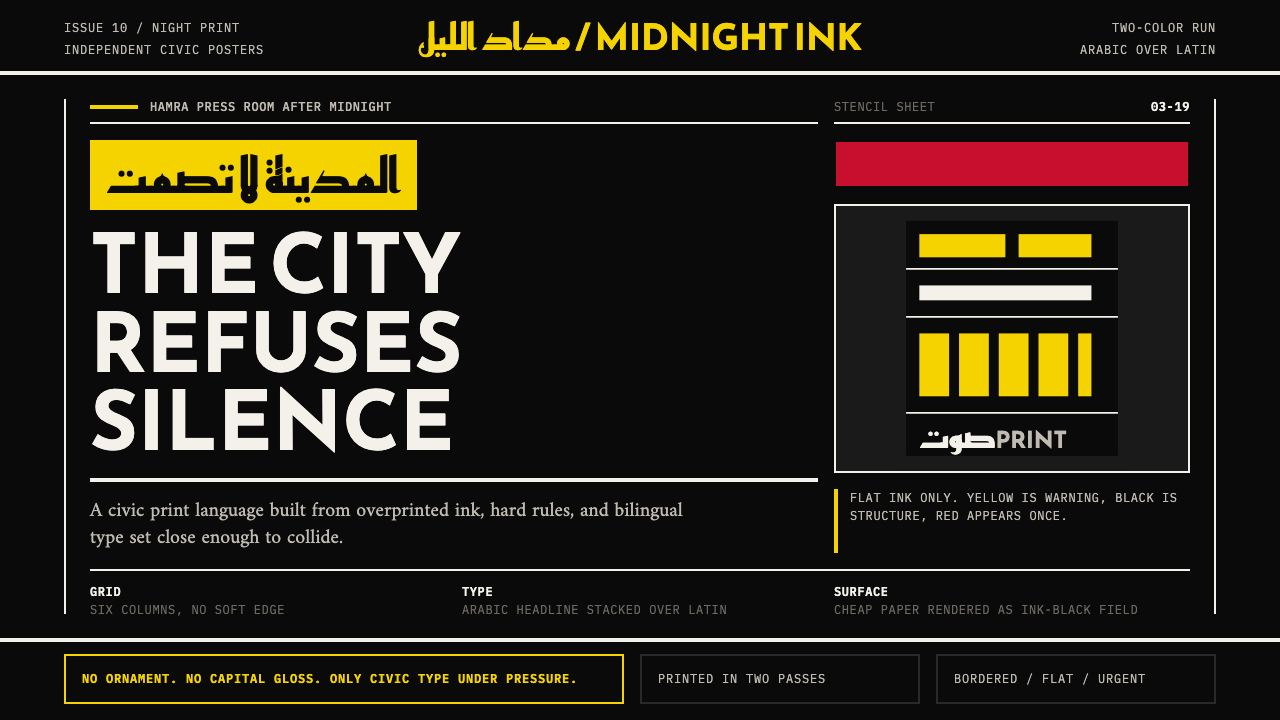 Beirut Indie Graphic DesignCivic type as protest. Sulfur yellow Arabic blocks collide with ink-black pos…
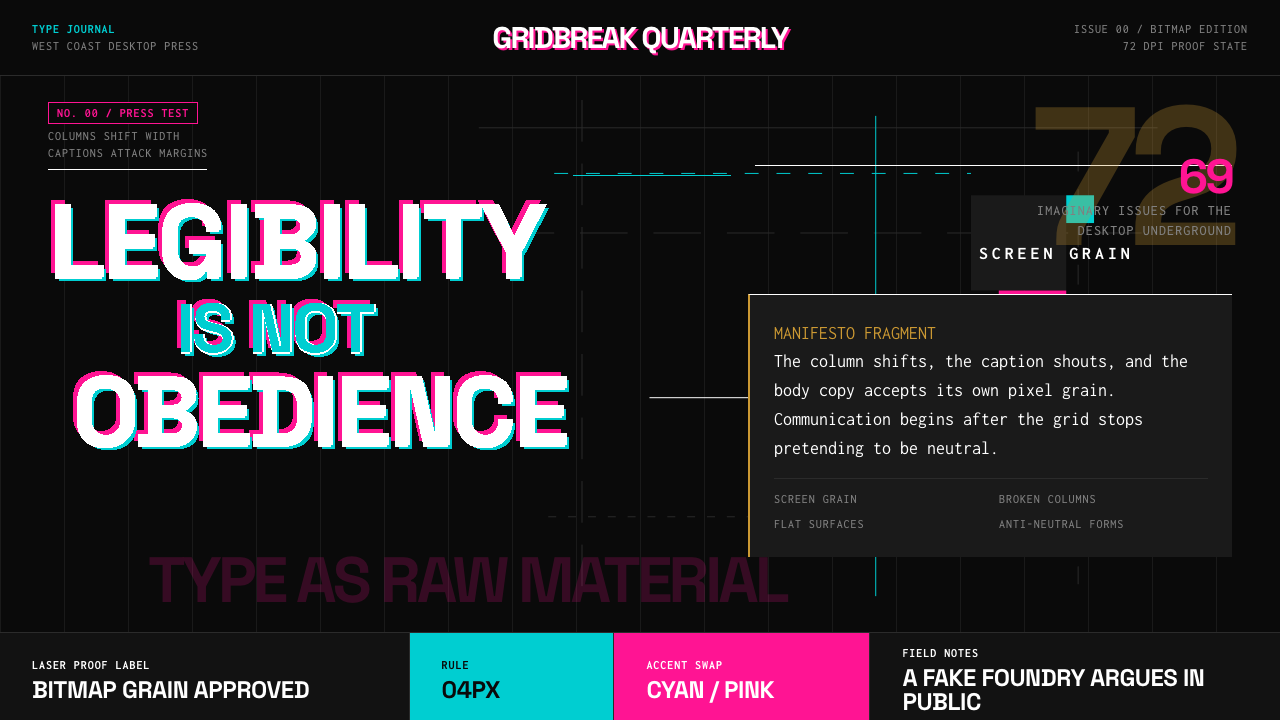 Emigre Magazine (1984–2005)Defies the tidy grid. Cyan, ochre, and hot-pink bitmap type collides on black.
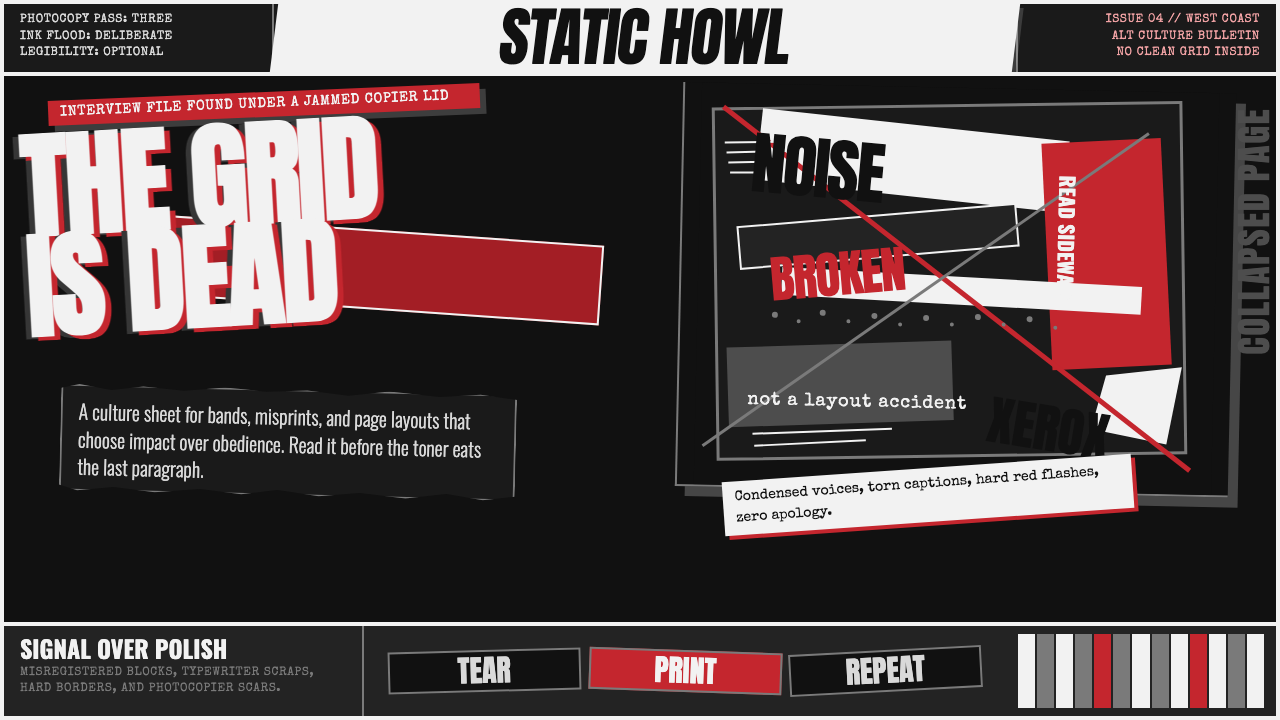 Ray Gun / David CarsonChaos becomes voice. Ink-black pages, Anton collisions, Xerox grain, and one…
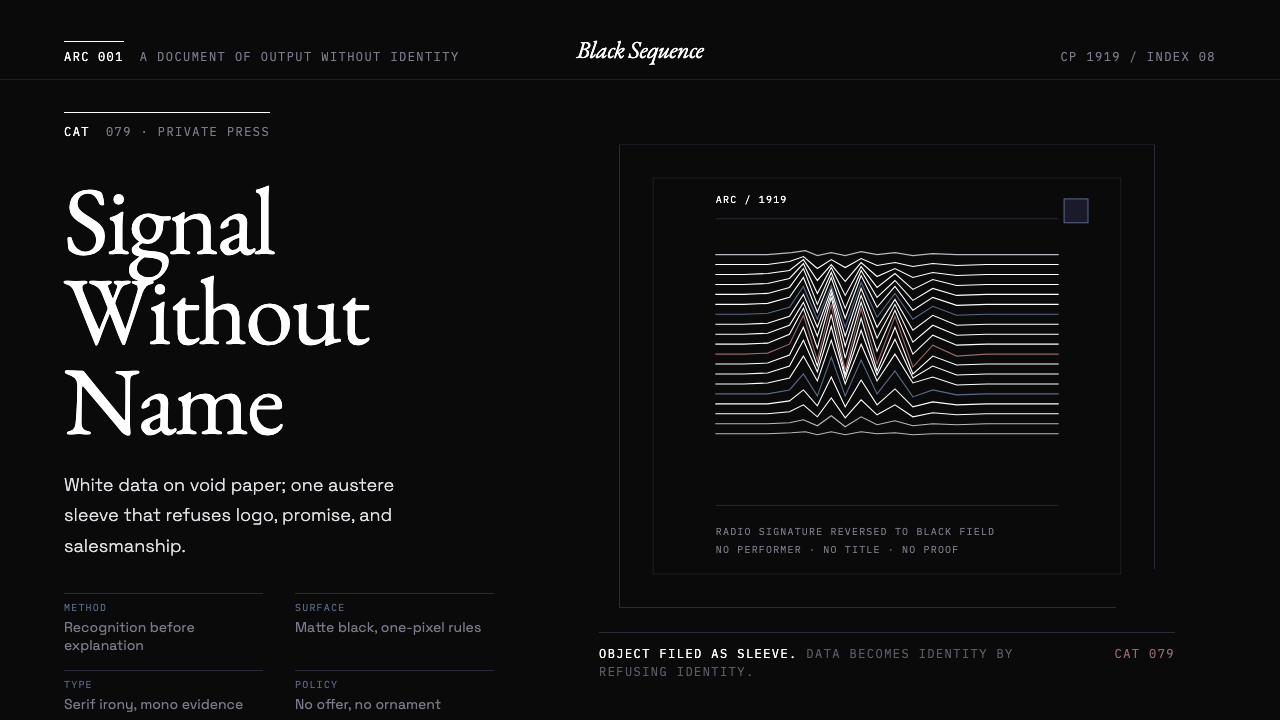 Peter Saville / Factory RecordsAnti-design becomes high art. Void black, white pulsar lines, and FAC mono la…
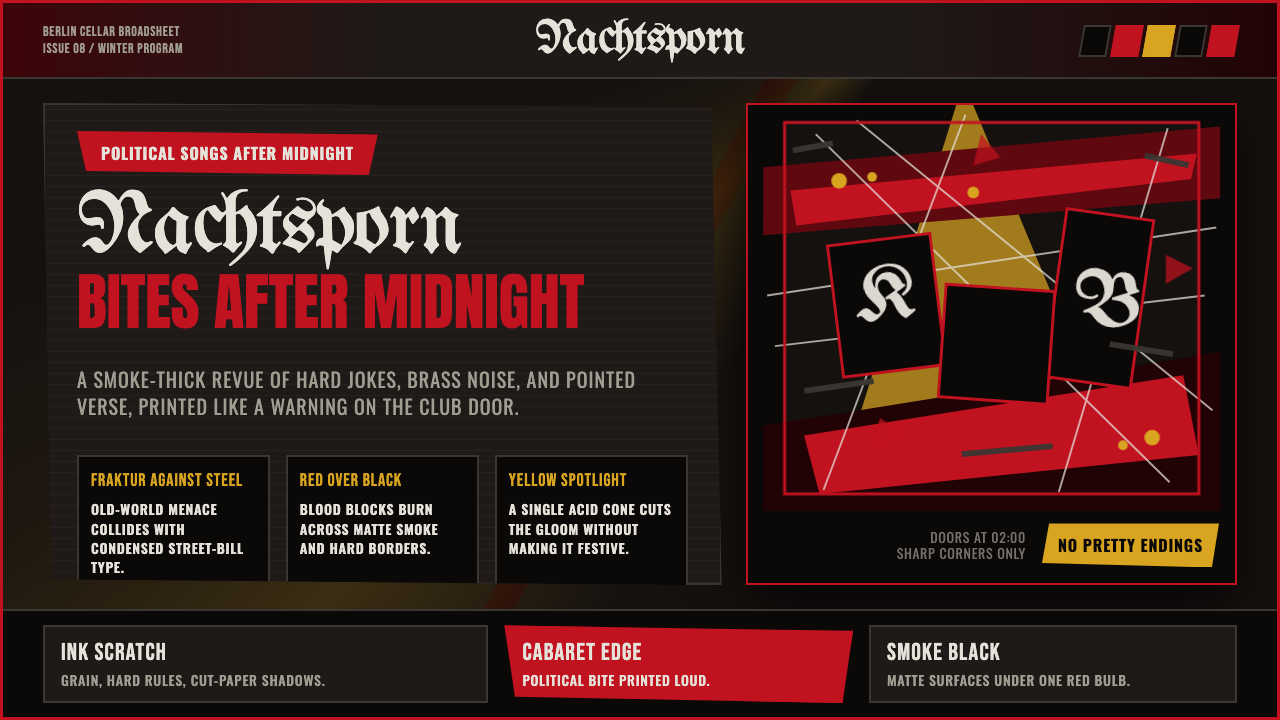 Weimar CabaretMenace at 2 a.m. Blood-red Fraktur, smoke-black grid, acid-yellow spotlight c…
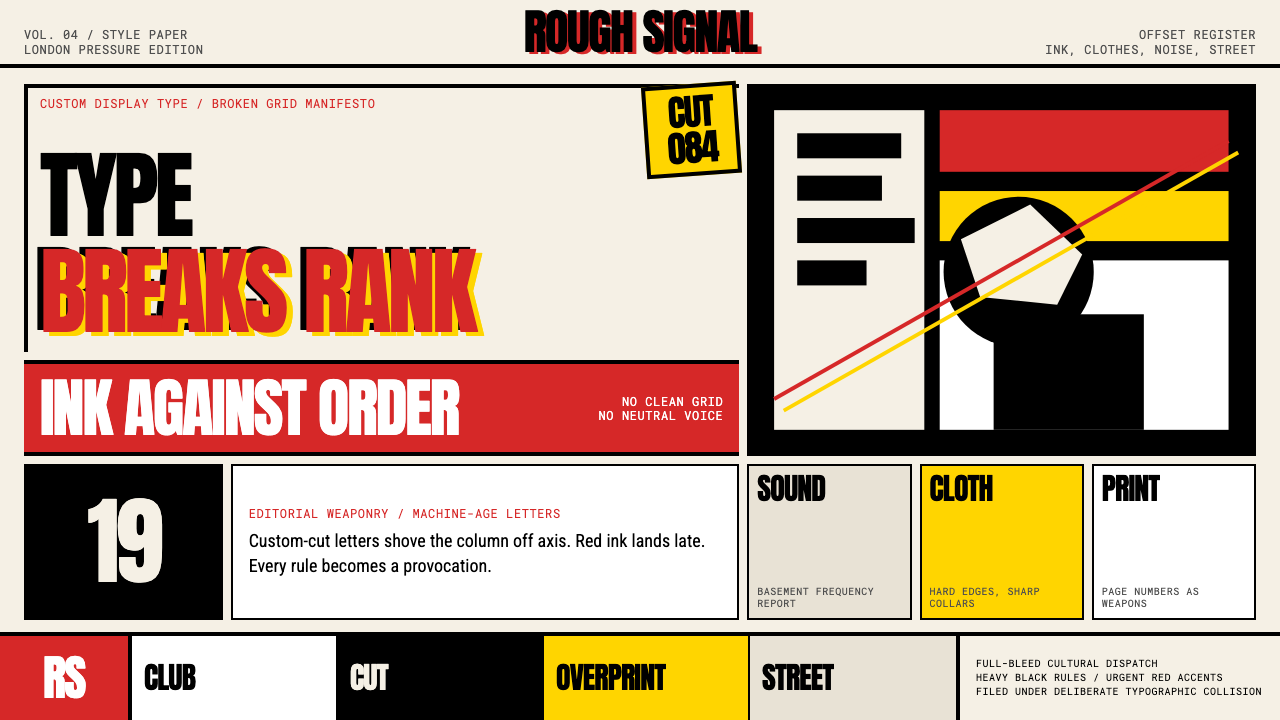 Neville Brody The FaceType mutinies on paper. Cream stock, black rules, urgent red overprint, broke…