What is Beirut Indie Graphic Design?
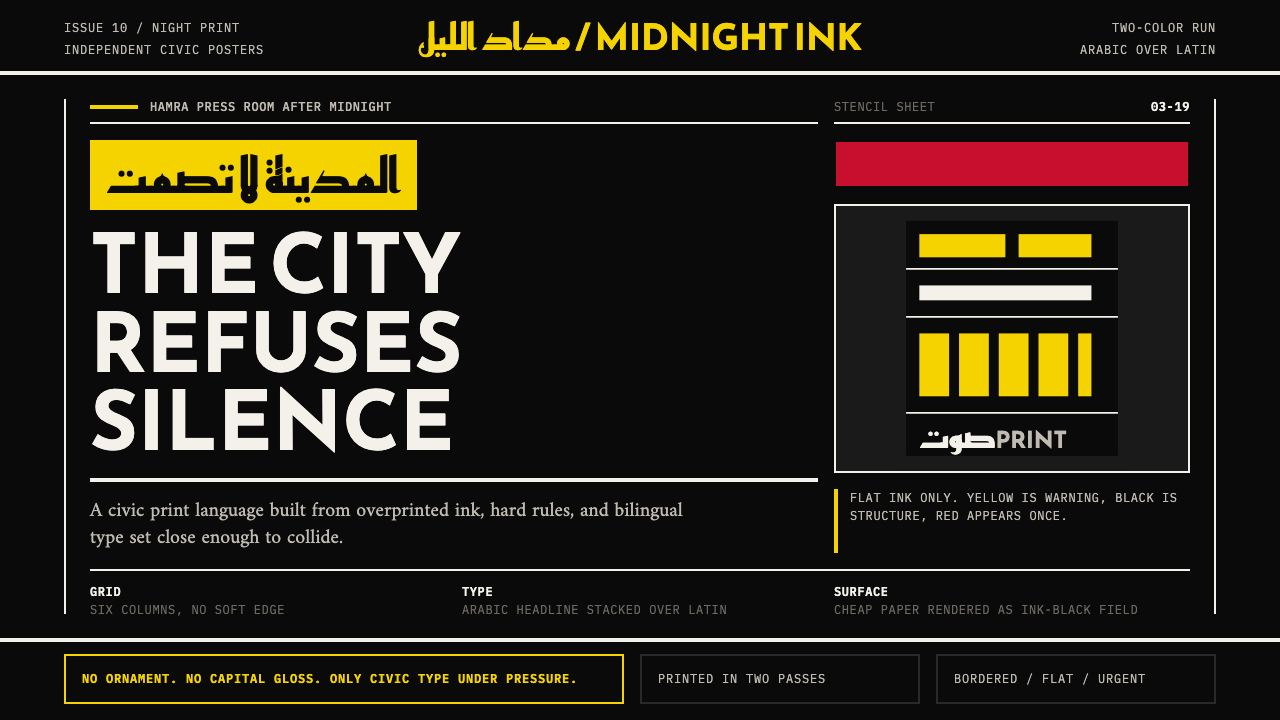
Beirut's indie graphic designers turned Arabic letterforms into acts of civic defiance — stacking script and Roman type so tight they fuse into a single bilingual shout.
Beirut Indie Graphic Design in brief
Beirut Indie Graphic Design is the visual language forged in Lebanon's independent print workshops and art schools from the mid-2000s onward. It combines Arabic calligraphic tradition with the blunt geometry of European protest graphics, producing work that is simultaneously legible in two scripts and charged with political urgency. The palette is deliberately harsh: ink-black grounds, sulfur-yellow Arabic type blocks, and flashes of deep crimson — colors borrowed less from branding manuals than from newspaper ink and street paint.
The style's defining quality is its refusal of comfort. Where international editorial design smooths out tension with generous whitespace and curated photography, Beirut Indie stacks information until the grid strains. Arabic runs right-to-left while Latin runs left-to-right; rather than separating the two, designers force them into collision, treating the resulting visual tension as a message in itself. The page is a demonstration, not a composition.
This is not nostalgia for classical Arabic ornament, nor a straightforward adoption of Western modernism. It is something genuinely hybrid: a graphic dialect grown from risograph machines, cheaply produced zines, screen-printed street posters, and the urgent need to communicate across a society that had to address itself in multiple languages at once. The work looks unpolished by design — the grain, the misregistration, the overprinting are all deliberate.
Where does Beirut Indie Graphic Design come from?
The immediate trigger for Beirut's independent graphic culture was the 2005 Cedar Revolution — the mass street protests that followed the assassination of Prime Minister Rafik Hariri in February of that year. Within weeks, demonstrators were producing hand-drawn banners, screen-printed flags, and makeshift posters at a scale that overwhelmed any professional design infrastructure. Art students from the Lebanese American University, the American University of Beirut, and the École Supérieure des Arts et Métiers found themselves making protest graphics alongside militia flags and civil-society newsletters. The visual emergency of 2005 fused political urgency with print production in a way that redefined what Beirut's designers thought their work could be.
This moment did not emerge from a vacuum. Lebanon had maintained one of the Arab world's most cosmopolitan and multilingual print cultures since the late nineteenth century: Beirut was simultaneously a center of Arabic literary publishing, a hub for French-language journalism, and a proving ground for English-language advertising produced for Gulf markets. That inheritance meant that bilingual layout — Arabic and Latin in conversation — was not a novelty but a professional standard. What the 2005 generation did was radicalize that standard: instead of keeping the two scripts neatly partitioned, they threw them together and let the collision become the content.
The movement was also shaped by a specific material condition: the risograph. By the early 2010s, risograph duplicators — originally designed for low-cost office document reproduction — had become the machine of choice for independent cultural production across East Asia, Europe, and increasingly Beirut. The risograph's mechanical limitations are also its aesthetic signature: ink lays down in a slightly grainy texture, two-color printing almost always produces some misregistration, and the available ink colors skew toward vivid, ink-heavy hues rather than process-color subtlety. Beirut's designers embraced every one of these constraints as expressive tools rather than problems to engineer around.
The October 2019 thawra — the mass uprising that began on October 17 of that year, triggered by a proposed tax on WhatsApp calls and sustained by rage at the political class — became the moment when Beirut Indie Graphic Design reached its widest public. Within days of the uprising, designers were producing posters by the hundreds: on risograph, on screen-print, on digital-to-laser-print workflows, and painted directly onto the concrete barriers that ringed the parliament building. The visual language that had been developing in workshops and zine fairs since 2005 suddenly had to function at street scale, under direct sunlight, legible from fifty meters. It rose to the occasion.
What defines the Beirut Indie Graphic Design look?
Bilingual Collision Typography
The core formal gesture of Beirut Indie is placing Arabic and Latin type not in careful parallel but in deliberate conflict. Headlines might be set in a bold Arabic block that bleeds across a column of Roman text; captions might run in opposite directions on the same line. The resulting composition is dense and directional — the eye is forced to negotiate between two reading axes simultaneously. This is not a failure of typographic organization; it is the organization, using the scripts' structural difference as the primary compositional material.
Restricted Protest Palette
The palette is narrow and chosen for maximum impact at low production cost: ink-black, sulfur-yellow, and deep crimson are the three primary registers, used in combinations of two at most on any single piece. These are the colors that survive photocopy degradation, survive outdoor sun exposure, and read across the widest possible range of viewing distances. They are also colors that carry historical and cultural weight — the yellow of road-warning signs, the black of mourning, the red of blood or alarm — meanings that the designers exploit rather than neutralize.
Newsprint and Risograph Texture
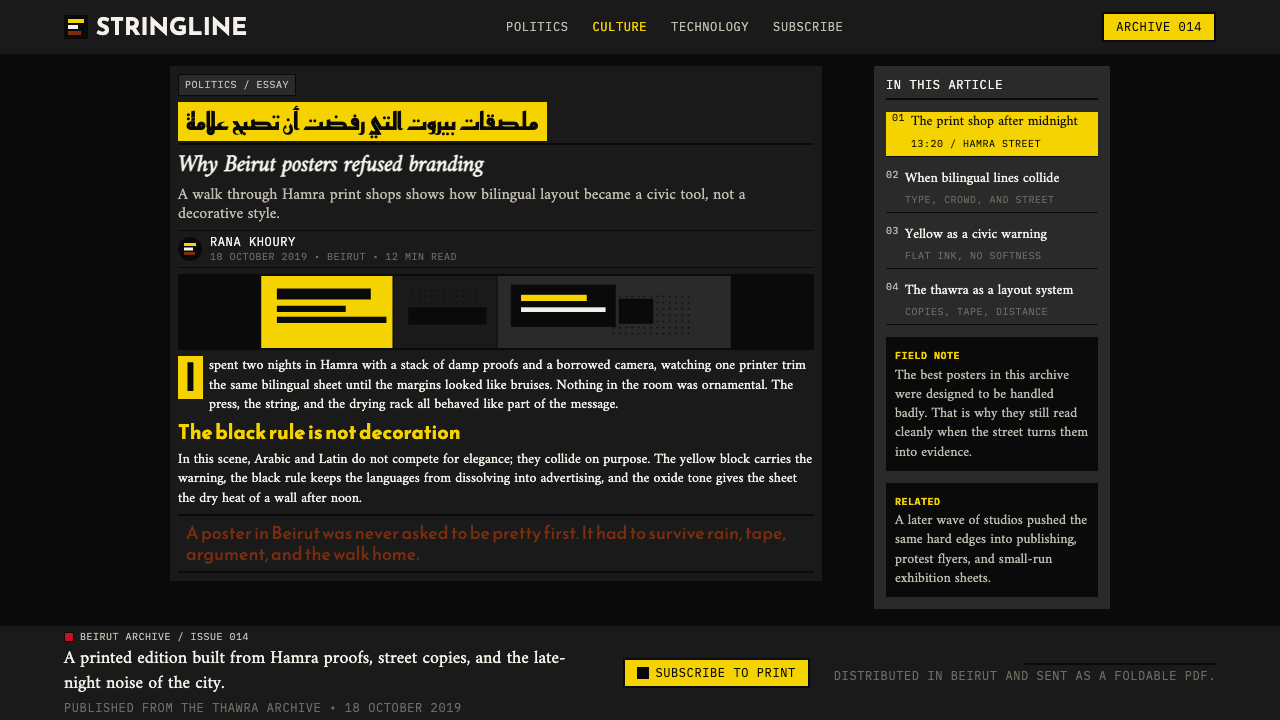
The material substrate matters enormously to this style. Cheap newsprint, uncoated stock, and risograph-printed sheets carry an inherent roughness — ink bleeds slightly into the paper fiber, edges soften, halftones break into visible dots. Beirut Indie designers treat these qualities as expressive content rather than print defects to minimize. The grain signals authenticity and speed: this was made fast, with available means, by people with something urgent to say. A version of this work produced on glossy coated stock would be a contradiction in terms.
Hard Editorial Grid
Despite its apparent rawness, Beirut Indie work is structured on a strict horizontal grid, derived from newspaper layout conventions. Thick rules divide the page into registers — a practice inherited from Arabic broadsheet design where rules have historically served as both organizational dividers and visual anchors for right-to-left readers. These rules are not decorative: they slice the page like editorial deadlines, enforcing the sense that every element has been allocated a precise slot in a constrained system. The grid is visible, unapologetic, and load-bearing.
Arabic Type as Visual Form
Beirut's designers — and specifically the Arabic-type reformers among them — treat the Arabic script not as a secondary or decorative system but as a primary visual architecture. Large Arabic letterforms are used at headline scale where their ligatures, counters, and stroke rhythms read as abstract shapes before they resolve into legible words. Designers such as Pascal Zoghbi pioneered Arabic typefaces specifically designed for editorial use at high contrast — faces with the visual authority to anchor a broadsheet front page or carry a protest slogan across a wall from twenty meters away.
Overprint and Register Misalignment
Overprinting — layering one color of ink directly over another, producing a third mixed tone — is used as a compositional tool rather than a problem to solve. A sulfur-yellow headline printed over a black photograph produces a bruised, dark yellow that carries more weight than either color alone. Similarly, deliberate misregistration between passes — so that type or shapes appear slightly doubled or shifted — is used to convey mechanical urgency and to signal that the work comes from a material printing process rather than a pixel-precise digital one.
Slogan Density
Text quantity is high by the standards of most international editorial design. Where a European modernist poster might use five words, a Beirut Indie poster might carry twenty-five — because the audience expects content, argument, and identification. The design challenge is not to reduce the word count but to find a typographic hierarchy that makes a dense text block legible at speed. This is achieved through dramatic contrast in type scale and weight: one or two lines enormous and immediate, the remainder smaller but still set with enough contrast to be read in sequence.
Who shaped Beirut Indie Graphic Design?
A Beirut-based designer and educator whose work on bilingual poster design and political visual communication is foundational to the movement. Choueiry's practice bridges the academy and the street: he has produced campaign graphics for civil-society organizations while teaching design at Lebanese institutions, shaping a generation of designers who understand political communication as a core design competency rather than a niche application.
A Dutch-Lebanese type designer and design director whose work has substantially advanced the legitimacy and visual range of Arabic typography in international editorial contexts. Atrissi's Arabic typefaces are designed to hold their authority alongside — rather than beneath — Latin companions, and his writing and teaching on Arabic type design have expanded the theoretical vocabulary that younger Beirut designers draw on when making choices about script hierarchy and bilingual layout.
A designer and art director whose editorial work — particularly his tenure at NOW Lebanon and subsequent independent projects — demonstrated that the Beirut Indie visual language could sustain long-form publication design, not only poster production. Imam's layouts use the same bilingual collision grammar as street-poster work but apply it across multi-page magazine spreads, proving that the aesthetic is structural rather than situational.
A type designer and the founder of 29LT (29 Letters), a type foundry focused specifically on Arabic-Latin bilingual type systems. Zoghbi's foundry work has produced typefaces where Arabic and Latin variants are drawn to the same visual weight, x-height equivalence, and rhythmic density — families in which neither script dominates. His 2011 doctoral research on Arabic type design in the digital age remains one of the most cited academic foundations for the movement's typographic ambitions.
An academic and practitioner whose work on Arabic comics and sequential visual narrative has expanded the style's vocabulary beyond poster and editorial work into sequential and narrative formats. Ghaibeh's research at the Lebanese American University examines how Arabic script functions in panel-based layouts — work that has directly influenced how Beirut designers think about text-image relationships and the spatial logic of right-to-left reading in multi-frame compositions.
How do you use Beirut Indie Graphic Design today?
Beirut Indie Graphic Design is a contextually specific style that transfers best when the communication goal is direct, urgent, or politically engaged — and struggles when asked to convey luxury, calm, or institutional neutrality. Applying it well means understanding what the style is actually doing: using scarcity of color, density of text, and collision of scripts as signals of urgency and authenticity rather than aesthetic decoration.
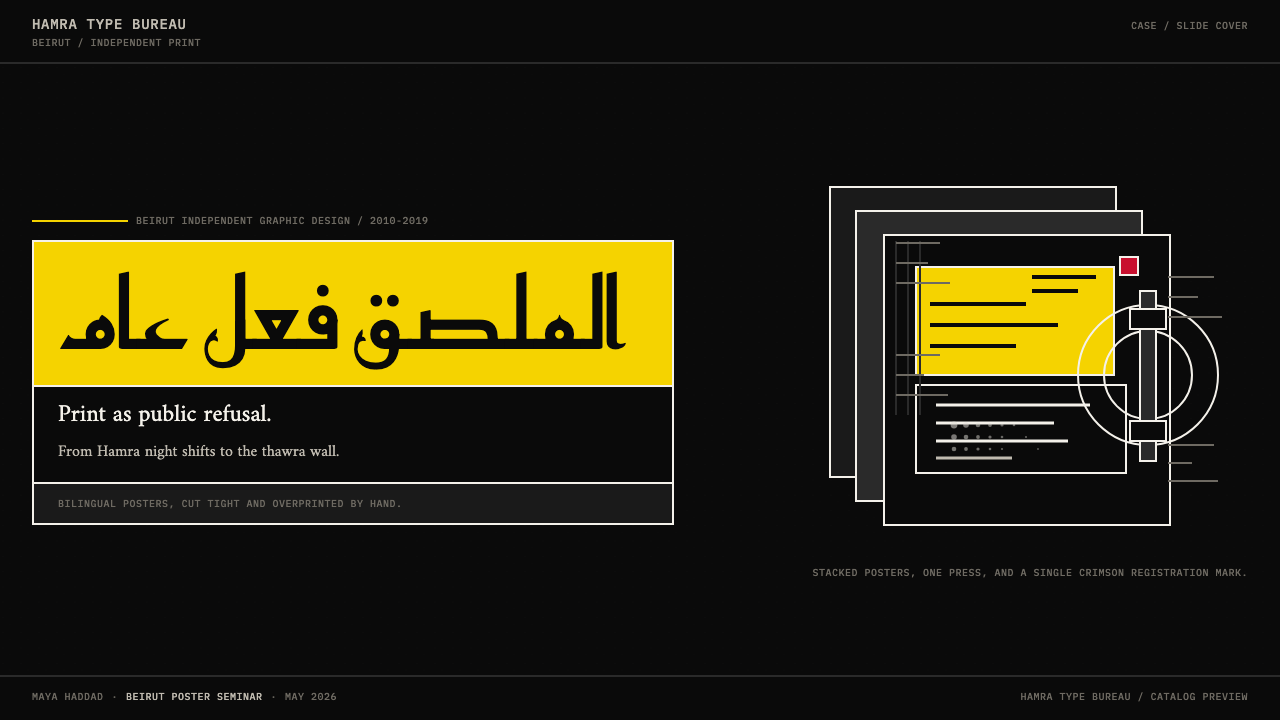
For presentation slides, the style works best at cover and section-break moments rather than on dense data slides. A cover built on this aesthetic might use a single bold Arabic or Latin word — enormous, filling most of the frame — against an ink-black ground, with a subtitle in the other script running below it at a dramatically smaller scale. Section break slides can echo this two-weight, two-script structure. Content slides, however, require restraint: the style's high density is an asset for posters viewed at a distance but becomes a liability when an audience must read bullet points from a projected screen. Limit the palette to two colors, let one color dominate, and keep type hierarchies to two levels only.
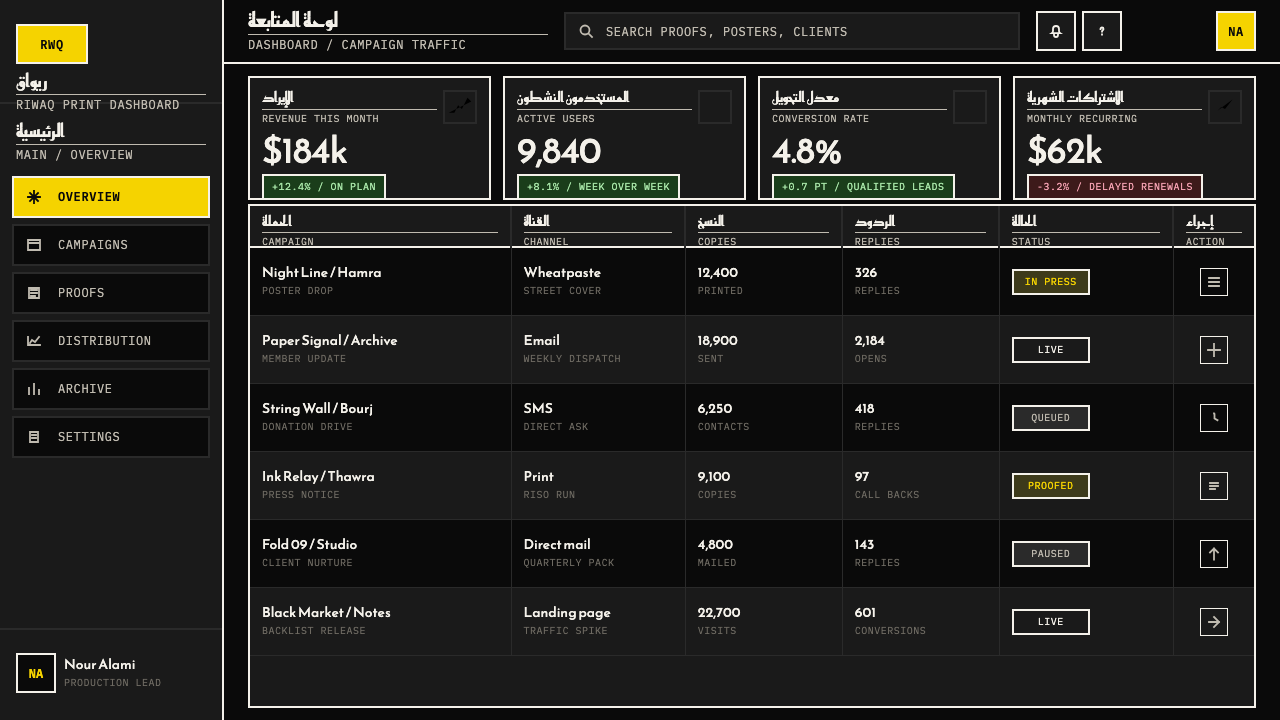
For web interfaces and digital products, the style is best suited to contexts where the brand explicitly wants to communicate cultural specificity, political earnestness, or a connection to the Arab world. Dashboards and SaaS interfaces generally should not use this style — the overprint textures, misregistration effects, and dense text blocks translate poorly to UI components that need to communicate precision and trustworthiness. Where the style does work digitally is in editorial sites, campaign microsites, cultural institution pages, and any context where the rawness is a feature rather than a bug. Use horizontal rules aggressively as section dividers, set headlines at oversized scale with generous leading cut short at the cap height, and let two-script labels coexist without padding them apart.
For editorial and print marketing, this is where the style performs at its highest register. A publication designed in this mode should use a strict modular grid visible through the layout — not hidden beneath it — with rules that bleed to the edge of the page. Full-bleed ink-black pages alternate with near-white pages to create a rhythm that reads as urgency without becoming monotonous. Photography, where used, should be treated as flat geometric areas rather than atmospheric windows: high contrast, cropped to edges, possibly overprinted with a second color. Pull quotes in the opposing script to the body text give each spread a bilingual axis that keeps the eye in motion.
The most common mistake when applying this style outside its cultural context is aestheticizing the rawness while removing the density. A cleaned-up, refined version of Beirut Indie — smooth registration, generous margins, tasteful two-color palette — is simply a generic modernist poster with Arabic flavoring. The density, the misregistration, and the typographic collision are the content; removing them in the name of polish produces a pastiche. A second common error is treating Arabic type as decorative texture — using it at small scale for visual pattern while privileging the Latin text for actual communication. That reproduces the colonial hierarchy the style was invented to refuse.
Beirut Indie Graphic Design — FAQ
Is this style exclusively for Arabic-language or Middle Eastern contexts?
Not exclusively, but the style's most powerful effects depend on bilingual script collision, and that collision only functions when both scripts are genuinely present and doing communicative work. Using Arabic type purely as visual texture in a Latin-script communication — without the Arabic carrying actual meaning — is both aesthetically hollow and culturally appropriative. Designers working in other bilingual contexts (Chinese-Latin, Hebrew-Latin, Cyrillic-Latin) can legitimately borrow the structural principles — hard grids, restricted palette, deliberate collision, risograph texture — without requiring the specific Arabic-Latin combination. The principles generalize; the specific scripts do not.
How do I reproduce the risograph texture in digital work?
The risograph texture has three components: ink grain, color halftone, and misregistration. Grain is achievable by layering a mid-scale noise texture over flat color fills at low opacity, then reducing the output to a limited color profile. Color halftone — the visible dot pattern — can be approximated by applying a bitmap halftone effect to images before placing them in a layout. Misregistration — the slight offset between two color passes — is best achieved by duplicating a type or shape layer, offsetting it by a small amount in one direction, assigning the duplicate to the secondary ink color, and compositing the two at full opacity. The effect is most convincing when the offset is imprecise and directionally consistent across a piece rather than applied mechanically to every element.
Does the style work for brands or only for activist communication?
The style originated in activist contexts and continues to carry those associations, which means brands that adopt it are implicitly claiming an affiliation with civil-society urgency and political directness. That alignment is an asset for certain brands — cultural organizations, media publications, independent food or fashion businesses positioning themselves against corporate blandness, NGOs communicating about social issues. It is a liability for brands that need to project institutional trust, luxury, stability, or political neutrality. A bank or pharmaceutical company adopting this style would produce cognitive dissonance. A music festival, an independent bookstore, or a civil-society campaign would find it genuinely fitting.
How does Beirut Indie differ from broader Arabic design movements?
Arabic graphic design encompasses a wide range, from classical calligraphic traditions to Gulf corporate identity to Egyptian commercial advertising. Beirut Indie is specifically a post-civil-war, post-assassination, post-uprising phenomenon — it is shaped by Lebanon's particular political situation, its cosmopolitan bilingualism, and its strong independent cultural sector. It has more in common with European and Latin American protest-print traditions than with, say, the ornamental Arabic-script calligraphy that appears in Islamic decorative arts or the slick modernist Arabic lettering developed for Gulf media brands. It is also specifically a product of a design-educated professional class working through inexpensive duplication technologies — not a folk craft tradition.
What makes a Beirut Indie piece feel authentic versus derivative?
Authenticity in this style is primarily a question of necessity. Authentic work in this tradition is built around a communication imperative — something that must be said, a deadline that exists, an audience that is genuinely addressed. The visual choices serve that imperative rather than demonstrating the designer's knowledge of the style. A derivative piece, by contrast, applies the visual signatures — the misregistration, the sulfur yellow, the collision typography — as surface effects layered onto a communication that would function equally well in any other style. The grain without the urgency is costume. The surest diagnostic is asking whether removing the stylistic elements would change the message: in authentic work, it would; in derivative work, it would not.
Related design styles
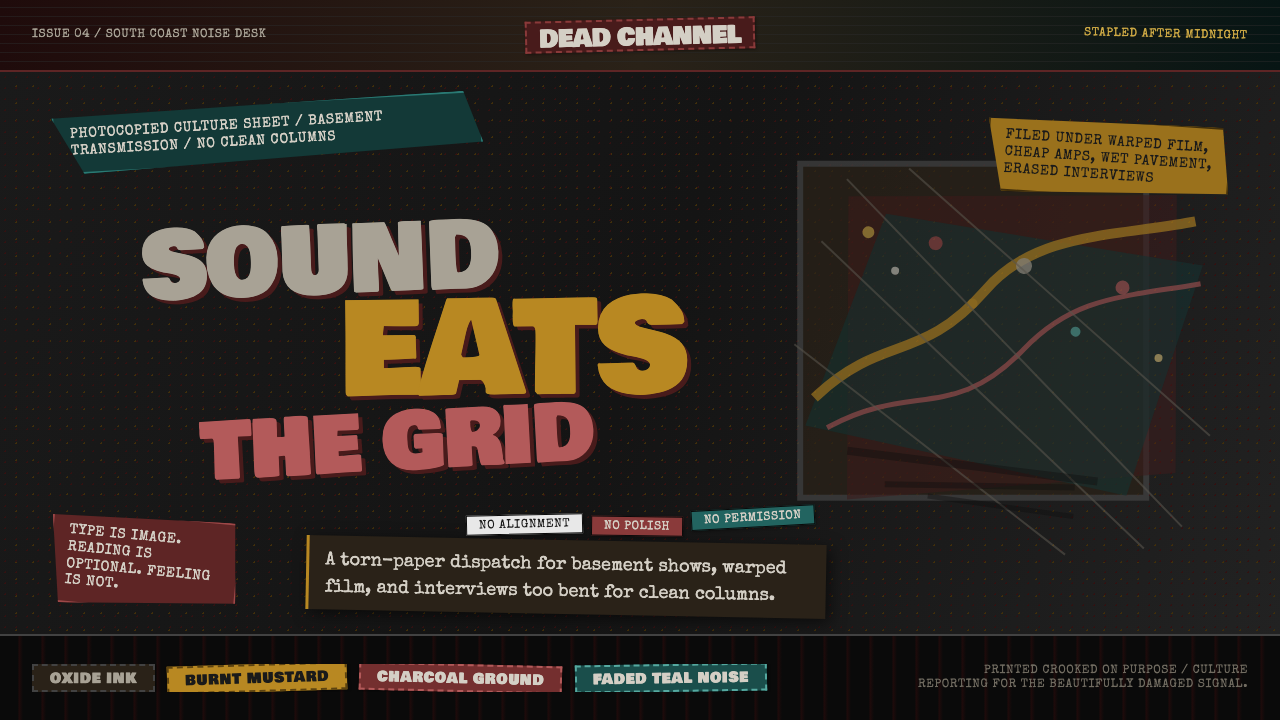 Grunge (Carson 1993)Carson's anti-rules, photocopied. Oxblood on charcoal, distressed type, delib…
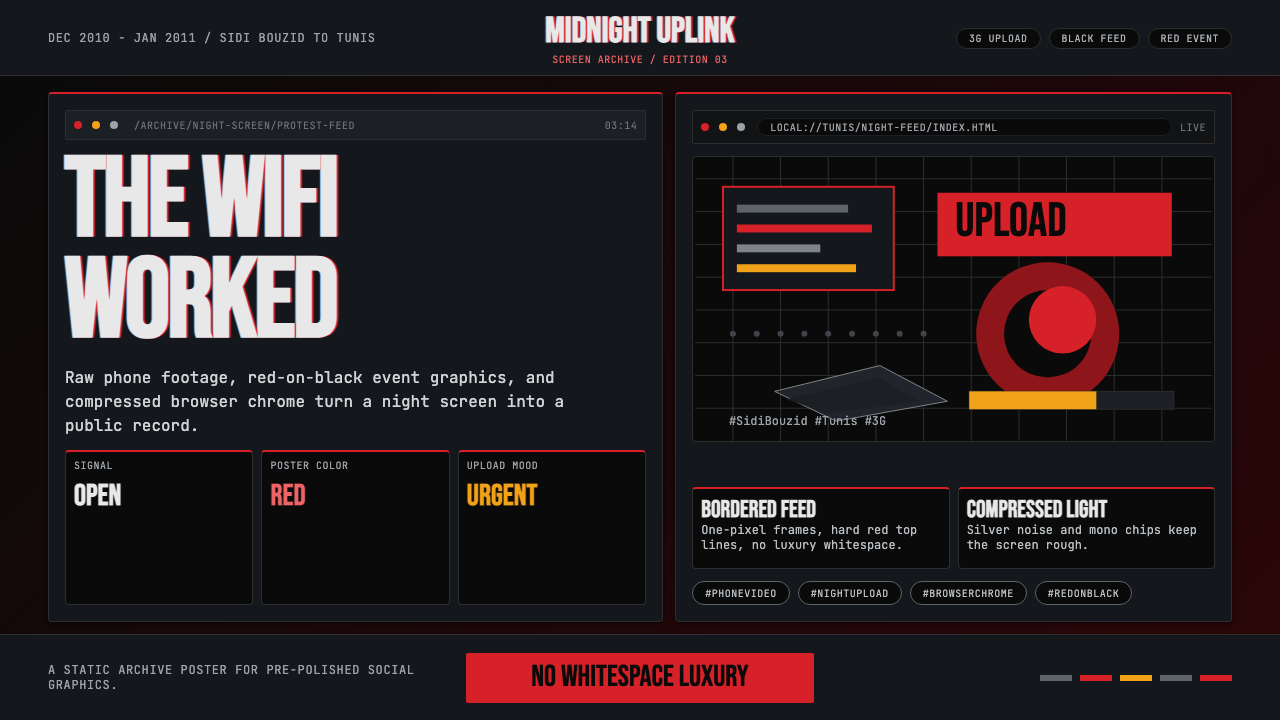 Tunisian Jasmine Revolution (2010)Raw urgency wins. Red browser grids and mono hashtags compress 3am protest in…
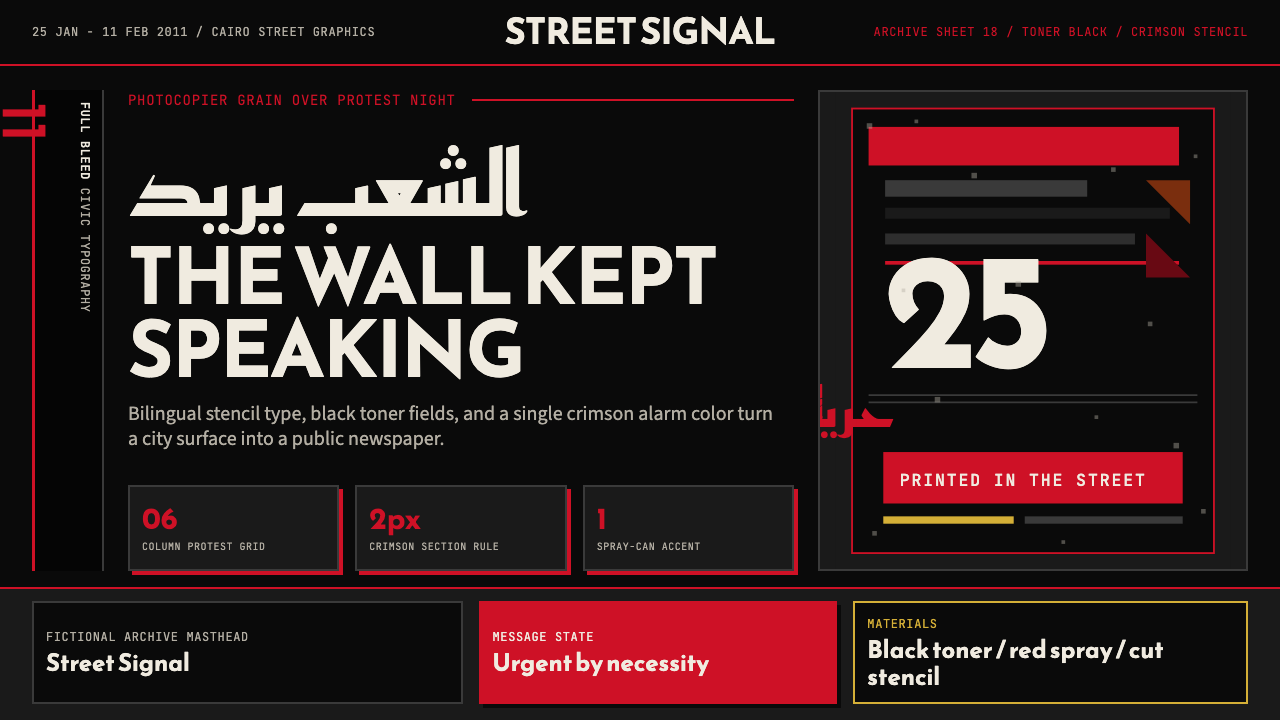 Tahrir Square 2011Civic signal, not polish. Photocopier black and crimson stencils on a hard gr…
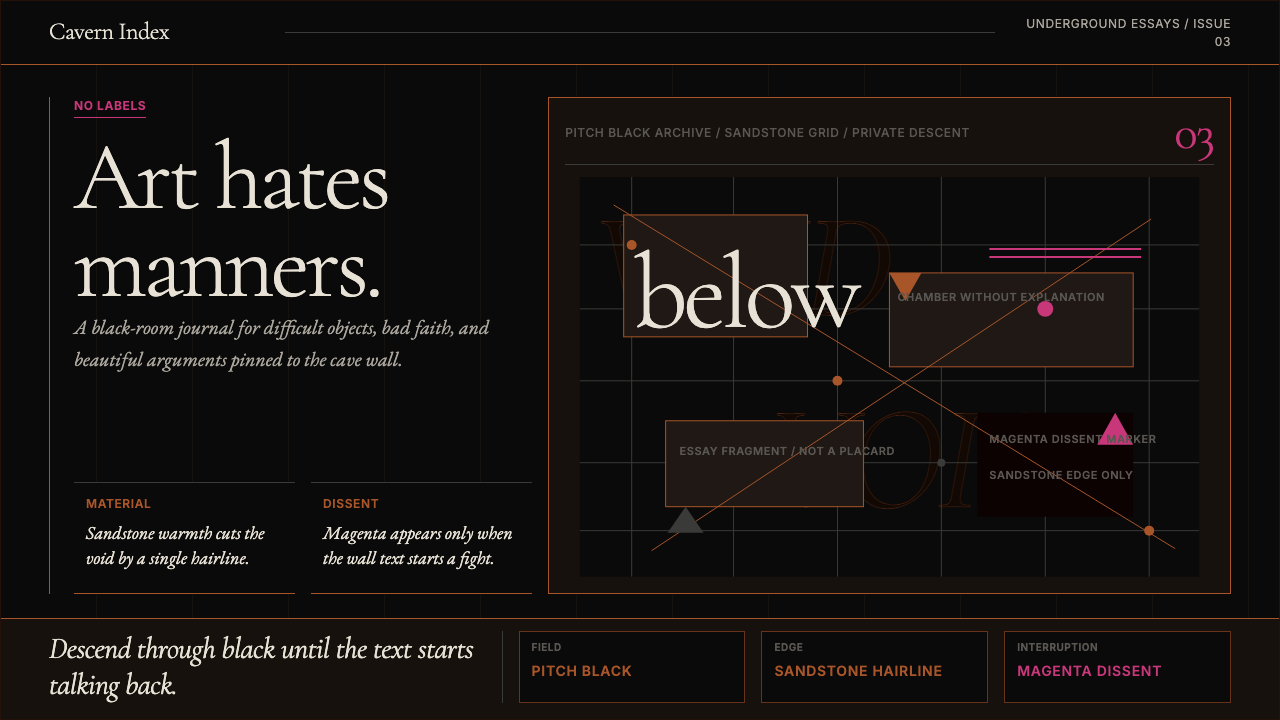 Tasmanian MONA Museum (2011)Hostile luxury underground. Pitch black, sandstone hairlines, magenta editori…
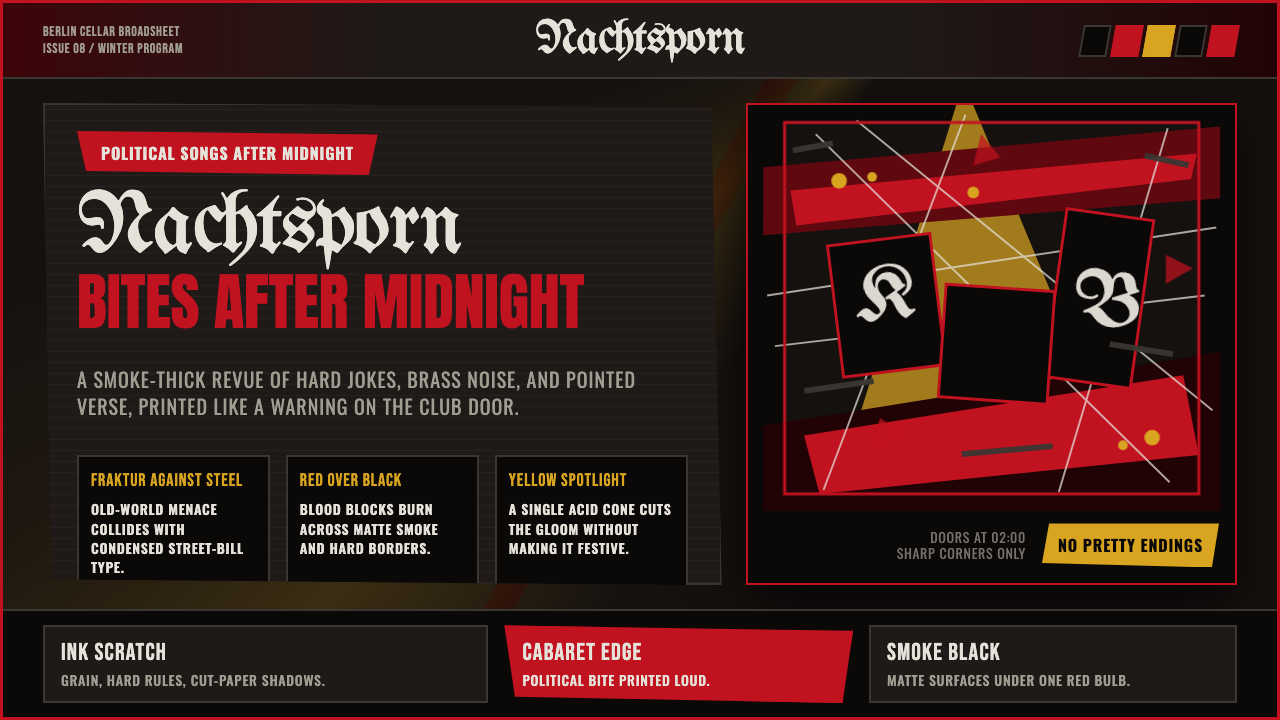 Weimar CabaretMenace at 2 a.m. Blood-red Fraktur, smoke-black grid, acid-yellow spotlight c…
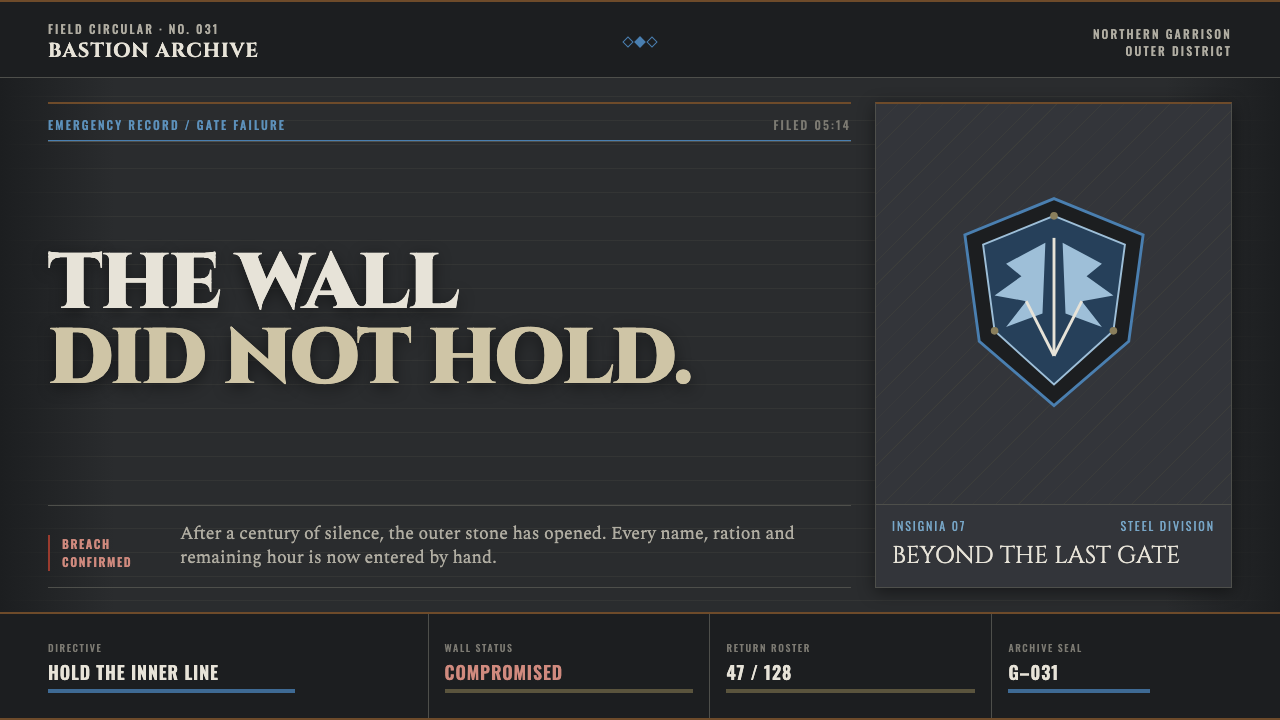 Attack on Titan (2013)Dread becomes duty. Stone-gray bands, engraved caps and one steel-blue crest…