What is Emigre Magazine (1984–2005)?
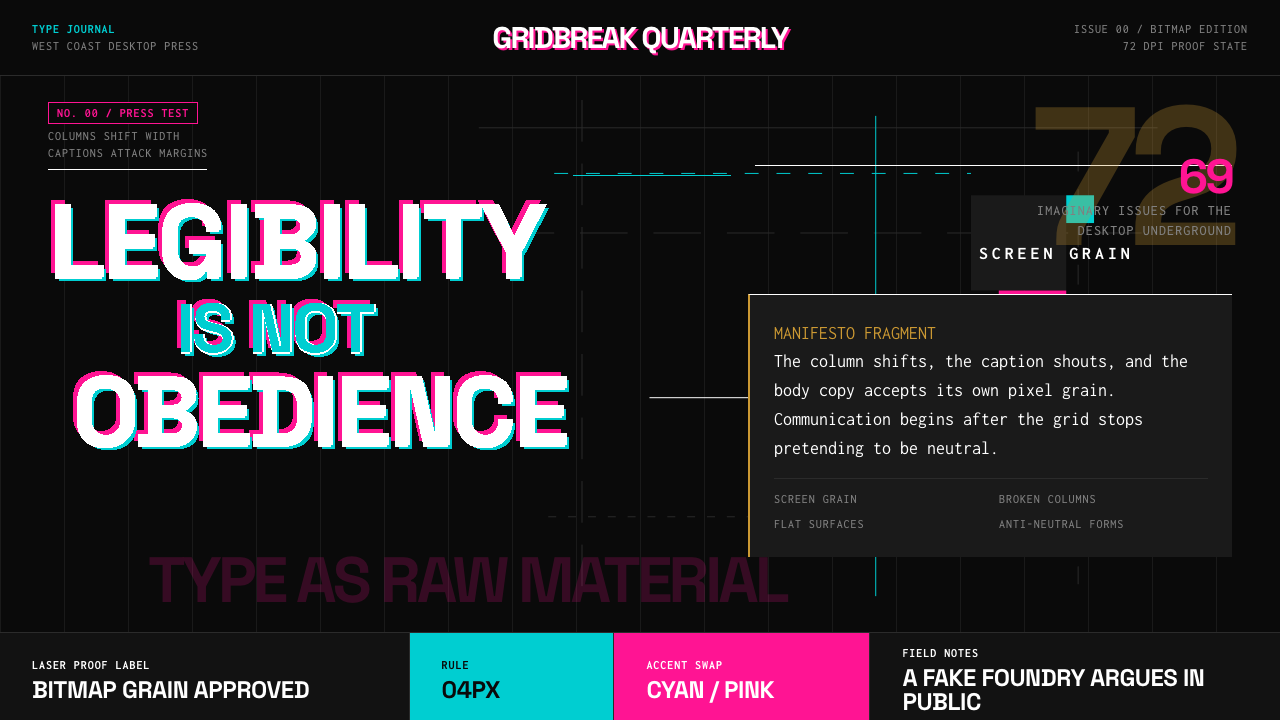
Emigre proved that a desktop computer could be a printing press, a type foundry, and a manifesto — all at once.
Emigre Magazine (1984–2005) in brief
Emigre Magazine (1984–2005) was a Berkeley-based graphic design quarterly that became the primary written and visual record of the typographic revolution unleashed by the Apple Macintosh. Over 69 issues and two decades, founders Rudy VanderLans and Zuzana Licko turned low-resolution digital output into a full aesthetic position — one that argued roughness, collision, and visual noise could carry as much meaning as precision and polish.
The magazine's visual language was a deliberate assault on the tidy, measured conventions of professional print design. Type was scaled to extremes, overlapping, rotated, and rendered in faces that exposed their bitmap origins. Layouts broke the grid not accidentally but programmatically — as a philosophical claim that legibility was not the only, or even the primary, goal of typography. Emigre proposed that designed artifacts could communicate through texture, density, and deliberate friction as much as through hierarchy and clarity.
Beyond its visual surface, Emigre functioned as a critical journal. Its pages hosted major debates in graphic design theory — about authorship, cultural appropriation, the role of the designer in society, and the meaning of style versus substance. The magazine was simultaneously a showcase for experimental typefaces (many designed by Licko and distributed through Emigre Fonts) and a literary space where designers argued, disagreed, and shaped a profession's self-understanding.

Where does Emigre Magazine (1984–2005) come from?
Emigre was born in 1984, the same year Apple released the Macintosh — a coincidence that shaped everything about its identity. VanderLans, a Dutch graphic designer who had emigrated to California, and Licko, a Czechoslovakian-born type designer who grew up in Berkeley, launched the magazine as a cultural journal for immigrants and expatriates. The title itself referred to that condition of displacement. Within a few issues, the magazine had pivoted entirely toward graphic design, driven by the discovery that a desktop computer and a laser printer could produce camera-ready art without a conventional print shop.
The early issues embraced the constraints of the Macintosh with deliberate enthusiasm. The machine's screen rendered type at seventy-two dots per inch — a resolution so coarse that letterforms appeared as visible grids of square pixels. Rather than treating this as a limitation to overcome, Licko designed typefaces that worked with the pixel structure rather than against it. Matrix, Emigre, and Oakland were among the early bitmap faces she created specifically for the low-resolution output of the period. They did not simulate hand lettering or metal type; they looked exactly like what they were — digital constructions made of small squares.
The magazine's emergence coincided with and contributed to a broader intellectual ferment in design education. Cranbrook Academy of Art in Michigan, under Katherine McCoy, was producing graduates deeply influenced by French literary theory — deconstruction, semiotics, post-structuralism — who saw visual form as a site of contested meaning rather than neutral communication. Many of these designers, including Barry Deck and Jeffery Keedy, published in Emigre and contributed typefaces to Emigre Fonts. The magazine became a bridge between West Coast digital experimentation and East Coast theoretical rigor.
As the 1990s progressed, the desktop publishing revolution spread to every studio and the technical novelty that had distinguished Emigre became universal. The magazine responded by evolving — its layouts grew more sophisticated, its theoretical ambitions expanded, and it increasingly devoted entire issues to single designers or single arguments. By the time it published its final issue in 2005, it had documented not only the digital typography revolution but its own arc from radical outsider to canonical reference. The complete run of 69 issues is now held in design archives and museum collections worldwide.
What defines the Emigre Magazine (1984–2005) look?
Bitmap and Digital Texture
The defining visual hallmark of early Emigre is the embrace of low-resolution digital texture — type rendered at the coarse screen resolutions of the mid-1980s, where each letterform is visibly constructed from a grid of square dots. Rather than smoothing or disguising this pixellation, the aesthetic foregrounds it. Bitmap type at large scale becomes a kind of architectural surface: dense, geometric, and illegible in close examination yet legible from the designed distance of a page. This deliberate roughness signaled that the machine's limitations were aesthetic material, not obstacles.
Type as Image
Emigre treated letterforms not as transparent carriers of content but as visual objects with weight, texture, and spatial presence. Type was scaled to fill spreads entirely, cropped at the margins, rotated off-axis, or layered so that multiple words occupied the same space, creating density that had to be read through rather than scanned. Headlines could be larger than the page images they announced; body text could be set so tight that individual characters merged into texture. The distinction between typographic and pictorial elements collapsed — every spread was simultaneously text and image.
Deliberate Grid Violation
Where conventional editorial design uses the grid to create consistency and predictability, Emigre layouts used the grid as a starting point that could be publicly broken. Columns of text collided at angles, text blocks overlapped photographs, and margins were ignored when the composition demanded it. This was not carelessness — the violations were calculated to create visual tension and to make the reader actively aware of the act of reading. The grid's absence, paradoxically, made the layout's underlying structure more visible by contrast.
Dark, High-Contrast Grounds
Emigre frequently worked against black or very dark grounds, with type and graphic elements in high-contrast tones — bright cyan, warm ochre, hot pink, or stark white — punching out of the darkness. This palette was partly a product of the laser printer era, where dark backgrounds dramatized the contrast available from toner on paper, and partly an aesthetic declaration of difference from the white-ground convention of mainstream publishing. The combination of saturated chromatic accents on black creates an aggressive, electric visual energy absent from more restrained design systems.
Experimental Typeface as Argument
Through Emigre Fonts, the magazine distributed typefaces that were not simply aesthetic choices but theoretical positions. Licko's early bitmap designs argued that digital constraints were generative rather than limiting. Her later PostScript faces — Mrs Eaves, a reinterpretation of Baskerville; Filosofia, a revisitation of Bodoni — engaged seriously with type history while proposing that revival need not mean reproduction. Keedy's typefaces introduced intentional awkwardness; Barry Deck's Template Gothic embraced the imperfection of stencil lettering. Each face was a proposition about what type could mean beyond legibility.
Layered Visual Density
Emigre spreads regularly achieved a density of visual information that required time rather than a glance to process. Multiple typographic hierarchies coexisted without clear dominance; background elements pressed against foreground elements; photographic imagery was cropped, halftoned, or treated to create surface rather than window. This density was not accidental accumulation — it was a formal argument that designed communication could be immersive and demanding rather than immediately transparent. The reader was positioned as an active participant rather than a passive receiver.
Visual Argument Over Visual Service
Perhaps the deepest structural characteristic of the Emigre aesthetic is its insistence that the designer is an author, not a service provider. The magazine's layouts did not subordinate form to content — they treated form as content. A spread could argue through its composition that hierarchy was arbitrary, that the reader's effort was valuable, or that the technology of production was itself part of the message. This authorial stance was controversial at the time and remains so: it challenges the assumption that good design is design you do not notice.

Who shaped Emigre Magazine (1984–2005)?
VanderLans co-founded Emigre and served as its art director, editor, and primary visual architect throughout its run. Trained in graphic design in the Netherlands and later at the University of California Berkeley, he brought both European modernist foundations and an outsider's curiosity about American visual culture. His role was less that of a systematic designer than of a visual curator and provocateur — each issue was a deliberate experiment in what a designed publication could look like if it refused inherited conventions. His sustained collaboration with Licko over two decades produced one of the most documented creative partnerships in design history.
Licko is the type designer whose work gave Emigre its most distinctive visual identity. Born in Bratislava and raised in Berkeley, she encountered the Macintosh as a tool that demanded new typographic thinking rather than imitation of existing forms. Her early bitmap typefaces — designed with the coarse pixel grid as an expressive parameter rather than a constraint — established a new category of digital type. Her later PostScript faces, including Mrs Eaves and Filosofia, demonstrated that the same rigor could be applied to historical revival. Through Emigre Fonts, which she co-directed with VanderLans, she made these and many other experimental faces commercially available, directly shaping the visual landscape of the 1990s.
Keedy was a Los Angeles-based designer and educator whose typefaces and critical writing appeared regularly in Emigre throughout the late 1980s and 1990s. A graduate of Cranbrook Academy, he brought a theoretical seriousness to the discussion of type design — arguing that new typefaces were not merely aesthetic objects but cultural statements about their moment. His own type designs embraced deliberate awkwardness and historical misquotation as a way of making the act of reading self-conscious. His essays in Emigre helped articulate the theoretical framework within which the magazine's visual experiments made sense.
Deck's typeface Template Gothic, designed in 1990 and distributed through Emigre Fonts, became one of the most recognized typefaces of the early 1990s and one of the clearest expressions of the Emigre aesthetic position. The face was derived from imperfect stencil lettering — the kind found on industrial signage — and retained the irregularities and optical accidents of that origin rather than smoothing them away. Its wide adoption in commercial design, including by major brands, demonstrated that Emigre's experimental sensibility could migrate from the avant-garde into mainstream visual culture while retaining enough of its original tension to remain interesting.
Ed Fella was a Detroit-based commercial artist who transitioned to design education at CalArts and became a singular presence in Emigre's pages. His lettering and poster work — hand-drawn, deliberately imperfect, aggressively personal — offered a counterpoint to the digitally generated aesthetics that dominated much of the magazine. Where Licko's work embraced the logic of the machine, Fella's embraced the logic of the hand resisting the machine. His presence in Emigre demonstrated the breadth of the magazine's definition of experimental design: it was not a single style but a commitment to making typography that refused to be invisible.
How do you use Emigre Magazine (1984–2005) today?
The Emigre aesthetic is one of the most distinctive and highest-risk historical styles available to contemporary designers. Applying it well requires understanding that its visual effects — bitmap texture, dense layering, deliberate illegibility, dark high-contrast grounds — are not decoration but argument. Every Emigre-derived composition should have a reason for its tension, not just its appearance. The style suits contexts where the work needs to communicate independence, experimental culture, or a deliberate refusal of corporate smoothness.
For presentation slides, the Emigre style works most effectively on cover and section-break pages rather than throughout an entire deck. A cover in this mode uses a dark ground — near-black or a very deep saturated tone — with large-scale type in a contrasting bright or white tone, intentionally cropped at the edges, suggesting that the composition extends beyond the frame. Section dividers can use a single bold typographic element at extreme scale, with the section title set at a different angle or weight to create productive collision. Content slides, however, should step back from full Emigre intensity: reduce the visual density, restore a clear reading hierarchy, and use the palette and type choices as atmosphere rather than argument. Data slides work well when charts are treated as graphic objects — bars rendered in the magazine's characteristic saturated accent tones on a dark background, with labels in a contrasting bitmap-style or condensed face.
For web interfaces, the Emigre aesthetic translates most successfully to contexts celebrating creative culture: portfolio platforms, music or art event sites, independent publishing platforms, cultural institution landing pages. The approach should treat background darkness as the baseline, use typographic scale as the primary navigational signal, and allow generous but purposeful whitespace — or rather, dark space — around key elements. Dashboard and data-heavy interfaces are generally not well suited: the style's deliberate density competes with the clarity that functional interfaces require. If the aesthetic is used on a pricing or feature page, it should be applied to a single bold hero section rather than the entire layout, with conventional hierarchy restoring readability in the detail sections.
For editorial and marketing work, the Emigre style is most at home in contexts where the brand explicitly positions itself as anti-mainstream or culturally serious. A full-Emigre editorial spread uses extreme typographic scale for pull-quotes, allows columns of body text to press against image edges, and treats section headers as visual objects rather than navigational markers. Marketing applications work best as poster-format single-panel compositions — event announcements, campaign hero images, social cards — where the composition's density reads as energy rather than confusion at the required output size. Long-form marketing copy or multi-section landing pages rarely benefit from sustained Emigre intensity.
The most common mistake when applying Emigre is mistaking visual complexity for the style itself. Authentic Emigre work is not complex for its own sake — every layer, every collision, every departure from conventional hierarchy is making a claim. The second most common mistake is applying the visual surface — dark grounds, rough type, high contrast — without the underlying editorial seriousness that gave those choices meaning. A dark bitmap aesthetic applied to conventional corporate messaging produces incoherence, not edge. Use this style when the content genuinely has something experimental to say, and let the form express that content's stance rather than substitute for it.

Emigre Magazine (1984–2005) — FAQ
Is Emigre style the same as grunge typography?
They overlap in period and in some visual effects, but their origins and logic differ significantly. What is often called grunge typography — the roughened, distressed, layered type aesthetic widespread in alternative music and youth culture in the early 1990s — drew partly on Emigre's experiments but generally used that vocabulary for stylistic effect rather than theoretical argument. Emigre's typographic experiments were motivated by specific positions about the nature of communication, authorship, and the role of the designer. Grunge typography applied similar surfaces to sell energy and rebellion. The easiest diagnostic: Emigre work rewards close reading; grunge typography is primarily a mood signal.
Can Emigre-style layouts be made accessible without losing their character?
This is the genuine tension at the heart of applying the style seriously. Emigre's deliberate illegibility and dense layering are not incidental — they are the argument. Full accessibility compliance, which requires sufficient contrast ratios, clear reading hierarchies, and text that can be extracted by screen readers, is structurally in tension with the aesthetic's core commitments. The practical resolution is zoning: use Emigre's full density for purely visual, non-functional elements — hero images, decorative type treatments, section dividers — while ensuring all actual content (navigation, body copy, data) meets accessibility standards. This is a compromise, but it is an honest one.
How does the Emigre style relate to Swiss International Style — are they opposites?
They are related as argument and counter-argument rather than as unrelated aesthetic positions. Swiss International Style — the rigorous grid-based, neutrally typeset, photography-incorporating system developed in Switzerland and Germany in the 1950s and 1960s — was precisely what Emigre was reacting against. Swiss Style believed in the designer as neutral conduit; Emigre believed in the designer as author. Swiss Style prized legibility above expressiveness; Emigre questioned whether that hierarchy was self-evidently correct. Understanding Swiss Style makes Emigre more legible as a position: it is not random visual noise but a deliberate counter-proposal to modernist design's claim to objective neutrality.
Why did Emigre stop publishing in 2005, and does the style feel dated today?
VanderLans cited the changed media landscape as the primary reason — by 2005, the design conversations Emigre had helped launch were happening online, in blogs and forums, in real time, making a quarterly print journal feel structurally obsolete. The style itself ages in two directions simultaneously. The bitmap texture and low-resolution aesthetic, which looked raw and threatening in 1986, now also reads as historical — a specific moment in computing history, not a timeless visual language. But the style's underlying commitments — to the designer as author, to form as argument, to deliberate friction — remain genuinely radical and are arguably more relevant now that digital tools have made visual smoothness essentially free and universal. Used knowingly, it reads as a position, not a period piece.
Is Emigre appropriate for client work, or is it only suited to self-initiated projects?
It is appropriate for client work in the right contexts, but it requires a client who understands and values the style's specific cultural signals. It works naturally for independent record labels, art book publishers, cultural festivals, architecture and design studios positioning themselves at the experimental edge, fashion brands with a deconstructive identity, and academic institutions communicating progressive credentials. It is poorly suited to consumer brands requiring warmth and approachability, financial services requiring authority without aggression, or any client whose audience expects immediate visual comfort. The question to ask is whether the client's audience will read the style's friction as intentional intelligence or as a failure of craft.
Related design styles
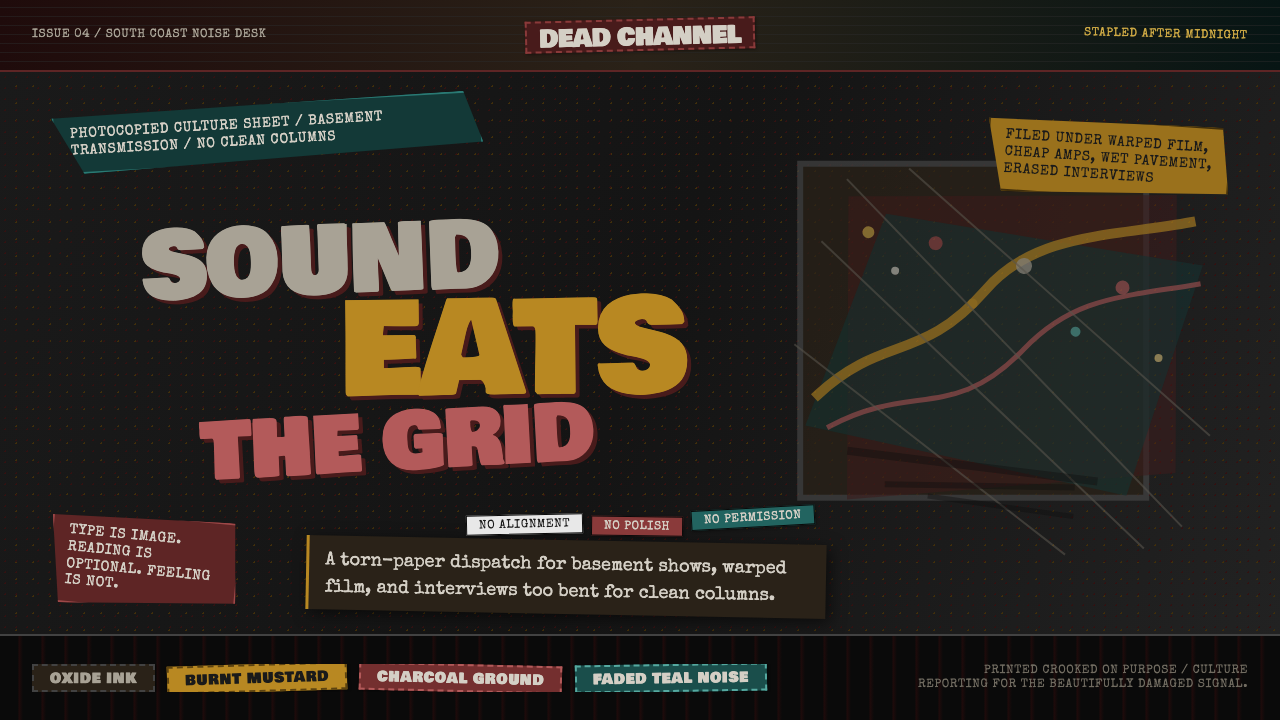 Grunge (Carson 1993)Carson's anti-rules, photocopied. Oxblood on charcoal, distressed type, delib…
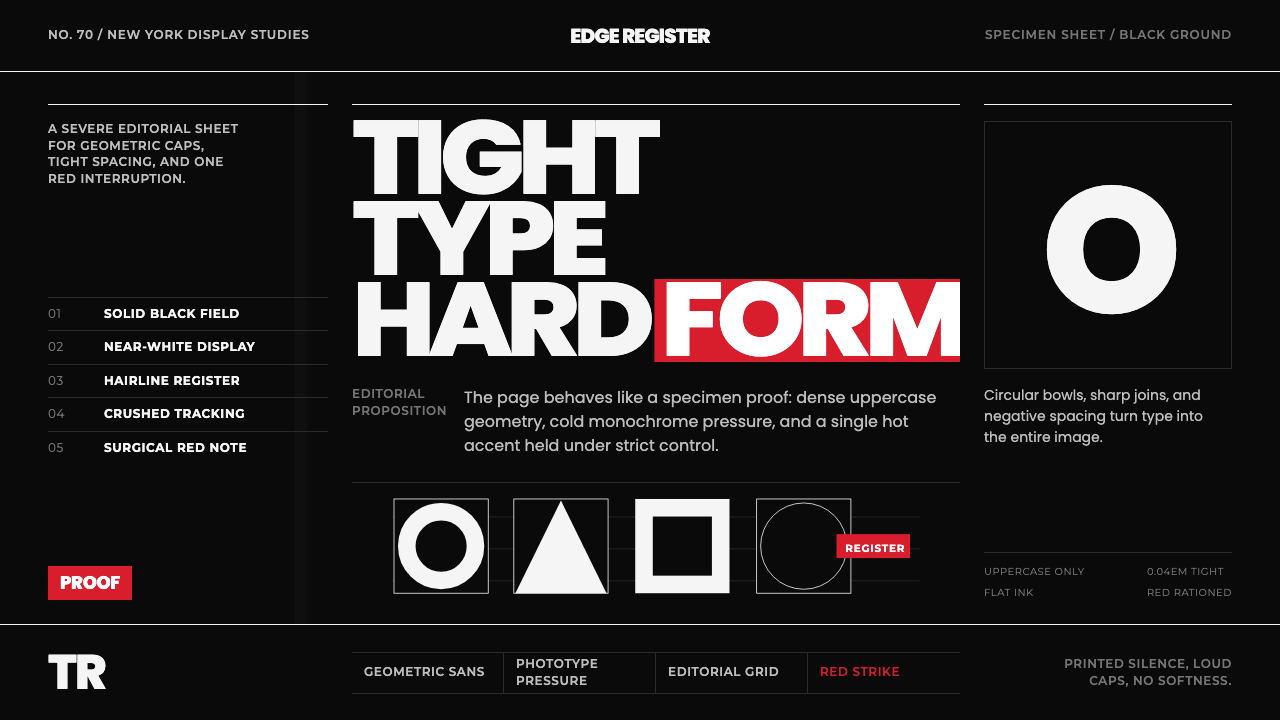 Avant Garde GothicType is the image. Tight white caps on black, ruled grids, one hot red strike.
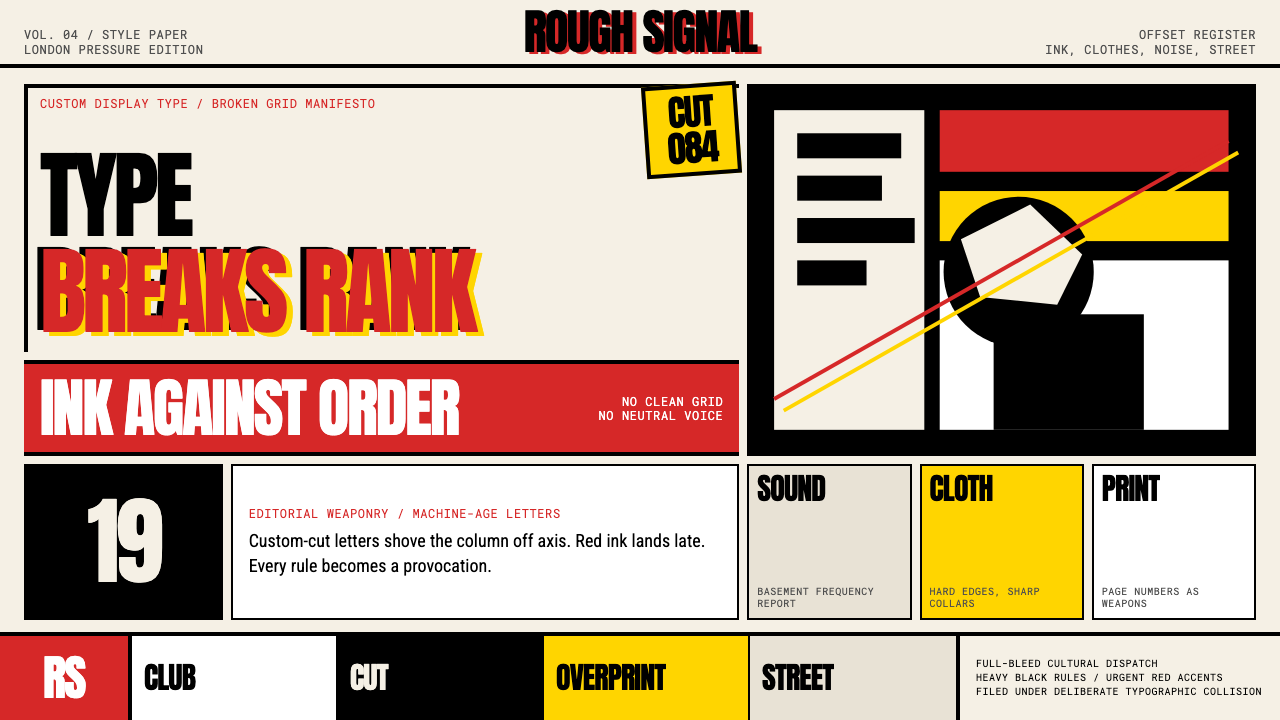 Neville Brody The FaceType mutinies on paper. Cream stock, black rules, urgent red overprint, broke…
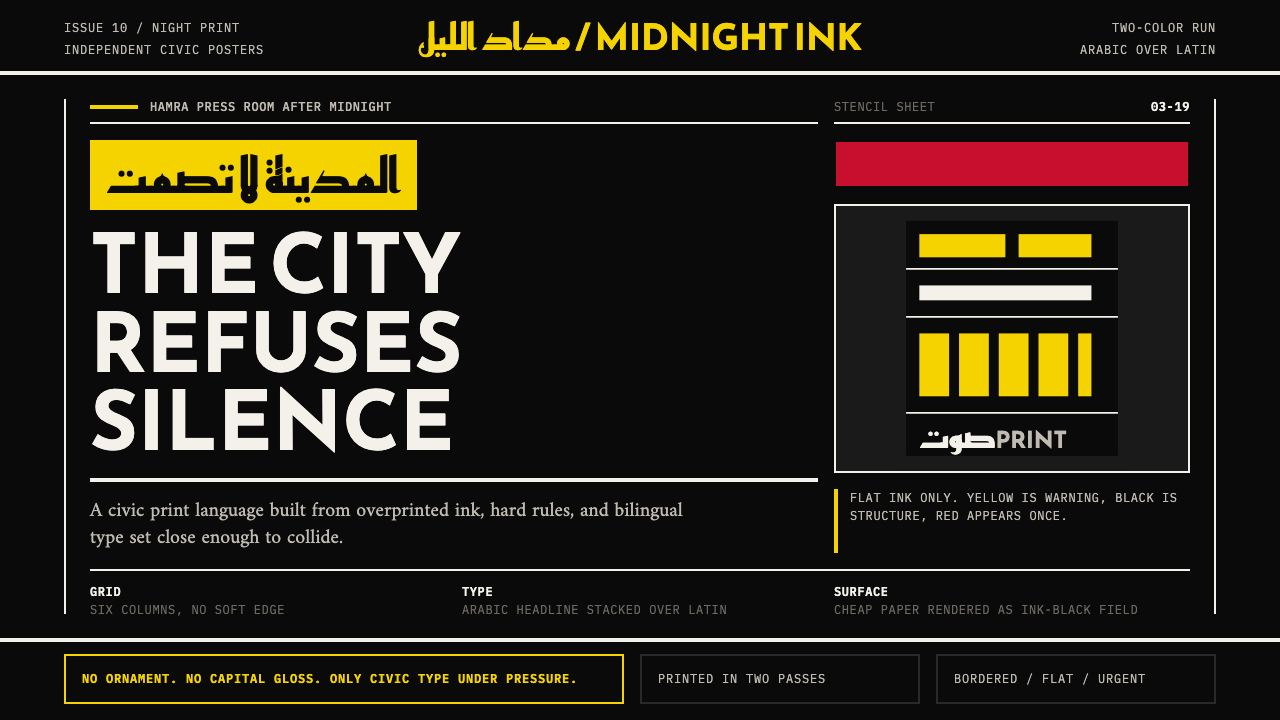 Beirut Indie Graphic DesignCivic type as protest. Sulfur yellow Arabic blocks collide with ink-black pos…
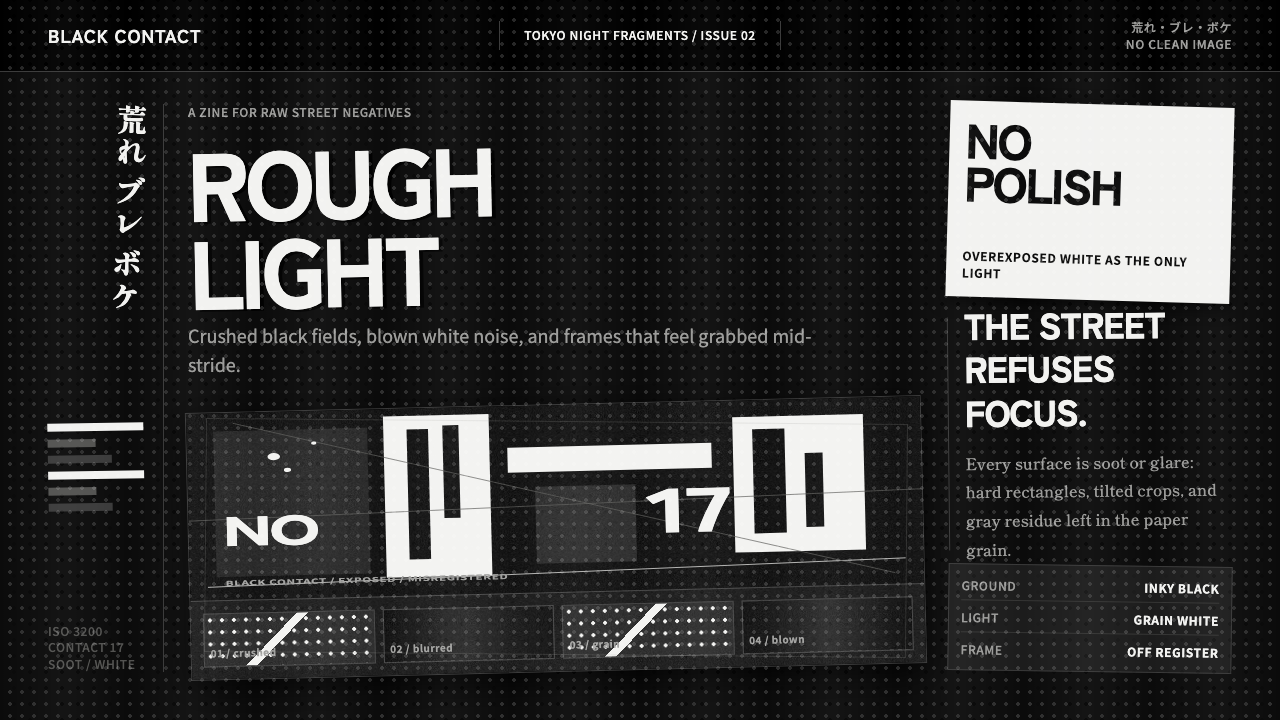 Daido Moriyama Are-Bure-BokeNothing is clean. Inky black, blown white grain, and tilted frames make the i…
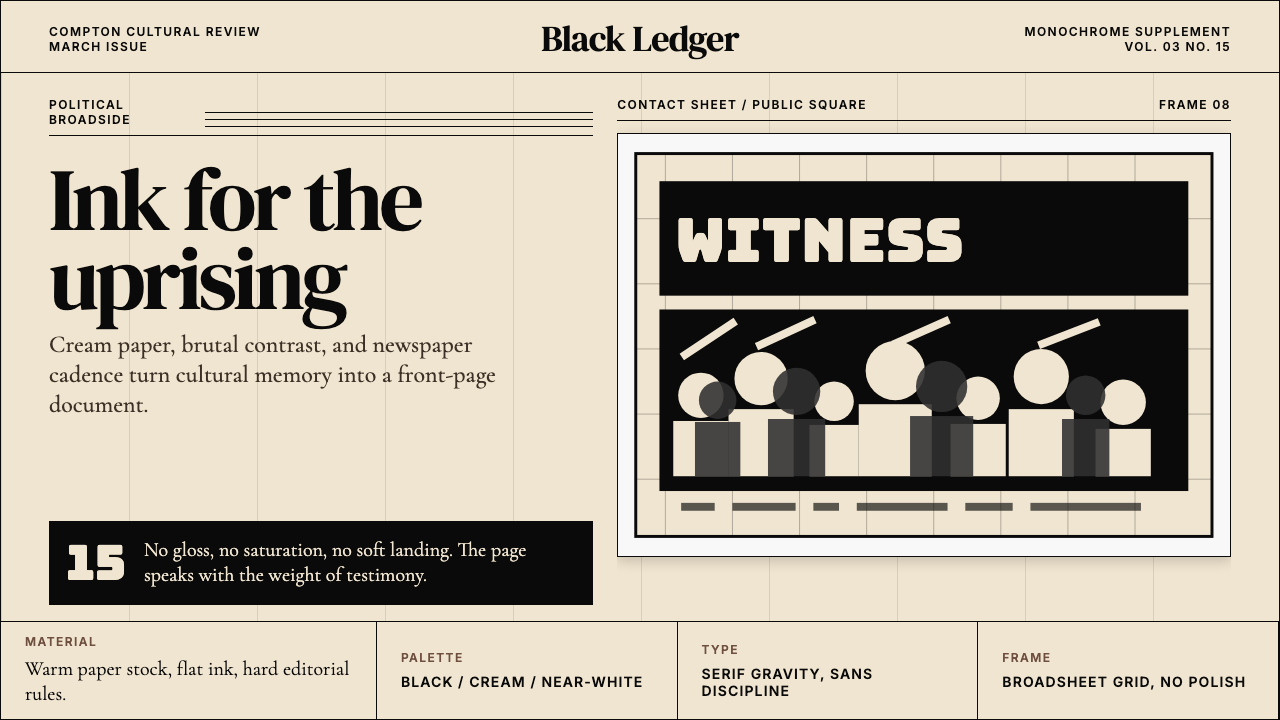 Kendrick — To Pimp a ButterflyPolitical weight, printed cold. Cream paper, hard serif type, monochrome crow…