What is Wu-Tang Clan — 36 Chambers?
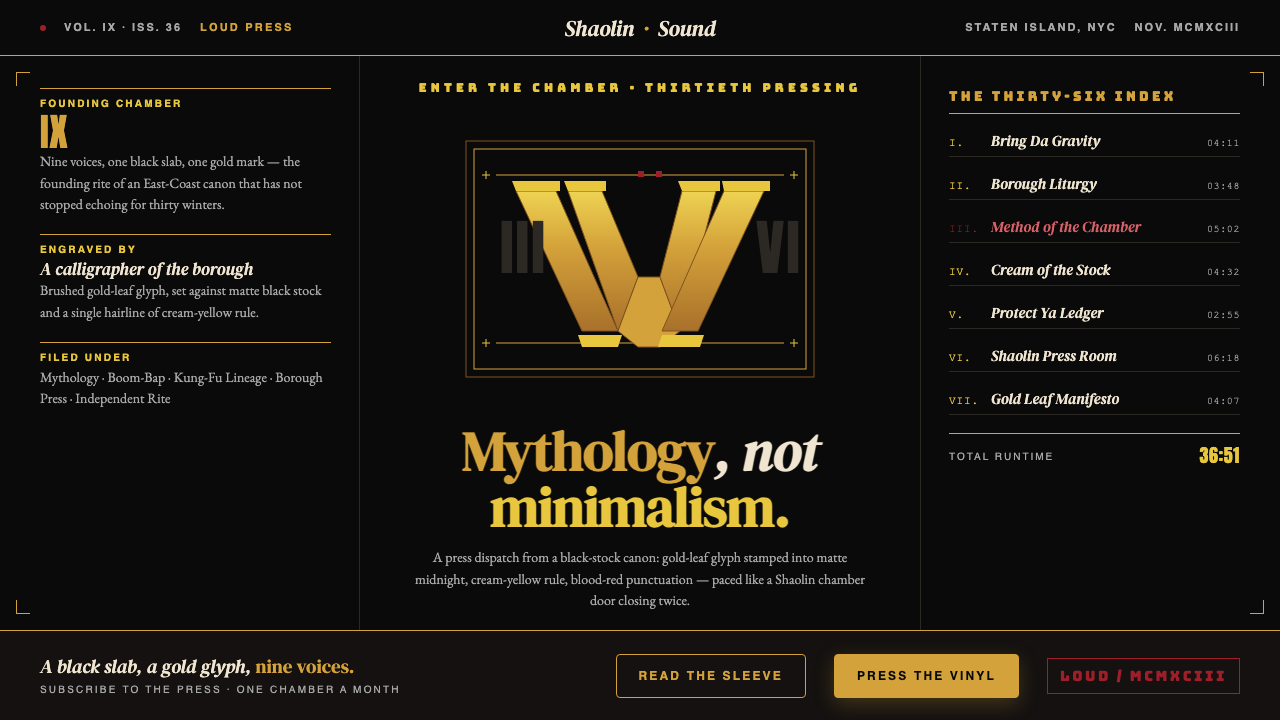
Nine MCs from Staten Island stamped a gold W onto pure black and rewrote the visual grammar of East-Coast hip-hop forever.
Wu-Tang Clan — 36 Chambers in brief
Wu-Tang Clan — 36 Chambers is the visual design language born from the 1993 debut album 'Enter the Wu-Tang (36 Chambers)' on Loud Records. Its defining features are a palette of four irreducible elements — deep matte black, saturated gold, cream-yellow, and blood-red — combined with calligraphic mark-making, sharp editorial serifs, and a graphic weight borrowed from Shaolin kung-fu film posters and New York City underground tape culture. It is a mythology-building aesthetic, not a minimalist one.
The system's emotional register is one of sovereign authority and subterranean menace. Where most hip-hop visual design of the early 1990s sought brightness and immediacy, Wu-Tang deliberately chose darkness, density, and oblique cultural reference. The shadowed group portrait on the original sleeve, the gold W stamped like a royal seal, the kung-fu film credits typography — all of these choices signal that the work is its own self-contained world, governed by its own codes.
What makes the aesthetic remarkably durable is its coherence. Every element — the color, the mark, the type treatment, the mythological imagery — serves the same underlying proposition: that this collective from a borough overlooked by mainstream culture had constructed something of permanent, monumental value. The visual language does not decorate that claim; it enacts it.

Where does Wu-Tang Clan — 36 Chambers come from?
The story begins not in a studio but in the movie theaters and video stores of Staten Island's North Shore, where RZA, GZA, and their extended crew grew up watching Shaw Brothers kung-fu films imported from Hong Kong. Films like 'The 36th Chamber of Shaolin' (1978) were not merely entertainment — they provided a mythology of discipline, brotherhood, and esoteric mastery that the group would consciously transpose onto their creative identity. The album's title is a direct citation of that film. The visual language carries the same reference: heavy, shadowed, ceremonial.
The graphic anchor of the aesthetic is the Wu-Tang 'W' logotype, designed by rapper and graphic artist Mathematics (Allah Mathematics). The W is not a conventional corporate letterform — it is a calligraphic weapon, its strokes thick and aggressive, suggesting both a flying crane and a set of blades. Mathematics conceived it as a seal of authenticity, something that could be stamped on any surface and immediately convey membership in a self-governing order. It became one of the most recognized marks in popular culture without ever being licensed to a major branding agency.
Photographer Daniel Hastings shot the original group portrait that appeared on the inner sleeve and in promotional materials. His approach was deliberately anti-commercial: low light, close framing, heavy shadow, nine faces barely resolved out of the dark. This was a calculated refusal of the brightly lit, aspirationally glossy photography that dominated hip-hop visual culture in the early 1990s. The shadowed portrait said, in effect, that this group did not need to be legible to outsiders — it was sufficient to be recognized by those who already knew.
The typographic layer drew from two contradictory traditions: the editorial serif fonts used in newspaper mastheads and academic texts (lending gravitas and permanence) and the chunky, hand-lettered display type of urban signage and bootleg tape covers (lending street-level rawness). This collision of high and low was intentional and precise — the same tension that animated the group's lyrical approach, which wove Five-Percenter theology, chess metaphors, and block-level vernacular into a single dense fabric.
What defines the Wu-Tang Clan — 36 Chambers look?
Color Palette
The palette consists of four fixed elements held in strict hierarchy. Deep matte black functions as the universal ground — not a neutral background but an active presence that gives the other colors their weight. Saturated gold operates as the primary mark and accent, associated with value, ceremony, and the divine in Five-Percenter symbolism. Cream-yellow serves as the typographic field, warm rather than clinical, recalling aged paper and lamplight. Blood-red appears sparingly as punctuation — a single rule, a drop, a highlight — carrying maximum charge precisely because it is rationed. No other colors belong to this system.
The Calligraphic Mark
The Wu-Tang W is the aesthetic's structural center of gravity. Its calligraphic construction — rendered with the weight and assertiveness of a brushstroke rather than the precision of a geometric letterform — means it carries energy that a corporate logotype does not. The mark functions simultaneously as initial, seal, emblem, and weapon. Its reproduction across surfaces both flat and dimensional (sleeves, merchandise, tattoos, graffiti) proved that the mark was powerful enough to survive radical changes in context and scale without losing its charge.
Typography
The type system operates through deliberate collision rather than harmonic consistency. Formal editorial serifs — the kind historically used in newspaper mastheads and academic publishing — coexist with heavy, condensed display lettering drawn from urban signage and bootleg tape culture. The contrast in weight, style, and cultural register is not accidental; it embodies the same high-low synthesis at work throughout the group's music. Text is often set tightly, with minimal leading, creating a dense block that occupies space with authority.
Shadow and Chiaroscuro
Shadow is not used as a depth simulation or a soft UI effect — it is used as drama. The photographic tradition within the aesthetic draws on the extreme contrast of noir and kung-fu film cinematography, where figures emerge from near-total darkness and background detail is suppressed in favor of silhouette and gesture. In graphic applications, drop shadows on type and marks are heavy and offset, functioning as structural elements that anchor text to the ground plane rather than lift it into an illusion of space. Light is always implied to come from a single, strong, directional source.
Mythological Density
Unlike most design systems that seek clarity and immediate legibility, 36 Chambers aesthetics reward sustained attention. Imagery and text reference the 36 chambers of Shaolin kung-fu lore, Five-Percenter Supreme Mathematics, chess strategy, and street-level New York City geography simultaneously. This layering creates a surface that reads quickly as powerful and opaque but rewards deeper reading with a coherent internal mythology. The visual density is intentional: it communicates that there is more here than can be absorbed in a single encounter.
Grid and Asymmetric Tension
Layouts within this system favor asymmetric compositions that feel inhabited and charged rather than balanced or neutral. The gold W or key imagery is often positioned off-center, creating a visual tension that the eye must resolve. Type blocks and graphical elements occupy different quadrants with deliberate irregularity. This is not chaotic — there is underlying structure — but the structure serves drama rather than order. The compositions feel like they are in motion, arrested at a moment of maximum tension.
Material and Tactile Implication
The aesthetic implies physical weight through its visual choices, even in flat reproduction. Gold carries the cultural memory of leaf gilding, precious metal, and ceremonial object. Matte black suggests pressed vinyl, suede, and anechoic chamber — surfaces that absorb rather than reflect. The cream-yellow of type fields evokes aged paper and warm incandescent light rather than the cold brightness of digital screens. This material richness operates at the level of connotation: the surfaces are described, not simulated, but the description is specific enough to be felt.

Who shaped Wu-Tang Clan — 36 Chambers?
Robert Fitzgerald Diggs, known as RZA, served as the Wu-Tang Clan's chief architect in every sense — musical producer, conceptual director, and the primary author of the group's mythological framework. It was RZA who synthesized Five-Percenter theology, Shaolin kung-fu lore, chess metaphor, and Staten Island street experience into a single coherent worldview, and who insisted that this worldview be expressed with total consistency across sound, language, and image. His five-year production deal he negotiated for each member allowed the collective to maintain creative sovereignty, a principle that directly informed the aesthetic's refusal to accommodate commercial softening.
Allah Mathematics, born Ronald Maurice Bean, is the graphic artist and DJ most directly responsible for the visual system's defining element: the Wu-Tang W logotype. A practicing Five-Percenter, Mathematics brought the movement's philosophical framework — Supreme Mathematics, the Supreme Alphabet — into the graphic vocabulary of the collective. His calligraphic W was not designed through any formal academic process; it emerged from the same improvisational, self-taught creative culture that produced the music. He has continued to serve as the group's primary visual steward for over three decades.
Photographer Daniel Hastings was responsible for the original group portraiture that established the aesthetic's photographic register. His deliberate choice to shoot in low light with heavy shadow, suppressing the kind of aspirational brightness common in early-1990s hip-hop photography, was a radical act of visual positioning. The portraits he produced said that this group existed on its own terms, in its own light, and did not require the conventions of commercial photography to legitimate itself. His approach became a template for subsequent Wu-Tang visual materials.
Gary Grice, known as GZA or the Genius, was among the founding members whose lyrical and conceptual contributions most shaped the aesthetic's intellectual register. His album 'Liquid Swords' (1995) — whose cover features a chess-playing samurai and deep black ground — extended the 36 Chambers visual vocabulary into its fullest expression. GZA's work demonstrated that the aesthetic was scalable: it could support solo projects that maintained the collective's visual identity while introducing new symbolic layers, confirming the system's coherence and flexibility.
How do you use Wu-Tang Clan — 36 Chambers today?
Applying the Wu-Tang 36 Chambers aesthetic requires understanding that its power comes from restraint within a very specific set of commitments, not from the mere accumulation of its surface features. The palette of black, gold, cream-yellow, and blood-red must be held strictly — introducing other colors, however contextually justified, immediately dissolves the authority the system derives from its refusal. The calligraphic mark, if used, must carry genuine weight; a thin or geometric substitute reads as a brand parody rather than a design system.
For presentation slides, the aesthetic works most powerfully on cover and transition slides where mythology and authority are the desired impression. A cover composed of pure black ground, a gold logotype or mark centered or slightly off-center, and a title set in a heavy editorial serif in cream-yellow achieves the aesthetic's essential effect: weight, ceremony, arrival. Content slides should reduce to the minimum — black ground, cream-yellow body text at generous size, blood-red used for a single key figure or data point per slide, and no decorative elements whatsoever. Data visualizations should be treated as objects of ceremony: bar charts in gold on black, axes in cream, a single red marker for the most critical value.
For web interfaces, this system applies most naturally to landing pages, product hero sections, and membership or access-gating contexts where the experience of encountering the brand should feel like being admitted to something. A dark-mode dashboard built in this vocabulary uses the deep black as the application background, gold for primary interactive elements and active states, cream-yellow for all body and label text, and blood-red strictly for alerts and critical state indicators. Navigation is typographic — heavy serif or slab wordmarks, not icon-led. Card components use hard shadow offsets rather than soft glows, reinforcing the aesthetic's commitment to solid, non-ambient depth.
For editorial and marketing materials, the system's poster lineage makes it naturally suited to full-bleed, high-impact layouts. A marketing page built in this vocabulary uses alternating full-width sections of deep black and near-black (never white or light grounds — this is a dark-native system), with gold as the primary headline color and cream-yellow for body text. Photography, where used, should be treated as Hastings treated his portraits: high-contrast, close-cropped, with background detail suppressed into darkness. The only exception to the dark ground is a deliberate cream or aged-paper texture used to introduce a single section of maximum typographic contrast.
The most common mistake when applying this aesthetic is treating gold as a general accent color rather than as a mark of singular authority. Gold should appear at most in two or three places per composition — as the primary logotype or mark, as a single headline, or as the key data point — and nowhere else. Distributing gold generously across a layout produces the opposite of the intended effect: instead of commanding attention, it becomes ambient decoration that the eye learns to ignore. A second common error is using any form of soft shadow, gradient, or bloom effect — these import a warmth and approachability that is fundamentally at odds with the aesthetic's deliberate severity.

Wu-Tang Clan — 36 Chambers — FAQ
Can this aesthetic work in a light-background context?
Rarely, and only with significant constraint. The 36 Chambers system is fundamentally dark-native — its authority derives in large part from the depth and absorption of the black ground. A cream or aged-paper background can work in specific editorial contexts, particularly for a single section that needs to contrast against the dominant dark ground, but it reads as an inversion of the system rather than its natural state. A fully light-mode execution risks becoming a generic gold-and-sepia treatment that loses the menace and ceremony that distinguish the original. If a light treatment is required by context, limit it to cream — never clinical white — and maintain the gold and blood-red palette without softening either into pastels.
How does this aesthetic differ from generic luxury or premium design?
Generic luxury design typically uses gold as an indicator of refinement and approachability — it is warm, inviting, and decorative. The 36 Chambers aesthetic uses gold as a seal of authority and sovereign identity — it is assertive, ceremonial, and exclusive in the sense of belonging to a defined order, not merely to a price tier. The difference is most visible in the type treatment: luxury design tends toward thin, elegant, widely spaced letterforms; this system uses heavy, condensed, densely packed type that occupies space rather than floating above it. The black ground in luxury design is often accompanied by soft shadow and warm ambient light; in this system, the black is unrelenting and the shadows are hard. The overall impression should be power, not comfort.
Is the Wu-Tang W logotype required, or can the aesthetic stand without it?
The W is not required, but its absence must be compensated. The calligraphic mark does enormous structural work in the system — it provides the focal center, anchors the composition, and delivers the mythology in concentrated form. Without it, the aesthetic risks becoming a palette exercise: black, gold, and cream-yellow without the mark can easily read as generic dark luxury rather than as a specific visual system with a defined cultural location. A strong typographic substitution — a heavily weighted display serif used as a monogram or symbolic device — can partially fill this structural role. Alternatively, a distinct custom mark developed specifically for the application serves better than no mark at all. What cannot be absent is something that plays the mark's role: a single, concentrated element of gold on black that anchors everything else.
How should photography be treated within this system?
Photography within this aesthetic should be treated as Daniel Hastings treated the original group portraits: high contrast, suppressed background, figures emerging from or partially consumed by shadow. Color photography almost never belongs — images should be converted to near-monochrome or treated with a duotone using black and a warm gold-brown, preserving the palette's coherence. Cropping should be assertive and close: cut to the gesture, the face, the object, and let the black ground absorb everything peripheral. Wide, establishing, or environmental shots work against the system's density and claustrophobic authority. If a portrait subject must be lit, the light source should be single, strong, and directional — never soft-box or ring-lit.
What contexts is this aesthetic poorly suited for?
This aesthetic is poorly suited to any context where warmth, accessibility, and approachability are primary values. Consumer wellness products, children's education platforms, community-facing nonprofits, food and hospitality brands, and any product whose core promise is nurturing or gentle are all contexts where the 36 Chambers aesthetic will work against the product's values rather than for them. The severity and opacity that constitute the system's strength become liabilities in contexts that depend on the user feeling welcomed, comfortable, and immediately understood. Similarly, the system is unsuitable for contexts requiring extensive use of data-dense information design: the dark ground and limited palette reduce the number of available visual channels below what many analytical tools require. Use it where authority, exclusivity, and mythological depth are genuine product values — not as a style transplant onto an otherwise warm or approachable product.
Related design styles
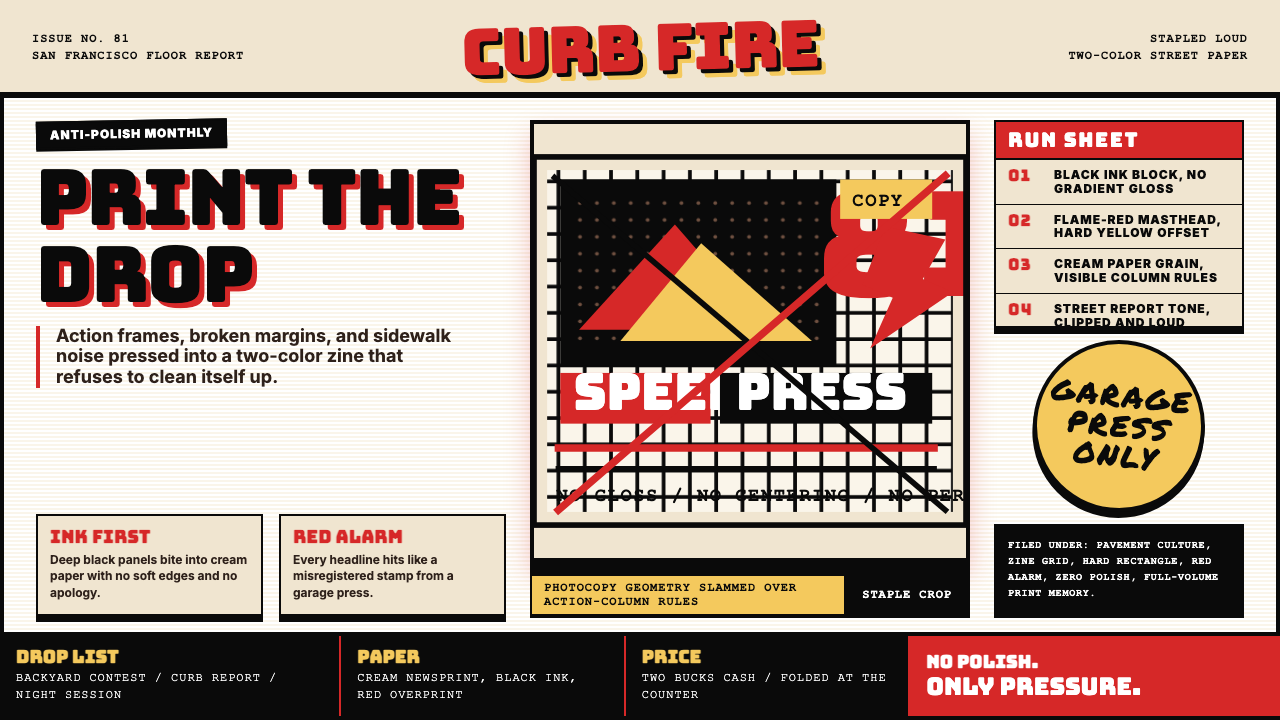 Thrasher Skate Zine (1981)Loud without polish. Flame red type, black ink blocks, and cream zine grids h…
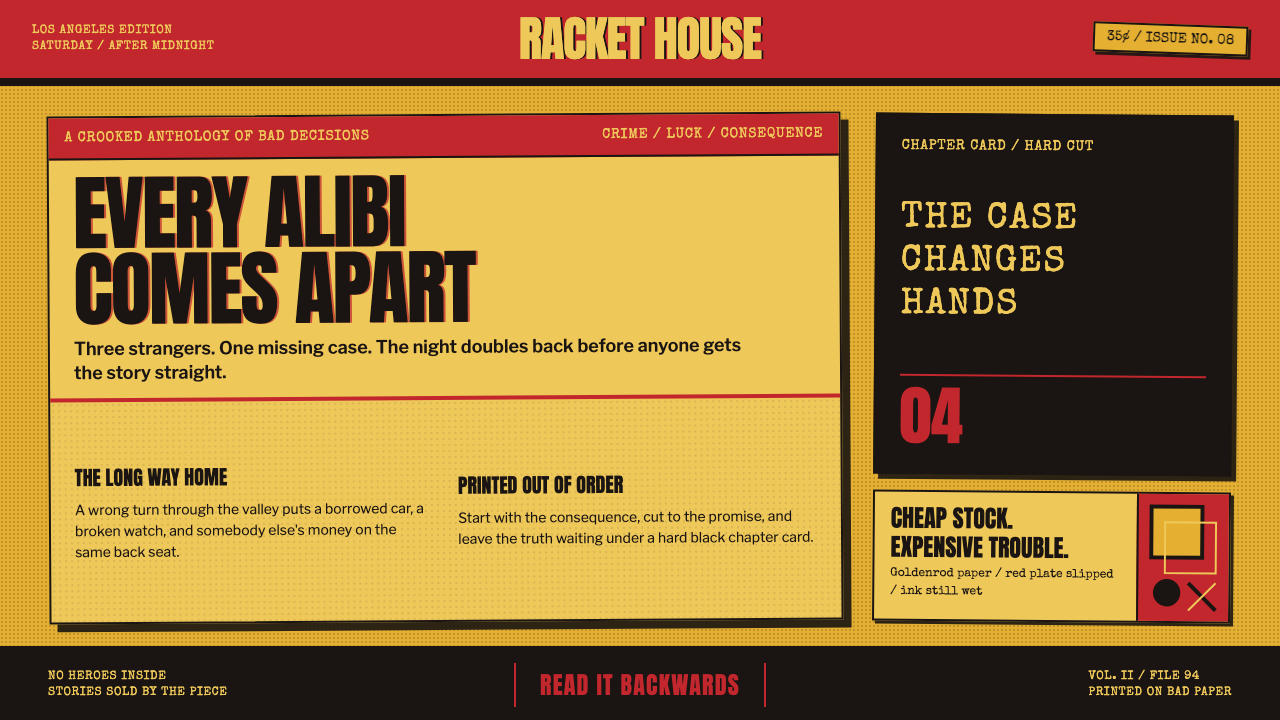 Pulp Fiction (1994)Cheap print, dangerous rhythm. Goldenrod stock, pulp red, and black chapter c…
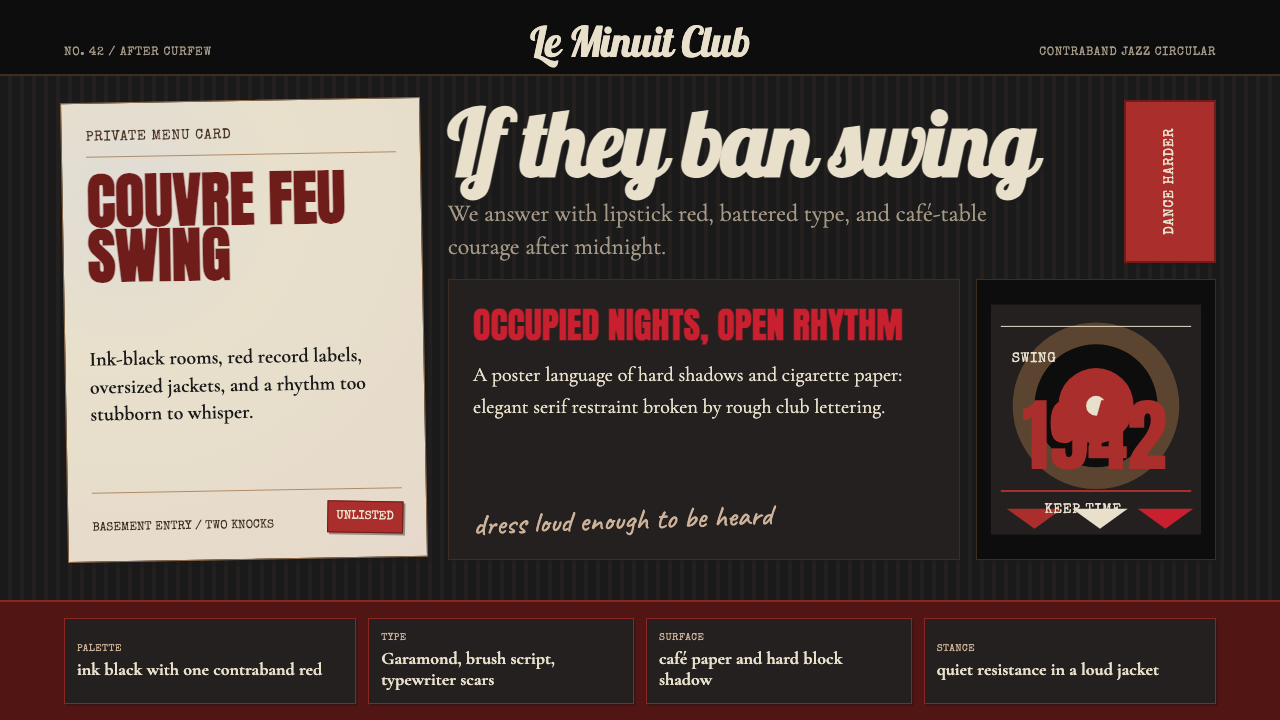 Parisian Zazou (1942)Defiance swings in the dark. Ink black, record-sleeve red, and battered typew…
 Rolling Stone MagazineCounterculture gets editorial weight. Cream paper, lipstick red script, serif…
 Cartoon Network 90s BlocksKids-cable noise, squared. Black-white checkerboards crash into hot-yellow Bu…
 DC Comics Batman NoirGravity, not cheer. Black panels, Gotham blue, and one bat-yellow signal cut…