What is Rolling Stone Magazine?
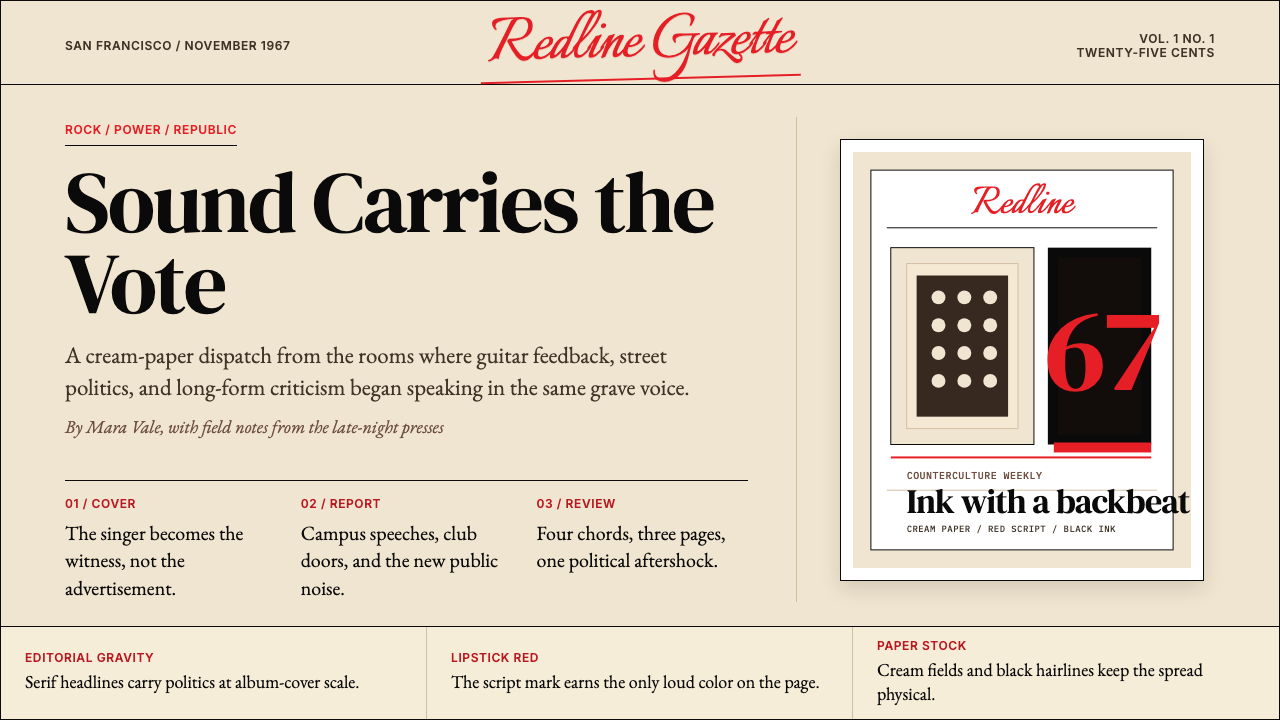
Born in a San Francisco loft in 1967, Rolling Stone turned counterculture into editorial weight — cream paper, lipstick-red script, and photographic portraiture that made rock music matter.
Rolling Stone Magazine in brief
Rolling Stone Magazine style is the visual language of America's most influential rock-and-politics journal, distilled from its founding year of 1967 through its decades-long run: warm cream backgrounds evoking newsprint, a saturated lipstick-red wordmark rendered in fluid script, deep-black serif body type that carries the gravity of serious editorial, and photographic portraiture that fills the cover with unguarded, charismatic presence. It is counterculture given the authority of a broadsheet.
What distinguishes this style from generic editorial pastiche is the specific tension it holds between heat and seriousness. The red wordmark is bold and sensuous — almost visceral — yet the body typography is composed, authoritative, and dense. The cream ground warms the whole system, softening what could otherwise feel combative into something that invites prolonged reading. This is not rock-poster energy; it is the energy of a journal that believed rock and politics and culture deserved the same analytical rigour as anything covered in the press.
On screen, the style translates as: a warm off-white or cream background field, a lipstick-red accent reserved for headlines, wordmarks, or primary calls to action, black serif type for body content, and photographic imagery given generous proportions and treated as the visual center of gravity. Decorative ornament is minimal — the system relies instead on typographic contrast, the boldness of the red, and the warmth of the ground to create hierarchy and atmosphere.

Where does Rolling Stone Magazine come from?
Rolling Stone was founded in November 1967 in a San Francisco loft by Jann Wenner, then twenty-one years old, and music critic Ralph J. Gleason. The timing was precise: the Summer of Love had just ended, Haight-Ashbury was in disarray, and the mainstream press still dismissed rock music as adolescent noise. Wenner and Gleason believed otherwise. Their founding editorial stated that they were not trying to be the music business's trade paper, nor a teenage magazine — they were a journal of rock and roll and the things and attitudes it represented. That ambition demanded a visual language to match.
The original design drew directly from the broadsheet newspaper tradition rather than from glossy music magazines. The first issues were printed on newsprint in a broadsheet format, which partly reflected the founders' limited budget and partly expressed a deliberate editorial stance: this was journalism, not fan culture. The cream-toned newsprint, the dense serif typography, and the serious layout all signalled that the content inside should be read and argued over, not skimmed. The lipstick-red script wordmark — handlettered in a fluid, cursive style — provided the only concession to rock and roll flamboyance, and it became immediately iconic.
Annie Leibovitz joined the magazine in 1970 at age twenty and became chief photographer by 1973, and her influence on the visual identity of Rolling Stone cannot be overstated. Her cover portraiture — John Lennon curled naked around Yoko Ono, shot hours before his murder; Keith Richards in a hotel room at dawn; Mick Jagger loose and laughing — defined what a magazine cover could do. The photographs were intimate and psychologically revealing in ways that fashion photography was not. They gave the cream-and-red cover system its emotional power: the color and type created authority; Leibovitz's images created feeling.
Hunter S. Thompson's association with the magazine, beginning with his 1970 coverage of the Kentucky Derby and peaking with Fear and Loathing in Las Vegas serialized across two 1971 issues, introduced gonzo journalism as both a literary and a visual genre. Thompson's dispatches arrived as raw, first-person documents of barely controlled chaos, and the magazine's design adapted accordingly: sprawling text layouts, images that broke across spreads, a sense that the page itself was barely holding its contents together. This editorial fearlessness — in content and in form — became as much a part of the Rolling Stone visual identity as the wordmark or the paper stock.
What defines the Rolling Stone Magazine look?
Cream Ground
The foundational color field is warm and off-white — reminiscent of aged newsprint or quality uncoated stock rather than sterile bright white. This warmth is not incidental. It softens the contrast of black type, reduces the visual aggression of the red wordmark, and signals analog editorial heritage. The cream ground is what separates the Rolling Stone aesthetic from cold modernist editorial design: the system feels printed, tactile, and time-stained in the best sense.
Lipstick-Red Accent
The defining chromatic gesture is a saturated, warm red — neither orange-red nor blue-red but the specific hue of cosmetic lacquer, bold and slightly sensuous. It appears in the wordmark, in primary headlines, and in key navigational or structural markers. Its deployment is disciplined: used in full force at one or two moments per composition, it reads as a confident editorial voice. Diluted or scattered across a layout, it loses its authority and becomes mere decoration.
Serif Authority
Body text and major headlines are set in serif type — a deliberate alignment with the broadsheet newspaper and literary journal traditions that Rolling Stone aspired to join. The serifs communicate seriousness and historical weight; they tell the reader that the content is meant to be read in full, not skimmed. Headline serifs are typically large, bold, and closely tracked; body serifs are set at a comfortable reading size with generous leading. The interplay between the serif gravity and the fluid red script wordmark creates the magazine's central visual tension.
Script Wordmark Energy
The flowing, handlettered wordmark is the single expressive release in an otherwise editorially restrained system. Its cursive looseness — the letters connecting and leaning as if written in one continuous gesture — introduces the spontaneity and physicality of rock and roll into a composition otherwise governed by journalistic convention. The script does not shout; it sings. Used sparingly as a signature element rather than a repeated motif, it anchors the identity without overwhelming the editorial content around it.
Photographic Portraiture
Imagery in this system is intimate, large-scale, and psychologically direct. Portraits dominate over landscapes or abstract imagery; the human face and body are given maximum visual real estate. Photographs are treated as primary editorial content rather than decorative fill — they are cropped to isolate psychological presence, not to flatten into graphic shapes. The color palette of the photographs tends to be rich and film-like: saturated but not processed, with the grain and warmth of analog photography rather than the hyper-precision of digital correction.
Editorial Density
Rolling Stone layouts are generous with text. Unlike contemporary digital editorial design, which often uses large white space as a luxury signal, the Rolling Stone tradition treats density as a mark of substance. Columns of body copy run long; headlines stack across multiple lines; pull quotes interrupt body text without apology. This density is not chaos — it is organized by a clear typographic hierarchy in which scale, weight, and color (especially the red) do the work of guidance.
Restrained Ornament
Despite its warmth and expressiveness, the Rolling Stone visual system uses very little decorative ornament. Ruled lines appear as section separators but are typically thin and unadorned. Drop caps, pull quotes, and typographic flourishes are used for functional editorial emphasis rather than visual enrichment. The restraint is what gives the red its power: in a system that indulges decoration freely, a saturated red accent becomes routine; in a system as disciplined as this one, it reads as a deliberate, authoritative gesture.

Who shaped Rolling Stone Magazine?
Wenner co-founded Rolling Stone at twenty-one and served as its editor and publisher for fifty years. His editorial vision — that rock music and the culture surrounding it deserved the same analytical seriousness as politics or literature — determined both the content and the visual ambition of the magazine. The broadsheet format, the long-form writing, and the insistence on photographic quality were all expressions of his conviction that Rolling Stone was journalism, not fandom. His editorial decisions, from commissioning Annie Leibovitz to serializing Hunter Thompson, shaped a visual and intellectual identity that outlasted him at the masthead.
Leibovitz joined Rolling Stone as a staff photographer in 1970 and became chief photographer in 1973, a position she held until 1983. Her covers defined the magazine's photographic identity for its most culturally formative period. She developed a style of portraiture that was intimate without being sentimental, psychologically penetrating without being cruel — achieved through extended time with subjects, unexpected locations, and an instinct for the unguarded moment. The visual grammar she established — generous scale, direct gaze, rich tonal range — became the template for editorial portraiture in the magazine era and remains the photographic reference point for the Rolling Stone visual system.
Thompson's contributions to Rolling Stone were as much visual events as literary ones. His gonzo journalism — first-person, subjective, formally chaotic — demanded page layouts that could accommodate unpredictable length, raw energy, and occasional illustration. The spreads designed around his work introduced a looser, more dynamic approach to the magazine's page architecture that balanced its otherwise disciplined editorial typesetting. His Fear and Loathing in Las Vegas, serialized in 1971 with Ralph Steadman's scratchy, aggressive illustrations, established that Rolling Stone would not sacrifice formal experimentation to visual tidiness.
Gleason was a jazz and music critic of established reputation when he co-founded Rolling Stone with Wenner. His presence lent the new magazine immediate intellectual credibility with an older readership skeptical of rock journalism. More importantly, his insistence that popular music deserved serious critical attention — the same argument he had made for jazz — provided the editorial and ethical foundation for everything the magazine would become. His influence on the magazine's tone, if not its visual identity, cannot be separated from its early design choices: the broadsheet seriousness, the long reviews, the refusal to treat musicians as celebrities rather than artists.
Steadman's illustrations for Hunter Thompson's gonzo dispatches in Rolling Stone introduced a visual counterpoint to the magazine's otherwise photographically driven identity. His ink-drenched, scratchy, deliberately ugly draftsmanship introduced raw expressionism into a layout system that was otherwise controlled and authoritative. The collaboration demonstrated that the Rolling Stone visual system was capacious enough to absorb formal contradiction — that the cream ground and red wordmark could coexist with illustration that was deliberately anti-beautiful — without losing its identity.
How do you use Rolling Stone Magazine today?
The Rolling Stone visual system transfers well to presentation slides, especially for editorial, cultural, music-industry, or brand-storytelling contexts where warmth and authority need to coexist. A cover slide built in this style anchors a large, intimate photograph — ideally a portrait — at full bleed or generous scale, with the presentation title set in large bold serif type in the upper third. The red accent appears in one place only: either the title itself or a horizontal rule below it. The cream ground is not pure white; allowing it to read as warm and slightly aged makes the whole composition feel intentional. Content slides follow a structured editorial layout: one or two columns of serif body text, section titles that step down through scale rather than color, and data panels that treat charts as editorial objects set within the same typographic system rather than visual appendages.
For web interfaces and digital dashboards, the style suits platforms that want to communicate authority, intelligence, and depth without the coldness of purely modernist design. A pricing or feature page built in this tradition uses the cream or warm off-white as the page field, black serif for all descriptive copy, and the red as the single interactive highlight — hover states, selected tiers, primary buttons. Photography in hero sections should be treated as Rolling Stone covers: large, portrait-oriented where possible, not cropped to a decorative rectangle but given room to breathe as the page's main event. Navigation should be typographic and restrained, letting the wordmark or logotype carry the brand identity rather than iconographic decoration.
In editorial and marketing contexts — magazine layouts, brand story documents, campaign landing pages — the style excels at building the impression that a brand has genuine history, intellectual seriousness, and cultural confidence. Long-form content is the natural territory: the system is built for sustained reading, not for rapid visual consumption. A marketing page in this mode structures its sections like editorial spreads — alternating cream-ground text sections with full-width photographs — and uses the red exclusively for calls to action and section-marking rules. Pull quotes in large serif type, set loose from the body column, provide visual rhythm without decorative ornament.
The system is less suited to products or contexts where cheerfulness, playfulness, or visual lightness are primary values. The warmth of the cream ground is inviting, but the overall register is adult, serious, and slightly weighted. Consumer products aimed at broad demographic appeal, children's or family contexts, or fast-moving digital products that require aggressive visual hierarchy across many competing elements will find the Rolling Stone palette and typographic approach too restrained and too slow.
A common mistake when applying this style is confusing warmth with looseness. The Rolling Stone visual system is warm but not casual — it is an editorial system with strict hierarchy, and the red accent works precisely because it appears rarely and deliberately. Using the red liberally across many interface elements, or substituting playful display typefaces for the authoritative serif, dismantles the system's logic. Similarly, substituting a bright clean white for the cream ground cools the system significantly, moving it toward generic editorial modernism and away from the analog heritage that gives Rolling Stone its particular emotional register.

Rolling Stone Magazine — FAQ
What makes the Rolling Stone style different from generic editorial design?
The distinguishing factor is the specific combination of warmth and authority. Generic editorial design tends to choose one or the other: modernist editorial is cool and authoritative; lifestyle editorial is warm and casual. Rolling Stone holds both at once — the cream ground and flowing script introduce warmth, while the dense serif type and serious photographic portraiture introduce authority. This tension is not a compromise; it is the system's defining characteristic, and it reflects the magazine's original conviction that counterculture deserved the same analytical weight as any establishment institution.
Can this style work for technology or software products?
It works for technology products that want to communicate depth, intelligence, and a point of view rather than neutral utility. Editorial tools, research platforms, long-form content applications, music or culture industry software, and any product positioning itself as thoughtful rather than fast would benefit from the system's warmth and typographic authority. It is less suited to software products that need to emphasize speed, efficiency, and frictionless interaction, where the serif density and cream warmth would read as slow and heavy rather than authoritative.
How should photography be selected and treated to fit this style?
Photographs should be selected for psychological presence rather than compositional tidiness. A slightly imperfect, emotionally direct image will almost always serve the system better than a highly produced, art-directed photograph that prioritizes visual perfection. The preferred treatment is minimal: print-like tonal richness, authentic grain or texture rather than digital smoothness, and cropping that isolates the subject's presence rather than flattening them into a design element. Black-and-white treatment is highly compatible with the system, as it allows photographs to participate in the cream-and-black typographic field without color competition.
Is the Rolling Stone style appropriate for dark-mode interfaces?
The canonical Rolling Stone palette is light-ground — cream and off-white are essential to the system's warmth, and the style is not primarily designed for dark inversion. A dark-mode adaptation is possible but requires compromise: a very deep warm charcoal or near-black replaces the cream ground, the red accent remains but may need to be slightly more orange to maintain vibrancy against a dark field, and the serif type becomes cream or near-white. The challenge is that much of the system's warmth comes from the cream ground itself; on a dark field, the warmth must be carried entirely by color temperature of the red and the slight warmth of the background rather than the ground's intrinsic lightness.
How does this style relate to other editorial styles like New Yorker or Vogue?
All three are editorial systems built around strong typographic identity and authoritative photographic culture, but they serve different emotional registers. The New Yorker is cooler, more literary, and more restrained in photographic scale — illustration and text dominate over photography. Vogue is warmer and more sensuous, but its warmth comes from luxury and glamour rather than analog texture; its photography is art-directed and idealized rather than intimate and psychologically revealing. Rolling Stone occupies the middle ground — warmer and more physical than the New Yorker, less aspirationally glamorous than Vogue, and more politically and culturally engaged than either. The cream ground and red script are specific to its particular fusion of credibility and heat.
Related design styles
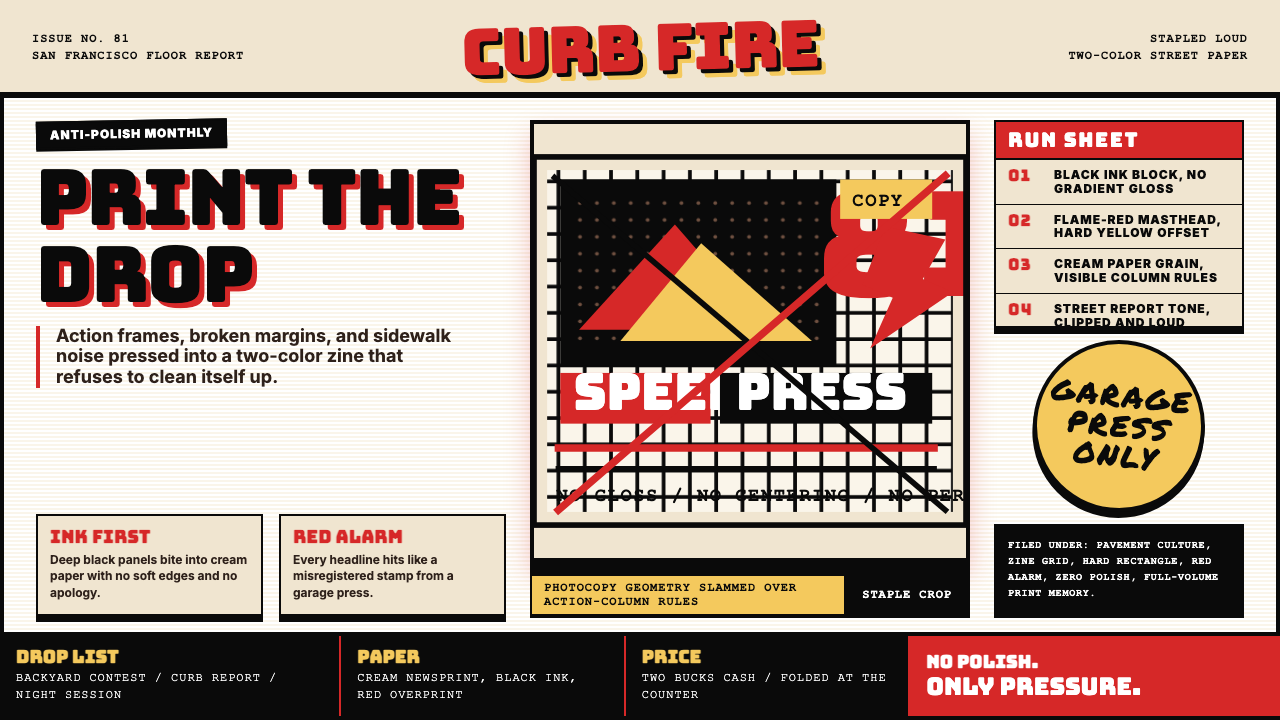 Thrasher Skate Zine (1981)Loud without polish. Flame red type, black ink blocks, and cream zine grids h…
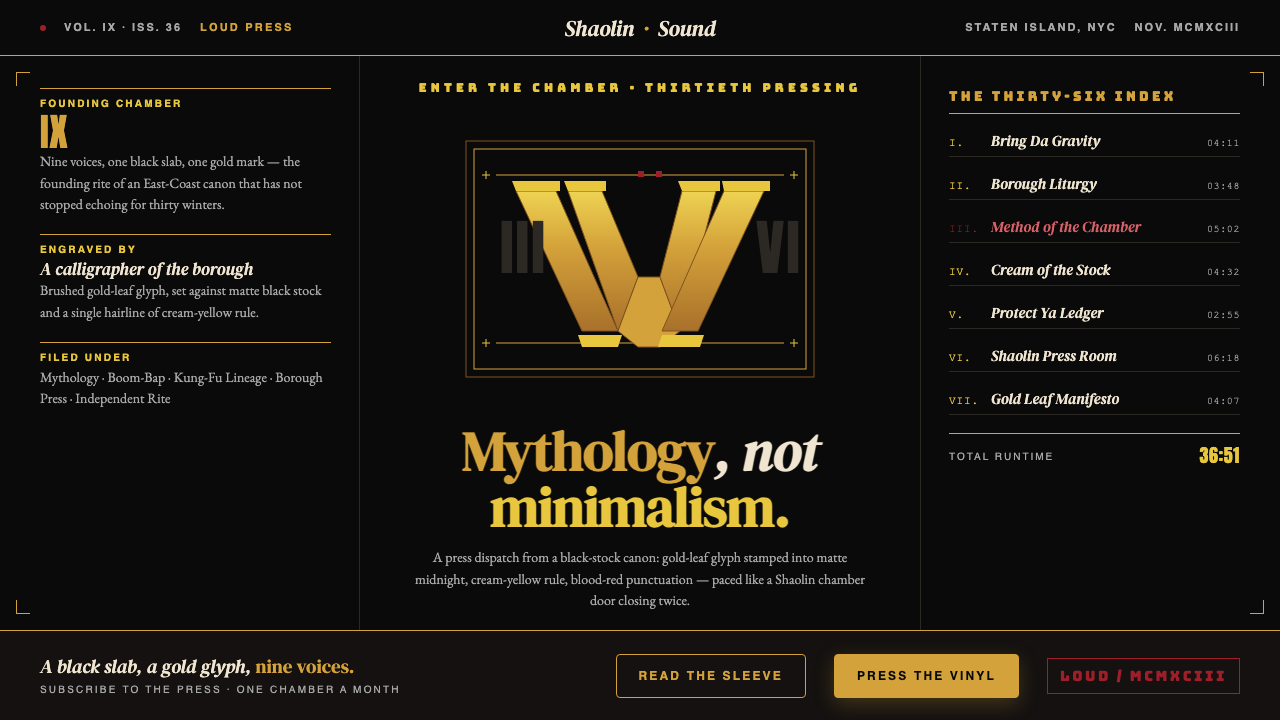 Wu-Tang Clan — 36 ChambersMythology, not minimalism. Gold-leaf glyph on matte black, cream-yellow rule,…
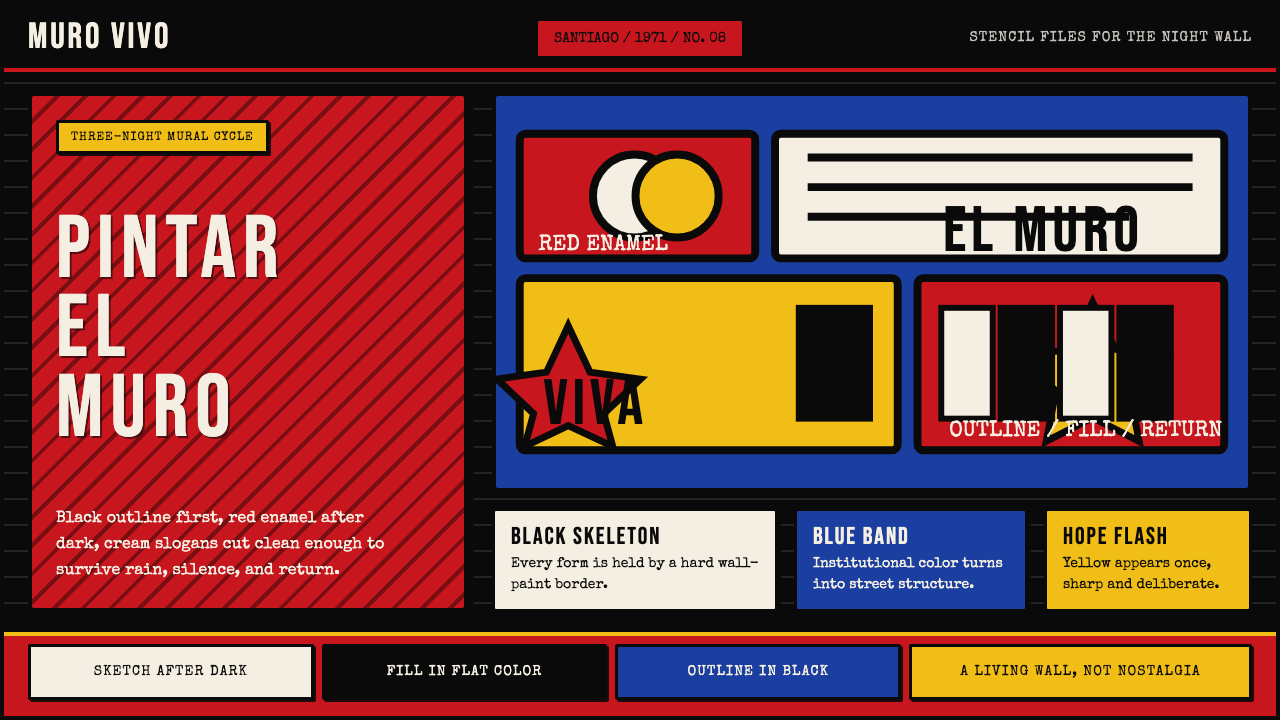 Chilean BRP Ramona Parra 1971Resistance stays alive. Blood red panels, black outlines, and stencil type re…
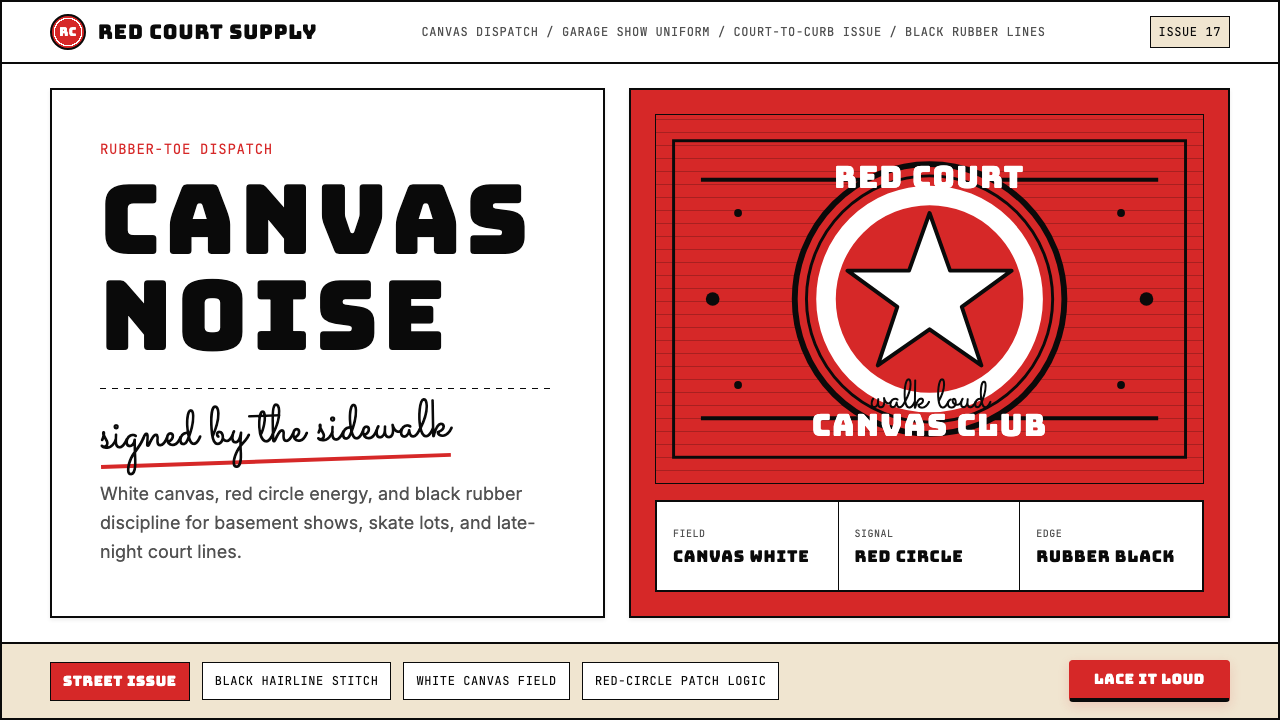 Converse Chuck TaylorPopulist and loud. Saturated red circles, Bungee type, black stitch lines on…
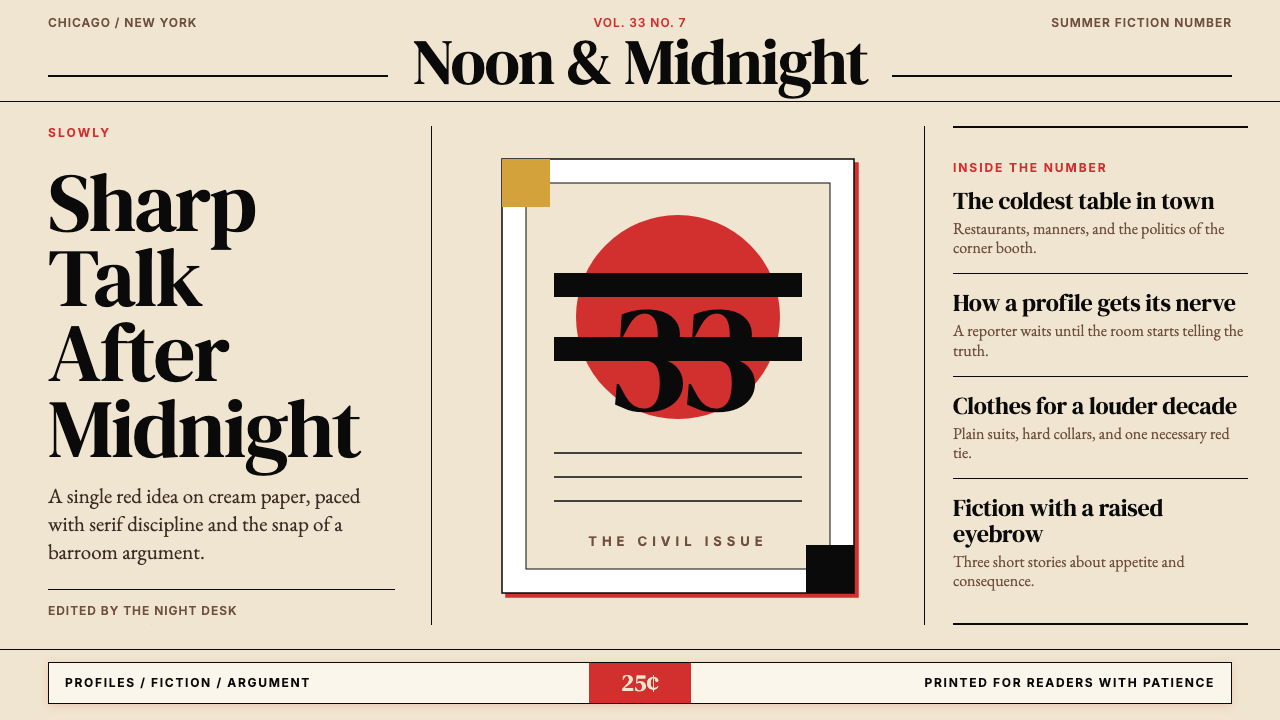 Esquire MagazineConceptual punch on paper. Cream stock, black hairlines, and one saturated re…
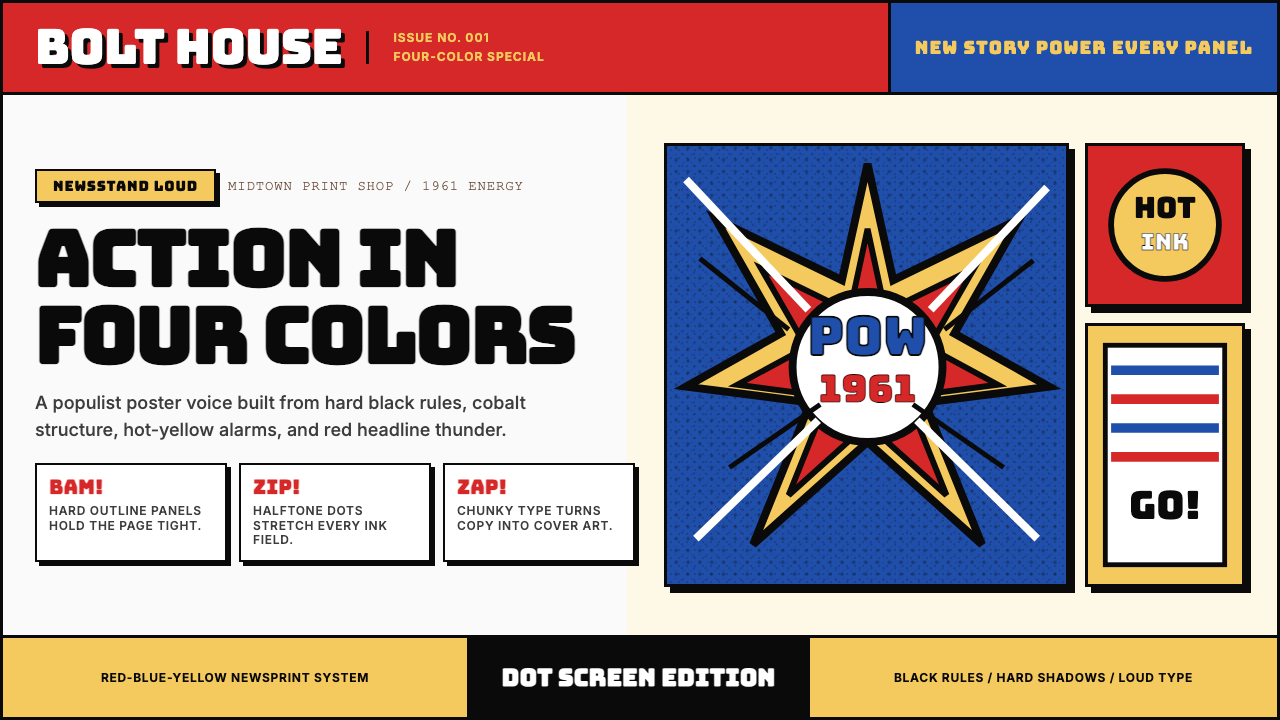 Marvel Comics (Kirby Era)Populist color hits hard. Red-blue-yellow panels, black rules, and halftone d…