What is Esquire Magazine?
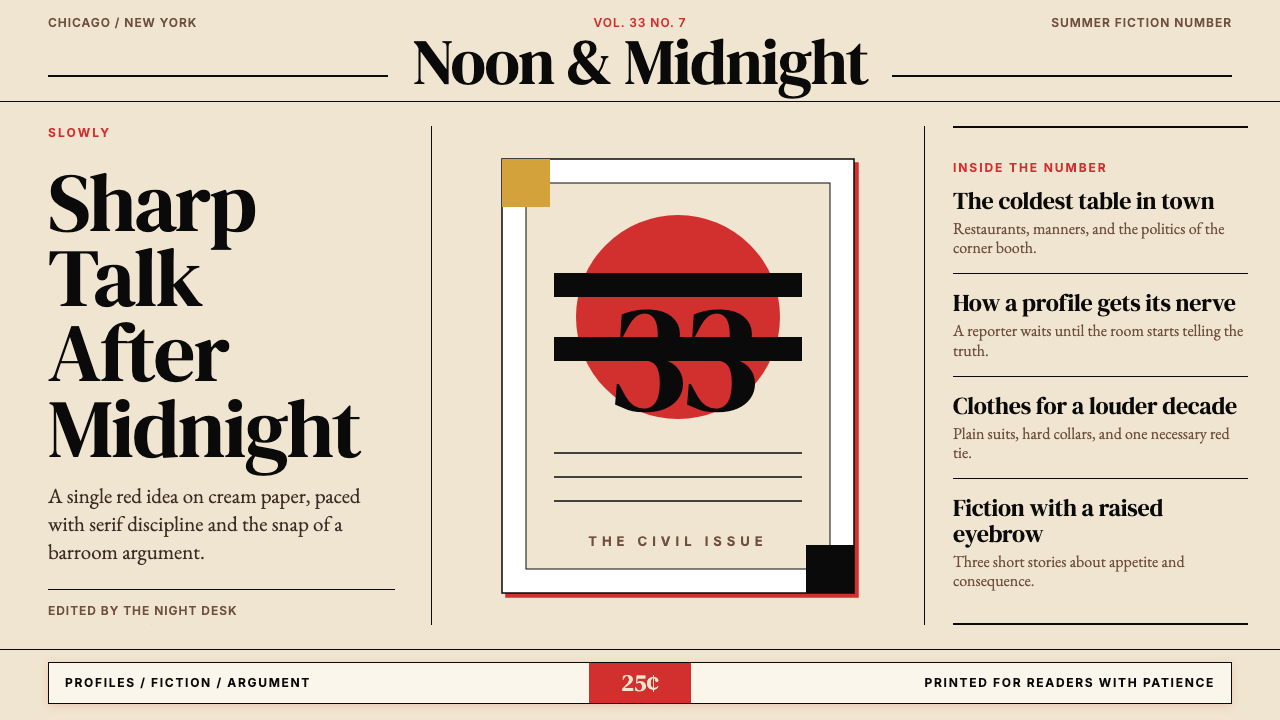
Cream stock, a single saturated red, and ninety-two covers that changed what an American magazine could say.
Esquire Magazine in brief
Esquire is America's most iconic mid-century men's magazine, founded in Chicago in 1933 and carried to the peak of design history by art director George Lois between 1962 and 1972. Its visual language is mid-century modern editorial: warm cream or off-white paper, one concentrated saturated red used as a conceptual weapon, deep black for type and structure, and generous letter-spacing on serif headlines that gives the page an air of measured authority. Composition is not decorative — it is argumentative. Every cover, every spread, makes a claim.
What distinguishes Esquire from other mid-century editorial styles is the marriage of New Journalism literary ambition with the blunt graphic force of a protest poster. The writers — Tom Wolfe, Gay Talese, Norman Mailer — supplied long-form prose of unusual intensity. Lois supplied covers that compressed the same intensity into a single image, often provocative to the point of controversy. The result was a magazine whose design and editorial voice were inseparable: the layout did not illustrate the text, it argued alongside it.
The core aesthetic rests on economy of means. A restrained palette of cream, black, and red is not a limitation — it is a discipline that forces every element to earn its place. Conceptual graphic compositions — a figure in an unexpected context, a symbol inverted, a headline that reframes the image — replace decorative arrangement. The style rewards confidence and punishes clutter. When applied correctly, it produces work that feels authoritative, cultured, and slightly dangerous.

Where does Esquire Magazine come from?
Esquire was founded in October 1933 in Chicago by David A. Smart, William H. Weintraub, and editor Arnold Gingrich. The launch was a calculated risk: the United States was in the depths of the Great Depression, and a quarterly men's magazine priced above competing publications seemed a dubious proposition. Smart bet on quality — both editorial and physical. The first issue, printed on heavy coated stock with color illustrations and contributions from Ernest Hemingway, F. Scott Fitzgerald, and John Dos Passos, sold out its print run of approximately one hundred thousand copies within days. The magazine's material presence — its weight, its paper, its illustrations — was itself an argument that men with refined tastes still existed and still spent money.
Through the 1940s and 1950s, Esquire established its literary identity and its visual credibility. Alberto Vargas contributed his celebrated pin-up illustrations, which became a signature feature; the magazine published fiction by Hemingway, Steinbeck, and later Nabokov. The art direction of this period was elegant but not yet revolutionary — sophisticated use of illustration, careful headline typography, and a consistent commitment to the cream-and-black color architecture that would later become the canvas for Lois's experiments.
The decisive transformation came in 1962, when Harold Hayes became editor and George Lois began his decade-long collaboration with the magazine. Lois, born in the Bronx to a Greek immigrant family, had trained under the art director Herschel Levit and worked at agencies before striking out independently. His approach to the Esquire cover was conceptual before the word was common currency in design: he did not illustrate the issue's contents, he constructed a single image-idea that commented on American culture. The 1968 cover depicting Muhammad Ali pierced by arrows in the pose of Saint Sebastian — a reference to Ali's persecution for refusing military induction — was named by a Columbia University survey as the best magazine cover of the twentieth century. Of the ninety-two covers Lois designed for Esquire, dozens entered the permanent collection of the Museum of Modern Art.
The New Journalism movement that ran parallel to Lois's visual revolution gave the magazine its editorial philosophy. Gay Talese's 1966 profile of Frank Sinatra, published without a single interview with its subject, and Tom Wolfe's reports from the counterculture front redefined what magazine journalism could do. The design responded: text-heavy layouts with clear hierarchy, generous white space treated as active composition rather than empty margin, and the sense that every page was a considered visual argument. This dual legacy — conceptual cover art and literary long-form — defines what it means to work in the Esquire aesthetic.
What defines the Esquire Magazine look?
Color Economy
The Esquire palette is deliberately narrow: warm cream or off-white as the ground, deep black for typography and structural elements, and one saturated red deployed as a conceptual accent. The red is never decorative — it marks the thing the image argues about. Secondary colors appear rarely, if ever, and when they do they are muted rather than competing with the primary tension. This economy is what gives the style its punch: with so little color in play, every chromatic decision carries full visual weight.
Conceptual Composition
The defining compositional move in Esquire design is the single conceptual image: one figure, one symbol, one juxtaposition that carries a complete argument. This is not photographic reportage and not decorative illustration — it is graphic rhetoric. The composition is built around a central visual idea that the viewer must decode, making the act of looking itself active. Backgrounds are minimal or absent; the conceptual figure occupies the field with nothing to dilute its authority.
Serif Typography with Breathing Room
Esquire's typographic sensibility is rooted in the mid-century editorial tradition of the quality press: serif typefaces for headlines and body text, set with generous letter-spacing that signals unhurried authority rather than tabloid urgency. The headline scale is bold — large enough to command the page — but the spacing prevents it from feeling aggressive. This combination of confident scale and restrained spacing is the typographic equivalent of speaking slowly and clearly. Subheads and captions are lean and precise, providing structure without competing for attention.
Editorial White Space
Esquire treats white space — or more precisely, cream space — as an active compositional element, not as the absence of content. Generous margins, breathing room between headline and body text, and deliberate voids around conceptual images all communicate seriousness and confidence. A page that is crowded signals anxiety; a page with room to breathe signals authority. This editorial generosity with space is one of the clearest markers of the style and one of the most commonly violated when imitated.
Provocative Image-Text Relationship
In authentic Esquire-style work, the image and headline do not simply illustrate each other — they create meaning through friction. The image sets a scene or makes a claim; the headline reframes it, contradicts it, or provides the key that unlocks its meaning. This tension between visual and verbal is the engine of the conceptual cover format and applies equally to interior spreads. A headline that merely describes the image it accompanies is a missed opportunity; a headline that reorients the image produces the signature Esquire effect.
Material Quality Signaling
From its first issue, Esquire used paper weight and print quality as meaning-making tools. The warm cream stock — heavier, warmer, and more tactile than newsprint — positioned the magazine as an object worth keeping, not discarding. In digital and presentation contexts, this material quality translates into careful attention to background tone (cream rather than pure white), text contrast, and the overall sense that nothing is cheap or rushed. The aesthetic communicates that its maker believes the work deserves the reader's sustained attention.
Restrained Wit
Esquire's visual wit is never obvious and never self-congratulatory. The conceptual twist in a Lois cover — Ali as Saint Sebastian, Andy Warhol drowning in a can of soup — is sharp and dark, not light and playful. The humor, where it exists, is the kind that makes the viewer think before laughing. This tone of restrained, knowing wit pervades the style: it shows sophistication without announcing it, and it privileges the reader's intelligence by assuming they will complete the thought.

Who shaped Esquire Magazine?
Lois served as Esquire's primary cover art director from 1962 to 1972, producing ninety-two covers that transformed the magazine cover from an illustration format into a medium for conceptual argument. Born in the Bronx to Greek immigrant parents, he developed a combative, idea-first approach to visual communication at advertising agencies before applying it to editorial design. His covers — including the Muhammad Ali as Saint Sebastian image of 1968, the 1965 cover of Sonny Liston as a Black Santa Claus, and the 1969 cover showing Lieutenant Calley surrounded by smiling Vietnamese children — used graphic shock to carry political meaning. Many entered the permanent collection of the Museum of Modern Art. Lois went on to a long career in advertising and continued to argue, until his death in 2022, that design without an idea is mere decoration.
Hayes served as editor of Esquire from 1963 to 1973, the period that coincides precisely with the magazine's creative peak. Where Lois provided the visual argument, Hayes provided the editorial philosophy: he believed that a magazine could operate at the highest literary and intellectual level while remaining a commercial object with popular reach. He commissioned the landmark works of New Journalism — Gay Talese's Frank Sinatra profile, Tom Wolfe's reports from the counterculture, Norman Mailer's essays on America — and he trusted Lois enough to give him covers that the magazine's sales team sometimes found alarming. Hayes understood that the design and the writing were making the same argument by different means, and he protected that alignment.
Gingrich was Esquire's founding editor, the man who set its tone from the first issue in 1933. His instinct was to treat male readers as a genuinely literary audience — capable of engaging with serious fiction and long-form journalism — at a moment when most men's publications offered lighter fare. He secured contributions from Hemingway, Fitzgerald, and Dos Passos for the first issue, establishing an editorial precedent that would carry through to the New Journalism era three decades later. Gingrich's belief that quality writing and quality design reinforced each other laid the philosophical foundation for what Lois and Hayes would build.
Wolfe was the New Journalism movement's most flamboyant stylist and one of Esquire's signature contributors during the magazine's peak years. His essays — on stock car racing, the counterculture, the astronaut program, the New York art world — brought a novelistic immediacy and satirical energy to reportage that had no precedent in American magazine writing. For Esquire's design team, Wolfe's long-form prose presented a productive constraint: how do you lay out five thousand words of maximum-density journalism in a way that respects both the text and the reader? The answer the magazine developed — clear typographic hierarchy, generous measure, white space as pacing device — became a template for serious editorial design.
Talese's 1966 Esquire profile of Frank Sinatra — published without a single direct quote from its subject, constructed entirely from observation and secondary sources — is one of the foundational texts of American narrative journalism and a demonstration of the editorial courage that Hayes and Esquire represented. The piece ran at a length and with a typographic seriousness that signaled to readers that what they were about to read was literature, not celebrity coverage. Talese's work, alongside Wolfe's, defined the editorial standard that Esquire's design language was built to support: writing that rewards sustained, unhurried attention deserves a layout that commands the same.
How do you use Esquire Magazine today?
The Esquire aesthetic translates most naturally into contexts where authority, cultural seriousness, and a degree of provocation are desirable. It is not a style for everything — it is a style for work that has a point of view and is not afraid to make it visible. Applied correctly, it produces decks, pages, and layouts that feel considered rather than decorated, argumentative rather than merely attractive.
For presentation slides, the cover page is the highest-leverage opportunity. A single conceptual image or graphic — one strong visual idea, not a collage — against a cream or near-white ground, with the title in a large serif at generous letter-spacing and one accent element in red. The image should not illustrate the title; it should reframe it or create tension with it. Content slides follow a strict hierarchy: one organizing idea per slide, body text in a readable serif with open line-spacing, section markers as bold rules rather than decorative ornaments. Data slides work best when charts are treated as designed objects — clean axes, color used to highlight the one datapoint that matters, no decorative grid lines.
For web interfaces and dashboards, the Esquire approach demands restraint and hierarchy. Use a cream or warm off-white background rather than pure white to soften screen fatigue; reserve black for all primary text. Navigation should be typographic — names and labels at consistent size and weight — with no icon clutter. Red appears only for the one thing that requires immediate attention: an alert, an active state, a primary call to action. Pricing pages benefit from the style's poster-like directness: large, confident type states the price; supporting detail is set smaller and given breathing room; no gradient cards or soft-shadow flourishes compete with the message.
For editorial and marketing materials, the style supports long-form content presented with confidence. An article layout in this mode uses a wide left margin for running heads or pull quotes, a narrow body text column with careful leading, and section breaks marked by a single bold horizontal rule. Marketing applications work well with the cover-poster logic: one full-width conceptual image, a headline in large serif that argues rather than describes, and a supporting line in smaller type that completes the thought. The red accent should appear once — on the call to action or on the element that deserves to be remembered.
A common mistake is reducing the Esquire aesthetic to its surface elements — cream background, red accent, big type — without understanding the conceptual logic underneath. The style does not work if the image is merely decorative and the headline merely descriptive. The visual-verbal tension that defines the style requires that image and text create meaning together that neither creates alone. A second common error is over-applying the red: one saturated accent in the right place is powerful; two competing red elements cancel each other. The economy of the palette is the source of its authority, not a limitation to be expanded.

Esquire Magazine — FAQ
Is the Esquire style the same as general mid-century editorial design?
Not quite. Mid-century editorial design is a broad category that includes everything from Life magazine's photojournalism layouts to Harper's Bazaar's fashion spreads and Time's newsweekly grids. What distinguishes the Esquire style specifically is the conceptual cover logic — the idea that image and text should argue rather than illustrate — and the very restricted palette centered on cream, black, and one saturated red. Many mid-century publications used richer color, more decorative typography, and illustrative rather than conceptual image strategies. Esquire's distinctiveness is its intellectual edge: it borrowed the tools of advertising (bold graphics, provocative imagery) in service of literary journalism.
Can this style work for brands outside publishing and media?
Yes, with careful alignment between the style's values and the brand's values. The Esquire aesthetic communicates authority, cultural seriousness, wit, and a degree of confidence that borders on provocation. It works well for brands that want to position themselves as the smart, principled choice in a crowded market — premium financial services, high-end consultancies, literary or arts institutions, and technology products targeting sophisticated professional users. It works poorly for brands where warmth, accessibility, playfulness, or broad-demographic appeal are primary goals. The style is inherently selective in who it speaks to, which is a feature when the brand is selective, and a liability when it is not.
How do you handle photography in this style without making it look generic?
The Esquire approach to photography is conceptual rather than documentary. The image is chosen or directed to make a specific argument, not to illustrate the general topic. This means selecting photographs that have an inherent visual idea — an unexpected juxtaposition, a figure in an incongruous context, a moment of tension captured at precisely the right instant — rather than photographs that are merely competent or beautiful. Cropping is aggressive: dead air around a subject is cut, and the figure is given the full weight of the frame. Color photography should typically be desaturated toward the palette's tonal range, or used at full saturation only for the red accent elements; competing saturated colors undermine the palette's authority.
What is the most common mistake when trying to apply the Esquire look to a corporate presentation?
Importing the palette without the conceptual logic. A cream background with a red accent and a large serif headline will look Esquire-adjacent, but it will not feel like Esquire if the image is a stock photo of a handshake and the headline is a literal description of the slide's content. The style's authority comes from the relationship between image and text, not from any individual element. A second common error is timidity with scale — the style requires commitment to large type, generous space, and strong contrast. A headline that is only slightly larger than the body text, a red accent that is faint to avoid looking 'too bold,' and a cream that has drifted to pure white are all signs that the style has been applied halfheartedly. Esquire's aesthetic is one that rewards conviction.
Does the style work in dark mode or on dark backgrounds?
The historic Esquire palette is unambiguously light-ground: cream or off-white is the canonical base. A dark inversion — black ground with cream or white type and a red accent — is possible and occasionally used effectively, but it shifts the style's character significantly. On a dark ground, the warmth of the cream is lost and the overall effect becomes colder and more confrontational. The red accent tends to vibrate more aggressively against black than against cream, which can be used deliberately for emphasis but easily becomes fatiguing. If a dark treatment is required, commit to a single warm light accent against a very dark (not pure black) ground, and reduce the use of red to the absolute minimum — one element, one moment.
Related design styles
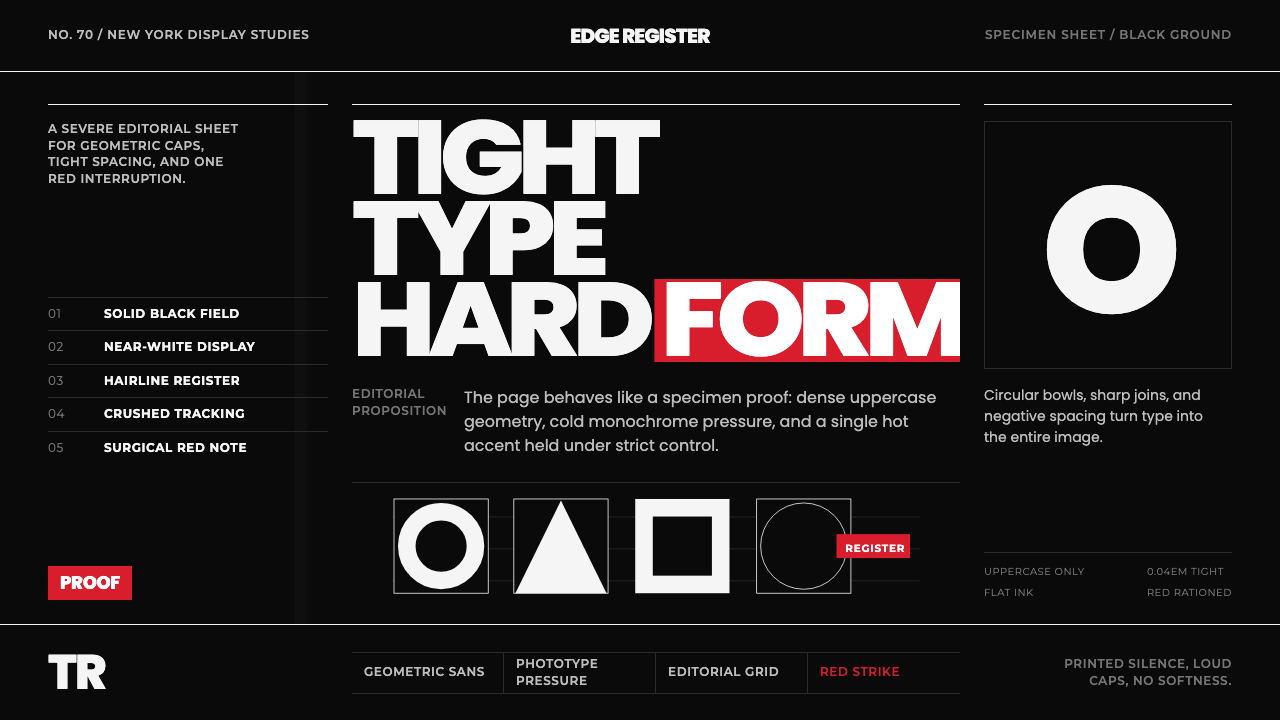 Avant Garde GothicType is the image. Tight white caps on black, ruled grids, one hot red strike.
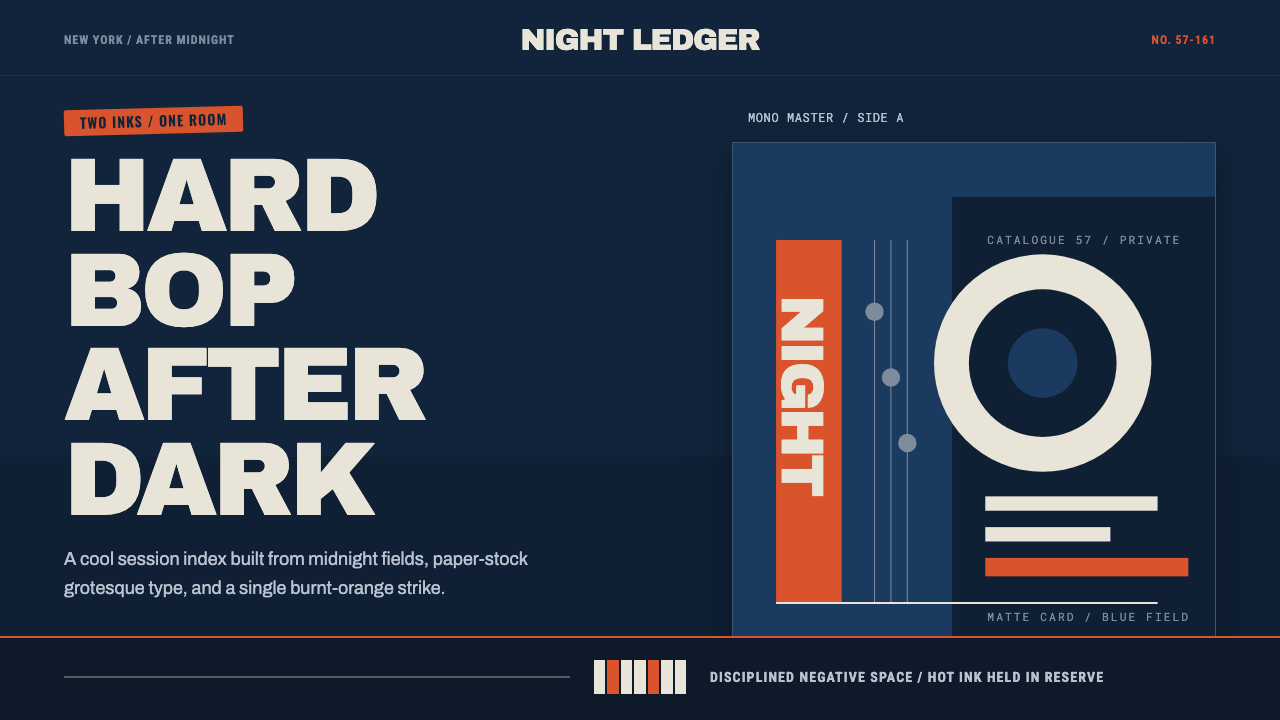 Blue Note JazzCool intelligence, printed flat. Midnight blue, paper type, and one burnt-ora…
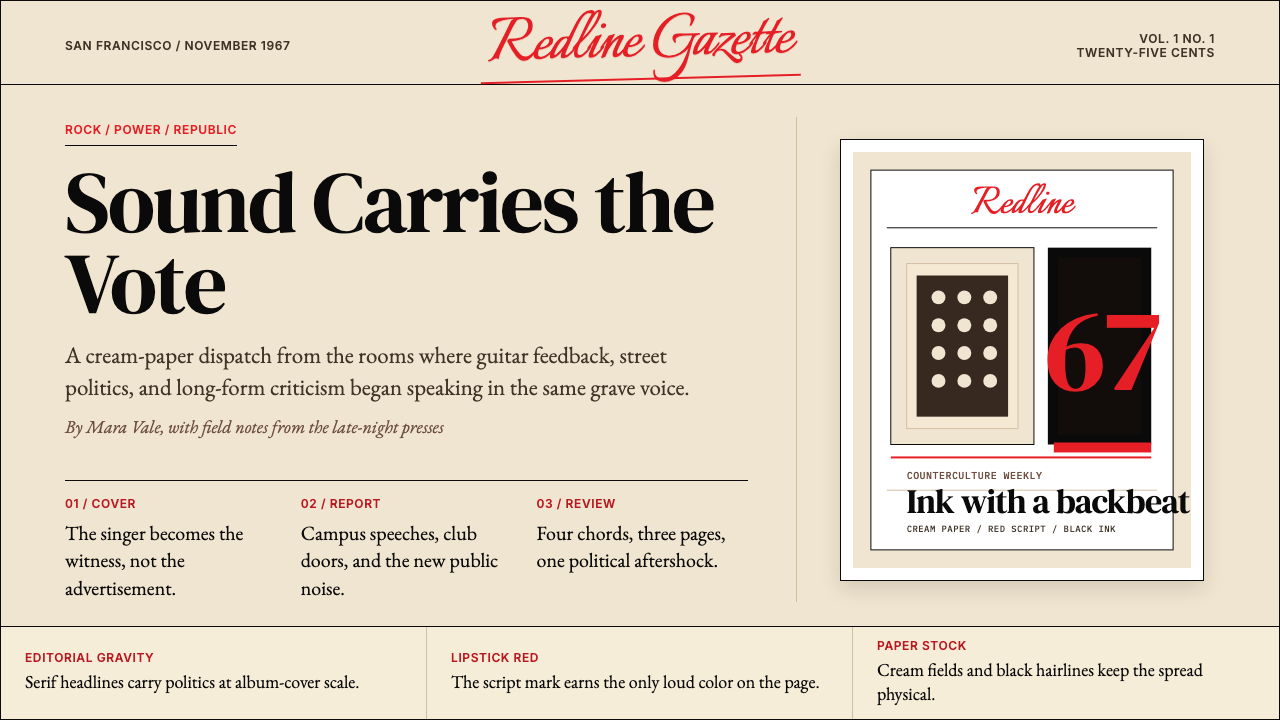 Rolling Stone MagazineCounterculture gets editorial weight. Cream paper, lipstick red script, serif…
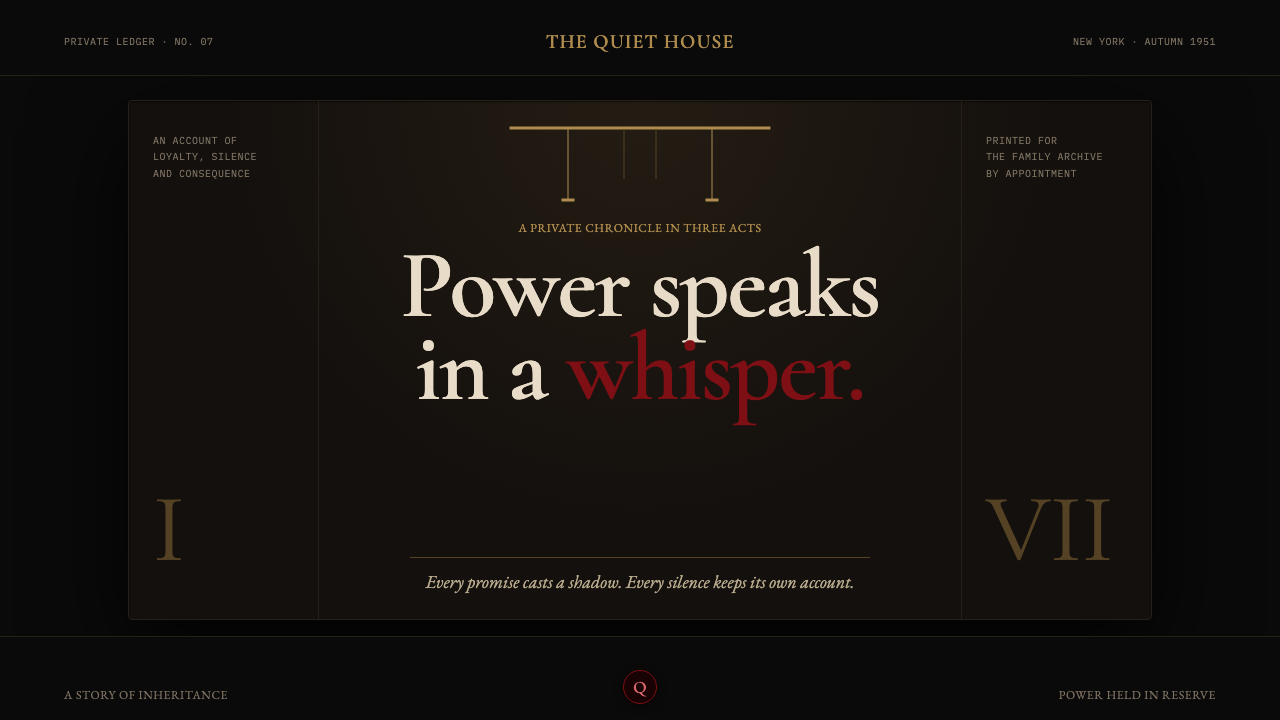 The Godfather (1972)Quiet authority becomes menace. Near-black shadow, brass rules, and one oxblo…
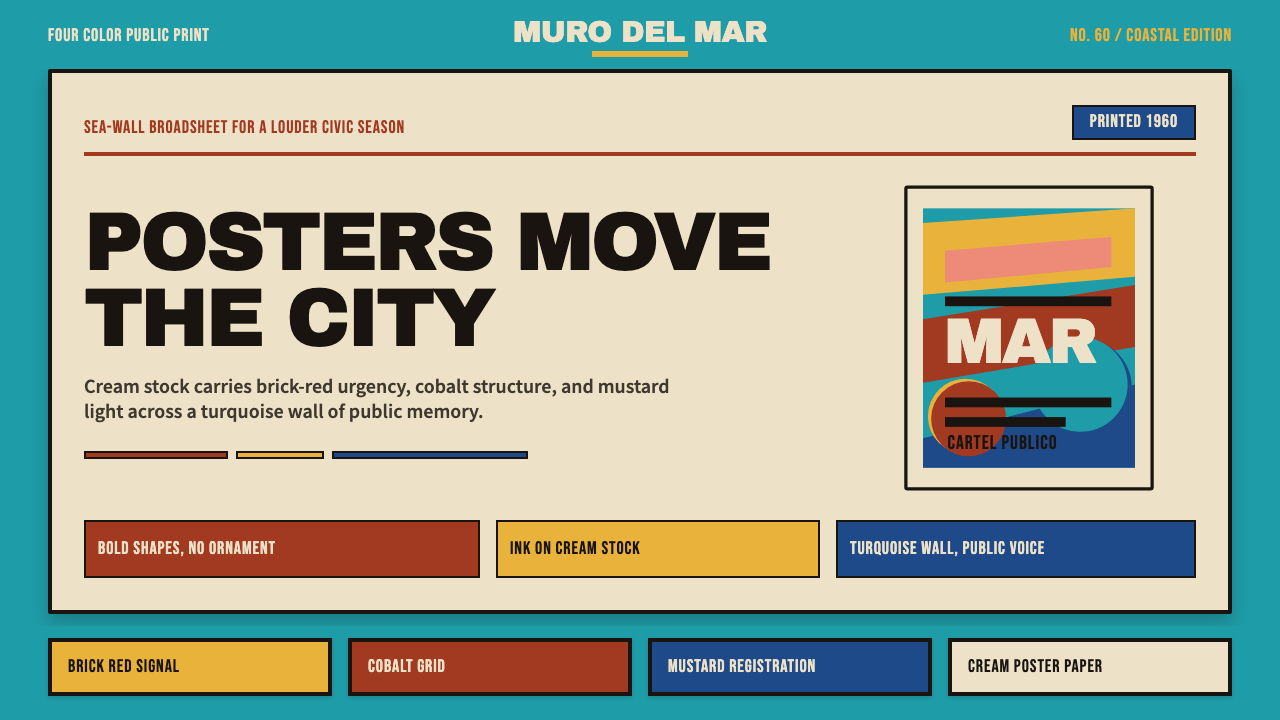 Cuban Malecón 1960 PosterPublic voice in flat ink. Turquoise wall, cream stock, brick red and cobalt b…
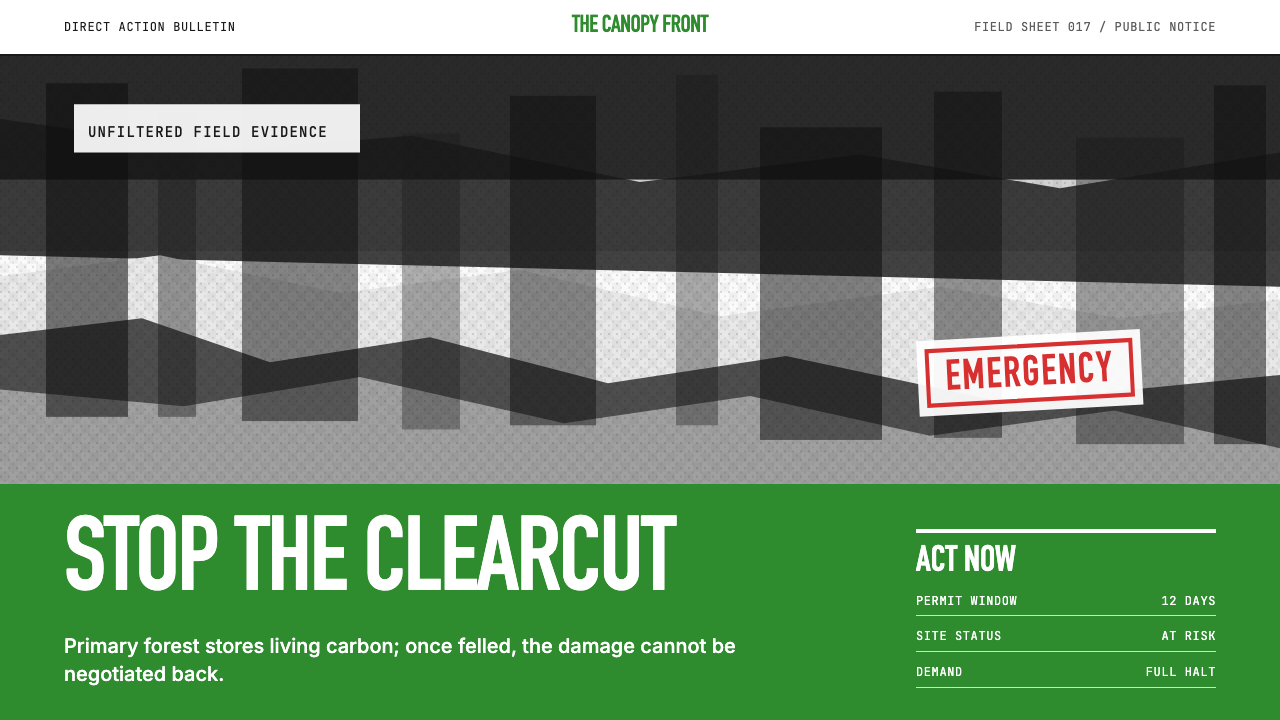 Greenpeace (Activist Poster)Protest without softness. Forest-green caps over monochrome newsprint, one de…