What is Greenpeace (Activist Poster)?
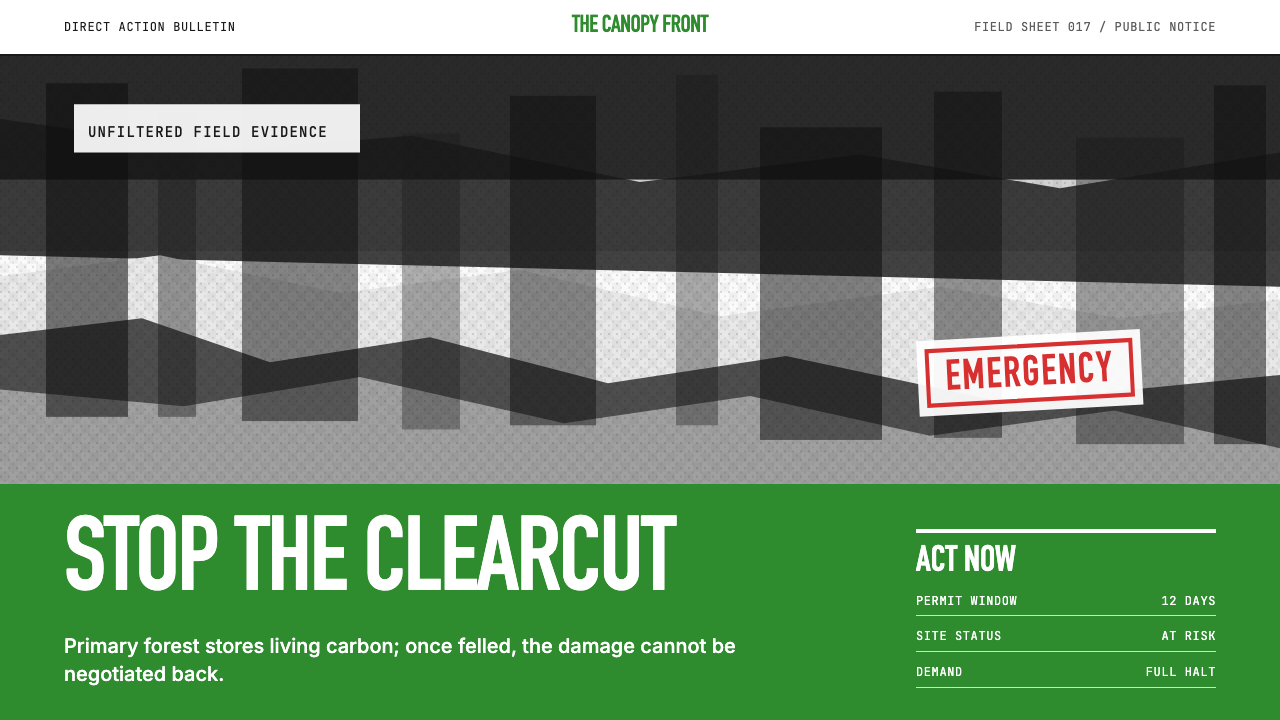
Greenpeace's visual language is protest stripped to bone — one black-and-white photograph, one all-caps demand, and forest green that refuses to negotiate.
Greenpeace (Activist Poster) in brief
Greenpeace Activist Poster is a visual system built entirely on urgency. Its grammar is borrowed from newspaper front pages and wheatpasted street posters rather than from design studios: a single devastating photograph in monochrome, a condensed all-capitals headline that functions as a demand rather than a description, and a controlled palette of forest green, pure white, and deep black. The result is design that communicates before it is read.
The style's discipline is enforced by moral conviction rather than aesthetic preference. Every element that is present must earn its place by serving the message. There is no illustration, no background pattern, no softening gradient. When photography appears — and it almost always does — it is treated as testimony: raw, high-contrast, cropped to eliminate everything that does not serve the argument.
What makes the system coherent across five decades of campaigning is its consistency under pressure. Whether the poster demands an end to whaling, warns of rainforest loss, or calls attention to Arctic ice melt, the visual logic is identical. Recognition is instant precisely because the style never accommodates or compromises. That refusal is itself the message.

Where does Greenpeace (Activist Poster) come from?
Greenpeace was founded in Vancouver in 1971 by a small group of activists — among them journalist Bob Hunter, Quaker pacifist Jim Bohlen, and Irving Stowe — who chartered a fishing vessel to protest United States nuclear testing at Amchitka Island off the Alaskan coast. They brought no professional designer. The visual material from that first voyage was made of necessity: hand-lettered protest signs, photocopied leaflets, and photographs taken aboard the boat. The graphic aesthetic was not chosen; it was imposed by circumstance, equipment, and urgency.
That accidental visual vocabulary — black-and-white documentary photography, bold handwritten or stenciled lettering, white paper as the only available ground — proved extraordinarily durable. In the years that followed, as Greenpeace mounted campaigns against commercial whaling, toxic dumping, and nuclear testing in the Pacific, the poster format remained the primary communication tool. The style evolved from handmade urgency into a reproducible system, but it preserved the raw quality of its origins: it continued to look like evidence rather than advertising.
The forest-green color identity emerged and solidified through the 1970s and 1980s as Greenpeace grew from a regional group into an international organization with offices across Europe and eventually a global headquarters in Amsterdam. Green was not chosen for its cultural or aesthetic resonance alone; it functioned as an immediate visual claim on the territory of environmental concern at a moment when that territory was contested. The color was distinctive enough to own and simple enough to reproduce cheaply on banners, stickers, and newsprint.
By the late 1980s and through the 1990s, Greenpeace began working with professional design and advertising partners — including the Amsterdam agency KesselsKramer — who codified and extended the visual system without abandoning its essential character. The collaboration produced campaign material that was more formally rigorous but retained the confrontational directness of the original wheatpasted posters. The aesthetic had moved from protest artifact to recognizable global brand, yet it continued to function on the same emotional register: alarm, demand, witness.
What defines the Greenpeace (Activist Poster) look?
Color
The palette is built around a single vivid accent — a deep, saturated forest green — set against fields of pure white and reinforced by an absolute black used for photographic content and typography. No secondary palette exists. No warm tones, no graduated hues, no neutrals introduced for softness. The green functions simultaneously as brand identification, environmental claim, and visual signal: it has the quality of a warning sign rather than a decorative choice. When the green appears against a white ground in combination with black photography, it achieves the visual weight of a headline.
Photography as Argument
Documentary photography is not decoration in this system — it is the primary load-bearing element. Images are always monochromatic, always high-contrast, and always chosen for their capacity to produce discomfort: a whale's body being processed on a factory ship, oil-blackened seabirds, a clearcut hillside. The photograph is cropped to foreground the subject with maximum impact, eliminating context that might dilute the argument. Photography functions as testimony: the image is evidence that the injustice exists, and the headline names it.
Typography
All caps condensed letterforms dominate the headline register. The type is set heavy and large — occupying as much real estate as the image itself in the most confrontational compositions — and it reads more as shout than statement. Body text, where it appears, is set small and in plain upright roman: its role is to specify and document, not to compete. The typographic contrast between the massive headline and subordinate copy is extreme by design, mirroring the editorial logic of a breaking news front page. Serif forms appear rarely; the style defaults to bold, industrial grotesque shapes.
Zero Ornament
There is no decorative element in the Greenpeace poster tradition that does not serve the argument. No borders, no background textures, no illustrative flourishes, no color fills applied for visual interest. The white space is not negative space in the design-school sense — it is the natural ground of newsprint and protest paper, the material context the style emerged from. Any element present is either the photograph or the text. This absolute discipline means that small additions — a single colored rule, a logo lockup — read at full weight because nothing competes with them.
Scale and Confrontation
The style is engineered for legibility at distance. Its origins in street-posted paper and protest banners demanded that the core message read at a run, across a crowded street, or from a moving vehicle. This origin requirement shaped the compositional logic: one dominant image, one dominant headline, maximum contrast at every junction. The contemporary application of this principle produces work that retains its legibility when scaled to a phone screen or reduced to a social media thumbnail, because the essential information was never more complex than a photograph and five words.
Green-on-White Lockup
The canonical Greenpeace composition positions the green element — logo, headline in a green field, or a green bar — as an anchor against the white ground, with the photographic content occupying a distinct zone. This lockup is so consistent that the forest-green-plus-white combination alone, without any text, evokes the organization and its cause. The color pairing is exclusive rather than welcoming: it asserts ownership of a territory rather than inviting participation in a community.
Single-Demand Clarity
Every campaign poster in this tradition is organized around one demand, one image, one moment of moral clarity. There is no secondary message, no subhead hedging the argument, no supporting bullet points softening the ask. This is not a limitation of the format — it is the format's governing principle. A poster that makes two demands makes none; a headline that qualifies its claim loses the authority of a demand. The visual system enforces the rhetorical discipline: the single clear frame is all it accommodates.

Who shaped Greenpeace (Activist Poster)?
Hunter was a Vancouver journalist and one of Greenpeace's founders who understood from the outset that the organization's power depended as much on image-making as on direct action. His concept of the 'mind bomb' — a single image or action so arresting that it lodged permanently in public consciousness — became the organizing principle of Greenpeace's visual communication. The photographs taken during the 1975 anti-whaling campaign in the Pacific, which showed inflatable boats positioned between harpoons and whales, are among the most consequential environmental images ever made, and they embody Hunter's theory that the right image at the right moment changes minds more effectively than any argument.
Bohlen, a Quaker and Sierra Club activist, co-founded Greenpeace with a conviction that nonviolent direct action could force media coverage of environmental destruction that was otherwise being ignored. His background in the American civil-rights movement and anti-Vietnam War protest shaped Greenpeace's understanding that visual documentation of confrontation was not an adjunct to activism but its primary vehicle. The organization's early habit of bringing photographers on every action — ensuring that the resulting images would be available to wire services and newspapers — was a strategic choice that Bohlen helped establish and that defined the organization's visual culture for decades.
Stowe was a Yale-educated lawyer and Quaker who brought to the founding of Greenpeace the tradition of Quaker testimony — the practice of placing one's body in visible witness against injustice. This concept of physical witness shaped the organization's understanding of what a photograph should do: it should show the witness, show the injustice, and make the viewer unable to claim ignorance. The visual language that emerged from Greenpeace's early campaigns — particularly the insistence on unretouched, documentary-style photography — carries Stowe's Quaker conviction that the truth, plainly shown, is persuasive enough on its own.
The Amsterdam-based creative agency KesselsKramer worked with Greenpeace International on several major campaigns from the 1990s onward, helping the organization translate its rawer protest-poster tradition into a more formally consistent global visual system without stripping out the confrontational quality that gave the aesthetic its authority. Their contribution was structural: they applied professional art-direction discipline — tighter typographic hierarchies, more precise compositional grids — while maintaining the foundational commitments to monochrome photography, single-demand clarity, and the green-white-black palette. Their work demonstrates how an activist aesthetic can be professionalized without being domesticated.
Weyler was a photographer and journalist who joined Greenpeace in the mid-1970s and documented the anti-whaling campaigns in the Pacific with images that became central to the organization's visual identity. His photographs of crew members in inflatable boats directly confronting whaling vessels — taken at sea, in rough conditions, without controlled lighting — established the aesthetic template for Greenpeace campaign photography: participatory, present, unmediated. These images were distributed to news organizations worldwide and appeared on front pages that in turn became the model for the organization's own poster design, cementing the relationship between documentary news photography and activist visual communication.
How do you use Greenpeace (Activist Poster) today?
The Greenpeace Activist Poster style is most effectively applied in contexts where the goal is to produce immediate emotional impact and to position the communicator as unambiguous in their stance. It is a style of moral authority, not of persuasion: it does not coax or invite, it declares. Applied correctly, it works exceptionally well for cause-driven campaigns, advocacy organizations, impact reports, and any communication where the audience is expected to take a side. It also functions well for thought-leadership content that needs to stand out sharply in visually crowded feeds or inboxes — its high contrast and typographic boldness make it legible and arresting even at small screen sizes.
For presentation slides, the style works best on advocacy decks, annual impact reports, and campaign launches where urgency is the appropriate register. Cover slides should use a full-bleed monochrome photograph with a high-contrast overlay panel — white or forest-green — carrying a single capitalized headline. The image should be chosen for emotional weight rather than pictorial beauty. Content slides should strip the layout to a minimum: one key finding per slide, presented in the largest readable type that fits without crowding, with supporting data treated as caption rather than body copy. Avoid multi-column text layouts and avoid decorative dividers; let the white space and typographic scale do the work of hierarchy.
For web interfaces, this style applies most naturally to awareness pages, campaign landing pages, pricing pages where a single offer is being made, and modal overlays communicating critical information. The approach requires committing to a high-contrast foundation: near-black backgrounds or pure-white grounds, with forest green reserved for primary calls to action or urgent state indicators. Navigation elements should be typographic and stripped of decorative icons. Hero sections should use full-width photographic content treated in high-contrast monochrome, overlaid by the headline in the largest weight and size the layout can support. Dashboard interfaces can borrow the palette for alert and status systems — the green-white-black combination is immediately readable as a state signal — but the full confrontational register of the style is too demanding for sustained data-reading contexts.
For editorial and marketing work, the style is powerful for materials that need to project conviction and authority: white papers, advocacy newsletters, social media campaign graphics, and print or digital advertising that makes a single bold claim. A Greenpeace-derived editorial layout pairs an edge-to-edge monochrome photograph at the top with a heavy capitalized headline below it, the green accent appearing in the organization name or a single callout. Marketing emails in this style should resist the temptation to add warm imagery or lifestyle photography; the palette and compositional logic function only when the commitment to urgency and simplicity is maintained throughout.
The most common mistake when applying this style is softening it — introducing warm photography, approachable pastel accents, or multiple simultaneous messages in response to the fear that the original register is too aggressive for the audience. This mistake dissolves what makes the style effective. A second common error is using the green as a background fill rather than as a typographic or structural accent: large areas of saturated forest green are harder to read against and can tip the composition from authoritative into heavy. The style is designed for a specific emotional frequency — alarm, witness, demand — and works only when that frequency is the one the communicator genuinely intends to occupy.

Greenpeace (Activist Poster) — FAQ
Can this style work for commercial brands, or is it only appropriate for nonprofits and advocacy organizations?
It can work for commercial brands, but only when the brand has a genuine and consistent commitment it is willing to declare rather than hedge. The style is effective for B-Corp certified companies, sustainable product brands, and any organization that positions itself through conviction rather than aspiration. What it cannot do is serve as visual camouflage for a position that the brand has not actually taken — the aesthetic is readable enough that audiences quickly identify when the confrontational register is borrowed without the substance to back it up. Used inauthentically, it tends to produce skepticism rather than belief.
Does the style require real documentary photography, or can illustrated or composed images work?
The style's authority is grounded in the documentary photograph's claim to witness — the image derives its power from the fact that it shows something that happened. Illustration can approximate the visual qualities of high-contrast monochrome work, but it surrenders the 'this is real' quality that makes the activist poster register function. Composed or staged photographs are a middle case: they can work if they have the quality of testimony and not of lifestyle advertising. The safest guidance is to use documentary photography where it exists, and to choose composed imagery that has the same quality of directness and discomfort that documentary work produces.
How do you apply this style to digital interfaces without making them feel inaccessible or aggressive to regular users?
The key is to use the style selectively rather than comprehensively. The full confrontational register — black-and-white photography, all-caps headline, forest green, no softening — is appropriate for the moments in an interface where urgency is genuinely required: critical alerts, campaign launches, zero-state prompts, or calls to action. For the supporting infrastructure of the interface — navigation, forms, data tables, help text — the palette can be maintained while the confrontational intensity is dialed back. Use the green sparingly as an accent on a predominantly white or light ground, use mixed case for body copy, and allow photography to include some tonal range rather than pushing every image to maximum contrast.
What is the difference between this style and generic minimalism?
Generic minimalism reduces elements in service of elegance and calm — it creates space so the product or content can be appreciated without distraction. The Greenpeace style reduces elements in service of urgency and moral clarity — it removes everything that might dilute, hedge, or soften the single argument being made. The emotional registers are opposite: minimalism invites attention; the activist poster demands it. The practical difference shows up in how each style handles photography. Minimalism chooses clean, light, airy images that reinforce a sense of ease. The activist poster chooses hard, dark, uncomfortable images that force a response. Both use restraint, but restraint in the service of entirely different ends.
How should this style handle color when a dark or inverted layout is needed?
The canonical Greenpeace palette is light-ground — white paper with black photography and green type or accents. An inverted version is possible and appears in some campaign material: black or very deep-toned backgrounds with the headline reversed to white and the green maintained as an accent. The inversion works when it serves the image rather than just the layout — a photograph with a naturally dark subject reads well against a black ground in a way it does not against white. What should not change in the inversion is the commitment to a single dominant color: white text on black is still one decision, not an opening for introducing warm secondary tones or softening the overall palette.
Related design styles
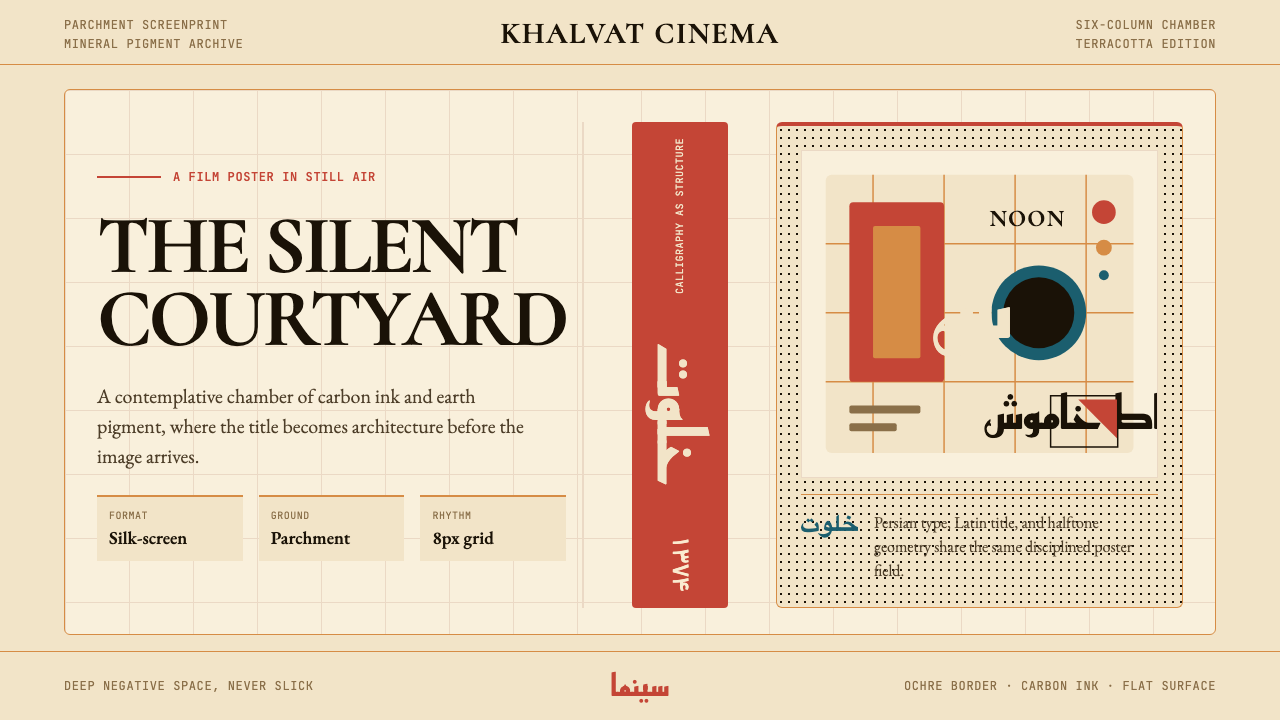 Iranian Modernist Cinema PosterStillness becomes monumental. Terracotta Kufi type breathes inside a Swiss pa…
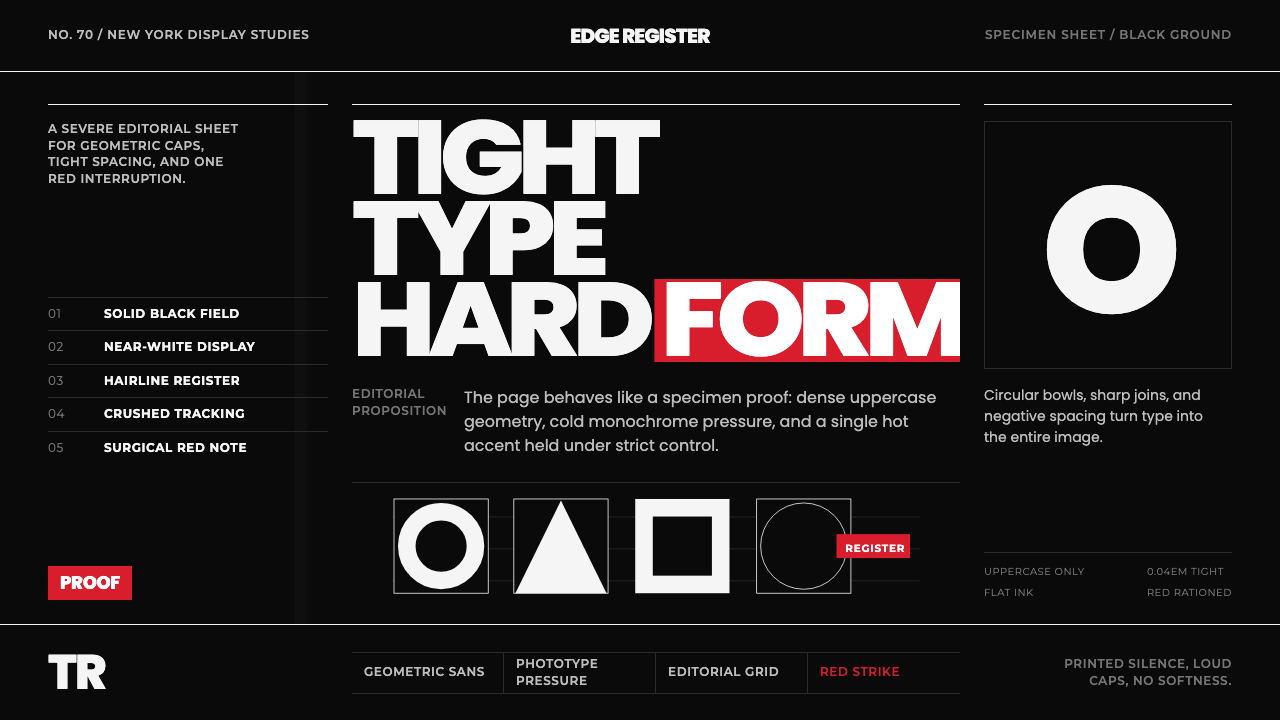 Avant Garde GothicType is the image. Tight white caps on black, ruled grids, one hot red strike.
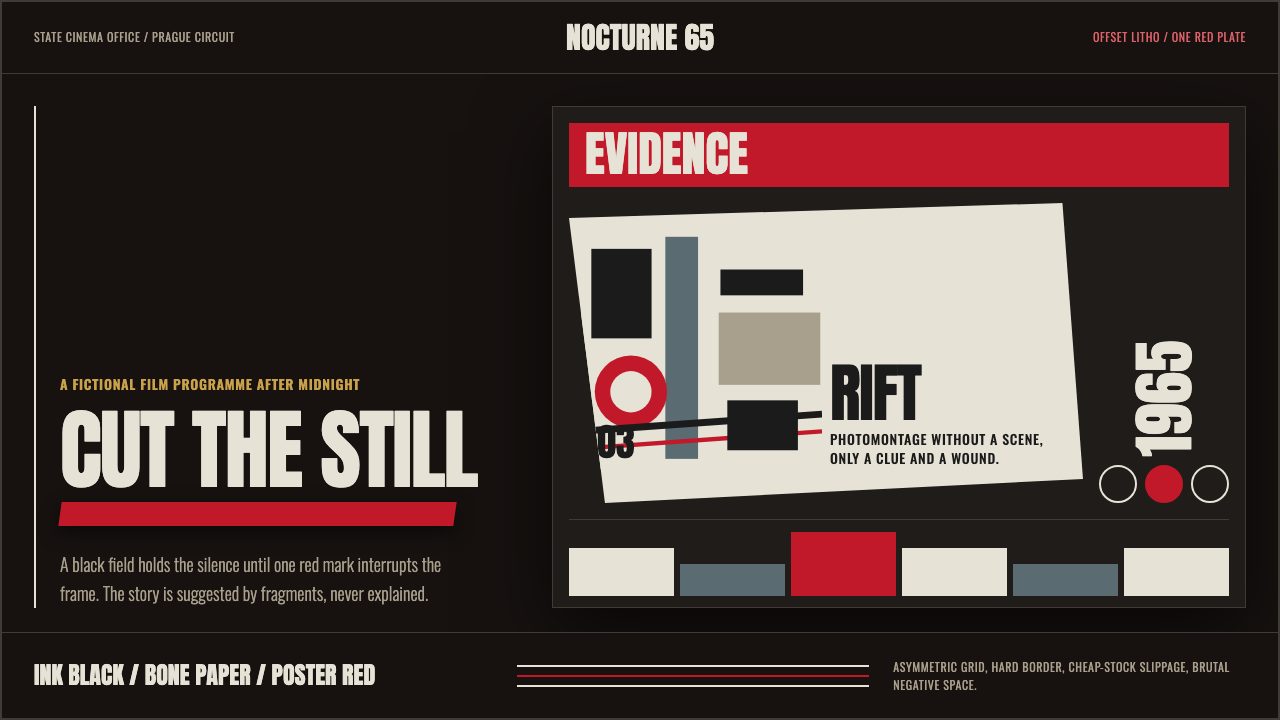 Czech New Wave PosterConcept before spectacle. Ink black, bone type and one poster-red incision fr…
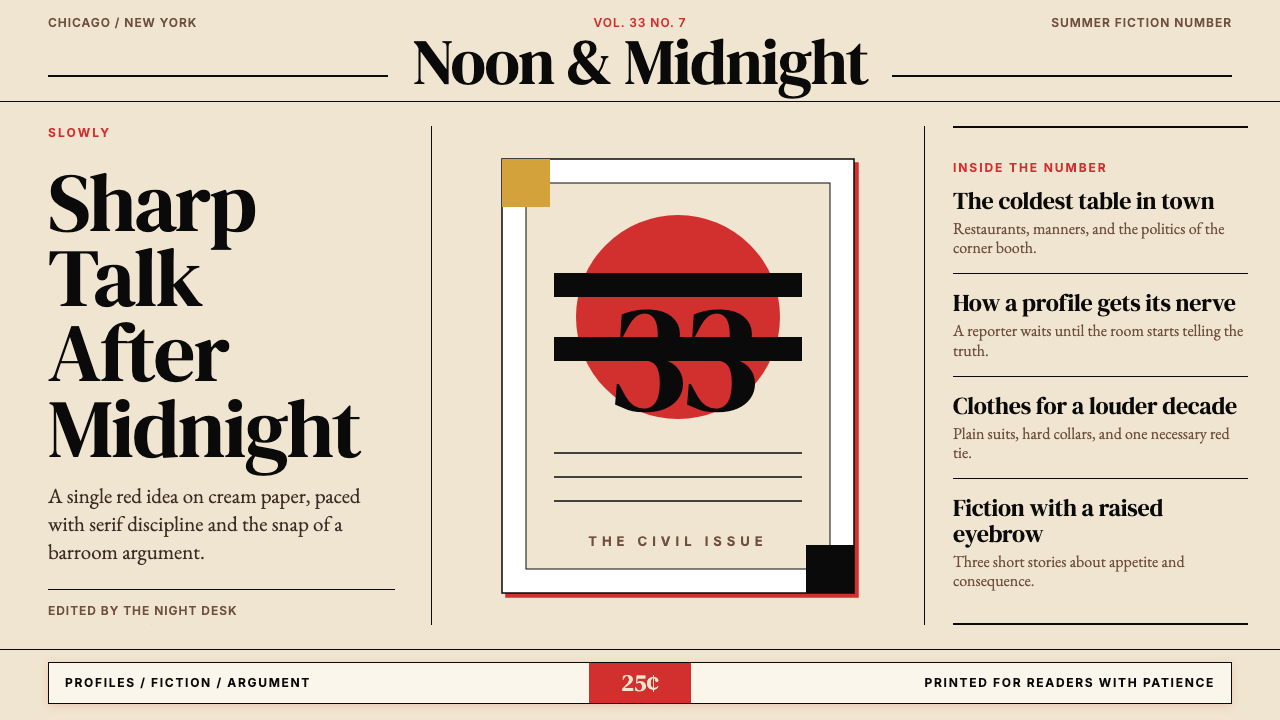 Esquire MagazineConceptual punch on paper. Cream stock, black hairlines, and one saturated re…
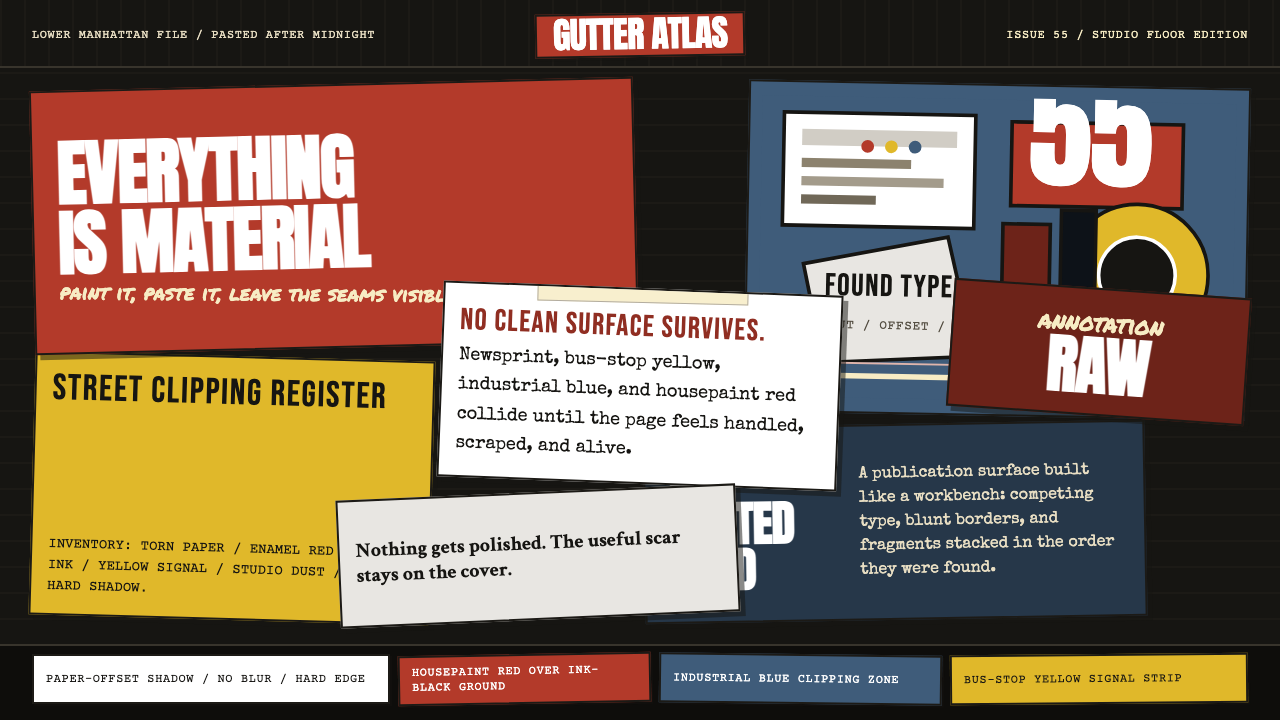 Rauschenberg Combine (1955)Street debris becomes syntax. Ink black, torn type, red-blue-yellow scraps co…
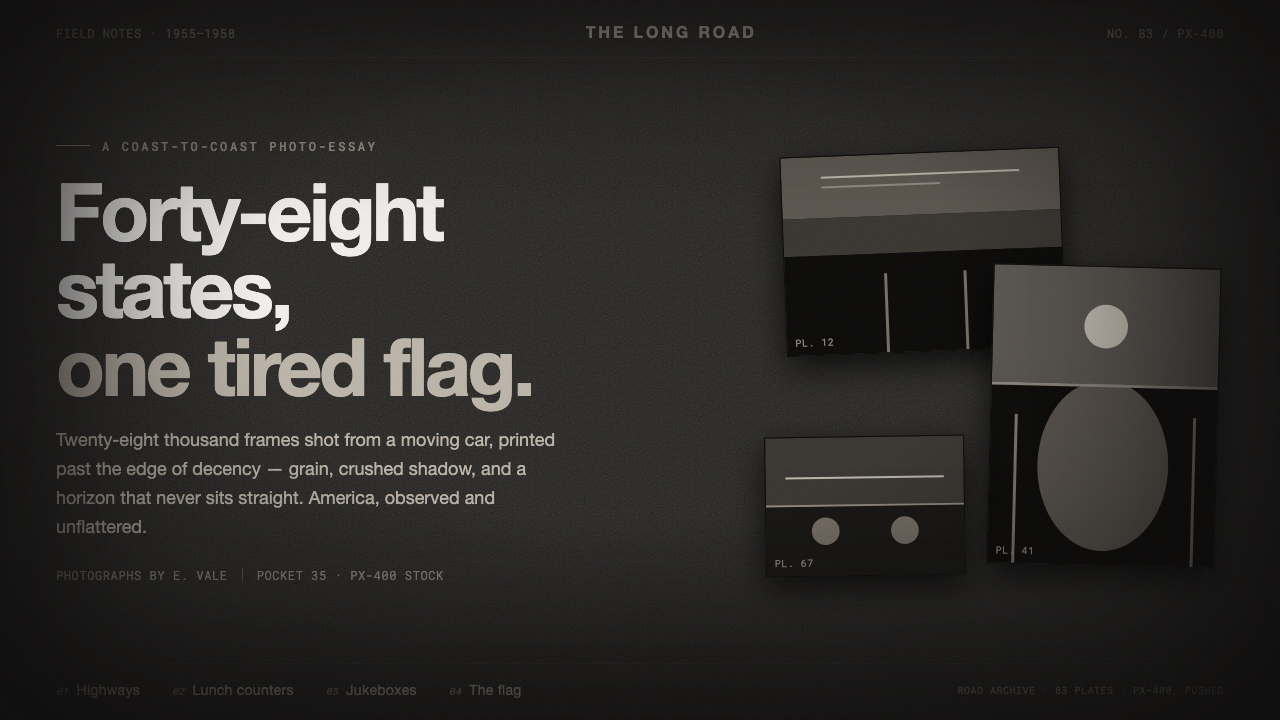 Robert Frank The AmericansReportage, polish stripped off. Warm sooty charcoal, crushed near-black shado…