What is Archigram Walking City (1964)?
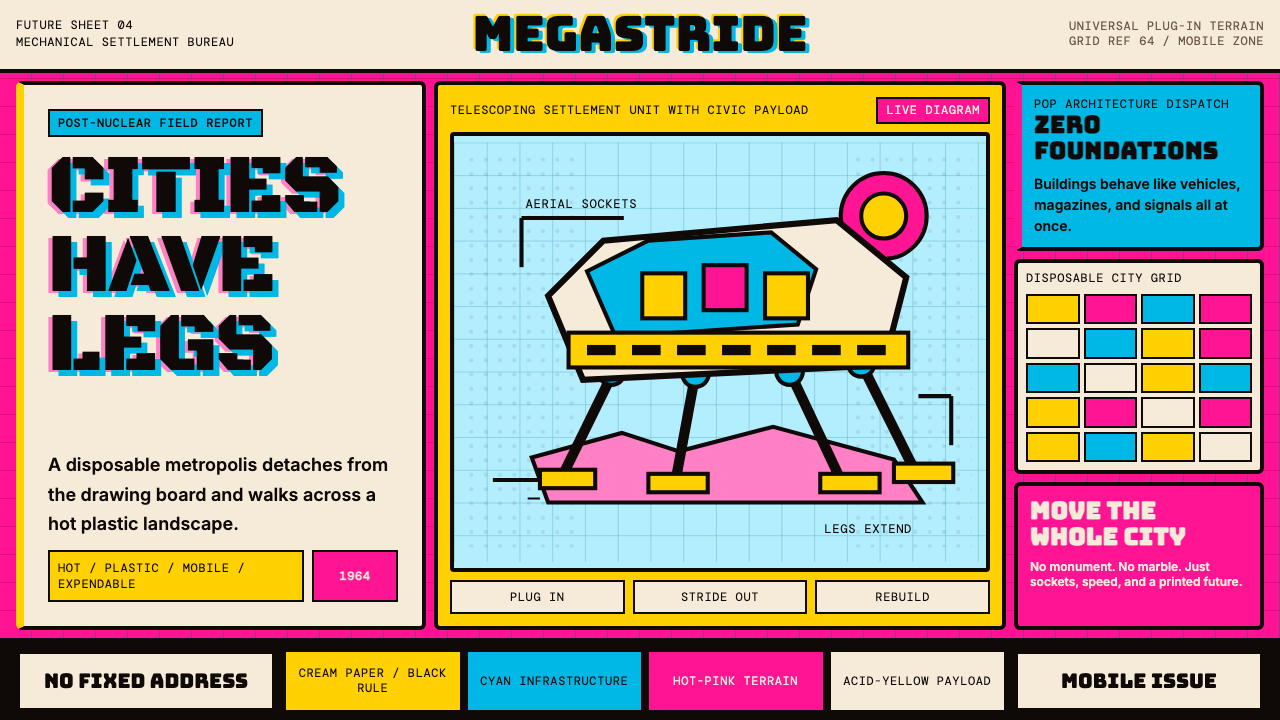
Archigram's Walking City imagined architecture as a living machine — giant mechanical organisms striding across continents on telescoping legs, making permanence itself obsolete.
Archigram Walking City (1964) in brief
Archigram Walking City is the visual language derived from Ron Herron's landmark 1964 proposition for the British avant-garde collective Archigram — a speculative architecture in which entire cities are imagined as colossal, self-propelled machines: reptilian in silhouette, bristling with docking ports and service conduits, free to migrate across post-nuclear landscapes in search of resources or community. The aesthetic is not cool or minimalist. It is hot, dense, and deliberately excessive — a riot of saturated color, thick comic-book ink lines, collaged textures, and futurist display lettering that treats the printed page like a propaganda broadsheet for a civilization that does not yet exist.
Where most architectural drawing systems prioritize precision and restraint, Archigram's visual method borrows directly from mid-century science-fiction paperbacks, American pop art, and the graphic energy of the British magazine tradition. Compositions are packed to the edges. Multiple color families — hot pink, electric cyan, acid yellow, vivid orange — coexist without mediating neutrals, separated only by the thick black borders that recall both comic-strip panels and the bold outlines of Roy Lichtenstein. Type is large, chunky, and unapologetically decorative, treated as a graphic object on equal footing with the drawn machinery.
As a design system, Walking City codifies these qualities into transferable visual conventions: a palette of simultaneous saturated hues anchored by heavy black line-work, comic-grid spatial organization, a preference for collage over clean illustration, and lettering that performs rather than merely labels. The aesthetic communicates optimism about technology, impatience with convention, and a pop-cultural conviction that architecture — and by extension any designed artifact — should be expendable, upgradeable, and above all alive.

Where does Archigram Walking City (1964) come from?
Archigram was founded in London in 1961 by a group of young architects — Peter Cook, Warren Chalk, Ron Herron, Dennis Crompton, Michael Webb, and David Greene — who shared a conviction that postwar British architecture had become timid, bureaucratic, and spiritually exhausted. They launched a mimeographed magazine, also called Archigram, distributing it free through architecture schools. The name fused 'architecture' and 'telegram' — the idea being that architecture should communicate with the urgency and directness of a wire transmission rather than the solemn ceremony of a stone monument. The magazine's visual style, from the first issue, was aggressive and collage-heavy, drawing on comic books, space-race imagery, consumer advertising, and the saturated graphic pop of swinging London.
Ron Herron's Walking City appeared in Archigram issue nine in 1964. The drawings depict clusters of enormous insectoid structures — each housing a complete city — wading through water or striding across open terrain. The machine-cities have eyes, joints, and what appear to be sensory antennae; they read simultaneously as architecture, vehicle, and creature. Herron rendered them in the magazine's characteristic technique: tight pen-and-ink linework overlaid with flat areas of bold color, photographic collage fragments, and typographic elements that bleed across the image's edges. The proposition was intentionally provocative: if buildings could walk, then land ownership, national borders, zoning laws, and the entire apparatus of permanent urban settlement were suddenly contingent rather than inevitable.
The cultural context was crucial. 1964 was the year of the Tokyo Olympics, the launch of the Bullet Train, the first unmanned Ranger spacecraft reaching the Moon, and the height of the British pop explosion. Technology felt genuinely revolutionary rather than incremental, and the generation who had grown up during the Second World War were impatient to replace what they saw as the ruins — both physical and conceptual — of the old world. Archigram absorbed the visual language of this moment: the space suit and the pop record sleeve, the systems diagram and the comic panel, the industrial component catalog and the psychedelic poster.
Walking City became the most widely reproduced image Archigram ever produced, appearing in architectural journals worldwide and eventually entering museum collections. The collective never built a Walking City — the proposition was always speculative, operating as critique rather than blueprint. But the visual system that Herron and his colleagues developed to express this vision proved enormously influential: it fed directly into the high-tech architecture movement of the 1970s and 1980s, shaped the graphic sensibility of magazines like Wired in its early years, and can be traced in the saturated, collage-forward aesthetics of contemporary digital design, festival branding, and speculative product visualization.
What defines the Archigram Walking City (1964) look?
Simultaneous Saturated Color
Unlike design systems that assign a single hero color, Walking City deploys multiple fully saturated hues side by side: hot pink, electric cyan, acid yellow, vivid orange, and deep red can all appear within the same composition without any neutral buffer. The colors do not harmonize in the conventional sense — they collide. This simultaneity is intentional, borrowed from pop art's assault on tasteful restraint. The palette reads as hot, urgent, and synthetic, communicating technological optimism rather than craft refinement.
Heavy Comic-Book Line Work
Every element — architectural forms, typographic blocks, image fragments, decorative borders — is outlined or contained by heavy black strokes of consistent substantial weight. This line-work serves multiple functions: it separates collaged fragments that would otherwise blur together, it gives the composition a graphic boldness that reads at distance, and it explicitly references the comic-book panel tradition that Archigram claimed as legitimate architectural discourse. The lines are not delicate engineering marks; they are declarative, ink-press-heavy, and slightly imprecise.
Pop Collage Density
Walking City compositions are typically packed to their edges with heterogeneous material: rendered mechanical drawings, photographic fragments, typographic elements, graphic patterns, and abstract color fields overlap without hierarchy or breathing room. This collage density is not a failure of organization but a deliberate statement — it mirrors the information overload of mass media and celebrates rather than apologizes for the visual noise of modern industrial culture. Empty space is treated as waste; every zone of the composition carries content.
Futurist Display Type
Typography in the Walking City system is not a supporting element but a co-equal visual actor. Letters are large, often chunky and condensed, drawn or set in display faces that evoke space-age lettering, industrial stencils, or the bold sans-serifs of mid-century science fiction. Type is frequently arranged at angles, stacked vertically, or allowed to overlap imagery. The relationship between letterform and image is deliberately ambiguous — text performs pictorially, and pictures carry textual weight.
Mechanical-Organic Silhouette
The characteristic drawn forms in Walking City imagery fuse mechanical components — telescoping legs, hydraulic cylinders, docking collars, ribbed conduits — with biological silhouettes: the overall shape reads as crustacean, insectoid, or reptilian even as every detail is explicitly engineered. This hybrid vocabulary communicates the proposition that technology and nature are not opposed categories but continuous ones. In design applications, this translates to forms that feel simultaneously industrial and alive, angular in component but curved and creature-like in overall mass.
Comic-Grid Spatial Organization
Rather than the clean column grids of Swiss-style design or the asymmetric balance of Bauhaus composition, Walking City layouts use the comic-book panel as their structural model. Content is distributed across bordered rectangular zones of varying sizes, some cinematic and horizontal, others narrow and tall. These panels can bleed into each other, share borders, or be interrupted by large typographic elements. The reading path is active rather than passive — the viewer is invited to scan, jump, and re-enter rather than read linearly.
Expendability as Aesthetic Value
Archigram explicitly theorized that buildings — and by extension designed artifacts — should be expendable: replaceable, upgradeable, pluggable, and free of the pretension to permanence. This philosophy manifests visually as a rejection of timeless refinement in favor of vivid immediacy. The aesthetic does not aspire to age gracefully. It is deliberately of-the-moment, synthetic, and somewhat disposable in the way a magazine or a pop record is disposable — which is to say, it communicates with maximum force at first encounter.

Who shaped Archigram Walking City (1964)?
Herron was the primary author of the Walking City drawings, producing the iconic series of images that would define the Archigram collective's most famous proposition. A trained architect who worked at the London County Council before joining Archigram, Herron brought technical drafting precision into direct collision with comic-book visual culture. His pen-and-ink technique — meticulous in mechanical detail, explosive in graphic composition — established the visual template that Walking City as a design system inherits. After Archigram dissolved, Herron continued to practice and teach architecture, and his drawings entered the permanent collection of the Museum of Modern Art in New York.
Cook was Archigram's most prolific theorist and editor, responsible for the overall direction of the magazine and for propositions including Plug-In City — a megastructure in which standardized dwelling capsules could be inserted into or removed from a permanent infrastructure framework. Cook's thinking shaped the ideological context from which Walking City emerged: the conviction that architecture should embrace the consumer economy's logic of planned obsolescence rather than resist it. He later became a professor at the Bartlett School of Architecture in London, carrying Archigram's speculative spirit into decades of architectural education.
Chalk brought to Archigram a particular interest in the aesthetics of technology derived from NASA's space program and the emerging consumer electronics industry. He was drawn to the visual language of capsules, pods, and systems components, and his influence can be seen in the Walking City's treatment of its structural elements as readable, almost catalogued parts. Chalk co-edited several Archigram issues and developed the Capsule Homes proposal, which imagined standardized living units as consumer products to be selected and replaced like any other durable good.
Crompton served as the technical and archival backbone of Archigram, managing much of the practical production of the magazine and later becoming the primary custodian of the collective's archive. His Computer City proposal from 1964 — produced in the same period as Walking City — imagined urban infrastructure as a giant information-processing network, anticipating themes that would only become culturally legible decades later with the rise of networked computing. Crompton's interest in systems thinking and information graphics gave Archigram a rigor beneath its pop-art exuberance.
How do you use Archigram Walking City (1964) today?
Archigram Walking City is a high-energy, intentionally confrontational aesthetic that works best when the goal is to communicate ambition, technological optimism, or forward-looking irreverence. Applying it correctly means embracing its density and saturation rather than trying to soften or modernize them — the system's power comes precisely from its refusal to be tasteful in the conventional sense.
For presentation slides, Walking City's visual language transforms both cover and content pages into graphic statements. A cover page benefits from the full treatment: multiple saturated color fields divided by heavy black rules, a title set in a chunky display typeface at commanding scale, and collaged imagery or diagrammatic elements that fill space aggressively. Content slides work best when designed as comic-grid layouts — bordered panels of varying proportion containing text, data, or imagery, with the borders themselves functioning as structural elements rather than mere dividers. Data visualizations take on a diagrammatic authority in this aesthetic: charts and graphs become components of a larger mechanical diagram, with fills drawn from the hot saturated palette.
For web interfaces and digital dashboards, Walking City's vocabulary is most effective on pages designed to project confidence and vision rather than quiet utility. A pricing page or product hero section built in this system might use vivid color blocking to separate tiers or features, with heavy bordered cards replacing conventional soft-shadow components. Navigation and labels are set in bold, display-weight type. Interactive states — hover, active, selected — use color shifts within the saturated palette rather than opacity changes. The aesthetic is not suited to long-form reading contexts; reserve it for high-impact surfaces.
For editorial and marketing work, Walking City excels at festival branding, speculative product launches, technology event identities, and any context where the message is explicitly about futures rather than present comfort. A poster or social card in this system packs its visual field: a dominant mechanical or abstract form occupies the center or bleeds off an edge, surrounded by typographic elements and color panels at the full saturation of the palette. Marketing campaigns gain distinction from the aesthetic's rarity — very few brands commit to this level of visual intensity, so those that do stand out immediately.
A common mistake when applying Walking City is treating the saturated palette as license for visual chaos without underlying structure. Archigram's original compositions, however dense, are always organized by the comic-grid logic: each panel has a clear function, the heaviest black lines establish the primary reading order, and the largest typographic element anchors the hierarchy. The second common error is softening the palette — introducing gradients, muted versions of the hues, or gentle shadows in an attempt to make the style more contemporary. This reliably destroys what makes the aesthetic distinctive. Walking City is not a style that benefits from tasteful editing; it requires full commitment to its own logic.

Archigram Walking City (1964) — FAQ
Is Walking City just pop art applied to architecture, or is there a distinct visual system?
There is a distinct visual system, though it draws heavily on pop-art conventions. The key difference is that Walking City's visual vocabulary is explicitly in service of architectural and spatial propositions — the mechanical forms, service conduits, and structural diagrams are not purely decorative but carry the argument that buildings should be understood as machines and cities as organisms. The comic-book language is chosen because Archigram believed architectural drawing had become too specialized and exclusionary; the pop format was a political choice as much as an aesthetic one. The resulting visual system has specific conventions — simultaneous saturated color, heavy bordered panels, display-weight type, collage density — that are transferable to other design contexts while remaining recognizably distinct from generic pop art.
Can this aesthetic work for a professional or corporate context, or does it only suit countercultural brands?
Walking City works in professional contexts when the professional aspiration is explicitly to signal disruption, frontier-thinking, or technological boldness — sectors like deep tech, space industry, synthetic biology, and advanced manufacturing have successfully adopted elements of this aesthetic because the visual intensity matches the genuine ambition of the work. It fails in contexts where trust, warmth, or institutional authority are primary values: legal services, healthcare, traditional financial institutions, or government communications. The test is whether the organization's actual proposition is as extreme as the aesthetic — if the visual makes a promise the product cannot keep, the mismatch reads as posturing.
How does Walking City differ from the Memphis design aesthetic?
Both aesthetics are saturated, anti-minimalist, and deliberately reference popular culture, but they diverge in tone and origin. Memphis (emerging from Milan in 1981) is playful, decorative, and domestically scaled — its geometric forms are surface patterns applied to furniture and objects, its color combinations are chosen for surprise and visual pleasure, and its underlying mood is ironic and postmodern. Walking City is industrial, spatial, and ideologically earnest — its visual density is in service of a genuine architectural argument, its mechanical forms are meant to be taken seriously as propositions about how cities might work, and its mood is optimistic rather than ironic. Memphis patterns are additive; Walking City structures are diagrammatic. One feels like a fun party; the other feels like a manifesto.
What happens if I use this style with a light, airy layout rather than the dense packed composition?
You lose the essential character of the style while retaining only its most superficial markers. Walking City's power comes from the tension of simultaneous competing elements — the density is not incidental but structural, communicating the idea that more is possible, that the world is fuller than conventional design allows for. A sparse layout with Walking City colors and type will simply look like generic pop-influenced design with a loud palette. If airy composition is what the project needs, a different design system will serve better. The Walking City aesthetic is not adjustable in that direction without fundamental compromise; it should be applied fully or not at all.
Is Walking City historically a print-only aesthetic, or can it translate to digital and motion contexts?
The original Walking City work was entirely print-based — magazine pages, exhibition panels, architectural drawings. But the aesthetic translates well to digital and motion contexts, partly because its visual conventions map naturally onto digital constraints and partly because motion can amplify the sense of mechanical life that is latent in Herron's drawings. In motion design, the heavy black bordered panels can open like mechanical joints; the saturated color fields can shift and transition with a mechanical decisiveness that avoids soft easing. In digital interfaces, the comic-grid panel logic is actually well-suited to responsive layout — panels resize and reorder the way capsules dock and undock from a megastructure. The key constraint in motion is to avoid the soft, organic easing curves of contemporary interface animation in favor of hard cuts, snap transitions, and mechanical timing.
Related design styles
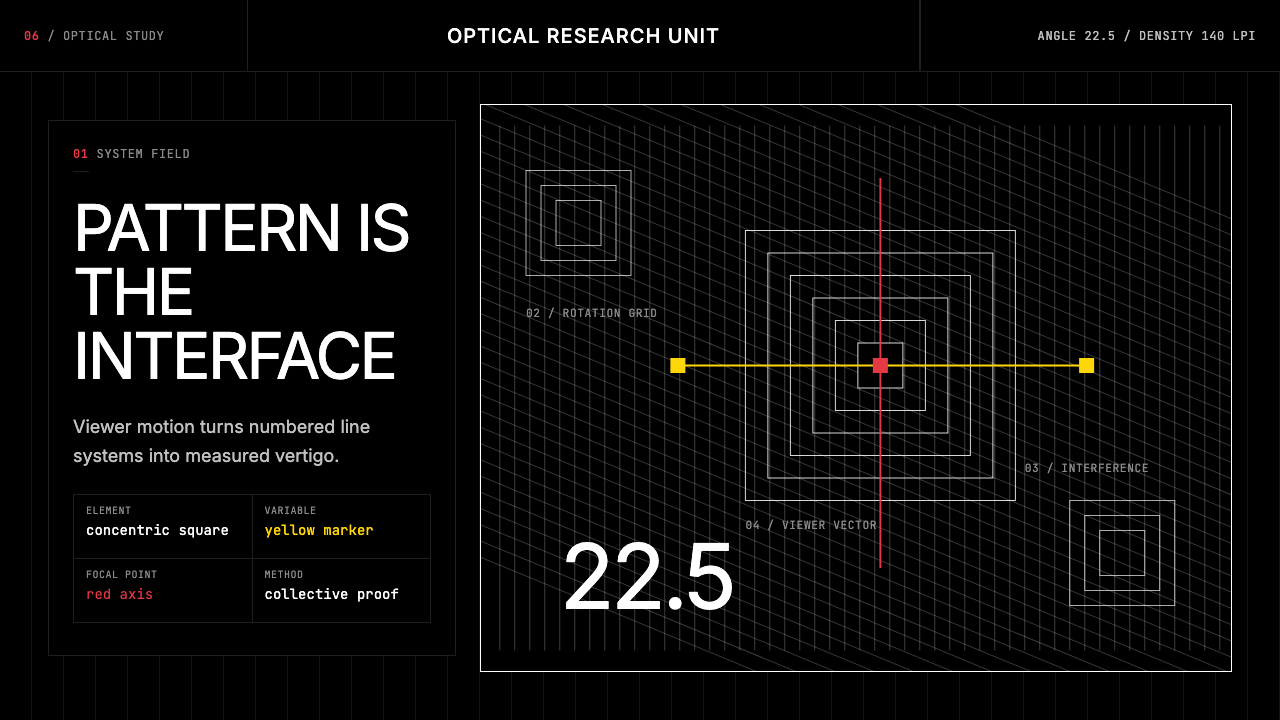 GRAV Op-Kinetic (1960)Vertigo by calculation. White line fields on black, with red and yellow as co…
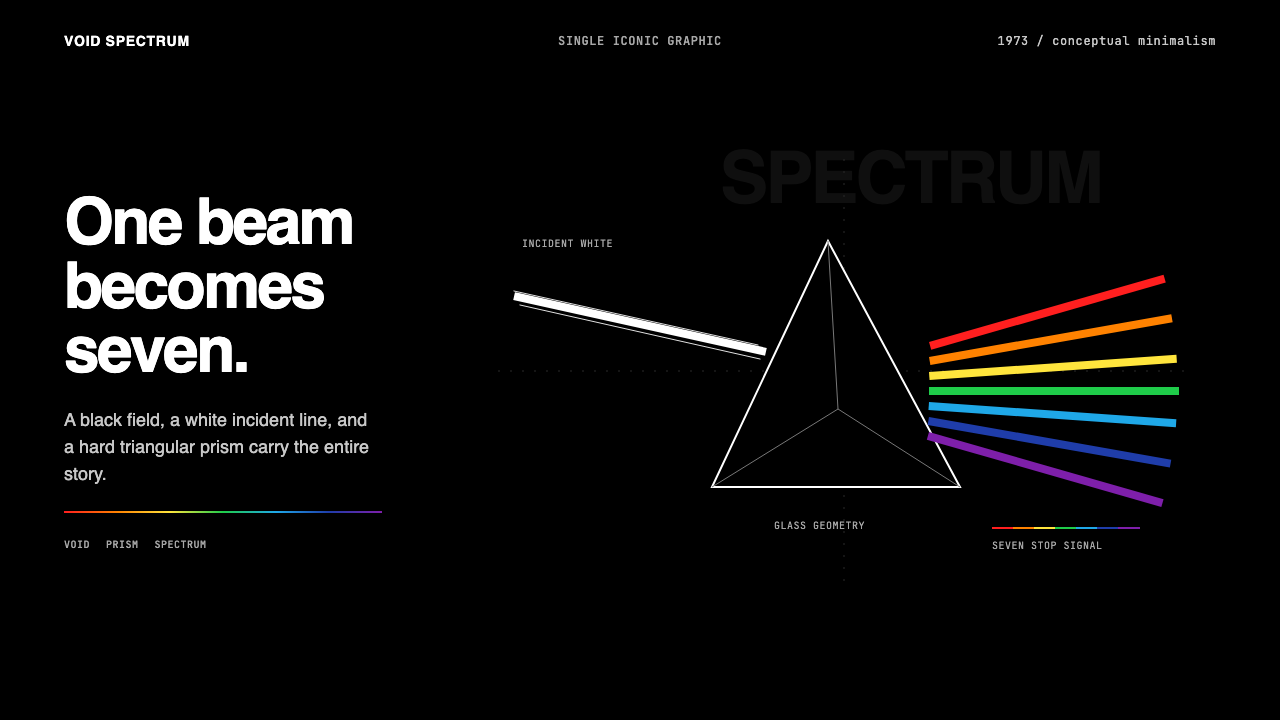 Pink Floyd — Dark Side of the MoonOne image does everything. Black void, white beam, hard prism, seven exact co…
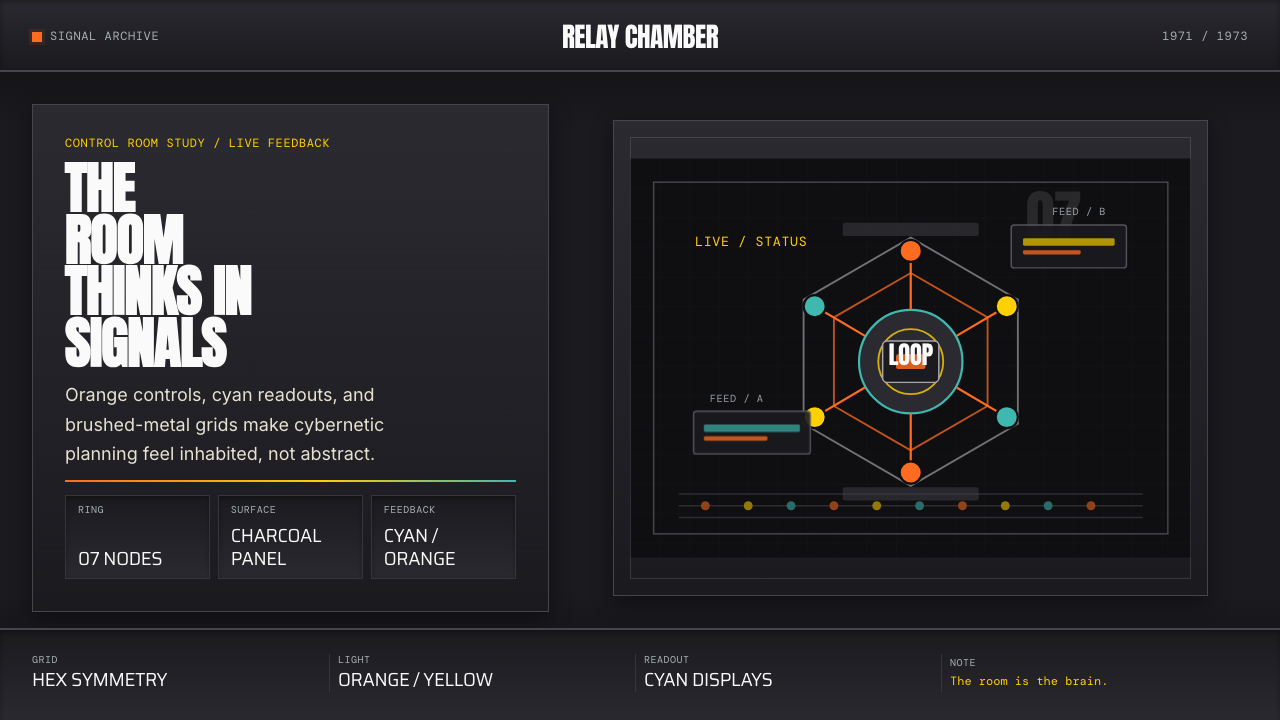 Cybernetic 1968 (Stafford Beer)Mission-control severity. Charcoal panels, orange buttons, cyan readouts, hex…
 Greenpeace (Activist Poster)Protest without softness. Forest-green caps over monochrome newsprint, one de…
 Hungarian Vasarely Op Art (1965)Mathematics makes vision pulse. Black grids, white units, cyan and tangerine…
 Iranian Modernist Cinema PosterStillness becomes monumental. Terracotta Kufi type breathes inside a Swiss pa…