What is Hungarian Vasarely Op Art (1965)?
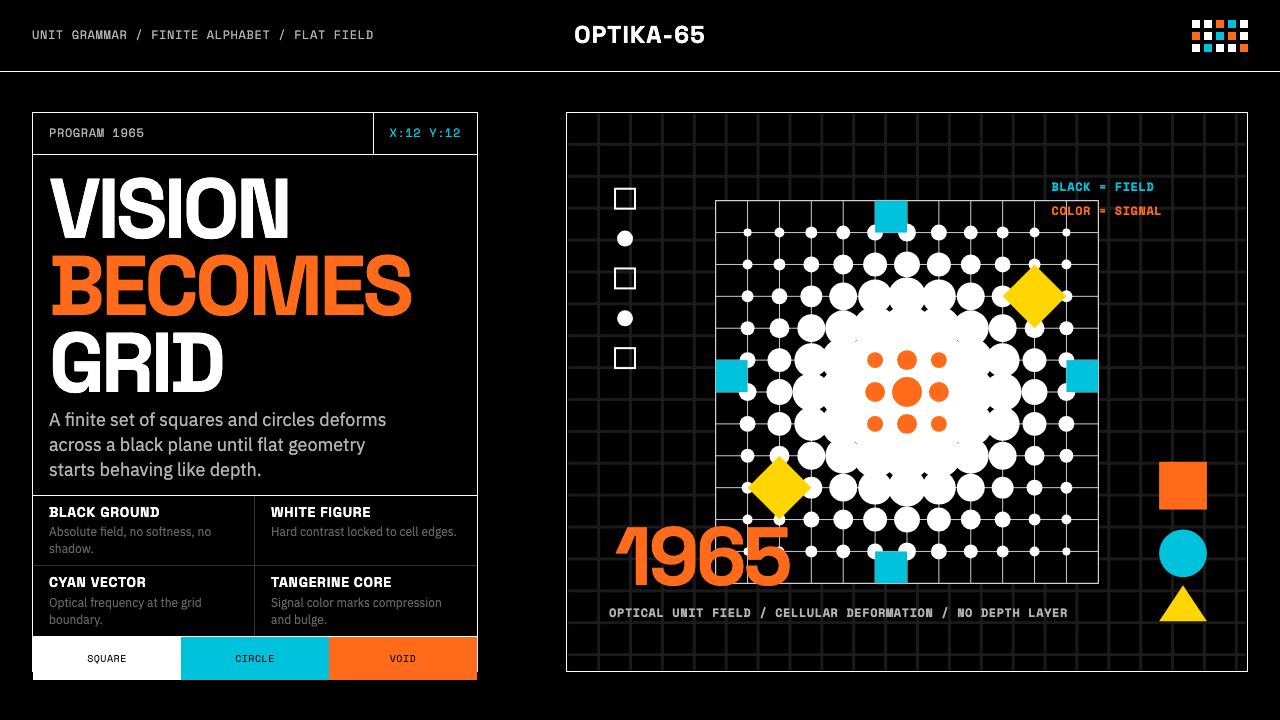
Victor Vasarely turned the flat canvas into a machine for generating optical illusions — grids that breathe, spheres that inflate from nothing, voids that swallow the eye.
Hungarian Vasarely Op Art (1965) in brief
Hungarian Vasarely Op Art (1965) names a precise moment in the longer arc of Victor Vasarely's practice: the year the Museum of Modern Art in New York opened 'The Responsive Eye', a landmark exhibition that placed Vasarely's work at the center of a global conversation about perception, mathematics, and the limits of visual experience. The system distills the formal language Vasarely had been refining since his 1955 Manifeste Jaune — a finite vocabulary of unit shapes, a rigid grid logic, and an electrifying palette of deep black ground against white figures and sharp accent tones that seem to pulse at the boundary of perception.
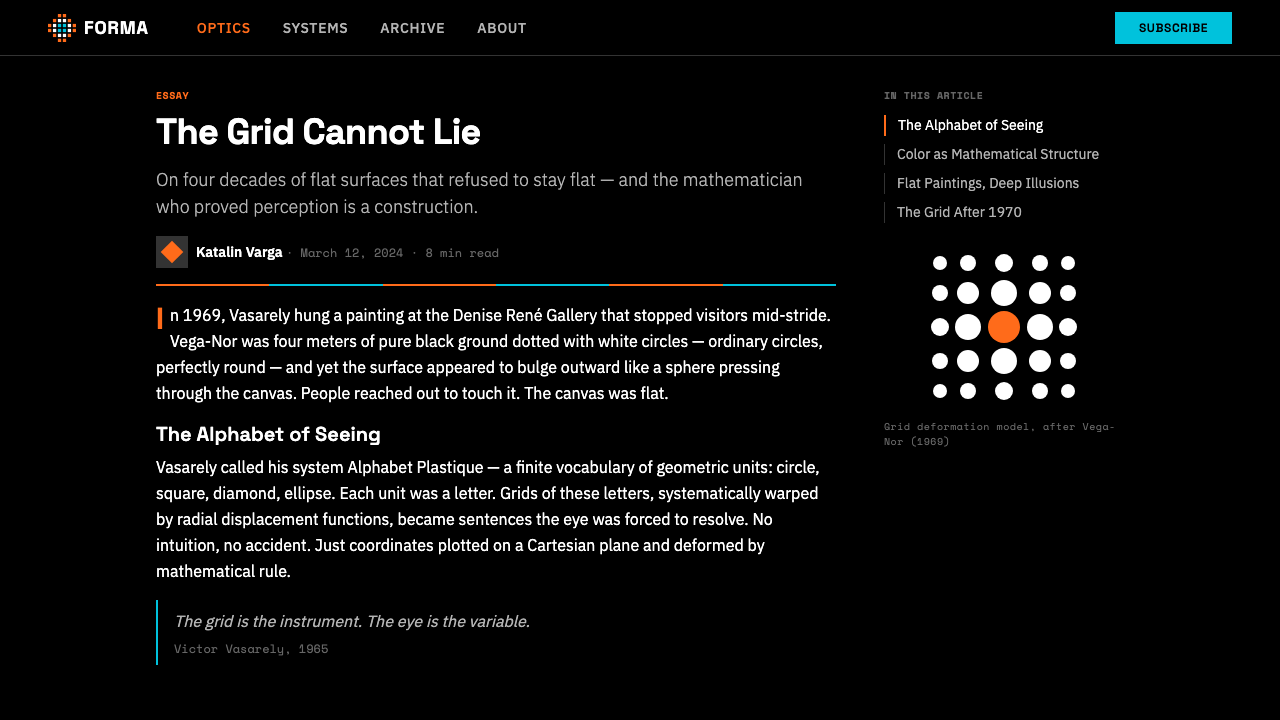
At its core, Vasarely's method is algorithmic. He developed what he called a 'plastic alphabet': a set of basic geometric units — squares, circles, hexagons, rhombuses — each existing in many deformed variants. By systematically substituting larger or smaller versions of these units across a grid, and by tilting or stretching their outlines according to precise geometric rules, he produced surfaces that read simultaneously as flat patterns and as three-dimensional topologies. A grid of identical squares becomes a convex sphere when the central units swell and the peripheral ones contract. A flat field of circles collapses into a concave funnel when the same logic is reversed.
The 1965 moment specifically captures the high-voltage palette of that peak period: an absolute black ground functions as the visual void against which white units detonate with maximum contrast, while electric cyan and tangerine accents are introduced with surgical restraint to guide the eye and mark the inflection points of three-dimensional illusion. There are no gradients, no organic softnesses, no rendered textures. Every boundary is a hard decision. The system is at once rigorous and dazzling — a proof that pure mathematics can induce genuine perceptual shock.
Where does Hungarian Vasarely Op Art (1965) come from?
Victor Vasarely was born in 1906 in Pécs, a city in southern Hungary then part of the Austro-Hungarian Empire. He studied at the Budapest Mühely — a school explicitly modeled on the Bauhaus — under Alexander Bortnyik, where he absorbed the foundational vocabulary of geometric abstraction, systematic visual analysis, and the idea that art could be reproduced, multiplied, and democratized. In 1930 he emigrated to Paris, where he spent the following decade working as a commercial graphic designer. The precision demanded by advertising — reduction to legible, reproducible graphic units — sharpened his thinking about what a minimal formal vocabulary could achieve.
The intellectual breakthrough came in stages. The 1955 Manifeste Jaune, published in Paris, announced Vasarely's conviction that a new kind of art was possible: programmatic, reproducible, not anchored to the unique object. He proposed that any trained person could execute a work from a set of instructions — a radically democratic position that anticipated later developments in conceptual and generative art by more than a decade. Around the same period, he began developing the plastic alphabet in earnest, working through hundreds of systematic variations of his geometric unit vocabulary to catalogue the perceptual effects of each deformation.
The Nouvelle Tendance movement — a loose international network of artists working in Paris, Zagreb, Düsseldorf, and Milan during the late 1950s and early 1960s — provided the intellectual community that amplified Vasarely's ideas. Figures like Pontus Hultén, the Swedish curator who later directed MoMA's Paris outpost, championed kinetic and optical art in museum contexts and helped secure institutional recognition for work that might otherwise have been dismissed as mere optical trick. William C. Seitz, the American curator who organized 'The Responsive Eye' at MoMA in 1965, assembled more than a hundred artists working with perception and visual vibration — but Vasarely's systematic, almost scientific methodology made him the exhibition's intellectual center of gravity.
The 1965 exhibition was transformative not only for Vasarely's career but for Op Art as a named movement. The press latched onto the 'Op Art' label — a play on 'Pop Art', whose commercial success the media hoped to replicate — and the style briefly entered mainstream fashion and graphic design with an enthusiasm that Vasarely himself found reductive. He disliked the term 'Op Art' and the implication that his work was primarily about tricks. His later career was devoted to architectural integration — murals, mosaics, and large-scale public works across France, Hungary, and beyond — and to establishing the Fondation Vasarely in Aix-en-Provence in 1976, a museum and archive dedicated to preserving his systematic method rather than the cult of the individual artwork. His son Yvaral (Jean-Pierre Vasarely) extended the family vocabulary into digital and computer-generated variants, underscoring how naturally the system translated into computational logic.
What defines the Hungarian Vasarely Op Art (1965) look?
Ground and Figure Contrast
The defining structural move of the 1965 system is an absolute black ground against which geometric units — rendered in white or near-white — achieve maximum optical tension. This is not simply high contrast for aesthetic effect: the void-like black ground removes any ambient lighting cue, forcing the eye to construct depth purely from the geometry of the units themselves. Where the black ground appears between tightly packed white units, it reads as negative space; where units crowd together to the point of near-adjacency, the black sliver between them vibrates with apparent luminosity.
Geometric Deformation and Grid Logic
Every element in Vasarely's system occupies a cell in a grid, and the grid itself never breaks — what changes is the size, proportion, and orientation of the unit within each cell. A circle that is perfectly round in the grid's center becomes progressively more elliptical toward the edges, as if the viewer is looking at a sphere from a slight angle. The deformation is systematic and calculable: Vasarely developed precise transformation rules so that any given composition could be reconstructed by a second person from a set of written instructions. This quality — the separability of the rule from the hand that executes it — is the deepest formal principle of the system.
Electric Accent Palette
Within the dominant black-and-white architecture, the 1965 palette introduces two accent tones — a highly saturated cyan and a tangerine that sits between orange and yellow — used with surgical precision to mark the inflection zones of three-dimensional illusion. These accents are never deployed as backgrounds or broad fields; they appear at the points of greatest curvature in a geometric deformation, where the eye most needs a landmark to calibrate the transition from convexity to concavity. The colors are chosen not for warmth or cultural association but for their specific behavior at the perceptual edge — their tendency to advance or recede relative to the surrounding black.
Unit Repeatability and the Plastic Alphabet
The plastic alphabet is the generative engine of the entire system. Vasarely catalogued a finite set of base units — each a simple geometric shape — and for each unit produced a family of systematic variants: stretched versions, compressed versions, rotated versions, versions with thinned or thickened outlines. Any composition is assembled by selecting units from this pre-existing vocabulary and arranging them according to a transformation rule. This approach makes the system modular and scalable: a small composition can be expanded to architectural scale without loss of logic, and the same alphabet can generate thousands of distinct visual outcomes. The modular structure is also what makes digital and computational reproduction of the system so natural.
Perceptual Depth Without Spatial Illusion Tools
Traditional pictorial depth — linear perspective, atmospheric haze, cast shadow — is entirely absent from Vasarely's system. Depth is induced purely by the systematic variation of unit size and shape across the picture plane: the eye interprets a regular gradient of shrinking or stretching units as a curved surface receding in space. This produces a peculiar kind of optical experience: the surface appears three-dimensional but the viewer cannot locate it in any stable spatial relationship to themselves. The impression oscillates — sometimes the sphere bulges outward toward the viewer, sometimes it recedes — and this oscillation, rather than any fixed illusion, is the genuine subject of the work.
Flatness as Method, Not Absence
Despite producing images of apparent depth, every element in the Vasarely system is absolutely flat. There are no soft edges, no anti-aliased transitions, no blended tones — each unit is filled with a single unmodulated color, and its boundary is a hard line. This flatness is not a limitation of the medium but a deliberate formal commitment: the depth effect must emerge entirely from the geometric logic of the arrangement, not from any simulation of three-dimensionality within individual units. The rigor of this constraint is what gives Vasarely's illusions their intellectual weight — the viewer knows the surface is flat and yet cannot suppress the perception of depth.
Democratic Reproducibility
One of the most distinctive formal properties of the system is its designed reproducibility. Vasarely insisted that his works were not unique objects but instances of a program — any competently executed instance was as valid as any other. This position had practical consequences for the visual language: the system had to be definable in terms precise enough that a second person could execute it faithfully. In design application, this translates to a system that scales cleanly, tiles logically, and maintains its optical properties across different output media, from small-format print to architectural mosaic to screen display. There is no originality premium attached to any particular instantiation.
Who shaped Hungarian Vasarely Op Art (1965)?
Born in Pécs in 1906 and trained at the Budapest Mühely under Alexander Bortnyik, Vasarely brought the Bauhaus-derived vocabulary of geometric abstraction to Paris in 1930 and spent the following decades transforming it into a fully algorithmic system. His 1955 Manifeste Jaune declared that art should be reproducible and that the hand of the artist was not a necessary condition of authenticity — a position that anticipated generative art by decades. The Fondation Vasarely in Aix-en-Provence, which he established in 1976, remains the primary repository of his systematic method and houses large-scale architectural integrations of his visual vocabulary.
Victor Vasarely's son, who worked under the name Yvaral, extended the family's visual system into computer-generated imagery from the 1970s onward. His work demonstrates the direct continuity between his father's analogue systematic method and the logic of digital computation: the same deformation rules that Vasarely applied by hand could be executed precisely and at any scale by algorithm. Yvaral's computer-generated works, including his pixelated portraits of historical figures, showed how the plastic alphabet could migrate into a completely different technological substrate while remaining formally continuous with its origins.
The American curator who organized 'The Responsive Eye' at MoMA in 1965 is inseparable from the public emergence of Op Art as a named movement. Seitz assembled over a hundred artists working with perception, optical vibration, and geometric abstraction, but his decision to foreground Vasarely's systematic methodology — as distinct from more purely retinal work by other artists in the exhibition — shaped how the public and the art world interpreted the movement's intellectual ambitions. The exhibition attracted more than 180,000 visitors in its first weeks, making it one of the most attended shows in MoMA's history at that point.
The Swedish curator and museum director who championed kinetic and optical art in European institutional contexts during the late 1950s and 1960s. Hultén organized major exhibitions of kinetic art in Stockholm and Paris that helped establish the intellectual legitimacy of work operating at the intersection of art, perception science, and engineering. His institutional support was crucial in distinguishing serious optical and kinetic practice from the commercial Op Art wave that followed the 1965 MoMA exhibition — a wave that Vasarely himself found reductive.
The Hungarian painter and designer who founded the Budapest Mühely in 1928 — a school deliberately modeled on the Bauhaus, with which Bortnyik had direct contact. Bortnyik taught Vasarely the foundational grammar of geometric abstraction, systematic visual analysis, and the idea that visual form could be reduced to a set of learnable principles. Without this training, Vasarely's later algorithmic method would lack its rigorous structural foundation. The Mühely's influence on Hungarian design culture more broadly helped establish an Eastern European strand of the Bauhaus-derived modernist tradition that ran parallel to its better-known Western European expressions.
How do you use Hungarian Vasarely Op Art (1965) today?
The Vasarely Op Art system is one of the most structurally demanding styles to apply well precisely because its visual effects depend on the underlying geometry being executed correctly. A carelessly assembled grid will produce a muddy surface rather than a coherent optical illusion; the system punishes approximation. Before reaching for the visual vocabulary, it is worth internalizing the core logic: depth emerges from systematic unit deformation across a regular grid, and the palette functions as a signaling layer on top of that geometry, not as a substitute for it.
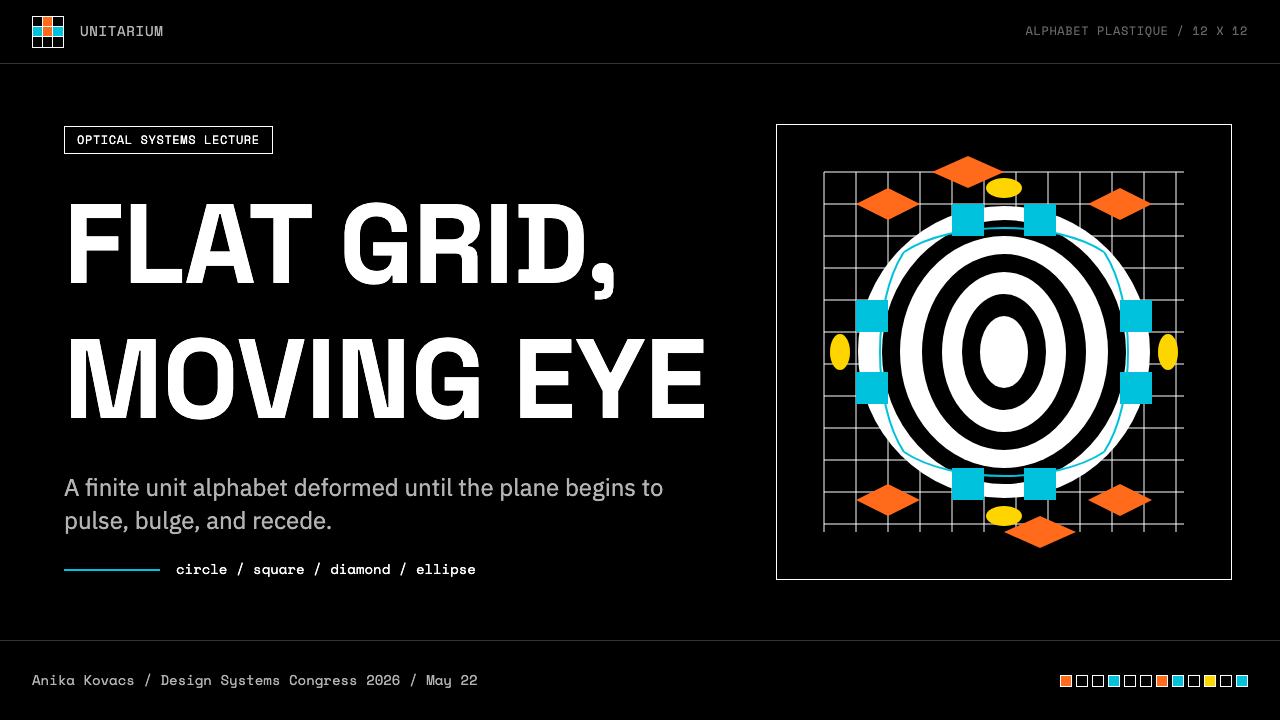
For presentation slides, the system rewards restraint and focus. A cover page designed in this vocabulary works best as a single large optical composition — one sphere or vortex construction occupying most of the slide area — with the title and subtitle set in clean, neutral type that does not compete with the optical surface. The temptation to fill every slide with the system's visual drama should be resisted: content slides function better when they use the black ground and high-contrast type hierarchy without the deformed-grid element, reserving the full optical construction for transitional or section-break slides. Data visualizations can draw from the palette's accent tones for chart series differentiation, using the electric cyan and tangerine as discrete markers without attempting to replicate the full grid logic.
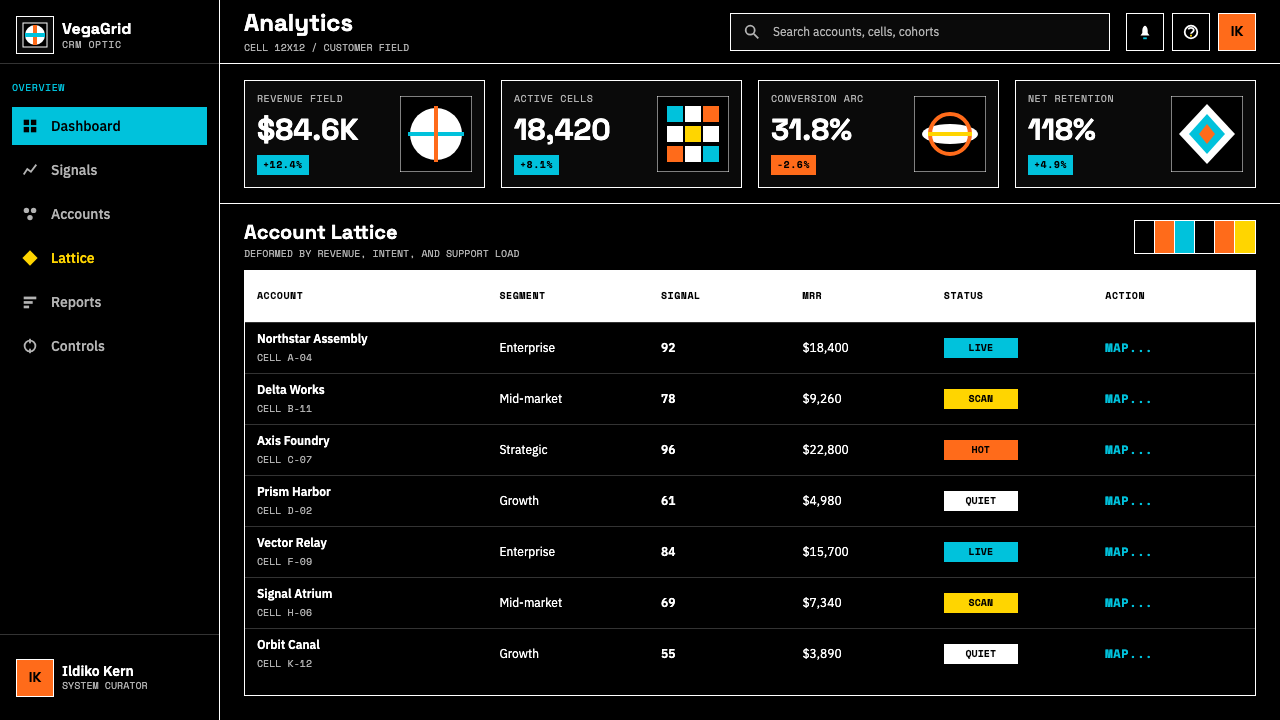
For web interfaces, the system is most naturally at home in contexts where optical richness is the primary communication goal rather than functional clarity — hero sections, splash pages, loading screens, and large-format promotional banners. Attempting to apply the full deformed-grid vocabulary to dense interface components like data tables, form fields, or navigation menus will undermine legibility. The productive approach is to use the system as an atmospheric layer: the black ground with its characteristic contrast becomes the page's ambient texture, while interactive components float against it in a simpler, more readable register. The accent palette works well for status indicators, tags, and active states.
For editorial and marketing work, the Vasarely vocabulary has historical precedent in poster design and cultural identity — the style was widely adopted by music festivals, cultural institutions, and technology brands during the late 1960s and 1970s, and has seen periodic revivals in contexts that want to evoke both mathematical precision and psychedelic visual energy. In contemporary editorial use, the system reads as simultaneously retro and forward-looking. Full-spread uses of the deformed-grid are most effective in print contexts where precise registration ensures the optical effect fires correctly; digital uses should account for the fact that screen rendering and scaling can blur the hard edges that the illusion depends on.
A common mistake when working with this system is to treat the accent colors as decorative elements that can be scattered freely across a composition. In the authentic vocabulary, the cyan and tangerine accents are structural: they mark specific zones in the geometric logic of a construction, not random areas of visual interest. Using them without this structural justification produces a surface that looks inspired by Vasarely without achieving the perceptual effect that makes his work cognitively interesting. Similarly, mixing the deformed-grid logic with soft rendering techniques — gradients, drop shadows, blurred edges — dissolves the flatness principle that gives the system its optical coherence. The illusion requires that every element be unambiguously flat so that the brain's attempt to resolve the apparent depth has nowhere to rest.
Hungarian Vasarely Op Art (1965) — FAQ
Is Op Art the same as Kinetic Art?
They are related movements that overlapped significantly in the 1960s and shared many of the same artists and institutional champions, but they are formally distinct. Kinetic Art involves actual physical movement — motorized sculptures, mobiles, works that change configuration over time. Op Art produces the perception of movement in a static image through optical illusion. Vasarely's grid works are Op Art: nothing moves, but the eye cannot suppress the impression of vibration or depth change. Many artists, including several in 'The Responsive Eye' exhibition, worked in both modes; Vasarely himself was primarily associated with Op Art, though his interest in programmatic systems put him in close dialogue with Kinetic artists.
Why does Vasarely use such a restricted palette when Op Art seems to be about visual abundance?
The restriction is the mechanism, not a limitation. Op Art's perceptual effects depend on precise color relationships — specifically on the relative luminosity and chromatic contrast between adjacent areas. Introducing many colors simultaneously creates ambiguity about which contrast relationships are doing the perceptual work and which are decorative noise. Vasarely's palette — deep black ground, maximum-contrast white figures, and two precisely calibrated accent tones — produces a system where every color relationship is load-bearing and legible. The electric cyan and tangerine are effective precisely because they appear against a field that is otherwise achromatic; the eye registers them as signals, not decoration.
How does this system relate to digital and generative art today?
Vasarely is one of the clearest historical anticipations of algorithmic generative art. His plastic alphabet is functionally identical to a parameterized design system: a set of base shapes, a set of transformation rules, and a grammar for combining instances to produce a composition. The only difference between Vasarely's hand-executed works and a contemporary generative system producing similar imagery is the substrate of execution. Contemporary designers working with generative tools — procedural noise fields, parametric deformation, algorithmic tiling — are operating within a formal tradition that Vasarely helped define. The system also ports naturally to data-driven design: the same deformation logic that Vasarely used to simulate spherical surfaces can be adapted to visualize quantitative gradients in a data field.
Does the system work in light-background contexts, or does it require the dark ground?
The 1965 Vasarely system is specifically calibrated for a deep black ground, and inverting it to a white or light ground changes the perceptual mechanics significantly. On a white ground, the black figure units produce a different kind of optical tension — the eye reads the space between units as positive rather than void — and the electric accent tones lose some of their shock against the ambient brightness. A light-ground variant is possible and was used by some Op Art practitioners, but it tends to produce a cooler, more graphic effect that reads as pattern rather than illusion. If a light-background application is required, the accent tones need to be reconsidered: the tangerine and cyan that advance powerfully against black may appear too close in luminosity to each other against white, weakening the system's spatial signaling.
What makes Vasarely's work different from other Op Art of the same period?
The most distinctive feature of Vasarely's work relative to his Op Art contemporaries is its systematic, programmable character. Artists like Bridget Riley, who was also prominently featured in 'The Responsive Eye', worked from an intuitive understanding of perceptual effects refined through studio practice — each work is a discovery rather than an execution of a rule. Vasarely's approach was explicitly algorithmic: he wanted any trained person to be able to execute a work from written instructions, and he catalogued transformation rules with the rigor of a mathematician. This made his practice simultaneously more reproducible and more conceptually radical: it detached the work's validity from the hand that made it, anticipating the dematerialization of the art object that Conceptual Art would later theorize.
Related design styles
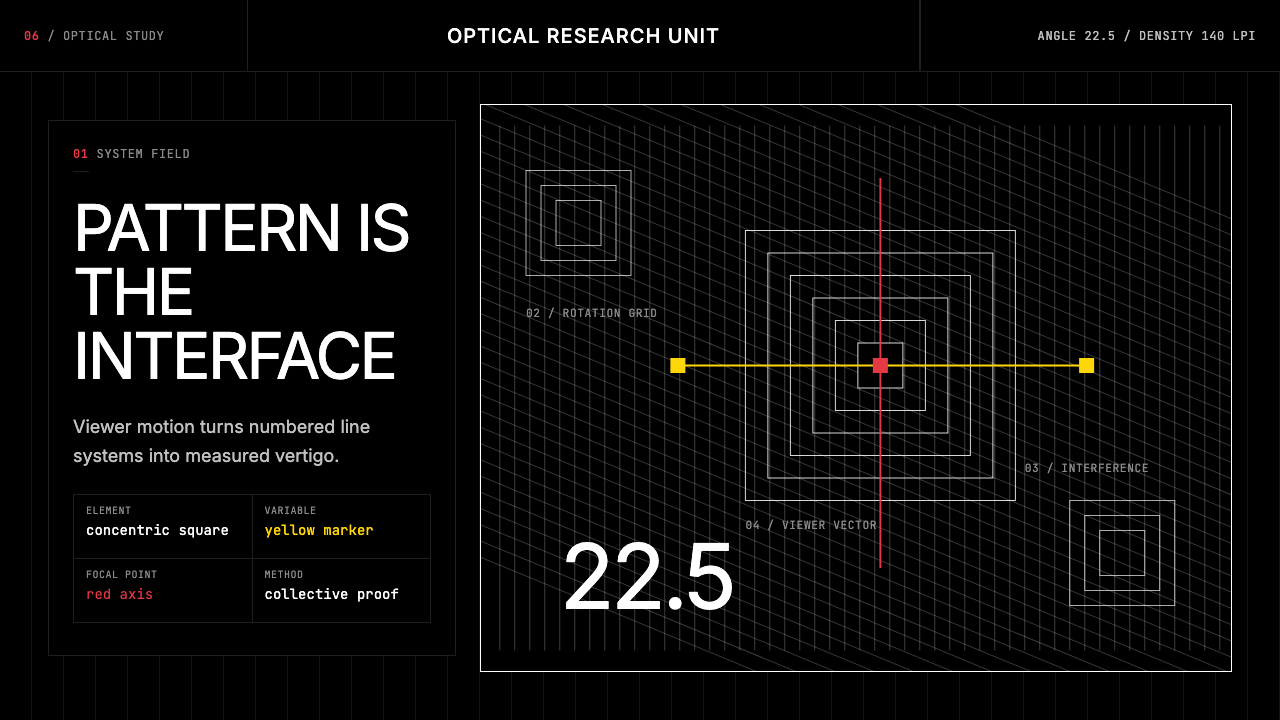 GRAV Op-Kinetic (1960)Vertigo by calculation. White line fields on black, with red and yellow as co…
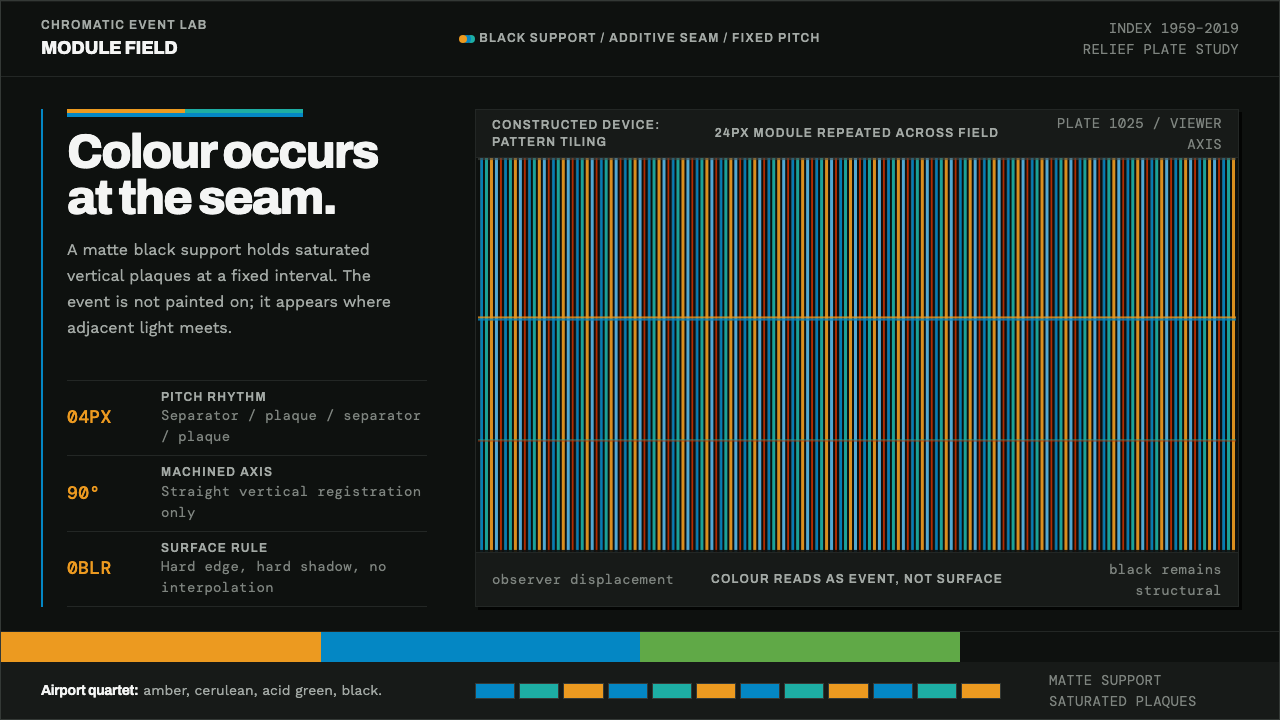 Cruz-Diez PhysichromieColour happens in motion. Fixed cyan-teal-amber stripes cut into structural b…
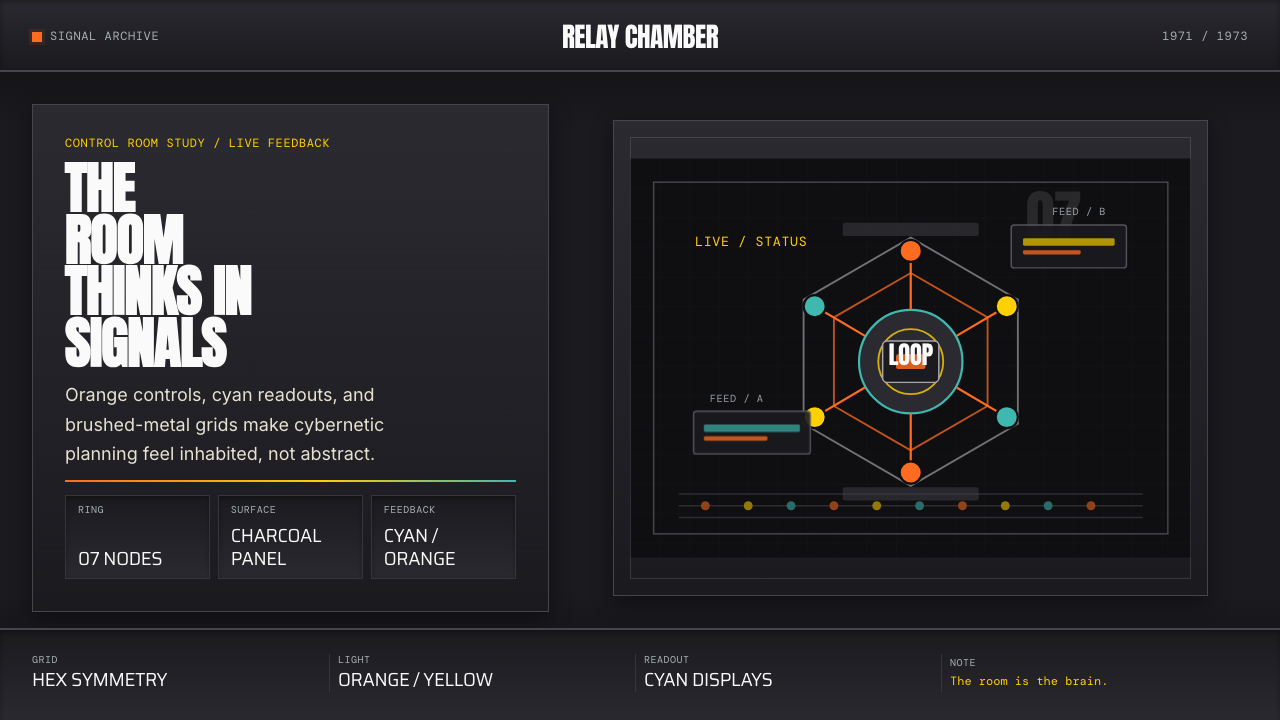 Cybernetic 1968 (Stafford Beer)Mission-control severity. Charcoal panels, orange buttons, cyan readouts, hex…
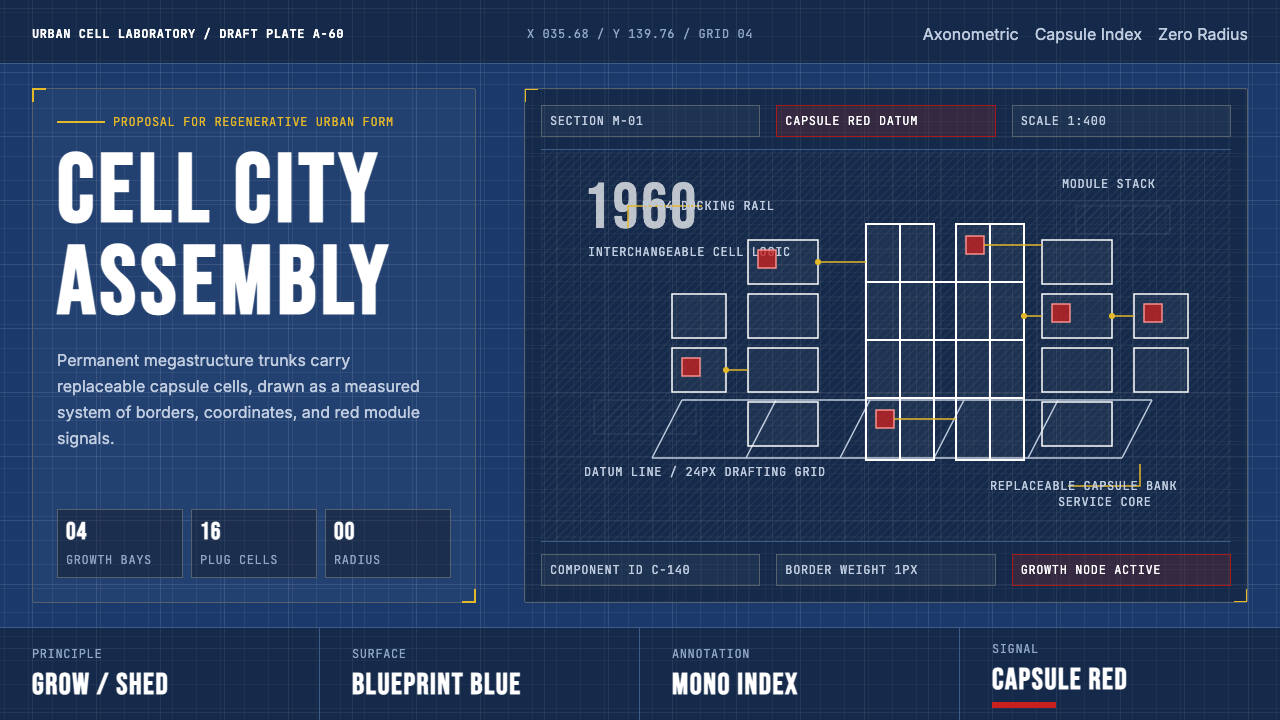 Metabolism Tokyo (1960)Cities become diagrams. Blueprint blue, mono labels, and capsule red mark mod…
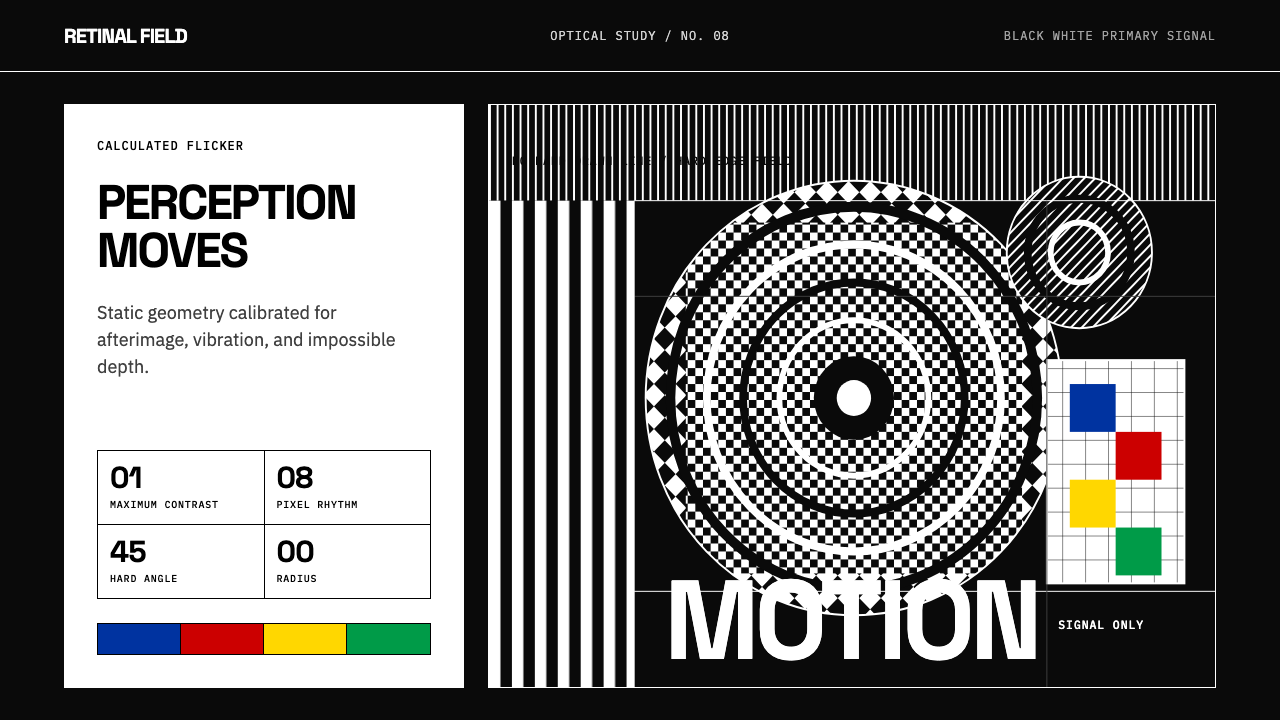 Op Art (Riley / Vasarely)Perception is engineered. Black-white grids and primary signals make static g…
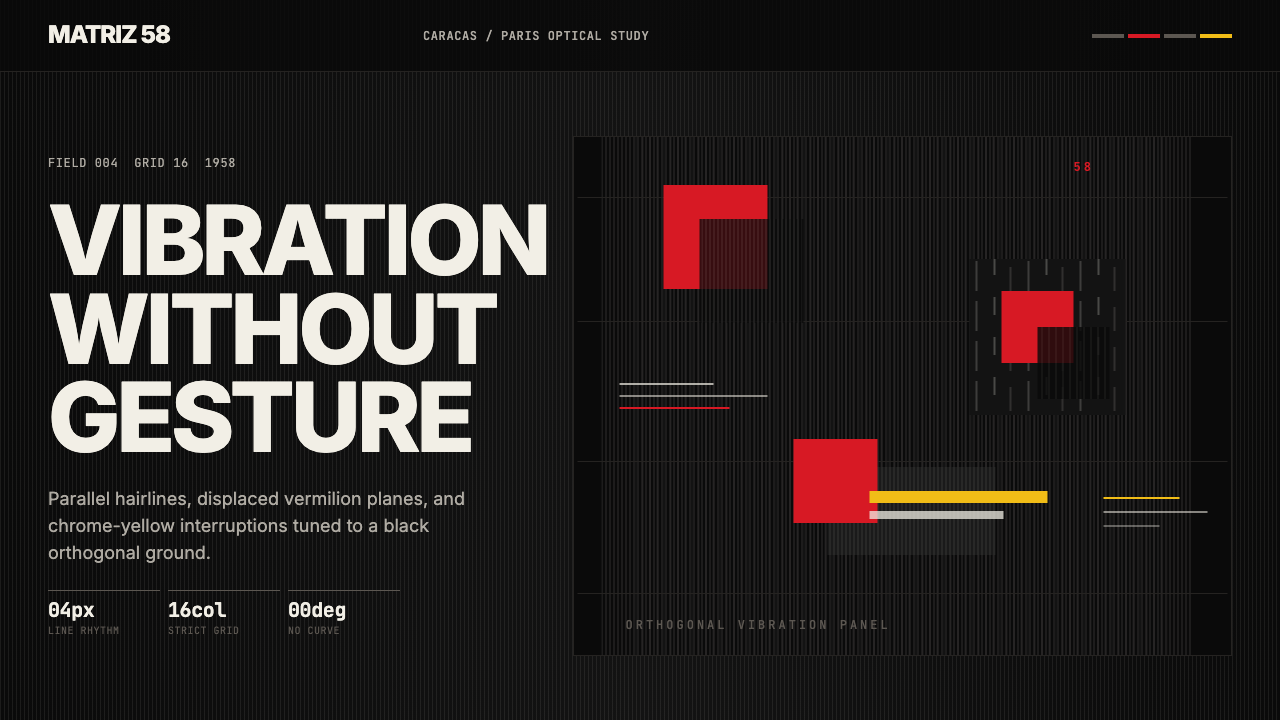 Venezuelan Cinético Soto 1958Optical tension holds still. Matte black, Inter, hairlines, and vermilion off…