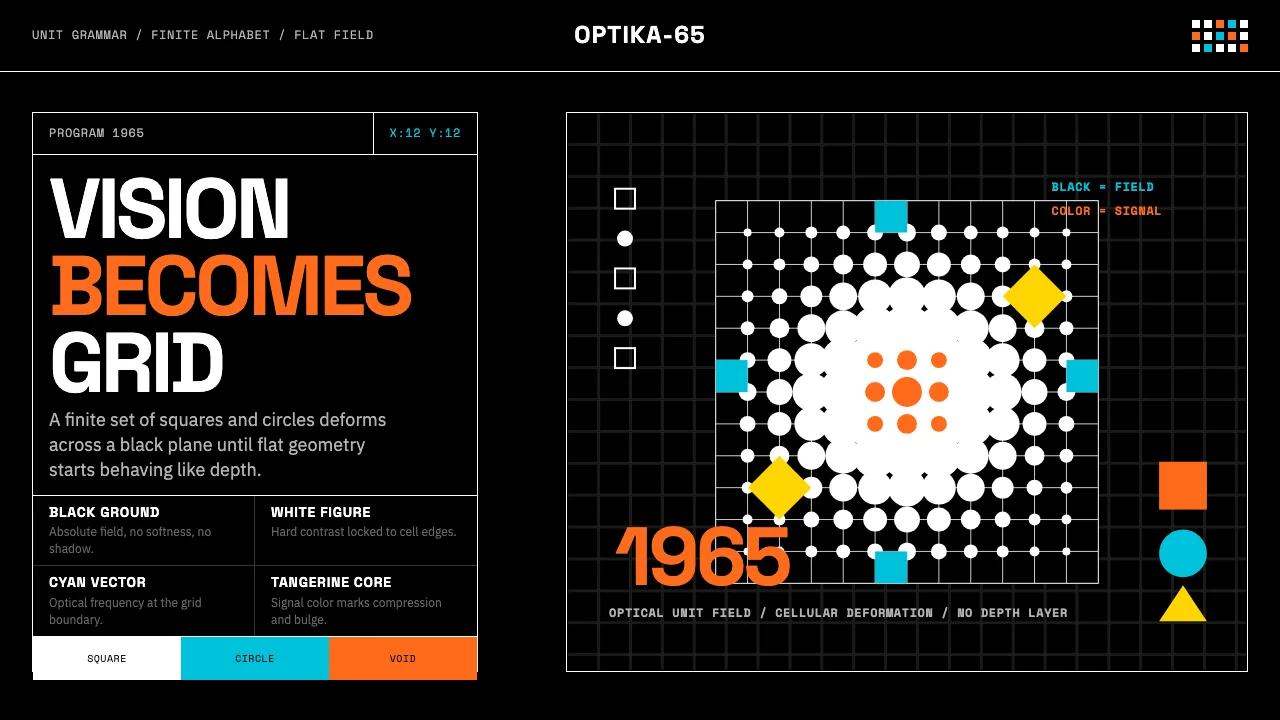
About Hungarian Vasarely Op Art (1965)
Victor Vasarely's Op Art distills vision into mathematics — a finite alphabet of unit shapes deformed across rigid grids until flat surfaces bulge into spheres or collapse into voids. This design system channels the 1965 Responsive Eye moment: pure black ground, blinding white figures, and electric tangerine and cyan accents that vibrate at the edge of perception.
Every element obeys the grid. No gradients, no shadows, no organic softness — only the precise optical tension between flat color zones and geometric deformation that made Vasarely the father of programmatic visual art.
- Origin
- Hungary (Pécs) → France (Paris, Aix-en-Provence)
- Era
- 1955 Manifeste Jaune through 1970s peak; 1965 MoMA Responsive Eye breakthrough
- Key figures
- Victor Vasarely · Yvaral (Jean-Pierre Vasarely) · William C. Seitz · Pontus Hultén
- Movements
- Op Art · Kinetic Art · Nouvelle Tendance
Hungarian Vasarely Op Art (1965) design spec
Colors
Typography
The other 11 sections — buttons, cards, spacing, motion, techniques and more — open once you unlock. Download the DESIGN.md or send it to your AI in one click. Unlock once, yours forever.
Sign up nowStyles similar to Hungarian Vasarely Op Art (1965)
Also inspired by art & artists, with a close feel.
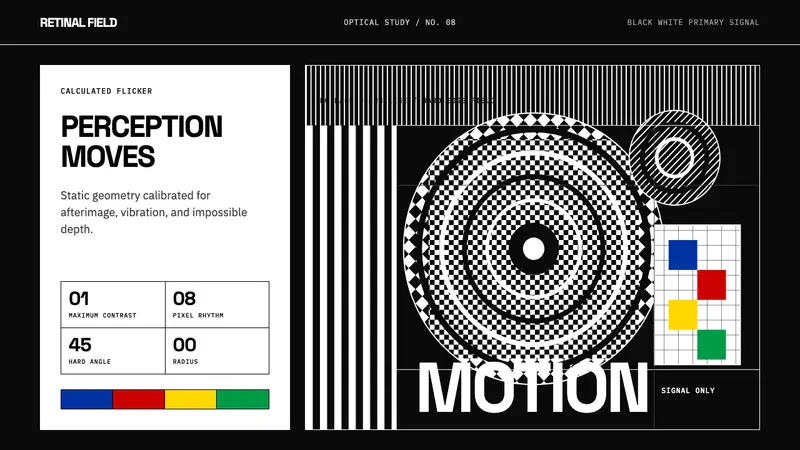 Op Art (Riley / Vasarely)Perception is engineered. Black-white grids and primary signals make static geometry vibrate.
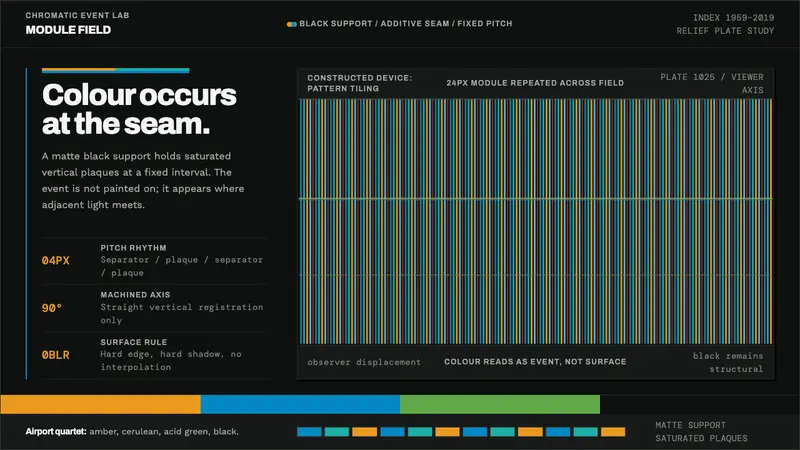 Cruz-Diez PhysichromieColour happens in motion. Fixed cyan-teal-amber stripes cut into structural black.
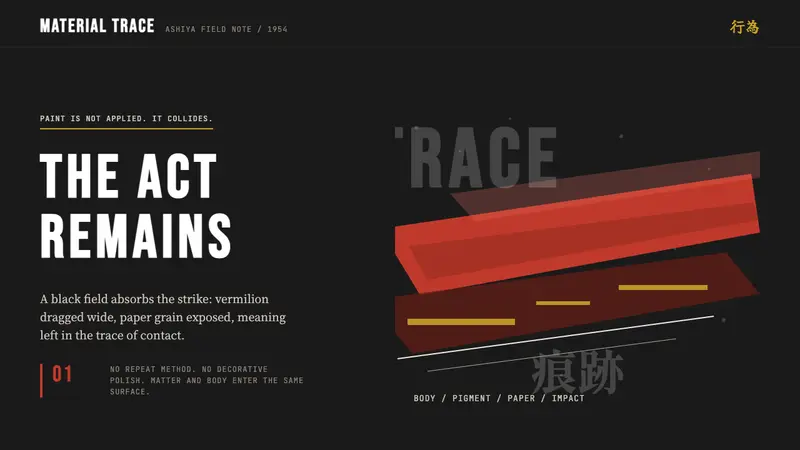 Gutai (Yoshihara, 1954)The gesture survives. Sumi black carries one vermilion strike and rough paper grain.
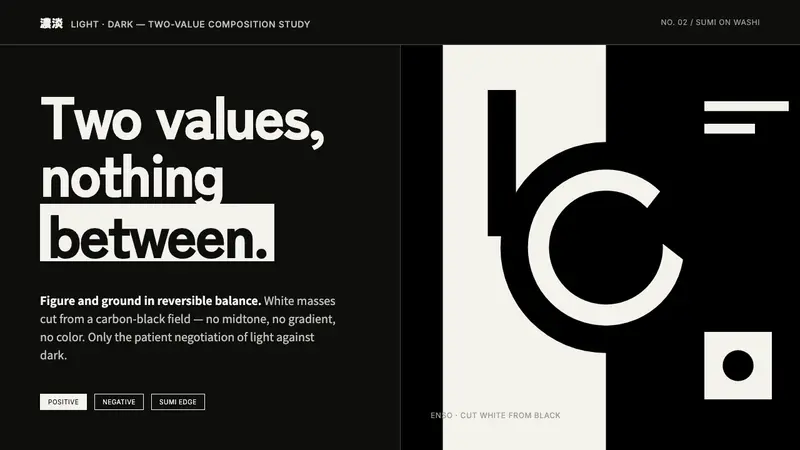 Notan Light-DarkTwo values, nothing between. White masses cut from a carbon-black field, figure-ground reversing.