What is Kraftwerk Trans-Europa Express?
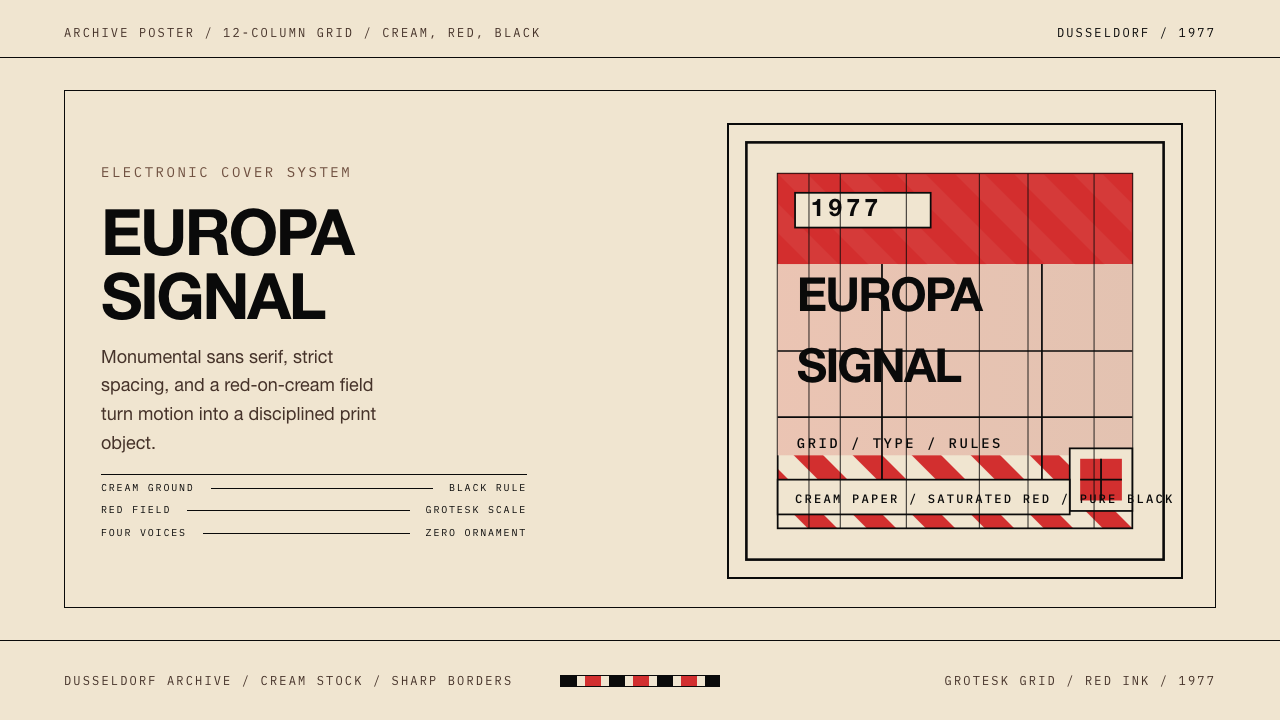
Three colors, no ornament, no apology — Kraftwerk's 1977 album cover redefined how electronic music looked for half a century.
Kraftwerk Trans-Europa Express in brief
Kraftwerk Trans-Europa Express is a visual design system derived from the cover art of Kraftwerk's 1977 album of the same name, created at the Kling Klang Studio in Düsseldorf under the art direction of Emil Schult, Florian Schneider, and Ralf Hütter. Its visual grammar is built on three colors — cream, saturated red, and pure black — deployed across a strict geometric grid with no ornament and no compromise.
The system is a variant of Bauhaus modernism filtered through the particular aesthetic demands of electronic music: it shares the parent movement's rejection of surface decoration and its commitment to geometric discipline, but adds a quality of cold monumentality that Bauhaus itself rarely achieved. Where Bauhaus could feel energetic and utopian, Trans-Europa Express feels precise and machine-like — a visual equivalent of the synthesizer sounds on the record itself.
The defining visual signature is the tension between the warmth of the cream ground and the severity of saturated red and absolute black laid across it. Type is set large, with no softening of edges and no transition between colors. Portrait photographs of the four band members are integrated into the grid with the same geometric rigor applied to every other element, treating the human face as one more shape to be composed. The result is not coldness for its own sake but a kind of radical clarity — everything irrelevant has been removed.

Where does Kraftwerk Trans-Europa Express come from?
Kraftwerk was founded in Düsseldorf in 1970 by Ralf Hütter and Florian Schneider, emerging from the experimental West German music scene that critics would later call Kosmische Musik or Krautrock. The band established the Kling Klang Studio as their permanent creative base, an environment they controlled entirely — recording, production, and visual identity were all developed in the same space, by the same people, according to the same principles. By the time Trans-Europa Express was released in 1977, Kraftwerk had already developed a distinctive visual language across their previous albums, but this record pushed it to its most distilled and architectural form.
Emil Schult, a visual artist and longtime collaborator, brought a formal art education background to the project. Schult had studied painting and was familiar with the Bauhaus legacy that permeated German design education of the era. The decision to work with a cream ground rather than white was deliberate — cream carries a quality of aged paper, of historical documents, that pure white does not. Against that ground, the saturated red of the lettering reads not as a brand color but as an assertion, a signal flag planted in precise territory. The diagonal stripe composition — a band of color cutting across the picture plane — references both the graphic traditions of European rail travel posters and the geometric abstraction of Constructivist design.
The album's subject matter shaped its aesthetics as much as its personnel did. Trans-Europa Express is conceptually about European modernity: the train as a metaphor for precision, for engineered efficiency, for the erasure of distance through technology. The cover needed to look like that idea felt — not warm, not organic, not handmade, but manufactured and exact. The use of photography for the band portraits, rather than illustration, served this logic: the camera produces facts, and the album's visual system was built around facts rather than impressions.
By 1977, Düsseldorf had become a significant node in the network of European modernist visual culture. The city's art school tradition, its industrial identity, and its proximity to the postwar reconstruction of German design institutions gave the Kling Klang Studio a particular intellectual environment. The influence of Josef Albers — who had taught at the Bauhaus and later at Yale — was felt in German art education in how color relationships were understood as structural rather than expressive. Kraftwerk's visual palette absorbed this understanding: the three colors in the Trans-Europa Express system are not chosen for beauty but for their capacity to define space, signal hierarchy, and create contrast at maximum efficiency.
What defines the Kraftwerk Trans-Europa Express look?
Three-Color Discipline
The entire system operates with exactly three colors: cream, saturated red, and pure black. Cream serves as the ground — warm enough to avoid the clinical quality of pure white, neutral enough to let red and black assert themselves without competition. Saturated red carries all naming and headline functions, functioning as a signal rather than a brand color. Black performs structural work: borders, portrait frames, typographic elements that must recede behind the red. No fourth color is permitted; no tone of any of the three is allowed to soften. The discipline is as strict as the Bauhaus three-primary system and produces a similarly immediate visual recognition.
Grid Precision
Every element in the composition is governed by an underlying geometric grid. Portrait photographs, typographic blocks, and diagonal stripe elements all lock to the same structural logic. Nothing floats freely; nothing is positioned by intuition alone. The grid is not visible — no rules or guides appear on the surface — but its presence is felt in the exactness of every alignment and the consistent mathematical relationship between elements. This invisible architecture is what distinguishes the style from superficially similar work that uses the same colors without the underlying structural commitment.
Monumental Typography
Type in this system is set large — assertively, almost aggressively so — in a geometric sans-serif form that carries none of the humanist warmth of older letterforms. The scale creates a poster-like quality where the title or label functions as an image in its own right, not merely as information. Uppercase characters dominate; the absence of lowercase in key display positions reinforces the mechanical, non-conversational quality of the system. Letter-spacing is precise rather than optical — the relationship between characters is engineered, not felt.
Diagonal Geometry
Where most grid-based systems rely on horizontal and vertical axes exclusively, the Trans-Europa Express visual language introduces a diagonal stripe or band as a structural compositional device. This diagonal is not decorative — it serves as a divider, a framing element, and a directional signal simultaneously. It recalls the angular compositions of Russian Constructivism and European rail poster design, and it introduces a sense of movement and speed that purely orthogonal grids cannot achieve. The angle is fixed, not varied — the same geometric decision applied consistently across the system.
Portrait as Geometric Object
Photography of human subjects enters the system as a geometric element rather than as a documentary or expressive medium. Portraits are cropped to precise geometric proportions, framed within hard-edged rectangles, and positioned within the grid with the same logic applied to abstract shapes. The photographic subjects — rendered in a high-contrast treatment that reduces tonal range — read as flat planes rather than illusionistic representations of depth. The effect is that the human face becomes part of the visual pattern, neither more nor less important than the typographic or stripe elements surrounding it.
Absolute Flatness
The system contains no gradients, no soft shadows, no texture, and no simulation of three-dimensional space. Color areas are flat and bounded by hard edges. Where elements overlap, they are opaque rather than transparent — there is no blending, no luminosity. This flatness is not a production limitation but a principled aesthetic decision: the visual world of Trans-Europa Express is two-dimensional by conviction, and any element that implies depth or lighting belongs to a different visual logic entirely.
Restrained Compositional Asymmetry
Like its Bauhaus antecedent, the system achieves balance through weight and tension rather than mirror symmetry. A heavy typographic mass on one side of the composition is counterbalanced by a differently-scaled element — a portrait grid, a diagonal band, a block of contrasting color — on the other. The asymmetry is never casual or expressive; it is always calculated, always in service of a clear visual hierarchy that leads the eye through the composition in a specific sequence. Randomness or accident have no place in this aesthetic.

Who shaped Kraftwerk Trans-Europa Express?
Co-founder of Kraftwerk and the project's primary conceptual architect, Hütter was responsible for the philosophical framework that treated music, visual identity, and public presentation as a single unified system. His insistence on controlling every aspect of Kraftwerk's output — from synthesizer design to sleeve artwork to live performance staging — resulted in one of the most coherent artist identity systems in popular music history. The Trans-Europa Express aesthetic cannot be separated from his determination that electronic music deserved its own visual language, distinct from rock and pop conventions.
The other founding member of Kraftwerk, Schneider brought a precision and technical sensibility that complemented Hütter's conceptual ambitions. As a trained classical musician who abandoned traditional instruments for electronics, his aesthetic trajectory embodied the Trans-Europa Express principle — the deliberate choice of the manufactured over the natural, the precise over the expressive. His visual instincts, applied to the album's imagery, consistently favored reduction: fewer elements, harder edges, less information.
As the primary visual collaborator on Trans-Europa Express and several other Kraftwerk albums, Schult brought formal fine-art training to the project that the musicians themselves lacked. His background in painting gave him a fluency with compositional structure, color theory, and the history of European modernist design — including the Bauhaus lineage that underpins the album's visual language. Schult also contributed lyric writing and conceptual framing to the Kraftwerk project, reinforcing the band's insistence that visual and musical ideas arose from the same source.
Joining Kraftwerk in 1975, Bartos was a member during the Trans-Europa Express period and contributed to the ensemble identity that the album's cover so precisely represents. As one of the four figures whose portraits appear in the album artwork, his physical presence in the image — treated with the same geometric discipline as every other visual element — illustrates the system's central premise: that the individuals within an artistic project can themselves become design elements when subjected to sufficient formal rigor.
The fourth member whose image appears on the Trans-Europa Express cover, Flür was part of the electronic percussion lineup that defined Kraftwerk's machine-music aesthetic. His presence in the cover system underscores the album's thematic consistency: just as the band replaced conventional drum kits with electronic percussion pads, the cover replaced conventional band photography — loose, informal, personality-driven — with a system that treated the four members as components in a designed ensemble rather than as individual expressive subjects.
How do you use Kraftwerk Trans-Europa Express today?
The Trans-Europa Express system is most powerful in contexts where authority, precision, and a deliberate sense of manufactured quality are desired values. The aesthetic communicates machine-era modernism — not the warm craft-inflected modernism of later movements, but the cold, engineered, intentional modernism of a system that has been optimized. It suits products and presentations that want to be perceived as rigorous, technically credible, and unconcerned with approval. For presentation decks, the system works particularly well on cover slides where a diagonal band in saturated red or pure black divides the cream ground, the event or product name sits in large geometric sans-serif above the divide, and a secondary line of information anchors below in smaller scale. The visual logic immediately signals that what follows will be organized and precise.
Content slides in this system should be treated as strict grids — no decorative dividers, no icon embellishments, no background textures. Text hierarchy is established through scale and weight alone: a large heading at the top of the grid, a clearly subordinate body at a smaller scale, and a footer line at the minimum scale. Data visualizations — bar charts, timeline diagrams, comparative tables — should embrace the geometric quality of the style: bars and segments in cream, red, and black only, with no gradient fills, and with data labels set in the same geometric sans-serif as the headline typography. When executed consistently, each slide becomes part of a visual argument rather than a container for information.
For web interfaces, the system is well-suited to dashboards, technical documentation sites, pricing pages, and any context where hierarchy and scannability outrank warmth. The recommended approach is a strict column grid with a near-cream or pure cream background, black for all body text, and saturated red reserved for active states, primary calls to action, and critical alerts. Card components should use hard borders rather than soft shadows — a thin black rule framing a cream or white surface is more consistent with the system's logic than a diffuse drop shadow. Navigation elements should be typographic: no rounded corners, no icon-only controls, no decorative separators beyond hard rules.
In editorial and marketing contexts, the style supports strong visual hierarchy and sustained attention across long-form content. A Trans-Europa Express-derived editorial layout uses generous left margins for pull quotes or chapter markers, a narrow measure for body text, and section breaks marked by bold horizontal rules or diagonal stripe elements rather than decorative ornaments. Marketing pages benefit from the system's poster-like quality: full-width feature sections alternating between cream grounds with red and black type, and black grounds with cream type, using the diagonal band motif as a transition device between sections. The effect is arresting rather than welcoming, which makes the style appropriate for brands positioning themselves on capability and precision rather than approachability.
The most common mistake when applying this system is treating the three-color palette as an invitation to use all three colors simultaneously at maximum saturation on every surface. The original album cover works because cream is the dominant ground, black is the secondary structural color, and saturated red appears selectively — for the album title, for key labels, for emphasis. In practice this means red should account for a small fraction of any composition's total area; when red and black appear in roughly equal proportion, the visual tension that makes the system dynamic collapses into noise. A second common error is using any softening effect — a gradient in the red, a soft drop shadow on a card, a slightly transparent overlay — which immediately undermines the system's essential flatness and reads as a failure of commitment rather than a refinement.

Kraftwerk Trans-Europa Express — FAQ
How is this style different from Bauhaus itself?
Both share the core commitments: geometric structure, restricted palette, no ornament, grid-based composition. The key differences are in temperature and purpose. Bauhaus was a school and a social project — its visual language was optimistic, even utopian, designed to demonstrate that good design could improve everyday life for ordinary people. Trans-Europa Express inverts this: it is deliberate, cool, and self-aware to the point of irony. Where Bauhaus sought to reach everyone, Trans-Europa Express signals that it is indifferent to whether it reaches you. Bauhaus uses primary red, yellow, and blue; Trans-Europa Express replaces yellow entirely with cream. This is a fundamental shift — cream carries historical weight, a quality of aged documentation, that yellow's energy does not.
Can this system work with imagery beyond photography?
Yes, but the imagery must be treated with the same geometric discipline that governs the typographic and color elements. Any photograph should be cropped to hard-edged geometric proportions and reproduced in a high-contrast treatment that reduces tonal complexity. Illustration, if used at all, should be geometric and flat — no hatching, no painterly texture, no representational depth. Diagrams and infographics are naturally compatible with the system and can be constructed entirely within the three-color palette. What does not work: lifestyle photography with ambient light and soft gradients, illustrative styles that imply hand production, or any image that carries more tonal range than the palette allows.
Is a dark-background version possible?
A dark inversion is possible but structurally more difficult than a dark Bauhaus variant. The problem is that cream — which defines the system's warmth and historical weight — becomes difficult to read as a background element on a black ground; it tends to look like an unintentional off-white rather than a deliberate material choice. The more workable dark variant replaces cream as the ground with pure black, uses cream and white as primary typographic colors, and reserves saturated red for structural accents rather than headline type. This loses some of the original's documentary quality but maintains the geometric discipline and high-contrast logic. The diagonal stripe element remains effective in dark versions: a cream or red band crossing a black ground retains the speed-and-precision reading of the original.
What kinds of brands or products fit this style, and which do not?
The style is well-matched to any product where manufactured precision, technical authority, and a cool confidence are central values. Developer tools, technical infrastructure products, financial platforms, analytical software, and industrial or hardware brands are natural fits. It also works for cultural institutions — music venues, contemporary art galleries, architecture practices — where the audience expects a sophisticated engagement with design history. It does not work where warmth, accessibility, or sensory richness are essential: food and beverage brands, healthcare applications aimed at general consumers, children's products, travel and hospitality, or any product that needs to feel welcoming to a broad audience. The system's indifference can read as exclusionary in contexts where inclusion is the point.
How should this style handle multiple languages or long translated text?
Long typographic runs — particularly in languages whose script density or line-break behavior differs significantly from Western Latin letterforms — require careful adaptation rather than direct transposition. The system's monumental large-scale headline approach works in most script systems where a geometric sans-serif equivalent exists. Where no close equivalent exists, the structural principle should take priority over the specific letterform: maintain the scale hierarchy, maintain the three-color discipline, and accept that the precise visual weight of the headline will shift. For body text in right-to-left or ideographic scripts, the grid logic remains valid but the diagonal stripe element may need repositioning to respect reading direction. The single non-negotiable rule is that the flatness and hard-edge quality of the system must be maintained regardless of script: no softening of letterforms, no addition of decorative stroke variations that are not intrinsic to the script itself.
Related design styles
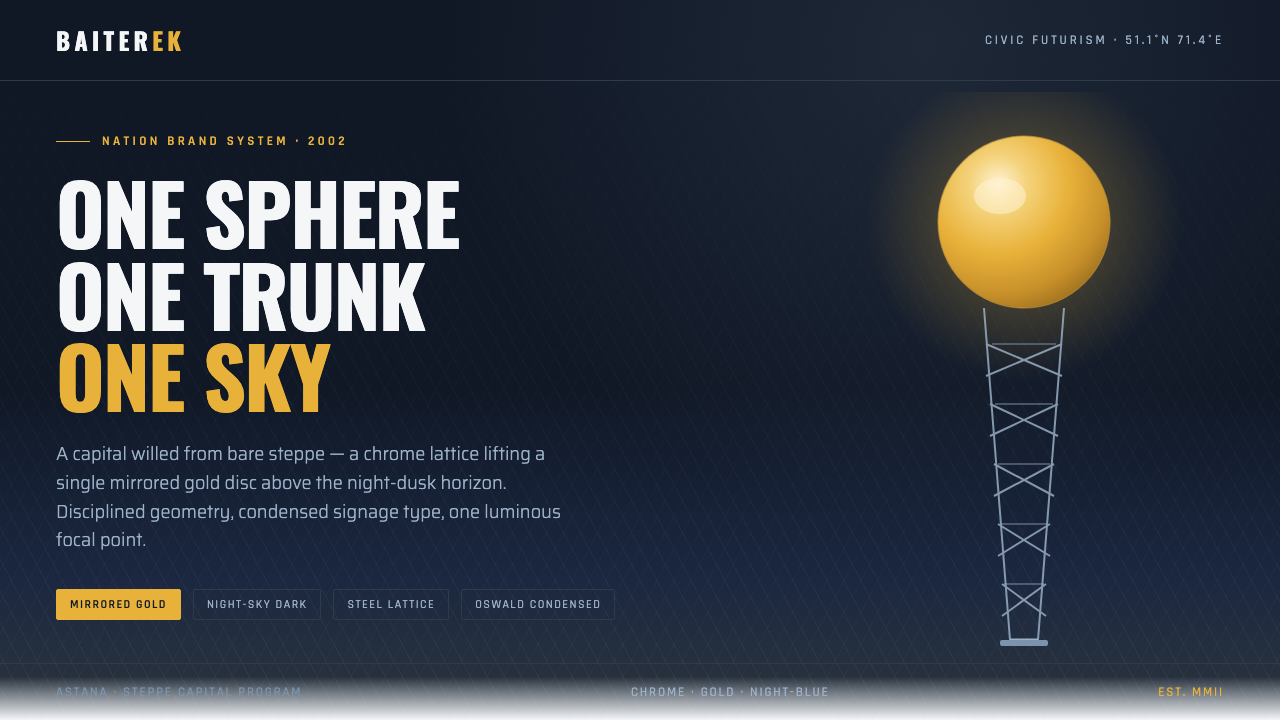 Astana Baiterek TowerCivic optimism in chrome and gold. A mirrored sphere crowns a white lattice t…
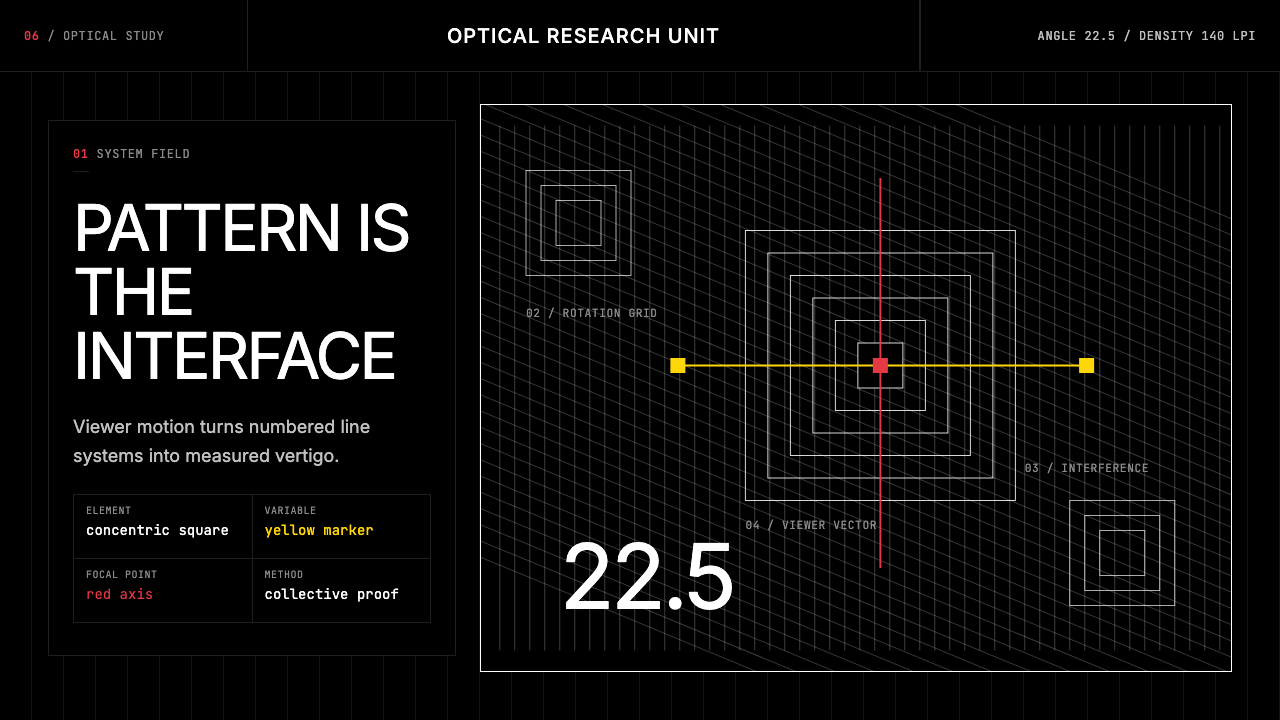 GRAV Op-Kinetic (1960)Vertigo by calculation. White line fields on black, with red and yellow as co…
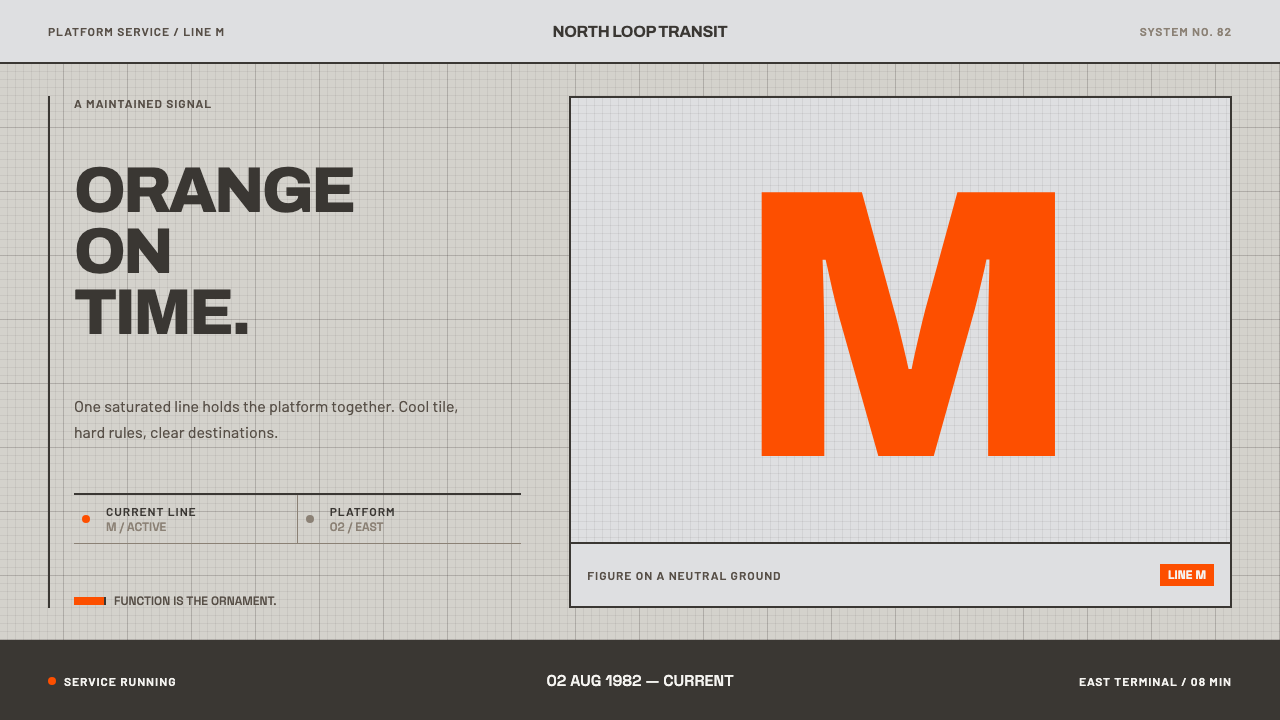 Helsinki Metro OrangeOne orange does the work. Archivo signage cuts across an 8px concrete tile gr…
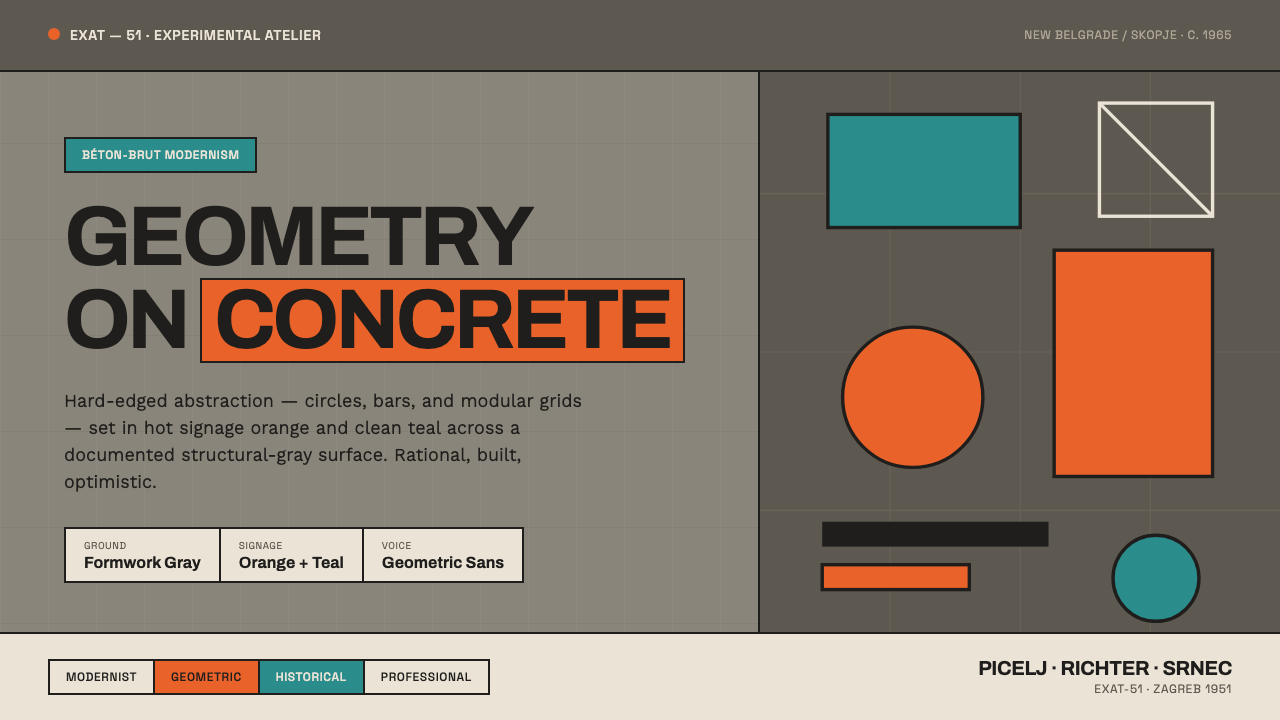 Yugoslav Socialist ModernismGeometry on concrete. EXAT-51 circles and bars in hot orange and clean teal,…
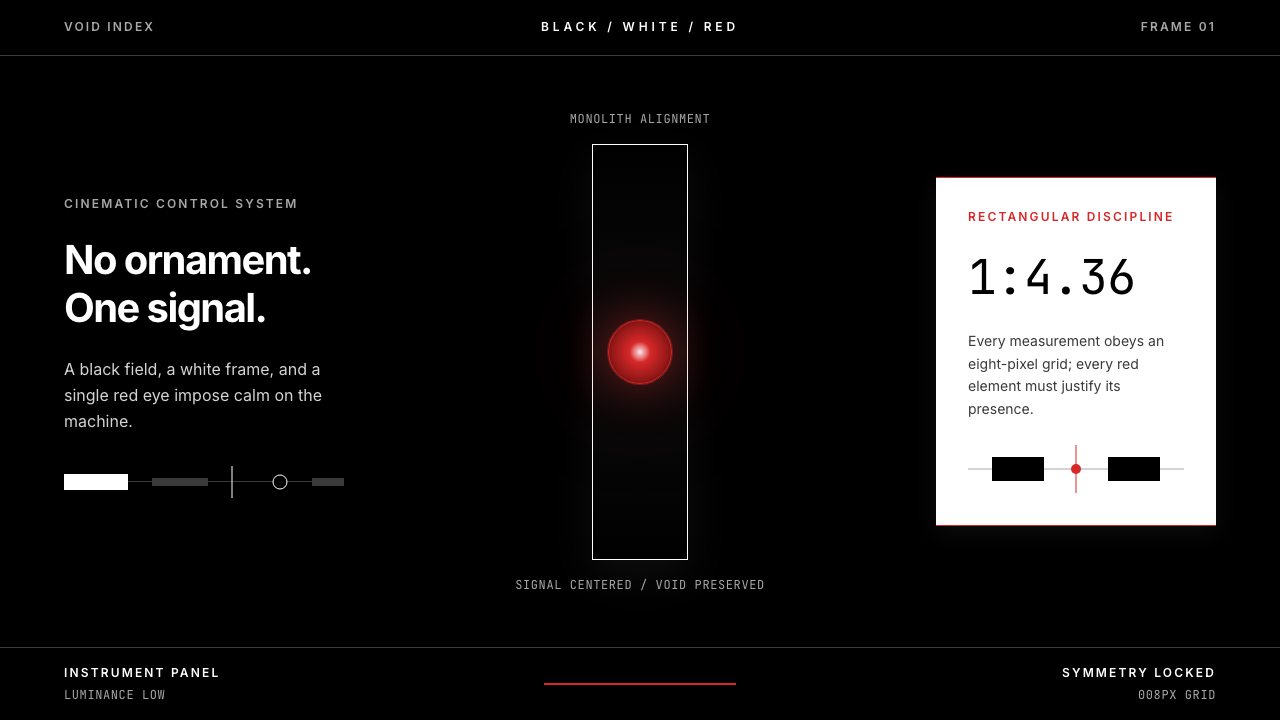 2001 — A Space OdysseyAbsolute restraint. Black void, white monolith geometry, one HAL-red signal.
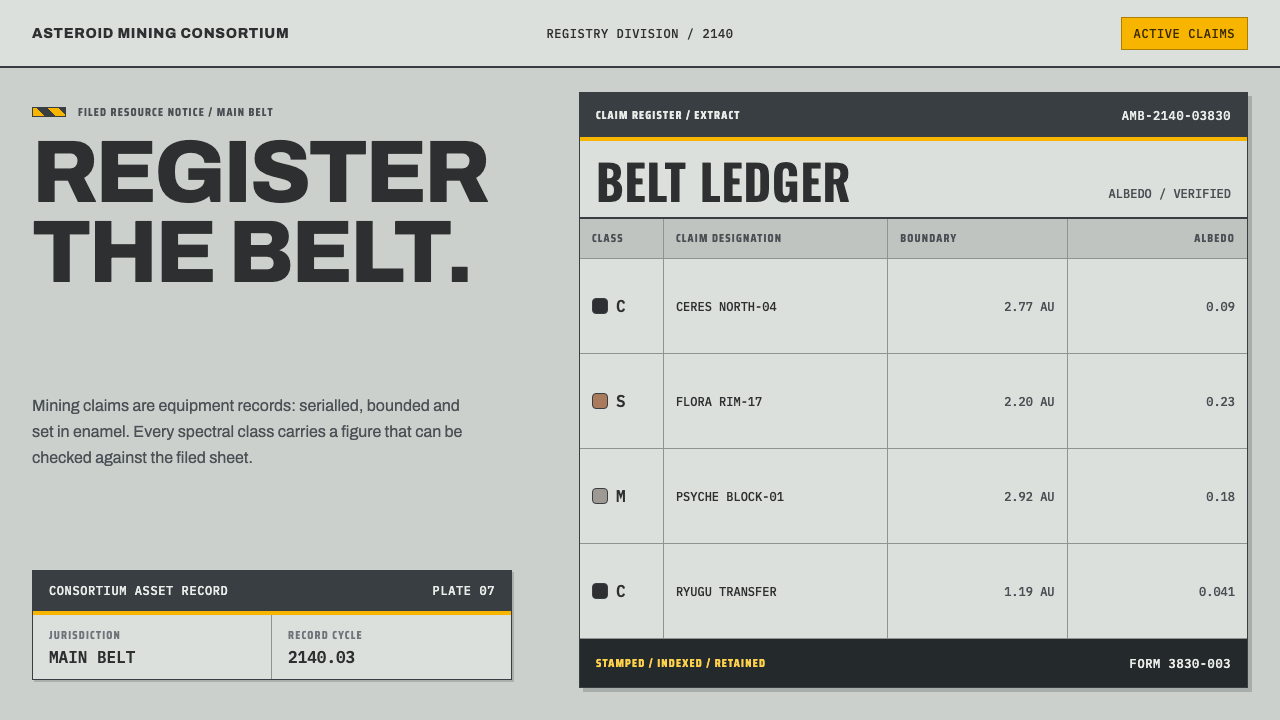 Asteroid Mining ConsortiumIndustry, not cinema. RAL enamel plates, hazard yellow and monospaced claim l…