What is Penrose Aperiodic Tiling?
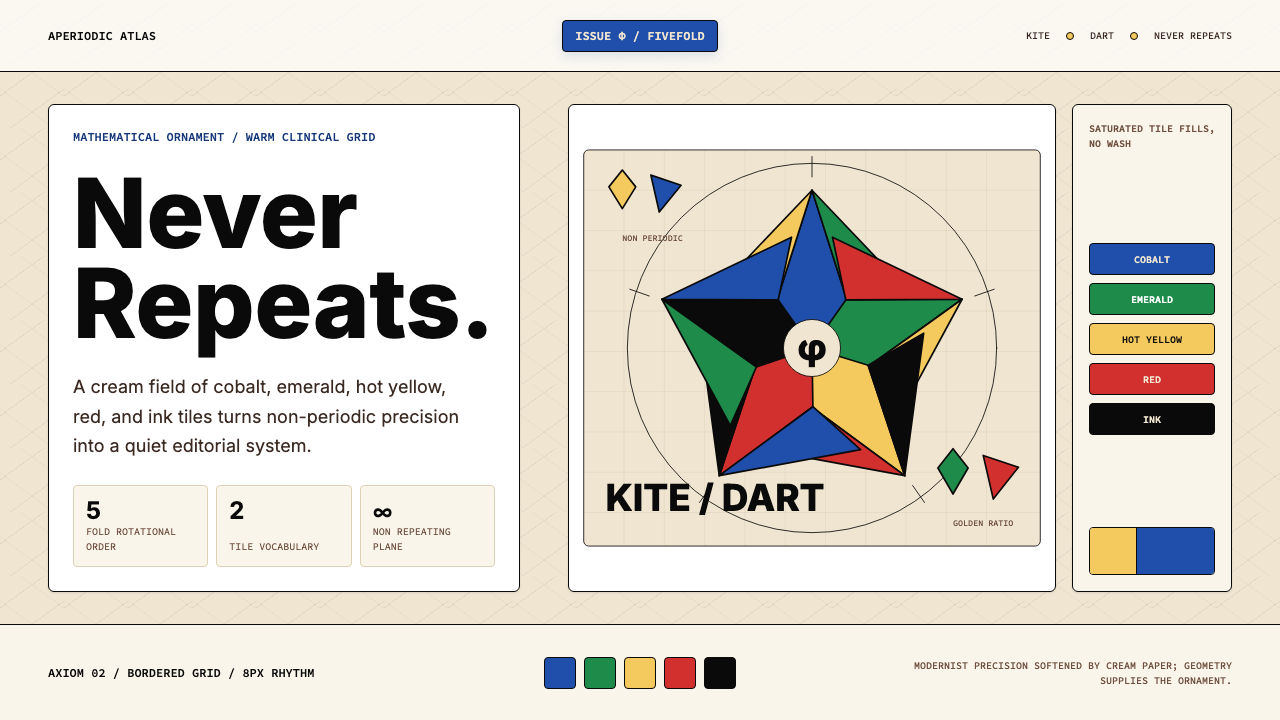
Penrose Tiling is the mathematical proof that infinite variety and perfect order can coexist — a kite-and-dart geometry that covers the plane forever without ever repeating.
Penrose Aperiodic Tiling in brief
Penrose Aperiodic Tiling is a design language rooted in one of mathematics' most celebrated discoveries: a set of tile shapes that can fill an infinite flat plane in five-fold rotational symmetry without ever forming a repeating periodic pattern. The canonical form uses two tile shapes — a broad kite and a slender dart — whose matching rules force quasi-crystalline order across every scale. The result is a surface that looks almost regular but rewards close inspection with endless local novelty.
As a visual system, the aesthetic pairs a warm cream canvas with a tight, saturated palette drawn directly from the tile colors: cobalt blue, emerald green, hot yellow, saturated red, and a near-black ink. The ground is never stark white — the warmth of the cream keeps the mathematical rigor from reading as clinical. The saturated fills land like inlaid tiles, each shape distinct in color but governed by the same quiet geometric logic.
Compositions in this language obey the golden ratio and five-fold rotational symmetry, the same constraints that govern the tiling itself. Typography is set with mathematical precision: tight tracking, deliberate scale contrasts, and alignment to the underlying angular geometry. The overall register is modernist and analytical, but the warm ground and jewel-like tile colors ensure it never feels sterile.

Where does Penrose Aperiodic Tiling come from?
The story of Penrose Tiling begins not with design but with a mathematical question that had occupied geometers for decades: is it possible to construct a finite set of tile shapes that can tile the infinite plane, but only aperiodically — that is, in a way that never produces a repeating, periodic pattern? In 1966, Robert Berger proved that aperiodic tilesets existed, using a set of over 20,000 tile shapes. Subsequent researchers reduced the number, but it was the British mathematician and physicist Sir Roger Penrose who, in 1974, reduced the problem to just two shapes: the kite and the dart, a pair of quadrilaterals whose simple matching rules generate unbounded five-fold symmetric patterns. Penrose published this discovery while working at the University of Oxford, and the tiling that bears his name became one of the most recognizable images in twentieth-century mathematics.
What made Penrose's result remarkable beyond its mathematical elegance was an unexpected historical resonance discovered decades later. In 2007, the physicist Peter Lu and cosmologist Paul Steinhardt published a landmark paper demonstrating that the geometric patterns decorating the facades of medieval Persian Islamic architecture — the Girih tile tradition, visible in buildings such as the Darb-i Imam shrine in Isfahan (circa 1453) — were constructed using the same underlying quasi-crystalline geometry as Penrose tiling, more than five centuries before Penrose formalized it. Islamic craftsmen had arrived at aperiodic five-fold geometry through accumulated empirical practice, without the formal mathematical apparatus that would later explain why it worked. This discovery transformed Penrose Tiling from a purely modern mathematical curiosity into a design lineage with deep historical and cultural roots.
The connection to quasicrystals extended the story further. In 1984, materials scientist Dan Shechtman discovered a metal alloy whose atomic structure exhibited the same five-fold symmetry that Penrose patterns display in two dimensions — a finding that earned him the 2011 Nobel Prize in Chemistry and overturned a century of crystallographic orthodoxy. The physical existence of quasicrystalline matter gave Penrose patterns a material reality beyond the page: the geometry that Penrose had described as a mathematical abstraction turned out to describe the atomic architecture of actual substances found in nature, including in certain meteorites.
By the late twentieth century, Penrose Tiling had migrated from academic mathematics into architecture, product design, and visual culture. Notable architectural applications include the floor of the Bradshaw Building at the University of Oxford and several university campus pavements in the United States and Europe. The pattern appeared in textile design, ceramics, and eventually as a recurring motif in computational and generative art, where its combination of local unpredictability and global order made it a natural subject for algorithmic exploration.
What defines the Penrose Aperiodic Tiling look?
Aperiodic Geometry
The defining visual property is infinite local variation within globally consistent rules. No two regions of the tiling are identical, yet the eye immediately senses an overarching order. This tension — between unpredictability at the detail level and coherence at the whole — is what gives the pattern its distinctive quality of perpetual discovery. In design application, it means compositions built from this logic resist the deadening effect of repetition while remaining legible as a unified system.
Five-fold Symmetry
Penrose patterns exhibit five-fold rotational symmetry — a rotation of one-fifth of a full turn maps the pattern onto itself in terms of statistical properties, even though no exact translation repeats. Five-fold symmetry is geometrically forbidden in classical periodic tilings, which is precisely what makes it visually arresting. Layouts that echo this symmetry through pentagonal arrangements, radial compositions, or repeated angular increments of seventy-two degrees inherit some of the pattern's tension between the familiar and the surprising.
Warm Ground, Saturated Tiles
The canonical color structure places highly saturated tile colors against a warm cream background rather than pure white. This choice is both historical — cream grounds appear throughout Islamic geometric art — and perceptual: warm cream reduces the harshness of the high-saturation fills and gives the overall composition a quality of illuminated manuscript or inlaid tilework rather than a screen graphic. The tile colors themselves — cobalt, emerald, hot yellow, saturated red — are bold enough to read at a distance but held in check by the warmth of the ground.
Mathematical Typography
Text in this visual language is set with the precision of a mathematical proof: tight tracking, strong scale hierarchies, and alignment to the underlying angular geometry of the tiling rather than to an orthogonal grid. Headlines are set at large scale with reduced weight to echo the broad, open quality of the kite tile; body text is dense and close-set, recalling the dart tile's compactness. The typeface choices favor clean, geometric sans-serif forms with no calligraphic residue — letterforms that read as constructed rather than drawn.
Golden Ratio Proportion
The kite and dart shapes are themselves derived from the golden ratio: their side lengths are in the proportion of the golden ratio to one. This means that any composition structured around golden-ratio proportions — in column widths, in the ratio of headline to body type, in the size of framing shapes — is already in implicit dialogue with the underlying mathematics of the tiling. Page formats, image crops, and layout divisions that approximate golden-ratio relationships feel internally consistent in a way that purely arbitrary proportions do not.
Depth Through Layering
Unlike the rigorously flat Bauhaus approach, Penrose-derived compositions frequently employ subtle layering to suggest the depth of inlaid tilework. One tile color sits slightly forward of another not through a gradient or drop shadow but through careful sequencing of opacity and overlap. The effect reads as physical — as if the colored shapes are resting on the cream ground rather than printed on it. This restrained sense of depth distinguishes the style from both pure flatness and from decorative styles that rely on heavy shadow or realistic rendering.
Structural Restraint
The palette is tight by design: five tile colors plus the cream ground, deployed with symbolic purpose rather than decorative freedom. Each color tends to be assigned a consistent role across a composition — one for primary structural shapes, one for secondary accents, one for highlights — so that the color logic reads like a key to the geometry rather than an expressive choice. Mixing all five tile colors simultaneously at equal weight produces visual noise; authentic Penrose-derived work leads with two or three and holds the others in reserve.

Who shaped Penrose Aperiodic Tiling?
Penrose is the British mathematician and physicist who, in 1974, reduced the problem of aperiodic tiling to just two shapes — the kite and the dart — while working at the University of Oxford. He had previously contributed to general relativity alongside Stephen Hawking and would later receive the Nobel Prize in Physics in 2020 for his work on black holes. The tiling that bears his name is among the most recognized images in twentieth-century mathematics, appearing in floor pavements, architectural installations, and as a foundational object of study in the mathematics of quasi-crystalline order.
In 2007, physicist Peter Lu and cosmologist Paul Steinhardt published the paper that reframed Penrose Tiling as a design lineage rather than a purely modern invention. Analyzing the Girih tile patterns of medieval Persian Islamic architecture, they demonstrated that craftsmen in the thirteenth through fifteenth centuries had independently discovered and applied the same quasi-crystalline five-fold geometry, most likely through a process of empirical refinement guided by aesthetic and structural intuition. Their work gave the pattern a five-hundred-year prehistory and connected mathematical abstraction to a living tradition of material craft.
The Israeli materials scientist whose 1984 discovery of quasicrystals — metal alloys with the same five-fold symmetry as Penrose patterns, at the atomic scale — transformed the mathematical abstraction into a physical reality. Shechtman's finding was initially rejected by the scientific establishment; he was reportedly asked to leave his research group for proposing what colleagues considered an impossibility. The Nobel Prize in Chemistry he received in 2011 for the discovery represents one of the most dramatic rehabilitations of a heterodox scientific claim in recent memory, and it established Penrose's two-dimensional geometry as a description of genuine three-dimensional matter.
The collective name for the system of geometric construction used by Islamic craftsmen in Persia from roughly the thirteenth century onward to produce the intricate star-and-polygon decorative patterns that cover the facades and interiors of mosques, shrines, and palaces across Iran, Central Asia, and the wider Islamic world. The Girih system was not fully understood in the West until Lu and Steinhardt's 2007 analysis, which revealed that its most sophisticated examples — particularly the Darb-i Imam shrine in Isfahan — were constructed using the same underlying quasi-crystalline logic as Penrose tiling. In the context of this design language, the Girih tradition represents the style's living historical lineage and its grounding in material craft.
How do you use Penrose Aperiodic Tiling today?
Penrose Aperiodic Tiling is among the more demanding historical design languages to apply correctly, because its aesthetic force depends on understanding what makes the pattern mathematically and visually coherent — not merely reproducing its tile shapes or color palette. The core principle is that infinite local variety arises from a small set of consistent global rules. Design work that succeeds in this language applies the same logic: a tightly constrained palette and geometry generating rich, non-repeating surface interest.
For presentation slides, the language is most powerful on cover pages and divider spreads. A cover built in this aesthetic leads with a large-scale fragment of the tiling as the primary visual, cropped at an unusual angle to emphasize the five-fold geometry rather than centering it predictably. The tile colors — deployed two or three at a time against the cream ground — carry the visual weight, with the title set in clean, mathematically precise type at strong scale contrast to the ground. Content slides should be treated as grid-governed but not rigidly symmetric: allow columns and text blocks to align to angular cues from the tile geometry, using the golden ratio to set proportional relationships between elements. Data slides benefit from the tile color logic applied directly: each data series or category receives one of the five canonical tile colors, assigned consistently and never mixed at equal saturation.
For web interfaces and digital dashboards, the aesthetic supports precision-oriented products where the user is expected to read carefully rather than scan casually. Dashboard layouts work well with a cream or warm off-white ground, near-black body text, and tile colors reserved for status indicators, alerts, and interactive states. Card components can carry subtle layered borders that evoke inlaid tilework without literal tile shapes. Pricing pages benefit from the five-fold color logic to differentiate tiers: each plan receives one tile color as its accent, clearly establishing hierarchy without relying on size alone. Navigation should be typographic and clean — wordmarks and labels with no decorative iconography beyond geometric indicators.
For editorial and marketing work, the style sustains strong information hierarchy with an unusual combination of warmth and analytical rigor. Feature articles and long-form layouts work well with a golden-ratio column structure: a primary reading column flanked by a narrower annotation margin, with section breaks marked by angular geometric rules rather than horizontal lines. Marketing pages can exploit the poster-like quality of the tile palette: full-width feature blocks that alternate the cream ground with one deep tile color as background, maintaining the constraint of one primary tile color per visual zone. The near-black ink color handles all body text and captions, while the tile colors mark structural divisions and calls to action.
A common mistake when applying this language is treating the five tile colors as a license for chromatic abundance — using all five simultaneously across a layout at full saturation. Authentic work in this style is disciplined: a well-executed composition uses two dominant tile colors and at most one accent, holding the others in reserve. A second common error is abandoning the warm cream ground in favor of pure white to appear cleaner; this removes the visual warmth that mediates between the mathematical rigor of the geometry and the viewer, making the result feel clinical rather than crafted. A third mistake is applying the tile shapes literally as decorative motifs without respecting the matching rules that govern their placement — fragments of Penrose tiling that do not respect the underlying geometry look arbitrary rather than ordered.

Penrose Aperiodic Tiling — FAQ
What makes Penrose Tiling different from other geometric or Islamic-inspired patterns?
Most geometric patterns — including the majority of Islamic geometric art — are periodic: they tile by repeating a fixed motif at regular intervals, like wallpaper. Penrose Tiling is aperiodic, meaning the pattern never repeats, no matter how far you extend it. It exhibits five-fold symmetry, which is geometrically impossible in any periodic tiling, and the relationship between the tile shapes is governed by matching rules derived from the golden ratio. The result looks ordered but is provably non-repeating — a quality no periodic pattern can possess. Islamic Girih tiling at its most sophisticated approximates the same geometry, but Penrose Tiling is the formal mathematical statement of that underlying structure.
Can this style work on a dark background?
The canonical form of this aesthetic uses a warm cream ground, and this choice is load-bearing: the cream mediates between the high-saturation tile colors and the viewer's eye, preventing the composition from feeling aggressive or digitally artificial. A dark-background inversion is possible — black grounds with the tile colors brought to high luminosity — but it shifts the register significantly, reading more like digital quasicrystal visualization than inlaid tilework. If a dark variant is used, the palette must be tightened further: hot yellow tends to dominate on dark grounds, and cobalt blue risks disappearing entirely. Reserve the dark inversion for specifically technical or dramatic contexts where the illuminated-gem effect is intentional.
How do I use the tile shapes themselves in digital layouts without it looking like clip-art?
The key is context and constraint. Tile shapes read as design rather than clip-art when they serve a structural purpose — as color-carrying zones that organize layout regions, as framing devices for photography, or as large-scale background elements that recede behind foreground content. They fail when used as small decorative accents scattered across a layout, or when the matching rules of the actual tiling are ignored, producing arbitrary kite-and-dart fragments that carry none of the pattern's geometric logic. The shapes should be large enough to read as geometric architecture, and the palette governing them should be the same two or three colors used everywhere else in the composition.
Is Penrose Tiling too mathematically niche to resonate with general audiences?
The pattern resonates with general audiences for the same reason it interests mathematicians: the human visual system is highly sensitive to near-regularity and slight deviation from expected order. Viewers do not need to know the mathematical definition of aperiodicity to feel the particular quality of attention the pattern demands — the way it rewards looking closely and yields something new each time. Used well, the aesthetic communicates authority, precision, and a sense that the system it represents is more sophisticated than it initially appears. These qualities are legible across audiences, and the warm cream ground ensures the mathematical severity reads as considered craft rather than cold system.
How does Penrose Tiling relate to Bauhaus or Swiss International Style?
All three are design languages rooted in geometric order and the conviction that mathematical structure produces aesthetic quality. The differences are significant, however. Bauhaus and Swiss Style are orthogonal — built on the right-angle grid and bilateral symmetry broken by asymmetric composition. Penrose Tiling is radial and five-fold — its organizing geometry is angular, rotational, and explicitly non-orthogonal. Bauhaus uses primary colors symbolically and derives from Western industrial modernism; Penrose Tiling uses saturated inlay colors against a warm ground and derives from both mathematical discovery and Islamic decorative tradition. The three styles share a discipline of restraint and system-thinking, but they produce very different compositional logics and emotional registers.
Related design styles
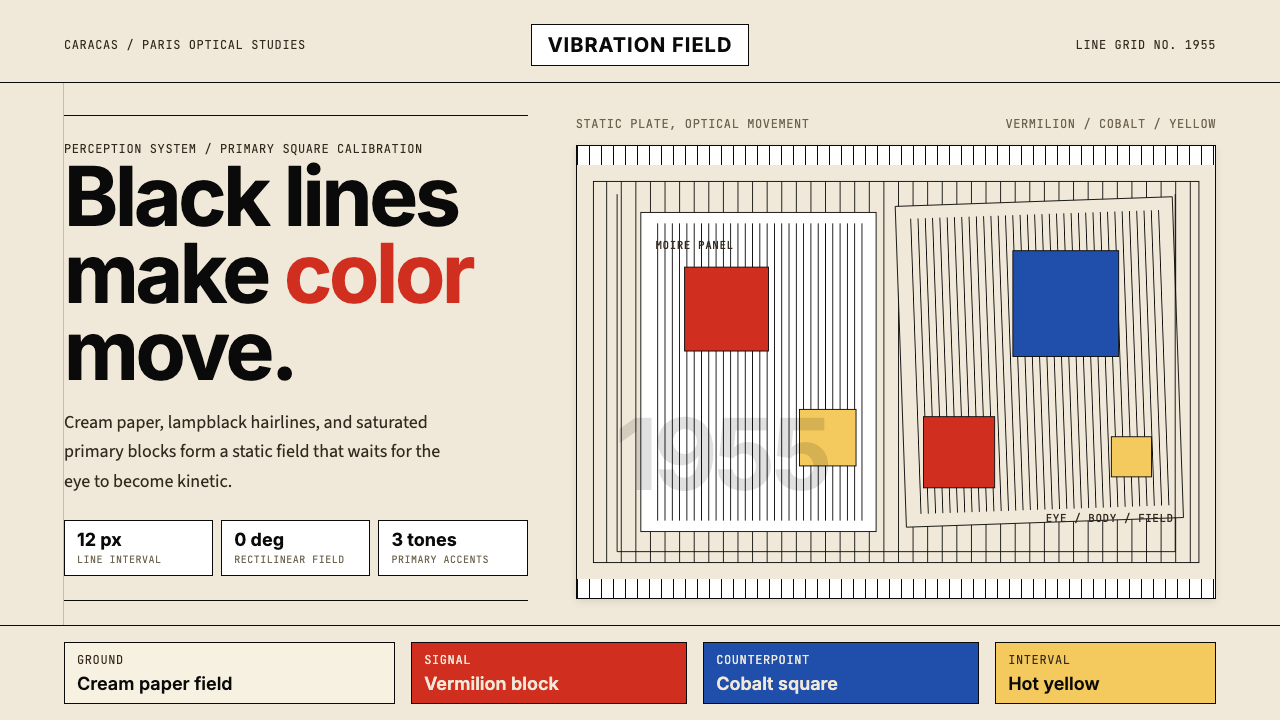 Jesús Soto Kinetic Art (Venezuela)Perception is the medium. Cream ground, black-line grids, and primary squares…
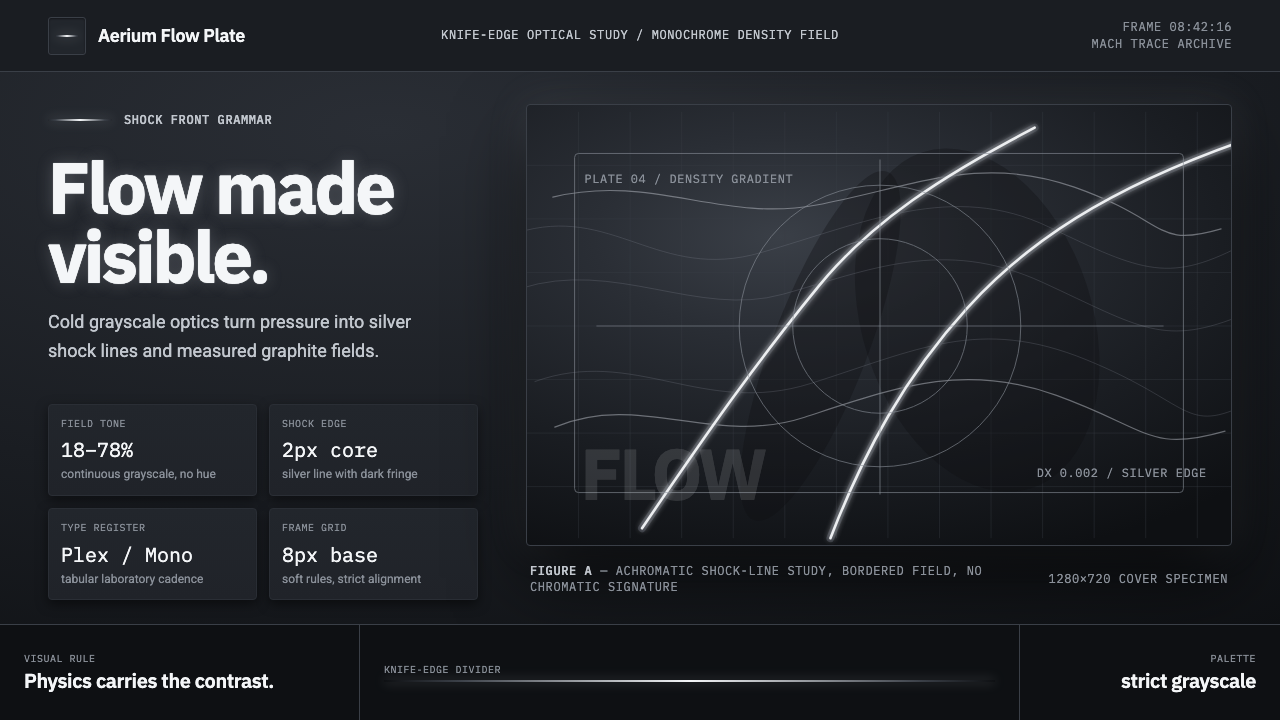 Schlieren ShadowgraphInvisible air becomes silver. Cool grayscale fields cut by precise shock line…
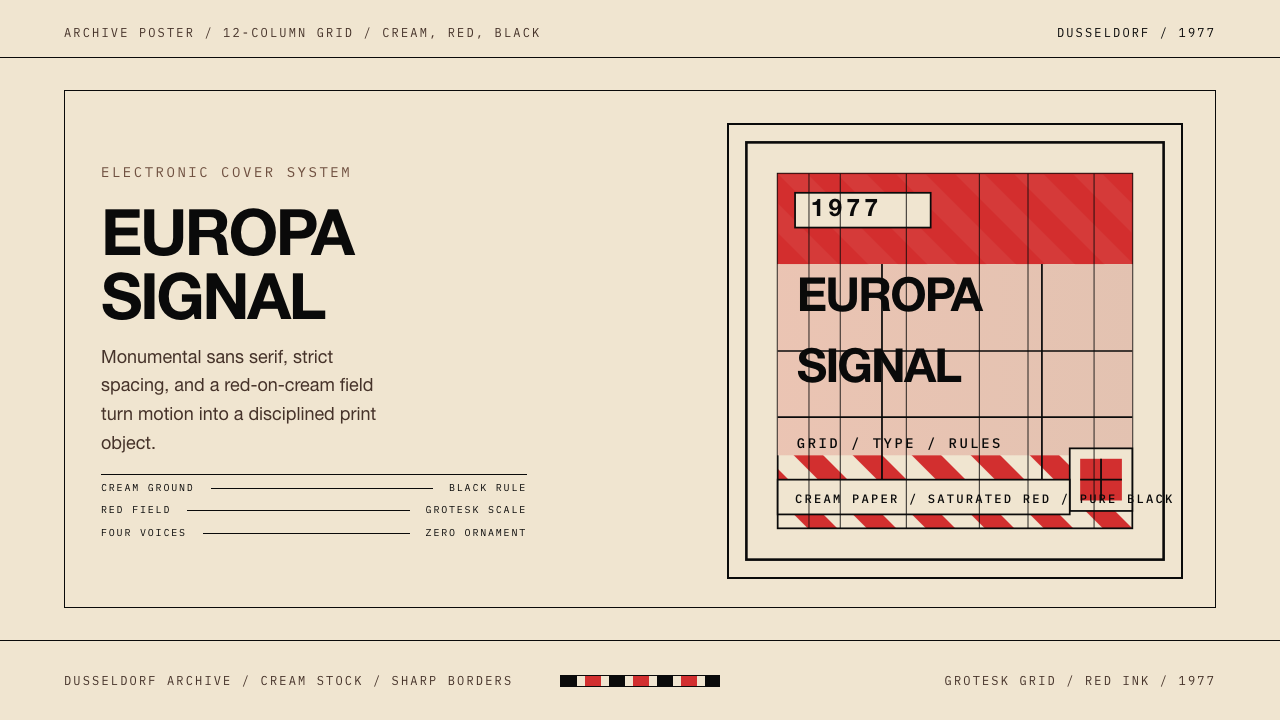 Kraftwerk Trans-Europa ExpressStark precision rules. Cream, red, and black lock the cover into a strict gri…
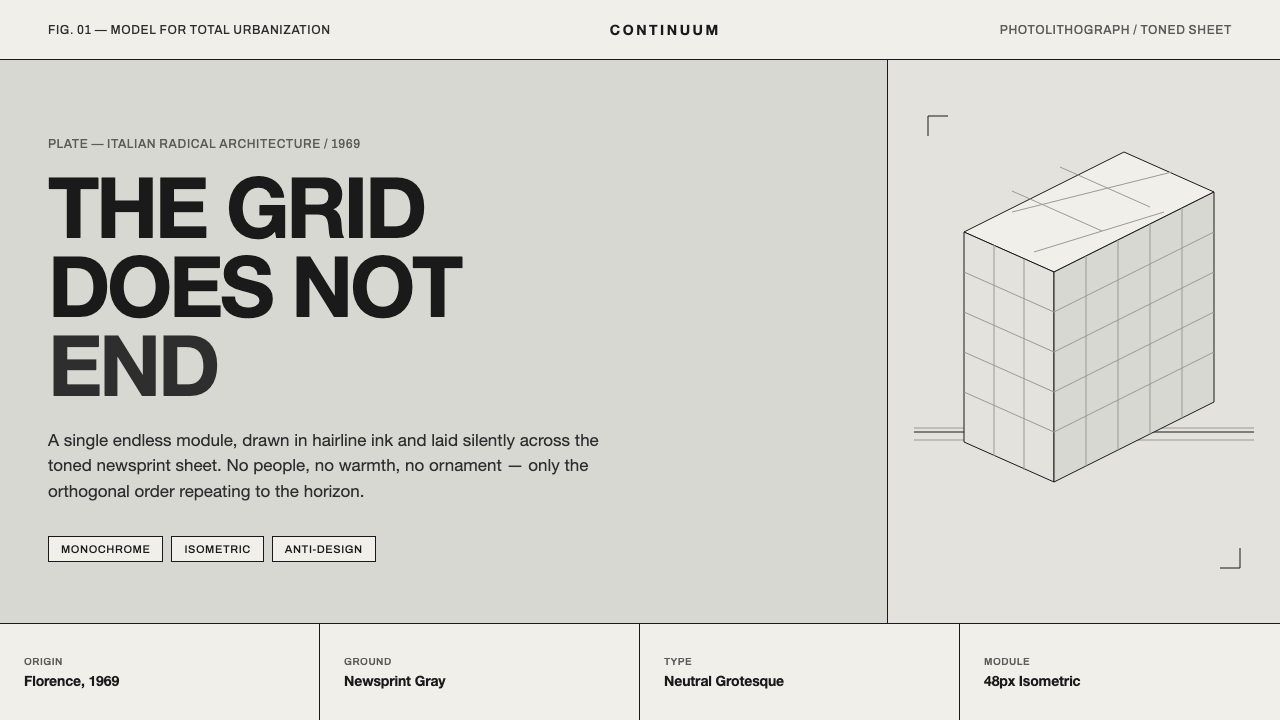 Superstudio Continuous MonumentThe grid does not end. Hairline black isometric ruling on toned newsprint-gra…
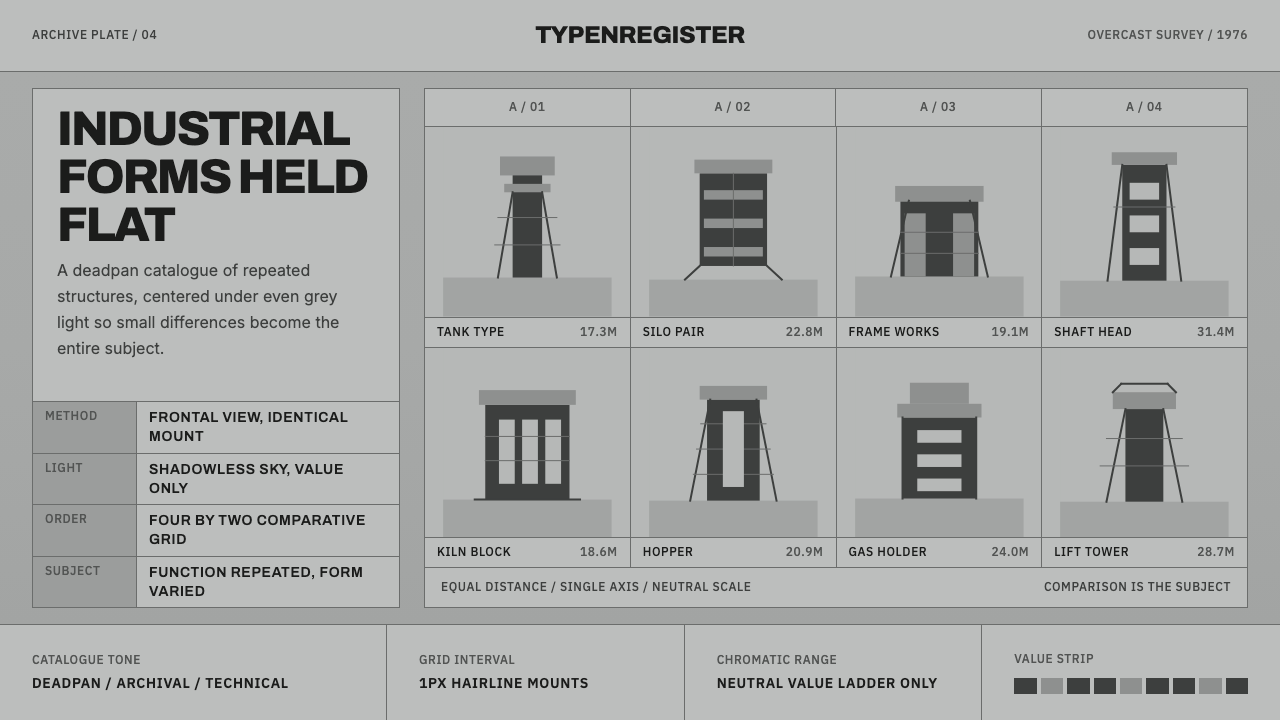 Bechers Industrial TypologyDeadpan order. Mid-grey ground, Archivo labels, and strict hairline grids rev…
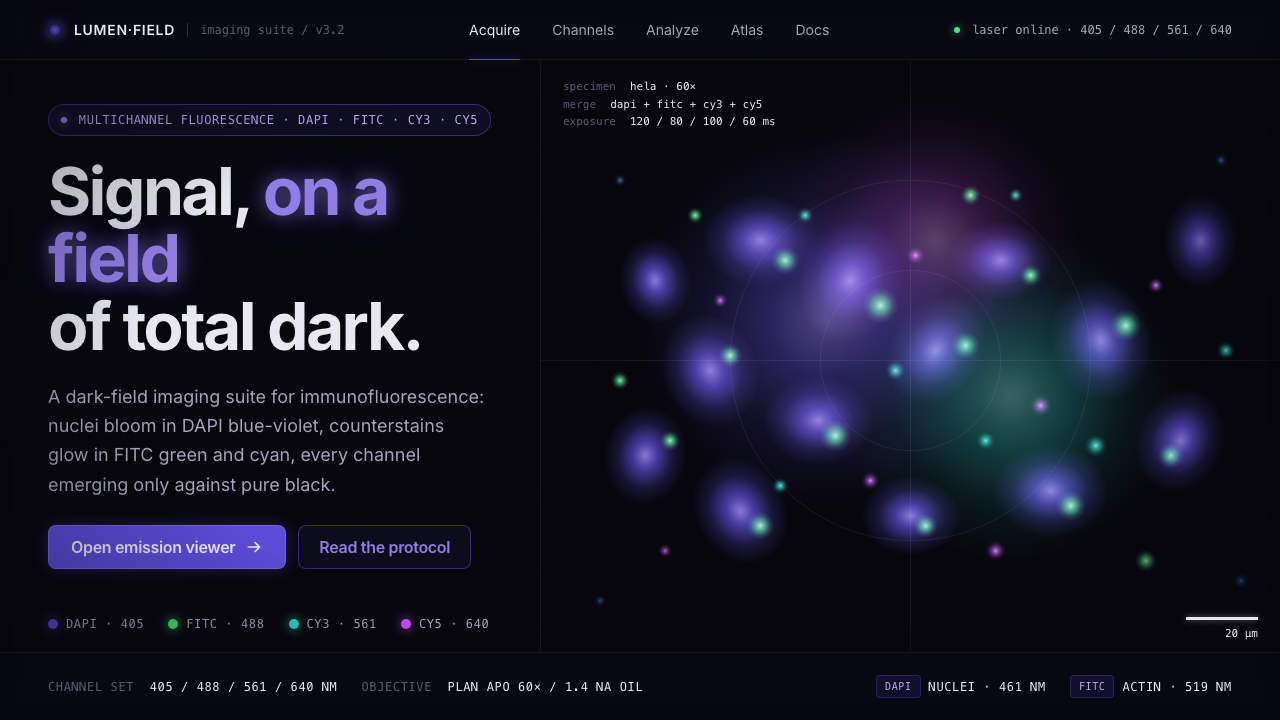 Cell MicroscopySignal on total dark. DAPI blue-violet and FITC green bloom as soft point-emi…